Hubbry Logo
NGC 6334NGC 6334Main
Open search
NGC 6334
Community hub
NGC 6334
logo
8 pages, 0 posts
0 subscribers
Be the first to start a discussion here.
NGC 6334
NGC 6334
from Wikipedia
NGC 6334
Emission nebula
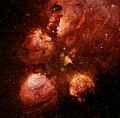
Near-infrared image of the Cat’s Paw Nebula from the James Webb Space Telescope.
Observation data: J2000 epoch
Right ascension17h 20m 50.9s[1]
Declination−36° 06′ 54″[1]
Distance4,370 ± 650[2] ly   (1,340±200[2] pc)
Apparent dimensions (V)35′ × 20′[3]
ConstellationScorpius
Physical characteristics
Radius~320 ly[4] ly
DesignationsCat's Paw Nebula, NGC 6334, Gum 64, RCW 127, ESO 392-EN 009,[5] Sharpless 8
See also: Lists of nebulae

NGC 6334 is a massive emission nebula and star-forming region located in the constellation Scorpius. It is colloquially known as the Cat's Paw Nebula, and can be found 3° to the west-northwest of the bright star Lambda Scorpii. NGC 6334 was discovered by English astronomer John Herschel on June 7, 1837, who observed it from the Cape of Good Hope in South Africa. It spans an angular area larger than the full Moon.[3] This structure is located in the Carina–Sagittarius Arm of the Milky Way,[6] at a distance of approximately 5.5 thousand light-years from the Sun.[7]

This nebula is a high mass filamentary cloud structure spanning ~320 ly. In the visible part of the spectrum, NGC 6334 emits mainly in red (from hydrogen atoms) and blue (from oxygen atoms).[4] The interior is heavily obscured by interstellar dust, with clumps ranging up to 3,000 M in mass. Although there is pervasive star formation throughout,[8] several embedded star-forming regions have been identified from infrared and radio emissions.[6] Four of these sites have formed H II regions.[6] X-ray sources within the nebula show the presence of ten distinct stellar clusters, most of which are associated with already identified infrared sources and H II regions.[9]

NGC 6334 is connected by a filamentary structure to NGC 6357, and the two may form a single complex.[10]

2025 James Webb Telescope discoveries

[edit]

In July of 2025, astrophysicists using the James Webb Space Telescope reported views of a stellar nursery within what they humorously call the "toe beans," the large, circular structures resembling the soft pads on the bottom of cats' paws. The team achieved a close-up of a red-orange oval toe bean within which veiled stars are beginning to shine, including one that produced a visible shockwave when it ejected gas and dust at high speeds.[11] The NASA press report begins:

It's the cat's meow! To celebrate its third year of revealing stunning scenes of the cosmos in infrared light, NASA's James Webb Space Telescope has "clawed" back the thick, dusty layers of a section within the Cat's Paw Nebula (NGC 6334). Focusing Webb's NIRCam (Near-Infrared Camera) on a single "toe bean" within this active star-forming region revealed a subset of mini toe beans, which appear to contain young stars shaping the surrounding gas and dust.[12]

The NASA press release also reported on the dust-filled nebular section known as the "Opera House" and other toe beans where, despite intense radiation, dust filaments may be dense enough to form protostars.

[edit]

References

[edit]
[edit]
Revisions and contributorsEdit on WikipediaRead on Wikipedia
from Grokipedia
NGC 6334, commonly known as the Nebula, is a vast and one of the most active star-forming regions in the , located approximately 5,500 light-years away in the constellation . Spanning about 50 light-years across, it is a complex of molecular clouds, dust lanes, and H II regions that resembles a cosmic paw print, serving as a prolific nursery for high-mass stars and hosting thousands of young stellar objects. Discovered by astronomer on June 7, 1837, from the , NGC 6334 exemplifies a Galactic mini-starburst, with its intense activity triggered by cloud-cloud collisions in the recent few million years. The nebula's structure includes several prominent sub-regions, such as NGC 6334A, B, V, and the embedded cluster in NGC 6334I, each characterized by dense gas cores where massive O-type stars are forming. It contains a total gas mass of around 220,000 solar masses, fueling a rate exceeding 8 solar masses per million years per squared and an efficiency greater than 10%, significantly higher than typical regions like Orion. Observations reveal over 2,000 young stellar objects, including hundreds of Class I protostars, along with several O stars that illuminate the surrounding gas, producing the nebula's characteristic red glow from ionized emissions. These young, hot stars—some up to 10 times the Sun's mass—disrupt nearby gas through outflows and radiation, carving out cavities and influencing further star birth across filamentary structures extending tens of s. Recent studies, including near-infrared imaging from the (as of July 2025), have unveiled intricate details such as "toe bean"-like mini-structures of gas and where low- to intermediate-mass are emerging, highlighting NGC 6334's role in understanding the full spectrum of from low-mass to high-mass regimes. At a making it one of the nearest high-mass star-forming complexes, it provides a crucial laboratory for probing the physics of triggered , magnetic fields, and chemical processes in dense interstellar environments.

General properties

Discovery and designations

NGC 6334 was first observed and recorded by British astronomer on June 7, 1837, during his of the southern skies from the Royal Observatory at the in . Using his 20-foot reflecting telescope with an 18.25-inch , Herschel noted the object as a "pretty bright, very large, very irregular oval" and cataloged it under his personal designation h 3678. This observation formed part of Herschel's broader effort to extend his father William Herschel's northern hemisphere catalog to the southern . In 1864, included the nebula in his General Catalogue of Nebulae and Clusters as GC 4288. It received its primary modern designation, NGC 6334, in the compiled by J. Louis Emil Dreyer and published in 1888, which synthesized observations from multiple astronomers including the Herschels. Early descriptions in these 19th-century catalogs highlighted its bright, diffuse, and irregular structure, leading to its classification as an characterized by ionized gas glowing from stellar excitation. The nebula has accumulated several alternative designations across subsequent astronomical surveys. It is commonly referred to as the Cat's Paw due to its claw-like appearance in wide-field images. In specialized catalogs of southern emission nebulae, it appears as Gum 64 from Colin Gum's 1955 survey of H II regions, RCW 127 from the 1960 Rodgers-Campbell-Whiteoak catalog, ESO 392-EN 009 in the atlas, and Sharpless 8 in Stewart Sharpless's 1959 catalog of galactic nebulae. These names reflect its identification as a key southern feature during mid-20th-century photographic surveys. Located in the constellation , NGC 6334 contributed to early mappings of the galaxy's structure.

Location and distance

NGC 6334 occupies equatorial coordinates of 17h 20m 50.9s and −36° 06′ 54″ in the J2000 . This positions it within the constellation , where it is best visible from the under dark skies, though its faint nature necessitates moderate to large telescopes for detailed resolution. The resides in the of the , contributing to a larger complex that may include the nearby NGC 6357. At an approximate distance of 5,500 light-years from , it exemplifies a distant segment of this spiral arm. More precise distance estimates, derived from trigonometric of associated H₂O masers and spectroscopic analyses of OB stars, place it at 4,370 ± 650 light-years (1.34 ± 0.20 kpc). With an apparent size spanning 35′ × 20′ and a visual magnitude of about 10.5, NGC 6334 appears as a diffuse emission feature, challenging for naked-eye or binocular even in optimal conditions.

Physical characteristics

Size and morphology

NGC 6334 is a high-mass filamentary cloud complex spanning approximately 50 parsecs, or about 160 light-years, along its primary elongation parallel to the , forming a coherent structure within the . This filamentary nature is evident in its network of velocity-coherent filaments, with a prominent main filament approximately 10 parsecs long and widths around 0.1–0.13 parsecs, fragmented into dense cores. The overall extent covers an area of roughly 10 by 50 parsecs, highlighting its elongated, hub-filament morphology characteristic of massive star-forming regions. The morphology of NGC 6334 resembles a , featuring several claw-like extensions of gas and dust that give it its colloquial name. Heavily obscured by interstellar dust, the complex appears predominantly as red emission in visible wavelengths due to ionized (Hα) from young, hot illuminating the surrounding material. Infrared observations reveal the underlying structure, including embedded dust lanes and protostellar cores within the filaments. NGC 6334 harbors a total mass of a few × 10⁵ solar masses in gas and dust, equivalent to approximately 200,000–900,000 M⊙, distributed across its filamentary network. This material is organized into numerous clumps, with individual masses ranging up to several thousand solar masses, such as 3,000 M⊙ or more, serving as sites for high-mass star formation. The high line-mass of the main filament, around 500–2,000 M⊙ per parsec, underscores its gravitational instability and role in channeling material toward dense hubs.

Composition and environment

NGC 6334 consists primarily of molecular (H₂), which dominates the gas content and is traced through (CO) emission, alongside and trace heavier elements such as oxygen and . The total gas mass of the complex is estimated at approximately 2.2 × 10⁵ solar masses, with atomic (HI) present in the outer envelopes and ionized concentrated in the embedded H II regions. Dust grains, making up roughly 1% of the total mass, are composed of a mixture of and small particles that contribute to and polarization effects. The of NGC 6334 features prominent red Hα line radiation from ionized , arising from recombination processes in regions photoionized by massive young stars, alongside blue [O III] emission from , which highlights zones of particularly energetic radiation. These spectral lines indicate the presence of high-temperature plasmas driven by photons from O and B-type stars, with the overall luminosity reflecting the substantial gas reservoir available for ongoing . Situated within the disk of the in the Sagittarius-Carina spiral arm, NGC 6334 experiences environmental influences such as density enhancements from spiral arm compression that promote cloud collapse. The complex is linked via a filamentary structure to the adjacent , forming a larger Galactic star-forming system spanning multiple H II regions. The filamentary morphology facilitates multiple compressions of the gas, aiding gravitational instability and collapse.

Star formation processes

Stellar clusters

NGC 6334 hosts approximately 10 distinct stellar clusters, primarily identified through observations that reveal a complex spatial distribution of young stars embedded within the region's dense molecular clouds. These clusters are predominantly associated with active sites, as evidenced by their alignment with far-infrared sources, radio H II regions, and molecular clumps, with the more obscured groups indicating ongoing high-mass star birth. Among the prominent clusters, NGC 6334-I stands out as a relatively evolved group featuring an ultra-compact and about 21 stellar members with a median mass of 3 solar masses, including potential massive O-type stars. In contrast, NGC 6334-I(N) is a younger, dust-rich cluster with 79 members, a median mass of 5 solar masses, and a dense protostellar population concentrated in filamentary structures and multiple dust cores, also harboring potential massive O-type stars without a dominant yet formed. Cluster ages across the region span on the order of a few million years, reflecting sequential triggered over this timescale. The dynamics of these clusters suggest hierarchical formation processes, where larger structures fragment into subclusters with embedded circumstellar disks, supported by observations of mass segregation in denser groups like NGC 6334-I and I(N). The total in NGC 6334 is estimated at 4800 to 17,400 solar masses, distributed across thousands of pre-main-sequence stars that drive the region's energetic output, including the ionization of surrounding gas to create H II regions.

H II regions and protostars

NGC 6334 hosts several prominent H II regions, with four main ones identified through radio continuum and observations, including ultra-compact types such as G351.44+0.73 (NGC 6334 I) and G351.39+0.73 (NGC 6334 F). These regions are characterized by bright emissions at wavelengths tracing ionized gas and warm dust, such as 6 cm radio maps and 70 μm far- data, revealing cometary or shell-like morphologies indicative of early evolutionary stages. The ultra-compact H II regions, in particular, are compact (∼0.1 pc) and optically thick, powered by embedded massive stars that ionize surrounding . These H II regions are ionized primarily by massive O- and B-type stars, which create expanding spherical photodissociation regions (PDRs) around the ionization fronts, leading to characteristic bubble structures observable in multi-wavelength images. A total of eight compact sources, including the aforementioned ultra-compact H II regions, contribute significantly to the complex's far-infrared luminosity, estimated at around 10^6 L⊙, highlighting their role in the overall energy budget of star formation. Embedded within these H II regions are hundreds of young stellar objects (YSOs), with surveys identifying approximately 375 Class I protostars and over 1900 Class II objects across the complex, many associated with dense molecular cores. Notable examples include hot cores in NGC 6334 I, which exhibit strong thermal emissions from NH3 and CH3OH, tracing warm (T > 100 K), dense gas (n > 10^7 cm^{-3}) near protostars undergoing accretion. These protostars often drive bipolar outflows and possess accretion disks, as evidenced by molecular line profiles and high-velocity CO emission, fostering the next generation of massive stars loosely associated with nearby young clusters.

Observational history

Early and ground-based observations

NGC 6334 was first observed by English astronomer on June 7, 1837, during his survey of the southern skies from the in , where he cataloged it as h 3678 with a brief description noting its faint, irregular nebulosity. This initial visual observation, made with an 18.25-inch , marked the nebula as a diffuse emission region but provided limited detail due to its low and the instrumental constraints of the era. In the mid-20th century, ground-based optical studies began to reveal the stellar content within NGC 6334's H II regions through photoelectric photometry. A key investigation in 1978 conducted UBV, VRI, and Hβ observations of 56 early-type stars across the fields encompassing NGC 6334 and the adjacent , identifying clusters of hot, massive stars responsible for ionizing the gas and producing the observed emission. These measurements, taken from ground-based telescopes, highlighted the presence of O and B-type stars embedded in the , with photometric distances estimated around 1.7 kpc, though heavy dust complicated accurate classifications. Among the findings was the identification of suspected No. 24 near a compact radio source, suggesting organized groupings of young stars driving the region's activity. Radio surveys in the late and further mapped the structure of NGC 6334, uncovering compact sources indicative of ongoing massive . Observations at 6 cm wavelength by Goss and Shaver in 1970 revealed extended thermal emission from the H II regions, with brighter peaks corresponding to ionized zones powered by embedded O stars. Complementary 1.95 cm mapping by Schraml and Mezger in 1969 identified compact radio components, such as those later designated G 351.4 + 0.7, highlighting dense, obscured cores within the complex. Ground-based imaging from facilities like the Anglo-Australian Telescope in the 1980s, including near-infrared JHK surveys, emphasized the dominance of red emission from Hα and molecular lines, delineating the nebula's clawed morphology while underscoring the limitations of optical views due to pervasive obscuration that necessitated shifts to longer wavelengths. Multi-wavelength studies have refined the distance to approximately 1.61 kpc using trigonometric measurements. Early ground-based detections in the provided the first glimpses of embedded regions invisible at optical wavelengths. Far- photometry at 45–350 μm by Emerson, Jennings, and Moorwood in 1973 detected strong continuum emission from dust heated by young stars, revealing multiple far-IR sources aligned along the molecular ridge. These observations, conducted with balloon-borne and ground-based detectors, confirmed the presence of deeply embedded protostellar activity and set the stage for detailed studies of the complex's star-forming cores through the 1980s and 1990s.

Infrared and multi-wavelength studies

Infrared observations have played a pivotal role in unveiling the embedded star-forming activity within NGC 6334, penetrating the obscuring dust that blocks visible light. Surveys using the Two Micron All Sky Survey (2MASS) in the near-infrared, combined with the Spitzer Space Telescope's Infrared Array Camera (IRAC) and Multiband Imaging Photometer (MIPS), have identified hundreds of young stellar objects (YSOs) and dense dust cores across the complex. For instance, a comprehensive census detected over 1,600 YSO candidates, predominantly Class II, clustered in regions like NGC 6334 V and the southwestern condensations, providing evidence of ongoing low- to intermediate-mass star formation. These data also mapped dust cores with masses ranging from 10 to 100 solar masses, highlighting filamentary structures that serve as nurseries for massive stars. Maser emissions further trace the hot cores associated with high-mass star formation in NGC 6334. High-resolution observations of ammonia (NH₃) and methanol (CH₃OH) lines reveal strong thermal emission in regions such as NGC 6334 I and I(N), where higher NH₃ (3,3) and (6,6) transitions indicate kinetic temperatures exceeding 200 K and densities above 10⁷ cm⁻³. CH₃OH masers, particularly class I and II variants, are detected with peak brightness temperatures reaching thousands of K. Multi-wavelength approaches integrate these infrared insights with other regimes to map the full extent of activity. observations have identified approximately 1,600 point sources, revealing young clusters with pre-main-sequence stars exhibiting luminosities of 10²⁹-10³¹ erg s⁻¹, indicative of magnetic activity and accretion processes in obscured environments. Radio with the (VLA) has delineated H II regions, mapping free-free emission from ionized gas in structures like the central ridge, with electron densities around 10⁴ cm⁻³ and sizes of 0.1-1 pc. Complementing these, far-infrared data (70-500 μm) have derived gas temperatures of 15-40 K in the outer envelope rising to over 100 K near protostars, with H₂ column densities up to ~3 × 10²³ cm⁻², estimating a total of approximately 380,000 solar masses. Notable findings include the detection of hard X-ray emissions (2-8 keV) from two ultra-compact H II regions in the NGC 6334 I complex, with luminosities around 10³³ erg s⁻¹, attributed to diffuse plasma heated by winds from embedded massive stars rather than point-like accretion. These emissions, observed in deep exposures, correlate with radio continuum peaks and suggest a of young O-type stars driving the ionization.

Recent discoveries

James Webb Space Telescope observations

In July 2025, NASA's James Webb Space Telescope (JWST) released a stunning near-infrared image of a portion of NGC 6334, captured by its Near-Infrared Camera (NIRCam), to celebrate the telescope's third anniversary of science operations. This image highlights intricate "toe beans"—compact, paw-like structures of gas, dust, and embedded stars—within the nebula's star-forming regions, revealing young stars and protostars nestled in dense dust filaments that block background starlight. A prominent bow shock, formed by high-speed ejection of gas and dust from a veiled protostar, appears as a curved arc in the lower left of the image, illustrating the dynamic outflows shaping the nebula's environment. The NIRCam observations uncover veiled stars emerging within red-orange ovals of dense material, marking early stages of massive obscured by thick dust. Scorching hot young stars, appearing as bright blue-white points, illuminate tiered layers of orange-brown dust in structures like the "" region, while their intense radiation carves cavities and produces a blue nebulous glow from ionized gas. , characteristic of JWST's hexagonal mirror segments, radiate from these massive stars, emphasizing their role in sculpting the surrounding . JWST's high-resolution capabilities reveal previously unseen details of a stellar nursery in this subset of NGC 6334, confirming the pervasive presence of massive across fiery red clumps and tuning-fork-shaped filaments. These findings build on earlier studies by providing sharper views through obscuring dust, exposing chaotic developmental processes that prior telescopes like Hubble and Spitzer could not resolve. As noted by officials, "Three years into its mission, Webb continues to deliver on its design, revealing previously hidden aspects of the universe."

Magnetic fields and dynamical studies

Recent studies utilizing near-infrared polarimetry have mapped the plane-of-sky (POS) in NGC 6334, revealing that these fields are predominantly perpendicular to the elongation of the main filamentary structure. This orientation suggests that channel gas flows along the filament, supporting ongoing activities. In particular, the primary filament is positioned between two prominent H II regions, which facilitates efficient gas accretion from the ionized shells surrounding these regions, as evidenced by [C II] emission observations. Dynamical analyses indicate that play a crucial role in regulating the within NGC 6334, transitioning the system from an initially sub-Alfvénic state to a super-critical and super-Alfvénic configuration during collapse. At column densities exceeding 10²³ cm⁻², dominates, reorienting to align with infalling gas motions, thereby enabling efficient inflows that drive massive . Observations from ALMA at 230 GHz across multiple scales, down to resolutions of 0.4 arcseconds (approximately 10³ au), show a bimodal distribution of field orientations—parallel or orthogonal to the —in NGC 6334, highlighting the dynamic interplay between magnetic support and gravitational forces in cluster evolution. These findings, integrated with imagery, underscore how magnetic fields influence the broader dynamical evolution of NGC 6334, connecting local filamentary accretion to galactic-scale star-forming processes. While direct measurements of field strengths remain challenging, the perpendicular configurations in active filaments imply strengths sufficient to guide accretion without fully suppressing collapse, aiding the formation of massive stellar clusters as observed in radio and data tracing young stellar populations.

References

Add your contribution
Related Hubs
User Avatar
No comments yet.