


Community hub
Recent from talks
Contribute something
Nothing was collected or created yet.
NGC 6302
View on Wikipedia| Emission nebula | |
|---|---|
| Planetary nebula | |
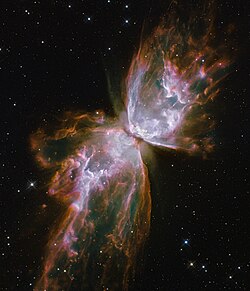
 NGC 6302, as taken by Hubble Space Telescope | |
| Observation data: J2000 epoch | |
| Right ascension | 17h 13m 44.211s[1] |
| Declination | −37° 06′ 15.94″[1] |
| Distance | 3400 ± 500[2] ly (1040 ± 160[2] pc) |
| Apparent magnitude (V) | 7.1B[1] |
| Apparent dimensions (V) | >3′.0[2] |
| Constellation | Scorpius |
| Physical characteristics | |
| Radius | >1.5 ± 0.2 ly[3] ly |
| Absolute magnitude (V) | -3.0B +0.4 −0.3[4] |
| Notable features | Dual chemistry, hot central star |
| Designations | Bipolar Nebula,[1] Bug Nebula,[1] PK 349+01 1,[1] Butterfly Nebula,[5][6] Sharpless 6, RCW 124, Gum 60, Caldwell 69 |
NGC 6302 (also known as the Bug Nebula, Butterfly Nebula, or Caldwell 69) is a bipolar planetary nebula in the constellation Scorpius. The structure in the nebula is among the most complex ever seen in planetary nebulae. The spectrum of Butterfly Nebula shows that its central star is one of the hottest stars known, with a surface temperature in excess of 250,000 degrees Celsius, implying that the star from which it formed must have been very large.
The central star, a white dwarf, was identified in 2009, using the upgraded Wide Field Camera 3 on board the Hubble Space Telescope.[7] The star has a current mass of around 0.64 solar masses. It is surrounded by a dense equatorial disc composed of gas and dust. This dense disc is postulated to have caused the star's outflows to form a bipolar structure[8] similar to an hourglass. This bipolar structure shows features such as ionization walls, knots and sharp edges to the lobes.
Observation history
[edit]
As it is included in the New General Catalogue, this object has been known since at least 1888.[9] The earliest-known study of NGC 6302 is by Edward Emerson Barnard, who drew and described it in 1907.[2]
The nebula featured in some of the first images released after the final servicing mission of the Hubble Space Telescope in September 2009.[10]
Characteristics
[edit]NGC 6302 has a complex structure, which may be approximated as bipolar with two primary lobes, though there is evidence for a second pair of lobes that may have belonged to a previous phase of mass loss. A dark lane runs through the waist of the nebula obscuring the central star at all wavelengths.[11]
The nebula contains a prominent northwest lobe which extends up to 3.0′ away from the central star and is estimated to have formed from an eruptive event around 1,900 years ago. It has a circular part whose walls are expanding such that each part has a speed proportional to its distance from the central star. At an angular distance of 1.71′ from the central star, the flow velocity of this lobe is measured to be 263 km/s. At the extreme periphery of the lobe, the outward velocity exceeds 600 km/s. The western edge of the lobe displays characteristics suggestive of a collision with pre-existing globules of gas which modified the outflow in that region.[2]
Central star
[edit]The central star, among the hottest stars known, had escaped detection because of a combination of its high temperature (meaning that it radiates mainly in the ultraviolet), the dusty torus (which absorbs a large fraction of the light from the central regions, especially in the ultraviolet) and the bright background from the star. It was not seen in the first Hubble Space Telescope images;[6] the improved resolution and sensitivity of the new Wide Field Camera 3 of the same telescope later revealed the faint star at the centre.[12] A temperature of 200,000 Kelvin is indicated, and a mass of 0.64 solar masses. The original mass of the star was much higher, but most was ejected in the event which created the planetary nebula. The luminosity and temperature of the star indicate it has ceased nuclear burning and is on its way to becoming a white dwarf, fading at a predicted rate of 1% per year.
Dust chemistry
[edit]The prominent dark lane that runs through the centre of the nebula has been shown to have an unusual composition, showing evidence for multiple crystalline silicates, crystalline water ice and quartz, with other features which have been interpreted as the first extra-solar detection of carbonates.[13] This detection has been disputed, due to the difficulties in forming carbonates in a non-aqueous environment.[14] The dispute remains unresolved.
One of the characteristics of the dust detected in NGC 6302 is the existence of both oxygen-bearing silicate molecules and carbon-bearing polycyclic aromatic hydrocarbons (PAHs).[13] Stars are usually either oxygen-rich or carbon-rich, the change from the former to the latter occurring late in the evolution of the star due to nuclear and chemical changes in the star's atmosphere. NGC 6302 belongs to a group of objects where hydrocarbon molecules formed in an oxygen-rich environment.[15]
See also
[edit]Notes
[edit]- ^ a b c d e f (SIMBAD 2007)
- ^ a b c d e (Meaburn et al. 2005)
- ^ Radius = distance × sin(angular size / 2) = 3.4 ± 0.5 kly * sin(>3′.0 / 2) = >1.5 ± 0.2 ly
- ^ 7.1B apparent magnitude - 5 * (log10(1040 ± 160 pc distance) - 1) = -3.0B +0.4
−0.3 absolute magnitude - ^ (Nemiroff & Bonnell 1998)
- ^ a b (Nemiroff & Bonnell 2004)
- ^ (Szyszka et al. 2009)
- ^ (Gurzadyan 1997)
- ^ Many sources credit its discovery to James Dunlop in 1826. E.g. (1) Wolfgang Steinicke, Nebel und Sternhaufen: Geschichte ihrer Entdeckung, Beobachtung und Katalogisierung- von Herschel bis Dreyers, 2009, p. 429. (2) Universe Today; (3) Stephen James O'Meara, The Caldwell objects. Cambridge University Press, 2002, p.274..
(O'Meara argues that Barnard credited it to Dunlop—but may have been mistaken.) - ^ News Release Number: STScI-2009-25: Hubble Opens New Eyes on the Universe [1] Archived 2016-11-13 at the Wayback Machine
- ^ (Matsuura et al. 2005)
- ^ (Szyszka et al. 2009)
- ^ a b (Kemper et al. 2002)
- ^ (Ferrarotti & Gail 2005)
- ^ (Matsuura et al. 2005).
References
[edit]- Nemiroff, R.; Bonnell, J., eds. (June 2, 1998). "NGC 6302: The Butterfly Nebula". Astronomy Picture of the Day. NASA.
- Nemiroff, R.; Bonnell, J., eds. (May 5, 2004). "NGC 6302: Big, Bright, Bug Nebula". Astronomy Picture of the Day. NASA.
- Szyszka, C.; Walsh, J. R; Zijlstra, A. A.; Tsamis, Y.G. (2009), "Detection of the Central Star of the Planetary Nebula NGC 6302", Astrophysical Journal Letters, 707 (1): L32 – L36, arXiv:0909.5143, Bibcode:2009ApJ...707L..32S, doi:10.1088/0004-637x/707/1/l32, S2CID 16952715
- Gurzadyan, Grigor A. (1997), The Physics and Dynamics of Planetary Nebulae, Germany: Springer, p. 3, ISBN 978-3-540-60965-0
- Meaburn, J.; López, J. A.; Steffen, W.; Graham, M. F.; et al. (2005), "The Hubble-Type Outflows from the High-Excitation, Polypolar Planetary Nebula NGC 6302", The Astronomical Journal, 130 (5): 2303–2311, arXiv:astro-ph/0507675, Bibcode:2005AJ....130.2303M, doi:10.1086/496978, S2CID 17361839
- SIMBAD (January 11, 2007), Results for NGC 6302, SIMBAD, Centre de Données Astronomiques de Strasbourg
- Kemper, F.; Molster, F. J.; Jaeger, C.; Waters, L.B.F.M. (2002), "The mineral composition and spatial distribution of the dust ejecta of NGC 6302", Astronomy and Astrophysics, 394 (2): 679–690, arXiv:astro-ph/0208110, Bibcode:2002A&A...394..679K, doi:10.1051/0004-6361:20021119, S2CID 15598841
- Ferrarotti, A. S.; Gail, H.-P. (2005), "Mineral formation in stellar winds. V. Formation of calcium carbonate", Astronomy and Astrophysics, 430 (3): 959–965, Bibcode:2005A&A...430..959F, doi:10.1051/0004-6361:20041856
- Matsuura, M.; Zijlstra, A. A.; Molster, F.J.; Waters, L. B. F. M.; et al. (2005), "The dark lane of the planetary nebula NGC 6302", Monthly Notices of the Royal Astronomical Society, 359 (1): 383–400, Bibcode:2005MNRAS.359..383M, doi:10.1111/j.1365-2966.2005.08903.x
External links
[edit]
- NASA News Release
- Discovery of the star
- ESA/Hubble News Release
- SIMBAD Query Result
- NGC 6302 on WikiSky: DSS2, SDSS, GALEX, IRAS, Hydrogen α, X-Ray, Astrophoto, Sky Map, Articles and images
- Butterfly Nebula at Constellation Guide
- NASA Astronomy Picture of the Day: The Butterfly Nebula from Hubble (1 October 2014)
| List |
|
|---|---|
| See also | |


NGC 6302
View on GrokipediaDiscovery and Observations
Discovery
NGC 6302 was discovered on September 29, 1880, by American astronomer Edward Emerson Barnard while searching for comets using a 5-inch refractor telescope at his private observatory in Nashville, Tennessee.[8] Barnard described it as a small, pretty bright planetary nebula with an extended form oriented east-west.[8] The object was cataloged as NGC 6302 in the New General Catalogue compiled by Danish-Irish astronomer John Louis Emil Dreyer and published in 1888.[9] Dreyer noted it as "pretty bright, extended pretty faint, planetary nebula," marking the first formal designation of NGC 6302 as a planetary nebula based on its disk-like appearance resembling a planet.[9] Some historical references suggest an earlier possible observation by Scottish astronomer James Dunlop in 1826 during his surveys in Australia, but this identification remains unconfirmed and is not reflected in the primary catalogs.[10] Its equatorial coordinates are right ascension 17h 13m 44.2s and declination −37° 06′ 15″ (J2000 epoch).[11] Early 20th-century spectroscopic studies confirmed the presence of emission lines characteristic of planetary nebulae, solidifying its classification.[12]Historical Observations
Following its initial cataloging in the 19th century, observations of NGC 6302 in the mid-20th century began to reveal its complex nature through ground-based spectroscopy and imaging. In the 1970s and 1980s, studies using the Anglo-Australian Telescope (AAT) provided key insights into its bipolar structure. These observations, conducted between 1977 and 1980, highlighted radial velocities up to 100 km/s in the bipolar lobes, establishing NGC 6302 as an archetype of asymmetric planetary nebulae driven by stellar winds.[13] Early ultraviolet spectroscopy further illuminated the nebula's high-excitation environment. International Ultraviolet Explorer (IUE) satellite observations in the early 1980s captured a rich spectrum dominated by lines from highly ionized species, including [Ne V] at 3426 Å and He II at 1640 Å, indicating ionization potentials exceeding 100 eV and temperatures around 20,000 K in the ionized gas.[14] These data, combined with ground-based optical spectra from the AAT, confirmed the presence of a fast stellar wind with velocities up to 800 km/s, contributing to the nebula's energetic expansion and layered structure.[15] The Hubble Space Telescope (HST) advanced these findings with high-resolution imaging in 2009 under program GO-11504, using the Wide Field Camera 3 to capture ultraviolet and visible light emissions. The resulting images revealed intricate filaments of gas and dust, with the nebula's prominent "wings"—bipolar lobes of hot, ionized gas—spanning over 2 light-years across.[16] These observations, highlighting clumpy structures heated to more than 36,000°F and moving at speeds exceeding 600,000 mph, solidified NGC 6302's reputation for its turbulent dynamics. Based on this visual appearance, the nebula earned the moniker "Butterfly Nebula," while its earlier "Bug Nebula" name persisted from 19th-century sketches.[17]Recent Observations
Observations of NGC 6302 were acquired in 2023 with the James Webb Space Telescope (JWST) using its Mid-Infrared Instrument (MIRI) in Medium Resolution Spectroscopy (MRS) mode as part of Cycle 1 General Observer program 1742, led by principal investigator Mikako Matsuura, with results published in 2025. These observations, spanning wavelengths from 4.9 to 27.9 μm over an 18.5″ × 15″ mosaic of the nebula's core, revealed previously hidden structures in the central regions, including a dense dusty torus surrounding the central star and intricate molecular emissions from polycyclic aromatic hydrocarbons (PAHs) and silicates. The data uncovered a UV-irradiated torus and a hot bubble interacting with it, providing insights into the dynamic processes shaping the nebula's bipolar outflows.[6] Building on the morphological foundation established by Hubble Space Telescope imaging, the JWST MIRI/MRS spectra highlighted fast-moving ionized gas and dust features obscured at shorter wavelengths. In August 2025, submillimeter imaging from the Atacama Large Millimeter/submillimeter Array (ALMA), combined with JWST data, mapped the distribution of cold molecular gas and large crystalline dust grains within the central torus, illustrating how these materials collimate the bipolar outflows into the nebula's characteristic "wings." This synergy demonstrated the torus's role in concealing the central star while channeling high-velocity material into extended lobes.[18][19] A landmark detection occurred in September 2025, when JWST MIRI/MRS observations identified the methyl cation (CH₃⁺) in NGC 6302—the first such observation in any planetary nebula. This ion, typically associated with carbon-rich environments, appeared in the oxygen-rich chemistry of the nebula's inner regions, suggesting unexpected hydrocarbon formation pathways driven by high-energy radiation from the central star. Reanalysis of archival Spitzer Space Telescope mid-infrared data in the 2020s, integrated with JWST findings, revealed temperature variations across the nebula's lobes, with hotter inner regions (~200–300 K) cooling outward due to dust absorption and expansion. These comparisons underscored evolutionary changes in dust heating since Spitzer's original observations, linking mid-infrared excesses to ongoing shock interactions in the lobes.[6]Physical Properties
Distance and Dimensions
NGC 6302 is situated in the constellation Scorpius, visible primarily from the Southern Hemisphere at a visual apparent magnitude of 9.6, though it appears brighter in Hα emission due to its ionized gas structure.[20][21] Distance estimates for NGC 6302 have been refined using Gaia DR3 astrometric data in combination with statistical methods for planetary nebulae, yielding values of approximately 3,400 light-years (1.04 kpc), consistent with updated analyses from 2022 to 2025.[19] Earlier trigonometric and expansion-based measurements place it between 3,400 and 4,000 light-years, reflecting uncertainties from interstellar extinction near the Galactic plane.[2][22] The nebula spans an angular size of about 3.6 arcminutes, corresponding to a physical diameter of roughly 3–4 light-years at the adopted distance, encompassing its bipolar lobes and extended features.[23] Proper motion studies of NGC 6302's expanding structures, derived from Hubble Space Telescope imaging over multi-year baselines, indicate a dynamical expansion age of 1,900–2,200 years, providing insight into the recent ejection of its outer envelope by the central star.[25][26] This age aligns with the nebula's youth and rapid evolution, shaped by the central engine's influence on its spatial extent.Kinematics
The kinematics of NGC 6302 reveal a complex velocity field dominated by rapid expansion in its bipolar structure, with the systemic radial velocity measured at -30.4 km/s relative to the local standard of rest (LSR).[27] This value, derived from modeling of CO emission lines, aligns with earlier spectroscopic determinations ranging from -30 to -40 km/s in the LSR frame, reflecting the nebula's recession relative to the Sun after accounting for galactic rotation.[28] The overall motion indicates a young, dynamically active system shaped by episodic ejections from the central engine. Expansion velocities in the bipolar lobes reach up to 100–150 km/s, as measured through long-slit spectroscopy of forbidden lines such as [O III] λ5007, which trace the ionized gas outflows.[28] These velocities exhibit a Hubble-like flow, where speed increases linearly with distance from the central star, consistent with ballistic expansion following an eruptive event. Position-velocity (PV) diagrams from such spectroscopy display an asymmetrical, hourglass-shaped morphology, indicative of collimated jets that carve out the lobes while interacting with denser equatorial material.[29] This asymmetry highlights the role of focused, high-velocity winds in sculpting the nebula's poly-polar features, with the northwestern lobe showing particularly pronounced gradients up to ~170 km/s at the tips.[30] Proper motion measurements, primarily from multi-epoch Hubble Space Telescope (HST) imaging spanning over a decade, confirm the radial expansion pattern and yield a dynamical age of approximately 2,000 years for the main bipolar lobes.[31] These observations detect angular expansions of 0.4–0.5 mas yr⁻¹ in the inner regions, accelerating outward in a manner that matches spectroscopic radial velocities when combined with distance estimates. Supplementary Gaia data on the central star's proper motion further constrain the kinematic center, supporting the young age and reinforcing the explosive ejection model without evidence of ongoing acceleration beyond the initial outburst.[30]Temperature and Luminosity
The ionized regions of NGC 6302 display electron temperatures ranging from approximately 17,000 to 19,000 K, derived from the ratios of [O III] forbidden emission lines such as the 4363/5007 Å ratio, which indicates collisional excitation in the plasma.[32][33] These temperatures are nearly uniform across the nebula but show slight increases (about 10%) near the central star and in the outer lobes, reflecting variations in ionization structure.[33] The high excitation levels observed are closely tied to the extreme temperature of the central star. The total bolometric luminosity of NGC 6302 is estimated at around 5,700 solar luminosities (L_⊙), accounting for contributions from both optical emission lines and infrared dust reradiation, with bolometric corrections applied using mid- and far-IR photometry to capture the full energy output.[34] This value represents a lower limit, as some ionizing radiation may be absorbed internally, and it highlights the nebula's energetic output driven by the post-asymptotic giant branch evolution of its progenitor.[34] Dust temperatures in NGC 6302 exhibit a gradient, with inner regions near the torus reaching 80–100 K and outer bipolar lobes cooling to 50 K, as inferred from spectral energy distribution modeling of Spitzer and submillimeter data tracing cool silicate and carbon-rich grains.[35][36] Surface brightness in the Hα line varies significantly, peaking at approximately 10^{-14} erg s^{-1} cm^{-2} arcsec^{-2} in the bright inner lobes due to dense ionized gas, and dropping in the extended wings where dust obscuration reduces visibility.[37] These variations underscore the nebula's complex thermal structure, with hotter plasma dominating the core and cooler dust shielding outer components.Central Engine
Central Star Properties
The central star of NGC 6302 is classified as a hydrogen-deficient Wolf–Rayet star of spectral type [WC], exhibiting prominent emission lines of carbon (such as C III and C IV) and helium (such as He II) that dominate its spectrum.[38] This classification reflects its evolved state, with a surface temperature exceeding 200,000 K—estimated at approximately 220,000 ± 10% K—making it one of the hottest known central stars powering planetary nebulae.[39] The star's intense ultraviolet radiation serves as the primary ionizing source for the nebula's complex structure.[39] Due to heavy obscuration by a dense equatorial dust torus (with visual extinction A_V ≈ 8 mag), the central star lacks direct optical detection and has an inferred unreddened visual magnitude of V_0 ≈ 17.6 mag; with A_V ≈ 8 mag, the apparent magnitude would be ≈ 25.6 mag, rendering direct optical detection impossible. Its properties are instead derived from ultraviolet and X-ray observations, which reveal high-energy emission consistent with the star's extreme temperature and luminosity of about 14,300 L_⊙.[4][39] The star drives a fast stellar wind with a terminal velocity of approximately 800 km s⁻¹, as evidenced by high-velocity wings in nebular emission lines like [Ne V].[30] Current mass-loss rates are low, on the order of 10^{-8} M_⊙ yr⁻¹, though past episodes reached ~5 × 10^{-4} M_⊙ yr⁻¹, inferred from radio continuum flux and the nebula's ionized gas dynamics.[40][41] Possible low-amplitude photometric variability (<0.5 mag) in the ultraviolet has been noted in recent surveys, potentially linked to instabilities in the stellar atmosphere. These observations confirm the central star's role in irradiating a hot bubble and dusty torus, with the latter containing micron-sized crystalline silicate grains.[6]Evolutionary Context
NGC 6302 is the remnant of a progenitor star with an initial mass estimated between 3.7 and 5.5 solar masses (M⊙), which underwent significant mass loss during its asymptotic giant branch (AGB) phase before entering the post-AGB stage. The central star, currently a hydrogen-deficient Wolf-Rayet-type object with a surface temperature exceeding 200,000 K, is rapidly evolving toward becoming a white dwarf remnant, having shed much of its envelope in a series of energetic ejections.[23] This evolution is characterized by high mass-loss rates, reaching up to 5 × 10⁻⁴ M⊙ yr⁻¹ during the late AGB, far exceeding typical values for single stars and indicating dynamic instabilities.[23] The bipolar asymmetry of NGC 6302 is hypothesized to result from the presence of a binary companion, which could have shaped the nebula through interactions during the AGB and post-AGB phases. Models from the 2010s suggest that a lower-mass companion diverted isotropic mass loss into an equatorial torus, leading to the observed pinched-waist morphology, with evidence drawn from the high mass-loss rates and the massive molecular torus.[41] Although no companion has been directly detected, indirect support comes from potential orbital modulations inferred in stellar wind line profiles and the nebula's structural complexity. Recent 2025 JWST/MIRI observations reveal a UV-irradiated dusty torus composed of large silicate grains and a surrounding hot bubble driven by the central star's radiation.[6] The system is likely in a post-common envelope phase, where the companion's influence persists in driving asymmetric outflows.[23] The timeline of NGC 6302's evolution places the bulk of AGB mass loss approximately 5,000 to 10,000 years ago, with the toroidal structure ejected over a span of about 2,000 years during this period. Subsequent explosive events around 2,200 years ago formed the optical bipolar lobes, marking the transition to the planetary nebula phase, while more recent outbursts (1,200–2,300 years ago) shaped finer features. Currently, the nebula is in an early, highly energetic post-AGB stage, with ongoing fast ejections observed within the last few centuries. In the coming ~10,000 years, the central star will cool into a white dwarf, with the nebula's ionized gas dispersing as ultraviolet radiation diminishes, leading to a fading remnant similar to other evolved planetary nebulae like NGC 2440. This dispersal will mark the end of the planetary nebula phase, leaving behind a cooling white dwarf core after the envelope fully ionizes and expands.Morphology and Structure
Overall Morphology
NGC 6302 exhibits a striking bipolar morphology characteristic of many planetary nebulae, featuring two expansive lobes that extend along a polar axis, giving the object its popular "butterfly" or "bug" appearance in broad-band optical images. This structure is formed by the ejection of material from a central post-asymptotic giant branch star, confined and shaped by a dense equatorial torus that creates the hourglass-like form. The nebula's overall extent spans more than 3 light-years across, with the bipolar lobes dominating the visual profile.[2] The lobes display notable asymmetry, with the northern (northwest breakout) lobe extending farther, reaching approximately 3.4 light-years from the nucleus, while the southern counterpart is less prominent in extent, though brighter due to reduced obscuration. This asymmetry arises from misaligned ejection events and off-axis flows during the nebula's formation. The central region consists of a compact ionized cavity, roughly 0.6 light-years in diameter, enveloped by the toroidal waist of dense, dusty material that pinches the outflow and obscures the hot central star from direct view.[30][42] The nebula is particularly prominent in emission lines such as Hα and [O III], which trace the ionized gas in the lobes and cavity, highlighting the bright, filamentary structures against the darker equatorial dust lane. High-resolution imaging from the Hubble Space Telescope and James Webb Space Telescope has revealed these features in exquisite detail, emphasizing the complex interplay of gas and dust in shaping the global form.[30][43][44]Detailed Features
NGC 6302 displays intricate structural details within its bipolar framework, including prominent knots, outflows, and a central torus that shape its overall appearance. The ansae at the tips of the bipolar lobes contain Herbig-Haro-like knots, which are shock-excited emission features driven by material propagating at velocities of 100–200 km/s into the surrounding medium. High-resolution imaging from the James Webb Space Telescope (JWST), with 2023 observations analyzed in 2025 studies and achieving angular resolutions of approximately 0.4 arcsec, has unveiled collimated outflows in the lobes featuring clumpy gas structures, such as arc-like filaments and edge-brightened condensations that trace the turbulent ejection history.[36] The equatorial region hosts a dense torus or disk, spanning roughly 0.4 light-years in diameter and composed primarily of silicate-rich dust, including ~5% crystalline grains like forsterite and enstatite, which obscure the central star and collimate the polar outflows.[45][36] Inner arcs and shells, visible in the nebula's core, are interpreted as remnants of episodic mass ejections from the central engine approximately 1,000–2,000 years ago, contributing to the layered complexity near the ionization front.[30]Chemical Composition
Ionized Gas Abundances
The ionized gas in NGC 6302 exhibits significant enrichments in key elements, as determined from emission line diagnostics in optical and infrared spectra. The helium abundance is elevated at He/H ≈ 0.15 by number, exceeding the typical threshold for Type I planetary nebulae (He/H ≥ 0.125), while oxygen maintains a near-solar value of O/H ≈ 5.1 × 10^{-4}. Neon is overabundant with Ne/H ≈ 2.4 × 10^{-4}, roughly twice the solar ratio, reflecting enhanced nucleosynthesis in the progenitor star. These abundances, derived from photoionization modeling of observed lines such as [O III] and [Ne III], confirm NGC 6302's classification as a Type I planetary nebula, characterized by high helium and neon relative to oxygen.[34] Nitrogen is particularly enriched, with N/H ≈ 3.9 × 10^{-4}, resulting in an elevated N/O ratio of approximately 0.8. This enrichment arises from the third dredge-up and hot-bottom burning processes during the asymptotic giant branch (AGB) phase of the progenitor star, which converted carbon into nitrogen via the CN cycle. The high N/O ratio further supports the Type I designation, where such enhancements are hallmarks of progenitors with initial masses around 4–5 M_⊙. These values were obtained using ionization correction factors applied to collisionally excited lines like [N II] and [O II], integrated across the nebula's bipolar structure.[34] In contrast, carbon shows a mild depletion with C/H ≈ 2.2 × 10^{-4} (about 80% of solar), while sulfur is enhanced with S/H ≈ 2.5 × 10^{-5} (roughly twice solar). The carbon depletion is attributed to incorporation into dust grains, as evidenced by the nebula's prominent infrared dust emission features observed alongside the gas-phase lines. Quantifications come from combining optical forbidden lines ([S II], [C II]) with IR permitted lines, accounting for dust extinction. The high excitation conditions, driven by the central star's extreme temperature (T_eff ≈ 220,000 K), enable ionization states up to O VI, as detected in ultraviolet spectra, facilitating these diagnostic analyses.[34][15]Dust and Molecules
The dusty envelope of NGC 6302 contains a mix of silicate and carbon-rich dust grains, reflecting its oxygen-rich chemistry with traces of carbon-based components. Silicate grains dominate, including amorphous and crystalline forms such as forsterite (Mg₂SiO₄), evidenced by infrared emission features in the 8–13 μm range, particularly a prominent 13 μm band attributed to crystalline olivines. These crystalline silicates indicate dust processing through annealing in the hot post-AGB environment, with micron-sized grains forming the bulk of the torus surrounding the central star. Carbon-rich dust, including polycyclic aromatic hydrocarbons (PAHs), appears in the inner bubble regions, likely triggered by UV irradiation from the hot central engine, as revealed by JWST/MIRI spectroscopy.[36][19][46] The molecular inventory of NGC 6302 is rich in the dense torus and inner regions, with key species including H₂, CO, and SiO detected via high-resolution observations. H₂ emission traces photodissociation regions (PDRs) adjacent to ionized zones, showing excitation temperatures of 500–2000 K and co-location with PAHs in the bubble structures. ALMA observations have mapped ¹²CO and ¹³CO (J=3–2) in the expanding torus, with abundances of ~10⁻⁴ and ~10⁻⁵ relative to total hydrogen, respectively, indicating a molecular mass of ~0.1 M⊙ in the dense core. SiO, a tracer of dust formation and shocks, is present in the inner envelope, arising from silicon vapor condensing onto grains during the AGB phase. The first detection of CH₃⁺, a carbon-bearing ion, occurred in 2025 JWST MIRI/MRS data, with an abundance of ~10⁻⁸ relative to H₂, surprisingly in this O-rich setting and suggesting UV-driven hydrocarbon chemistry at the torus-bubble interface.[47][48][19] Overall, the chemistry in NGC 6302 is predominantly oxygen-rich, dominated by silicates and oxides, consistent with the progenitor's high C/O ratio evolution. Water ice is absent in the irradiated dusty envelope due to the intense UV radiation from the central star, which photodissociates H₂O before it can condense, despite the cold outer regions. This absence highlights the harsh radiative environment shaping the non-ionized components, contrasting with less energetic planetary nebulae where ices form more readily.[49][19] The dust-to-gas mass ratio in NGC 6302 ranges from ~0.01 to 0.1, with a canonical value of ~0.01 in the torus based on submillimeter opacity assumptions. This ratio underscores the significant dust content, which obscures the central star at optical and near-infrared wavelengths, requiring mid- to far-infrared observations to probe the core. The dust contributes substantially to the nebula's total mass (~0.4–0.5 M⊙ for gas, plus dust), influencing its expansion dynamics and radiative transfer.[45][50]References
- https://science.[nasa](/page/NASA).gov/asset/hubble/ngc-6302-the-butterfly-nebula/