


Community hub
Recent from talks
Contribute something
Nothing was collected or created yet.
Habersham County, Georgia
View on Wikipedia
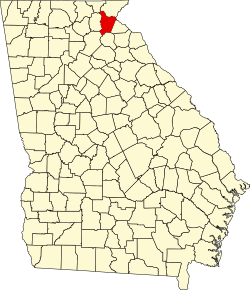
Habersham County is a county in the Northeast region of the U.S. state of Georgia. As of the 2020 census, the population was 46,031.[1] The county seat is Clarkesville.[2] The county was created on December 15, 1818, and named for Colonel Joseph Habersham of the Continental Army in the Revolutionary War.[3] Habersham County comprises the Cornelia, GA Micropolitan Statistical Area.
Key Information


Geography
[edit]According to the U.S. Census Bureau, the county has a total area of 279 square miles (720 km2), of which 277 square miles (720 km2) is land and 2.3 square miles (6.0 km2) (0.8%) is water.[4] The county is located within the Blue Ridge Mountains, a segment of the Appalachian Mountains. The county also includes part of the Chattahoochee National Forest.
The highest point in the county is a 4,400-foot (1,300 m) knob less than 700 feet (210 m) southeast of the top of Tray Mountain, the seventh-highest mountain in Georgia. Habersham shares this portion of Tray Mountain, just 30 vertical feet shy of the peak's 4,430-foot summit, with White County to the west and Towns County to the north. 2.4 miles to the northeast of Tray Mountain is Young Lick (elevation 3,809 feet (1,161 m)). The Appalachian Trail runs along the top of the high ridge between Young Lick and Tray, a part of the Blue Ridge Mountain crest.
Habersham is mostly located in the Upper Chattahoochee River sub-basin of the ACF River Basin (Apalachicola-Chattahoochee-Flint River Basin), with the northeastern corner of the county located in the Tugaloo River sub-basin in the larger Savannah River basin, and the southeastern portion located in the Broad River sub-basin of the same Savannah River basin.[5]
The Chattahoochee River rises in what used to be Habersham County, as portrayed in Sidney Lanier's poem "Song of the Chattahoochee":
- Out of the hills of Habersham,
- Down the valleys of Hall,
- I hurry amain to reach the plain,
- Run the rapid and leap the fall,
- Split at the rock and together again.
The county, originally comprising much of Northeast Georgia, was cut up dramatically in the latter half of the 19th century and the first years of the 20th century; as population increased in the area, new counties were organized from it and borders were changed. In 1857, its most western part was added to Lumpkin County, which had been created in 1832. That same year, the area east of Lumpkin and west of present-day Habersham became White County. In 1859, Banks County was carved from Habersham's southernmost territory. Finally, in 1905, Stephens County was formed from parts of Habersham and Banks.
Major highways
[edit] U.S. Route 23
 U.S. Route 123
 U.S. Route 441
 U.S. Route 441 Business (west of Toccoa)
 State Route 15
 State Route 15 Connector
 State Route 15 Loop
 State Route 17
 State Route 17 Alternate
 State Route 105
 State Route 115
 State Route 197
 State Route 197 Connector
 State Route 255
 State Route 255 Alternate
 State Route 356
 State Route 365
 State Route 384
 State Route 385


Adjacent counties
[edit]- Rabun County - north
- Oconee County, South Carolina - east
- Stephens County - east
- Banks County - south
- Hall County - southwest
- White County - west
- Towns County - northwest
Education
[edit]
All of Habersham County is served by the Habersham County School District.[6]
The Tallulah Falls School is located in Tallulah Falls. Piedmont University and North Georgia Technical College are also located in Habersham county.
Demographics
[edit]| Census | Pop. | Note | %± |
|---|---|---|---|
| 1820 | 3,145 | — | |
| 1830 | 10,671 | 239.3% | |
| 1840 | 7,961 | −25.4% | |
| 1850 | 8,895 | 11.7% | |
| 1860 | 5,966 | −32.9% | |
| 1870 | 6,322 | 6.0% | |
| 1880 | 8,718 | 37.9% | |
| 1890 | 11,573 | 32.7% | |
| 1900 | 13,604 | 17.5% | |
| 1910 | 10,134 | −25.5% | |
| 1920 | 10,730 | 5.9% | |
| 1930 | 12,748 | 18.8% | |
| 1940 | 14,771 | 15.9% | |
| 1950 | 16,553 | 12.1% | |
| 1960 | 18,116 | 9.4% | |
| 1970 | 20,691 | 14.2% | |
| 1980 | 25,020 | 20.9% | |
| 1990 | 27,621 | 10.4% | |
| 2000 | 35,902 | 30.0% | |
| 2010 | 43,041 | 19.9% | |
| 2020 | 46,031 | 6.9% | |
| 2024 (est.) | 49,665 | [7] | 7.9% |
| U.S. Decennial Census[8] 1790-1880[9] 1890-1910[10] 1920-1930[11] 1930-1940[12] 1940-1950[13] 1960-1980[14] 1980-2000[15] 2010[16] 2020[17] | |||
2020 census
[edit]| Race / Ethnicity (NH = Non-Hispanic) | Pop 2000[18] | Pop 2010[16] | Pop 2020[17] | % 2000 | % 2010 | % 2020 |
|---|---|---|---|---|---|---|
| White alone (NH) | 30,486 | 34,621 | 34,694 | 84.91% | 80.44% | 75.37% |
| Black or African American alone (NH) | 1,551 | 1,412 | 1,722 | 4.32% | 3.28% | 3.74% |
| Native American or Alaska Native alone (NH) | 89 | 81 | 83 | 0.25% | 0.19% | 0.18% |
| Asian alone (NH) | 664 | 955 | 990 | 1.85% | 2.22% | 2.15% |
| Native Hawaiian or Pacific Islander alone (NH) | 30 | 47 | 35 | 0.08% | 0.11% | 0.08% |
| Other race alone (NH) | 5 | 34 | 109 | 0.01% | 0.08% | 0.24% |
| Mixed race or Multiracial (NH) | 327 | 558 | 1,518 | 0.91% | 1.30% | 3.30% |
| Hispanic or Latino (any race) | 2,750 | 5,333 | 6,880 | 7.66% | 12.39% | 14.95% |
| Total | 35,902 | 43,041 | 46,031 | 100.00% | 100.00% | 100.00% |
As of the 2020 census, there were 46,031 people, 16,408 households, and 10,440 families residing in the county.[19] The median age was 40.2 years, with 22.1% of residents under the age of 18 and 19.3% aged 65 or older.[19]
For every 100 females there were 89.0 males, and for every 100 females age 18 and over there were 84.4 males age 18 and over.[19] 40.7% of residents lived in urban areas, while 59.3% lived in rural areas.[20]
The racial makeup of the county, as of the 2020 census, was 78.7% White, 3.8% Black or African American, 0.5% American Indian and Alaska Native, 2.2% Asian, 0.1% Native Hawaiian and Pacific Islander, 6.6% from some other race, and 8.1% from two or more races. Hispanic or Latino residents of any race comprised 14.9% of the population.[21]
There were 16,408 households in the county, of which 31.1% had children under the age of 18 living with them and 24.7% had a female householder with no spouse or partner present. About 23.7% of all households were made up of individuals and 12.3% had someone living alone who was 65 years of age or older.[19]
There were 18,340 housing units, of which 10.5% were vacant. Among occupied housing units, 74.3% were owner-occupied and 25.7% were renter-occupied. The homeowner vacancy rate was 2.1% and the rental vacancy rate was 6.7%.[19]
2010 census
[edit]As of the 2010 United States census, there were 43,041 people, 15,472 households, and 11,307 families living in the county.[22] The population density was 155.5 inhabitants per square mile (60.0/km2). There were 18,146 housing units at an average density of 65.6 units per square mile (25.3 units/km2).[23] The racial makeup of the county was 85.7% white, 3.4% black or African American, 2.2% Asian, 0.5% American Indian, 0.2% Pacific islander, 6.3% from other races, and 1.8% from two or more races. Those of Hispanic or Latino origin made up 12.4% of the population.[22] In terms of ancestry, 15.6% were English, 13.9% were Irish, 13.7% were American, and 9.9% were German.[24]
Of the 15,472 households, 34.4% had children under the age of 18 living with them, 57.8% were married couples living together, 10.5% had a female householder with no husband present, 26.9% were non-families, and 23.2% of all households were made up of individuals. The average household size was 2.63 and the average family size was 3.08. The median age was 38.6 years.[22]
The median income for a household in the county was $40,192 and the median income for a family was $49,182. Males had a median income of $35,974 versus $27,971 for females. The per capita income for the county was $19,286. About 15.7% of families and 19.6% of the population were below the poverty line, including 31.2% of those under age 18 and 12.5% of those age 65 or over.[25]
2000 census
[edit]As of the census[26] of 2000,[needs update] there were 35,902 people, 13,259 households, and 9,851 families living in the county. The population density was 129 people per square mile (50 people/km2). There were 14,634 housing units at an average density of 53 units per square mile (20 units/km2). The racial makeup of the county was 88.88% White, 4.48% Black or African American, 1.89% Asian, 0.29% Native American, 0.10% Pacific Islander, 2.99% from other races, and 1.36% from two or more races. 7.66% of the population were Hispanic or Latino of any race.
There were 13,259 households, out of which 32.00% had children under the age of 18 living with them, 60.90% were married couples living together, 9.30% had a female householder with no husband present, and 25.70% were non-families. 22.40% of all households were made up of individuals, and 9.60% had someone living alone who was 65 years of age or older. The average household size was 2.57 and the average family size was 2.98.
In the county, the population was spread out, with 23.50% under the age of 18, 11.10% from 18 to 24, 28.50% from 25 to 44, 23.10% from 45 to 64, and 13.80% who were 65 years of age or older. The median age was 36 years. For every 100 females there were 105.50 males. For every 100 females age 18 and over, there were 103.00 males.
The median income for a household in the county was $36,321, and the median income for a family was $42,235. Males had a median income of $28,803 versus $23,046 for females. The per capita income for the county was $17,706. About 8.80% of families and 12.20% of the population were below the poverty line, including 14.40% of those under age 18 and 15.00% of those age 65 or over.
Politics
[edit]
Habersham County is a Republican stronghold, having last voted for a Democrat in 1980. In every presidential election since 2012, the Republican candidate has received over 80% of the vote.
As of 2012, the county is split into 14 voting precincts:[27]
- North: Batesville, Cool Springs, Fair Play, Deep Creek, Glade Creek, Fork, Falling Water, Clarkesville
- South: Demorest, Center Hill, Cornelia, View, Mud Creek and Baldwin
Ty Akins serves as chairman of the Board of County Commissioners as of July 2022. Since 2011, Habersham County has been represented in the Georgia House of Representatives by Republican member Terry Rogers. Habersham County was represented in the US House of Representatives as part of the 10th District. Representative Charlie Norwood represented the county for one month, until his death (February 13, 2007). The seat remained vacant until a special election in July 2007, which was won by Republican Paul Broun, an Athens physician. Broun served in the House until 2014, when he ran unsuccessfully for the Republican nomination for the U.S. Senate seat vacated by the retiring Saxby Chambliss.
With the 2012 reapportionment, Habersham County became part of the 9th congressional district. Former Georgia House of Representatives member Doug Collins won the seat in the 2016 election.
Habersham county is the current home of former governor Nathan Deal after his term expired in 2019.
Habersham County became the first Second Amendment sanctuary county in Georgia on January 13, 2020.
For elections to the Georgia State Senate, Habersham County is part of District 50.[28] For elections to the Georgia House of Representatives, Habersham County is divided between District 10 and District 32.[29]
| Year | Republican | Democratic | Third party(ies) | |||
|---|---|---|---|---|---|---|
| No. | % | No. | % | No. | % | |
| 1912 | 45 | 5.31% | 485 | 57.26% | 317 | 37.43% |
| 1916 | 48 | 3.23% | 1,032 | 69.45% | 406 | 27.32% |
| 1920 | 626 | 55.45% | 503 | 44.55% | 0 | 0.00% |
| 1924 | 322 | 27.01% | 808 | 67.79% | 62 | 5.20% |
| 1928 | 1,404 | 55.96% | 1,105 | 44.04% | 0 | 0.00% |
| 1932 | 225 | 11.56% | 1,693 | 86.95% | 29 | 1.49% |
| 1936 | 424 | 18.21% | 1,884 | 80.93% | 20 | 0.86% |
| 1940 | 421 | 18.55% | 1,840 | 81.06% | 9 | 0.40% |
| 1944 | 504 | 21.48% | 1,842 | 78.52% | 0 | 0.00% |
| 1948 | 368 | 17.77% | 1,477 | 71.32% | 226 | 10.91% |
| 1952 | 921 | 25.81% | 2,647 | 74.19% | 0 | 0.00% |
| 1956 | 855 | 27.31% | 2,276 | 72.69% | 0 | 0.00% |
| 1960 | 895 | 26.13% | 2,530 | 73.87% | 0 | 0.00% |
| 1964 | 1,595 | 31.84% | 3,412 | 68.12% | 2 | 0.04% |
| 1968 | 1,611 | 28.32% | 1,070 | 18.81% | 3,008 | 52.87% |
| 1972 | 971 | 84.95% | 172 | 15.05% | 0 | 0.00% |
| 1976 | 1,315 | 20.44% | 5,120 | 79.56% | 0 | 0.00% |
| 1980 | 2,224 | 32.80% | 4,394 | 64.80% | 163 | 2.40% |
| 1984 | 4,647 | 68.62% | 2,125 | 31.38% | 0 | 0.00% |
| 1988 | 4,871 | 69.45% | 2,114 | 30.14% | 29 | 0.41% |
| 1992 | 4,569 | 50.02% | 3,098 | 33.92% | 1,467 | 16.06% |
| 1996 | 4,730 | 51.93% | 3,170 | 34.80% | 1,208 | 13.26% |
| 2000 | 6,964 | 71.86% | 2,530 | 26.11% | 197 | 2.03% |
| 2004 | 10,434 | 78.59% | 2,750 | 20.71% | 92 | 0.69% |
| 2008 | 11,766 | 79.18% | 2,900 | 19.52% | 193 | 1.30% |
| 2012 | 12,166 | 82.90% | 2,301 | 15.68% | 209 | 1.42% |
| 2016 | 13,190 | 80.76% | 2,483 | 15.20% | 660 | 4.04% |
| 2020 | 16,637 | 81.39% | 3,562 | 17.42% | 243 | 1.19% |
| 2024 | 19,142 | 81.91% | 4,036 | 17.27% | 192 | 0.82% |
| Year | Republican | Democratic | Third party(ies) | |||
|---|---|---|---|---|---|---|
| No. | % | No. | % | No. | % | |
| 2020 | 16,385 | 80.88% | 3,340 | 16.49% | 534 | 2.64% |
| 2020 | 14,871 | 82.47% | 3,160 | 17.53% | 0 | 0.00% |
| Year | Republican | Democratic | Third party(ies) | |||
|---|---|---|---|---|---|---|
| No. | % | No. | % | No. | % | |
| 2020 | 10,319 | 51.28% | 2,133 | 10.60% | 7,670 | 38.12% |
| 2020 | 14,776 | 82.00% | 3,243 | 18.00% | 0 | 0.00% |
| 2022 | 13,509 | 80.06% | 2,887 | 17.11% | 478 | 2.83% |
| 2022 | 12,668 | 82.35% | 2,715 | 17.65% | 0 | 0.00% |
| Year | Republican | Democratic | Third party(ies) | |||
|---|---|---|---|---|---|---|
| No. | % | No. | % | No. | % | |
| 2022 | 14,513 | 85.42% | 2,322 | 13.67% | 155 | 0.91% |
Prison
[edit]The Georgia Department of Corrections operates the Arrendale State Prison in an unincorporated area in the county, near Alto.[31]
Lee Arrendale State Prison was built in 1926. The prison was named after Lee Arrendale, former chairman of the Georgia Board of Corrections, after he and his wife were killed in a plane crash.[citation needed] The facility was originally constructed as a tuberculosis (TB) hospital, when treatment consisted primarily of rest in sanatoriums. It operated until the mid-1950s; with antibiotics, TB was better controlled and such hospitals were no longer needed. The facility was transferred to the Georgia Prison system.
Once acquired by the Georgia Department of Corrections, it was first used to house youthful offenders from ages 18–25. Over a short amount of time, Lee Arrendale prison gained a bad reputation as the second most violent all-male prison in the state. In 2005, however the Department of Corrections decided to make the prison an exclusive general purpose women's prison. As a result of the prison's past troubles and reputation for violence, the state decided to make this change to improve the prison's status in the state. In March 2006, the prison took in 350 women prisoners from Georgia's overflowing jail system to start this process.
Lee Arrendale is also home to the United States' first all-female fire department[citation needed] and the state's first inmate fire department,[citation needed], thanks to the Georgia Department of Corrections' (GDC) Fire Services Division. The GDC operates many fire departments throughout the state, staffed solely by inmates, who are supervised by GDC employees. Such inmates are trained as certified officers but as professional firefighters. The inmate firefighter program provides fire protection to the largely rural communities without local or volunteer fire departments near the prisons, as well as to other locations in Georgia during emergencies. Inmates are trained and certified in accordance with Georgia law and the Georgia Firefighter Standards and Training Council, as with any regular fire department. In 2007, inmate fire squads responded to the wildfires in South Georgia near Waycross, Georgia,[citation needed] in addition to the hundreds of other alarms they received statewide.
Communities
[edit]See also
[edit]References
[edit]- ^ "Census - Geography Profile: Habersham County, Georgia". United States Census Bureau. Retrieved December 27, 2022.
- ^ "Find a County". National Association of Counties. Retrieved June 7, 2011.
- ^ Krakow, Kenneth K. (1975). Georgia Place-Names: Their History and Origins (PDF). Macon, GA: Winship Press. p. 101. ISBN 0-915430-00-2. Archived (PDF) from the original on September 17, 2003.
- ^ "US Gazetteer files: 2010, 2000, and 1990". United States Census Bureau. February 12, 2011. Retrieved April 23, 2011.
- ^ "Georgia Soil and Water Conservation Commission Interactive Mapping Experience". Georgia Soil and Water Conservation Commission. Archived from the original on October 3, 2018. Retrieved November 18, 2015.
- ^ "2020 CENSUS - SCHOOL DISTRICT REFERENCE MAP: Habersham County, GA" (PDF). U.S. Census Bureau. Archived (PDF) from the original on August 14, 2022. Retrieved August 1, 2022. - Text list
- ^ "County Population Totals and Components of Change: 2020-2024". United States Census Bureau. Retrieved August 22, 2025.
- ^ "Decennial Census of Population and Housing by Decades". United States Census Bureau.
- ^ "1880 Census Population by Counties 1790-1800" (PDF). United States Census Bureau. 1880.
- ^ "1910 Census of Population - Georgia" (PDF). United States Census Bureau. 1910. Archived from the original (PDF) on January 16, 2024.
- ^ "1930 Census of Population - Georgia" (PDF). United States Census Bureau. 1930.
- ^ "1940 Census of Population - Georgia" (PDF). United States Census Bureau. 1940.
- ^ "1950 Census of Population - Georgia -" (PDF). United States Census Bureau. 1950.
- ^ "1980 Census of Population - Number of Inhabitants - Georgia" (PDF). United States Census Bureau. 1980.
- ^ "2000 Census of Population - Population and Housing Unit Counts - Georgia" (PDF). United States Census Bureau. 2000.
- ^ a b "P2: Hispanic or Latino, and Not Hispanic or Latino by Race – 2010: DEC Redistricting Data (PL 94-171) – Habersham County, Georgia". United States Census Bureau.
- ^ a b "P2: Hispanic or Latino, and Not Hispanic or Latino by Race – 2020: DEC Redistricting Data (PL 94-171) – Habersham County, Georgia". United States Census Bureau.
- ^ "P004 Hispanic or Latino, and Not Hispanic or Latino by Race – 2000: DEC Summary File 1 – Habersham County, Georgia". United States Census Bureau.
- ^ a b c d e "2020 Decennial Census Demographic Profile (DP1)". United States Census Bureau. 2021. Retrieved 13 December 2025.
- ^ "2020 Decennial Census Demographic and Housing Characteristics (DHC)". United States Census Bureau. 2023. Retrieved 13 December 2025.
- ^ "2020 Decennial Census Redistricting Data (Public Law 94-171)". United States Census Bureau. 2021. Retrieved 13 December 2025.
- ^ a b c "DP-1 Profile of General Population and Housing Characteristics: 2010 Demographic Profile Data". United States Census Bureau. Archived from the original on February 13, 2020. Retrieved December 29, 2015.
- ^ "Population, Housing Units, Area, and Density: 2010 - County". United States Census Bureau. Archived from the original on February 13, 2020. Retrieved December 29, 2015.
- ^ "DP02 SELECTED SOCIAL CHARACTERISTICS IN THE UNITED STATES – 2006-2010 American Community Survey 5-Year Estimates". United States Census Bureau. Archived from the original on February 13, 2020. Retrieved December 29, 2015.
- ^ "DP03 SELECTED ECONOMIC CHARACTERISTICS – 2006-2010 American Community Survey 5-Year Estimates". United States Census Bureau. Archived from the original on February 13, 2020. Retrieved December 29, 2015.
- ^ "U.S. Census website". United States Census Bureau. Retrieved May 14, 2011.
- ^ Habersham delays consolidation of voting precincts, a June 19, 2012, article by Rob Moore from AccessNorthGa.com. Retrieved September 14, 2012.
- ^ "Georgia General Assembly". www.legis.ga.gov. Retrieved November 28, 2025.
- ^ "Georgia General Assembly". www.legis.ga.gov. Retrieved November 28, 2025.
- ^ Leip, David. "Dave Leip's Atlas of U.S. Presidential Elections". uselectionatlas.org. Retrieved March 20, 2018.
- ^ "Arrendale State Prison Archived 2014-01-16 at the Wayback Machine." Georgia Department of Corrections. Retrieved on November 15, 2010. "ADDRESS: 2023 GAINESVILLE HWY, SOUTH POST OFFICE BOX 709, ALTO, GA 30510."
External links
[edit]- Chamber of Commerce, local web site from local Chamber of Commerce
- Habersham County, Roadside Georgia
- Habersham County website
- Habersham County historical marker, Georgia Info
- Habersham Iron Works Manufacturing Company, historical marker, Georgia Info
Places adjacent to Habersham County, Georgia | ||||||||||||||||
|---|---|---|---|---|---|---|---|---|---|---|---|---|---|---|---|---|
| ||||||||||||||||


Municipalities and communities of Habersham County, Georgia, United States | ||
|---|---|---|
| Cities |  | |
| Towns | ||
| CDP | ||
| Unincorporated communities | ||
| Footnotes | ‡This populated place also has portions in an adjacent county or counties | |


| International | |
|---|---|
| National | |
| Geographic | |
| Other | |

Habersham County, Georgia
View on GrokipediaHistory
Establishment and Etymology
Habersham County was established on December 15, 1818, by acts of the Georgia General Assembly, carved from territory previously occupied by the Cherokee Nation.[2][4] This creation followed the cession of Cherokee lands through treaties, enabling white settlement in the northeastern Georgia foothills, with the county initially encompassing a larger area that later contributed to the formation of adjacent counties such as White and Towns.[2][5] The county derives its name from Joseph Habersham (1751–1815), a Savannah native who served as a colonel in the Continental Army during the American Revolutionary War and later as the first United States Postmaster General under Presidents George Washington and John Adams.[2][4] Habersham's military contributions, including leading a raid on British armaments in Augusta, Georgia, in 1779, earned him recognition among Georgia's revolutionary leaders, prompting the legislature to honor him posthumously despite his lack of direct connection to the specific territory beyond regional ties.[4][5]Native American Era and Land Acquisition
The territory comprising present-day Habersham County was primarily inhabited by the Cherokee people during the Native American era, with occupation concentrated in the northern portions after approximately 1715, while the lower half and areas east of the Chattahoochee River remained outside their primary domain.[6] Archaeological and historical records indicate several Cherokee settlements within the region, including one known as "Sakwi-yi" or "Su-ki," located near the site of modern Clarkesville.[7] These communities engaged in agriculture, hunting, and trade along river valleys, with the Chattahoochee and its tributaries serving as key lifelines, though direct evidence of large-scale villages in the southern extents is limited.[6] Land acquisition by the state of Georgia proceeded through a series of treaties with the Cherokee Nation, beginning with cessions in 1816 and 1817 that transferred all territory now within Habersham County to state control.[7] The pivotal Treaty of the Cherokee Agency, signed on July 8, 1817, formalized the cession of significant lands in northeastern Georgia, enabling surveys and lotteries for white settlement.[8] These agreements, often negotiated under pressure from expanding American frontiersmen and federal intermediaries, divided the ceded lands into districts for distribution via Georgia's headright and lottery systems, with Habersham County formally established by legislative act on December 18, 1818.[8][2] Additional Cherokee cessions in 1819 via the Treaty of Washington incorporated western portions into the county's boundaries, while further annexations in 1828 and 1829 expanded its area to approximately 713 square miles at peak, drawing initial white settlers to riverbanks for farming and milling.[2] The process culminated in the broader Cherokee removal efforts, with remaining tribal members in Georgia, including stragglers in Habersham, forcibly relocated westward starting in 1838 under the Indian Removal Act of 1830 and the Treaty of New Echota (1835), clearing the region for uninterrupted European-American development.[2] This acquisition reflected Georgia's systematic push for sovereignty over indigenous-held lands, substantiated by treaty texts and state records, though Cherokee resistance and legal challenges, such as those reaching the U.S. Supreme Court, underscored the contentious nature of the transfers.[9]19th-Century Development and Civil War
Following its creation on December 15, 1818, from Cherokee land cessions in 1817 and 1819, Habersham County experienced rapid settlement by white farmers and planters, who established large agricultural operations, particularly in the lowlands of present-day Banks and Stephens counties and the Nacoochee Valley.[2][5] These plantations relied on enslaved labor for cultivating crops such as corn, wheat, and limited cotton, alongside livestock rearing, reflecting the county's position in the Appalachian foothills where diversified farming predominated over the monoculture of the Georgia lowcountry.[5] The county expanded territorially in 1828 and 1829 with additional Cherokee land claims, peaking at 713 square miles before subsequent divisions reduced it to its modern boundaries.[2] By the mid-19th century, Clarkesville, the county seat, emerged as a summer retreat for affluent families from southern Georgia seeking cooler elevations, fostering modest commercial growth around agriculture and small-scale milling.[8] Economic activity centered on subsistence and market-oriented farming, with infrastructure limited to rudimentary roads and trails until post-war railroad expansions in the 1870s began integrating the area more firmly into regional trade networks.[3] Habersham County aligned with Georgia's secession in 1861, producing over 1,000 Confederate volunteers who served in units such as the 52nd Georgia Infantry Regiment, with many perishing in major eastern theater engagements.[3][10] The county's home front endured hardships from supply shortages and foraging, culminating in the Battle of the Narrows on October 12, 1864, where local Confederate forces under Colonel J.J. Finley repelled a Union raid led by Colonel Ivan Turchin near Long Creek, preventing pillaging of crops and livestock essential for sustaining Southern armies.[11][12] This skirmish, involving approximately 300 Confederates against a larger Union detachment, marked the only significant Civil War action in the county and underscored its strategic value for grain production amid Sherman's Atlanta Campaign.[11] Post-war, the county faced economic disruption from emancipation and disrupted trade, shifting toward recovery through diversified agriculture by the 1870s.[3]20th- and 21st-Century Growth
The population of Habersham County reached 13,604 by 1900, reflecting steady expansion driven by agricultural expansion and improved transportation links from late-19th-century railroads.[8] In 1905, a longstanding dispute over the county seat was resolved through the creation of Stephens County from northern portions of Habersham, affirming Clarkesville's status and stabilizing local governance amid territorial adjustments.[8] The economy during the early 20th century emphasized diversified farming, including apple orchards and vineyards, which capitalized on the region's fertile mountain soils and moderate climate, supplemented by educational institutions like Piedmont College, established in 1897 and expanding thereafter.[2] [3] Mid-century growth sustained agricultural dominance, with poultry, corn, and fruit production forming the economic core, while natural features such as the Chattahoochee National Forest began fostering nascent tourism.[2] By 2000, the population had more than doubled to 35,902, indicating cumulative advances in rural infrastructure and proximity to urban centers like Atlanta.[13] Industrial diversification emerged, including manufacturing sectors that leveraged the county's location along U.S. highways for logistics.[14] Into the 21st century, population growth accelerated, rising to 43,401 by 2010 and 46,031 by 2020—a 7.2% increase over the decade—attributable to inbound migration seeking affordable housing, outdoor recreation, and employment in expanding sectors like advanced manufacturing and healthcare.[2] [15] Economic development initiatives, coordinated by the Habersham Development Authority since its formalization, prioritized job creation through industry recruitment and workforce training tied to local education, yielding a 1.3% population uptick from 2022 to 2023 alone.[16] [17] This expansion strained infrastructure, prompting comprehensive planning efforts documented in the 2023 Joint Comprehensive Plan, which addressed housing, transportation, and service demands amid a micropolitan economy oriented toward agriculture, tourism via sites like Tallulah Gorge, and light industry.[18] [2] Local leaders noted in 2006 that a 6.3% population surge to over 42,000 necessitated balanced growth strategies to preserve rural character while accommodating business inflows.[19]Geography
Physical Features and Climate
Habersham County is situated in the foothills of the Blue Ridge Mountains, part of the Appalachian range, in northeast Georgia, featuring a landscape of rolling hills, valleys, and extensive forested areas, including portions of the Chattahoochee National Forest.[2][1] Elevations typically range from 1,400 to 2,000 feet above sea level, with the county's highest point at Young Lick Knob, reaching 3,800 feet.[1] The region lies within the Upper Chattahoochee River sub-basin, where tributaries such as the Soque River, which originates and flows entirely within the county, feed into the broader Chattahoochee River system.[20] The county experiences a humid subtropical climate marked by four distinct seasons, hot and humid summers, and mild winters.[21] Annual precipitation averages approximately 57 inches, occurring on about 140 days, with March as the wettest month and September and October the driest.[21] Snowfall totals around 4.5 inches over roughly 5 days per year, while thunderstorms occur on 50 to 60 days, predominantly in spring and summer.[21] Summer afternoon high temperatures average in the lower 80s°F, with highs of 90°F or above on 15 to 25 days and overnight lows in the 60s°F; winter highs average in the 40s°F, lows in the 20s°F, and freezing temperatures or below occur on about 100 days annually.[21] The median annual temperature is 69.7°F, with the first average freeze in October and the last in April.[21]Transportation Infrastructure
Habersham County's transportation network relies heavily on roadways, with state highways forming the backbone for regional connectivity. U.S. Highway 23 and U.S. Highway 441 provide primary north-south corridors through the county, linking it to Atlanta approximately 70 miles southwest and to the North Carolina border to the north.[22] [1] State Route 365, a divided four-lane highway, connects Cornelia to Interstate 85 in Hall County, facilitating freight and commuter access to larger metropolitan areas.[1] [23] Additional state routes, including Georgia Highway 17, Georgia Highway 115, and Georgia Highway 197, serve intra-county travel and link to adjacent communities.[1] [24] The Georgia Department of Transportation oversees maintenance and improvements, with recent and ongoing projects focused on safety and capacity. These include resurfacing segments of SR 365 from Hall County to its junction with US 441 and SR 17, as well as implementing restricted crossing U-turn intersections at locations such as Luthi Road, Charlie Davis Road, and U.S. 23 to reduce crash risks at high-volume access points.[25] [23] County-maintained roads supplement state highways, though portions of routes like Business US 441 and SR 365 fall under state jurisdiction.[24] Public transit options are limited to demand-response services operated by Habersham County Transit, which requires advance reservations via phone at 706-839-0167 for trips within the county, operating weekdays from approximately 7 a.m. to 4 p.m.[26] Aviation infrastructure centers on Habersham County Airport (ICAO: KAJR), a public-use general aviation facility in Cornelia with a 5,503-foot paved runway, a 3,000-square-foot terminal, and capacity for 63 based aircraft.[27] [28] The airport supports business travel, medical evacuations, emergency services, and tourism, with daily staffing from 8 a.m. and infrastructure upgrades enhancing its role in economic development.[27] [29] Freight rail access is available, particularly serving industrial parks near key highway and airport nodes, though passenger rail service is absent.[30] Historically, the Tallulah Falls Railway operated from Cornelia northward until its abandonment in the mid-20th century, once vital for regional freight and passenger transport.Adjacent Counties and Boundaries
Habersham County borders Towns County and Rabun County to the north, White County to the west, Banks County and Hall County to the south, Stephens County to the southeast, and Oconee County in South Carolina to the east.[17][2] The county's eastern boundary follows the Tugaloo River, which delineates the Georgia-South Carolina state line in this region.[1] Other boundaries largely conform to natural features such as ridgelines in the Appalachian foothills and tributaries of the Chattahoochee River system, including the Soque and Tallulah Rivers within or adjacent to the county.[2][1] Originally encompassing 713 square miles upon its formation in 1818, Habersham County's boundaries were reduced through legislative acts creating neighboring counties, resulting in its current area of 279 square miles as of the latest surveys.[3][2]Demographics
Population Trends and Composition
The population of Habersham County, Georgia, has exhibited steady growth since the late 20th century, driven by economic opportunities in manufacturing, agriculture, and proximity to regional hubs. The 2020 United States Census recorded 46,031 residents. By July 2024, estimates placed the population at approximately 49,665, reflecting a 7.9% increase from the 2020 baseline. Between 2010 and 2022, the county grew from 43,058 to 47,475 residents, a 10.3% rise, with annual increases averaging around 1.5% in recent years, including a 1.34% uptick from 2022 to 2023.[31] [17] Earlier decades saw accelerated expansion, with a 30% surge from 1990 to 2000, followed by sustained but moderating growth through 2023, totaling nearly 35% over the 2000–2023 period at an average annual rate of 1.52%.[32] [15] Demographically, the county remains predominantly White, though diversification has occurred, particularly through Hispanic immigration tied to labor demands in poultry processing and construction. In 2022, non-Hispanic Whites constituted 75.2% of the population, down from 80.4% in 2010.[31] Hispanic or Latino residents, of any race, comprised about 16% as of 2023 estimates.[33] The following table summarizes the 2019–2023 American Community Survey racial and ethnic composition:| Category | Percentage |
|---|---|
| White alone (including Hispanic Whites) | 89.7% |
| Black or African American alone | 4.2% |
| American Indian and Alaska Native alone | 1.0% |
| Asian alone | 1.2% |
| Hispanic or Latino (any race) | 15.5% |
| Two or more races | 3.1% |
Economic Indicators from Census Data
According to the U.S. Census Bureau's American Community Survey (ACS) 2019–2023 5-year estimates, the median household income in Habersham County was $65,622, reflecting earnings adjusted to 2023 dollars. This figure represents the midpoint where half of households earned more and half earned less, encompassing all sources of income for household members aged 15 and older. Per capita income, calculated as total income divided by the total population, stood at $30,661 over the same period, indicating average individual earnings including non-workers such as children and retirees. The county's poverty rate, based on ACS 2018–2022 5-year estimates, was 13.6 percent of the population, encompassing individuals and families with incomes below the federal poverty threshold adjusted for household size and composition. This rate aligns closely with Georgia's statewide figure of 13.5 percent but exceeds the national average of 12.4 percent, highlighting localized economic pressures amid broader rural Appalachian influences.[35] Employment-related indicators from the ACS reveal a civilian labor force participation rate of approximately 57.5 percent for the population aged 16 and older in recent estimates, with 82 percent of employed residents in private wage and salary positions.[36] Unemployment, as captured in ACS data, averaged around 4 percent in the 2018–2022 period, though monthly Bureau of Labor Statistics figures derived from Census inputs show it at 3.1 percent as of October 2024, underscoring a tight labor market in manufacturing and agriculture sectors.| Indicator | Value | Period | Source |
|---|---|---|---|
| Median Household Income | $65,622 | 2019–2023 | ACS 5-year estimates |
| Per Capita Income | $30,661 | 2019–2023 | ACS 5-year estimates |
| Poverty Rate | 13.6% | 2018–2022 | ACS 5-year estimates |
| Labor Force Participation | 57.5% | Recent ACS | ACS-derived profiles |
Economy
Agriculture and Natural Resources
Agriculture in Habersham County is the leading economic sector, dominated by poultry production that constitutes 98% of the $133.8 million in total market value of agricultural products sold in 2022. The county supported 375 farms across 27,608 acres of farmland, with average farm size at 74 acres. Poultry output included 2.95 million broilers and other meat-type chickens, alongside 457,841 layers and 200,034 pullets, driving sales of $125.4 million from poultry and eggs.[37] Fieldale Farms, a vertically integrated family-owned operation founded over 50 years ago, processes millions of birds annually and remains one of the county's largest employers in the sector.[38][3] Crop production, while minor at 2% of sales ($2.8 million), focuses on forage for hay and haylage (5,110 acres), corn for silage or greenchop (826 acres), soybeans for beans (275 acres), and corn for grain (274 acres); irrigated cropland totals 47 acres. Fruits such as peaches and apples represent key cash crops, with apples holding historical prominence—Habersham once produced more per capita than any other U.S. region, though modern efforts emphasize heirloom varieties for preservation amid declining commercial scale.[37][1][39] Livestock beyond poultry includes 9,320 cattle and calves ($4.6 million in sales), supporting beef production, along with smaller inventories of goats (524), hogs (124), horses (263), and sheep (215). Pastureland spans 9,732 acres, aiding grazing operations.[37][1] Natural resources encompass 6,541 acres of woodland operated as part of farms, contributing to timber harvesting regulated by county ordinances requiring permits and best management practices to mitigate erosion and water quality impacts. Portions of the Chattahoochee National Forest lie within the county, managed for conservation following historical depletion from logging, mining, and fires; the Georgia Forestry Commission provides fire suppression, prevention, and management assistance. Mineral deposits include gold, kyanite, mica, graphite, garnets, and others, primarily of historical extraction value rather than current industrial scale.[37][40][41][42][1]Manufacturing and Industrial Base
Manufacturing constitutes the largest employment sector in Habersham County, supporting 3,630 jobs in 2023 and surpassing health care and retail trade.[17] This sector benefits from the county's strategic location near Interstate 85 and a labor force exceeding 17,500 workers, with historically low unemployment rates around 3.7% annual growth.[14] Poultry processing dominates local manufacturing, led by Fieldale Farms Corporation, one of the world's largest independent poultry producers and the county's top private employer with over 2,000 workers as of the early 2010s; the firm processes chickens raised on nearby farms, leveraging Habersham's agricultural heritage for integrated operations.[43] [3] Diversification includes medical devices, textiles, and metal fabrication. Ethicon, a Johnson & Johnson subsidiary in Cornelia, manufactures surgical sutures and related products, employing 751 people. Mt. Vernon Mills operates textile facilities focused on fabrics and yarns, with 725 employees. Habersham Metal Products Company, founded in 1954, produces engineered steel doors and frames, achieving annual sales of $23.16 million.[44][45] [46] Smaller but notable firms in Cornelia bolster the base, such as Globaltech Industries ($11.14 million in sales) and Salford BBI Inc. ($10.34 million), specializing in industrial components and equipment. Solmax Americas employs about 240 in geosynthetic textiles, while Morito Scovill manufactures fasteners and hardware.[46][47] The Habersham County Development Authority promotes industrial expansion through site preparation and incentives, emphasizing advanced manufacturing to complement agriculture and reduce reliance on seasonal sectors.[14]Tourism, Events, and Recent Development Initiatives
Habersham County's tourism centers on its natural landscapes in the Appalachian foothills, including scenic trails, waterfalls, and recreational areas such as Lake Russell and Panther Creek Falls.[48] The Chenocetah Fire Tower, a 40-foot granite structure built in 1936 by the Works Progress Administration, offers panoramic views of Lake Russell Recreation Area and is accessible to visitors on Saturdays from April through October.[49] [50] Other attractions include segments of the Appalachian Trail and state parks like Tallulah Gorge, which has drawn visitors since 1882 via rail excursions to view its waterfalls.[3] [51] Annual events highlight local agriculture and culture, with the Chattahoochee Mountain Fair, established in 1975, featuring vendors, livestock shows, rides, music, and a rodeo as a major family-oriented gathering.[52] The Mountain Laurel Festival and Cornelia's Big Red Apple Festival celebrate regional flora and produce, while the Habersham Harvest Festival spans a weekend in October with carnival activities starting at 4:00 p.m. on Friday.[53] [54] Additional fall events include the Clarkesville Fall Festival on October 5 and various community fairs emphasizing historical and seasonal themes.[55] Recent development initiatives prioritize industrial expansion and economic diversification alongside tourism and agriculture, including a new 200-acre industrial site under development to attract businesses.[56] Habersham County supports job creation through incentives like a state tax credit of $3,000 per job for five years for qualifying employers offering benefits, with a minimum of 10 jobs.[57] The county's Joint Comprehensive Plan, updated as of 2023, addresses growth management, housing, density, and employment opportunities amid proximity to expanding corridors like I-985/GA 365.[58] [18] In March 2025, Demorest considered resolutions to enable tax allocation districts for targeted redevelopment and economic stimulation.[59]Government and Politics
Local Government Structure
Habersham County operates under a commission-manager form of government, with a five-member Board of County Commissioners serving as the primary legislative and policy-making body. The commissioners are elected at-large to staggered four-year terms, representing five districts but not required to reside within them.[60] The board enacts ordinances and resolutions governing public health, safety, and welfare; levies property taxes to fund operations; and directs the planning and delivery of essential services, including road construction and maintenance, parks and recreation, support for law enforcement and fire protection, emergency medical services, courthouses and jails, airports, libraries, 911 emergency communications, landfills, animal control, economic development, zoning, and emergency management.[60] The board meets on the third Monday of each month at 6:00 p.m. in the Clarkesville courthouse and annually elects a chairman and vice chairman from its members to lead proceedings.[60] Day-to-day administration falls to a county manager, appointed by the board to oversee departmental operations, implement policies, and act as liaison between the commissioners and staff. Tim Sims assumed this role full-time in April 2025, following an interim period after serving as chief financial officer.[61][62] Several constitutional officers are elected independently by county voters for four-year terms, operating autonomously from the board: the sheriff, who commands the county's primary law enforcement and jail operations; the probate judge, handling estates, wills, guardianships, and vital records like marriage licenses; the clerk of superior court, maintaining judicial records and managing civil filings; the tax commissioner, collecting ad valorem taxes, business licenses, and issuing motor vehicle registrations; and the coroner, investigating unattended or suspicious deaths.[63][64] Additional elected roles with county-level impact include the magistrate judge for minor civil and criminal matters and the state court judge for traffic and misdemeanor cases, though superior court judges serve broader circuits.[63] County departments deliver core functions such as elections and voter registration, property assessment and recording, welfare services, public health initiatives, and infrastructure like roads and public transportation, supplementing state-mandated programs with local enhancements authorized under Georgia's 1983 constitution.[64][65] The county seat, Clarkesville, hosts administrative offices, while municipalities maintain separate charters for their internal governance.[64]Electoral History and Political Alignment
Habersham County exhibits a strong Republican political alignment, with voters consistently delivering overwhelming majorities to GOP presidential candidates in recent elections, reflecting the county's rural, conservative demographic base.[66]| Election Year | Republican Candidate | Votes | Percentage | Democratic Candidate | Votes | Percentage | Total Votes Cast |
|---|---|---|---|---|---|---|---|
| 2024 | Donald Trump | 19,142 | 82.6% | Kamala Harris | 4,036 | 17.4% | ~23,178 |
| 2020 | Donald Trump | 16,616 | 81.4% | Joe Biden | 3,559 | 17.4% | 20,406 |
| 2016 | Donald Trump | 13,190 | 80.8% | Hillary Clinton | 2,483 | 15.2% | 16,333 |
Education
K-12 Public Education System
The Habersham County School District oversees public K-12 education in the county, serving 6,553 students across 14 schools during the 2023-24 school year.[71] The district maintains a student-teacher ratio of approximately 16:1, with instruction spanning pre-kindergarten through grade 12.[72] It operates eight elementary schools—Baldwin Elementary School, Clarkesville Elementary School, Cornelia Elementary School, Demorest Elementary School, Fairview Elementary School, Hazel Grove Elementary School, Level Grove Elementary School, and Woodville Elementary School—along with three middle schools, Habersham Ninth Grade Academy, Habersham Central High School, and Habersham Success Academy as an alternative program for at-risk students.[73] [74] Student performance on the Georgia Milestones Assessment System, which evaluates proficiency in core subjects from grades 3 through high school, placed the district above regional Educational Service Agency averages in all 19 tested areas in 2023, outperforming 79% of Georgia school systems statewide.[75] Statewide data indicate that 46% of district students achieved proficiency or above in reading and mathematics combined, reflecting above-average results relative to the state's overall performance.[72] At Habersham Central High School, the sole comprehensive high school serving grades 10-12, 41% of students are from minority backgrounds and 62% qualify as economically disadvantaged, correlating with graduation rates and college readiness metrics tracked under state accountability standards.[76] The district's fiscal operations run on a July 1 to June 30 cycle, with a proposed operating budget of $137 million for the period aligned with 2025 planning, funded through a mix of state allocations, local property taxes, and federal grants including $11.5 million from American Rescue Plan ESSER III funds allocated for pandemic recovery efforts through 2024.[77] [78] Budget approvals require balance under Georgia's Quality Basic Education formula, emphasizing instructional costs amid enrollment growth of about 2.9% in upper grades from the prior year.[79]Higher Education Institutions
Piedmont University, a private liberal arts institution founded in 1887, maintains its primary residential campus on 300 acres in Demorest, within Habersham County.[80] The university offers more than 40 undergraduate degree programs, with particular emphasis on fine arts, alongside graduate and online options across its Demorest, Athens, and virtual campuses.[81] As of fall 2024, Piedmont enrolls approximately 1,159 undergraduate students system-wide, with a student-faculty ratio of 12:1 and average class sizes around 10 students.[82] Undergraduate enrollment on the Demorest campus rose by 8% in fall 2023 compared to the prior year, reflecting growth in residential students by over 6%.[83] North Georgia Technical College, part of Georgia's Technical College System, operates its main Clarkesville campus at 1500 Georgia Highway 197 North in Habersham County, serving as a hub for technical and vocational education in a mountainous setting.[84] Accredited by the Southern Association of Colleges and Schools Commission on Colleges (SACSCOC), the institution provides over 80 associate degree, diploma, and certificate programs focused on career training in fields such as health sciences, industrial trades, and business, with a student-to-faculty ratio of 22:1.[84] The Clarkesville campus supports adult education, continuing education, and facilities including a bookstore and career services, contributing to high job placement rates exceeding 99% for completers in targeted programs.[85] While NGTC maintains additional campuses in Blairsville and Toccoa, the Clarkesville location anchors higher education access for Habersham County residents seeking affordable, debt-minimizing pathways to workforce entry.[86]Law Enforcement and Corrections
County Sheriff's Office and Jail Operations
The Habersham County Sheriff's Office maintains primary law enforcement jurisdiction over unincorporated county areas, executes court summonses and property levies, and operates the county detention center as mandated by Georgia law.[87] Located at 1000 Detention Drive in Clarkesville, the office employs command staff including Major Les Hendrix, who oversees jail operations, alongside division heads for patrol and investigations.[88] Sheriff Robin Krockum assumed office on January 1, 2025, after winning the November 2024 general election unopposed in qualification; Krockum, possessing over 29 years of experience, began at the detention center in 1995 handling jailer, dispatching, and transport duties before advancing through local police departments and returning as patrol commander in 2008.[88][89] The Jail Division manages the Habersham County Detention Center, constructed in the mid-1990s with a rated capacity of 130 beds, though daily populations range from 150 to 230 inmates, resulting in over 60 housed in external facilities to mitigate overcrowding.[90][91] The center confines pre-trial detainees and those with sentences of one year or less, with staff conducting booking, classification, supervision, transportation, and visitor services; provisions include virtual visitation for families and attorneys, nutritionally adequate meals, and protocols for secure housing.[90][92] Capacity constraints, intensified by increased arrests including among female offenders and prior additions of 34 beds, prompted a proposed $52 million expansion in August 2025, dependent on Special Purpose Local Option Sales Tax (SPLOST) approval via fall referendum to accommodate projected growth.[93][91] Current inmate records are accessible publicly via an online inquiry tool maintained by the office.[94]Lee Arrendale State Prison
Lee Arrendale State Prison is a medium-security correctional facility for female offenders, situated at 2023 Gainesville Highway South in Alto, Habersham County, Georgia. Originally built in 1926 as a tuberculosis sanatorium and repurposed for the state prison system in 1951, the site underwent significant renovations in 1999 and transitioned to an exclusively women's institution in early 2005 after relocating male youth detainees. With a rated capacity of 1,476, it houses adult and juvenile female felons as well as probationers, emphasizing special mission functions such as substance abuse treatment, mental health services, diagnostic evaluations, and transitional programming; it also maintains a Children's Center for visitation and family support. Vocational offerings include training in auto mechanics, cosmetology, and small engine repair, alongside academic programs like GED preparation and counseling in moral reconation therapy and reentry planning.[95][96][97] The facility hosts the adjacent Arrendale Transitional Center, a minimum-security annex constructed in 1980 and opened in 2008, accommodating up to 117 adult female felons nearing release. This unit prioritizes community reintegration via work release opportunities in Habersham and Hall counties, alongside interventions for substance abuse, family violence intervention, and job readiness assessments. In January 2023, the Georgia Department of Corrections proposed downsizing the main prison by transferring most inmates to a repurposed federal facility elsewhere in the state, while preserving the transitional center; however, the prison continued full operations through 2025, including responses to internal security challenges.[98][99] Operational difficulties have included persistent violence and oversight lapses. At least three inmate homicides were documented from 2022 to 2024, involving mechanisms such as asphyxia from neck compression and other blunt force traumas. Gang influence contributed to a August 2022 riot, yielding charges of institutional rioting, gang terrorism violations, and theft against six participants. In July 2025, 32-year-old inmate Sheqweetta Vaughan was pronounced dead in her cell amid 90-degree heat, with her body in advanced decay, leading her family to question medical monitoring and response times. Separate allegations include a 2024 lawsuit claiming brutal assault by correctional officers on an inmate, alongside a June 2025 federal indictment tying an internal "prison broker" to methamphetamine distribution networks spanning south Georgia.[100][101][102][103][104]Communities
Incorporated Cities
Habersham County includes seven incorporated municipalities: Alto, Baldwin, Clarkesville, Cornelia, Demorest, Mount Airy, and Tallulah Falls.[105] These cities and towns vary in size and historical development, primarily emerging in the late 19th century along railroad lines and in the Appalachian foothills, with Clarkesville serving as the county seat since its early establishment.[2]| Municipality | Incorporation Date | 2023 Population Estimate |
|---|---|---|
| Alto | December 16, 1895 | 1,011 |
| Baldwin | December 17, 1896 | 3,730 |
| Clarkesville | 1823 | 1,830 |
| Cornelia | October 22, 1887 | 5,371 |
| Demorest | 1889 | 2,340 |
| Mount Airy | 1874 | 1,480 |
| Tallulah Falls | 1885 | 273 |