


Community hub
Recent from talks
Contribute something
Nothing was collected or created yet.
Haneunim
View on Wikipedia
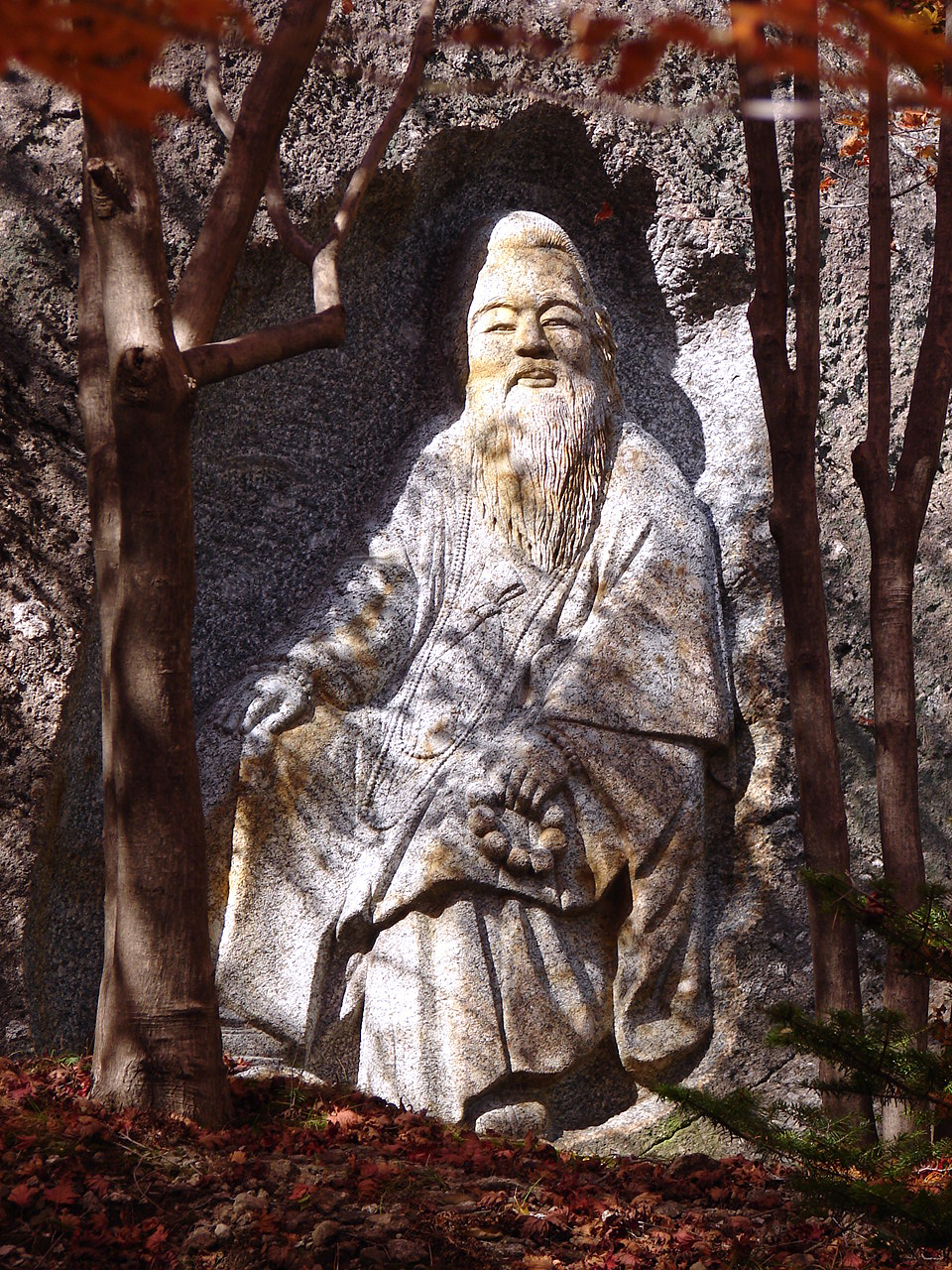
Haneunim or Hanunim (Korean: 하느님; lit. Lord of Heaven; Heavenly Lord)[a] is the sky god in Korean mythology.[1][2] In the more Buddhist-aligned parts of these religions, he is identified with Indra. In the more Taoist-aligned parts of these religions, he is identified with Okhwang Sangje (옥황상제; 玉皇上帝; lit. Jade Emperor). Under that name, he is a deity in the Poncheongyo religion.[3]
Dangun myth
[edit]Dangun is traditionally considered to be the grandson of Hwanin, the "Heavenly King", and founder of the Korean nation.[4] Myths similar to that of Dangun are found in Ainu[5] and Siberian cultures.[6]
The myth starts with prince Hwanung ("Heavenly Prince"), son of Hwanin. The prince asked his father to grant him governance over Korea.[7] Hwanin accepted, and Hwanung was sent to Earth bearing three Heavenly Seals and accompanied by three thousand followers.[7] The prince arrived under the sindansu (신단수; 神檀樹; lit. Holy Tree of Sandalwood)[8] on the holy mountain, where he founded his holy city.[7]
At the time of his reign, Ungnyeo[8]—bear—and a tiger were living in a cave near the holy city, praying earnestly that their wish to become part of humankind might be fulfilled.[7] Ungnyeo patiently endured weariness and hunger, and after twenty-one days she was transformed into a woman, while the tiger ran away for it could not tolerate the effort.[7] The woman Ungnyeo was overjoyed, and visiting the sandalwood city she prayed that she might become the mother of a child.[7]
Ungnye's wish was fulfilled, so that she became the queen and gave birth to a prince who was given the royal name of Dangun: the "Sandalwood King".[7] Dangun reigned as the first human king of Korea, giving to his kingdom the name of Joseon, "Land of the Morning Calm", in 2333 BC.[7]
According to some scholars, the name Dangun is related to the Turko-Mongol Tengri ("Heaven"),[9] while the bear is a symbol of the Big Dipper (i.e. Ursa Major), itself a symbol of the supreme God in many Eurasian cultures. Later in the myth, Dangun becomes the Sansin, the "Mountain God" (metaphorically of civilising growth, prosperity).[10]
See also
[edit]Counterparts of Haneullim in other Asian cultures
- Amenominakanushi, the Japanese counterpart
- Indra/Trimurti, the Hindu counterpart
- Jade Emperor, the Chinese counterpart
- Ông Trời, the Vietnamese counterpart
- Śakra/Adi Buddha, the Buddhist counterpart
- Tengri, the Turko-Mongolian counterpart
- Thagyamin, the Burmese Buddhist representation of Śakra, a counterpart of the Jade Emperor
Notes
[edit]- ^ also spelled Hanallim (하ㄴㆍㄹ님/하날님), Hanullim (한울님), birth name Hwanin (환인; 桓仁 or 桓因), also called Sangje (상제; 上帝, "Highest Deity"), Sangjenim (상제님; 上帝任/mixed script: 上帝님, "Highest Divine Lord"), or Cheonju (천주; 天主, "Heavenly Lord"/"Lord of Heaven"), or known simply as Haneul (하늘 "Heaven"), Cheon (천; 天, "Heaven", in Sino-Korean), Cheonje (천제; 天帝, "Heavenly Emperor"/"Emperor of Heaven", in Sino-Korean), or Cheon-sin / Cheon-shin (천신; 天神, "God of Heaven")
References
[edit]- ^ Grayson, James H. (2015). "Tan'gun and Chumong: The Politics of Korean Foundation Myths". Folklore. 126 (3): 253–265. ISSN 0015-587X. Retrieved 30 December 2024.
- ^ Hong (2009), p. 39.
- ^ "Okhwangsangje". Encyclopedia Britannica. Retrieved 2023-04-23.
- ^ Lee (1981), p. 13.
- ^ Lee (1981), p. 20.
- ^ Lee (1981), p. 21.
- ^ a b c d e f g h Lee (1981), p. 14.
- ^ a b Lee (2010s), pp. 10–13.
- ^ Lee (1981), pp. 17–18.
- ^ Lee (1981), pp. 16–18.
Sources
[edit]- Didier, John C. (2009). "In and Outside the Square: The Sky and the Power of Belief in Ancient China and the World, c. 4500 BC – AD 200". Sino-Platonic Papers (192). Victor H. Mair. Volume I: The Ancient Eurasian World and the Celestial Pivot, Volume II: Representations and Identities of High Powers in Neolithic and Bronze China, Volume III: Terrestrial and Celestial Transformations in Zhou and Early-Imperial China.
- Lee, Chi-ran (2010s). "The Emergence of National Religions in Korea" (PDF). Archived from the original (PDF) on 13 April 2014.
- Lee, Jung Young (1981). Korean Shamanistic Rituals. Mouton De Gruyter. ISBN 9027933782.
- Hong, Sung-wook (2009). Naming God in Korea. Wipf & Stock. ISBN 978-1606086261.
Haneunim
View on GrokipediaEtymology and Terminology
Linguistic Origins
The term Haneunim (하느님 or variants such as Haneullim) linguistically derives from the native Korean noun haneul (하늘), denoting "sky" or "heaven," compounded with the honorific suffix -nim (님), which conveys reverence and denotes a superior or lordly figure. This morphological structure yields a literal interpretation of "Heavenly Lord" or "Lord of the Sky," emphasizing a hierarchical celestial authority inherent in pre-modern Korean conceptualizations of the divine.[2] In the context of Korean shamanism (musok), this etymology aligns with animistic traditions where sky-related terms personified overarching natural forces, though primary worship focused on localized spirits (sin) rather than a singular heavenly entity. Scholarly examinations trace such compounds to indigenous linguistic patterns predating Sino-Korean influences, with haneul rooted in proto-Korean vocabulary for atmospheric and cosmic phenomena, as evidenced in ancient mythological narratives like the Dangun legend referencing heavenly kingship (Hwanin). Claims of pre-Christian monotheistic connotations for Haneunim, however, stem from later reinterpretations, often tied to nationalist or missionary agendas rather than unadulterated folk usage, which remained polytheistic and non-exclusive.[2][10]Variations and Modern Spellings
Haneunim, denoting the supreme sky deity in Korean shamanism, derives from the Korean term haneunim (하느님), compounded from haneul ("heaven" or "sky") and nim (an honorific suffix meaning "lord"). This form, attested in ancient records and modern ethnographic surveys of folk practices, emphasizes the deity's celestial dominion within a polytheistic framework rather than monotheistic exclusivity.[2] English transliterations vary due to evolving romanization systems: pre-2000 scholarship often employed McCune-Reischauer conventions, yielding Hanunim or Haneunim, as seen in early 20th-century missionary and anthropological texts. South Korea's adoption of the Revised Romanization in 2000 standardized forms like Haneulnim for haneulnim (하늘님), a synonymous variant literally translating to "heaven's lord," commonly used in contemporary discussions of shamanic cosmology.[2] Additional variants include Hanullim and Haneollim, which emerged in 19th- and 20th-century indigenous movements such as Cheondogyo and Taejonggyo, respectively, adapting the term to articulate reformed theological concepts influenced by encounters with Christianity and Confucianism. In mythological contexts like the Dangun narrative, the deity appears as Hwanin (환인), an archaic designation for the "heavenly ruler" or originator of cosmic order.[2][11] Distinguish Haneunim from Hananim (하나님), the latter popularized by Protestant missionaries from the 1890s onward as a rendering of the Christian God, stemming from a folk etymology reinterpreting haneunim to imply "the one lord" amid efforts to indigenize biblical terminology. This Christian adaptation, while phonetically linked, diverges semantically from shamanistic usages, where Haneunim connotes a high god amid subordinate spirits rather than a singular creator.[2][11]Role in Korean Shamanism
Position as Supreme Deity
In Korean shamanism, known as musok, Haneunim (also rendered as Haneullim or Hananim) occupies the position of the supreme sky god and heavenly ruler, conceptualized as the ultimate source of all being and the apex of the cosmic hierarchy. This deity embodies the heavens (haneul), serving as the creator and overseer of the universe, distinct from and superior to lesser spirits, nature deities, and ancestral entities that populate the animistic framework of the tradition.[3][12] Haneunim's supremacy is reflected in its etymological roots, denoting the "fountain of the universe" or "supreme mind," positioning it as a transcendent, self-sufficient entity above the multitude of intermediary gods and spirits invoked in rituals. In cosmological terms, it presides over a structured pantheon where lower deities—such as those governing mountains, rivers, and households—handle human affairs, while Haneunim remains aloof and rarely directly petitioned. This remoteness underscores a hierarchical realism: shamans (mudang) mediate through possession by subordinate spirits rather than communing with the high god, emphasizing causal delegation in spiritual efficacy.[3][2] Scholarly analysis reveals contention over Haneunim's pre-modern prominence, with some arguing it functioned more as a vague heavenly principle amid polytheistic practices than a monotheistic sovereign, potentially amplified by 19th-century Christian terminological adaptations that retrofitted indigenous terms for doctrinal alignment. Empirical accounts from ethnographic studies confirm its exalted status in folk cosmology, yet practical worship prioritizes immanent forces, aligning with shamanism's empirical focus on observable ritual outcomes over abstract supremacy.[2][3][12]Attributes and Cosmological Function
Haneunim, also rendered as Hananim or Haneullim, functions as the supreme deity and ruler of heaven in Korean shamanism, embodying the ultimate cause of all existence and natural order.[13] This entity is conceptualized as the invisible sovereign residing in the celestial realm, from which all phenomena originate, including human life, agricultural yields, rainfall, and other environmental processes.[13] Attributed with oversight of the universe's foundational forces, Haneunim maintains cosmic equilibrium, often linked to astral entities such as the Pole Star and the Seven Star Spirit (Ch’ilsŏng-nim), symbolizing yin-yang harmony and celestial bureaucracy.[13] In cosmological terms, Haneunim occupies the apex of a hierarchical spirit world, delegating direct intervention in earthly affairs to subordinate deities and guardians, such as the Five Directional Generals (Obang changgun).[13] This remoteness underscores a deistic quality, where the supreme being remains detached and unapproachable, rarely invoked in rituals; instead, shamans mediate through intermediary spirits to address practical concerns like health, prosperity, or calamity.[13] Such delegation reflects a layered cosmology where heavenly authority cascades downward, preserving Haneunim's transcendence while enabling localized spiritual agency.[13] Historical records trace this role to ancient Korean traditions, predating syncretic influences, with Haneunim positioned as the primordial source akin to the heavenly emperor in foundational myths.[13]Worship Practices and Rituals
In Korean shamanism, Haneunim, as the supreme heavenly deity, is honored primarily through seasonal ceremonies held in spring and autumn. These rituals reflect the belief that Haneunim descends to earth in spring and ascends to heaven in fall, with participants engaging in singing, dancing, and wine consumption to achieve ecstatic communion and seek agricultural blessings.[14][14] Direct rituals targeting Haneunim are uncommon owing to the deity's remote and transcendent role, contrasting with the frequent gut ceremonies mediated by mudang (female shamans) that address immanent spirits and ancestors for healing, fortune, and exorcism.[14] In such gut, Haneunim may be invoked as the overarching sovereign, but the focus remains on propitiating subordinate entities believed to influence daily affairs. Offerings in these practices typically include food, rice wine, and symbolic items presented at shrines or altars, often accompanied by rhythmic drumming and incantations to bridge the human and divine realms. Sites like Samseonggung, dedicated to Hwanin—the heavenly king associated with Haneunim—host periodic rites blending shamanic elements with invocations for national prosperity and spiritual harmony.[14] These traditions persist in rural communities and among modern practitioners reviving folk religion, emphasizing communal participation over individual devotion.[15]Mythological Narratives
The Dangun Myth
The Dangun myth originates from the Samguk Yusa (Memorabilia of the Three Kingdoms), a 13th-century compilation by the monk Iryeon, which records the legendary founding of Gojoseon, Korea's earliest kingdom, dated to 2333 BCE. In this narrative, Hwanin, the supreme ruler of heaven equated with Haneunim the sky god, oversees the celestial realm. His son Hwanung, desiring to impart divine governance to humanity, petitions Hwanin to descend to earth. Hwanin consults auspicious signs from clouds and bears, then permits Hwanung to establish rule at the site where divine light manifests, specifically Mount Taebaek (or Paekdu in some variants).[16][17] Accompanied by 3,000 heavenly attendants, Hwanung founds the "City of Gods" (Sin-si) and assumes authority over 360 human concerns, including agriculture, justice, weather, and longevity, thereby extending Haneunim's cosmic order to the terrestrial plane. A bear and a tiger, aspiring to human form, beseech Hwanung for transformation; he provides them with sacred mugwort and garlic, instructing seclusion from sunlight for 100 days. The bear perseveres, becoming the woman Ungnyeo, while the tiger fails; Ungnyeo marries Hwanung and gives birth to Dangun Wanggeom, the bear-child destined to found the nation.[16] Dangun establishes Gojoseon at Asadal (later Pyongyang), reigning for 1,500 years until yielding the throne to the sage-king Gija in the 12th century BCE, after which he retreats to Mount Kunghol as a mountain deity. The myth positions Haneunim (as Hwanin) as the ultimate causal authority, initiating the divine-human linkage that legitimizes Korean ethnogenesis through shamanic and celestial descent. This foundational tale, preserved in medieval historiography, reflects pre-Buddhist Korean cosmology where the sky god's will manifests via progeny rather than direct intervention.[16][18]References in Other Ancient Texts
In the Samguk Yusa (Memorabilia of the Three Kingdoms), compiled in 1281 CE by the monk Il-yeon, the foundational Dangun myth describes Hwanin (桓因) as the supreme heavenly ruler who grants his son Hwanung permission to descend to earth, establishing the divine origins of the Korean people. Hwanin is portrayed as the emperor of heaven, overseeing the celestial realm and authorizing the creation of human civilization through bear-woman transformation and sacred marriage rituals. Scholars interpret Hwanin as a Sino-Korean rendering of the indigenous sky deity, linguistically linked to haneul (sky) and honorific suffixes, aligning with later shamanic conceptions of Haneunim as the ultimate cosmic authority, though the text itself employs classical Chinese terminology influenced by Confucian cosmology rather than native Korean vernacular.[2] The Samguk Sagi (History of the Three Kingdoms), completed in 1145 CE by Kim Busik, similarly recounts the Dangun legend in its appendix, referencing Hwanin as the "Heavenly Emperor" (Cheonje) who dispatches Hwanung with 3,000 spirits to govern earthly affairs, emphasizing hierarchical divine order and the sanctity of mountains as conduits to the sky. This depiction underscores a supreme, singular heavenly sovereign without explicit polytheistic subordinates in the core narrative, though embedded within a broader animistic framework; however, the term Haneunim does not appear, reflecting the text's adoption of Chinese imperial motifs over purely indigenous terms. Historical linguists note that such references substantiate sky worship (cheondo) as a pre-Buddhist Korean practice, but claims of explicit monotheism via Hwanin-Haneunim equivalence rely on etymological reconstruction rather than direct textual attestation, with some analyses attributing the linkage to 19th-20th century nationalist reinterpretations amid Christian influence.[19] Sparse allusions to a paramount sky god also surface in earlier Chinese chronicles influencing Korean historiography, such as the Weilüe (Brief Account of Wei, ca. 239 CE), which describes ancient Korean tribes performing sacrifices to heaven (cheonje), paralleling indigenous rituals later associated with Haneunim in shamanic lore. These accounts, while external and potentially filtered through Han Chinese perspectives, corroborate archaeological evidence of sky-oriented altars from the Gojoseon period (ca. 2333–108 BCE), yet lack the specific nomenclature of Haneunim, which emerges more prominently in oral traditions and Joseon-era (1392–1910) folk compilations rather than canonical ancient historiography. Debates persist on whether these textual proxies truly evidence a unified Haneunim cult or represent syncretic adaptations, with empirical analysis favoring the latter due to the absence of vernacular Korean script (Hangul) until the 15th century, limiting direct indigenous attestations.[20]Syncretism with Imported Religions
Identification with Buddhist Figures
In syncretic traditions blending Korean shamanism and Buddhism, particularly during the Goryeo dynasty (918–1392 CE) when Buddhism served as the state religion, Haneunim was equated with Śakra, the deva king ruling the Trayastrimśa heaven in Buddhist cosmology. Śakra, derived from the Vedic deity Indra and depicted as a thunderbolt-wielding protector of the Dharma, mirrored Haneunim's attributes as a distant, authoritative sky sovereign overseeing cosmic order and natural phenomena. This alignment facilitated the absorption of shamanic elements into Buddhist practice, allowing mudang (shamans) to venerate the sky god within temple settings while subordinating him to the Buddha as the ultimate transcendent reality.[21] Such identifications were not uniform but emerged in folk practices where Haneunim's supremacy was reframed through Buddhist hierarchies, with Śakra serving as an intermediary deity between earthly worshippers and higher enlightenment. Archaeological evidence from Goryeo-era sites, including temple inscriptions and ritual artifacts, shows hybrid iconography blending shamanic sky motifs with Buddhist deva imagery, underscoring practical accommodations rather than doctrinal overhaul. However, this syncretism often prioritized Buddhist orthodoxy, portraying Haneunim-Śakra as a worldly guardian rather than an equal to nirvanic figures like Amitābha or Vairocana.[22] Later Joseon dynasty (1392–1897 CE) Confucian suppression of Buddhism diminished overt linkages, yet residual folk identifications persisted in regional cults, where Haneunim retained Śakra-like traits such as control over rain and thunder. Scholarly analyses of these traditions highlight how such equivalences preserved shamanic vitality amid religious competition, though primary texts like the Samguk yusa (13th century) emphasize narrative parallels over explicit theological fusion.[23]Integration with Confucianism and Taoism
In the Joseon dynasty (1392–1897), Neo-Confucianism as state orthodoxy marginalized shamanic worship of Haneunim, portraying it as superstitious animism inferior to the impersonal Tian, the ethical cosmic order enforcing moral governance and dynastic rule.[24] Yet, practical syncretism emerged in folk religion and royal rituals, where Haneunim's role as supreme sky overseer paralleled Tian's mandate of heaven (cheonmyeong), allowing persistence of native invocations during agrarian ceremonies and ancestral rites.[25] Joseon kings, bound by Confucian duty, conducted sacrifices at altars like the Gyeongbokgung's Cheondojae to honor heaven, effectively merging Haneunim's cosmological authority with Tian's regulatory function without fully anthropomorphizing the latter. Taoist influences, introduced via China from the Three Kingdoms period (57 BCE–668 CE) and syncretized with shamanism, reinforced Haneunim's attributes through concepts of primordial harmony between heaven (cheon) and earth, akin to the Dao's generative force.[25] In esoteric Korean Taoism, limited to clerical elites and folk alchemy, Haneunim functioned as a transcendent ruler overseeing yin-yang balance, distinct from polytheistic spirits but compatible with Taoist immortality quests that echoed shamanic ascent to the sky realm.[24] This blending, however, remained peripheral, as Taoism never rivaled Confucianism's dominance and often dissolved into broader folk practices by the 15th century, preserving Haneunim more through vernacular cosmology than doctrinal reform.[25] No evidence supports a unified monotheistic framework pre-dating 19th-century Protestant innovations; instead, integration reflected pragmatic adaptation, with Confucian scholars critiquing Haneunim's personalism as heterodox while folk adherents retained it as heaven's active progenitor.[2] Archaeological texts from Goguryeo tombs (circa 37 BCE–668 CE) depict sky motifs aligning with early Taoist imports, but Joseon records emphasize suppression over synthesis, underscoring causal tensions between elite rationalism and indigenous causality.[24]Relation to Korean Christianity
Adoption as Term for God
Korean Protestant missionaries in the late 19th century, seeking to translate the Bible into vernacular Korean, selected Haneunim (하느님) or its variant Hananim (하나님)—both derived from indigenous terms for the supreme sky deity—as the designation for the monotheistic God of Christianity, viewing it as a culturally resonant equivalent to a transcendent creator absent from everyday polytheistic worship.[26] This choice facilitated inculturation by leveraging the pre-existing concept of a distant high god in Korean shamanism and folk religion, though scholars note that Haneunim functioned more as an abstract celestial authority than a personal, intervening deity in traditional contexts, and its monotheistic reframing may reflect missionary imposition rather than native theology.[2] Early translations, such as those initiated by Scottish missionary John Ross in collaboration with Korean assistants around 1882, initially experimented with terms but settled on Hananim for its phonetic and etymological ties to "one" (hana) and "heaven" (haneul), promoting a folk etymology that emphasized unity and supremacy.[20] The full Korean New Testament, published in 1906 by American Bible Society efforts involving missionaries like Horace Grant Underwood and Korean scholars, standardized Hananim among Protestants, embedding it in liturgy and doctrine as the proper name for Yahweh and the Christian God, distinct from Sino-Korean alternatives like Sin (神, generic for deity).[27] Catholic translations, influenced by earlier Chinese Jesuit precedents using Tianzhu (天主, "Lord of Heaven"), initially resisted native terms to preserve doctrinal purity but adopted Haneunim in the 20th century amid Vatican II's emphasis on vernacular adaptation; by the 1980s, official Korean Catholic Bibles incorporated it, resolving inter-denominational disputes while retaining Hananim for Protestant usage.[28] This adoption persists today, with over 20 million Korean Christians employing the term daily in worship, though some theological critiques argue it conflates animistic hierarchy with biblical monotheism, potentially diluting distinctions between the indigenous high god and the covenantal God of Israel.[26][2]Historical Context of Translation
The introduction of Christianity to Korea in the late 19th century prompted Protestant missionaries to translate biblical texts into the Korean vernacular, necessitating a term for the monotheistic God that could bridge foreign theology with indigenous concepts. Efforts began outside Korea proper, with Scottish Presbyterian missionary John Ross initiating work in Manchuria around 1875, collaborating with colleagues like John McIntyre and Korean assistants including Eung Chan Lee. The Gospels of Luke and John, published in 1882, marked the first use of "Haneunim" (or its variant "Hananim") for God, derived from the pre-existing shamanistic term denoting the supreme heavenly lord, to facilitate cultural resonance and avoid alien neologisms.[29][30] This choice stemmed from missionary investigations into Korean folk religion and Confucian texts, where "Haneunim" was interpreted as referring to a singular supreme deity akin to the biblical Yahweh, influenced by earlier Chinese Protestant preferences for terms like Shangdi (Supreme Ruler). Ross's full New Testament, completed in 1887, standardized "Hananim"—a Pyongyang dialectal pronunciation emphasizing "hana" (one) for monotheistic connotations—over alternatives like shin (generic deity, rejected for polytheistic associations) or ch’ŏnju (Lord of Heaven, a Catholic-favored transliteration from Chinese T’ienzhu). American missionaries such as Horace G. Underwood initially resisted, citing risks of syncretism with "heathen" shamanism and preferring transliterations like Yohowa (Jehovah), but shifted support by 1905 amid growing consensus.[26][30][29] The ensuing "Term Question" debate (1882–1911) involved translation committees from Presbyterian and Methodist missions, weighing indigenization against doctrinal purity, with Korean converts like Chi-Ho Yun endorsing "Hananim" for its alignment with perceived native monotheism in myths like Dangun. Protestant adoption of "Hananim" prevailed in the 1906 New Testament and 1911 full Bible (Authorized Version), driving Christianity's rapid spread among the populace familiar with heavenly lord worship. Catholics, adhering to Vatican directives from 1742 rejecting indigenous terms, retained ch’ŏnju but later incorporated "Haneunim" in joint efforts like the 1977 Common Translation, though Protestants rejected it for grammatical and etymological reasons favoring their form.[30][26]Scholarly and Cultural Debates
Monotheistic vs. Polytheistic Interpretations
Scholars of Korean religion generally classify traditional Korean shamanism, in which Haneunim functions as the paramount sky deity, as polytheistic or animistic, featuring a hierarchy of numerous gods, ancestral spirits, and nature entities invoked in rituals. Haneunim, derived from terms meaning "great heavens" or "one heaven," is depicted as the ultimate overseer but coexists with subordinate deities such as Sansin (mountain gods) and the goddess of birth, without exclusive worship or denial of other divine powers.[26] This framework aligns with ethnographic accounts of shamanic kut ceremonies, where practitioners mediate between Haneunim and a pantheon exceeding 200 spirits, emphasizing relational pluralism over singular sovereignty.[26] Interpretations positing Haneunim as evidence of indigenous Korean monotheism emerged prominently in the late 19th and early 20th centuries, often advanced by Protestant missionaries and Korean intellectuals seeking cultural continuity with Christianity.[30] Figures like Horace Newton Allen and Korean reformers argued that ancient Koreans held a "primitive monotheism" centered on Hananim as the singular supreme being, which allegedly degenerated into polytheistic practices under shamanic or foreign influences like Buddhism.[25] This "degeneration theory" portrayed Haneunim's role in myths, such as the Dangun legend where Hwanin (equated with Haneunim) appoints Hwanung to earth, as reflective of a unitary divine authority akin to Yahweh, facilitating the adoption of Hananim for biblical God in Korean translations starting in 1882.[30] Proponents cited linguistic uniqueness—Hananim implying "one" or "great one"—and folk invocations of Haneunim in crises as signs of latent monotheistic residue.[31] Contemporary scholarship largely rejects these monotheistic claims as retrospective constructions influenced by Christian apologetics and 20th-century Korean nationalism, lacking pre-modern textual or archaeological substantiation for exclusive Haneunim worship.[2] Analyses of terms like Hanullim or Haneollim reveal them as shamanic designations for a high god within a polyvalent cosmos, not a monotheistic absolute, with variations emerging post-contact to harmonize with Abrahamic theology.[2] Critics note that missionary sources, while documenting shamanic hierarchies, projected monotheistic frameworks onto animistic data, a pattern echoed in nationalist historiography to assert Korea's "civilizational" parity with monotheistic West or East Asian traditions.[25] Empirical ritual studies confirm polytheistic praxis, where Haneunim receives indirect veneration through intermediaries, underscoring henotheistic tendencies rather than strict monotheism. This debate highlights tensions between cultural essentialism and historical linguistics, with recent works favoring contextual pluralism over anachronistic singular deity projections.[2]Nationalist and Ethnocentric Claims
Some Korean nationalists have portrayed Haneunim as the embodiment of an indigenous monotheistic tradition, distinct from and predating imported religions like Buddhism, Confucianism, and Taoism, to underscore Korea's unique cultural and spiritual primacy. Proponents argue that Haneunim, interpreted as the singular heavenly sovereign (Hwanin in foundational myths), functioned as the supreme creator and moral arbiter in ancient Korean cosmology, evidencing an advanced, proto-Abrahamic theology native to the Korean ethnos rather than a derivative polytheistic system. This framing positions Korean shamanism not as animistic or multitudinous but as hierarchically monotheistic, with lesser spirits subordinate to Haneunim's absolute authority, thereby claiming evidentiary superiority over contemporaneous East Asian traditions influenced by continental polytheisms.[2] These assertions intensified during the early 20th century amid resistance to Japanese colonial suppression of Korean heritage (1910–1945), where revivalist movements repurposed Haneunim to symbolize unadulterated ethnic purity and divine mandate for Korean sovereignty. Intellectuals and cultural nationalists, drawing on the Samguk Yusa (13th century) and Dangun narrative, contended that Haneunim's worship by ancient bear-totem ancestors demonstrated Korea's prehistoric enlightenment, contrasting it with perceived foreign corruptions and fostering a narrative of ethnic exceptionalism. In this view, Haneunim's invocation in folk rituals and royal oaths reflected a continuous, ethnocentric lineage of heavenly legitimacy exclusive to Koreans, untainted by Sino-centric hierarchies.[2] Post-liberation, such claims persisted in South Korean cultural nationalism, intersecting with shamanic revivalism to assert Haneunim as a bulwark against Western secularism and Christian proselytization, which some nationalists accused of overwriting native theology. Ethnocentric extensions include arguments that Haneunim's attributes—omnipotence over nature and ethical oversight—prove Koreans' innate moral and civilizational edge, as evidenced by purportedly ancient altars and oral traditions predating 2333 BCE (the mythical Dangun founding). These positions, advanced in works on shamanic heritage, prioritize interpretive continuity over archaeological polytheistic indicators, aiming to reinforce tanil minjok (single ethnic nation) ideology.[32]Empirical Evidence from Archaeology and Texts
The primary textual evidence for a supreme sky deity akin to Haneunim appears in the Samguk Yusa (1281 CE), a compilation by the Buddhist monk Illyeon drawing on earlier oral traditions and records. In its account of the Dangun myth, Hwanin—interpreted by some scholars as linguistically related to haneul-nim (lord of heaven)—is described as the ruler of the heavens who grants his son Hwanung permission to descend to earth with 3,000 followers, establishing divine governance that culminates in the founding of Gojoseon by Dangun around 2333 BCE.[2] This narrative positions Hwanin as a high god overseeing cosmic order, though the text integrates Buddhist syncretism, occasionally aligning the figure with Indra rather than portraying an exclusive monotheistic entity.[2] Preceding Korean texts, such as Chinese annals like the Weilüe (3rd century CE), reference Korean tribal practices including rituals to celestial bodies but omit any named supreme sky god equivalent to Hwanin or Haneunim, suggesting the concept's crystallization in later medieval syntheses. Archaeological correlates are indirect and sparse; sites like the Chamseongdan altar on Namsan Mountain in Gyeongju, used for heaven-directed sacrifices, attest to sky veneration from at least the Three Kingdoms period (57 BCE–668 CE), with traditions tracing it to Gojoseon-era practices, but no epigraphic or artifactual proof links these to a singular deity by the term Haneunim or confirms monotheistic exclusivity over shamanistic multiplicity.[33] Bronze Age dolmens and ritual pits from circa 1000 BCE yield evidence of ancestral and nature spirit offerings, yet lack iconography or inscriptions specifying a transcendent sky lord, aligning more with animistic than centralized theistic worship.[34] Scholarly analysis of these sources highlights interpretive challenges: while nationalists and some 20th-century reconstructions posit Hwanin as evidence of indigenous monotheism, examinations of the Samguk Yusa and related records reveal polytheistic underpinnings, with Haneunim-like terminology gaining prominence only through 19th-century Christian adaptations rather than unbroken ancient attestation. No verified pre-Goryeo (918–1392 CE) inscriptions or artifacts bear the term, underscoring that empirical support remains textual and inferential rather than materially direct.[2]Contemporary Significance
Persistence in Folk Religion
Despite the dominance of institutional religions such as Buddhism and Christianity, Haneunim, revered as the supreme sky deity and ruler of heaven in Korean folk religion, persists primarily through shamanic practices known as musok. In this tradition, Haneunim—etymologically derived from haneul (heaven or sky) and the honorific suffix -nim—functions as the ultimate high god and source of all phenomena, including natural events like rain and harvests, though direct worship is rare and typically delegated to intermediary spirits or shamans (mudang) who channel divine will during rituals (kut).[13][3] These rituals maintain Haneunim's cosmological primacy, often linking it to celestial symbols such as the Pole Star or the trinity of Hwanin (heavenly emperor), Hwanung, and Dangun, reflecting a hierarchical animistic worldview where the sky god oversees lesser deities of earth, water, and ancestors.[13] Contemporary persistence is evident in the vitality of shamanism amid South Korea's rapid modernization and secularization. Government estimates indicate 300,000 to 400,000 active shamans operating as of 2022, with an average of 66 shaman sites per administrative district across the country's 229 districts, underscoring widespread accessibility for consultations on personal crises, prosperity, or supernatural intervention.[35][36] This endurance, particularly among younger generations and those identifying as non-religious (a growing demographic), stems from shamanism's pragmatic appeal for direct supernatural aid, where Haneunim's authority is implicitly affirmed as the overarching heavenly order, even if not explicitly invoked in every rite.[37][38] Folk practices invoking Haneunim's influence also survive in syncretic forms, such as household altars or seasonal prayers for harmony with nature, resisting full erosion by state-led anti-superstition campaigns in the 20th century. While urban migration and legal marginalization have reduced shrine numbers, cultural revivals since the early 2000s have integrated shamanic elements into popular media and festivals, preserving Haneunim's role as a symbol of cosmic balance and Korean indigeneity.[3][39]Influence on Korean Identity and Culture
The concept of Haneunim, denoting the supreme heavenly ruler in Korean folk religion, persists in contemporary Korean culture as a symbol of indigenous spirituality that underpins national origin myths, such as the Dangun legend where Hwanin—the heavenly emperor identified with Haneunim—sires the foundational figure of Korean ethnicity. This linkage fosters a sense of cultural continuity, with shamanistic shrines like Samseonggung maintaining rituals honoring these deities as emblems of ethnic purity and historical legitimacy, thereby reinforcing collective identity amid modernization.[6][23] In modern nationalist discourses, Haneunim has been retroactively positioned as evidence of an ancient Korean monotheism, purportedly predating foreign influences and distinguishing Korean spirituality from neighboring polytheistic traditions; proponents, including new religions like Daejongism, invoke this to promote minjok (ethnic nation) unity and cultural exceptionalism. However, empirical analysis of pre-modern texts and archaeological records reveals no such singular monotheistic terminology or exclusive worship, with ancient practices exhibiting polytheistic elements involving multiple spirits under a distant heavenly overseer; the standardized monotheistic framing of Haneunim emerged in the late 19th century through Protestant missionary translations and subsequent nationalist reinterpretations, serving post-colonial identity construction rather than reflecting verifiable historical continuity.[2] Haneunim's adoption as the term for the Christian God further embeds it in Korean societal fabric, where Christianity—embracing about 20% of the population as of 2015—channels shamanistic notions of a supreme heavenly authority into practices like intense early-morning prayer vigils, which echo folk appeals to celestial intervention for prosperity and protection. This syncretism has facilitated Christianity's rapid expansion since the late 19th century, blending indigenous deference to Haneunim with monotheistic doctrine and contributing to cultural resilience, as seen in the term's unchallenged dominance despite initial missionary debates over its shamanistic connotations.[9][4]References
- https://en.wiktionary.org/wiki/%25ED%2595%2598%25EB%258A%2590%25EB%258B%2598