Hubbry Logo
HarikathaHarikathaMain
Open search
Harikatha
Community hub
Harikatha
logo
8 pages, 0 posts
0 subscribers
Be the first to start a discussion here.
Harikatha
Harikatha
from Wikipedia

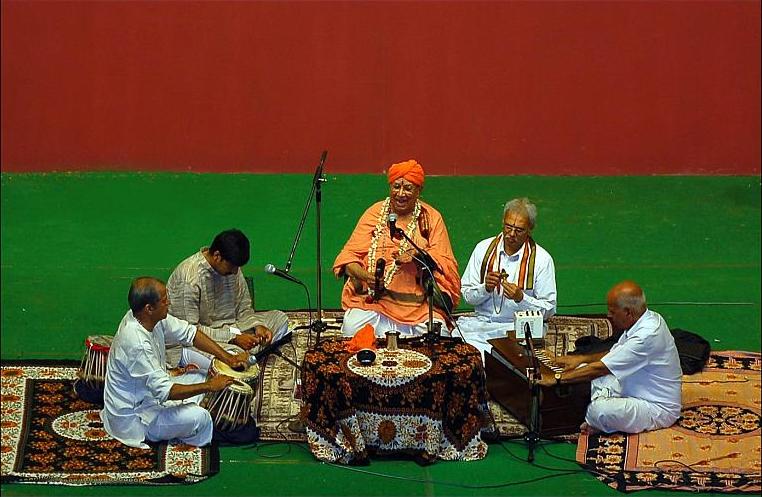
Bhadragiri Achyuta Das performing Harikatha in Kannada.

Harikatha (Kannada: ಹರಿಕಥೆ : Harikathe; Telugu: హరికథ : Harikatha; Marathi: हरीपाठ : Haripatha, lit.'story of Hari'), also known as Harikatha Kaalakshepam in Telugu, Tamil and Malayalam(lit.'spending time to listen to Hari's story'), is a form of Hindu traditional discourse in which the storyteller explores a traditional theme, usually the life of a saint or a story from an Indian epic. The person telling the story through songs, music and narration is called a Haridasa.

Harikatha is a composite art form composed of storytelling, poetry, music, drama, dance, and philosophy most prevalent in Andhra Pradesh, Telangana, Maharashtra, Karnataka, Kerala and ancient Tamil Nadu. Any Hindu religious theme may be the subject for the Harikatha. At its peak Harikatha was a popular medium of entertainment, which helped transmit cultural, educational and religious values to the masses. The main aim of Harikatha is to imbue truth and righteousness in the minds of people and sow the seeds of devotion in them. Another of the aims is to educate them about knowledge of Ātman (the self) through stories and show them the path of liberation.

Hindu mythology

[edit]

In Hindu mythology, the first Harikatha singer was sage Narada who sang for Vishnu, other prominent singers were Lava and Kusha twin sons of Rama, who sang the Ramayana in his court at Ayodhya.[1]

History

[edit]

This is an ancient form that took current form during the Bhakti movement in around 12th century. Many famous Haridasa are Purandaradasa, Kanakadasa.

The Telugu form of Harikatha originated in Coastal Andhra during the 19th century.[2] Harikatha Kalakshepam is most prevalent in Andhra even now along with Burra katha. Haridasus going round villages singing devotional songs is an age-old tradition during Dhanurmaasam preceding Sankranti festival. Ajjada Adibhatla Narayana Dasu was the originator of the Telugu Harikatha tradition, and with his Kavyas and Prabandhas has made it a special art form.[citation needed]

Style

[edit]

Harikatha involves the narration of a story, intermingled with various songs relating to the story. Usually, the narration involves numerous sub-plots and anecdotes, which are used to emphasize various aspects of the main story. The main storyteller is usually assisted by one or more co-signers, who elaborate the songs and a Mridangam accompanist. The storyteller uses a pair of cymbals to keep the beat.

Famous exponents

[edit]

Following Krishna Bhagavatar, other great exponents of this art form such as Pandit Lakshmanachar, Tirupazhanam Panchapakesa Bhagavatar, Mangudi Chidambara Bhagavatar, Muthiah Bhagavatar, Tiruvaiyyar Annasami Bhagavatar, Embar Srirangachariyar, Konnoor Sitarama Shastry, Sulamangalam Vaidyanatha Bhagavatar, Sulamangalam Soundararaja Bhagavatar, Ajjada Adibhatla Narayana Dasu, Embar Vijayaraghavachariar, Saraswati Bai and Padmasini Bai popularized the Harikatha tradition.[citation needed]

Saraswati Bai was a pioneering woman Harikatha exponent. She broke the monopoly of Brahmin men over this art form. This was attested by F. G. Natesa Iyer (in 1939) who said: "Saraswati Bai is a pioneer, and today, as a result of her sacrifices. Brahmins and non-Brahmins walk freely over the once forbidden ground. C. Saraswati Bai has achieved this miracle."[3]

Recent practitioners of Harikatha include Veeragandham Venkata Subbarao, Kota Sachchidananda Sastri, Mannargudi Sambasiva Bhagavatar, Banni Bai, Mysore Sreekantha Shastry, Kamala Murthy, Muppavarapu Simhachala Sastry, Embar Vijayaraghavachariar, Kalyanapuram Aravamudachariar, Vishaka hari, Gururajulu Naidu and T S Balakrishna Sastry.[citation needed]

Paruthiyur Krishna Sastri started out as a Harikatha exponent and then changed to Pravachan style.[citation needed] One of the best harikatha renderings is on the life of saint Tyagaraja by Mullukutla Sadasiva Sastry from Tenali.[citation needed]

See also

[edit]

Notes

[edit]

References

[edit]
[edit]
Revisions and contributorsEdit on WikipediaRead on Wikipedia
from Grokipedia
Harikatha is a devotional performing art form originating in , characterized by the narration of religious stories—primarily tales from Hindu scriptures involving deities like ()—interwoven with poetry recitation, , dramatic exposition, and occasional mime or dance to convey moral and philosophical teachings. Emerging in the 18th and 19th centuries, particularly within the Maratha kingdom of , Harikatha evolved from earlier traditions such as Telugu dramatic or Bhajana devotional , adapting to urban and rural audiences in regions like , , and . Scholars trace its formalized structure to exponents who blended scriptural exposition with musical interludes, often drawing on Puranic narratives to foster devotion among listeners. Central to Harikatha is the performer's ability to alternate between prose narration (katha), poetic verses, and sung compositions in ragas, typically accompanied by instruments like the or , emphasizing ethical lessons over mere . Notable exponents include Adibhatla Narayana Das (1864–1945), renowned for innovating the form's narrative depth, and Harikesanallur , who integrated scholarly sastra knowledge with musical proficiency to elevate performances. This art has sustained cultural transmission of , adapting minimally to modern stages while preserving its core as a medium for spiritual edification.

Definition and Origins

Etymology and Core Concept

The term Harikatha originates from , combining Hari, a name for the denoting "the remover of sins," with katha, meaning "story" or "narrative ." This etymology underscores its focus on recounting divine exploits and virtues associated with , Krishna, or allied figures from Vaishnava traditions, often extending to saints' lives or epic episodes. An alternative designation, kathā kālakṣepa, translates to "story-time diversion" or the devotional act of immersing in sacred tales, emphasizing its role as a structured, leisurely exposition rather than mere . At its core, Harikatha constitutes a multimodal performative tradition rooted in Hindu devotional practices, wherein a solo narrator—typically a learned exponent—interweaves linear storytelling from , itihasas (epics like the and ), or hagiographies with interpolated songs (kritis or padas in regional languages), rhythmic poetry, and impromptu philosophical commentary. This synthesis serves to not only preserve scriptural narratives but also extract causal moral lessons on (righteous conduct), (devotion), and human frailty, fostering audience introspection through vivid mimicry, tonal modulation, and call-and-response elements. Unlike purely musical forms such as Carnatic concerts, Harikatha's narrative primacy distinguishes it as a didactic vehicle, historically performed in temple precincts or courts to cultivate ethical realism amid listeners' lived contexts. Its emphasis on unadorned scriptural fidelity, drawn from primary texts like the , prioritizes empirical devotion over interpretive liberties, though exponents occasionally adapt for contemporary relevance while anchoring in canonical sources.

Roots in Ancient Storytelling Traditions

Harikatha's narrative foundation traces to the ancient Indian practice of purana pravachana, a solemn tradition of expounding Puranic texts through recitation and commentary, performed by pauranikas to convey mythological stories, moral lessons, and devotional themes to audiences. The Puranas, composed between approximately the 3rd and 10th centuries CE, were designed for oral delivery in temple and public settings, integrating prose narration with interpretive discourse to make complex cosmology and epic lore accessible. This form emphasized sequential storytelling from sacred texts, foreshadowing Harikatha's structured progression through divine tales. Deeper antecedents appear in Vedic akhyana, narrative recitations by sutas (heralds and bards) during ritual assemblies, as described in Brahmanical literature like the (circa 1000–800 BCE), where stories illustrated and cosmic order. These performances, often interspersed with chants, paralleled later katha elements by blending exposition with rhythmic delivery to engage listeners spiritually. In South Indian contexts, early Tamil traditions referenced in the Tolkappiyam (circa BCE–1st century CE) include tonmai narratives of divine exploits, linking regional to broader Sanskritic epics like the and , which frame themselves as oral histories recited by sages such as Ugrashrava Sauti. The harikirtan strand, crediting sage as originator per the , further roots the devotional storytelling in antiquity, evolving from bhakti-infused recitals of Vishnu's exploits to foster audience immersion through repetitive invocation. Unlike purely exegetical modes, these ancient practices incorporated mnemonic verse and gestural emphasis, laying groundwork for Harikatha's fusion of and artistry without the later musical elaboration. Scholars note systemic continuity from such rituals to medieval pravachana, though Harikatha's distinct synthesis emerged centuries later amid regional influences.

Historical Development

Pre-Colonial Precursors

The precursors to Harikatha lie in ancient and medieval Indian traditions of religious narration, where served as a vehicle for disseminating Puranic lore, epic tales, and through oral performance. These early forms emphasized exposition (pravachana) of Hindu scriptures, often in temple settings, combining prose narration with devotional elements to engage audiences in spiritual reflection. Purana-pravachana, a scholarly lecture style on texts like the , dates back to at least the medieval period and involved detailed of mythological narratives, foreshadowing Harikatha's blend of story and ethical discourse. In , the tradition, systematized by saint-poet Samartha Ramdas around 1608 CE, integrated rhythmic chanting, music, and illustrative anecdotes drawn from the lives of deities and saints, providing a proto-structure for performative that emphasized (devotion). This form influenced southern practices following Maratha expansions into regions like by the late 17th century, where keertan performances adapted local idioms without colonial mediation. South Indian variants included in Telugu and Kannada contexts, emerging during the (14th–16th centuries), which fused dance, music, and episodic narration of epic themes in vernacular languages, serving as a dramatic precursor to Harikatha's format. Folk narratives and bhajana traditions, involving communal singing of divine stories, further contributed rhythmic and improvisational techniques, as evidenced in pre-Maratha temple recitations across Tamil and Andhra regions. These indigenous practices prioritized empirical transmission of cultural knowledge over textual rigidity, laying groundwork for Harikatha's evolution amid regional patronage.

Emergence in 18th-19th Century South India

Harikatha emerged as a distinct performative art form in South India during the 18th and 19th centuries, primarily in the Thanjavur region under Maratha rule, which had been established since 1676 and fostered a synthesis of Marathi devotional kirtan traditions with local Carnatic music, Tamil poetry, and epic narratives. This period saw the evolution of storytelling from temple-based bhajana and kalakshepa practices into structured Harikatha performances, characterized by rhythmic prose, musical interludes, and philosophical exposition, often drawing from the Bhagavata Purana and Ramayana. The Maratha patronage in Thanjavur, blending Maharashtrian influences like those from saint Samarth Ramdas (1608–1681), who formalized kirtan as a musical discourse on divine stories, with South Indian elements such as Carnatic ragas and talas, provided the cultural milieu for this development. In , early Harikatha incorporated nirupana—expansive thematic elaborations on scriptural themes—performed by exponents who integrated Vedantic teachings with dramatic delivery to engage audiences in temples and courts. Pioneers such as Tanjavur Krishna Bhagavatar (1847–1903), often credited as the father of the Thanjavur style, refined the form around the mid-19th century by introducing Marathi metrical structures into Tamil performances, enhancing its rhythmic and poetic depth while propagating it widely. Other notable early figures included Lakshmanachar, Tiruppayanam Panchapakesa Satrigal, and Sulamangalam Vaidyanatha Bhagavatar, who contributed to its localization through compositions and delivery techniques suited to Tamil-speaking audiences. By the late 19th century, Harikatha began spreading beyond to regions like , where Telugu variants emerged, influenced by performances such as Kuppuswami Naidu's 1883 rendition of Dhruva Charitram in , which inspired local artists to adapt the form using Telugu poetry and regional musical idioms. This expansion reflected the art's adaptability, transitioning from courtly and temple settings to broader discourse, while maintaining its core emphasis on moral and devotional instruction through integrated music and narrative. The period's socio-cultural environment, marked by devotional fervor and artistic patronage under Maratha and later princely states, solidified Harikatha's role as a vehicle for preserving Hindu scriptural lore amid evolving performative traditions.

20th Century Evolution and Regional Spread

In the early , Harikatha transitioned from primarily rural and temple-based performances to structured urban presentations in music sabhas, particularly in Madras (now ), where it integrated more deeply with festivals and professional ensembles comprising violin, , and cymbals for rhythmic support. This shift, beginning around 1910, emphasized narrative precision and musical elaboration, with exponents refining techniques like darus (descriptive songs) and padams (poetic compositions) to engage educated audiences amid growing cultural institutions. The inclusion of female performers represented a key evolution; C. Bai (1874–1974), trained from age six, performed Harikatha by the 1910s, blending it with her Karnatak music expertise, though earlier precedents like Ilayanarvelur Saradambal's 1915 rendition challenge claims of her as the absolute pioneer. Prominent male exponents further advanced the form's sophistication. In , figures such as Muthiah Bhagavathar, Chidambara Bhagavathar, and Embar Srirangachariar (active into the 1930s–1940s) elevated delivery through vivid mime, philosophical discourse, and epic , often drawing from Puranic themes while adapting to sabha demands for brevity and appeal. These artists, performing in venues like the , numbered over a dozen active professionals by mid-century, sustaining the tradition amid competition from cinema and radio broadcasts that occasionally featured Harikatha segments starting in the . Regionally, Harikatha solidified its presence across but showed limited expansion northward. In , Ajjada Adibhatla Narayana Das (1864–1945) formalized Telugu Harikatha around 1900, composing over 50 works on Puranic tales and introducing structured formats that popularized it in villages and towns by the 1920s, influencing successors like Balijepalli Lakshmikanta Kavi. Karnataka's version retained influences from the 14th century, with 20th-century performers adapting Sahitya for local bhajans, while Kerala's renditions incorporated poetry but remained niche. In , the lineage dominated, with over 20 documented exponents by 1950 fostering regional variants tied to temple circuits. Beyond these states, diffusion was marginal; isolated North Indian adaptations via Katha-Keerthan emerged post-1940s, but Harikatha retained its Dravidian core without widespread national adoption.

Performance Elements

Narrative and Structural Format

Harikatha performances adhere to a structured format that blends devotional exposition with extempore flexibility, typically unfolding over two to three hours in a solo-led presentation supported by minimal accompanists. The performer initiates with a or invocatory segment, reciting slokas or rendering an auspicious song to invoke divine blessings and introduce the central theme drawn from epics, , or saintly lives. This opening establishes a reverential atmosphere, aligning the audience's focus on and moral edification. The main body centers on katha narration in prose, progressing through key episodes of the primary story while incorporating upakathas—subordinate tales and anecdotes—to elucidate character motivations, ethical dilemmas, or theological concepts. These digressions, often laced with humor or histrionics, enable non-linear that emphasizes causal relationships in divine narratives, such as karma's consequences or devotion's transformative power, without rigid chronology. The performer employs expressive gestures, voice modulation, and occasional to embody multiple roles, fostering audience immersion. Interludes punctuate the prose with musical and poetic elements, including renditions of Carnatic kritis by composers like , sloka recitations, or thematic verses in regional languages, which amplify emotional peaks or philosophical insights before resuming exposition. Accompaniment via , mridangam, cymbals, or harmonium underscores rhythm, while upanyasa discourses follow select songs to unpack Vedantic or ethical interpretations, ensuring the narrative serves didactic purposes. The format concludes with story resolution, synthesizing themes into a devotional climax—often affirming unity with the divine, as in "Sarvam Kesavam Pratigacchati"—reinforced by a final or , leaving audiences with reinforced imperatives. This cyclical structure, rooted in ancient kathakalakshepa traditions, prioritizes auditory engagement (sravanam) over visual spectacle, adapting dynamically to performer expertise and audience response.

Integration of Music, Poetry, and Drama

Harikatha performances fuse , , and into a seamless solo exposition, where the exponent narrates religious narratives while interspersing melodic songs, verse recitations, and mimetic enactments to evoke devotion and moral insight. This composite structure, often termed "one-person theatre," allows the performer to stand and deliver the entire act, blending verbal with expressive histrionics supported by minimal accompaniment from a co-singer and instrumentalists. Music forms the rhythmic backbone, incorporating Carnatic elements such as the 22 srutis, 72 mela kartas, and dasa gamakas in songs rendered in languages like Telugu, , Tamil, and Marathi. The exponent sings kirtans, kritis by composers like , and other devotional pieces, accompanied by for melody, for percussion, and cymbals (jalra or chipla) for rhythmic punctuation, which the performer often handles personally to maintain tempo during dramatic peaks. These musical interludes heighten emotional intensity, transitioning fluidly from narration to lyrical devotion without disrupting the narrative flow. Poetry integrates through recited slokas, divyaprabandha verses, and original compositions like Adibhatla Narayana Dasu's Rukmini Kalyanam, which provide philosophical depth and convey navarasa (nine emotions) alongside navavidha bhakti (nine forms of devotion). These poetic segments, drawn from epics such as the , , and Bhagavatam, serve as exegetical bridges, explicating moral lessons or subplots before yielding to musical or dramatic elaboration. Dramatic elements manifest in , facial expressions, and gestural enactment of characters and scenes, enabling the exponent to portray dialogues, conflicts, and anecdotes with vivid histrionics sans costumes or sets. This theatrical layer, adaptable to audience responses via proverbs, , or improvised one-liners, amplifies the storytelling's immediacy, often culminating in parables that reinforce the poetic and musical themes. The of these components demands multidisciplinary mastery, as the performer shifts instantaneously between , , , and action to sustain engagement over sessions lasting 1.5 hours to overnight.

Techniques of Delivery and Audience Engagement

Harikatha performers employ a solo delivery style characterized by standing posture throughout the performance, enabling dynamic movement and emphasis through gestures and mime to dramatize narratives from epics and . The exponent narrates in regional languages such as Tamil or Telugu, interspersing exposition with sub-stories (upakathas), philosophical digressions, and histrionics that convey the navarasa (nine emotions) via a sonorous, pitch-perfect voice modulated for emotional depth. includes a co-singer for elaboration, for melodic support, for rhythmic foundation, and cymbals (jalra or chipla) to mark beats and transitions, with songs drawn from multilingual compositions in ragas selected to evoke specific (moods). Audience engagement relies on evoking navavidha bhakti (nine forms of devotion) through vivid anecdotes and pauses that prompt reflection or interaction, such as performers halting mid-narrative to heighten anticipation, as exemplified in historical accounts of exponents like Bannibai. Listeners participate actively via jaijaikara—spontaneous cheers or choral responses—particularly during bhajana-style segments, fostering communal immersion and reinforcing themes of and self-knowledge. This interactive rhythm, combined with the performer's scholarly interpretation of texts, sustains attention over extended durations, often two to three hours, by blending , entertainment, and spiritual upliftment without scripted rigidity, allowing improvisation attuned to the crowd's responses.

Repertoire and Themes

Stories from Hindu Epics and Puranas

Harikatha narratives primarily draw from the Ramayana and Mahabharata, the two great Sanskrit epics attributed to Valmiki and Vyasa respectively, which recount the lives and exploits of divine figures like Rama and the Pandavas to exemplify dharma and bhakti. Performers often select episodes emphasizing devotion, such as Rama's adherence to righteousness during his forest exile in the Ramayana, where he upholds paternal obedience and protects the weak despite personal sacrifice. Similarly, from the Mahabharata, tales like the Saindhava Vadhe episode—detailing Abhimanyu's heroic entry into the Chakravyuha formation and his tragic death at the hands of multiple warriors—highlight themes of valor, treachery, and karmic consequences in the Kurukshetra war. The Bhagavata Purana, a key Vaishnava text compiling Krishna's lilas (divine plays), forms another cornerstone of Harikatha repertoire, with performers narrating Krishna's childhood exploits in Vrindavan, such as the slaying of Putana demon or the Govardhana hill lifting, to evoke audience surrender to Vishnu's incarnations. These Puranic stories, derived from Vyasa's compilation around the 9th-10th century CE, integrate subplots and anecdotes, like Krishna's rasa lila dances with gopis, to underscore ecstatic devotion over ritualism. Other Puranas, including references to Padma Purana motifs, appear in renditions focusing on cosmic creation or avatar descents, always interwoven with Carnatic kritis to amplify emotional resonance. Performers adapt these ancient texts regionally, such as in Telugu Harikathas retelling Ramayana Kathamrutham series, which span Rama's birth to his coronation, preserving oral traditions while embedding moral imperatives like truthfulness from Sita's swayamvara in Seethakalyanam. This selective emphasis on epic heroism and Puranic , rather than exhaustive retellings, aligns with Harikatha's devotional aim, fostering through vivid character portrayals and philosophical digressions on karma and surrender.

Philosophical Teachings and Moral Lessons

Harikatha exponents embed philosophical expositions within epic narratives to convey bhakti as the quintessential path to self-realization and union with the divine, often referencing Vedantic ideas of the soul's inherent divinity and the illusory nature of material existence. These discourses, drawn from texts like the Bhagavata Purana, stress devotion (bhakti) over mere intellectual inquiry or mechanical rituals, positing surrender to Vishnu or his avatars as the means to transcend ego and attain liberation (moksha). Performers illustrate how nadopasana—worship through music—purifies the mind, aligning actions with cosmic order (dharma) to mitigate karmic bondage. Moral imperatives emerge from dramatized episodes, emphasizing ethical conduct rooted in (dharma), accountability for actions (karma), and the futility of . Ramayana-based Harikathas highlight Rama's unyielding commitment to truth and , portraying his and victory over as exemplars of loyalty, self-control, and the inevitable downfall of driven by and . Krishna narratives, conversely, teach , , and detachment, as in leelas where divine play reveals the supremacy of selfless love over worldly gains, urging audiences to cultivate and reject egoistic pursuits. To deepen engagement, performers invoke the ninefold bhakti practices—listening (shravana), chanting (keertana), remembrance (smarana), and others—transforming stories into lived that link moral virtue to spiritual awakening. Episodes like Bheeshma's battlefield devotion to Krishna underscore that even warriors of unparalleled prowess achieve grace through humility, not prowess, reinforcing that dharma-aligned karma yields divine favor and eventual .

Notable Exponents

Early Pioneers

Tanjavur Krishna Bhagavatar (1851–1903), trained under influences from northern traditions, emerged as a foundational figure in Tamil Harikatha during the late in the region, where the form evolved under Maratha patronage. He systematically incorporated songs in Telugu, , Marathi, and Tamil into his performances, blending discourse with musical elements to popularize the art in . Preceding him, kirtankar Meru Swami contributed to the early development of Harikatha in , inspiring compositions such as Swati Tirunal's Harikatha Nirupana on Kuchelopakhyanam, which drew directly from renditions and helped formalize the structure of integrated with devotion and . In the Telugu tradition, Ajjada Adibhatla Narayana Dasu (1864–1945), revered as Harikatha Pithamaha, pioneered the Coastal Andhra variant in the late 19th century by composing original kavyas and prabandhas tailored for Harikatha, elevating it through his multilingual scholarship in , Telugu, and other languages while performing across regions to establish its narrative-musical format.

Mid-20th Century Masters

C. Banni Bai (1912–1999), born Alamelu Manga Thayar in Madras to a family of traditional musicians, emerged as one of the foremost female exponents of Harikatha in the mid-20th century, performing extensively from the 1930s onward and popularizing the form among diverse audiences through her narrative depth and musical integration. She trained under earlier pioneers like C. Saraswathi Bai and emphasized philosophical interpretations of epics such as the , often drawing on Carnatic compositions to enhance devotional themes, which sustained Harikatha's appeal in urban centers like during the post-independence era. Her performances, marked by precise and audience engagement, contributed to the form's endurance amid competition from cinema and radio, earning her recognition as synonymous with Harikatha by the 1950s. T. S. Balakrishna Sastrigal (1919–2003), born on August 19, 1919, in Tiruvidaimarudur to scholarly parents, became a leading Harikatha master known for his scholarly rigor and innovative style that blended sangeeta upanyasam with vivid storytelling, captivating listeners in the 1940s through 1970s across . Trained in Vedic traditions and , he specialized in elaborate expositions of texts like the and Devi Bhagavatam, incorporating rare kritis and improvisational elements that highlighted moral and devotional causality, as evidenced in recordings from venues like Asthika Samajam. His approach, distinct for its intellectual depth over mere entertainment, helped preserve Harikatha's philosophical core during a period of cultural transition, influencing subsequent performers through disciples and documented discourses. Mannargudi Sambasiva Bhagavatar (1912–2004), a Carnatic vocalist and composer alongside his Harikatha expertise, performed prolifically from the 1930s to the 1980s, serving the art form for over seven decades and exemplifying its musical evolution in mid-20th-century . Under the guidance of Maharajapuram Viswanathan, he refined Harikatha by weaving intricate ragam-tanam-pallavi segments into narratives on Tyagaraja's life and works, enhancing the form's aesthetic appeal and scholarly value during festivals and sabhas. His contributions, including compositions that bridged and discourse, underscored Harikatha's role in cultural continuity, as noted in archival performances that drew large crowds in the and .

Contemporary and Revival Performers

In recent decades, Harikatha has seen revival efforts through dedicated exponents who adapt the form to contemporary audiences via digital platforms, educational institutions, and innovative themes, countering its earlier decline. Performers emphasize accessibility, including English-language renditions and online dissemination, with initiatives like channels garnering significant followings to preserve philosophical and devotional content. Vishakha Hari, a prominent Carnatic vocalist and Harikatha practitioner, has advanced the tradition by founding the Vijayashree School of Harikatha in February 2020, offering classes to students of all ages, including children as young as 7-8 from global locations, grouped by maturity levels rather than strict age cohorts. Trained under her spiritual guru and father-in-law Sri Sri Krishna Premi Swamigal and husband Sri R. Hari, she integrates with to promote cultural values and mental well-being. Sharat R. Prabhat, a multifaceted artist from the Haridasa lineage and great-grandson of early 20th-century exponent , performs fused with dance and Carnatic vocals, directing productions like dance musicals and training students at Prabhat Kala Tapovana in Bengaluru. His adaptations include modern topics such as rituals, delivered both in-person and online, with plans to launch youth-focused classes amid growing demand. Younger revivalists include Srilalitha Uliyaru, a 24-year-old IT professional and MBA graduate from , who completed her 501st live Harikatha performance on June 3, 2024, having begun at age 3 in 2007 and becoming one of Karnataka's few female exponents. Her repertoire spans mythological narratives like Shri Krishna Leele and contemporary subjects such as Bhagat Singh's sacrifice, performed across sites including and , with durations from 3 minutes to 3 hours. Dushyanth Sridhar, based in Bengaluru, has popularized English and Tamil Harikatha discourses on , amassing over 116,000 subscribers after transitioning from a corporate career, and advocates for its integration into school curricula under India's National Education Policy. Similarly, Vignesh Chandrasekaran, a Carnatic trained from age 4, delivers Harikatha performances on themes like and Krishna, as seen in events and recordings from 2021 to 2023.

Cultural and Social Impact

Role in Religious Devotion and Cultural Preservation

Harikatha serves as a vital medium for cultivating , or devotional sentiment, within by narrating divine stories that emphasize ethical conduct, spiritual realization, and surrender to deities such as and Krishna. Performers interweave scriptural tales with musical renditions and philosophical discourse, fostering practices like shravanam (listening to sacred narratives) and smaranam (remembrance of the divine), which are core to Vaishnava devotion. This tradition, rooted in the bhakti movement's emphasis on accessible spiritual paths, enables audiences to internalize moral righteousness and deepen emotional bonds with the divine, often leading to transformative experiences of awakening. Beyond devotion, Harikatha preserves South Indian cultural heritage by sustaining oral transmission of ancient Hindu narratives, poetic forms, and musical elements from epics like the and . Originating in regions like under influences such as Swami Ramdas's teachings in the , it adapts lore into vernacular languages, ensuring continuity of regional idioms, rhythms, and performative techniques amid linguistic shifts and colonial disruptions. By embedding philosophy within , it counters cultural erosion, with modern revivals highlighting its role in maintaining intangible traditions like integration.

Influence on South Indian Arts and Society

Harikatha profoundly shaped South Indian performing arts by integrating elements of , , and dramatic narration, creating a hybrid form that emphasized devotional themes from Hindu epics and . Performances typically feature elaborate renditions of kritis by composers such as and , accompanied by and co-singers, thereby serving as a platform for propagating classical compositions and enriching the tradition with multilingual verses in , Tamil, Telugu, and others. This synthesis, particularly in the Tanjore style from the 1850s, influenced regional variants like Andhra's Burrakatha and Karnataka's Kathakalakshepa, fostering interconnected storytelling traditions across , , , and . In , Harikatha functioned as a vital medium for cultural preservation and moral education, transmitting , philosophical insights, and ethical lessons to diverse audiences in temples, weddings, and village gatherings until the mid-20th century. By narrating stories interspersed with philosophical discourses, it instilled principles of truth, , devotion, and self-knowledge, contributing to the movement's dissemination and reinforcing community cohesion through shared devotional experiences. Exponents adapted the form for social awareness campaigns on issues like health, sanitation, and , as seen in where performances addressed prevention and literacy, with surveys indicating high reception rates among rural populations. This enduring role underscores Harikatha's contribution to grassroots education and cultural continuity in .

Decline, Challenges, and Revivals

Factors Leading to Decline

The decline of Harikatha as a performative art form in accelerated in the mid-20th century, primarily due to diminishing institutional from cultural sabhas and religious organizations, which historically provided platforms and financial support for performances. By the and 1980s, urban sabhas increasingly prioritized more commercially viable concert formats like recitals over narrative-heavy Harikatha, leading to fewer opportunities for exponents and a contraction in audience reach. Competition from , particularly cinema and television, further eroded Harikatha's appeal among younger demographics starting in the post-independence era. offered visually dynamic retellings of epic stories with broader , drawing audiences away from the traditional, devotion-oriented format of Harikatha, which required sustained attention to musical interludes and philosophical discourses. This shift was compounded by and modernization, as rural temple-based performances waned with migration to cities, where fast-paced entertainment supplanted lengthy oral traditions. Internal challenges within the practitioner community also contributed, including a perceived overemphasis on remuneration (dakshina) rather than devotional propagation, which alienated traditional patrons. Additionally, the form's rigid adherence to classical repertoires without sufficient in themes or failed to adapt to evolving audience preferences, fostering an among emerging artists by the late 20th century. These factors collectively reduced the number of active performers, with many lineages facing by the 2010s due to lack of and .

Modern Adaptations and Efforts at Renewal

In recent years, Harikatha has seen renewal through dedicated training institutions, such as the Vijayashree School of Harikatha established by performer in February 2020, which offers classes without age restrictions and groups students by maturity level to accommodate diverse learners, including children as young as seven from global locations. This initiative emphasizes transmission to younger generations amid declining traditional patronage. Similarly, the National Education Policy's incorporation of Harikatha into curricula has supported formal educational integration, fostering structured learning and preservation. Digital platforms have accelerated revival by expanding reach; for instance, performer , transitioning from a corporate career, has amassed over 116,000 subscribers by delivering discourses in English and Tamil, enabling features like subtitles, multiple takes, and global accessibility that traditional live formats lack. and online streaming have drawn younger and international audiences, countering the art form's historical localization in South Indian temples and courts. Adaptations include content modifications for contemporary relevance, such as incorporating humor referencing events like India's 2016 demonetisation or discussions on modern social practices like rituals, while retaining core devotional narratives from epics. In development communication, Harikatha has been repurposed for public awareness on , schemes, environmental conservation, and social issues, leveraging its power to engage rural and semi-urban populations effectively. Performance innovations feature unconventional styles, exemplified by V. Malini's seated Harikatha rendition of Chamundeshwari's story during the 2019 Katha Kuthuhala festival (March 27–29, Bangalore), which highlighted women exponents and deviated from standing traditions to emphasize vocal and musical elements. Organized events underscore renewal efforts; the 2016 Harikatha Saptaham in , , hosted by Mitra Samskritika Samiti with ' support, featured seven days of performances by artists including M.V. Simhachala Shastri and M. Nagamani, narrating tales like Rukmini Kalyanam and attracting youth to instill Indian values against Western cultural influences. Such initiatives, alongside festivals promoting female practitioners, aim to diversify and sustain the form by addressing gender imbalances in historical exponents and adapting to modern audience preferences.

References

Add your contribution
Related Hubs
User Avatar
No comments yet.