



Community hub
Recent from talks
Contribute something
Nothing was collected or created yet.
Hello, Goodbye
View on Wikipedia
| "Hello, Goodbye" | ||||
|---|---|---|---|---|
 US picture sleeve | ||||
| Single by the Beatles | ||||
| B-side | "I Am the Walrus" | |||
| Released | 24 November 1967 | |||
| Recorded | 2 October – 2 November 1967 | |||
| Studio | EMI, London | |||
| Genre | Pop,[1] psychedelia[2] | |||
| Length | 3:27 | |||
| Label |
| |||
| Songwriter | Lennon–McCartney | |||
| Producer | George Martin | |||
| The Beatles singles chronology | ||||
| ||||
| Promotional film | ||||
| "Hello, Goodbye" on YouTube | ||||
"Hello, Goodbye" (sometimes titled "Hello Goodbye") is a song by the English rock band the Beatles, written by Paul McCartney and credited to Lennon–McCartney. Backed by John Lennon's "I Am the Walrus", it was issued as a non-album single in November 1967, the group's first release since the death of their manager, Brian Epstein. The single was commercially successful around the world, topping charts in the United States, the United Kingdom, France, West Germany, Canada, Australia and several other countries. In the UK, it was the Christmas number one of 1967.
McCartney later said that the lyrics take duality as their theme. The song originated when, in response to a question from Beatles aide Alistair Taylor about songwriting, McCartney sat down at a harmonium and asked Taylor to say the opposite of whatever he said. The completed song includes a musical coda, which was improvised by the Beatles when they were recording the track in October 1967. Unimpressed with the composition, Lennon pushed for "I Am the Walrus" to be the single's A-side, before reluctantly accepting that "Hello, Goodbye" was the more commercial-sounding of the two sides. The Beatles produced three promotional films for the song, one of which was shown on The Ed Sullivan Show in America. Due to the regulations against lip-syncing on British television, none of the clips were aired there.
"Hello, Goodbye" has traditionally received a varied response from music critics. While some reviewers praise the song for its classic pop qualities, others deem it unadventurous by the Beatles' standards, and inconsequential. The track was included on the expanded US release of the Magical Mystery Tour soundtrack EP, and later appeared on compilation albums such as 1967–1970 and 1. McCartney has often performed "Hello, Goodbye" in concert, beginning with his Driving World Tour in 2002. James Last, Bud Shank, Allen Toussaint, the Cure and the cast of Glee are among the acts who have also recorded the song.
Background
[edit]The answer to everything is simple. It's a song about everything and nothing ... If you have black you have to have white. That's the amazing thing about life.[3]
Although "Hello, Goodbye" is credited to Lennon–McCartney, the song was written solely by Paul McCartney.[4] The composition came about through an exercise in word association between McCartney and Alistair Taylor,[5] an assistant of the Beatles' manager, Brian Epstein.[6] It originated during a period when, following the completion of their album Sgt. Pepper's Lonely Hearts Club Band in April 1967, the Beatles typically embraced randomness and simplicity as part of the creative process.[7]
According to Taylor's recollection, he was visiting McCartney at his home in St John's Wood, London, and asked the Beatle how he went about writing a song. In response, McCartney took Taylor into the dining room, where they both sat at a harmonium; McCartney then began playing the instrument and asked Taylor to call out the opposite to each word he happened to sing.[8] Author Steve Turner writes of the result: "And so it went – black and white, yes and no, stop and go, hello and goodbye."[8] Taylor later reflected: "I've no memory at all of the tune ... I wonder whether Paul really made up [the melody to] that song as he went along or whether it was running through his head already."[8]
Talking in the 1990s to his official biographer, Barry Miles, McCartney said that the lyrics address duality, reflecting his astrological sign of Gemini.[9] He added: "It's such a deep theme in the universe, duality – man woman, black white, ebony ivory, high low, right wrong, up down, hello goodbye – that it was a very easy song to write." McCartney also said that, in "Hello, Goodbye", he was promoting "the more positive side of the duality".[10]
Among Beatles biographers, Ian MacDonald dates the composition to late September 1967,[11] while Bob Spitz says it was written in time for the Our World international television broadcast, in June that year.[12] According to Spitz, McCartney suggested "Hello, Goodbye" as the Beatles' contribution to Our World,[12] an honour that instead went to the John Lennon-composed "All You Need Is Love".[13][nb 1]
Composition
[edit]"Hello, Goodbye" is in the key of C major and in 4
4 time.[14] MacDonald describes the musical structure as "characteristically scalar" and founded on "a descending sequence in C", with "a brief touchdown on A flat as its only surprise".[15] Musicologist Walter Everett writes that the bassline in the chorus is an inverted form of the descending scale, which is accentuated on the Beatles' recording by the lead guitar part.[16]
In Everett's estimation, much of "Hello, Goodbye" references previous Lennon–McCartney compositions: over the verses, the parallel thirds in the vocal recall the band's unreleased song "Love of the Loved", among others; melodically, the chorus is similar to the keyboard part on "For No One"; and the complementary vocal parts in the final verse recall "Help!"[17] Everett also suggests that, early in "Hello, Goodbye", McCartney appears to be imitating the V–VI chord "ambivalence" of "Strawberry Fields Forever".[16] Everett describes the composition as "derivative McCartney", for the most part, "freshened up" primarily through the use of phrase lengths that deviate from a standard eight bars.[16]
Consistent with the song title, the lyrics comprise a series of antonyms – such as yes–no, high–low and stop–go.[18] With the narrative perspective alternating between first and second person, the composition also recalls George and Ira Gershwin's "Let's Call the Whole Thing Off".[14][4]
Following the third chorus, at 2:36 on the released recording, the bassline descends chromatically to mark the start of what musicologist Alan Pollack terms the "first outro"[14] and Everett calls a "codetta".[16] After this false ending, the song returns with a 45-second coda,[14] which MacDonald identifies as a "Maori finale – a mistake for 'Hawaiian' (aloha)".[19] The coda consists of a repeated musical phrase over a pedal point in C major,[14] accompanied by the vocal refrain "Helaheba-hello-a".[20]
Recording
[edit]The Beatles began recording "Hello, Goodbye" at EMI Studios (now Abbey Road Studios) in October 1967,[21] towards the end of filming for their Magical Mystery Tour television special.[15] The latter was a film project that McCartney had initiated[22] in an effort to focus the group in the wake of Epstein's death that August.[23][24] Under the working title "Hello Hello", the Beatles taped the basic track for the song on 2 October,[25] with George Martin producing the session and Geoff Emerick and Ken Scott as engineers.[20] Author Richie Unterberger comments that the production and recording was unusually straightforward, relative to the experimentalism that had characterised much of the Beatles' studio work since completing Sgt. Pepper.[26] The line-up on the take selected for overdubs, take 14,[27] was McCartney on piano, Lennon on Hammond organ, George Harrison on maracas, and Ringo Starr on drums.[28]
The band members then added tambourine, conga drum and bongos over the coda.[16] This last section of the song came about while the group were working in the studio.[20] Lennon, who was otherwise highly critical of "Hello, Goodbye",[10] approved of the addition, saying: "The best bit was the end, which we all ad-libbed in the studio, where I played the piano. Like one of my favourite bits on 'Ticket to Ride', where we just threw something in at the end."[29] In McCartney's recollection, the coda "didn't sound quite right" until Emerick increased the reverberation on the tom-tom drums, at which point, "it just came alive."[30][nb 2] Everett cites the "Maori finale" as an example of the Beatles' pioneering use of codas in their recordings; in this instance, they provided "the cold ending followed by an unrelated coda", having similarly pioneered the "fade-out–fade-in coda" at the end of "Rain" and "Strawberry Fields Forever".[31]
The Beatles returned to the song on 19 October, two days after attending a memorial service for Epstein at the New London Synagogue on Abbey Road.[32][33] At this session, Harrison added his lead guitar parts (treated with Leslie effect), McCartney recorded the lead vocal,[nb 3] and Lennon, McCartney and Harrison supplied backing vocals; handclaps were also overdubbed.[16] With two reduction mixes having been carried out since 2 October, to free up space on the four-track tape for these and later overdubs, the master take was now nominally take 16.[27] This version of the song appeared on the 1996 outtakes compilation Anthology 2.[35][36] In his book The Unreleased Beatles, Unterberger writes that take 16 features a more "active" guitar line from Harrison, who answers McCartney's vocal phrasing over the opening verse with a series of descending fills.[37] Also present on this version is a short guitar solo, which would be replaced on the official release by what Unterberger terms "some inspired Paul scat-tinged singing".[37] Unterberger speculates that the removal of these guitar parts may have caused tension between McCartney and Harrison, anticipating the pair's disagreements regarding the lead guitarist's role on McCartney compositions such as "Hey Jude" and "Two of Us" over 1968–69.[38]
Two violas were added to "Hello, Goodbye" at Abbey Road on 20 October.[39][40] These string parts were played by classical musicians Kenneth Essex and Leo Brinbaum,[15] and scored by Martin, who based the arrangement on a melody McCartney supplied on piano.[41] McCartney overdubbed bass guitar on 25 October and, following a trip to Nice in France to film his "Fool on the Hill" segment for Magical Mystery Tour,[40] added further bass to the track on 2 November.[42][43] A mono mix of "Hello, Goodbye" was completed that same day, and the stereo version on 6 November.[42]
Release
[edit]That's another McCartney. Smells a mile away, doesn't it? An attempt to write a single. It wasn't a great piece.[29]
"Hello, Goodbye" was selected as the Beatles' single for the 1967 Christmas season,[5] their first release since Epstein's death.[44] Lennon pushed for his composition "I Am the Walrus" to be the A-side instead, but then ceded to McCartney and Martin's insistence that "Hello, Goodbye" was the more commercial of the two tracks.[45] Lennon remained dismissive of the song;[46] he later said: "'Hello, Goodbye' beat out 'I Am the Walrus' ... Can you believe that? I began to submerge."[47] Everett writes that, had "I Am the Walrus" been the A-side, "[it] would probably have encouraged Lennon to lead the Beatles to new heights", whereas the decision to choose "Hello, Goodbye" was "one more nail in the Beatles coffin".[48][nb 4]
In Britain, Parlophone issued "Hello, Goodbye" backed by "I Am the Walrus" on 24 November 1967,[50] with the catalogue number R 5655.[51] Within a day of its release, the record had sold over 300,000 copies there.[48] It went on to top the national chart compiled by Record Retailer (later the UK Singles Chart)[52] for seven weeks, through to 23 January 1968,[53] giving the Beatles their longest run at number 1 on that chart since "She Loves You" in 1963.[54] In the process, the song became the group's fourth Christmas number 1 single in five years.[55] For three weeks from 27 December 1967, the band held the top two positions in the UK, with the Magical Mystery Tour soundtrack EP trailing "Hello, Goodbye".[56]
The single was released on 27 November in the United States, as Capitol 2056,[51] and in the issue dated 30 December replaced the Monkees' "Daydream Believer" at number one on Billboard's Hot 100, where it remained for three weeks,[57] becoming the band's fifteenth American chart-topper.[58] The single was certified gold by the Recording Industry Association of America on 15 December 1967.[59] It was later listed by Billboard magazine as the band's seventh biggest US chart hit.[58] The single was successful in many other countries, topping charts in Australia,[60] Canada,[61] West Germany, Holland and Norway.[62] It also peaked at number 2 in Ireland,[63] Austria, Belgium and Switzerland.[62]
"Hello, Goodbye" was included on the American Magical Mystery Tour album,[64] which Capitol Records compiled by adding five non-album singles tracks from 1967 to the six songs issued in most other countries on the double EP.[55][65] In the Magical Mystery Tour film, which aired on British television on 26 December 1967,[66] the song's coda plays over the end credits.[3] "Hello, Goodbye" subsequently appeared on Beatles compilation albums such as 1967–1970 and 1.[67] As part of EMI's policy of celebrating the 20th anniversary of each Beatles single, "Hello, Goodbye" was reissued in the UK in November 1987[68] and peaked at number 63 on the UK Singles Chart.[69]
Promotional films
[edit][Directing] was something I'd always been interested in, until I actually tried it ... I didn't really direct the film[s] – all we needed was a couple of cameras, some good cameramen, a bit of sound and some dancing girls ... we took our Sgt Pepper suits along.[70]
The band made three promotional clips for "Hello, Goodbye".[71] Filmed on 10 November 1967 at the Saville Theatre in London,[72] a theatre leased by Epstein since 1966, the clips were directed by McCartney.[71][73] The first one shows the Beatles dressed in their Sgt. Pepper uniforms,[74] apart from some brief cut-aways where the group are wearing their 1963-era matching collarless suits.[75][76] In author John Winn's description of the three clips, this version shows the Beatles performing the song against a psychedelic backdrop, while over the coda they are joined on the stage by female hula dancers. Starr is seen playing a miniature drum kit and, unusually, Lennon appears without his granny glasses. In the second clip, the Beatles mime to the song dressed in more conventional attire and with the stage backdrop depicting a rural setting. The third version combines footage shot during these two scenes with the band playing the song before what Winn terms a "glittery pastel backdrop".[75][nb 5]

In the US, the first promo for "Hello, Goodbye" was premiered on The Ed Sullivan Show on 26 November.[76][77] Author Mark Hertsgaard describes the film as "a slapdash affair featuring the hula dancers that was salvaged only by some ludicrously spastic dancing by Lennon".[18] Music critic Robert Christgau was also unimpressed; speculating in the May 1968 issue of Esquire on the content of the Magical Mystery Tour film, which had yet to air in America, Christgau wrote: "But if Paul McCartney's work on the film clip of 'Hello Goodbye' is any indication, we would be wise not to hope for too much."[78] In his book Rock, Counterculture and the Avant-Garde, author Doyle Greene finds it significant that Starr's miniature bass drum lacks the familiar Beatles logo, and he interprets the band's waving to the viewer while dressed in their 1963 stage attire as the Beatles "waving 'goodbye' to the mop-top era and 'hello' to the counterculture".[79]
In Britain, the Beatles ran foul of the Musicians Union's ban on miming on television.[80] With the first clip scheduled to premier on the 23 November edition of Top of the Pops,[76] George Martin mixed a version of the track without violas, since no musician was seen to be playing those instruments;[80] the Beatles then allowed the BBC to film them at work editing Magical Mystery Tour on 21 November, in the hope that this new footage would replace any sections that contravened the ban.[75] Instead, Top of the Pops aired the song over scenes from the band's 1964 film A Hard Day's Night.[71] For the 7 December edition of the same show, the BBC ran a clip comprising still photographs mixed with some of the editing-suite film[75] – a combination that served as the promo for "Hello, Goodbye" throughout the remainder of its UK chart run.[80]
The clip included in the 1996 Beatles Anthology video release consists of the Beatles' first Saville Theatre film, until the song's coda, which incorporates footage from all three of the original promo films.[81] The first of the original promos was included in the Beatles' 2015 video compilation 1, and all three were included in the three-disc versions of the compilation, titled 1+.[82] The BBC-compiled clip appeared as a bonus feature on the 2012 DVD reissue of Magical Mystery Tour,[83] under the title "Top of the Pops 1967".[84] In May 2013, a Vox electric guitar used by Lennon during part of the filming for "Hello, Goodbye" sold for US$408,000 at an auction in New York.[85][86][nb 6]
Critical reception
[edit]Writing in December 1967, Richard Goldstein of The New York Times said that "Hello, Goodbye" "sounds like a B-side" and described it as "interesting but subordinate".[87] In his single review for Melody Maker, Nick Jones wrote: "Superficially it's a very 'ordinary' Beatles record without cascading sitars, and the involved, weaving hallucinogenic sounds that we've grown to love so much. However, all the Beatles soul and feeling is shining through ..."[88] Derek Johnson of the NME welcomed the simplicity of "Hello, Goodbye", describing it as "Supremely commercial, and the answer to those who feel The Beatles are going too way out".[89] Cash Box's reviewer said that the song's closing section was "brilliant" and wrote: "Minimum of words, minimum of melody and practically no subject at all, yet the Beatles have a new side that packs a panchromatic rainbow of sound into the narrow limits that Lennon & McCartney have chosen to work with …"[90]
In his book Revolution in the Head, Ian MacDonald views the track as "blandly catchy" and comments that its long stay at number 1 in Britain "says more about the sudden decline of the singles chart than the quality of the song itself".[91] Rob Sheffield of Rolling Stone considers that, at this stage in their career, "the Beatles didn't need to push – they could have hit #1 with a tape of themselves blowing their noses", which, he suggests, "would have been catchier" than both "Hello, Goodbye" and the band's next single, "Lady Madonna".[92] Writing for Rough Guides, Chris Ingham describes "Hello, Goodbye" as a "harmless, facile word and chord-play that kept the far more challenging 'Walrus' from being the A-side of the [Beatles'] first post-Epstein single".[93] In the opinion of cultural commentator Steven D. Stark, the song has "the catchiest of tunes" but "insipid" lyrics, which, had the Beatles' two principal songwriters been collaborating in the manner of previous years, Lennon would have insisted that McCartney rework.[94] Peter Doggett labels it "commercial but rather inconsequential ... three minutes of contradictions and meaningless juxtapositions, with a tune that was impossible to forget".[95]
In a 2005 review of the Magical Mystery Tour album, Sputnikmusic lauded the song for "encapsulating everything that made the Beatles such a great pop band", and praised its piano line, Starr's drumming, and the coda.[96] Writing for AllMusic, Richie Unterberger names "Hello, Goodbye" as one of the "huge, glorious, and innovative singles" on Magical Mystery Tour,[97] while Billboard's Chris Payne rates the track among the band's "most perfect pop songs".[98] Scott Plagenhoef of Pitchfork cites it as an example of how McCartney "excelled at selling simplistic lyrics that risk seeming cloying", although he adds: "the kaleidoscopic, carnival-ride melody and interplay between lead and backing vocals ensure it's a much better record than it is a song."[99]
In the NME's 2015 list of the "100 Greatest Beatles Songs" as selected by other musicians, "Hello, Goodbye" was chosen by the Cure and ranked 91st.[100] Ultimate Classic Rock website places the track at number 45 on its list of the "Top 50 Beatles Songs",[101] while Rolling Stone ranks it last on the magazine's "100 Greatest Beatles Songs" list, with the editor remarking: "McCartney never claimed that the irresistibly bouncy 'Hello, Goodbye' was his most profound songwriting moment."[102] In 2006, the track appeared at number 36 in a similar list compiled by Mojo, accompanied by commentary from Alan McGee, who described it as "the greatest-ever pop song, bar none".[103] "Hello, Goodbye" is ranked 76th by Stephen Spignesi and Michael Lewis in their book 100 Best Beatles Songs, where the authors call it a "classic" and a "fine, fresh, fun piece of pop".[1]
Cover versions and Paul McCartney live performances
[edit]James Last, the Hollyridge Strings, Bud Shank and the Soulful Strings were all among the artists who covered "Hello, Goodbye" in the year following its release in 1967. Allen Toussaint, with whom McCartney worked briefly on his and Wings' 1975 album Venus and Mars,[104] released a version of the song in 1989.[105] More recent covers include recordings by Dwight Twilley and the band Ash, and a novelty version by Looney Tunes characters credited to "Bugs & Friends".[106]
The cast of the US television show Glee released a recording of "Hello, Goodbye" as the opening track of their 2010 album Glee: The Music, Volume 3 Showstoppers.[107] This version became a hit when issued as a single.[108][nb 7] In 2014, the Cure recorded the song with McCartney's son James, for inclusion on the multi-artist compilation The Art of McCartney.[111] Classic Rock magazine described it as "Sufficiently clattery and 'Love Cats'-ish to escape comparisons with the original".[112] Evanescence's co-founder and lead vocalist Amy Lee included a cover of "Hello, Goodbye" on her 2016 children's album Dream Too Much.[113]
McCartney has performed "Hello, Goodbye" on many of his tours as a solo artist.[45] These include 2002's Driving World Tour and 2003's Back in the World Tour, when he opened his concerts with the song,[114] and the On the Run Tour in 2011–12.[45] In addition, throughout his 1989–90 world tour, McCartney segued the coda onto the end of "Put It There".[115][116] This medley was included on McCartney's 1990 triple album Tripping the Live Fantastic,[117] while a full live rendition of "Hello, Goodbye" appeared on Back in the U.S. in 2002.[118]
Personnel
[edit]According to Ian MacDonald:[15][nb 8]
The Beatles
- Paul McCartney – double-tracked lead vocal, backing vocal, piano, bass, bongos, conga
- John Lennon – backing vocal, lead guitar, Hammond organ
- George Harrison – backing vocal, lead guitar
- Ringo Starr – drums, maracas, tambourine, backing vocal (over coda)[20]
Additional musicians and production
- Kenneth Essex – viola
- Leo Birnbaum – viola
- George Martin – producer
- Geoff Emerick – sound engineer
- Ken Scott – sound engineer
Charts
[edit]
Weekly charts[edit]
|
Year-end charts[edit]
|
Certifications and sales
[edit]| Region | Certification | Certified units/sales |
|---|---|---|
| Denmark (IFPI Danmark)[143] | Silver | 50,000[143] |
| France | — | 200,000[144] |
| Netherlands | — | 100,000[145] |
| United Kingdom | — | 500,000[146] |
| United States (RIAA)[147] | Gold | 1,000,000^ |
| Summaries | ||
| Worldwide | — | 2,000,000[146] |
|
^ Shipments figures based on certification alone. | ||
Notes
[edit]- ^ Spitz's claim contradicts the more widely held view that McCartney submitted "Your Mother Should Know" for the broadcast.[12]
- ^ McCartney added: "we put this echo full up on the tom-toms ... We Phil Spector'd it."[30]
- ^ McCartney's vocal on the song was sped up to give a "cleaner" sound.[34]
- ^ Similarly unimpressed with the song, Bill Turner, a friend from the band's years in Liverpool, told McCartney, "Well to be honest with you, I thought it was a bit repetitious really, and not one of your best records."[49]
- ^ According to Winn, this third film is "by far the most entertaining version", since the Beatles are seen "flirting with the dancers, running across the stage, and dancing frenetically".[75]
- ^ The same guitar was played by Harrison during rehearsals for the "I Am the Walrus" segment in Magical Mystery Tour.[85][86]
- ^ Among its international chart placings, the single peaked at number 23 in Canada[109] and number 24 in Ireland.[110]
- ^ Among other commentators, however, Walter Everett credits Harrison with all of the song's guitar parts (as well as maracas on the basic track),[16] as does Kenneth Womack,[20] while Jean-Michel Guesdon and Philippe Margotin similarly question whether Lennon played lead guitar.[10] According to Lennon's own recollection, in 1980, he played piano over the song's coda.[29]
References
[edit]Citations
- ^ a b Spignesi & Lewis 2009, p. 234.
- ^ Carr & Tyler 1978, p. 69.
- ^ a b Turner 1999, p. 140.
- ^ a b Womack 2014, p. 370.
- ^ a b Everett 1999, p. 142.
- ^ Turner 1999, pp. 125, 139.
- ^ MacDonald 1998, pp. 223, 227, 238.
- ^ a b c Turner 1999, p. 139.
- ^ Guesdon & Margotin 2013, pp. 440, 441.
- ^ a b c Guesdon & Margotin 2013, p. 440.
- ^ MacDonald 1998, p. 238fn.
- ^ a b c Womack 2014, p. 31.
- ^ MacDonald 1998, p. 229.
- ^ a b c d e Pollack, Alan W. (1996). "Notes on 'Hello Goodbye'". soundscapes.info. Retrieved 22 June 2015.
- ^ a b c d MacDonald 1998, p. 238.
- ^ a b c d e f g Everett 1999, p. 143.
- ^ Everett 1999, pp. 143–44.
- ^ a b Hertsgaard 1996, p. 232.
- ^ MacDonald 1998, pp. 238–39.
- ^ a b c d e Womack 2014, p. 371.
- ^ Miles 2001, p. 280.
- ^ Hertsgaard 1996, p. 233.
- ^ MacDonald 1998, pp. 224fn, 232–33.
- ^ Sounes 2010, pp. 194–95.
- ^ Lewisohn 2005, p. 128.
- ^ Unterberger 2006, p. 182.
- ^ a b Winn 2009, p. 129.
- ^ Everett 1999, pp. 142–43.
- ^ a b c Sheff 2010, p. 198.
- ^ a b Lewisohn 2005, p. 15.
- ^ Everett 2009, p. 154.
- ^ Miles 2001, pp. 281, 282.
- ^ Winn 2009, pp. 79, 133.
- ^ Womack 2009, p. 99.
- ^ Lewisohn, Mark (1996). Liner notes. Anthology 2 CD booklet. Apple Corps/EMI. p. 43.
- ^ Badman 2001, pp. 553–54.
- ^ a b Unterberger 2006, p. 183.
- ^ Unterberger 2006, pp. 183, 244.
- ^ Lewisohn 2005, p. 129.
- ^ a b Miles 2001, p. 282.
- ^ Guesdon & Margotin 2013, p. 441.
- ^ a b Lewisohn 2005, p. 130.
- ^ Everett 1999, pp. 90, 142–43.
- ^ Ingham 2006, pp. 44, 48.
- ^ a b c Womack 2014, p. 372.
- ^ Schaffner 1978, p. 144.
- ^ Stark 2005, p. 220.
- ^ a b Everett 1999, p. 144.
- ^ Ingham 2006, p. 46.
- ^ Miles 2001, pp. 283–84.
- ^ a b Castleman & Podrazik 1976, p. 63.
- ^ "Key Dates in the History of the Official UK Charts". Official Charts Company. Archived from the original on 10 January 2008. Retrieved 15 August 2015.
- ^ "Official Singles Chart Top 50: 17 January 1968 – 23 January 1968". Official Charts Company. Retrieved 25 June 2015.
- ^ MacDonald 1998, p. 239.
- ^ a b Lewisohn 2005, p. 131.
- ^ MacDonald 1998, p. 396.
- ^ Castleman & Podrazik 1976, p. 350.
- ^ a b Billboard Staff (7 February 2014). "The Beatles' 50 Biggest Billboard Hits: 10–1". billboard.com. Retrieved 22 June 2015.
- ^ "RIAA – Gold & Platinum Searchable Database > 'Hello Goodbye'". Recording Industry Association of America. Retrieved 28 June 2015.
- ^ a b "Go-Set Australian Charts – 17 January 1968 (Singles)". poparchives.com.au. Archived from the original on 26 March 2015. Retrieved 29 May 2015.
- ^ "RPM Top Singles – Volume 8, No. 18 Dec 30, 1967". Library and Archives Canada. 17 July 2013. Retrieved 30 May 2015.
- ^ a b "The Beatles – Hello, Good Bye". dutchcharts.nl. Retrieved 26 June 2015.
- ^ a b "Search: 'Hello Goodbye'". irishcharts.ie. Archived from the original on 26 June 2015. Retrieved 26 June 2015.
- ^ Carr & Tyler 1978, pp. 69–70.
- ^ Schaffner 1978, p. 92.
- ^ Miles 2001, p. 287.
- ^ Ingham 2006, pp. 46, 69.
- ^ Badman 2001, pp. 306, 397.
- ^ "The Beatles" > "Singles". Official Charts Company. Retrieved 9 July 2017.
- ^ The Beatles 2000, p. 278.
- ^ a b c Miles 2001, p. 283.
- ^ Hill 2007, pp. 302–03.
- ^ Unterberger 2006, p. 324.
- ^ Sounes 2010, p. 199.
- ^ a b c d e Winn 2009, p. 135.
- ^ a b c Castleman & Podrazik 1976, p. 259.
- ^ Miles 2001, p. 284.
- ^ Christgau, Robert (May 1968). "Columns: Dylan-Beatles-Stones-Donovan-Who, Dionne Warwick and Dusty Springfield, John Fred, California". robertchristgau.com. Retrieved 23 June 2015.
- ^ Greene 2016, p. 37.
- ^ a b c Hill 2007, p. 303.
- ^ Winn 2009, p. 136.
- ^ Rowe, Matt (18 September 2015). "The Beatles 1 to Be Reissued With New Audio Remixes ... and Videos". The Morton Report. Archived from the original on 29 December 2015. Retrieved 9 January 2016.
- ^ Goldmine staff (22 August 2012). "Beatles' restored 'Magical Mystery Tour' arrives in U.S. Oct. 9". Goldmine. Retrieved 5 August 2015.
- ^ "Order Your Copy". magicalmysterytour.com. Retrieved 29 May 2015.
- ^ a b "Beatles guitar smashes auction estimates". 3 News. 20 May 2013. Archived from the original on 3 July 2013. Retrieved 30 June 2015.
- ^ a b Coulehan, Erin (20 May 2013). "Beatles Guitar Sells for $408,000". rollingstone.com. Retrieved 30 June 2015.
- ^ Goldstein, Richard (31 December 1967). "Are the Beatles Waning?". The New York Times. p. 62.
- ^ Jones, Nick (18 November 1967). "Still the Beatles Old Soul and Feeling". Melody Maker. p. 10. Available at Rock's Backpages (subscription required).
- ^ Sutherland, Steve, ed. (2003). NME Originals: Lennon. London: IPC Ignite!. p. 50.
- ^ "Cash Box Record Reviews". Cash Box. 25 November 1967. p. 30.
- ^ MacDonald 1998, pp. 238, 239.
- ^ Brackett & Hoard 2004, p. 53.
- ^ Ingham 2006, p. 48.
- ^ Stark 2005, pp. 219–20.
- ^ Doggett & Humphries 2010, p. 127.
- ^ Med57 (14 April 2005). "The Beatles Magical Mystery Tour". Sputnikmusic. Retrieved 22 June 2015.
{{cite web}}: CS1 maint: numeric names: authors list (link) - ^ Unterberger, Richie. "The Beatles Magical Mystery Tour". AllMusic. Retrieved 22 June 2015.
- ^ Payne, Chris. "Watch The Cure Cover 'Hello, Goodbye' for Star-Studded Paul McCartney Tribute Album". billboard.com. Retrieved 22 June 2015.
- ^ Plagenhoef, Scott (9 September 2009). "The Beatles – Magical Mystery Tour". Pitchfork. Retrieved 22 June 2015.
- ^ "100 Greatest Beatles Songs As Chosen By Music's A-Listers: 100–51". nme.com. 17 March 2015. Retrieved 22 June 2015.
- ^ Gallucci, Michael (7 February 2014). "Top 50 Beatles Songs 50–31". Ultimate Classic Rock. Retrieved 22 June 2015.
- ^ "100 Greatest Beatles Songs: 100 – 'Hello, Goodbye'". rollingstone.com. 19 September 2011. Retrieved 25 June 2015.
- ^ Alexander, Phil; et al. (July 2006). "The 101 Greatest Beatles Songs". Mojo. p. 83.
- ^ Madinger & Easter 2000, pp. 201, 203.
- ^ "Allen Toussaint Orchestra Beatles Songbook". AllMusic. Retrieved 27 June 2015.
- ^ McCormick, Moira (23 September 1995). "Beatles Are a Bunch of Looney Tunes: Kid Rhino Heavily Promotes 'Bugs & Friends' Set". Billboard. p. 82. Retrieved 27 June 2015.
- ^ Leahey, Andrew. "Glee Glee: The Music, Vol. 3 – Showstoppers". AllMusic. Retrieved 27 June 2015.
- ^ O'Donnell, Kevin (7 October 2010). "'Glee' Cast Smashes Beatles Chart Record". Spin. Retrieved 27 June 2015.
- ^ "Canadian Music: Top 100 Songs Chart". billboard.com. 1 May 2010. Retrieved 27 June 2015.
- ^ "Discography Glee Cast". irish-charts.com. Archived from the original on 11 October 2010. Retrieved 27 June 2015.
- ^ Guardianmusic (9 September 2014). "Hear the Cure cover the Beatles on their first new recording for six years – exclusive". theguardian.com. Retrieved 27 June 2015.
- ^ Dalton, Stephen (February 2015). "The Hard Stuff: Albums". Classic Rock. p. 99.
- ^ Weingarten, Christopher R. (17 August 2016). "Evanescence's Amy Lee Details Kids Album 'Dream Too Much'". rollingstone.com. Retrieved 9 November 2016.
- ^ Sounes 2010, p. 512.
- ^ Madinger & Easter 2000, pp. 308, 315–17, 320–32.
- ^ Badman 2001, p. 430.
- ^ Madinger & Easter 2000, pp. 317, 334.
- ^ Erlewine, Stephen Thomas. "Paul McCartney Back in the U.S.". AllMusic. Retrieved 27 June 2015.
- ^ "The Beatles – Hello, Good Bye". austriancharts.at. Retrieved 30 June 2015.
- ^ "The Beatles – Hello, Good Bye". ultratop.be. Retrieved 30 June 2015.
- ^ "RPM Top 100 Singles - December 23, 1967" (PDF). Library and Archives Canada. Retrieved 5 April 2022.
- ^ a b c "Hits of the World". Billboard. 27 January 1968. p. 43. Retrieved 23 December 2021.
- ^ "The Beatles – Hello, Good Bye". dutchcharts.nl. Retrieved 30 June 2015.
- ^ Nyman, Jake (2005). Suomi soi 4: Suuri suomalainen listakirja (in Finnish) (1st ed.). Helsinki: Tammi. ISBN 951-31-2503-3.
- ^ "Tous les succès des Années 60". InfoDisc. Archived from the original on 18 October 2015. Retrieved 9 November 2015.
- ^ "The Beatles". Flavour of New Zealand. Archived from the original on 30 March 2019. Retrieved 2 March 2019.
- ^ "The Beatles – Hello, Good Bye". norwegiancharts.com. Retrieved 30 June 2015.
- ^ Kimberley, C (2000). Zimbabwe: Singles Chart Book. p. 10.
- ^ "Swedish Charts 1966–1969/Kvällstoppen – Listresultaten vecka för vecka > December 1967" (PDF) (in Swedish). hitsallertijden.nl. Retrieved 21 February 2018.
- ^ Hallberg, Eric; Henningsson, Ulf (1998). Eric Hallberg, Ulf Henningsson presenterar Tio i topp med de utslagna på försök: 1961 - 74. Premium Publishing. p. 53. ISBN 919727125X.
- ^ "The Beatles – Hello, Good Bye". hitparade.ch. Retrieved 30 June 2015.
- ^ "The Beatles". Official Charts Company. Retrieved 30 June 2015.
- ^ "The Beatles – Awards". AllMusic. Retrieved 31 July 2013.
- ^ "CASH BOX Top 100 Singles – Week ending DECEMBER 30, 1967". cashboxmagazine.com. Archived from the original on 30 September 2012. Retrieved 31 May 2015.
{{cite web}}: CS1 maint: bot: original URL status unknown (link) - ^ "The Beatles Single-Chartverfolgung (in German)". musicline.de. Archived from the original on 13 December 2013. Retrieved 20 September 2015.
- ^ "Billboard Hits of the World". Billboard. 17 February 1968. p. 46. Retrieved 12 July 2017.
- ^ "RPM 100 Top Singles of 1967". RPM. Library and Archives Canada. Archived from the original on 12 August 2016. Retrieved 5 October 2024.
- ^ "Go-Set Top 40 for 1968". poparchives.com.au. Archived from the original on 27 March 2015. Retrieved 28 August 2014.
- ^ "Jahreshitparade 1968" (in German). austriancharts.at. Archived from the original on 5 September 2014. Retrieved 28 August 2014.
- ^ "Jaaroverzichten 1968" (in Dutch). Ultratop. Retrieved 28 August 2014.
- ^ "RPM 1968 YearEnd". Library and Archives Canada. 17 July 2013. Retrieved 28 August 2014.
- ^ "Top 100-Jaaroverzicht van 1968" (in Dutch). Dutch Top 40. Retrieved 28 August 2014.
- ^ a b "Silver Disk to Producer Martin". Billboard. Vol. 80, no. 18. 4 May 1968. p. 51. ISSN 0006-2510. Retrieved 23 December 2021 – via Google Books.
- ^ Syndicat National de l'Édition Phonographique (SNEP). Fabrice Ferment (ed.). "TOP – 1967". 40 ans de tubes : 1960–2000 : les meilleures ventes de 45 tours & CD singles (in French). OCLC 469523661. Archived from the original on 27 February 2022. Retrieved 26 March 2023 – via Top-France.fr.
- ^ "From Music Capitols of the World - Amsterdam". Billboard. Vol. 80, no. 4. 27 January 1968. p. 39. ISSN 0006-2510. Retrieved 23 December 2021 – via Google Books.
- ^ a b Murrells, Joseph (1985). Million selling records from the 1900s to the 1980s : an illustrated directory. Arco Pub. p. 235. ISBN 0668064595.
Released simultaneously in Britain and the U.S.A. on 24 November 1967, this disc sold its first half million in Britain and a million in the U.S.A. within three weeks of release ... Global sales were over two million
- ^ "American single certifications – The Beatles – Hello Goodbye". Recording Industry Association of America. Retrieved 14 May 2016.
Sources
- Badman, Keith (2001). The Beatles Diary Volume 2: After the Break-Up 1970–2001. London: Omnibus Press. ISBN 978-0-7119-8307-6.
- The Beatles (2000). The Beatles Anthology. San Francisco, CA: Chronicle Books. ISBN 978-0-8118-2684-6.
- Brackett, Nathan; Hoard, Christian, eds. (2004). The New Rolling Stone Album Guide. New York, NY: Fireside/Simon & Schuster. ISBN 0-7432-0169-8.
- Carr, Roy; Tyler, Tony (1978). The Beatles: An Illustrated Record. London: Trewin Copplestone Publishing. ISBN 0-450-04170-0.
- Castleman, Harry; Podrazik, Walter J. (1976). All Together Now: The First Complete Beatles Discography 1961–1975. New York, NY: Ballantine Books. ISBN 0-345-25680-8.
- Doggett, Peter; Humphries, Patrick (2010). The Beatles: The Music and the Myth. London: Omnibus Press. ISBN 978-0-85712-361-9.
- Everett, Walter (1999). The Beatles as Musicians: Revolver through the Anthology. New York, NY: Oxford University Press. ISBN 978-0-19-512941-0.
- Everett, Walter (2009). The Foundations of Rock: From "Blue Suede Shoes" to "Suite: Judy Blue Eyes". New York, NY: Oxford University Press. ISBN 978-0-19-531024-5.
- Greene, Doyle (2016). Rock, Counterculture and the Avant-Garde, 1966–1970: How the Beatles, Frank Zappa and the Velvet Underground Defined an Era. Jefferson, NC: McFarland. ISBN 978-1-4766-6214-5.
- Guesdon, Jean-Michel; Margotin, Philippe (2013). All the Songs: The Story Behind Every Beatles Release. New York, NY: Black Dog & Leventhal. ISBN 978-1-57912-952-1.
- Hertsgaard, Mark (1996). A Day in the Life: The Music and Artistry of the Beatles. London: Pan Books. ISBN 0-330-33891-9.
- Hill, Tim (2007). John, Paul, George, and Ringo: The Definitive Illustrated Chronicle of the Beatles, 1960–1970. New York, NY: Sterling Publishing. ISBN 978-1-4027-4223-1.
- Ingham, Chris (2006). The Rough Guide to the Beatles. London: Rough Guides. ISBN 978-1-84353-720-5.
- Lewisohn, Mark (2005). The Complete Beatles Recording Sessions: The Official Story of the Abbey Road Years 1962–1970. London: Bounty Books. ISBN 978-0-7537-2545-0.
- MacDonald, Ian (1998). Revolution in the Head: The Beatles' Records and the Sixties. London: Pimlico. ISBN 0-7126-6697-4.
- Madinger, Chip; Easter, Mark (2000). Eight Arms to Hold You: The Solo Beatles Compendium. Chesterfield, MO: 44.1 Productions. ISBN 0-615-11724-4.
- Miles, Barry (2001). The Beatles Diary Volume 1: The Beatles Years. London: Omnibus Press. ISBN 0-7119-8308-9.
- Schaffner, Nicholas (1978). The Beatles Forever. New York, NY: McGraw-Hill. ISBN 0-07-055087-5.
- Sheff, David (2010). All We Are Saying: The Last Major Interview with John Lennon and Yoko Ono. New York, NY: Macmillan. ISBN 978-1-4299-5808-0.
- Sounes, Howard (2010). Fab: An Intimate Life of Paul McCartney. London: HarperCollins. ISBN 978-0-00-723705-0.
- Spignesi, Stephen; Lewis, Michael (2009). 100 Best Beatles Songs: A Passionate Fan's Guide. New York, NY: Black Dog & Leventhal. ISBN 978-1-57912-842-5.
- Stark, Steven D. (2005). Meet the Beatles: A Cultural History of the Band That Shook Youth, Gender, and the World. New York, NY: HarperCollins. ISBN 0-06-000892-X.
- Turner, Steve (1999). A Hard Day's Write: The Stories Behind Every Beatles Song (2nd edn). New York, NY: Carlton/HarperCollins. ISBN 0-06-273698-1.
- Unterberger, Richie (2006). The Unreleased Beatles: Music & Film. San Francisco, CA: Backbeat Books. ISBN 978-0-87930-892-6.
- Winn, John C. (2009). That Magic Feeling: The Beatles' Recorded Legacy, Volume Two, 1966–1970. New York, NY: Three Rivers Press. ISBN 978-0-307-45239-9.
- Womack, Kenneth (2014). The Beatles Encyclopedia: Everything Fab Four. Santa Barbara, CA: ABC-CLIO. ISBN 978-0-313-39171-2.
- Womack, Kenneth, ed. (2009). The Cambridge Companion to the Beatles. Cambridge, UK: Cambridge University Press. ISBN 978-0-521-86965-2.
External links
[edit]


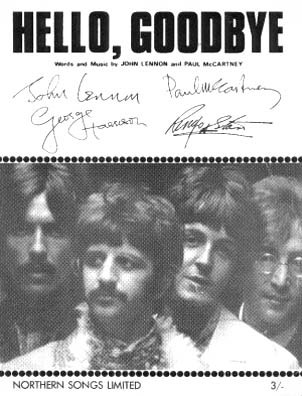
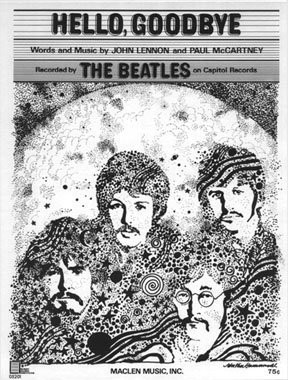
Hello, Goodbye
View on GrokipediaOrigins
Background
The death of The Beatles' manager Brian Epstein on August 27, 1967, from an accidental overdose of sleeping pills, marked a significant period of transition for the band, leaving them without their key organizational figure and amid growing internal uncertainties. This event occurred just weeks after the release of their experimental album Sgt. Pepper's Lonely Hearts Club Band, prompting the group to navigate self-management while seeking to maintain momentum in their career.[5][6] Paul McCartney emerged as the primary songwriter for "Hello, Goodbye," driven by a motivation to deliver a straightforward, uplifting single that contrasted the band's recent psychedelic explorations and provided a sense of stability during this turbulent time. He aimed for an accessible track suitable as a Christmas release, emphasizing positivity to counter the disorientation following Epstein's passing. McCartney later described the song as an exploration of duality, stating, "It's just a song of duality, with me advocating the more positive," and noted that the theme was inspired by his astrological sign of Gemini, which symbolizes opposites and twins.[7][1] McCartney composed the initial ideas for "Hello, Goodbye" at his London home on Cavendish Avenue in late September 1967, during a casual demonstration of his songwriting process for EMI executive Alistair Taylor, using a harmonium to play contrasting phrases like "hello" and "goodbye." This personal creative moment captured the song's essence amid the band's evolving dynamics.[2][1]Composition
"Hello, Goodbye" was composed entirely by Paul McCartney, though credited to the Lennon–McCartney partnership as per the Beatles' standard practice. The song originated during a casual word-association exercise at McCartney's London home in late September 1967, involving NEMS Enterprises press officer Alistair Taylor, who suggested words like "hello" to which McCartney responded with opposites such as "goodbye," "yes" to "no," and "good" to "bad." McCartney began developing the piece on piano, creating an initial demo that captured its upbeat, scalar melody in C major and 4/4 time. From the outset, he envisioned incorporating orchestral elements to enhance its pop-orchestral feel, aligning with the band's evolving studio experimentation.[1][8] The lyrical structure revolves around binary oppositions, as in lines like "You say yes, I say no" and "You say goodbye and I say hello," illustrating the dualities inherent in human interaction and existence without delving into explicit philosophy. Musically, the song follows a straightforward verse-refrain (chorus) form, with verses building tension through descending basslines and the refrain resolving in a brighter, ascending melody at approximately 99 beats per minute. The outro features a mantra-like repetition of "hello, goodbye," evoking a hypnotic, chant-like quality.[1][8][9] John Lennon expressed initial skepticism toward the song, viewing it as superficial and later describing it as "three minutes of contradictions and meaningless juxtapositions." Reflecting the band's internal tensions during this period, he preferred more introspective material amid their collaborative dynamics.[2][10]Production
Recording
The recording of "Hello, Goodbye" took place at EMI Studios (now Abbey Road Studios) in London, spanning several sessions from 2 October to 2 November 1967, under the production of George Martin and engineering by Ken Scott and Geoff Emerick.[2] The initial session on 2 October in Studio Two began at 7 p.m. and lasted until 3:30 a.m., where the Beatles captured the basic rhythm track across 16 takes, featuring Paul McCartney on piano and bass guitar, John Lennon on rhythm guitar and organ, George Harrison on guitar, and Ringo Starr on drums.[2] This foundational work established the song's upbeat structure, with McCartney providing lead vocals during later overdubs.[2] Subsequent sessions built on this track through extensive overdubs, highlighting the band's collaborative input and Martin's orchestral enhancements. On 19 October in the larger Studio One, from 7 p.m. to 3:30 a.m., McCartney double-tracked his lead vocals, while Lennon and Harrison added backing vocals and dual lead guitar parts; the group also recorded handclaps and improvised "Hela, heba, heloa" chants for the coda, creating a layered, rhythmic vocal texture that contributed to the song's playful energy.[2] Lennon contributed rhythm guitar throughout, Harrison added lead guitar parts, and Starr enhanced the percussion with maracas and tambourine on the basic track.[2] A tape reduction combined elements into take 17, freeing tracks for further additions.[2] The following day, 20 October, focused on the coda's development, with Martin arranging two viola parts—played by session musicians Kenneth Essex and Leo Birnbaum—based on McCartney's hummed piano melody, introducing a string element that added emotional depth to the fade-out without overwhelming the rock arrangement.[2] Additional overdubs occurred on 25 October, including McCartney's first bass guitar layer, before the final session on 2 November, where McCartney added a second bass part and the track was deemed complete.[2] During mixing, Martin and the engineers opted to extend the viola coda for dramatic effect, applying heavy echo to Starr's tom-toms to heighten the sense of resolution and expansiveness, resulting in a mono mix that emphasized the song's dynamic close.[2]Personnel
The personnel for "Hello, Goodbye" consisted of the core Beatles lineup, supplemented by session musicians for the string overdubs in the coda.[2] The Beatles- Paul McCartney: lead vocals, backing vocals, bass guitar, piano, bongos, congas[1][11]
- John Lennon: backing vocals, lead guitar (with Leslie speaker), Hammond organ, piano (coda)[1][11]
- George Harrison: backing vocals, lead guitar (with Leslie speaker), maracas[1][11]
- Ringo Starr: drums, tambourine, maracas[1][11]
- Kenneth Essex: viola (coda)[1][11]
- Leo Birnbaum: viola (coda)[1][11]
- George Martin: producer, arranger (viola parts)[1][2]
- Geoff Emerick: engineer (tape editing, effects including echo on tom-toms)[1][2]
- Ken Scott: engineer (mixing)[1][2]
Release and Promotion
Release
"Hello, Goodbye" was issued as a non-album single in the United Kingdom on 24 November 1967 by Parlophone Records, with the catalogue number R 5655 and "I Am the Walrus" as the B-side.[12] In the United States, Capitol Records released it on 27 November 1967 as catalogue number 2056, again backed by "I Am the Walrus".[13] The UK edition featured a standard pictureless sleeve typical of Parlophone singles at the time, while initial US copies were sometimes distributed in imported picture sleeves derived from the accompanying album artwork.[14] The track was included on The Beatles' Magical Mystery Tour project, appearing on the double EP release in the UK on 8 December 1967 (Parlophone MMT-1/MMT-2), which represented a departure from the standard single-EP format with its gatefold packaging and 24-page color booklet containing lyrics and photographs from the accompanying television film.[15] In the US, "Hello, Goodbye" led off the Magical Mystery Tour LP, issued on 27 November 1967 (Capitol MAS-2835), expanding the EP's content with additional non-album singles to create a full-length album.[16] The choice of "Hello, Goodbye" as the A-side occurred despite John Lennon's strong preference for "I Am the Walrus" to serve in that role, a decision ultimately driven by Paul McCartney and producer George Martin to prioritize commercial appeal following the death of manager Brian Epstein.[2] The single saw robust initial sales, exceeding 300,000 copies in the UK within its first day of availability.[17]Promotional Films
The Beatles produced three promotional films for their single "Hello, Goodbye," continuing their use of filmed visuals to promote releases and helping lay early groundwork for the modern music video format that would later be popularized by MTV decades hence.[18] Directed primarily by Paul McCartney with assistance from Apple Films producer Tony Bramwell, the films were shot on November 10, 1967, at the Saville Theatre in London's West End, a venue leased by manager Brian Epstein.[19] Filmed in color on 35mm stock by a small crew using a single camera, the productions featured the band miming to the track amid a psychedelic stage setup, despite British Musicians' Union restrictions on lip-syncing that initially limited UK broadcasts.[18][20] The first version depicted the group in everyday "street clothes," performing straightforwardly on stage with a sequence of dancing girls in the finale to evoke a lively cabaret atmosphere.[19] The second version showcased the band in their colorful Sgt. Pepper's Lonely Hearts Club Band uniforms against a swirling psychedelic backdrop, incorporating quick cutaways to archival footage of the Beatles in their 1963 collarless suits as a symbolic nod to their origins, and concluding with hula-dancing women in Hawaiian costumes.[19] A third, more experimental version compiled outtakes from the prior shoots, including playful mime sequences where John Lennon danced the Twist and the group engaged in spontaneous, surreal antics like exaggerated gestures and stage romping, adding a layer of whimsy without reverse footage or additional locations.[21] These elements—mime, costume shifts, and lighthearted symbolism—highlighted McCartney's improvisational directing style, as he called out shots on the fly during the single afternoon's filming.[22] Although the films could not air on the BBC's Top of the Pops due to the miming ban, they debuted internationally on The Ed Sullivan Show in the United States on November 26, 1967, and The Hollywood Palace on November 28, 1967, helping propel the single to the top of charts worldwide.[18] In the UK, still photographs from the shoots were eventually used on Top of the Pops in December 1967 as a compromise.[23] The promotional films underwent restoration for the 2015 reissue of The Beatles 1 compilation, where high-definition transfers preserved their vibrant colors and sharp details, making them available on DVD, Blu-ray, and digital platforms for the first time in enhanced form.[22]Reception
Critical Reception
Upon its release in November 1967, "Hello, Goodbye" garnered positive initial reviews for its catchiness and pop appeal. In Melody Maker, Nick Jones described it as superficially ordinary but infused with the Beatles' soul and feeling, highlighting its enduring charm despite lacking exotic elements like sitars.[1] Similarly, New Musical Express critic Derek Johnson praised it as supremely commercial, serving as a reassuring counterpoint to perceptions that the band had veered too far into experimental territory.[1] However, responses were mixed; Richard Goldstein in The New York Times deemed it akin to a B-side—interesting yet subordinate to the band's more ambitious work, particularly when contrasted with the psychedelic complexity of its B-side, "I Am the Walrus."[24] John Lennon expressed personal disdain for the track, viewing it as a lesser McCartney composition and dismissing it as "three minutes of contradictions and meaningless juxtapositions" in a 1980 interview, reflecting his preference for more substantive material. In contrast, Paul McCartney defended it as an intentional exploration of pop duality, emphasizing themes of opposites like yes/no and hello/goodbye to capture life's fundamental tensions in an accessible form.[3] Retrospective assessments have often highlighted the song's orchestral innovations amid its simplicity. In Revolution in the Head: The Beatles' Records and the Sixties (1994), Ian MacDonald called it "blandly catchy" but commended the lavish string arrangement by George Martin, which elevated its playful structure into a sophisticated pop artifact. It ranked #100 on Rolling Stone's 2010 list of the 100 greatest Beatles songs, with critics noting its irresistible bounce and role in bridging the band's psychedelic phase with classic pop sensibilities.[7] Post-2020 analyses have underscored the song's accessibility in the streaming era, where its concise, duality-driven lyrics resonate with modern pop's thematic contrasts, as seen in tracks by artists like Billie Eilish exploring emotional binaries. A 2023 Ultimate Classic Rock retrospective linked its enduring streams—over 168 million on Spotify as of November 2025—to this timeless exploration of opposites, positioning it as a precursor to contemporary duality motifs in hits like Taylor Swift's "Anti-Hero."[25]Commercial Performance
"Hello, Goodbye" was a major commercial success for the Beatles, topping charts in multiple countries and achieving strong sales figures shortly after its release. In the United Kingdom, the single debuted at number two on the Official Singles Chart before ascending to number one on 6 December 1967, where it remained for seven consecutive weeks. It sold over 500,000 copies within its first three weeks on sale and is estimated to have reached approximately 750,000 units in the UK market during its original run. The track also ranked as the second-best-selling single of 1967 in the UK. In the United States, "Hello, Goodbye" entered the Billboard Hot 100 at number 71 before climbing to number one on 30 December 1967, holding the top position for three weeks. The Recording Industry Association of America (RIAA) certified the single Gold on 15 December 1967, recognizing one million units shipped at the time. Sales in the US are estimated at 1.4 million copies from the original release period, with the song reaching #11 on Billboard's year-end Hot 100 chart for 1968. Internationally, the single performed strongly, reaching number one in Canada on the RPM 100 chart and in Australia on the Kent Music Report. It also topped charts in countries including West Germany, the Netherlands, Norway, and New Zealand.| Chart (1967–1968) | Peak Position | Weeks at No. 1 | Source |
|---|---|---|---|
| UK Singles Chart | 1 | 7 | Official Charts Company |
| US Billboard Hot 100 | 1 | 3 | Billboard |
| Canadian RPM 100 | 1 | N/A | RPM |
| Australian Kent Music Report | 1 | N/A | Kent Music Report |