Hubbry Logo
Bongo drumBongo drumMain
Open search
Bongo drum
Community hub
Bongo drum
logo
8 pages, 0 posts
0 subscribers
Be the first to start a discussion here.
Bongo drum
Bongo drum
from Wikipedia
Bongo
Percussion instrument
Other names
  • Bongos
  • bongo drum
Classification Percussion
Hornbostel–Sachs classification211.251.2
(Sets of single-skin conical drums)
DevelopedLate 19th century in Cuba
Related instruments
Bongos playing a cumbia beat

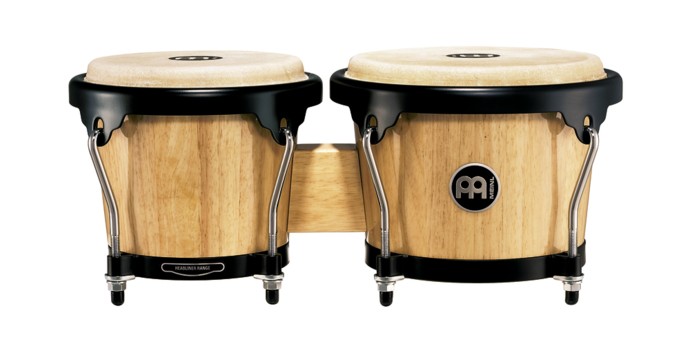
Bongos (Spanish: bongó) are an Afro-Cuban percussion instrument consisting of a pair of small open bottomed hand drums of different sizes.[1] The pair consists of the larger hembra (lit.'female') and the smaller macho (lit.'male'), which are joined by a wooden bridge. They are played with both hands and usually held between the legs, although in some cases, as in classical music, they may be played with sticks or mounted on stands.

Bongos are mainly employed in the rhythm section of son cubano and salsa ensembles, often alongside other drums such as the larger congas and the stick-struck timbales. In these groups, the bongo player is known as bongosero and often plays a continuous eight-stroke pattern called martillo (lit.'hammer') as well as more rhythmically free parts, providing improvisatory flourishes and rhythmic counterpoint.[2]

Bongos originated in eastern Cuba at the end of the 19th century, possibly from a pair of larger drums such as the bokú. These older, larger bongos are known as bongó del monte and played in changüí. The smaller bongos used in son cubano were popular across Cuba by the 1910s and reached the concert halls of the eastern United States in the 1930s. By the 1940s, bongos and congas were sharing the stage as son ensembles grew in size and Latin music began to cross-pollinate with jazz and other genres. During the second half of the 20th century, bongos began to be played in a wide variety of genres, from bachata to Latin rock.[3]

Construction

[edit]

Bongo drums are about 20 centimetres (8 in) high and have diameters of approximately 20 centimetres (8 in) and 25 centimetres (10 in).[4][5][6] The shells of the drums and the bridge (the small block that joins them) are usually made of wood, although fiberglass is also common. The heads are typically made of calfskin and attached to the shells via steel hardware that enables their tuning (lug tuning). Originally, metal tacks were used, so the skins had to be tightened by heating the skins with a flame and loosened with water or by striking them vigorously.[4][7] This method of tuning is still used for the traditional bongos used in changüí. Therefore, Fernando Ortiz places the original bongó in the category of tambores de candela (flame-tuned drums), along with bokú, yuka, conga, bembé and smaller drums, since these were all tuned with the flame of an oil lamp.[8]

Technique

[edit]
Grupo Changüí de Guantánamo in 1962. The bongosero (left) is playing bongó de monte, which is much taller than the standard bongó.

Bongo drums produce relatively high-pitched sounds compared to conga drums, and should be held behind the knees with the larger drum on the right when right-handed. It is most often played by hand and is especially associated in Cuban music with a steady pattern or ostinato of eighth-notes known as the martillo (hammer).[3] They are traditionally played by striking the edge of the drumheads with the fingers and palms. The glissando used with bongó de monte, called bramido (howl), is done by rubbing the third finger, supported by the thumb, across the head of the drum. Usually, this is done during the climax of a changüí performance.[7] The finger is sometimes moistened with saliva or sweat before rubbing it across the head,[9] but many players use beeswax instead.[7]

When playing son cubano and other popular genres, the macho is on the left and the hembra on the right. In changüí, the bongó de monte is positioned the opposite way.[7] Playing patterns are also different in changüí, where the bongó does not follow a steady beat. Instead, it usually marks offbeats and beat four while improvising.[7] Thus, the playing technique in changüí resembles that of the congas (moreover, their pitch is often lower than both bongos and congas).[7] This reflects it origin, since the bongó del monte evolved from pairs of bokús, a larger drum from eastern Cuba similar to the conga.[7]

Bongos can also be played on a stand, as is the case with concert orchestras and bands. In classical music performances, bongos are usually struck with mallets or drumsticks. Examples of pieces featuring bongos include Ionisation by Varèse (1931), Le Marteau sans maître by Boulez (1955) and In seinem Garten liebt Don Perlimplin Belisa by Fortner (1962).[10] Steve Reich's 1971 piece Drumming features four pairs of carefully tuned bongos played with drumsticks.[11]

History

[edit]

Origin and etymology

[edit]
Desi Arnaz playing a bokú in the 1940s. His father had banned the bongos 20 years earlier. The bokú is the most likely ancestor of the bongos.

The origin of the bongo is largely unclear. Its use was first documented in the eastern region of Cuba, the Oriente Province, during the late 19th century, where it was employed in music styles such as nengón, changüí, and their descendant, the son cubano.[3] According to Fernando Ortiz, the word bongó derived from the Bantu words mgombo or ngoma, meaning drum.[12] He hypothesizes that the word evolved through metathesis and by similarity with another Bantu word, mbongo.[12] According to Ortiz's early 20th century informants, the large bongó del monte (mountain bongo) used in changüí was the ancestor of the smaller bongó used in son cubano and salsa.[7]

As explained by eastern Cuban informants to Benjamin Lapidus, the oral tradition among changüí musicians in Oriente is that the bongó originated as a replacement for pairs of bokús that were slung over the player's knee.[7] Bokús are tall drums popular in the eastern provinces, particularly during carnival processions, and featured in early changüí groups. Eventually, these drums were cut in half into bongos. This may explain why the bongó del monte used in changüí is larger than the bongos used in son. In Holguín, similar drums which are considered possible ancestors of the bongó are known as tahona, which might have a been a generic word for drum in Cuba and also refers to an unrelated music genre.[13] Other generic terms that have been used to refer to bongos across eastern Cuba include tahonitas, tambora, atambora and tumba.[14]

The bokú/tahona origin of the bongos agrees with the generally agreed notion held by Afro-Cuban cultural historians that the bongo derives from Bantu drum models from Central Africa, noticeable in the open bottoms. The strong historical presence of Africans from the Congo/Angola region in eastern Cuba (where the bongo first appeared) makes such an influence possible, as does the widespread use of the term bongó/bonkó among Bantu speakers.[7] Moreover, Central African/Congo influences are also documented in both son cubano and changüí, and initially the development of the bongo drum was in parallel with these genres. From such conceptual African drum models, the bongo developed further in Cuba itself, and some historians state that the attaching of the two drums was a later invention that took place in Cuba. Therefore, the instrument has been described as "African in concept but Cuban in invention".[15] Ortiz's hypothesis for the origin of the bokú is that their tall unusual shape was the result of a purposeful avoidance of "African-looking" drums by Afro-Cuban musicians at a time when most drums of that sort were banned.[16]

Less supported hypotheses for the origin of the bongos, largely based on their superficial similarity to other twin drums, include the Cuban pailas and timbales (descended from European tympani), the Arab nakers, the North African tbilat (called "African clay bongos"),[17] the Indian tabla, etc.[18][19]

Evolution and popularization

[edit]
Sexteto Habanero in 1925. First on the left is Agustín Gutiérrez, the bongosero. His tuning lamp is on the ground (circled).

The bongo entered Cuban popular music as a key instrument of early son ensembles, quickly becoming—due to the increasing popularity of the son—"the first instrument with an undeniable African past to be accepted in Cuban “society” circles".[3] This is attested, for example, in poems by Nicolás Guillén.[3] As son evolved and distanced itself from its precursor, the changüí, so did the bongos. The bongos used in changüí, known as bongó de monte, are larger and tuned lower than their modern counterparts, have tack-heads instead of tunable hardware, and play in a manner similar to the lead conga drum (quinto) and other folkloric lead drum parts.[7] Unlike modern son, changüí never extended its popularity beyond eastern Cuba, and hence its bongos remain a rare sight. It is commonly accepted that the son reached Havana partly as a result of the arrival of musicians members of Cuba's ejército permanente (permanent army), which brought music from eastern Cuba with them. Among the first known bongoseros to enlist in the ejército permanente in Santiago de Cuba was Mariano Mena.[20]

During the sexteto era, son groups began performing and touring more than ever before, and for the first time, recordings were being made. It was in this context that the first great innovators of the bongo made their mark, and unlike their predecessors, their names were not lost in time.[3] Of particular note were Óscar Sotolongo of the Sexteto Habanero and José Manuel Carriera Incharte "El Chino" of the Sexteto Nacional, the two leading groups of the 1920s and '30s. Sotolongo himself would later leave the Habanero and direct his own group, the Conjunto Típico Cubano.[21] His replacement was Agustín Gutiérrez "Manana", who is widely considered one of the most influential bongoseros, partly due to his condition as an Abakuá member, which allowed him to develop techniques based on the ekué (secret drum) drumming of such society.[15] In 1930, Sotolongo's son, Andrés Sotolongo replaced Gutiérrez in the Habanero.[22] Decades later, at 82 years of age, Andrés Sotolongo was recorded for the Routes of Rhythm documentary playing alongside Isaac Oviedo.[23]

"The Cuban government has prohibited the beating of the African bongo drum. The restriction carries heavy penalties on the ground that the monotonous reverberations induce a state of savagery in ignorant listeners and a state of irritation in others."

Life magazine, 1929[24]

In 1929, bongos and other drums were banned by the Cuban government.[24][25] This prohibition extended that of 1925, which outlawed congas in the context of street carnivals, but not the comparsas themselves. Ironically, this original ban was enacted by the mayor of Santiago de Cuba, Desiderio Arnaz II, father of Desi Arnaz, who later popularized congas, bongos and bokús across America and the world. This repression of Afro-Cuban culture was denounced by poets in the Afrocubanismo such as Guillén, whose "Canción del bongó" (Song of the bongo) was published in 1931.[26]

The 1930s saw an increase in the technical skill of bongoseros, as evidenced by Clemente "Chicho" Piquero, whose virtuosic performances inspired a young Mongo Santamaría to take up the instrument.[27][note 1] By the early 1940s, Santamaría had become a master of the instrument, performing with the Lecuona Cuban Boys, Sonora Matancera, Conjunto Matamoros and Arsenio Rodríguez's "Conjunto Segundo" among others.[27] Arsenio had pioneered the conjunto format by incorporating a tumbadora (conga drum) into the rhythm section and having the bongosero double on cowbell. Arsenio's long-time bongosero was Antolín "Papa Kila" Suárez, who is often cited as one of the greatest of his time along with Pedro Mena of the Conjunto Matamoros.[30] Arsenio's group also helped break the barriers of race, which particularly affected bongoseros. For example, the Orquesta Casino de la Playa did not allow their black bongosero Ramón Castro to perform on stage, nor was Arsenio allowed on the tres.[31] The Casino de la Playa would also feature bongosero Cándido Requena, who later joined the Conjunto Kubavana and Conjunto Niágara, and became one of Cuba's foremost makers of bongos and tumbadoras.[32] Requena, as well as the Vergara brothers, were instrumental in the technological improvement of bongos and congas.[33] Before the advent of mechanically tunable bongos and congas in the 1940s, both instruments used to be tuned with oil or kerosene lamps. The heat of the flame was used to contract the drumhead to achieve the desired sound.[33]

Following the popularization of the tumbadora, Santamaría switched to the instrument, while remaining a close friend of bongosero Armando Peraza.[34] Both moved to New York by 1950, bringing their music abilities with them. Among the bongoseros who stayed in Cuba were the aforementioned Chicho Piquero, who had become a close friend of Benny Moré in Mexico and became his Banda Gigante's bongosero back in Cuba. Also important during the 1950s were Papa Gofio of the Conjunto Rumbavana and Rogelio "Yeyo" Iglesias, the main bongo player in Havana's descarga scene.[35] Over the course of the 20th century, the bongo spread throughout Latin America. In the Dominican Republic, the bongo became integral to bachata, a genre related to bolero that emerged in the 1960s.[36]

In the United States

[edit]
Jose Mangual, Sr. on bongos (left) alongside Machito on maracas and Carlos Vidal on conga at the Glen Island Casino, New York, 1947.

In the 1920s, bongos were first played in the United States during the recording sessions of Cuban son ensembles such as Sexteto Nacional, which recorded in New York City for Columbia Records. Among the tracks recorded in their 1927 sessions was "Viva el bongó",[37] a song about the instrument itself which—unlike the stylized Cuban son popular at the time—brought percussion to the foreground.[38] Since these recordings were mainly sold in Cuba, they did not have any cultural impact in the US.

Things changed one Saturday afternoon in April 1930, when the Havana Casino Orchestra directed by Don Azpiazú debuted their live show at the Palace Theatre in New York. Featuring José "Chiquito" Socarrás on bongos, Don Azpiazú's successful performances and recordings of "El manisero" gave rise to a dance craze known as "rhumba" (in reality based on Cuban son) which led to the widespread use of the bongo among Latin bands in New York.[39] In the early 1930s, Cuban orchestras proliferated in New York, featuring the bongo as key percussion instrument, including those directed by Antonio Machín, Alberto Socarrás, Pedro Vía, Antobal, Enrique Bryon, etc. However, apart from Chiquito Socarrás, who was also a singer, there were no bongoseros of renown and the instrument did not yet permeate American music styles.

Spearheaded by the iconic conguero Chano Pozo, the late 1940s saw an exodus of Afro-Cuban percussionists from Cuba to the United States. Among the leading bongoseros of Cuban origin in the United States were Armando Peraza, Chino Pozo (unrelated to Chano) and Rogelio Darias, who had a long career in Las Vegas and was known as the King of the Bongo.[40] Many others, however, would become primarily conga players, such as Mongo Santamaría, Sabú Martínez and Cándido Camero.

The Latin music scene of New York, and the US in general, was primarily constituted by Puerto Ricans, and many influential bongoseros were Puerto Ricans who learned from Cubans. An early example is Rafael "Congo" Castro, who arrived in New York in 1924 and had a long career as a bongosero in Chicago until the 1980s.[41] In New York, many Puerto Rican bongoseros would go on to join the pioneering Afro-Cuban jazz ensembles of the time such as Machito and his Afro-Cubans, whose singles "Tangá" and "Mango mangüé"—considered the first examples of the genre—featured José Mangual Sr. "Buyú" on bongos. Mangual's prolific career was continued by his sons José Mangual Jr. and Luis Mangual, who played in a variety of salsa groups in the 1970s. The two biggest Latin orchestras of the 1950s in New York, led by Tito Puente and Tito Rodríguez, were home to two generations of bongoseros represented by Johnny "La Vaca" Rodríguez and his son Johnny "Dandy" Rodríguez, of Puerto Rican ancestry.[42]

Other Puerto Rican musicians who made a name for themselves on the bongos were Richie Bastar of El Gran Combo de Puerto Rico, Ralph Marzán of Johnny Pacheco's charanga, "Little" Ray Romero, Frank Colón and Roberto Roena. On the other hand, American master bongoseros include Jack Costanzo and Willie Bobo (of Puerto Rican origin), the latter more active on timbales. Other bongoseros who had more impact as timbaleros were Manny Oquendo, Orestes Vilató and Nicky Marrero. American novelty rock acts such as Preston Epps and Michael Viner's Incredible Bongo Band capitalized on the popularity of the instrument as well as its exotic and rhythmic qualities.

Notes

[edit]

References

[edit]
Revisions and contributorsEdit on WikipediaRead on Wikipedia
from Grokipedia
Bongo drums are a pair of small, Afro-Cuban percussion instruments consisting of two conjoined wooden shells of differing diameters topped with taut drumheads, the larger hembra producing a lower pitch and the smaller macho a higher one. They are typically played seated, held horizontally between the knees with the shells angled outward, and struck using the fingers, palms, and heels of the hands to generate a range of tones including open slaps, muffled bass notes, and sharp rim shots. Originating in eastern Cuba during the late 19th century, bongos evolved from African drumming traditions, particularly Bantu and Yoruba influences introduced via the transatlantic slave trade, blending with local Spanish elements to form core components of genres like son cubano, rumba, and conga ensembles. Initially tuned by heating or moistening rawhide heads, modern bongos feature hardware lugs for precise pitch adjustment using tension rods, enabling their adaptation across global styles from Latin jazz to rock and pop.

Design and Construction

Materials and Components

Bongo drums consist of a pair of single-headed, open-bottomed drums of unequal sizes, termed the macho (smaller, higher-pitched) and hembra (larger, lower-pitched), affixed side by side via a central block or bridge. The macho typically measures 6.75 to 7.25 inches in diameter, while the hembra ranges from 7.75 to 8.625 inches. Shells are primarily fashioned from , such as , , , or Siam oak, using methods like gluing wooden staves into a cup shape and refining on a to ensure uniform resonance and tone. or ABS plastic shells offer greater durability and resistance to environmental factors as alternatives to wood. Each drumhead comprises a thin stretched taut over the shell's bearing edge, which is the precise circular rim supporting the head for . Traditional heads employ natural animal skins, including , , goat, or buffalo hide, prepared by soaking, stretching over the shell and a securing hoop, and drying under tension. Synthetic heads, made from materials like , provide enhanced consistency, longevity, and immunity to humidity changes. Hardware components enable tuning and assembly, featuring metal rims (often or aluminum, sometimes chrome-plated) that clamp the head, connected via hooks or lugs to a bottom ring and tension rods. These 8 mm-thick lugs and rods allow precise adjustment of head tension to alter pitch, replacing earlier tack-based fixation methods. The central block rigidly connects the shells, with some designs incorporating internal bolting for stability.

Tuning and Acoustics

Bongo drums are tuned by adjusting the tension of the drumheads via metal lugs or rods encircling the rims, using a specialized tuning to rotate them clockwise for increased tension. The process begins with the heads seated evenly, often using a cloth to press the center while loosening lugs initially if needed, followed by gradual tightening in a criss-cross or circular pattern—starting with 2-3 full turns per lug when loose, then reducing to quarter or eighth turns for precision—to ensure uniform tension and prevent head warping or rim cracks. Evenness is verified by tapping the head midway between lugs and listening for consistent pitch, or visually checking the head's profile for flatness; uneven tension leads to inconsistent tones and reduced playability. The smaller macho drumhead is tuned to a higher pitch than the larger hembra, typically an interval of a perfect fourth, fifth, or octave apart to facilitate interlocking rhythms. Common reference pitches include tuning the macho to B through D (approximately two octaves above middle C) or G6 for crisp articulation, with the hembra correspondingly lower, such as A or an octave below, though exact notes vary by player preference and musical context rather than absolute intonation. Tools like tone generators, pitch pipes, or apps (e.g., Drumtune Pro) assist in matching desired frequencies, but tuning remains relative, prioritizing resonance between drums over fixed scales. Acoustically, bongo sound arises from the vibration of the taut membrane upon striking, exciting fundamental and higher-order modes of the circular drumhead, where the fundamental (0,1) mode produces bass tones and peripheral strikes activate overtones for slaps and open tones. Higher head tension raises the , yielding brighter, more articulate sounds, while the smaller macho shell's dimensions contribute inherent higher resonance compared to the hembra's deeper cavity, which sustains lower frequencies with greater warmth. Traditional rawhide heads offer rich harmonics influenced by thickness and drying, whereas synthetic alternatives provide weather-resistant consistency but potentially altered sustain and . Proper tuning optimizes these modes for clear projection and tonal variety, with detuning slightly after sessions preserving head longevity by reducing stress.

Playing Techniques

Basic Strokes and Grips

Bongo drums are typically played in a seated position, with the instrument held horizontally between the knees and secured by thigh pressure rather than straps. The larger drum, known as the hembra, is placed on the outside (to the right for right-handed players), while the smaller macho drum is positioned inward. Hands are positioned with palms facing each other and fingertips resting lightly on the drumheads to maintain contact and control resonance. The primary hand grip emphasizes relaxation to facilitate fluid motion, avoiding tension that could impede rebound or endurance. On the macho drum, the fingers are often slightly curled to strike the edge with the fingertips for articulate tones, while the palm remains available for occasional slaps. For the hembra, the grip incorporates a rocking motion between the heel of the palm (for bass notes) and the fingertips (for higher tones), with the thumb sometimes bracing against the drum shell for stability. This setup allows independent hand techniques, with the left hand typically handling melodic tones on the macho and the right executing bass and rhythmic foundations on the hembra. Basic strokes derive from Afro-Cuban traditions and produce distinct timbres through variations in contact point, force, and finger release. The open tone is executed by striking the edge with the padded area where palm meets fingers, allowing the fingertips to rebound freely off the head, yielding a sustained, resonant ring; this is achieved by lifting the hand approximately 4 inches post-impact. The slap tone involves cupping the fingers slightly before impacting the head near the edge, producing a sharp, high-pitched "pop" as air escapes, distinct from the open tone by its abrupt release and brighter attack. Muted or closed tones are generated similarly to open tones but with the fingers remaining in contact with the head after the initial strike, damping for a short, percussive thud; this technique prioritizes the fingertips on the edge while the palm heel stays anchored. The heel-toe (or heel-tip) stroke, fundamental to rhythmic patterns like the martillo, involves resting the full hand on the head and rocking from the palm heel (for a low bass) to the fingertips (for a higher tone), maintaining continuous contact to create interlocking eighth-note pulses without lifting the hand. These strokes demand practice for even volume and clarity, with edge strikes favoring articulation and central hits enhancing depth, though excessive force risks hand strain or uneven tuning.

Rhythmic Patterns and Styles

![Portrait of Machito, Jose Mangual, and Carlos Vidal](./assets/PortraitofMachitoPortrait_of_Machito%252C_Jose_Mangual%252C_and_Carlos_Vidal(%253F) The martillo rhythm, translating to "hammer," serves as the foundational pattern for bongo drums in Afro-Cuban music, particularly within the son cubano genre. This pattern alternates strikes between the smaller hembra (female) drum and the larger macho (male) drum, typically featuring slaps and open tones synchronized to the son clave rhythm, which emphasizes a 2-3 pulse structure. The martillo maintains a steady, interlocking groove that supports improvisation and ensemble cohesion, adaptable to tempos ranging from moderate in son to faster in derived styles like salsa. In styles such as guaguancó, bongo patterns derive from the martillo but incorporate more dynamic variations, including palm presses and finger rolls to mimic call-and-response dialogues inherent to Afro-Cuban traditions. These adaptations heighten rhythmic complexity, aligning with the clave while allowing the bongocero (bongo player) to accentuate clave beats for propulsive energy in dance-oriented performances. Bolero rhythms on bongos employ a subdued martillo variant at slower tempos, around 80-100 beats per minute, prioritizing subtle tones over aggressive slaps to complement the genre's lyrical melodies. In contrast, mambo and salsa demand heightened syncopation, where bongo players embellish the basic martillo with sixteenth-note fills and cross-stick accents to drive forward momentum in large ensembles. Beyond traditional Afro-Cuban contexts, bongo patterns have influenced and rock, featuring simplified martillo-inspired ostinatos or 6/8 adaptations for polyrhythmic textures, as seen in post-1950s international ensembles. These evolutions preserve the core hand techniques—finger pads for tones and heel-palm for mutes—while integrating with non-Latin meters.

Historical Origins

Development in Cuba

The bongo drum emerged in eastern Cuba during the late 19th century, primarily in the Oriente Province, including areas around Guantánamo. Its development drew from Central African Bantu drum traditions introduced by enslaved people from the Congo region, who settled heavily in eastern Cuba's rural areas. These influences manifested in paired, hand-played drums with open bottoms, distinct from larger conga drums that evolved later post-1886 slavery abolition. Early bongos featured wooden shells of varying sizes—typically a larger (male) drum and smaller hembra (female) drum—lashed together and tuned by adjusting rawhide heads with heat or tension ropes. They were played seated, held between the knees, emphasizing slap and tone strokes to produce sharp, resonant sounds suited to acoustic ensembles. Cuban anthropologist Fernando Ortiz documented their use in the late 1800s, linking them to Afro-Cuban folk practices rather than urban or conga traditions. In genres like changüí, originating in Guantánamo's region around the 1880s, bongos provided the core rhythmic pulse alongside the tres guitar, , and voice. This rural music, blending Bantu percussion with Spanish string elements, laid groundwork for , which adopted bongos by the early 1900s as it migrated westward to and eventually . The instrument's portability and versatility facilitated its integration into son septets, where it complemented clave rhythms and clave patterns, marking a shift from folk to formalized . By the 1910s, bongos symbolized eastern Cuba's cultural synthesis, with no evidence of pre-Cuban origins despite African prototypes.

Etymology and Early Documentation

The term "bongó" for the paired hand drums is derived from Bantu-language words such as ngoma or mgombo, both signifying "drum," according to Cuban ethnologist , who traced the linguistic evolution through African influences in . This etymology reflects the instrument's roots in Central African drumming traditions transported via the transatlantic slave to eastern , where Bantu-speaking slaves from regions like the Congo contributed to local musical forms. Ortiz hypothesized that the word adapted phonetically in , distinguishing the bongó from larger conga drums while retaining its African semantic core. Earliest documented use of bongos appears in the late 19th century in Cuba's Oriente Province, particularly in rural genres like changüí and son, which emerged among Afro-Cuban communities in areas such as Guantánamo and Santiago de Cuba. These drums, played in pairs between the knees, provided rhythmic foundations for dances and fiestas, with historical accounts noting their prevalence in congas de conga—processional groups tied to Congo-derived rituals—by the 1880s following slavery's abolition in 1886. Unlike taller congas, bongos' compact size suited portable, intimate ensemble playing in eastern Cuban tumbao styles, as evidenced by oral histories and early 20th-century ethnographic records from the region. By the early 1900s, bongos gained mention in Cuban musical literature as integral to son ensembles spreading westward, though primary documentation remains sparse due to reliance on folk transmission rather than written notation. The name "bongo" entered broader Spanish usage around this period, coinciding with urban adaptations, but its earliest verifiable appearances tie to Oriente's Afro-Bantu heritage rather than direct African prototypes. Scholars caution that while African precedents exist, the modern bongó form crystallized in Cuba, with no pre-19th-century textual evidence from slave narratives or colonial inventories specifying the instrument by name.

Evolution and Global Spread

Popularization in Latin American Music

The bongo drums gained prominence in Latin American music through the expansion of Cuban son cubano, a genre originating in eastern Cuba during the late 19th and early 20th centuries, where bongos provided essential rhythmic drive in smaller ensembles like septetos. As son bands toured internationally starting in the 1920s, their recordings and performances introduced bongos to audiences in Mexico, Venezuela, Colombia, and Puerto Rico, integrating the instrument into local folk and urban dance traditions. This dissemination was facilitated by radio broadcasts and the growing popularity of Cuban music in Latin American capitals, with bongos underscoring the clave rhythm central to son. In the 1930s and 1940s, the evolution toward , pioneered by tres player , elevated bongos in larger orchestras, blending them with elements that birthed mambo—a high-energy style that proliferated across via live performances and imported records. Mambo ensembles, featuring bongo martillo patterns during sections, influenced dance crazes in cities like , , and , embedding the drums in commercial . By the mid-20th century, bongos had become staples in genres like and early salsa precursors, adapting to regional variations while retaining Afro-Cuban polyrhythms. This popularization reflected migration patterns of musicians and the appeal of syncopated percussion in urban nightlife, though adoption varied; for instance, in and , occasionally supplemented indigenous drums but rarely supplanted them. Empirical evidence from period recordings shows in over 70% of exported Cuban son tracks by 1940, correlating with their integration into pan-Latin repertoires. The instrument's portability and finger-play technique enabled quick assimilation, fostering hybrid styles that sustained its role amid post-World War II cultural exchanges.

Adoption in the United States

![Portrait of Machito, Jose Mangual on bongos, and Carlos Vidal](./assets/PortraitofMachitoPortrait_of_Machito%252C_Jose_Mangual%252C_and_Carlos_Vidal(%253F) Bongo drums arrived in the United States in the 1930s through Cuban musicians who immigrated to , incorporating the instrument into Latin dance bands as Afro-Cuban genres like gained traction among American audiences. This period coincided with the craze, where bongos provided syncopated rhythms essential to the ensembles' energetic sound. In the , penetrated circles, with Jack Costanzo, dubbed "Mr. Bongo," credited for introducing them to American by performing in nightclubs alongside artists like and . A pivotal moment came in 1947 when Cuban percussionist joined Dizzy Gillespie's , employing in compositions that birthed cubop—a synthesis of improvisation and Afro-Cuban percussion—exemplified in tracks like "Manteca." Concurrently, and His Afro-Cubans orchestra, featuring bongocero José Mangual, advanced this fusion in New York venues, blending brass with traditional Cuban drum patterns. The 1950s mambo craze further entrenched bongos in mainstream American music, as bands under leaders like and utilized them in percussion sections to drive the high-energy dance style sweeping ballrooms and media. Bongos enhanced the polyrhythmic complexity of mambo arrangements, contributing to their widespread appeal until the trend waned by the late decade, though the instrument persisted in evolving genres like salsa and rock fusions.

International Influence Post-1950s

In the , bongos gained traction in , where they added rhythmic texture to emerging pop and psychedelic sounds. employed a subtle bongo pattern in their 1964 single "," enhancing the track's melodic introspection. integrated a laid-back bongo backbeat into "There Is a Mountain" (1967), aligning with the era's exploratory folk-rock ethos. Similarly, Jethro Tull featured bongos to underscore thematic elements in "" from their 1969 debut album . These applications reflected a broader incorporation of Latin percussion into European rock, facilitated by the transatlantic exchange of musical ideas post-World War II. By the 1970s, bongos featured prominently in fusion and experiments with wider repercussions. The Incredible Bongo Band's Bongo Rock album (1973) showcased bongo-driven arrangements in covers of popular tracks, blending rock drums, congas, and brass for an upbeat, percussive style. The album's track "Apache"—a reworking of the 1960 instrumental—proved especially enduring, with its drum and bongo breaks sampled over 700 times in subsequent recordings, profoundly shaping hip-hop's foundational breaks and extending to subgenres like and . This sampling legacy amplified bongos' global footprint as hip-hop disseminated from New York to Europe and beyond in the and . British acts continued the trend, as seen in ' urgent bongo rhythms on "Juke Box Music" (1977). The mechanical tuning innovations of the 1950s, which allowed precise pitch adjustment via tension rods, further enabled ' adaptability in non-Latin contexts, contributing to their permeation into fusions. While primary adoption remained in Western popular genres, bongos appeared sporadically in African urban styles influenced by Latin imports, such as adaptations that incorporated similar hand percussion for polyrhythmic depth in the late 1950s and 1960s. Overall, post-1950s international influence stemmed from rock's and percussion's role in rhythmic experimentation, rather than standalone traditions outside the .

Cultural and Musical Role

Integration into Afro-Cuban and Jazz Traditions

![Portrait of Machito, Jose Mangual, and Carlos Vidal](./assets/PortraitofMachitoPortrait_of_Machito%252C_Jose_Mangual%252C_and_Carlos_Vidal\(%253F Bongo drums became integral to Afro-Cuban music in the late 19th and early 20th centuries, originating in eastern Cuba's changüí and son traditions, where they derived from Central African Bantu drum models and provided the primary rhythmic pulse in small ensembles. By the 1920s, son orchestras routinely incorporated bongos alongside the tres guitar and maracas, evolving from basic trios to septets that fused Spanish guitar elements with African-derived percussion, laying the groundwork for broader Cuban popular music forms like the son montuno. This integration reflected the syncretic nature of Afro-Cuban rhythms, blending enslaved Africans' polyrhythmic complexities with local folk practices, as evidenced in early recordings and ensemble descriptions from the period. In the 1930s and 1940s, bongos featured prominently in urban Afro-Cuban genres such as mambo and danzón-mambo, contributing to the percussion battery that defined Havana's scene before migrating to the . Cuban expatriates and Puerto Rican musicians introduced bongos to New York City's milieu, where they fused with swing and to pioneer , or "cubop." Mario Bauzá's arrangement of "Tanga" in 1943, recorded by and His , exemplified this synthesis, employing bongos within a framework of brass, , bass, and trap drums to layer Cuban clave rhythms over harmonies. Machito's orchestra, formed around 1940, standardized the use of bongos alongside congas and in ensembles, crediting the instrument's role in bridging African diasporic traditions with improvisational structures, as detailed in archival analyses of their instrumentation. This period marked bongos' transition from folk accompaniment to a core element in cross-cultural innovation, influencing subsequent artists and solidifying their presence in jazz's rhythmic evolution through verifiable ensemble recordings and performances from the 1940s onward.

Notable Performers and Contributions

![Portrait of Machito, Jose Mangual, and Carlos Vidal](./assets/PortraitofMachitoPortrait_of_Machito%252C_Jose_Mangual%252C_and_Carlos_Vidal\(%253F Armando Peraza, a Cuban percussionist born in 1924, gained prominence as a bongo specialist in Havana during the 1940s before emigrating to the United States in 1950, where he collaborated with jazz musicians like George Shearing and Cal Tjader. His technique featured exceptional speed and rhythmic precision, as demonstrated in 1957 recordings showcasing lightning-fast bongo execution that influenced Latin jazz percussion standards. Peraza's work helped bridge Afro-Cuban rhythms with bebop, contributing to the evolution of conga-bongo interplay in ensemble settings through the 1960s and beyond. Jack Costanzo, known as "Mr. Bongo," emerged in the 1940s as an Italian-American percussionist who mastered Afro-Cuban styles after studying under Cuban masters, performing at high-profile nightclubs with artists like by the mid-1950s. His 1954 album Mr. Bongo highlighted innovative bongo solos fused with elements, popularizing the instrument among non-Latin American audiences and earning him credits on over 250 recordings. Costanzo's adaptations, including stick techniques on bongos, expanded technical possibilities and facilitated the drum's entry into mainstream American entertainment. José Mangual Sr., a key bongocero in Machito's orchestra from the 1930s onward, played a foundational role in standardizing the percussion section that included alongside congas and , as pioneered by the band in New York by 1940. This configuration, under Machito's leadership, enabled the harmonic integration of Afro-Cuban clave rhythms with , influencing the birth of cubop in the 1940s through recordings like those with . Mangual's consistent presence in the ensemble underscored ' role in maintaining rhythmic drive during extended improvisations. Cándido Camero, born in 1921 in , advanced bongo proficiency in multi-percussion setups starting in the 1940s, joining ensembles that fused the instrument with jazz after arriving in New York in 1946. His contributions included pioneering three-conga orchestration complemented by bongo leads, as heard in collaborations with and , which by the 1950s established polyrhythmic complexity in . Camero's longevity, performing until age 99, exemplified enduring technical innovations in bongo phrasing derived from traditions.

Modern Developments

Innovations in Manufacturing and Variants

Traditional bongo drums featured shells constructed from using stave methods, where thin wooden staves are glued together to form barrel-shaped bodies, or turned techniques, involving lathe-shaping from solid wood blocks, typically or . Drumheads were made from animal skins such as goatskin or , secured by tacking or ropes, with tuning achieved through heating, moistening, or manual adjustment. A key innovation occurred in the 1940s with the development of metal tuning lugs, enabling easier pitch adjustment without relying on environmental methods. By the 1950s, manufacturers introduced comprehensive mechanical tuning systems incorporating securable rims, lugs, and tension rods, which allowed precise and stable tuning comparable to larger percussion instruments. Post-1960s advancements included the adoption of synthetic drumheads, such as Mylar or other , providing greater resistance to and changes while maintaining consistent tone and facilitating quicker tuning. Shell materials expanded to and ABS , offering enhanced durability, lighter weight, and immunity to warping in adverse conditions, particularly beneficial for touring musicians. Variants of bongo drums primarily differ in shell construction and materials. Stave-constructed wooden models preserve traditional warm tones but require careful maintenance. Turned-wood shells yield brighter, more focused sounds due to their seamless form. variants, often with contoured rims, prioritize projection and longevity, commonly sized with a 7-inch macho (smaller) drum and 8.5-inch hembra (larger) drum. Single-headed or mini bongos exist for practice or niche applications, though paired sets remain standard. Head options include natural skins for authentic or synthetics for reliability, with tuning hardware standardized across professional models.

Contemporary Applications and Usage

In contemporary music, bongos maintain a prominent role in Latin genres such as salsa and , where they provide syncopated accents and rhythmic drive in ensemble settings. Their adaptability has led to incorporation in diverse styles including rock, , pop, rap, and even symphonic percussion, often enhancing grooves with high-pitched slaps and tones. For instance, rock bands like integrated bongos into tracks such as "Light My Fire" (1967) to infuse psychedelic energy and polyrhythmic layers. Beyond performance, bongos feature in (EDM) productions, where sampled or live-played patterns add organic texture to synthesized beats, as noted in discussions among producers seeking rhythmic variety. In jazz contexts, they contribute improvisational flair and complexity, supporting solos while maintaining pulse in fusion ensembles. Bongos also serve educational purposes, aiding in rhythm training and endurance building; instructors recommend sustained playing at tempos like 120 bpm to develop technique in percussion classes. In music , they facilitate motor skill improvement, anxiety reduction, and emotional expression, particularly for individuals with challenges or , through group percussion sessions that promote coordination and sensory engagement. Studies and clinical applications highlight their role in enhancing speech coordination and emotional regulation via rhythmic vibration and repetition.

References

Add your contribution
Related Hubs
User Avatar
No comments yet.