


Community hub
Recent from talks
Contribute something
Nothing was collected or created yet.
Hexagonaria
View on Wikipedia
| Hexagonaria Temporal range: Devonian
| |
|---|---|

| |
| Hexagonaria percarinata | |
Scientific classification 
| |
| Kingdom: | Animalia |
| Phylum: | Cnidaria |
| Subphylum: | Anthozoa |
| Class: | †Rugosa |
| Order: | †Stauriida |
| Family: | †Disphyllidae |
| Subfamily: | †Hexagonariinae |
| Genus: | †Hexagonaria Gürich, 1896 |
| Species | |
| |
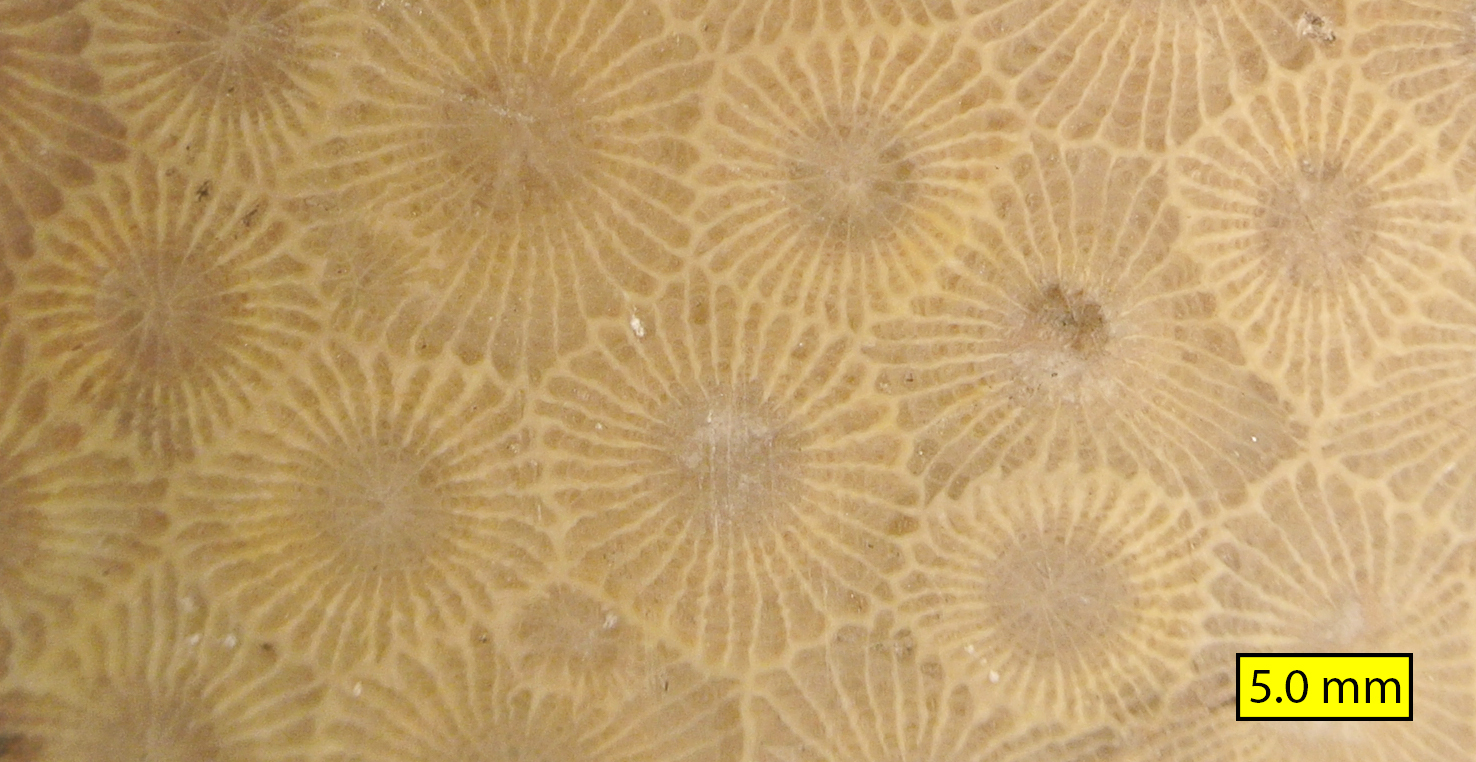
Hexagonaria is a genus of colonial rugose coral. Fossils are found in rock formations dating to the Devonian period, about 350 million years ago. Specimens of Hexagonaria can be found in most of the rock formations of the Traverse Group in Michigan. Fossils of this genus form Petoskey stones, the state stone of Michigan.[1] They can be seen and found in most Midwestern U.S. states.
Hexagonaria is a common constituent of the coral reefs exposed in Devonian Fossil Gorge below the Coralville Lake spillway[2] and in many exposures of the Coralville Formation in the vicinity of Coralville, Iowa.[3]
Species Identification
[edit]Based on Erwin C. Stumm's Corals of the Traverse Group of Michigan Part 13, Hexagonaria, published in 1970.[1] Notably, other species of Hexagonaria occur in rocks outside the Michigan Basin; those other species are not covered by the chart below and may overlap with the species below in size and numbers of septa. Other features diagnose the differences between species; the metrics below merely represent handy features for diagnosis in the Michigan Basin, not comprehensive diagnoses.
| Species | Corallites (diameter) | Septa (count) |
|---|---|---|
| H. anna | 12–16 mm | 32-44 |
| H. cristata | 16–20 mm | 36-44 |
| H. fusiformis | 6–10 mm | 34-38 |
| H. percarinata | ~10 mm | 38-40 |
| H. alpenensis | 2–6 mm | 26-28 |
| H. subcarinata | 8–12 mm | 30-34 |
| H. attenuate | 8–14 mm | 30-38 |
| H. potterensis | 4–15 mm | 36-38 |
| H. profunda | 13–15 mm | 38-42 |
Image Gallery
[edit]-
 Hexagonaria mirabilis
 -
 H. percarinata, "Petoskey stone"

.jpg)
References
[edit]- ^ a b Stumm, Erwin C. (19 June 1970), Corals of the Transverse Group of Michigan Part 13, Hexagonaria (PDF), vol. 23, Ann Arbor: The University of Michigan Press, pp. 81–91
- ^ Jean Prior, Devonian Fossil Gorge Archived 2010-06-18 at the Wayback Machine, Iowa Geological Survey, 1998.
- ^ Brian J. Witzke and Bill J. Bunker, Sedimentation and stratigraphic architecture of a Middle Devonian (late Givetian) transgressive-regressive carbonate-evaporite cycle, Coralville Formation, Iowa area, Paleozoic Sequence Stratigraphy, Biostratrigraphy and Biogeology, Special Paper 321, Geological Society of America, 1997.
- "Hexagonaria". The Paleobiology Database. Archived from the original on 20 July 2011. Retrieved 27 February 2010.
Further reading
[edit] Media related to Hexagonaria at Wikimedia Commons
- Stumm, Erwin C. (1948). Lower Middle Devonian species of the tetracoral genus Hexagonaria of east-central North America. Contributions from the Museum of Paleontology. Vol. v. 7, no. 2. Ann Arbor: Univ. of Michigan Press. OCLC 11520377.

Hexagonaria
View on GrokipediaDescription and Morphology
General Characteristics
Hexagonaria is a genus of extinct colonial rugose corals in the class Rugosa, phylum Cnidaria.[5][1] These corals are characterized by interconnected hexagonal corallites, forming colonies where multiple polyps coexisted within a shared skeletal framework.[6] Unlike solitary rugose corals, the colonial habit of Hexagonaria allowed for collective growth and resource sharing among polyps.[7] Colonies of Hexagonaria typically exhibited encrusting or massive forms, with diameters reaching up to 30 cm or more.[3] The basic anatomy consisted of a calcareous skeleton secreted by the polyps, featuring septa as radial plates that divided the interior of each corallite.[1][8] This structure supported the polyps' tentacles for capturing prey in ancient marine environments. Their overall form bears a superficial resemblance to modern scleractinian corals, though the two groups are evolutionarily distinct.[9] Hexagonaria existed exclusively during the Devonian Period of the Paleozoic Era, approximately 416 to 359 million years ago.[6]Corallite Structure
The corallites of Hexagonaria are characteristically hexagonal prisms, typically measuring 2–20 mm in diameter, and are tightly packed in a cerioid, honeycomb-like colonial arrangement that shares common walls between adjacent units.[3] This polygonal geometry provides structural efficiency in the compact colonies, distinguishing the genus from other rugose corals with more rounded or irregular corallite shapes.[3] Internally, the corallites feature thin, radial septa numbering 20–44 per corallite, which are often long and continuous from the wall but short enough not to fully meet at the center, forming a stellate pattern that enhances skeletal support without a continuous axial fusion.[3] These septa may exhibit wavy or carinate (ridged) margins, contributing to the genus's diagnostic trabecular microstructure.[3] Horizontal tabellae, present as flat to slightly arched partitions, divide the corallite interior into compartments, aiding in compartmentalization and providing additional stability during growth.[3] An axial columella, or central pillar, occurs in some specimens, offering enhanced stability in the corallite axis, though it is absent in others where the septa remain discontinuous.[6] Wall thickness varies, with a thin external epitheca enclosing the structure, while dissepiments—small, globose to elongate vesicles—fill the peripheral spaces between corallites, forming multiple columns that are flat or inclined toward the axis.[3]Taxonomy and Classification
History of Classification
The genus Hexagonaria was originally described by Georg Gürich in 1896, based on specimens from Devonian deposits in the Holy Cross Mountains of Poland, where he erected it to accommodate colonial rugose corals previously assigned to names such as Lithodendron and Cyathophyllum hexagonum.[10] Earlier descriptions of similar fossils from North America, including Michigan's Devonian strata, appeared in Alexander Winchell's 1863 report on the state's geological survey, which documented colonial corals from the Marshall and Huron groups without formal generic assignment.[11] Significant advancements in classification came in the mid-20th century, particularly through Erwin C. Stumm's detailed 1970 monograph on the corals of Michigan's Traverse Group, which clarified species-level distinctions within Hexagonaria and emphasized morphological variations in corallite arrangement and septal development.[12] Stumm's work built on prior revisions, such as those distinguishing Hexagonaria from related genera through its characteristic hexagonal corallite patterns and carinate septa. Taxonomic revisions in the late 20th century placed Hexagonaria within the family Disphyllidae and the subfamily Hexagonariinae (established by Bulvanker in 1958), reflecting its shared traits with other colonial rugosans like dissepiment development and colony integration.[5] Debates persisted regarding synonymy with genera such as Billingsastraea, particularly over wall structure and carina morphology, with some early studies proposing merger based on overlapping features in North American Devonian faunas, though later analyses upheld separation. Today, Hexagonaria is widely accepted as a valid genus within the extinct class Rugosa, with phylogenetic studies employing cladistic methods to explore its relationships to other Devonian corals, highlighting evolutionary trends in coloniality and septal complexity across paleogeographic realms.[3]Recognized Species
The genus Hexagonaria encompasses several valid species from Middle Devonian deposits, predominantly in North America, distinguished by variations in corallite morphology and septal development. A prominent North American species is H. percarinata, widely recognized as the fossil forming the Petoskey Stone, while others such as H. anna, H. cristata, H. fusiformis, H. fisherae, H. alpenensis, H. subcarinata, H. attenuata, H. potterensis, H. profunda, and H. mirabilis occur in associated formations. These species exhibit cerioid colonial growth with hexagonal corallites, and identification relies on metrics like corallite diameter and septal count, alongside features such as carinae and tabularium width.[13][14] Hexagonaria percarinata (Sloss, 1939; emended Stumm, 1970), the dominant species in Michigan, features mature corallites averaging 10 mm in diameter with 30–34 septa, marked by prominent yardarm carinae and a false inner wall formed by crowded dissepiments; its epithet derives from the intensely keeled ("percarinata") septa resembling perforated ridges. It is common in the Traverse Group, particularly the Gravel Point Formation, and some earlier names like Prismatophyllum percarinatum are junior synonyms.[13] Hexagonaria anna (Whitfield, 1882; emended Stumm, 1948) has corallites 9–16 mm in diameter (average 10 mm) and 36–40 septa of equal length extending halfway to two-thirds toward the axis, with narrow peripheral platforms and incomplete tabulae; synonyms include Stylastraea anna and Prismatophyllum annum. It occurs in the Dundee and Columbus limestones of southeastern Michigan and northwestern Ohio.[14] Hexagonaria cristata is characterized by larger corallites (16–20 mm diameter) and 36–44 septa, with strongly developed zigzag carinae; it is found in Traverse Group equivalents in Michigan.[13] Hexagonaria fusiformis exhibits smaller corallites (6–10 mm diameter) and 34–38 septa, with fusiform colony shapes and attenuated septa; distributed in Middle Devonian strata of the Great Lakes region.[13] Hexagonaria fisherae is known from the H. fisherae group, featuring yardarm-carinate forms common in certain Devonian facies.[3] Hexagonaria alpenensis, H. subcarinata, H. attenuata, H. potterensis, H. profunda, and H. mirabilis are less common but valid, varying in corallite size (8–15 mm) and septal counts (32–42), often with regional endemism in Michigan's Traverse Group; for instance, H. subcarinata shows subcincta-like thin septa and aulate structures, while H. goldfussi (Goldfuss, 1826) serves as a junior synonym for aspects of the type species H. hexagona in some classifications.[13][3]| Species | Corallite Diameter (mm) | Septa Count |
|---|---|---|
| H. percarinata | ~10 | 30–34 |
| H. anna | 9–16 | 36–40 |
| H. cristata | 16–20 | 36–44 |
| H. fusiformis | 6–10 | 34–38 |
| H. fisherae | 8–12 | 32–36 |
| H. alpenensis | 8–12 | 32–36 |
| H. subcarinata | 10–14 | 34–38 |
| H. attenuata | 7–11 | 32–40 |
| H. potterensis | 9–13 | 36–42 |
| H. profunda | 12–15 | 38–42 |
| H. mirabilis | 10–14 | 34–40 |