


Community hub
Recent from talks
Contribute something
Nothing was collected or created yet.
Hilda Gadea
View on Wikipedia
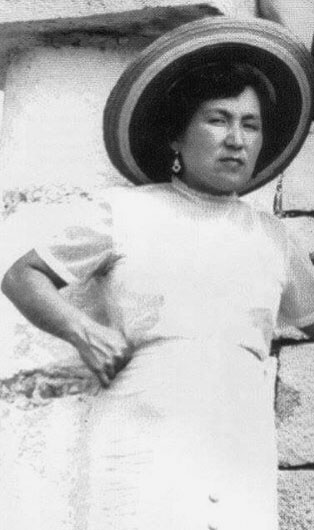
Hilda Gadea Acosta (21 March 1921 – 11 February 1974)[1][2] was a Peruvian economist, and author. She was the first wife of the revolutionary Che Guevara.
Key Information


Gadea Acosta was Secretary of the Economy of the Executive National Committee for Alianza Popular Revolucionaria Americana (APRA, American Popular Revolutionary Alliance).[2] Her activities in Peru led to her exile in 1948. She first met Guevara in Guatemala in December 1953.[2][3] Gadea and Guevara moved to Mexico due to pressure from their politics. She introduced Guevara to several Cuban rebels.
Gadea married Guevara in Mexico in September 1955, after learning she was pregnant. The marriage ended in a divorce in May 1959. They had a daughter named Hilda Beatriz "Hildita" Guevara Gadea in February 1956 who died of cancer in 1995.[4]
Following the Cuban Revolution, in which Guevara fought, Gadea came to Cuba, to be confronted with the announcement by Guevara that he had fallen in love with another woman, Aleida March, and requested a divorce. Gadea remained loyal to Guevara's political movement; she died in Havana in 1974.[4] She wrote the memoir My Life With Che.[2] Gabriel San Roman, a writer for Z Magazine, began writing a play about Gadea.[5]
References
[edit]- ^ Gadea, Hilda (30 September 2008). My Life With Che. Pen & Sword Books Limited. ISBN 978-1-78383-722-9.
- ^ a b c d "My Life With Che Archived 2009-09-22 at the Wayback Machine." Macmillan; retrieved 23 February 2009.
- ^ "Rebel Wife", The Washington Post; retrieved 23 February 2009.
- ^ a b Snow, Anita. My Life With Che Deprecated link archived 5 December 2012 at archive.today by Hilda Gadea" (Associated Press), WJXX-TV. 16 August 2008; retrieved 23 February 2009.
- ^ San Román, Gabriel. "On the Roadshow with Che Archived 2009-10-01 at the Wayback Machine." Z Magazine. February 2009; retrieved 23 February 2009.
| Events |  | |
|---|---|---|
| Ideas | ||
| People | ||
| Books | ||
| Films | ||
| Theatre | ||
| Iconography | ||
| Comics | ||

| International | |
|---|---|
| National | |
| Academics | |
| Other | |

  | This article about a Peruvian politician is a stub. You can help Wikipedia by adding missing information. |
Hilda Gadea
View on GrokipediaEarly Life and Education
Birth and Family Background
Hilda Gadea Acosta was born on March 21, 1925, in Lima, Peru.[2] She grew up as the eldest of seven siblings in a humble family originating from the outskirts of Lima, where economic constraints shaped early experiences amid Peru's socio-political turbulence of the 1920s and 1930s.[4][5] Limited records detail her parents' professions or ethnic heritage beyond typical mestizo influences common in working-class Limeño families, though no verified claims of specific Asian or indigenous ancestries beyond standard Peruvian demographics have been substantiated in primary accounts.[6]Academic Training and Early Influences
Hilda Gadea Acosta pursued her higher education in economics at the Universidad Nacional Mayor de San Marcos in Lima, Peru, entering the Faculty of Economic Sciences around 1940.[7] She completed her studies to become a licenciada en economía, establishing a foundation in economic theory that informed her later professional roles in policy and analysis.[8] This institution, one of Latin America's oldest universities, provided a rigorous academic environment amid Peru's turbulent interwar and postwar periods, where economic curricula often intersected with discussions of national development and inequality.[9] During her university years, Gadea was profoundly influenced by the Alianza Popular Revolucionaria Americana (APRA), a political movement founded in 1924 by Víctor Raúl Haya de la Torre, emphasizing anti-imperialism, indigenous rights, and continental solidarity against U.S. dominance.[10] As a student leader at San Marcos, she actively promoted APRA's principles, engaging in campus activism that aligned economic reform with revolutionary nationalism, though APRA's doctrinal blend of Marxism, populism, and anti-oligarchic stance drew persecution from Peru's conservative governments.[8] This early immersion shaped her worldview, transitioning her from academic pursuits to committed political organizing, with APRA's focus on structural economic change providing a causal framework for her critiques of dependency and underdevelopment in Latin America.[9]Political Involvement in Peru
Affiliation with APRA
Hilda Gadea Acosta joined the Alianza Popular Revolucionaria Americana (APRA) during her university years at the Universidad Nacional Mayor de San Marcos in Lima, where she studied economics and engaged in party activities through its youth wing.[11] Her involvement reflected APRA's emphasis on anti-imperialism, social reform, and continental solidarity against U.S. influence, principles articulated by founder Víctor Raúl Haya de la Torre since the party's establishment in 1924.[12] Upon graduating with a degree in economics in 1948, Gadea ascended to a prominent role as the first woman appointed to the party's Executive National Committee, serving as Secretary of the Economy.[13] In this position, she contributed to APRA's economic policy formulation amid Peru's political turbulence, including efforts to mobilize support for agrarian reform and labor rights, aligning with the party's populist platform.[2] Her rapid rise underscored APRA's inclusion of educated women in leadership, though the party faced systemic repression from conservative governments wary of its radical rhetoric.[14] Gadea's affiliation deepened her commitment to APRA's revolutionary ideals, but it also exposed her to persecution as the party clashed with Peru's ruling elites, culminating in events that prompted her departure from the country later that year.[12] Despite exile, her foundational ties to APRA influenced her subsequent political trajectory in Guatemala and beyond.[11]Leadership Roles and the 1948 Coup
Gadea Acosta emerged as a prominent figure within Peru's Alianza Popular Revolucionaria Americana (APRA), a political party founded in 1924 advocating for anti-imperialist reforms and continental solidarity. As a university student at San Marcos in Lima, she joined the Juventud Aprista, the party's youth organization, where her oratory skills propelled her to leadership roles in organizing student activism and party cadre activities during the mid-1940s.[11] By the late 1940s, Gadea had ascended to the national level, becoming the first woman appointed as Secretary of the Economy on APRA's Executive National Committee, responsible for economic policy formulation and analysis amid the party's push for agrarian reform and industrialization. In this capacity, she contributed to APRA's platform during the brief period of democratic governance under President José Luis Bustamante y Rivero (1945–1948), whose administration tolerated limited APRA participation despite underlying tensions. Her role involved coordinating economic arguments against oligarchic interests, drawing on her economics training to critique Peru's export-dependent economy.[15] The October 29, 1948, military coup led by General Manuel A. Odría dismantled Bustamante's government, targeting APRA as a primary threat due to its mass mobilization and perceived radicalism, which Odría's regime framed as subversive. The coup initiated the "Ochenio de Odría" (Odría Decade), marked by martial law, censorship, and systematic persecution of APRA leaders, including arrests, exiles, and violent suppression of party networks. Gadea's high-profile position exposed her to immediate risk; her political activities prompted authorities to force her into exile shortly after the takeover, compelling her to flee Peru for Guatemala via clandestine routes to evade capture. This event severed her direct involvement in Peruvian politics, scattering APRA cadres and undergrounding the party until the 1950s.[14]Exile and Guatemala Period
Work in the Arbenz Administration
Following her exile from Peru after the 1948 coup against the Alianza Popular Revolucionaria Americana (APRA), Hilda Gadea Acosta arrived in Guatemala, where she obtained a position as an economist at the Instituto de Fomento de la Producción (INFOP).[16] This agency, founded during President Juan José Arévalo's tenure (1945–1951) to promote industrial development and national production through initiatives like import substitution and infrastructure support, continued operations under Jacobo Árbenz Guzmán, who took office on March 15, 1951.[17] Gadea's expertise in economics, gained from her studies at the Universidad Nacional Mayor de San Marcos, positioned her to contribute to policy efforts aimed at economic diversification amid Guatemala's agrarian economy. During the Árbenz administration, Gadea's role at INFOP aligned with broader reforms, including the promotion of domestic manufacturing and agricultural productivity enhancements, though her specific responsibilities focused on economic analysis and planning rather than direct policymaking.[18] The government's Decree 900, enacted on June 17, 1952, redistributed over 1.5 million acres of uncultivated land from large estates—primarily affecting foreign-owned plantations like those of the United Fruit Company—to some 100,000 peasant families, reflecting a commitment to reducing rural inequality and boosting output. While INFOP supported complementary industrial goals, Gadea's work as a mid-level official involved technical support for production incentives, consistent with APRA's nationalist economic principles that emphasized state intervention against foreign dominance.[19] Gadea's tenure ended abruptly with the CIA-orchestrated coup of June 27, 1954, which ousted Árbenz and led to the purging of reformist officials, including her as a perceived leftist influence.[20] This event, driven by U.S. concerns over expropriations and alleged communist ties—despite Árbenz's democratic election and the reforms' focus on idle lands—underscored the administration's vulnerability to external pressures, with INFOP's initiatives curtailed under the ensuing military regime. Her experience in Guatemala reinforced her advocacy for anti-imperialist economic policies, informed by direct observation of reformist governance's challenges.Meeting Ernesto "Che" Guevara
Hilda Gadea first met Ernesto Guevara in Guatemala City in December 1953, amid the community of Latin American political exiles drawn to President Jacobo Árbenz's reformist administration.[21][13] Gadea, a Peruvian economist exiled for her APRA affiliations, held a position in the government's Instituto de Fomento de la Producción, analyzing agrarian reforms.[22] Guevara, an Argentine physician who had arrived in Guatemala in July 1953 to study its social experiments, sought connections within leftist circles and encountered Gadea through shared exile networks.[23] Their initial interaction centered on political discussions, with Gadea recalling Guevara's intense focus on Guatemala's land redistribution and anti-imperialist policies.[24] Despite Guevara's private diary noting her physical unattractiveness alongside intellectual appeal—"a pity she's so ugly" but capable—their shared ideological commitment fostered rapport.[14] Gadea soon introduced Guevara to other exiles, including Nicaraguan Myrna Torres and Cuban revolutionaries linked to the Castro brothers, broadening his exposure to armed struggle advocates.[22][25] This encounter marked a pivotal shift for Guevara, transitioning from observer to active revolutionary amid the escalating U.S.-backed opposition to Árbenz, which culminated in the 1954 coup.[21] Gadea's memoirs describe how the meeting evolved into collaboration, as they analyzed the regime's vulnerabilities and Guevara's critiques of its hesitancy deepened his radicalization.[13] Their bond strengthened through joint efforts to support Árbenz's defenders, setting the stage for their joint exile to Mexico.[24]Personal Relationships and Family
Courtship and Marriage to Guevara
Following the overthrow of the Arbenz government in Guatemala in June 1954, Hilda Gadea and Ernesto Guevara relocated to Mexico City as political exiles, where their initial acquaintance blossomed into a romantic partnership amid shared leftist ideals and mutual support in a foreign environment.[26][27] In Mexico, Guevara secured employment as a physician at the General Hospital, while Gadea pursued economic research and APRA-related activities; their cohabitation and frequent political discussions deepened their connection, with Gadea influencing Guevara's growing commitment to armed revolution.[24] Despite Guevara's private diary entries critiquing Gadea's physical appearance—once noting "it's a pity she's so ugly"—their relationship progressed, reflecting a pragmatic alliance rooted in ideology rather than conventional romance.[14] By mid-1955, upon Gadea's discovery of her pregnancy, the couple formalized their union through a civil ceremony on August 18, 1955, in Tepotzotlán, State of Mexico, officiated simply with witnesses including Raúl Castro; the marriage certificate, preserved as a historical document, confirms the event's modest nature amid their precarious exile circumstances.[28][29] This union, prompted largely by impending parenthood, provided familial stability as Guevara prepared for involvement with Cuban revolutionaries, though Gadea later portrayed it in her 1972 memoir My Life with Che as a pivotal phase in his ideological evolution.[3][24]Daughter and Marital Dissolution
Hilda Gadea and Ernesto "Che" Guevara welcomed their only child together, daughter Hilda Beatriz "Hildita" Guevara Gadea, on February 15, 1956, in Mexico City.[30][31] The birth followed their civil marriage on September 18, 1955, in Tepotzotlán, Mexico, prompted by Gadea's pregnancy earlier that year.[6][32] Guevara's commitment to the Cuban revolutionary expedition led him to depart Mexico for the Sierra Maestra in November 1956, effectively separating the family geographically during the insurgency.[31] Upon the rebels' victory, Gadea arrived in Havana with their three-year-old daughter on January 21, 1959.[33] She consented to a divorce shortly thereafter, finalized on June 2, 1959, enabling Guevara to wed Aleida March, with whom he had begun a relationship during the guerrilla campaign.[33][31] Despite the dissolution, Guevara maintained paternal affection, as evidenced by a letter he wrote to Hildita from the Bolivian jungle on her tenth birthday in 1966.[34] Gadea remained in Cuba post-divorce, pursuing professional work and authoring memoirs while sustaining occasional contact with her ex-husband.[31] Their daughter later resided in Havana until her death on August 21, 1995, at age 39.[30]Role in the Cuban Revolution
Support for the Castro Brothers
In Mexico City, following the 1954 overthrow of the Arbenz government in Guatemala, Hilda Gadea integrated into the community of Latin American political exiles, where she encountered Fidel and Raúl Castro shortly after their amnesty and release from Cuban prisons in May 1955.[35] As an active APRA militant with experience in revolutionary organizing, Gadea forged close ties with the Castro brothers, who were planning the invasion of Cuba to overthrow Fulgencio Batista.[21] She played a pivotal role in connecting Ernesto "Che" Guevara to Fidel Castro, introducing him to the group of Cuban exiles—including participants in the 1953 Moncada Barracks attack—and facilitating Guevara's eventual integration into the 26th of July Movement's preparations for the Granma expedition.[21] [35] Gadea's support extended to formalizing her alignment with the movement; in September 1955, she married Guevara in a civil ceremony attended by Raúl Castro as best man, underscoring the personal and ideological bonds within the exile network.[35] From Peru, where she maintained APRA connections despite her exile status, Gadea served as the official representative of the 26th of July Movement, promoting its anti-Batista campaign through propaganda, recruitment efforts, and logistical support until the rebels' triumph on January 1, 1959.[11] Her contributions from abroad included aiding in the dissemination of the movement's message and mobilizing international solidarity among leftist exiles, though specific fundraising totals or recruitment figures attributable to her remain undocumented in primary accounts.[36] This role positioned her as a key transnational link, leveraging her Peruvian networks to bolster the Castros' insurgent apparatus without direct participation in the Sierra Maestra campaigns.[37]Contributions During and After the Revolution
During the armed phase of the Cuban Revolution from 1956 to 1959, Hilda Gadea acted as the representative of the 26th of July Movement in Peru, coordinating political support, propaganda efforts, and logistical assistance for Fidel Castro's guerrilla campaign against Fulgencio Batista's dictatorship from exile.[11] Her activities included mobilizing Peruvian sympathizers and APRA networks to raise awareness and resources, leveraging her position in leftist circles to amplify the movement's international profile amid Batista's repression.[11] Following the revolutionaries' victory on January 1, 1959, Gadea arrived in Havana shortly thereafter with her daughter Aleida Beatriz, born in 1956, to join the new government.[38] Despite her divorce from Ernesto Guevara on June 2, 1959, she remained in Cuba and secured her initial role at the Instituto Nacional de Reforma Agraria (INRA), the agency tasked with implementing land redistribution and agricultural restructuring as core pillars of the post-revolutionary economy.[35] [11] As an economist, Gadea applied her expertise in statistical analysis and policy planning—honed during her APRA tenure and Guatemalan exile—to support INRA's operations, including housing construction for rural workers and data-driven evaluations of expropriated estates, though the reforms faced implementation challenges like inefficiencies in collectivization.[11] Her contributions aided the rapid nationalization of over 1 million hectares of farmland by mid-1959, aligning with the government's push for socialist agrarian transformation.[35]Later Career and Writings in Cuba
Economic and Political Positions
Gadea held socialist economic views emphasizing state-led reforms, land redistribution, and industrialization in developing nations, influenced by her experience in Peru's APRA party and Guatemala's Arbenz administration. As secretary of the economy for APRA's executive committee, she advocated policies promoting popular sovereignty and anti-imperialist development, though APRA's approach prioritized national bourgeois alliances over immediate proletarian revolution. In Cuba, she applied these principles at the National Institute of Agrarian Reform (INRA), where she contributed to post-revolutionary land expropriations and rural housing initiatives, aligning with the government's aim to dismantle latifundia systems and foster cooperative production.[11] Politically, Gadea identified as a Marxist with Trotskyist sympathies, favoring permanent revolution, internationalism, and opposition to bureaucratic centralism in socialist states. She viewed revolutions in peripheral economies as inherently socialist, requiring democratic workers' control to avoid Stalinist distortions, a perspective she imparted to Guevara during their time together.[39][40] Despite these leanings, she integrated into Cuba's revolutionary framework post-1959, representing the 26th of July Movement abroad and maintaining loyalty to its leadership without public schisms.[11] In her 1972 memoirs, My Life with Che, Gadea portrayed socialism as a practical necessity for Latin American independence, critiquing U.S. dominance while stressing disciplined implementation over idealism; she described herself as more pragmatic than Guevara, prioritizing institutional roles amid revolutionary fervor.[3] This reflected her broader stance against dogmatic orthodoxy, though she endorsed Cuba's model as a viable anti-imperialist path, evidenced by her continued residence in Havana until her death.[41]Publication of Memoirs
Gadea published her memoirs, originally titled Che Guevara: Años decisivos in Spanish, in 1972, with the English translation Ernesto: A Memoir of Che Guevara released that same year by Doubleday.[42][43] The work chronicles her personal and political life with Guevara from their 1954 meeting in Guatemala City, where she encountered him through leftist exile circles, through their courtship, marriage in Mexico in 1955, and the birth of their daughter Hildita in 1956, up to his departure for the Cuban revolutionary expedition with Fidel Castro.[3] Drawing on private correspondence, daily interactions, and shared exile experiences amid the 1954 CIA-backed overthrow of Guatemala's Jacobo Árbenz government—which Gadea served as an economic advisor for—the memoirs depict Guevara's ideological shift from an asthmatic Argentine intellectual skeptical of Soviet communism to a resolute anti-imperialist committed to armed struggle across Latin America.[44] The publication occurred while Gadea resided in Havana, Cuba, where she had relocated post-revolution and held positions in economic planning under Guevara's influence, though by then their marriage had ended amicably in 1959.[24] Despite her proximity to the Cuban regime, the memoirs avoid overt hagiography, presenting Guevara as a principled but human figure—romantic, paternal, and intolerant of personal betrayal—without evident resentment toward his later abandonment of family for revolutionary pursuits or his second marriage to Aleida March. Gadea attributes Guevara's radicalization to direct exposure to U.S. interventionism in Guatemala, where he witnessed the destruction of agrarian reforms she helped design, fostering his view of multinational corporations as extensions of Yankee dominance. A revised English edition, My Life with Che: The Making of a Revolutionary, appeared in 2008 via Palgrave Macmillan, including a foreword by Gadea's brother Ricardo Gadea Acosta, who contextualized her narrative against post-Guevara hagiographies that often idealized him at the expense of factual personal history.[3] The memoirs stand as a primary source for Guevara's formative years, corroborated by contemporaneous letters and exile testimonies, though critics note their insider perspective may underemphasize his early flirtations with Trotskyism or personal flaws like emotional detachment.[45] Published two years before Gadea's death from cancer on February 11, 1974, at age 48, the book received limited initial circulation outside leftist circles but gained retrospective value for humanizing a figure mythologized in revolutionary lore.[21]Death and Immediate Aftermath
Health Decline and Demise
Hilda Gadea succumbed to cancer on February 11, 1974, in Havana, Cuba, at the age of 48.[41][21] She had continued residing in Cuba after her divorce from Ernesto Guevara, maintaining loyalty to the revolutionary government and publishing her memoir Che Guevara: Years of Decision in 1972, which detailed their early relationship and shared political experiences.[41] Limited public records exist on the specific timeline of her diagnosis or the progression of her illness, though she remained active in intellectual and political circles until shortly before her death.[21]Funeral and Official Tributes
Hilda Gadea Acosta died of cancer in Havana on February 11, 1974, at the age of 48.[8][41] Details regarding her funeral arrangements remain sparsely documented in accessible historical records, with no evidence of a state-sponsored ceremony or extensive media coverage in Cuban outlets such as Granma. This paucity of information aligns with the Cuban regime's historiographical tendencies to prioritize native-born leaders and central revolutionary icons like Fidel Castro and Che Guevara himself, often marginalizing supporting expatriate figures regardless of their loyalty. Gadea's prior contributions, including her work in government propaganda and the 1972 publication of her memoir Mi vida con el Che, received some recognition during her lifetime, but no prominent post-mortem tributes from high-ranking officials are attested. Her daughter, Hilda Beatriz "Hildita" Guevara Gadea, who shared her commitment to the revolutionary cause, continued residing in Cuba until her own death in 1995.[30]Legacy and Critical Assessment
Influence on Guevara's Ideology
Hilda Gadea Acosta, a Peruvian economist affiliated with leftist exile groups, met Ernesto "Che" Guevara in Guatemala City in December 1953 while working in the reformist administration of President Jacobo Árbenz Guzmán.[26] Their relationship facilitated Guevara's immersion in Marxist study and anti-imperialist circles, accelerating his ideological commitment beyond the anti-capitalist sentiments he had developed during his earlier travels across Latin America.[46] Gadea, who had studied political science and aligned with Marxist-inclined Peruvian nationalism before evolving toward more radical views, served as an informal tutor, providing Guevara with foundational texts and discussions that deepened his understanding of class struggle and revolutionary praxis.[47][40] Gadea loaned Guevara writings by José Carlos Mariátegui, the Peruvian Marxist thinker whose indigenist and anti-imperialist framework emphasized adapting socialism to Latin American realities rather than rigid Soviet models.[48] This exposure reinforced Guevara's emerging critique of imperialism as a systemic economic force, influencing his later advocacy for continental unity against U.S. dominance, though Guevara had already encountered similar ideas in works by authors like Pablo Neruda during his motorcycle journey.[48] In her 1977 memoir My Life with Che, Gadea recounts how she challenged Guevara's initial romantic individualism, steering him toward disciplined Marxist analysis during their time in Guatemala and subsequent exile in Mexico.[49] The 1954 CIA-orchestrated coup against Árbenz, witnessed by both, crystallized Guevara's radicalization, with Gadea's networks connecting him to Cuban exiles like Raúl and Fidel Castro.[21] She advocated a heterodox Marxism skeptical of Stalinist bureaucracy, attempting to orient Guevara toward critiques of Soviet deviations from orthodox principles, though his ideology ultimately synthesized these influences with foco guerrilla theory.[50] This period marked Gadea's pivotal role in transitioning Guevara from observer to activist, evident in his post-Guatemala writings decrying "Yankee imperialism" as the root of Latin American underdevelopment.[51] Their marriage on September 18, 1955, in Mexico City further embedded these shared views, though Guevara's field experiences would later diverge from Gadea's more institutional economic perspectives.[49]Achievements Versus Failures of Affiliated Movements
Hilda Gadea's affiliations extended to Peru's APRA movement, the reformist government of Jacobo Árbenz in Guatemala, and the Cuban Revolution through her marriage to Ernesto Guevara and subsequent support for its outcomes. The APRA, founded in 1924 as an anti-imperialist, populist force advocating Indo-American unity and social reforms, achieved limited electoral gains but faced systemic repression, including a 1932 massacre of supporters and bans until 1980.[52] When APRA's Alan García assumed Peru's presidency in 1985, heterodox policies like price controls, wage hikes, and partial debt repudiation triggered hyperinflation reaching 7,650% annually by 1990, a 25% contraction in GDP, and a 40% drop in real wages, exacerbating poverty and Shining Path insurgency.[53] [54] These failures stemmed from fiscal indiscipline and rejection of market-oriented adjustments, undermining APRA's reformist ideals despite initial promises of equitable growth.[55] In Guatemala, Gadea worked for Árbenz's administration (1951–1954), which enacted Decree 900 for agrarian reform, redistributing over 1.5 million acres to about 100,000 peasant families and challenging United Fruit Company's holdings.[35] However, inadequate compensation for expropriations, coupled with expanded state control, alienated domestic elites and prompted U.S.-backed intervention via the 1954 coup, leading to Árbenz's exile, political instability, and a 36-year civil war that claimed 200,000 lives.[56] The movement's collapse highlighted vulnerabilities of unilateral reforms in a geopolitically sensitive context, fostering radicalization among exiles like Guevara but failing to sustain democratic transitions or economic diversification. The Cuban Revolution, which Gadea endorsed post-1959, registered early social gains, including the 1961 literacy campaign that raised rates from 76% in 1953 to near 100% by 1961 through mobilizing 250,000 volunteers to educate 700,000 adults, alongside universal healthcare that elevated life expectancy from 64 years in 1959 to 78 by 2023.[57] [58] Yet these were offset by economic stagnation and authoritarian consolidation: GDP per capita growth averaged just 0.8% annually from 1950–2006, trailing Latin America's 2.5% average, with post-Soviet collapse (1990–1993) seeing a 35% GDP plunge, chronic shortages, and reliance on $4–6 billion yearly Soviet subsidies until 1991.[59] [60] Centralized planning suppressed private incentives, resulting in external debt per capita rising 33-fold from 1958 to 2008, mass emigration of over 2 million (20% of population), and political repression via executions (over 500 post-revolution), labor camps, and one-party rule without competitive elections.[61] Empirically, the revolution prioritized equity over efficiency, yielding improved human development indices at the expense of prosperity and liberties, as evidenced by Cuba's lag behind comparable nations like Costa Rica in both metrics.[62]| Metric | Pre-Revolution (1950s) | Long-Term Post-Revolution Outcome |
|---|---|---|
| Literacy Rate | ~76–80% | 99.8%, but regional peers achieved similar without revolution[62][57] |
| GDP Per Capita Growth (Annual Avg.) | Baseline for comparison | 0.8% (1950–2006), vs. Latin America 2.5%[59] |
| Emigration/Political Dissent | Limited under Batista | 2M+ exiles, ongoing refugee flows[60] |