Hubbry Logo
Civil marriageCivil marriageMain
Open search
Civil marriage
Community hub
Civil marriage
logo
8 pages, 0 posts
0 subscribers
Be the first to start a discussion here.
Contribute something
Civil marriage
Civil marriage
from Wikipedia
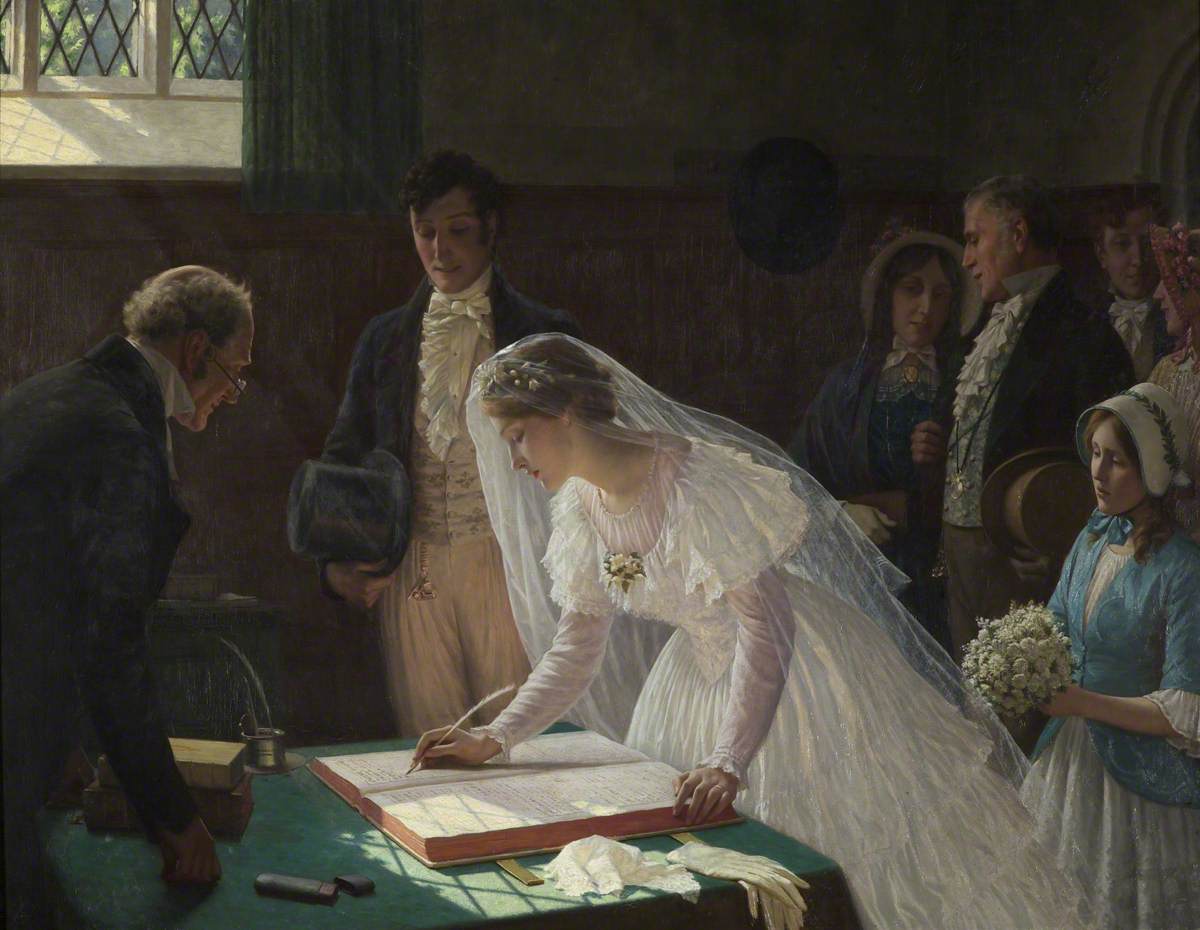
Edmund Leighton, The Wedding Register.

A civil marriage is a marriage performed, recorded, and recognized by a government official.[1] Such a marriage may be performed by a religious body and recognized by the state, or it may be entirely secular, in which it is known as a secular marriage.

History

[edit]

Countries maintaining a population registry of its residents keep track of marital status,[2] and all United Nations (UN) member states except Iran, Somalia, South Sudan, Sudan, and Tonga have signed or ratified either the United Nations Convention on Consent to Marriage, Minimum Age for Marriage, and Registration of Marriages (1962)[3] or the United Nations Convention on the Elimination of All Forms of Discrimination against Women (1979) which carry a responsibility to register marriages.[4] Most countries define the conditions of civil marriage separately from religious requirements. Certain states, such as Israel, allow couples to register only on the condition that they have first been married in a religious ceremony recognized by the state, or were married in a different country.

In England

[edit]

In medieval Europe, marriage was governed by canon law, which recognized only those marriages where the parties stated they took one another as husband and wife as valid, regardless of the presence or absence of witnesses. It was not necessary, however, to be married by any official or cleric. This institution was canceled in England with the enactment of the Marriage Act 1753, which required that, in order to be valid and registered, all marriages were to be performed in an official ceremony in a religious setting recognized by the state, i.e. Church of England, the Quakers, or in a Jewish ceremony. Any other form of marriage was abolished. Children born into unions that were not valid under the act would not automatically inherit the property or titles of their parents. For historical reasons, the act did not apply in Scotland. Consequently, until 1940, it continued to be enough in Scotland for a man and a woman to pledge their commitment to each other in front of witnesses to legalize their marriage. This led to an industry of "fast marriages" in Scottish towns on the border with England; the town of Gretna Green was particularly well known for this. The Marriage Act 1836 removed the requirement that the ceremony takes place in a religious forum, and registrars have given the authority to register marriages not conducted by a religious official.

In other European countries

[edit]
A couple waiting to get married in the town of Alghero on the island of Sardinia, Italy

Many European countries had institutions similar to common-law marriage. However, the Catholic Church forbade clandestine marriage at the Fourth Lateran Council (1215), which required all marriages to be announced in a church by a priest. In 1566, the edict of the Council of Trent was proclaimed denying Catholics any form of marriage not executed in a religious ceremony before a priest and two witnesses.

The Protestant pastor and theologian of Geneva, John Calvin, decreed that in order for a couple to be considered married they must be registered by the state in addition to a church ceremony.

In 1792, with the French Revolution, civil marriage was created in France and made independent from religious marriage which was no more recognised by the French state. In 1802, with the Organic Articles of the Concordat of 1801, Napoleon, advised by Portalis, in order to reconciliate civil and religious marriage in a state-controlled way, stated that religious ceremonies could be performed only for couples who had already been married in a civil ceremony [fr]. Napoleon spread this custom throughout most of Europe. In present-day France, only civil marriage has legal validity for the state. A religious ceremony may be performed only after the civil union, and it has no legal effect for the state. Since 1802 in France, religious ministers celebrating religious marriages without preliminary civil marriages risk criminal sanctions.

In Germany, the Napoleonic Code was valid only in territories conquered by Napoleon. With the fall of his empire, civil marriage in Germany began to die out. However, certain sovereign German states introduced civil marriages, which were either obligatory (like the French model) or optional, with either a religious or civil ceremony being accepted. Already before 1848, the Grand-Duchy of Saxe-Weimar-Eisenach enacted optional civil marriages, followed by the German republics of the Free City of Frankfurt upon Main (1850, obligatory), Free and Hanseatic City of Hamburg (1851, optional) and Free and Hanseatic City of Lübeck (1852, optional). German Grand-Duchies such as Oldenburg (1852/55, optional), Baden (1860), and Hesse (1860) as well as the Kingdom of Württemberg (1863) followed suit.[5] Civil marriages enabled interfaith marriages as well as marriages between spouses of different Christian denominations. After the unification of Germany in 1871, the Reichstag adopted a bill initiated by Chancellor Otto von Bismarck as the "Civil Marriage Law" in 1875 (see: Kulturkampf); since then, only civil marriages have been recognized in Germany. Religious ceremonies may still be performed at the couple's discretion. Until December 31, 2008, religious marriages could not be performed until the couple had first married in a civil ceremony.

In the modern world

[edit]
Civil marriage by country
  State recognizes civil marriages only
  State recognizes both civil and certain religious marriages
  State recognizes civil marriages; no additional information
  State recognizes religious marriages only
  Civil marriages only for foreigners
  Civil marriages only for non-Muslims

England and Wales

[edit]

Today marriages in England or Wales must be held in authorized premises, which may include register offices, premises such as stately homes, castles, and hotels that have been approved by the local authority, churches or chapels of the Church of England or Church in Wales, and other churches and religious premises that have been registered by the registrar general for marriage.[6]

Civil marriages require a certificate and at times a license, that testify that the couple is fit for marriage. A short time after they are approved in the superintendent registrar's office, a short non-religious ceremony takes place which the registrar, the couple, and two witnesses must attend; guests may also be present. Reference must not be made to God or any deity, or to a particular religion or denomination: this is strictly enforced, and readings and music in the ceremony must be agreed upon in advance.[7]

United States

[edit]

Marriage in the United States is largely regulated by state laws, though the Supreme Court has the authority to strike down unconstitutional laws (see Loving v. Virginia and Obergefell v. Hodges).

All states and the District of Columbia, as well as U.S. territories, require a marriage license issued by local civil authorities. As a rule, ministers of religion (e.g., rabbis or pastors) are authorized in law to perform marriages, while such state and local officials as mayors, judges, deputy marriage commissioners, and justices of the peace are empowered to conduct civil wedding ceremonies, which may take place in public offices. Owing to its Quaker heritage, many counties in the Commonwealth of Pennsylvania allow self-uniting marriages for which no official minister is required. The type of ceremony (religious or civil) has no bearing on the legal validity of the marriage, and there is no requirement to precede a religious rite with a civil ceremony.[citation needed] Marriages performed outside of the United States are legally binding if officially recognized by the government of the country in which they are performed.[citation needed]

Countries with mandatory civil marriage

[edit]

In most European and Latin American countries there is a civil ceremony requirement. Religious marriages have no legal effect. For some countries, there is an obligation of priority of civil marriage over religious marriage [fr]. Such ceremonies, however, only serve to provide religious recognition of the marriage already recognized by the state. In countries such as Belgium and the Netherlands, most couples marry without any religious ceremony at all.[8] Full formal weddings, complete with wedding gowns and the presence of family and friends, are usually conducted in special ceremonial rooms in the town hall.[citation needed]

Countries with no civil marriage

[edit]

There is no civil marriage in many Middle Eastern countries, including Jordan,[9] Palestine, Saudi Arabia, Qatar, Iran, Lebanon, and Israel, as well as Libya and Indonesia;[10] all marriages are conducted by religious authorities and registered by civil authorities only after having been registered by authorities of officially approved religions or having been registered abroad. Israel and Lebanon officially recognize Islam, Christianity, Druze, and Judaism as different religious sects within the legal system; marriage is only possible within the same religion but allowed between different denominations of that religion.[11] In Lebanon, depending on gender and religion, interfaith marriages are permissible. A Muslim man may marry a Christian or Jewish woman, but a Muslim woman may not marry outside her faith. Druze themselves only permit intrafaith marriages. In Lebanon, gender and religion intersect in legal affairs. This intersection is captured by the concept of Sextarianism, which highlights that sectarian divisions and gender inequalities both are reinforced by personal status laws.[12] Lebanon does recognise civil marriages performed abroad,[13] but only if the parties to the marriage physically travel outside of Lebanon, which is unfeasible if they are denied a passport by the General Directorate of General Security.[14] By contact, Israeli law recognizes any marriage conducted abroad, even those officiated remotely by video conference in which the parties do not physically leave Israel. Malaysia and the United Arab Emirates allow civil marriage for non-Muslims only,[15] while in Kuwait, Bahrain and Afghanistan[16] it is allowed for foreign citizens only.

Civil marriage and other unions of same-sex couples

[edit]
People leaving the town hall of Høje-Taastrup, Denmark following a civil marriage

As of January 2025, the following jurisdictions permit same-sex marriages:

In 22 countries worldwide and in several jurisdictions within Mexico, a same-sex couple can be legally partnered in a civil union, domestic partnership or registered partnership. Couples in these unions or partnerships are afforded rights and obligations similar to, but not identical to, those of a married couple.

See also

[edit]

Notes

[edit]

References

[edit]

Bibliography

[edit]
[edit]
Revisions and contributorsEdit on WikipediaRead on Wikipedia
from Grokipedia

Civil marriage is a legally binding union between two individuals solemnized by a , such as a registrar, , or , establishing a civil that confers specific and obligations under secular , distinct from religious ceremonies which may lack automatic legal recognition without state registration. This form of marriage prioritizes state oversight to ensure mutual consent, capacity of parties, and public recording, serving as the foundational mechanism for legal spousal benefits including property division, inheritance, tax advantages, and parental .
Historically, civil marriage emerged as a secular alternative to unions during the Enlightenment and revolutionary periods, with instituting mandatory civil ceremonies in 1792 to assert state authority over personal status independent of the Church. In , the Marriage Act of 1836 formalized , allowing non-religious solemnization while requiring civil oversight for validity. This separation reflected broader efforts to disentangle religious doctrine from civil governance, enabling marriages across faiths or for non-believers, though in practice, many jurisdictions now require religious ceremonies to include for legal effect. In contemporary law, civil marriage delineates eligibility through criteria like minimum age, absence of close , and—until recent decades in many nations—opposite-sex pairing, with variations reflecting empirical societal norms on family stability and procreation rather than uniform global standards. Controversies arise over expansions, such as same-sex inclusion, which have prompted debates on redefining the institution's core contractual purpose, often pitting state uniformity against traditional definitions rooted in biological complementarity. Key achievements include universal access to legal protections in secular contexts, yet challenges persist where civil recognition clashes with religious freedoms or where enforcement varies, underscoring marriage's role as a state-regulated for regulating , child-rearing, and economic partnerships.

Definition and Core Features

Civil marriage constitutes the legal union of two individuals, established through mutual and governed by state or national statutes as a civil or status. This union requires legal capacity, such as minimum age and absence of prohibited relationships, and typically involves formalities like obtaining a and solemnization by an authorized . Unlike religious ceremonies, civil marriage derives its validity solely from secular , imposing reciprocal and duties including spousal support, privileges, and shared interests. The primary purpose of civil marriage lies in regulating interpersonal and familial relations to serve broader societal interests, such as ensuring the orderly transfer of property, legitimizing offspring for and custody purposes, and fostering stable economic units. State regulation aims to preserve moral and civil order by channeling potentially procreative relationships into committed frameworks, historically emphasizing responsible procreation and child-rearing within recognized unions. This framework provides legal predictability in dissolution through proceedings, tax treatments, and spousal benefits in areas like and healthcare. By conferring status rather than mere private agreement, civil marriage enables enforcement of obligations and access to entitlements not replicable through contracts alone, underscoring the state's role in promoting stability and welfare over in relational matters. Empirical rationales for state involvement include reduced social costs from unstable unions, as evidenced in legal precedents linking to procreative responsibilities.

Distinctions from Religious and Common-Law Unions

Civil marriage is fundamentally secular, deriving its validity exclusively from state statutes and administered by civil authorities such as registrars or judges, thereby separating legal recognition from any religious or doctrinal framework. In contrast, religious unions are solemnized under the rites and authority of a specific tradition, often by , and their legal effects depend on jurisdictional rules—many require concurrent or prior to confer state-recognized rights like spousal inheritance, tax filings, or immigration benefits. Where religious officiants are state-authorized, such as in much of the , a religious can simultaneously fulfill civil requirements if a license is obtained and filed, blurring the lines but underscoring that the state's , not the alone, establishes enforceability. Certain jurisdictions mandate civil marriage as a prerequisite for legal validity, rendering standalone religious ceremonies insufficient. In France, civil marriage was introduced on September 3, 1791, via revolutionary legislation desacralizing unions, and remains obligatory under Article 433 of the Napoleonic Code (1804), prohibiting religious rites without prior civil solemnization under penalty of fines up to €7,500 and imprisonment. Similar mandates apply in Italy (Civil Code Article 83, requiring civil before religious) and Germany (Civil Status Act §13), where unregistered religious unions hold no civil standing, ensuring state neutrality and preventing faith-based variances in legal outcomes. Civil marriage further differs from common-law unions, which emerge informally through and intent without mandatory licensing, ceremonies, or registration. As of 2025, is recognized in eight U.S. jurisdictions—, , , , New Hampshire (for post-1968 deaths), , , and of Columbia—generally necessitating at least one year of (varying by state), mutual consent to , and consistent public portrayal as spouses. In these areas, valid common-law unions yield identical legal consequences to civil marriages, including equitable property division upon dissolution, yet lack the documentary trail of civil proceedings, complicating proof and portability across non-recognizing states. Elsewhere, prolonged confers no marital , distinguishing it sharply from civil marriage's formalized entry into state oversight.

Historical Development

Origins in Enlightenment-Era

The Enlightenment's emphasis on reason, individual autonomy, and laid the intellectual foundation for civil marriage as a secular institution governed by civil law rather than religious authority. Thinkers like advocated for the desacralization of , arguing it should be treated as a focused on mutual consent and societal utility, free from clerical oversight that often enforced indissolubility and doctrinal restrictions. This perspective aligned with broader critiques of power, portraying as a rational agreement for procreation, , and companionship, rather than a divine . These ideas materialized during the , when revolutionaries sought to dismantle the Catholic Church's monopoly on personal status laws amid efforts to establish a secular . On September 3, 1791, the decreed civil marriage as the sole legally binding form, requiring couples to declare their union before municipal officials, with records maintained in state registries; religious ceremonies, if desired, became optional and subordinate to civil validation. This reform, enacted via the Constitution of 1791's civil provisions, aimed to ensure equality under law by removing barriers like consanguinity rules tied to and enabling , which was legalized on September 20, 1792, further underscoring marriage's contractual, revocable nature. The French model influenced subsequent European reforms by demonstrating how could regulate marriage to align with Enlightenment principles of and rationality, though implementation faced resistance from conservative and monarchists who viewed it as an assault on traditional moral order. Early adoptions remained limited outside revolutionary until the , as absolutist regimes elsewhere preserved church dominance over matrimonial rites.

19th-Century Institutionalization

The institutionalization of in the originated in revolutionary France, where the established marriage as a purely civil on 20 September , permitting unions without religious ceremonies and conducted solely before civil officials. This decree marked a decisive separation from authority, reflecting Enlightenment principles of state sovereignty over personal status laws. The reform facilitated easier divorce and emphasized contractual equality, though subsequent Napoleonic adjustments reintroduced patriarchal elements. These French innovations were systematized in the of 1804, promulgated under , which required all marriages to be registered civilly by municipal officers, rendering religious rites optional and non-binding for legal validity. The stipulated minimum ages of 18 for men and 15 for women, with needed until majority, and imposed civil effects like unless specified otherwise. Exported through conquests to regions including the , , and parts of , the embedded civil marriage as a , standardizing procedures and prioritizing secular documentation over traditional customs. Beyond Napoleonic influence, other European states adopted similar frameworks to assert national control and accommodate religious pluralism. In the United Kingdom, the Marriage Act 1836 authorized civil ceremonies in newly established register offices across towns and cities, offering a non-religious alternative primarily for nonconformists and enabling legal recognition without Anglican rites. This Act required banns or licenses and superintendent registrar oversight, integrating civil registration with vital statistics for administrative efficiency. By mid-century, such reforms had proliferated, with compulsory civil preliminaries emerging in unified Italy to consolidate state authority over family law amid post-1815 restorations. These developments underscored a broader trend toward secular governance, where civil marriage served as a tool for uniformity, record-keeping, and reducing clerical influence on societal institutions.

20th- and 21st-Century Expansions and Reforms

In the , civil marriage underwent significant reforms emphasizing individual autonomy and reduced state entanglement with religious norms, particularly through liberalization of laws. California's 1969 adoption of , signed by Governor , allowed dissolution without proving or cruelty, marking a shift from fault-based systems rooted in influences. This model proliferated across U.S. states, with all 50 implementing no-fault provisions by 1985, correlating with divorce rates peaking at 5.3 per 1,000 population in 1981 before declining to 2.5 by 2021. Similar reforms occurred in ; the UK's introduced no-fault grounds, reflecting broader secular trends where civil ceremonies surpassed religious ones in popularity by the late 20th century. These changes prioritized personal choice over moral fault, though empirical data indicate they contributed to higher marital instability, with U.S. divorce rates doubling from 1960 to 1980. Reforms also addressed discriminatory barriers, such as bans on interracial unions. In the U.S., the Supreme Court's 1967 decision invalidated state laws prohibiting marriages between whites and non-whites, which had persisted in 16 states until then, affecting an estimated 1-2% of couples seeking pre-ruling. Globally, Latin American countries, where civil marriage had been mandatory since the in nations like (1859) and (1888), saw 20th-century updates for ; for instance, Brazil's 1916 revisions granted women fuller property rights in civil unions, aligning with suffrage gains in 1932. In , Mustafa Kemal Atatürk's 1926 imposed mandatory civil marriage, abolishing and religious courts, influencing secular models in the amid modernization efforts. These expansions decoupled civil marriage from religious exclusivity, fostering state monopolies on legal validity in over 20 European and Latin American jurisdictions by mid-century. The 21st century featured expansions to include same-sex couples, redefining civil marriage's eligibility criteria in response to advocacy for contractual equality. The Netherlands pioneered legal same-sex civil marriage on April 1, 2001, followed by Belgium (2003), Spain and Canada (2005), South Africa (2006), and 28 more countries by 2023, encompassing 1.2 billion people or 15% of the global population. In the U.S., the 2015 Obergefell v. Hodges Supreme Court ruling mandated nationwide recognition, overriding state bans and enabling approximately 700,000 same-sex couples to marry by 2020. Proponents cited equal protection under civil law, yet critics, drawing parallels to no-fault divorce's unintended rise in family fragmentation, argued such reforms erode traditional marital norms without empirical evidence of societal benefits beyond individual access; studies post-legalization show no measurable harm to opposite-sex marriage rates but limited data on long-term child outcomes. Concurrently, some jurisdictions introduced civil partnerships as precursors, such as France's 1999 PACS (civil solidarity pact), which by 2020 accounted for 10% of formal unions, offering opt-in alternatives to full marriage for cohabiting pairs. These developments underscore civil marriage's evolution toward contractual flexibility, though adoption varies, with mandatory civil preliminaries persisting in Italy (post-1865) and Greece to ensure legal primacy over religious rites.

Universal Elements Across Jurisdictions

Civil marriage, as a state-recognized union, universally requires the voluntary and of both parties, ensuring no or incapacity affects the agreement. This must be expressed freely, with both individuals possessing the mental competence to understand the contract's implications, a standard upheld to prevent voidable unions. A minimum age threshold applies globally, typically set at 18 years for both parties, though some jurisdictions permit younger marriages with judicial or parental approval; this aims to protect minors from premature commitments. Prohibitions on or are near-universal, requiring proof of single status through affidavits or certificates of no impediment to verify no existing valid exists. Formalization occurs via a or declaration before an authorized government official, such as a registrar, culminating in the signing of a marriage register or equivalent document. This process ensures public recordation, with issuance of a serving as official proof of the union's validity. Upon completion, the state confers legal rights and obligations, including spousal inheritance, tax benefits, and decision-making authority in matters like healthcare. Eligibility excludes close blood relatives to avoid incestuous unions, a restriction grounded in genetic and social stability concerns, enforced through or oaths. While specifics like waiting periods or medical tests vary, the core procedural integrity—verification of eligibility, consensual formalization, and state registration—remains consistent to guarantee enforceability across borders where recognized.

Variations in Eligibility, Ceremonies, and Dissolution

Eligibility for civil marriage encompasses requirements related to age, relational prohibitions, capacity, and in some systems, biological sex composition, with notable jurisdictional differences. A minimum 18 prevails without exceptions in 117 countries for females and similar for males, per a 2018 cross-national review, though 103 countries permit lower ages via , ranging from 16 downward to or 9-13 in six cases, often justified by cultural practices but increasingly reformed amid concerns over child welfare. restrictions universally prohibit unions between ascendants-descendants, siblings, and sometimes uncles-aunts across civil regimes to mitigate risks, while first-cousin marriages face bans in about 20% of countries including and the , permitted elsewhere without legal impediment. Mental competence and are standard prerequisites, verified via affidavits or medical certificates in many systems. Regarding sex-based eligibility, civil marriage traditionally and statutorily limits participants to one man and one woman in the vast majority of jurisdictions, aligning with biological dimorphism's role in procreation and family structures; however, 38 countries extend legal civil marriage to same-sex couples as of 2025, concentrated in and the following legislative shifts starting with the in 2001. Ceremonial procedures for civil marriage emphasize state authentication of voluntary union, varying in location, , and ritual elements while excluding religious content. In , the mandatory civil rite occurs at the municipal , presided by the or delegate, featuring a public reading of articles 212-226 on spousal duties, oral affirmations of consent, and registry signing with at least two witnesses; the process follows a 10-day publication period, with ceremonies limited to one year thereafter, rendering any preceding religious rite invalid. In the United States, state-specific statutes govern, often requiring a , an authorized like a or , and witnesses, though some states (e.g., ) allow non-ceremonial self-solemnization via ; ceremonies typically span 5-10 minutes, incorporating basic vows and pronouncement without prescribed scripts. Other variations include residency mandates or blood tests in select locales (e.g., former requirements in some U.S. states for screening), and in countries like , civil rites at registry offices may integrate symbolic exchanges but prioritize legal declaration over festivity. Dissolution of civil marriages occurs exclusively through secular judicial mechanisms, with grounds and processes diverging based on legal traditions and policy aims. No-fault divorce, predicated on sustained marital breakdown without assigning blame—typically a one-year separation—dominates in 40+ countries including the U.S. (pioneered in California in 1969) and Australia (1975), facilitating unilateral petitions and reducing adversarial litigation; fault grounds like adultery, cruelty, or desertion persist in hybrid systems such as India's Special Marriage Act (1954), requiring court proof. Absolute divorce remains unavailable in civil contexts in places like the Philippines and Vatican City, limited to annulments declaring the union void ab initio on grounds like fraud or impotence. Post-dissolution, asset division varies from mandatory community property (equal shares of marital gains) in civil-law nations like France to discretionary equitable distribution in common-law jurisdictions like England, with child custody prioritizing best interests via welfare assessments rather than parental rights presumptions.

Global Distribution and Variations

Jurisdictions Mandating Civil Marriage

Numerous jurisdictions, primarily in continental Europe, Latin America, and select Asian and Eurasian states, mandate civil marriage as the sole means of achieving legal recognition of a union, rendering purely religious ceremonies insufficient for conferring marital rights and obligations under state law. This requirement typically involves a formal civil ceremony or registration conducted by government officials, often preceding any optional religious rite, to ensure state oversight of vital statistics, inheritance, and family law compliance. Such mandates emerged from secular reforms aimed at centralizing authority over personal status away from religious institutions, with enforcement varying from automatic invalidation of unregistered unions to criminal penalties for non-compliance. In , civil marriage has been obligatory since the 1791 Constitution and the 1804 , which stipulate that only marriages celebrated before a are valid; performing a religious without prior is a punishable by fines up to €7,500 and imprisonment for up to six months as of the French Penal Code (Article 433-21). Similarly, Germany's 1875 Civil Marriage Law requires exclusive civil ceremonies for legal validity, with religious marriages lacking any civil effect and necessitating separate state registration to activate spousal rights like or social security benefits. enforces a comparable rule, mandating civil marriage prior to religious ones, as religious unions alone hold no legal standing for purposes such as property division or parental authority. follows suit, requiring civil proceedings before religious rites for state recognition. Turkey's secular framework, established via the 1926 adoption of a modified , permits only civil marriages officiated by municipal authorities to be legally binding, with religious ceremonies—prevalent among the Muslim majority—affording no state-recognized status and often performed symbolically afterward. In , post-1917 Bolshevik decrees and subsequent codes treat religious marriages as private matters without civil validity, compelling couples to register at state civil registry offices (ZAGS) for legal effects like joint taxation or jurisdiction. These European and Eurasian examples reflect a broader civil law tradition prioritizing state monopoly on legal unions, contrasting with systems where religious officiants may directly register marriages. Latin American nations, inheriting French- and Spanish-inspired codes, universally require for validity, often excluding religious officiants from legal authority. For instance, Mexico's 1857 Constitution and 1884 Civil Code reforms confined to civil judges, prohibiting clerical involvement in state-recognized unions—a policy upheld amid 19th-century liberal . While specific enforcement data varies, non-registration typically voids spousal claims in courts across the region, including in and where civil acts precede optional religious blessings. This model ensures uniform application of , independent of ecclesiastical variances.

Systems Offering Civil as Optional or Exclusive

In jurisdictions such as , civil marriage serves as the exclusive legal mechanism, with religious ceremonies conferring no state-recognized status unless preceded by or integrated into a . This system originated with the French Civil Code of 1804, which formalized as a secular under Article 433, requiring solemnization by a civil registrar (maire) at the town hall before any optional religious rite. As of 2023, approximately 240,000 civil marriages were recorded annually in , underscoring the model's prevalence, while standalone religious unions lack enforceability for rights like inheritance or spousal benefits. Similar frameworks exist in and , where is mandatory prior to religious observances, ensuring state neutrality in since reforms in the . Other European nations, including the and , adopt exclusive civil models with variations; for instance, 's 1865 Civil Code mandates civil ceremonies under Article 67, rendering religious marriages non-binding until civilly validated, a rule upheld in over 90% of unions as of 2022 data from the National Institute of Statistics. In , countries like and enforce exclusivity through mandatory civil rites, influenced by 19th-century ; 's 1857 separated church authority, requiring for legal effect, with 1.2 million such marriages in 2021 per federal records. These systems prioritize causal separation of and governmental roles, avoiding dual legal tracks that could complicate dissolution or interfaith recognition. Conversely, systems offering civil marriage as optional integrate religious solemnization into legal frameworks, allowing authorized to perform state-recognized unions without a distinct secular step. In , under the Marriage Act 1949 as amended, religious ceremonies in registered buildings or by licensed officiants—such as Anglican vicars—constitute valid civil marriages, with 78,000 church weddings recorded in 2019 alongside civil options at registry offices. This duality provides choice, as civil ceremonies remain available for non-religious couples via superintendents, comprising about 40% of total per 2022 figures. In the United States, civil marriage is optional at the state level, where over 40 states permit ordained ministers to officiate legally binding ceremonies under varying licensing, blending religious ritual with civil validity; for example, California's Family Code Section 400 allows this, resulting in roughly 60% of marriages involving religious elements per CDC data from 2021. Canada and follow suit, with provinces or states authorizing religious bodies for legal effect, offering civil alternatives through magistrates—Canada logged 140,000 marriages in 2022, split between options per . These arrangements reflect pragmatic accommodation, enabling religious communities to maintain ceremonial authority while upholding state oversight, though unregistered religious-only unions hold no legal weight.

Regions Lacking Civil Marriage Frameworks

In Israel, marriage is exclusively conducted and registered through recognized religious authorities, with no domestic option for civil marriage ceremonies or registration by state officials independent of religious oversight. This system stems from the Ottoman-era millet framework, preserved post-1948, whereby personal status matters like marriage fall under the jurisdiction of rabbinical courts for Jews, Sharia courts for Muslims, ecclesiastical courts for Christians, and qadi courts for Druze. Couples seeking non-religious or interfaith unions often travel abroad for civil ceremonies, which Israel recognizes upon return, though such foreign marriages constituted about 8,000 of the roughly 50,000 annual unions as of 2015 data. A limited civil union alternative exists since 2010 for couples without religious affiliation, but it excludes those registered with religious communities and does not equate to full civil marriage. Legislative attempts to introduce civil marriage, such as a 2015 bill by Yesh Atid MK Aliza Lavie, have failed due to opposition from religious parties emphasizing halakhic authority. Several Middle Eastern jurisdictions, particularly those applying Sharia-based personal status laws, lack frameworks for civil marriage, requiring unions to conform to Islamic contractual requirements overseen by religious courts or officials. In Saudi Arabia, marriages are formalized as nikah contracts under Hanbali fiqh, registered via Sharia courts without any secular civil alternative, as family law derives directly from Quranic and prophetic sources interpreted by muftis. Similarly, in Jordan, only Muslim or Christian religious marriages are legally valid, with civil ceremonies prohibited and personal status governed by religious tribunals; interfaith unions face additional barriers under Article 14 of the Personal Status Law. Qatar and Yemen maintain analogous systems, where state recognition hinges on religious certification, and no provision exists for non-religious civil registration, reflecting the integration of Islamic jurisprudence into civil codes. In these contexts, the absence of civil marriage reinforces religious exclusivity in family formation, often limiting options for non-conforming couples to informal cohabitation or expatriation for legal recognition elsewhere. Beyond the , isolated cases persist in regions prioritizing customary or religious norms over state secular frameworks, though comprehensive civil alternatives are increasingly rare globally. For instance, in parts of under or Palestinian Authority control, marriage adheres to for Muslims, with no unified civil system amid fragmented governance. These arrangements prioritize communal religious legitimacy over individualized state contracts, potentially complicating enforcement of rights like or dissolution for those outside dominant faiths, as evidenced by reliance on foreign civil marriages for expatriate . Empirical data on prevalence is sparse, but reports indicate thousands of and annually seek overseas civil options, underscoring practical workarounds to domestic constraints.

Relations with Religious Institutions

Complementary Models and Concordats

In complementary models of civil-religious marriage relations, states and religious bodies collaborate such that religious ceremonies confer civil validity under predefined legal protocols, obviating separate civil rites for participants while preserving state prerogatives on public order and eligibility. These arrangements typically hinge on bilateral concordats—international treaties between the and states—that embed provisions into domestic frameworks, ensuring religious marriages produce automatic civil effects like spousal rights and inheritance, contingent on compliance with ecclesiastical formalities. This integration reflects pragmatic reciprocity, where states leverage religious institutions' administrative capacity and moral authority to enforce marital stability, while churches gain legal enforceability for doctrines like indissolubility. The 1929 Lateran Concordat between and the exemplifies this model, with Article 34 stipulating that the state recognizes Catholic marriages celebrated per as fully civilly valid; ecclesiastical nullity rulings bind civil courts upon notification, subject to limited state review for violations. Enacted amid post-unification tensions, it resolved prior conflicts by granting the Church exclusive jurisdiction over matrimonial and impediments, while retained oversight on age and capacity requirements, resulting in over 80% of Italian marriages occurring via this "concordatario" rite as of recent data. Germany's 1933 similarly mandates in Article XIII that Catholic marriages follow exclusively, with state authorities bound to acknowledge church decisions on validity and nullity, thereby elevating religious rites to civil equivalence without prior secular ceremonies. Though initially stabilizing church-state ties, Nazi-era breaches—such as coerced sterilizations incompatible with canon impediments—undermined its efficacy, highlighting concordats' vulnerability to unilateral state actions despite status. Poland's 1993 Concordat with the Holy See operationalizes complementarity through "concordat marriage" under Article 9(2) of the Civil Code, permitting Catholic ceremonies to register directly as civil unions if preceded by state-verified eligibility documents, thus aligning constitutional cooperation principles with canon requirements for form and intent. Malta mirrors this via its Holy See agreement, which explicitly grants civil effects to canonical marriages and ecclesiastical tribunal outcomes, streamlining processes in a historically Catholic jurisdiction where religious rites predominate. Such pacts, numbering over 30 active concordats globally, predominantly involve Catholic states but occasionally extend to Protestant or Orthodox bodies, presupposing doctrinal alignment with civil norms on consent and exclusivity to avert jurisdictional clashes.

Conflicts Over Authority and Recognition

In jurisdictions separating civil and religious spheres, conflicts emerge when the state mandates civil ceremonies for legal validity while religious doctrines deem such unions incomplete or invalid sacramentally. The , for instance, does not recognize civil marriages between two Catholics as valid, requiring instead the —typically a church ceremony with a —for sacramental validity among the baptized. This stance, rooted in Canon 1055 and related provisions, presumes civil marriages valid for non-Catholics or unbaptized persons but treats Catholic civil unions as null for ecclesiastical purposes, barring participants from sacraments like Holy Communion until convalidation. Such divergence creates dual marital statuses: legally binding under state law for property and but spiritually deficient per church , prompting thousands of annual convalidations worldwide to align civil facts with religious requirements. Conversely, in systems granting religious bodies monopoly over solemnization, state recognition of civil alternatives sparks disputes over encroaching secular authority. exemplifies this, lacking domestic civil marriage for since its 1948 founding, with authority vested in the Orthodox Chief Rabbinate, which controls validity for over 70% of the population. Secular, interfaith, or non-Orthodox couples—estimated at 20-30% of applicants—must wed abroad, often in or via U.S. services, leading to persistent legal challenges for domestic recognition. A 2022 District Court ruling compelled the Interior Ministry to honor virtual marriages, affirming foreign civil unions' validity despite rabbinical opposition, while a 2024 survey found 66% of favoring state recognition of non-Orthodox ceremonies performed locally. These rulings underscore tensions between theocratic delegation and demands for pluralistic civil oversight, with non-recognition historically enabling rabbinical vetoes on conversions or eligibility. Religious-only marriages without civil compliance further exacerbate recognition gaps, forfeiting state-enforced like spousal support or survivor benefits. In the U.S., courts have invalidated claims in such cases, as when a religious ceremony absent licensing precluded palimony suits, highlighting how doctrinal purity yields practical vulnerabilities under civil law. Analogous issues arise globally where states prioritize uniform legal contracts over rites, as in France's post-1791 model requiring prior civil rites—rendering standalone religious unions null for civil effects—and prompting resistance during secular reforms. These frictions reflect irreconcilable claims: states asserting authority for societal order via enforceable records, versus religions safeguarding intrinsic definitions unbound by temporal .

Key Controversies

Religious and Traditional Critiques

Religious critiques of civil marriage often center on the assertion that matrimony constitutes a divine ordinance transcending state authority, rendering civil unions incomplete or invalid absent religious consecration. In the Catholic tradition, Pope Leo XIII's 1880 Arcanum Divinae Sapientiae condemns civil marriage as a product of secular disregard for the nature of union, arguing that it facilitates impediments to matrimony and judicial dissolutions that violate the indissoluble bond established by . The posits that by treating marriage as a mere civil contract, states usurp guardianship, leading to moral decay through legalized , which had proliferated in Protestant nations by the late . The explicitly deems civil marriages between two baptized Catholics invalid, requiring convalidation through the of Matrimony to achieve legitimacy, as civil rites fail to invoke essential for the union's procreative and unitive purposes. This stance reflects canon law's insistence on form for validity among Catholics, viewing state-only ceremonies as deficient in conferring the spiritual permanence that counters societal trends toward instability, evidenced by rising rates post-civil reforms in during the . Traditional Orthodox perspectives similarly emphasize marriage's realization through blessing rather than contractual formality, critiquing civil exclusivity as diminishing the mystery of in the rite. From a broader traditionalist lens informed by , civil marriage is faulted for subordinating the pre-political institution of to bureaucratic oversight, potentially enabling state redefinition of norms detached from biological and teleological realities. Critics, drawing on Leo XIII's framework, warn that this secular primacy erodes familial , correlating with empirical patterns of marital dissolution; for instance, jurisdictions prioritizing civil over religious forms exhibited rates climbing from under 1 per 1,000 population in 1880s Catholic to over 10 per 1,000 by the mid-20th century in secularized states. Such objections underscore a causal chain wherein state monopolization severs from its transcendent ends, fostering over communal and reproductive duties.

Debates on State Overreach in Family Definition

Critics of civil marriage contend that state involvement in defining marital unions represents an unwarranted intrusion into the private domain of family formation, traditionally governed by social, religious, or contractual norms predating modern governance. Libertarian scholars argue that marriage originated as a pre-political institution rooted in mutual consent and community recognition, not state licensing, which they view as a mechanism for regulatory control over inheritance, taxation, and child custody. For instance, economist Jennifer Roback Morse posits that government's monopoly on marriage certification supplants voluntary associations, potentially eroding individual liberty by compelling adherence to bureaucratic standards. This perspective gained traction in the early 2010s, with figures like Ron Paul advocating for the abolition of state-issued marriage licenses to restore marriage as a purely private contract enforceable under general contract law. Proponents of limited state intervention counter that civil marriage serves a compelling in promoting stable structures conducive to child welfare and societal order, drawing from historical precedents where governments recognized marriage to ensure lineage and property transmission. Founding-era thinkers, as analyzed by scholars, viewed as the foundational unit of , with state recognition reinforcing rather than originating marital bonds; they warned against expansive government authority that could undermine this natural order. Empirical data supports selective involvement: studies indicate that state-sanctioned traditional marriages correlate with lower rates and better child outcomes compared to , suggesting overreach occurs when definitions deviate from biological realities of and , as in expansions to non-procreative unions. Debates intensified post-Obergefell v. Hodges (2015), where opponents like Senator argued that federal imposition of uniform definitions overrides state sovereignty and cultural variances in family norms, constituting judicial overreach into democratic processes. Libertarian critiques extend further, proposing privatization to accommodate diverse arrangements without state favoritism; a analysis outlines how contract-based systems could handle dissolution and rights without predefined family models, avoiding the "all-or-nothing" civil framework that privileges certain unions via tax incentives or legal presumptions. However, detractors of full privatization, including some conservatives, caution that absent state oversight, vulnerable parties—particularly children—face heightened risks from unstable or opportunistic arrangements, as evidenced by rising out-of-wedlock births correlating with weakened marital enforcement since the 1960s no-fault reforms. These arguments highlight a tension between causal realism—recognizing marriage's in channeling sexual behavior toward responsible procreation—and concerns over coercive state power; while empirical correlations favor state encouragement of intact biological , excessive definitional rigidity risks alienating non-traditional households without clear societal harm. Sources from libertarian and conservative think tanks, less prone to institutional biases prevalent in academia, emphasize that true overreach lies in government's capacity to redefine rather than merely regulate essentials.

Inclusion of Same-Sex Unions

The inclusion of same-sex unions in civil represents a significant redefinition of state-recognized , shifting from historical norms centered on opposite-sex pairs to encompass unions between individuals of the same sex, granting equivalent legal such as inheritance, tax benefits, and parental recognition. The became the first country to legalize same-sex civil on April 1, 2001, following parliamentary approval in 2000, marking a departure from prior models limited to civil unions, like Denmark's registered partnerships established in 1989. This legalization extended civil benefits without religious involvement, emphasizing state neutrality in family formation. Subsequent adoptions accelerated, with (2003), and (2005), and (2006) among early followers, often via legislative or judicial means. As of 2025, same-sex civil marriage is legal in 38 countries, primarily in and the , with recent expansions in (effective January 23, 2025) and (January 1, 2025), reflecting a trend toward broader acceptance in secular legal frameworks but limited global reach, as over 150 nations maintain restrictions. Proponents frame this inclusion as advancing equality under civil law, arguing that excluding same-sex couples denies akin to historical barriers overturned for interracial unions, without altering the core contractual nature of civil marriage. Critics, drawing from philosophy, contend that civil marriage's traditional purpose—facilitating procreation and child-rearing in stable male-female unions—loses coherence when redefined, potentially eroding incentives for opposite-sex pairings and state interest in demographic stability. Empirical data on societal impacts post-legalization show mixed effects on marriage dynamics. Legalization has increased rates in adopting jurisdictions, with no consistent evidence of elevated overall among opposite-sex couples, though same-sex unions exhibit higher dissolution risks, particularly among female pairs (up to 12.3% dissolution in some longitudinal samples versus 2% for male pairs and 8.3% for heterosexual). Studies indicate benefits for same-sex households, such as reduced disparities and improved access to care, but broader institutional effects remain debated, with some analyses suggesting weakened norms of marital fidelity due to higher rates in same-sex relationships. Regarding child outcomes, peer-reviewed research predominantly finds no significant deficits—and in some cases advantages—in emotional, behavioral, or academic performance for children raised by same-sex parents compared to opposite-sex ones, with meta-analyses of over 70 studies affirming parity after controlling for socioeconomic factors. However, methodological critiques highlight selection biases in samples (e.g., favoring , affluent families) and underrepresentation of unstable same-sex households, with dissenting studies reporting elevated risks in areas like sexual experimentation or emotional when using population-level data. Opposition to inclusion persists globally, rooted in religious doctrines viewing as a sacred, procreative institution—evident in major faiths like Catholicism, , and —and traditionalist concerns over cultural erosion, with public support varying sharply by religiosity (e.g., 62% of U.S. evangelicals opposing as of 2025).

Empirical Societal Impacts

Marriage Stability and Divorce Correlations

Empirical studies reveal a between the type of and subsequent stability, with civil ceremonies associated with higher rates of marital dissolution compared to religious ones. In , analysis of survey data from over 8,000 women showed separation rates of 12.6% for civil marriages versus 7.4% for religious ceremonies, though multivariate models attributed this primarily to selectivity—individuals opting for civil rites often exhibit preexisting traits linked to instability, such as premarital , rather than the itself causing dissolution. Research on U.S. couples further supports lower risks for those married in religious settings. A nationwide study of first-time married pairs found that religious ceremonies reduced the likelihood of marital breakdown, independent of other factors like attendance, with husbands' exerting a protective effect through reinforced commitment norms. Complementary evidence indicates that frequent religious service attendance halves odds over 14 years, suggesting that civil-only frameworks, by omitting faith-based vows and community oversight, may erode stabilizing influences tied to doctrinal views of as indissoluble. In regions prioritizing or mandating civil marriage, these patterns manifest in broader trends where secular unions predominate. For instance, the absence of required religious elements correlates with elevated dissolution, as secular participants report weaker adherence to lifelong marital ideals, though confounding variables like cultural complicate direct . Such dynamics underscore how civil marriage, as a contractual state mechanism, facilitates easier exit compared to religiously infused unions, where moral and social penalties deter separation.

Outcomes for Children and Family Structures

Children raised in intact families with two married biological parents demonstrate superior outcomes in educational achievement, , , and behavioral adjustment compared to those in single-parent, , or cohabiting arrangements. A longitudinal analysis of children born to married versus cohabiting parents found the former exhibited higher cognitive and socio-emotional scores at ages 3 and 5, even after adjusting for maternal and income. These benefits stem from greater parental stability, resource commitment, and norms inherent in , which civil legal frameworks reinforce through enforceable obligations like and custody rights. Cohabiting unions, often lacking the same institutional barriers to dissolution, correlate with elevated instability and adverse effects, including increased risk and emotional distress. Children in such households face higher exposure to parental separation, with cohabiting couples dissolving at rates up to twice that of married ones, disrupting trajectories. Civil marriage mitigates this by embedding relational permanence via state-enforced contracts, promoting longer-term cohesion essential for child thriving. Divorce within civil marriage systems, particularly post-no-fault reforms since the , has amplified negative impacts: affected children show an 8% reduced likelihood of high school completion and heightened long-term risks of issues and socioeconomic disadvantage. Approximately 72% of divorces occur within the first 14 years of marriage, predominantly impacting younger children whose family structures fragment, leading to single-parent households with documented deficits in and . Empirical data underscores that sustained two-parent marital stability—facilitated but not guaranteed by civil recognition—yields the strongest causal protections against these vulnerabilities. Expansions of civil marriage to same-sex unions have yielded contested findings on child outcomes. Population-level analyses report similar or marginally better academic performance in some metrics for children of same-sex parents, potentially due to higher parental . However, other peer-reviewed syntheses highlight elevated emotional and behavioral challenges, attributing these to absent gender-specific parental modeling and higher union instability rates. Methodological critiques note selection biases in pro-equivalence studies, with larger, less selective samples often revealing disparities akin to non-biological families. Overall, biological parental complementarity appears to confer unique advantages, though civil frameworks prioritize legal equity over optimizing these empirical patterns.

Broader Social and Economic Effects

Civil marriage, by providing a standardized legal framework for union recognition, contributes to economic stability through mechanisms such as spousal specialization, risk sharing, and , which empirical analyses link to improved household financial outcomes and reduced rates. For instance, married couples with children experience rates as low as 1.9% among college-educated women, compared to higher rates for cohabiting or single-parent equivalents, highlighting how legal facilitates resource pooling and long-term planning. These effects extend societally, as higher rates correlate with decreased ; studies indicate that promoting work and could eliminate much of without increased cash assistance, underscoring the role of civil recognition in incentivizing stable partnerships over alternatives like . However, declining marriage rates under civil systems—often tied to economic pressures like wage stagnation for less-skilled workers—exacerbate income inequality and household economic divergence, with less-educated groups increasingly forgoing , leading to widened class gaps in accumulation. Welfare policies within civil frameworks can further discourage through implicit penalties, such as reduced benefits for coupled low-income households, perpetuating cycles of single parenthood and higher public expenditures estimated in billions annually from fragmentation. Socially, civil marriage promotes broader access to legal protections, fostering societal cohesion by legitimizing diverse unions and reducing marginalization, though reveal higher in civil-only marriages compared to those with religious elements, with premarital —a common precursor—elevating dissolution risks. At the macro level, robust civil marriage institutions correlate with lower social costs, including reduced material hardship and enhanced stability, as married populations exhibit better outcomes and lower mortality, indirectly bolstering economic productivity. Yet, in advanced economies, rising economic has rendered marriages more fragile, challenging the long-term social durability of purely civil arrangements.

References

Add your contribution
Related Hubs
Contribute something
User Avatar
No comments yet.