


Community hub
Recent from talks
Contribute something
Nothing was collected or created yet.
History painting
View on WikipediaHistory paintings is a genre of Western art that focuses on the depiction of historical, mythological, biblical, or literary subjects, often with a moral or didactic purpose. Considered the most prestigious genre in the academic art hierarchy during the 17th to 19th centuries, history painting aimed to capture significant moments or narratives, emphasizing grandeur, heroism, and moral lessons.


History painting is a genre in painting defined by its subject matter rather than any artistic style or specific period. History paintings depict a moment in a narrative story, most often (but not exclusively) Greek and Roman mythology and Bible stories, opposed to a specific and static subject, as in portrait, still life, and landscape painting. The term is derived from the wider senses of the word historia in Latin and histoire in French, meaning "story" or "narrative", and essentially means "story painting". Most history paintings are not of scenes from history, especially paintings from before about 1850.
In modern English, "historical painting" is sometimes used to describe the painting of scenes from history in its narrower sense, especially for 19th-century art, excluding religious, mythological, and allegorical subjects, which are included in the broader term "history painting", and before the 19th century were the most common subjects for history paintings.
History paintings almost always contain a number of figures, often a large number, and normally show some typical states on that is a moment in a narrative. The genre includes depictions of moments in religious narratives, above all the Life of Christ, Middle Eastern culture as well as narrative scenes from mythology, and also allegorical scenes.[1] These groups were for long the most frequently painted; works such as Michelangelo's Sistine Chapel ceiling are therefore history paintings, as are most very large paintings before the 19th century. The term covers large paintings in oil on canvas or fresco produced between the Renaissance and the late 19th century, after which the term is generally not used even for the many works that still meet the basic definition.[2]
History painting may be used interchangeably with historical painting, and was especially so used before the 20th century.[3] Where a distinction is made, "historical painting" is the painting of scenes from secular history, whether specific episodes or generalized scenes. In the 19th century, historical painting in this sense became a distinct genre. In phrases such as "historical painting materials", "historical" means in use before about 1900, or some earlier date.[4]
Prestige
[edit]
History paintings were traditionally regarded as the highest form of Western painting, occupying the most prestigious place in the hierarchy of genres, and considered the equivalent to the epic in literature. In his De Pictura of 1436, Leon Battista Alberti had argued that multi-figure history painting was the noblest form of art, as being the most difficult, which required mastery of all the others, because it was a visual form of history, and because it had the greatest potential to move the viewer. He placed emphasis on the ability to depict the interactions between the figures by gesture and expression.[5]
This view remained general until the 19th century, when artistic movements began to struggle against the establishment institutions of academic art, which continued to adhere to it. At the same time, there was from the latter part of the 18th century an increased interest in depicting in the form of history painting moments of drama from recent or contemporary history, which had long largely been confined to battle-scenes and scenes of formal surrenders and the like. Scenes from ancient history had been popular in the early Renaissance, and once again became common in the Baroque and Rococo periods, and still more so with the rise of Neoclassicism. In some 19th or 20th century contexts, the term may refer specifically to paintings of scenes from secular history, rather than those from religious narratives, literature or mythology.
Development
[edit]
The term is generally not used in art history in speaking of medieval painting, although the Western tradition was developing in large altarpieces, fresco cycles, and other works, as well as miniatures in illuminated manuscripts. It comes to the fore in Italian Renaissance painting, where a series of increasingly ambitious works were produced, many still religious, but several, especially in Florence, which did actually feature near-contemporary historical scenes such as the set of three huge canvases on The Battle of San Romano by Paolo Uccello, the abortive Battle of Cascina by Michelangelo and the Battle of Anghiari by Leonardo da Vinci, neither of which were completed. Scenes from ancient history and mythology were also popular. Writers such as Alberti and the following century Giorgio Vasari in his Lives of the Artists, followed public and artistic opinion in judging the best painters above all on their production of large works of history painting (though in fact the only modern (post-classical) work described in De Pictura is Giotto's huge Navicella in mosaic). Artists continued for centuries to strive to make their reputation by producing such works, often neglecting genres to which their talents were better suited.

There was some objection to the term, as many writers preferred terms such as "poetic painting" (poesia), or wanted to make a distinction between the "true" istoria, covering history including biblical and religious scenes, and the fabula, covering pagan myth, allegory, and scenes from fiction, which could not be regarded as true.[6] The large works of Raphael were long considered, with those of Michelangelo, as the finest models for the genre.
In the Raphael Rooms in the Vatican Palace, allegories and historical scenes are mixed together, and the Raphael Cartoons show scenes from the Gospels, all in the Grand Manner that from the High Renaissance became associated with, and often expected in, history painting. In the Late Renaissance and Baroque the painting of actual history tended to degenerate into panoramic battle-scenes with the victorious monarch or general perched on a horse accompanied with his retinue, or formal scenes of ceremonies, although some artists managed to make a masterpiece from such unpromising material, as Velázquez did with his The Surrender of Breda.
An influential formulation of the hierarchy of genres, confirming the history painting at the top, was made in 1667 by André Félibien, a historiographer, architect and theoretician of French classicism became the classic statement of the theory for the 18th century:
Celui qui fait parfaitement des païsages est au-dessus d'un autre qui ne fait que des fruits, des fleurs ou des coquilles. Celui qui peint des animaux vivants est plus estimable que ceux qui ne représentent que des choses mortes & sans mouvement; & comme la figure de l'homme est le plus parfait ouvrage de Dieu sur la Terre, il est certain aussi que celui qui se rend l'imitateur de Dieu en peignant des figures humaines, est beaucoup plus excellent que tous les autres ... un Peintre qui ne fait que des portraits, n'a pas encore cette haute perfection de l'Art, & ne peut prétendre à l'honneur que reçoivent les plus sçavans. Il faut pour cela passer d'une seule figure à la représentation de plusieurs ensemble; il faut traiter l'histoire & la fable; il faut représenter de grandes actions comme les historiens, ou des sujets agréables comme les Poëtes; & montant encore plus haut, il faut par des compositions allégoriques, sçavoir couvrir sous le voile de la fable les vertus des grands hommes, & les mystères les plus relevez.[7]
He who produces perfect landscapes is above another who only produces fruit, flowers or seashells. He who paints living animals is more than those who only represent dead things without movement, and as man is the most perfect work of God on the earth, it is also certain that he who becomes an imitator of God in representing human figures, is much more excellent than all the others ... a painter who only does portraits still does not have the highest perfection of his art, and cannot expect the honour due to the most skilled. For that he must pass from representing a single figure to several together; history and myth must be depicted; great events must be represented as by historians, or like the poets, subjects that will please, and climbing still higher, he must have the skill to cover under the veil of myth the virtues of great men in allegories, and the mysteries they reveal".
By the late 18th century, with both religious and mytholological painting in decline, there was an increased demand for paintings of scenes from history, including contemporary history. This was in part driven by the changing audience for ambitious paintings, which now increasingly made their reputation in public exhibitions rather than by impressing the owners of and visitors to palaces and public buildings. Classical history remained popular, but scenes from national histories were often the best-received. From 1760 onwards, the Society of Artists of Great Britain, the first body to organize regular exhibitions in London, awarded two generous prizes each year to paintings of subjects from British history.[8]

The unheroic nature of modern dress was regarded as a serious difficulty. When, in 1770, Benjamin West proposed to paint The Death of General Wolfe in contemporary dress, he was firmly instructed to use classical costume by many people. He ignored these comments and showed the scene in modern dress. Although George III refused to purchase the work, West succeeded both in overcoming his critics' objections and inaugurating a more historically accurate style in such paintings.[9] Other artists depicted scenes, regardless of when they occurred, in classical dress and for a long time, especially during the French Revolution, history painting often focused on depictions of the heroic male nude.
The large production, using the finest French artists, of propaganda paintings glorifying the exploits of Napoleon, were matched by works, showing both victories and losses, from the anti-Napoleonic alliance by artists such as Goya and J. M. W. Turner. Théodore Géricault's The Raft of the Medusa (1818–1819) was a sensation, appearing to update the history painting for the 19th century, and showing anonymous figures famous only for being victims of what was then a famous and controversial disaster at sea. Conveniently their clothes had been worn away to classical-seeming rags by the point the painting depicts. At the same time the demand for traditional large religious history paintings very largely fell away.

In the mid-nineteenth century there arose a style known as historicism, which marked a formal imitation of historical styles and/or artists. Another development in the nineteenth century was the treatment of historical subjects, often on a large scale, with the values of genre painting, the depiction of scenes of everyday life, and anecdote. Grand depictions of events of great public importance were supplemented with scenes depicting more personal incidents in the lives of the great, or of scenes centred on unnamed figures involved in historical events, as in the Troubadour style. At the same time scenes of ordinary life with moral, political or satirical content became often the main vehicle for expressive interplay between figures in painting, whether given a modern or historical setting.
By the later 19th century, history painting was often explicitly rejected by avant-garde movements such as the Impressionists (except for Édouard Manet) and the Symbolists, and according to one recent writer "Modernism was to a considerable extent built upon the rejection of History Painting... All other genres are deemed capable of entering, in one form or another, the 'pantheon' of modernity considered, but History Painting is excluded".[10]
History painting and historical painting
[edit]
The terms
[edit]Initially, "history painting" and "historical painting" were used interchangeably in English, as when Sir Joshua Reynolds in his fourth Discourse uses both indiscriminately to cover "history painting", while saying "...it ought to be called poetical, as in reality it is", reflecting the French term peinture historique, one equivalent of "history painting". The terms began to separate in the 19th century, with "historical painting" becoming a sub-group of "history painting" restricted to subjects taken from history in its normal sense. In 1853 John Ruskin asked his audience: "What do you at present mean by historical painting? Now-a-days it means the endeavour, by the power of imagination, to portray some historical event of past days."[11] So for example Harold Wethey's three-volume catalogue of the paintings of Titian (Phaidon, 1969–75) is divided between "Religious Paintings", "Portraits", and "Mythological and Historical Paintings", though both volumes I and III cover what is included in the term "History Paintings". This distinction is useful but is by no means generally observed, and the terms are still often used in a confusing manner. Because of the potential for confusion modern academic writing tends to avoid the phrase "historical painting", talking instead of "historical subject matter" in history painting, but where the phrase is still used in contemporary scholarship it will normally mean the painting of subjects from history, very often in the 19th century.[12] "Historical painting" may also be used, especially in discussion of painting techniques in conservation studies, to mean "old", as opposed to modern or recent painting.[13]
In 19th-century British writing on art the terms "subject painting" or "anecdotic" painting were often used for works in a line of development going back to William Hogarth of monoscenic depictions of crucial moments in an implied narrative with unidentified characters,[14] such as William Holman Hunt's 1853 painting The Awakening Conscience or Augustus Egg's Past and Present, a set of three paintings, updating sets by Hogarth such as Marriage à-la-mode.
19th century
[edit]
History painting was the dominant form of academic painting in the various national academies in the 18th century, and for most of the 19th, and increasingly historical subjects dominated. During the Revolutionary and Napoleonic periods the heroic treatment of contemporary history in a frankly propagandistic fashion by Antoine-Jean, Baron Gros, Jacques-Louis David, Carle Vernet and others was supported by the French state, but after the fall of Napoleon in 1815 the French governments were not regarded as suitable for heroic treatment and many artists retreated further into the past to find subjects, though in Britain depicting the victories of the Napoleonic Wars mostly occurred after they were over. Another path was to choose contemporary subjects that were oppositional to government either at home and abroad, and many of what were arguably the last great generation of history paintings were protests at contemporary episodes of repression or outrages at home or abroad: Goya's The Third of May 1808 (1814), Théodore Géricault's The Raft of the Medusa (1818–19), Eugène Delacroix's The Massacre at Chios (1824) and Liberty Leading the People (1830). These were heroic, but showed heroic suffering by ordinary civilians.
.jpg)

Romantic artists such as Géricault and Delacroix, and those from other movements such as the English Pre-Raphaelite Brotherhood continued to regard history painting as the ideal for their most ambitious works. Others such as Jan Matejko in Poland,[15] Vasily Surikov in Russia, José Moreno Carbonero in Spain and Paul Delaroche in France became specialized painters of large historical subjects. The style troubadour ("troubadour style") was a somewhat derisive French term for earlier paintings of medieval and Renaissance scenes, which were often small and depicting moments of anecdote rather than drama; Ingres, Richard Parkes Bonington and Henri Fradelle painted such works. Sir Roy Strong calls this type of work the "Intimate Romantic", and in French it was known as the "peinture de genre historique" or "peinture anecdotique" ("historical genre painting" or "anecdotal painting").[16]
Church commissions for large group scenes from the Bible had greatly reduced, and historical painting became very significant. Especially in the early 19th century, much historical painting depicted specific moments from historical literature, with the novels of Sir Walter Scott a particular favourite, in France and other European countries as much as Great Britain.[17] By the middle of the century medieval scenes were expected to be very carefully researched, using the work of historians of costume, architecture and all elements of decor that were becoming available. An example of this is the extensive research of Byzantine architecture, clothing, and decoration made in Parisian museums and libraries by Moreno Carbonero for his masterwork The Entry of Roger de Flor in Constantinople.[18] The provision of examples and expertise for artists, as well as revivalist industrial designers, was one of the motivations for the establishment of museums like the Victoria and Albert Museum in London.[19]
New techniques of printmaking such as the chromolithograph made good quality reproductions both relatively cheap and very widely accessible, and also hugely profitable for artist and publisher, as the sales were so large.[20] Historical painting often had a close relationship with Nationalism, and painters like Matejko in Poland could play an important role in fixing the prevailing historical narrative of national history in the popular mind.[21] In France, L'art Pompier ("Fireman art") was a derisory term for official academic historical painting,[22] and in a final phase, "History painting of a debased sort, scenes of brutality and terror, purporting to illustrate episodes from Roman and Moorish history, were Salon sensations. On the overcrowded walls of the exhibition galleries, the paintings that shouted loudest got the attention".[23] Orientalist painting was an alternative genre that offered similar exotic costumes and decor, and at least as much opportunity to depict sex and violence.
Gallery
[edit]-

-
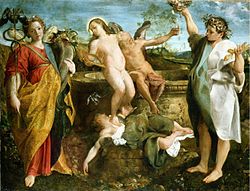 Annibale Carracci, An Allegory of Truth and Time (1584–85), an allegorical history painting
 -
 Allegory of Magnificence, Eustache Le Sueur, c. 1654
 -
 Charles Le Brun, 1664, Entry of Alexander into Babylon, Louvre, Paris
 -
 Sebastiano Ricci, Allegory of France as Minerva Trampling Ignorance and Crowning Virtue, 1717–18
 -

-

-
-
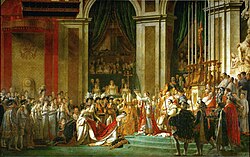
 Justice and Divine Vengeance Pursuing Crime, Pierre-Paul Prud'hon, c. 1805–1808
 -

-
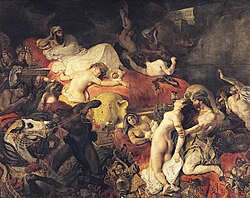 Eugène Delacroix, 1827, Death of Sardanapalus, Louvre, Paris
 -
 Karl Bryullov, The Last Day of Pompeii, 1827–1833
 -
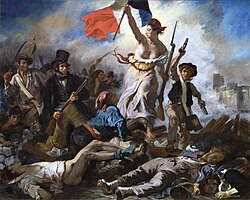 Eugène Delacroix, Liberty Leading the People, 1830, Louvre, Paris
 -
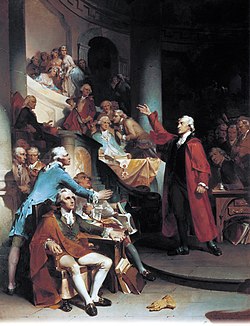 Patrick Henry Before the Virginia House of Burgesses, 1851, Red Hill Patrick Henry National Memorial, Brookneal
 -
-

-

-
-
-

-

-

-

-

-
 Jan Matejko, The Maid of Orléans, 1886, National Museum, Poznań
 -

-
 Jacob Spoel, 1867, The Welcome by the Mayors of Rotterdam of William IV, Prince of Orange and his Consort Anne of Great Britain
 -
_01.jpg)
.JPG)


.jpg)


_-_Google_Art_Project.jpg)


.png)

.jpg)


.jpg)


See also
[edit]Notes
[edit]- ^ National Gallery, Glossary entry; History Painting Gallery Archived 2016-08-30 at the Wayback Machine from The National Gallery of Art in Washington, DC; Green and Seddon, 7-8; Harrison, 105-106
- ^ Green and Seddon, 11-15
- ^ "History painting". Webster's Revised Unabridged Dictionary. The Free Dictionary.
- ^ lobo (2020-07-02). "The History of Painting. The evolution of Art". Lobo Pop Art. Retrieved 2023-06-08.
- ^ Blunt, 11-12; Barlow, 1
- ^ See Reynolds below; nonetheless he bowed to convention: "In conformity to custom, I call this part of the art history painting; it ought to be called poetical, as in reality it is." (Discources, IV); for debates over terminology in the Italian Renaissance, see Bull, 391–394
- ^ Books.google.co.uk, translation
- ^ Strong, 17, and 32–34 and generally on growth of historical painting.
- ^ Rothenstein, 16–17; Strong, 24–26
- ^ Barlow, 1
- ^ Lecture IV, p. 172, Lectures on Architecture and Painting: Delivered at Edinburgh, in November, 1853, 1854, Wiley, Internet Archive.
- ^ As shown in the usages in Barlow, Strong, and Wright
- ^ As in "The beautifully renovated Rijksmuseum in Amsterdam will open its doors to the public in 2013. To celebrate this event the Rijksmuseum will host a three-day symposium on Historical Painting Techniques. The central theme of the symposium will be the technical study of historically used painting techniques, the historical painting materials, their origin and trade, and their application in the painter’s workshop." Rijksmuseum, "Painting Techniques - Call for Papers" Archived 2013-05-31 at the Wayback Machine
- ^ Pamela M. Fletcher (1 January 2003). Narrating Modernity: The British Problem Picture, 1895-1914. Ashgate Publishing, Ltd. p. 146 note 12. ISBN 978-0-7546-3568-0.
- ^ (In Polish) Maciej Masłowski: Dzieje Polski w obrazach, Warsaw 1962, ed. by "Arkady Publishers"
- ^ Strong, 36-40; Wright, 269-273, French terms on p. 269
- ^ Wright, throughout; Strong, 30-32
- ^ "Entrada de Roger de Flor en Constantinopla | artehistoria.com". www.artehistoria.com (in Spanish). Archived from the original on 2018-11-16. Retrieved 2018-11-16.
- ^ Strong, 24-26, 47-73; Wright, 269-273
- ^ Harding, 7-9
- ^ Strong, 32-36
- ^ Harding, throughout
- ^ White, 91
References
[edit]- Barlow, Paul, "The Death of History Painting in Nineteenth-Century Art?" PDF, Visual Culture in Britain, Volume 6, Number 1, Summer 2005, pp. 1–13(13)
- Blunt, Anthony, Artistic Theory in Italy, 1450-1660, 1940 (refs to 1985 edn), OUP, ISBN 0-19-881050-4
- Bull, Malcolm, The Mirror of the Gods, How Renaissance Artists Rediscovered the Pagan Gods, Oxford UP, 2005, ISBN 0195219236
- Green, David and Seddon, Peter, History Painting Reassessed: The Representation of History in Contemporary Art, 2000, Manchester University Press, ISBN 9780719051685, google books
- Harding, James. Artistes pompiers: French academic art in the 19th century, 1979, New York: Rizzoli
- Harrison, Charles, An Introduction to Art, 2009, Yale University Press, ISBN 9780300109153, google books
- Rothenstein, John, An Introduction to English Painting, 2002 (reissue), I.B.Tauris, ISBN 9781860646782
- Strong, Roy. And when did you last see your father? The Victorian Painter and British History, 1978, Thames and Hudson, ISBN 0500271321
- White, Harrison C., Canvases and Careers: Institutional Change in the French Painting World, 1993 (2nd edn), University of Chicago Press, ISBN 9780226894874, google books
- Wright, Beth Segal, Scott's Historical Novels and French Historical Painting 1815-1855, The Art Bulletin, Vol. 63, No. 2 (Jun., 1981), pp. 268–287, JSTOR
Further reading
[edit]- Ayers, William (ed.), Picturing History: American Painting 1770–1903, ISBN 0-8478-1745-8.
External links
[edit]

History painting
View on GrokipediaDefinition and Scope
Core Characteristics
History painting encompasses narrative depictions drawn from ancient history, classical mythology, biblical scripture, or literary sources, prioritizing elevated themes over contemporary events or portraiture.[2] These works emphasize dramatic moments that convey moral virtues, heroic actions, or divine interventions, often requiring the artist to invent compositions that synthesize historical knowledge with imaginative interpretation.[6] Unlike lower genres such as landscape or still life, history painting demands mastery of anatomy, perspective, and expression to evoke intellectual and emotional elevation in the viewer.[7] Central to the genre is its grand scale and complex figural groupings, typically executed in large formats suitable for public or ecclesiastical display, fostering a sense of universality and timelessness.[8] Artists employed an idealized "grand manner" style, drawing on antique models to portray figures with heroic proportions and dignified poses, avoiding the mundane details of everyday life.[6] This approach, formalized in academic theory, positioned history painting atop the hierarchy of genres, as articulated by André Félibien in 1669, who argued it required the greatest intellectual effort and erudition, combining invention (invenzione) with technical proficiency.[7] The didactic intent distinguishes history painting, aiming to instruct on ethical principles through visual storytelling, such as the triumph of reason over passion or piety amid adversity, often allegorizing broader human conditions.[9] Compositional strategies, including dynamic diagonals, chiaroscuro for depth, and symbolic accessories, heighten narrative tension and moral clarity, ensuring the scene's pivotal action—be it a sacrificial oath or sacrificial martyrdom—resonates as a microcosm of larger truths.[6] While rooted in factual or scriptural events, the genre permits artistic license to amplify emotional impact, provided it serves the overarching aim of moral edification rather than mere verisimilitude.[10]Position in the Hierarchy of Genres
In the academic system of Western art established during the 17th century, history painting held the preeminent position in the hierarchy of genres, ranked above portraiture, genre scenes, landscapes, and still lifes. This ranking, formalized by André Félibien in his Entretiens sur les vies et sur les ouvrages des plus excellents peintres (1666–1688), positioned history painting first due to its capacity to depict noble human actions drawn from antiquity, mythology, religion, or significant historical events, thereby demanding the highest intellectual and technical skills from the artist.[11] The French Royal Academy of Painting and Sculpture, founded in 1648, enshrined this hierarchy as a pedagogical and evaluative standard, influencing art education and exhibitions across Europe by prioritizing subjects that conveyed moral, ethical, or heroic lessons over mere representation of everyday objects or scenery.[7] The supremacy of history painting stemmed from its requirement for invenzione—the creative synthesis of composition, anatomy, expression, and narrative—skills deemed intellectually superior to the more mechanical replication involved in lower genres. Félibien argued that painters of history elevated the viewer's mind through depictions of virtuous or tragic figures, fostering civic virtue and emotional depth, whereas still lifes or landscapes catered primarily to sensory pleasure and thus ranked lowest.[11] This valuation echoed Aristotelian notions of imitation (mimesis) refined during the Renaissance, where history painters like Raphael or Poussin were celebrated for embodying ut pictura poesis (painting as poetry), integrating literary and historical knowledge with visual artistry.[12] By the 18th century, academies such as the Royal Academy in London and equivalents in Italy and Spain adopted this framework, awarding top prizes like the Prix de Rome exclusively for history paintings to train artists in grand manner techniques, often executed in large-scale oil formats suitable for public commissions.[7] This institutional emphasis reinforced history painting's status until the 19th century, when Romanticism and Realism began challenging the rigid hierarchy by elevating personal expression and contemporary subjects.Historical Development
Ancient and Medieval Foundations
The foundations of history painting trace back to ancient Greek and Roman visual narratives, where depictions of mythological and legendary events served educational and commemorative purposes. In Greece, from the 7th century BCE, black-figure vase painting illustrated epic tales from Homer's Iliad and Odyssey, such as the exploits of Achilles and Odysseus, using silhouetted figures incised through slip to convey dramatic actions and heroic ideals.[13] This technique evolved into red-figure painting by the late 6th century BCE, allowing greater anatomical detail and dynamic compositions in scenes of divine interventions and mortal struggles, as seen on the François Vase (c. 570 BCE), a volute-krater featuring over 200 figures from multiple myths including the Calydonian boar hunt and wedding of Peleus and Thetis.[14] These ceramic narratives prioritized storytelling over mere decoration, influencing later monumental painting lost to time but referenced in ancient texts like Pliny's Natural History.[13] Roman art expanded these traditions through large-scale frescoes, particularly in the 1st century CE, adorning elite villas with mythological cycles drawn from Greek sources to evoke cultural prestige and moral exemplars. In Pompeii, the House of the Vettii and similar sites featured panels of gods, heroes, and allegories, such as Daedalus and Icarus or the labors of Hercules, executed in the Fourth Pompeian Style with vivid colors and spatial illusionism on wet plaster.[15] Recent excavations have revealed banquet rooms with black-ground frescoes depicting Trojan War episodes, including Cassandra clinging to the Palladium and Priam before Achilles, underscoring the Romans' adaptation of Greek myths for domestic edification and imperial ideology.[16][17] Such works, preserved by the eruption of Vesuvius in 79 CE, demonstrate narrative sequencing akin to modern comics, blending history, legend, and didactic intent.[18] During the medieval period, Christian dominance redirected narrative art toward biblical and hagiographic subjects, fostering continuity in history painting's emphasis on moral instruction through sequential scenes. Illuminated manuscripts, produced from the 5th to 15th centuries in monastic scriptoria, illustrated scriptural histories with miniature cycles, as in the Vienna Genesis (6th century), which used gold leaf and vibrant pigments to depict Genesis events in framed panels for liturgical and devotional use.[19] Church frescoes, such as those in Romanesque basilicas like San Clemente in Rome (11th-12th centuries), rendered Old and New Testament narratives in linear progression to catechize illiterate congregations.[20] Secular precedents emerged in the Bayeux Tapestry (c. 1070s), an embroidered linen chronicle of the Norman Conquest of England in 1066, comprising 58 sequential scenes of historical events from Edward the Confessor's death to the Battle of Hastings, blending factual record with propagandistic glorification.[21] These medieval forms, though stylized and symbolic rather than naturalistic, preserved the genre's core function of visualizing consequential actions to convey ethical and historical truths, bridging antiquity to Renaissance revival.[19]Renaissance Codification
The Renaissance formalized history painting as the preeminent genre through theoretical treatises that emphasized narrative complexity and intellectual engagement over mere representation. Leon Battista Alberti's Della pittura (1435), the first comprehensive Renaissance text on painting, introduced "istoria" as the ideal form, defined as compositions depicting historical, mythological, or biblical narratives with multiple figures exhibiting varied emotions, gestures, and interactions to stir viewers' minds and souls.[22][23] Alberti argued that such works, inspired by classical authors like Homer and Virgil, surpassed portraits or landscapes by imitating human actions and virtues, thereby elevating painting to a liberal art akin to poetry.[22] This codification drew from humanism's revival of antiquity, where painters emulated ancient masters praised in Pliny the Elder's Natural History for depicting momentous events with anatomical precision and dramatic tension. Alberti prescribed technical innovations like linear perspective and balanced composition to achieve "variety" in istoria, ensuring figures appeared lifelike and the scene harmonious, as in his recommendation for grouping three or four figures per action to convey narrative clarity without overcrowding.[22] Early practitioners, such as Paolo Uccello, applied these principles in The Battle of San Romano (c. 1438–1440), a triptych portraying the 1432 Florentine victory over Siena with innovative foreshortening of lances and horses to simulate battlefield depth and motion, commissioned likely by the Medici family to glorify civic triumphs.[24][25] By the High Renaissance, istoria influenced monumental works in papal and princely commissions, solidifying history painting's status. Giorgio Vasari's Lives of the Most Excellent Painters, Sculptors, and Architects (1550) later reinforced this hierarchy, portraying artists like Raphael—whose Vatican frescoes, such as The Meeting of Leo the Great and Attila (1514), blended historical accuracy with allegorical grandeur—as pinnacles of the genre's evolution from Alberti's foundations.[3] These developments positioned history painting not merely as decoration but as a vehicle for moral instruction and rhetorical persuasion, distinguishing it from medieval religious icons by prioritizing secular and classical subjects alongside sacred ones.[3]Baroque Elaboration
![Rembrandt, Judas Returning the Thirty Silver Pieces (c. 1629)][float-right] The Baroque era, emerging around 1600 amid the Counter-Reformation and absolutist monarchies, elaborated history painting by amplifying Renaissance foundations with heightened emotional intensity, theatrical staging, and innovations in light and movement to evoke awe and persuasion. This development aligned with the Catholic Church's need for vivid religious imagery to counter Protestant iconoclasm, as seen in Italian artists' use of tenebrism—extreme chiaroscuro—to spotlight sacred drama, while northern Europeans adapted similar techniques for psychological depth in biblical scenes. Compositions often featured swirling figures, foreshortening, and illusionistic space invasion, prioritizing narrative climax over static balance to immerse viewers in moral or heroic tales.[26][27][28] In Italy and Flanders, Peter Paul Rubens exemplified this elaboration through large-scale cycles blending mythology and history with sensual vitality; his Marie de' Medici Landing in Marseille (1622–1625), part of a 21-painting series for the Luxembourg Palace, allegorically fused classical subjects with contemporary politics via dynamic groupings and rich color to glorify royal power. Nicolas Poussin, working in France, countered with a more restrained classicism, structuring history paintings like The Death of Germanicus (1628) around rational order, geometric composition, and stoic figures to emphasize intellectual moral lessons, influencing the emerging Académie Royale de Peinture et de Sculpture founded in 1648.[29][30] Dutch masters like Rembrandt van Rijn further diversified the genre in Protestant contexts, infusing biblical history with intimate realism and empathetic characterization; Judas Returning the Thirty Silver Pieces (c. 1629) captures betrayal's anguish through gestural frenzy and selective illumination, prioritizing human psychology over doctrinal propaganda. This northern introspection contrasted southern grandeur, yet both strands elevated history painting's prestige, commissioning altarpieces, palace decorations, and private devotions that reinforced cultural authority through elevated subject matter. By mid-century, these approaches solidified the genre's adaptability across confessional divides, paving neoclassical refinements.[29][31]Neoclassical Revival
![Jacques-Louis David, Oath of the Horatii, 1784–1785][float-right] The Neoclassical revival in history painting, emerging around the 1760s, represented a deliberate return to the classical ideals of ancient Greece and Rome, emphasizing clarity, proportion, and moral exemplars in contrast to the emotional exuberance of Baroque art and the decorative frivolity of Rococo. This shift aligned with Enlightenment values of reason, order, and civic virtue, as artists drew from archaeological discoveries such as the excavations at Herculaneum (starting 1738) and Pompeii (1748), which unearthed frescoes and sculptures reinforcing ideals of harmony and restraint. History paintings during this period featured subjects from antiquity—mythological narratives, heroic deaths, and republican oaths—rendered with linear precision, sculptural forms, and subdued coloring to convey timeless ethical lessons, positioning the genre as a tool for public edification in academies and salons.[32][33] Jacques-Louis David emerged as the preeminent figure in this revival, particularly in France, where his works bridged artistic reform with political upheaval. Trained under Joseph-Marie Vien and influenced by stays in Rome (1775–1780), David rejected Rococo excess for a style of austere composition and dramatic clarity, as seen in The Oath of the Horatii (1784–1785), which depicts Roman brothers swearing loyalty to the state, symbolizing stoic sacrifice and foreshadowing revolutionary fervor. Exhibited at the Paris Salon in 1785, the painting garnered acclaim for its moral intensity and classical rigor, establishing David as the leader of Neoclassicism. Subsequent works like The Death of Socrates (1787), portraying the philosopher's defiant acceptance of hemlock, further exemplified the genre's focus on rational heroism and virtue amid adversity, with compositions structured around strong horizontals and verticals to evoke antiquity's gravitas.[34][35][36] David's influence extended through the French Revolution and Napoleonic era, where history painting served propaganda purposes while maintaining neoclassical forms; commissions such as The Intervention of the Sabine Women (1799) and The Coronation of Napoleon (1807) blended antique themes with contemporary events to legitimize republican and imperial ideals. Beyond France, artists like Angelica Kauffman in Britain and Switzerland produced history scenes with classical motifs, such as her Mother of the Gracchi (1785), emphasizing maternal virtue and domestic heroism in line with Enlightenment domestic ethics. In Italy, Gavin Hamilton's archaeological-inspired narratives, including Agrippina and Germanicus (1765–1770), anticipated the revival by integrating excavated motifs into moral tableaux. This phase waned by the 1830s as Romanticism introduced emotional dynamism, yet Neoclassicism solidified history painting's prestige as a didactic pinnacle, influencing 19th-century academies across Europe.[34][36][35]Romantic Expansion
The Romantic era expanded history painting by emphasizing emotional depth, dramatic tension, and the sublime over Neoclassical order and moral didacticism, incorporating subjects from contemporary catastrophes, revolutions, and exotic narratives to evoke personal and collective passions.[37] This shift reflected broader Romantic values of individualism and intuition, broadening the genre's scope beyond ancient exemplars to include politically charged modern events and literary inspirations drawn from sources like Lord Byron.[38] Artists employed loose brushwork, vibrant colors, and dynamic compositions to prioritize subjective experience and atmospheric intensity, departing from precise line and balanced form.[39] Théodore Géricault's The Raft of the Medusa (1818–1819) exemplified this evolution, portraying the survivors of the 1816 French frigate wreck in a tableau of desperation and cannibalism that critiqued governmental incompetence, exhibited amid scandal for its raw realism and scale exceeding 16 by 23 feet.[37] The painting's grotesque figures and turbulent sea underscored human frailty against nature's fury, influencing later works by amplifying visceral emotion in historical narrative.[38] Eugène Delacroix, as the preeminent French Romantic painter, further propelled this expansion with canvases like The Massacres at Chios (1824), which depicted Ottoman mass killings during the Greek War of Independence using fragmented forms and luminous highlights to convey collective tragedy and stir sympathy for national liberation struggles.[39] His Death of Sardanapalus (1827), based on Byron's play about the Assyrian king's suicide amid orgiastic destruction, featured swirling nudes and jewel-toned chaos on a vast 12-by-16-foot surface, provoking Salon outrage for its sensual excess and rejection of heroic idealization.[39] Delacroix's Liberty Leading the People (1830), completed in response to the July Revolution, fused allegorical female liberty with diverse revolutionaries charging over barricades, symbolizing popular uprising while blending myth with immediate history in a 8.5-by-10-foot format that captured revolutionary fervor through billowing smoke and expressive poses.[40] Beyond France, Karl Bryullov's The Last Day of Pompeii (1827–1833) transported viewers to the 79 CE Vesuvian eruption via meticulous archaeological detail combined with theatrical pathos, its 15-by-26-foot expanse exhibited in Russia to acclaim for merging historical accuracy with Romantic spectacle of doom.[41] These innovations sustained history painting's prestige into the 1830s by adapting it to Romantic sensibilities, though they foreshadowed challenges from emerging Realism by grounding grandeur in observable human drama.[37]Nineteenth-Century Shifts
The nineteenth century marked a period of both expansion and eventual decline for history painting, beginning with Romanticism's infusion of emotional intensity and dramatic narratives into the genre. Théodore Géricault's The Raft of the Medusa (1818–1819), depicting survivors of a recent shipwreck scandal, scandalized viewers with its raw portrayal of human suffering and political critique, signaling a shift toward contemporary events over ancient exempla.[42] Eugène Delacroix advanced this trend, prioritizing vibrant color and dynamic composition in works like The Death of Sardanapalus (1827), inspired by Lord Byron's play and emphasizing exotic violence and passion against Neoclassical linearity championed by Jean-Auguste-Dominique Ingres.[42] [37] By the 1830s, history painting increasingly incorporated recent historical upheavals, as seen in Francisco Goya's The Third of May 1808 (1814), which captured Spanish resistance to Napoleonic invasion through stark contrasts of light and shadow, blending reportage with moral allegory.[42] Delacroix's Liberty Leading the People (1830) further exemplified this evolution, allegorizing the July Revolution with modern figures in a barricade scene, thus blurring lines between history and current events while maintaining grand scale.[42] Paul Delaroche's The Execution of Lady Jane Grey (1833) introduced theatrical pathos in Tudor history, adapting settings for emotional impact and appealing to bourgeois audiences amid expanding public exhibitions.[42] Mid-century Realism posed a direct challenge, with Gustave Courbet rejecting the Salon's preference for idealized history subjects in favor of unvarnished depictions of contemporary labor, as in The Stone Breakers (1849), which was denied Salon entry for its scale typically reserved for historical scenes.[43] Courbet's 1855 Pavilion of Realism showcased oversized modern-life paintings to rival history painting's prestige, critiquing its detachment from social realities amid industrialization.[43] This reflected broader secularization and democratic shifts, diminishing demand for moralistic grandeur as portraiture, landscape, and genre scenes aligned better with middle-class patronage.[44] In the late nineteenth century, history painting persisted in academic circles but faced mounting criticism for artificiality and bombast, transforming into illustrative or decorative forms rather than autonomous moral vehicles.[45] Critics favored subtle drama over exaggeration, as in Edwin Austin Abbey's Shakespearean scenes like The Trial of Queen Katherine (1898–1900), which emphasized composition over narrative pomposity.[45] By 1900, the genre's ambitions had largely channeled into murals and applied arts, yielding primacy to emerging modernist emphases on form and perception.[45] [44]Distinction from Historical Painting
Terminological Origins
The term "history painting" traces its conceptual roots to the Italian Renaissance, where Leon Battista Alberti in his treatise De Pictura (1435) elevated istoria—narrative compositions depicting virtuous actions from ancient history, mythology, or scripture—as the noblest form of painting, capable of instructing viewers through expressive figures and moral exempla.[46] This usage drew from classical precedents, such as Plutarch and Quintilian, emphasizing painting's rhetorical power to move emotions and convey ethical truths, distinct from mere decoration or portraiture.[46] By the 17th century, the French Royal Academy formalized "peinture d'histoire" (history painting) as the apex of the genre hierarchy, encompassing religious, allegorical, and literary subjects alongside historical ones, with the term entering English as "history painting" to denote elevated, large-scale narratives prioritizing idealization over literalism.[2] The narrower term "historical painting" emerged in the 19th century amid Romantic and nationalist movements, distinguishing literal depictions of verifiable past events—often contemporary or national history—from the broader, myth-infused "history painting," which retained classical elevation and fictional elements.[47] This terminological divergence reflected a shift toward empirical verisimilitude in works like those of Delacroix or Goya, where "historical painting" denoted subgenres focused on factual chronicles rather than timeless moral allegories, though the terms were often used interchangeably until 20th-century scholarship clarified the split.[48] Prior to this, no strict separation existed, as both fell under the prestigious "history" umbrella in academic theory.[45]Subject Matter and Stylistic Divergences
History painting traditionally draws its subject matter from ancient classical texts, mythology, the Bible, and literary sources, encompassing narratives that blend factual history with legendary or allegorical elements to convey moral, philosophical, or heroic ideals.[2] Examples include depictions of Trojan War episodes from Homer or biblical scenes like the Expulsion from Paradise, where the emphasis lies on timeless human dramas rather than chronological accuracy.[6] In contrast, historical painting narrows to documented events from verifiable past records, often focusing on medieval, Renaissance, or modern occurrences such as battles, coronations, or political assassinations, prioritizing specificity over universality.[49] This divergence reflects history painting's roots in Renaissance humanism, which elevated "istoria" as narratives instructing virtue through idealized exemplars, whereas historical painting emerged more prominently in the 19th century amid demands for empirical fidelity to eyewitness accounts or archives.[6][45] Stylistically, history painting favors grandeur and idealization, with figures rendered in noble proportions, dynamic compositions, and elevated rhetoric to evoke emotional catharsis and ethical reflection, as theorized by Leon Battista Alberti in De pictura (1435), which prescribed clarity and variety in grouping to mirror oratorical persuasion.[6] Painters like Jacques-Louis David exemplified this in works such as Oath of the Horatii (1784), where Roman senators' stoic poses transcend mere reportage to symbolize republican virtue, employing contrapposto and chiaroscuro for dramatic intensity.[2] Historical painting, by comparison, leans toward verisimilitude and contextual detail, incorporating accurate period attire, architecture, and crowd behaviors derived from historical evidence, as seen in Francisco Goya's The Second of May 1808 (1814), which captures the raw chaos of a Madrid uprising with unflinching realism in lighting and anatomy to document collective trauma rather than exalt individuals.[5] This stylistic shift aligns with Enlightenment empiricism and Romantic nationalism, where artists like Eugène Delacroix in Liberty Leading the People (1830) blended history painting's allegorical fervor with historical specificity, yet retained less idealization for figures to reflect lived tumult.[45][49] The divergences are not absolute, as 19th-century history paintings increasingly incorporated modern events—such as Napoleonic triumphs—adopting historical painting's factual anchors while preserving stylistic elevation for propaganda or patriotic ends, blurring genre boundaries under academic rubrics.[45] Critics like those in post-1870 debates noted this tension, arguing that pure history painting's mythological liberty allowed artistic invention unbound by evidence, whereas historical painting risked pedantry through over-reliance on costumes and settings at the expense of narrative profundity.[45] Ultimately, subject matter in history painting serves didactic universality, sourced from canonical texts like Virgil or Plutarch, while historical painting grounds itself in annals or dispatches for temporal authenticity, influencing stylistic choices toward either heroic abstraction or mimetic precision.[6][5]Prestige and Societal Function
Institutional Endorsement in Academies
The French Académie Royale de Peinture et de Sculpture, founded in 1648 under the patronage of Cardinal Mazarin and later Jean-Baptiste Colbert, established history painting as the preeminent genre within a formalized hierarchy that prioritized subjects demanding intellectual depth and moral elevation.[50] This institution divided paintings into ranked categories—history encompassing religious, mythological, and allegorical narratives at the summit, followed by portraiture, genre scenes, landscapes, and still lifes—reflecting the view that true artistry lay in elevating viewers through complex human dramas rather than mere representation of the everyday.[51] Academy regulations classified members by specialty, granting history painters superior rank, larger studio allotments, and priority in state commissions, thereby embedding the genre's prestige in professional structures.[50] In 1669, Académie secretary André Félibien explicitly codified this hierarchy in his Entretiens, arguing that history painting excelled by imitating nature selectively to instruct on virtue and vice, drawing on ancient precedents like Plutarch and Livy for narrative authenticity.[51] Under directors like Charles Le Brun from 1683, the Académie enforced doctrinal conformity through conférences—lectures dissecting exemplary works—and biennial Salons, where history paintings occupied central galleries and garnered official accolades, reinforcing their role as vehicles for royal propaganda and civic education.[50] This system marginalized rival genres, with still-life practitioners often barred from full membership, underscoring the Academy's commitment to history painting as the pinnacle of le grand manière.[51] The French model disseminated across Europe, shaping institutions like the Accademia di San Luca in Rome (reorganized 1593 but influential post-1660s) and the Prussian Academy in Berlin (1696), which adopted similar genre rankings to cultivate national artistic elites.[52] In Britain, the Royal Academy of Arts, chartered in 1768 by George III under Joshua Reynolds' presidency, mirrored this endorsement by designating history painting the "first rank" in its foundational discourses, emphasizing its demand for erudition in classics and anatomy to rival continental grandeur.[53] Reynolds' 1769 discourse praised history works for their "poetical" elevation over "mechanical" imitation, influencing annual exhibitions where such pieces commanded premium pricing and public veneration.[53] By the late 18th century, over 80 academies operated continent-wide, collectively sustaining history painting's institutional dominance until Romantic and realist challenges eroded it in the 19th century.[54]Moral and Educational Imperatives
History painting occupied the apex of the academic hierarchy of genres, established by the French Royal Academy in 1669, primarily because it served as the premier vehicle for disseminating moral and educational content to viewers. André Félibien, the Academy's secretary, articulated that history paintings provided the optimal platform for communicating elevated messages infused with moral significance, such as depictions of heroism, piety, and justice drawn from ancient, biblical, or mythological sources.[55] This ranking reflected the belief that art's highest function was not mere aesthetic pleasure but the instruction of society in virtuous conduct and eternal truths.[56] Proponents viewed history painting as an exemplum virtutis, or model of virtue, intended to guide public morality by presenting noble actions and sufferings that evoked sympathy and aspiration. In eighteenth-century theory, such works functioned explicitly as moral exemplars, offering viewers patterns of behavior to emulate amid contemporary challenges.[45] Sir Joshua Reynolds, first president of the Royal Academy of Arts, reinforced this imperative in his Discourses on Art (1769–1790), asserting that the history painter must "endeavour to improve [mankind] by the grandeur of his ideas" rather than amuse with superficial imitation, thereby elevating the mind and heart akin to poetry's instructional role.[57] Reynolds emphasized subjects of universal concern, like heroic actions from classical history or Scripture, to strike the imagination and foster public sympathy, underscoring art's duty to regulate affections and impart wisdom.[57] Academies across Europe endorsed history painting's educational mandate by privileging it in competitions and exhibitions, training artists to compose narratives that unpacked ethical lessons for diverse audiences, from nobility to the emerging public. This approach aligned with Enlightenment ideals of rational improvement, where visual representations of moral dilemmas—such as oaths of loyalty or martyrdoms—encouraged reflection on duty, sacrifice, and civic responsibility.[58] By prioritizing intellectual engagement over sensory appeal, history painting aimed to cultivate a refined sensibility, making viewers "wiser and better" through encounters with idealized human potential.[57]Patronage Dynamics
History paintings were predominantly commissioned by powerful institutions and elites who sought to leverage art for ideological, religious, and propagandistic purposes. In Renaissance Italy, the Catholic Church emerged as a primary patron, funding large-scale biblical and hagiographic narratives to reinforce doctrinal authority and inspire the faithful in ecclesiastical settings.[59] Secular patrons, including merchant princes like the Medici family, supported mythological and historical subjects in palaces to symbolize civic virtue and familial prestige, as seen in commissions for works evoking classical antiquity.[60] These dynamics bound artists to patrons' visions, often requiring inclusion of donor portraits or allegorical elements that advanced the commissioner's status.[61] During the Baroque era, absolutist monarchies intensified centralized patronage, channeling resources through court academies to produce grandiose histories glorifying royal power. Louis XIV of France exemplified this by appointing Charles Le Brun as premier painter in 1663, tasking him with overseeing Versailles decorations and executing allegorical histories like the 1664 Entry of Alexander into Babylon, which paralleled the king's conquests.[62] Such commissions, supported by state funds exceeding those for other genres, prioritized dynastic narratives over artistic autonomy, with artists like Le Brun directing workshops to meet exacting royal specifications.[63] In this system, history painting served as visual propaganda, embedding monarchical absolutism in public and palatial displays. Neoclassicism sustained state-driven patronage amid Enlightenment reforms, with academies mediating commissions for morally instructive ancient histories. Jacques-Louis David's Oath of the Horatii (1784–1785) was directly commissioned by Louis XVI upon David's return from Rome, embodying republican sacrifice to align with royal reformist ideals before the Revolution.[64] Patrons favored these works for official buildings, expecting fidelity to classical sources while adapting themes to contemporary politics, though artists occasionally negotiated subjects for salon acclaim. By the nineteenth century, however, patronage eroded with the rise of bourgeois markets and nationalism; institutional support waned, shifting demand toward genre scenes and reducing grand history commissions, as private buyers prioritized accessible subjects over elevated narratives.[45][65] This transition diminished the genre's economic viability, compelling artists to adapt or abandon it amid democratized art consumption.