Hubbry Logo
Household silverHousehold silverMain
Open search
Household silver
Community hub
Household silver
logo
8 pages, 0 posts
0 subscribers
Be the first to start a discussion here.
Household silver
Household silver
from Wikipedia
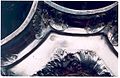
German toilet service of 1743-45, Metropolitan Museum of Art. The set is mostly in silver-gilt, but includes two Japanese export porcelain Imari ware teacups and saucers. For a lady's dressing-table, including items for snacks and hot drinks.

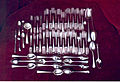
Household silver or silverware (the silver, the plate, or silver service) includes tableware, cutlery, and other household items made of sterling silver, silver gilt, Britannia silver, or Sheffield plate silver. Silver is sometimes bought in sets or combined to form sets, such as a set of silver candlesticks or a silver tea set.

Historically, silverware was divided into table silver, for eating, and dressing silver for bedrooms and dressing rooms. The grandest form of the latter was the toilet service, typically of 10-30 pieces, often silver-gilt, which was especially a feature of the period from 1650 to about 1780.

History

[edit]
Late Roman spoons, Hoxne Hoard, England

Elites in most ancient cultures preferred to eat off precious metals ("plate") at the table; China and Japan were two major exceptions, using lacquerware and later fine pottery, especially porcelain. In Europe the elites dined off metal, usually silver for the rich and pewter or latten for the middling classes, from the ancient Greeks and Romans until the 18th century. Another alternative was the trencher, a large flat piece of either bread or wood. In the Middle Ages this was a common way of serving food, the bread also being eaten; even in elite dining it was not fully replaced in France until the 1650s.[1]

The Vyborgian coffee pot from the 18th century on display in the National Museum of Finland

Possession of silverware obviously depends on individual wealth; the greater the means, the higher was the quality of tableware that was owned and the more numerous its pieces. The materials used were often controlled by sumptuary laws. In the late Middle Ages and for much of the Early Modern period much of a great person's disposable assets were often in plate, and what was not in use for a given meal was often displayed on a dressoir de parement or buffet (indeed, similar to a large Welsh dresser) in the dining hall. At the wedding of Philip the Good, Duke of Burgundy, and Isabella of Portugal in 1429, there was a dresser 20 feet long on either side of the room, each with five rows of plate.[2] Inventories of King Charles V of France (r. 1364–1380) record that he had 2,500 pieces of plate.[3] Plate was often melted down to finance wars or building, and hardly any of the enormous quantities recorded in the later Middle Ages survives. The French Royal Gold Cup now in the British Museum, in solid gold and decorated with enamel and pearls, is one of few exceptions.

Maintenance

[edit]

Silver requires a good deal of care, as it tarnishes and must be hand polished, since careless or machine polishing ruins the patina and can completely erode the silver layer in Sheffield plate.

A silverman or silver butler has expertise and professional knowledge of the management, secure storage, use, and cleaning of all silverware, associated tableware, and other paraphernalia for use at military and other special functions. This expertise covers the maintenance, cleaning, proper use, and presentation of these assets to create aesthetically correct layouts for effective ambience at such splendid occasions. The role of silverman tends now to be restricted to some private houses and large organizations, in particular the military.

One advantage of silverware is that growth of bacteria is inhibited by the oligodynamic effect.

See also

[edit]

Notes

[edit]

References

[edit]
[edit]
Revisions and contributorsEdit on WikipediaRead on Wikipedia
from Grokipedia
Household silver, also known as silverware or the plate, encompasses a range of domestic items crafted from , including , , serving vessels, and decorative objects such as salts, candlesticks, and tea services, which have been valued for their aesthetic appeal, functionality, and social prestige since antiquity. Primarily composed of 92.5% pure silver alloyed with other metals like for added strength, these items over time but are renowned for their luster, malleability, and conductivity, making them ideal for both practical household use and ornamental display. In historical contexts, household silver served as a marker of wealth and refinement, often commissioned or inherited as heirlooms to signify family status during formal entertaining or ceremonial occasions. The tradition of household silver flourished particularly in from the late medieval period through the , with Britain emerging as a major center of production in the 16th to 18th centuries, where goldsmiths crafted intricate pieces reflecting contemporary styles like Elizabethan, , and neoclassical designs. Techniques such as embossing, chasing, , and die-stamping were employed to create elaborate motifs, including grotesques, floral patterns, and armorial bearings, which not only enhanced beauty but also personalized items to patrons' tastes and achievements. These objects complemented grand home architectures and were integral to social rituals, such as placing large "great salts" on high tables to denote among diners, a practice common by the mid-16th century. Beyond , silver's domestic applications extended to colonial America, where imported and locally made pieces underscored emerging elite identities amid transatlantic trade. In modern times, household silver continues to hold cultural and economic value, often collected as antiques or used in contemporary settings, though maintenance against tarnishing—caused by exposure to compounds—is essential to preserve its shine. Its enduring legacy lies in bridging utility and artistry, embodying historical shifts in craftsmanship, consumerism, and societal norms across centuries.

Overview

Definition and Scope

Household silver, also referred to as silverware, the silver, the Plate, or , encompasses , , and other household items made primarily from , , , or Sheffield plate. These materials were chosen for their , luster, and prestige, allowing the objects to serve both practical functions in daily domestic life and as symbols of and refinement. Common examples include candlesticks for illumination, sets for serving beverages, and serving platters for meals, all designed to enhance the and rituals of home entertaining. Historically, household silver has been divided into two main categories: table silver, intended for dining and eating, and dressing silver, used in bedrooms and dressing rooms for . Table silver typically features essential eating utensils such as spoons, forks, and knives, often produced in matched sets to facilitate formal meals. Dressing silver, by contrast, includes items like ewers and basins for washing, along with more ornate accessories for and skincare. The most elaborate examples of dressing silver are services, grand ensembles of 10 to 30 pieces—frequently crafted in for added opulence—that were especially popular from 1650 to 1780 among the elite. The scope of silver is deliberately focused on functional and decorative domestic objects, distinguishing it from other silver forms such as industrial tools, monetary , or personal jewelry. This emphasis highlights its role in private, non-commercial settings, where items like hollowware (e.g., and pitchers) and flatware (e.g., utensils) contribute to household rituals rather than , , or .

Significance in Domestic Life

Household silver has long served as a prominent emblem of wealth and social standing among and upper classes, particularly in Western societies where it was meticulously displayed to impress visitors and affirm prosperity. In colonial America, for instance, affluent Newport merchants acquired silver pieces not merely for utility but to emulate European , positioning them in conspicuous locations such as parlors or dining rooms for public viewing. Similarly, during Roman banquets, elite hosts utilized elaborate silver vessels to ostentatiously exhibit their political power and economic affluence, transforming meals into spectacles of opulence that reinforced hierarchical distinctions. In elite households, household silver was deeply integrated into daily routines and household management, requiring dedicated oversight by staff to ensure its proper use and maintenance. Butlers, as senior male servants, bore primary responsibility for safeguarding, cleaning, and serving the silver, often coordinating with footmen during meal preparations and events to arrange table settings impeccably. In Victorian-era homes, housekeepers oversaw cleaning duties including silver care, while specialized roles like silver butlers emerged in larger establishments to handle the intricate maintenance of these valuables. This involvement extended to routine tasks such as inventorying pieces before dinners or banquets, underscoring silver's centrality to the orchestrated efficiency of domestic life among the . Beyond status, household silver fulfilled key social functions by elevating dining experiences and symbolizing gracious , while its inherent properties supported in pre-modern contexts. In aristocratic settings, silver-enhanced tablescapes conveyed warmth and generosity to guests, fostering alliances and social bonds through shared indulgence in finely served meals. Moreover, silver's natural antibacterial qualities—recognized since ancient times—helped preserve food and water in utensils and vessels, reducing spoilage and microbial risks in eras without modern ; for example, Persian rulers stored water in silver containers to maintain its freshness for extended periods, a practice echoed in pioneer households where silver coins were added to pails. Over time, this utilitarian luxury evolved into cherished heirlooms, passed through generations to embody family legacy and continuity in Western traditions, as seen in the Washington family's silver, which descendants safeguarded across centuries, including burial during the Civil War to preserve its historical significance. In colonial families, engraved pieces like tankards were retained as tangible links to ancestral prosperity, often circulating within lineages for over two centuries.

History

Ancient and Medieval Origins

In , silver was highly prized for household items, serving as a symbol of wealth and refinement in elite dining and daily life. It was commonly used for plate ware such as large serving trays and dishes, individual bowls and plates, as well as utensils like spoons, which were the primary eating implements during banquets. These items often featured elaborate decorations, including repoussé work with motifs like cupids or Dionysiac scenes, and were part of comprehensive sets known as ministerium, even in moderately affluent households. A notable example of late Roman household silver is the Hoxne Hoard, discovered in 5th-century Britain, which includes approximately 200 items of silver tableware buried amid the empire's decline. This cache features 78 spoons, 20 ladles, and pepper-pots, many gilded and intricately designed, illustrating the continued prestige of silver utensils and serving pieces in provincial Roman elites. During the medieval period in Europe, silver gradually supplanted gold as the preferred material for elite household tableware due to its relative affordability and abundance compared to scarce gold supplies. By the 14th and 15th centuries, silver pieces were displayed prominently on dressoirs—tiered buffets in great halls—to signify status, as seen at the 1429 wedding of Philip the Good, Duke of Burgundy, to Isabella of Portugal, where two 20-foot-long dressers each held five rows of elaborate silver plate. Inventories from this era highlight the scale of ownership among nobility; for instance, King Charles V of France (r. 1364–1380) possessed over 3,900 precious items cataloged in his 1380 inventory. However, such opulence was confined to the upper classes, with non-elites relying on trenchers—flat rounds of stale bread or wooden platters—for meals, often alongside rudimentary spoons. Regional variations existed, notably in and , where and were favored over silver for items due to their aesthetic luster, durability, and non-reactive properties suitable for food service, reflecting cultural preferences for lightweight, intricately decorated alternatives to metal. Much medieval silver, however, faced frequent , as and pieces were melted down to fund wars or construct buildings, such as when French cathedrals like Notre-Dame contributed silver to royal mints during conflicts. This practice persisted into the post-medieval era, limiting surviving artifacts.

Renaissance to Industrial Developments

The Renaissance period marked a significant expansion in the production of household silver across , driven by growing economic prosperity and the rediscovery of classical aesthetics. Centers such as , , and saw increased output of ornate silver items for domestic use, including cups, ewers, and salvers, often featuring intricate chasing and inspired by ancient motifs. Royal courts played a pivotal role in shaping designs, with monarchs commissioning elaborate pieces to symbolize wealth and power; for instance, the French court under in the mid-17th century popularized opulent silver furnishings that influenced aristocratic households throughout . A notable development during this era was the creation of toilet services between approximately 1650 and 1780, which served as luxurious dressing table sets for the elite. These services, comprising items like mirrors, boxes, and candlesticks coated in gold over silver, were status symbols often gifted in royal marriages, such as the set presented by James, Duke of York, to in 1659. Production was concentrated in workshops in , , and , where techniques enhanced the pieces' durability and visual appeal for personal grooming rituals. By the , stylistic shifts toward transformed household silver, emphasizing clean lines, symmetry, and motifs drawn from Greco-Roman antiquity. This trend, prominent from around 1760 to 1830, was fueled by archaeological discoveries and Enlightenment ideals, leading to simplified forms in tea services, , and flatware that contrasted with the preceding extravagance. In and , silversmiths like those in the Bateman family produced neoclassical teapots and urns with fluted columns and laurel wreaths, making such items more refined for emerging bourgeois homes. The invention of Sheffield plate in the 1760s provided an affordable alternative to , democratizing access to elegant ware. Developed by Boulsover in 1743 through accidental fusion of silver and copper, the process was commercialized by Joseph Hancock around 1765, allowing mass production of plated items like trays and without the high cost of . This innovation, centered in , , spurred a boom in domestic silver production, with exports reaching global markets by the late . Entering the Industrial era, in the 1840s further revolutionized household silver by enabling precise, inexpensive application of silver onto base metals. Patented by George and Henry Elkington in Birmingham in 1840, this electrochemical method replaced Sheffield plate for many manufacturers, producing durable plated flatware and hollowware for the rising . As a result, solid silver's dominance waned after 1850, with rising material costs and labor-intensive crafting making plated alternatives preferable for everyday use. Key events like 19th-century silver rushes in the significantly impacted supply and pricing. Discoveries such as the in in 1859 flooded markets with new silver. This lowered global prices and increasing availability for both solid and plated household items. This abundance supported industrial-scale production but also contributed to economic debates over in the late 1800s. Regulatory hallmarks for silver evolved during this period to ensure quality, building on medieval foundations from the 1300s. In Britain, the system introduced under Edward I around 1300 was refined in the with date letters and maker's marks, and further standardized in 1784 by adding a duty mark to verify tax payment on silverware. These developments, overseen by assay offices like those in and , provided consumers with verifiable standards amid the shift to mass-produced items.

Types and Forms

Flatware and Cutlery

Flatware and in household silver encompass the personal eating utensils designed for table use, primarily consisting of forks, spoons, and knives crafted from or silver alloys. These items evolved from functional tools to symbols of refined dining, with matched sets becoming standard for formal meals by the . The core components reflect centuries of adaptation to and , emphasizing durability and elegance. Forks were introduced to European dining tables in the 16th century, brought from Italy by influential figures such as Catherine de’ Medici, who included silver forks in her 1533 trousseau upon marrying Henry II of France. Initially two-tined for spearing food, forks evolved to multi-tined designs by the 18th century, with four tines becoming common in France and Germany by the late 18th century for better grip on varied foods. Spoons, the oldest utensil, date back to ancient civilizations but in silver form appeared in Europe by the 15th century, with specialized sizes emerging later: teaspoons (approximately 5 ml capacity) for stirring tea, developed in the 17th century as the beverage gained popularity, and tablespoons (about 15 ml) for serving or eating denser foods. Knives featured silver handles for aesthetic appeal paired with steel blades for sharpness, as silver proved too soft for cutting; this combination became widespread in the 18th and 19th centuries, with blunted tips introduced in France by 1637 to promote courteous dining. Design variations in silver flatware often centered on handle patterns, which added ornamental flair while maintaining functionality. The fiddle pattern, originating in around 1675 and adopted in by the early , featured a violin-shaped handle for its graceful, tapered form. King's pattern, introduced circa 1815, incorporated scrolled shells and gadrooning for a regal look inspired by late 18th-century opulence. Thread-and-shell, a variant of fiddle popular from 1810 through the , combined fine threading with raised shell motifs at the handle's base. These patterns were typically produced in matched services for 6 to 12 place settings, including essential serving pieces like ladles for or , ensuring cohesive presentation at the table. Functional adaptations included specialized items tailored to specific foods, reflecting 19th-century dining precision. Fish forks, with a notched longer tine to separate flesh from bone, emerged in the Victorian period alongside fish knives. tongs, designed with broad, flat jaws to handle delicate spears without bruising, appeared in the late but proliferated in the amid growing vegetable popularity. Such utensils complemented standard flatware, evolving from two-tined serving forks to more versatile personal tools. In formal dining, silver flatware was presented in complete, matched services to convey and status, often stored in canteens for protection. sets adhered to weight standards for quality, with table forks typically weighing 2.5 to 3 ounces per piece, contributing to their substantial feel and value. These services paired with hollowware for full table settings, enhancing the overall domestic silver ensemble.

Hollowware and Serving Pieces

Hollowware in silver refers to larger vessels and containers designed for communal serving, pouring, and display, distinguishing them from flatware by their capacity to hold liquids or foods. These pieces, often crafted from or silver alloys, facilitated social rituals such as drinking and formal dining in affluent homes from the onward. Primary types include bowls for punch or fruit, which served both practical and ornamental purposes; for instance, punch bowls from colonial America, measuring around 9-10 inches in diameter, were frequently engraved with commemorative inscriptions to mark like weddings or naval victories. Pitchers and ewers, evolving from simple tankards in the early to pear-shaped forms by the mid-century, were used for beverages, with for example, a pear-shaped produced by Jr. in 1796 weighing approximately 21 ounces, featuring a spout for controlled pouring. Trays and platters, such as salvers with gadrooned edges and cast feet, supported services or drinks, ranging from small 10-inch diameters for personal use to larger oval trays up to 30 inches long for settings. and coffee pots, integral to daily routines, adopted globular or inverted-pear shapes in the , often part of matched services including stands and creamers. Candlesticks and snuffers provided essential lighting for evening meals, transitioning from hammered pairs in the early 1700s to cast forms by the late , with snuffer stands matching for aesthetic cohesion. Serving specifics encompassed specialized items like s for soups, salvers for presenting beverages, and sauceboats for gravies, varying in scale from intimate personal sugar bowls—often double-bellied with domed lids and urn finials, around 4-6 inches high—to grand banquet centerpieces exceeding 15 inches in diameter. , such as Paul Storr's neoclassical soup on stand from 1794-1795, featured elaborate covers and ladles for formal buffets, while salvers evolved from trumpet-footed designs in the early to curvilinear rims on three or four cast feet by the period. Sauceboats, typically paired and measuring 7-8 inches long on scroll feet, complemented these in styles for butter or sauces during meals. These pieces integrated seamlessly with flatware in complete table settings, enhancing the overall presentation. Sizes reflected household status, with smaller items for daily use and larger ones reserved for entertaining. Decorative elements elevated hollowware's role beyond utility, employing techniques like , chasing, and embossing to convey artistry and ownership. , which involved cutting lines into the surface for monograms, armorials, or bright-cut patterns, was prevalent in neoclassical pieces from the late , as seen in wreaths and ribbons on American coffeepots around 1780-1790. Chasing displaced metal with punches to create relief designs, such as foliage or motifs on sugar bowls and candlesticks in the mid-1700s, while embossing, often via repoussé, raised floral sprays or scrolls for three-dimensional effect on bowls and trays. Historical shifts mirrored stylistic evolutions: Baroque massiveness with gadrooning in the early gave way to Queen Anne's elegant S-curves by 1720-1750, followed by playful naturalism in the mid-century, and restrained neoclassical urn forms and bright by the 1790s, influenced by European trends in British and American households. In household integration, hollowware formed cohesive ensembles for tea services or buffets, symbolizing refinement in domestic life; for example, four-piece tea sets from circa 1800, including pots and creamers, were gifted for weddings and used in elite settings like . Candlesticks illuminated these gatherings, while larger platters and tureens anchored formal displays. A notable early precedent is the Royal Gold Cup, a circa 1380 French piece of solid gold (though akin to silver hollowware in form and prestige), lavishly enamelled in basse taille with scenes from St. Agnes's life; weighing 1.935 kilograms, too heavy for practical use as a drinking vessel, it was adapted for display in royal households, with later extensions like Tudor roses added in the for ornamental purposes. Such items underscored silver's dual role in functionality and visual splendor across centuries.

Materials and Production

Silver Alloys and Compositions

Household silver primarily utilizes , an alloy consisting of 92.5% pure silver and 7.5% other metals, most commonly , which enhances its strength and durability for without compromising the metal's inherent qualities. This composition balances the softness of pure silver, making it suitable for crafting durable items like flatware and serving pieces that withstand frequent handling. Variants of silver alloys offer alternatives for higher purity or aesthetic enhancements in household applications. Britannia silver, a British standard alloy, contains 95.8% pure silver with the remainder typically copper, providing greater resistance to wear while maintaining a high silver content. Silver-gilt features a base of sterling or pure silver coated with a thin layer of gold, often applied through fire gilding or electroplating, to achieve a luxurious golden appearance on items such as decorative hollowware. Sheffield plate, another variant, involves fusing a layer of sterling silver onto a copper core, creating a solid composite that mimics the look of solid silver at reduced cost. The properties of silver alloys stem from silver's fundamental characteristics, including its high luster that imparts a brilliant shine to household objects, exceptional malleability allowing intricate shaping, and superior electrical and thermal conductivity, though these are more relevant in specialized uses. However, silver is prone to tarnishing through a reaction with compounds in the air, forming black (Ag₂S) that dulls the surface, particularly in alloys containing ; this can be mitigated but requires regular maintenance. Additionally, silver exhibits natural antibacterial effects due to the action of silver ions, which disrupt bacterial cell membranes, making it hygienic for items like . For affordability, modern household silver often employs electroplated nickel silver (EPNS), where a base alloy of copper, zinc, and nickel is coated with a thin layer of silver via electrolysis, introduced in the 1840s as a cost-effective alternative to solid silver while preserving a similar aesthetic. This method allows widespread access to silver-like tableware without the expense of higher-purity alloys. Hallmarks on silver items briefly indicate alloy purity standards, such as "925" for sterling.

Manufacturing Techniques and Hallmarks

Household silver has traditionally been crafted using a range of hand techniques that transform raw silver into functional and decorative forms. One foundational method is raising, where silversmiths hammer annealed silver sheets over shaped stakes or molds to create hollow vessels such as bowls and cups, gradually stretching and forming the metal without seams. Casting involves pouring molten silver into molds to produce intricate components like handles or feet, which are then attached to raised bodies. joins these parts using a lower-melting silver heated with a or , ensuring strong, seamless bonds. Decorative finishing often employs chasing and repoussé, complementary techniques that add texture and relief. In repoussé, the silver sheet is softened with pitch and hammered from the reverse side using specialized punches to push out designs, creating raised motifs; the piece is then turned over for chasing, where hammering from the front refines and sharpens the patterns without thinning the metal excessively. These methods, dating back centuries, allow for elaborate floral, figural, or geometric embellishments on household items like trays and teapots. The introduced industrial techniques that scaled production while maintaining aesthetic quality. Spinning, developed in the early 1800s, uses a to rotate a silver disk against a shaped former, pressing the metal into hollow forms like salvers or candlesticks; this method reduced labor compared to raising and enabled smoother interiors without . , invented in 1805 by Luigi Brugnatelli, deposits a thin silver layer onto base metals like or via an , revolutionizing affordable household silver by replacing costlier solid silver or fused Sheffield plate after around 1840. Hallmarks serve as standardized stamps ensuring silver quality and traceability, originating in Britain around 1300 to combat fraud through mandatory assaying. The British system typically includes four key elements: the standard mark indicating purity, such as the lion passant for (92.5% pure) adopted in in 1544; the maker's or sponsor's mark identifying the ; the date letter denoting the year of assay, cycling through alphabetic fonts unique to each ; and the assay office symbol, like the leopard's head crowned for . These marks are applied after official testing at authorized offices, confirming compliance with legal standards. International variations reflect differing regulations and purity levels; for instance, often uses 800 standard silver with marks like a crescent moon for purity, while some countries employ numerical stamps like "925" without date letters. In the United States, hallmarks are not mandatory for domestic silver, relying instead on voluntary "sterling" or ".925" inscriptions from the late 19th century onward, lacking the compulsory assay offices and date systems of . Quality control centers on testing to verify silver content and prevent adulteration. Traditional methods include the touchstone test, rubbing the metal on a stone and comparing the streak to known samples for approximate purity, or , where a filed sample is melted in a furnace to separate silver from base metals by weight. These assays, conducted by independent offices, ensure household silver meets purity thresholds, with hallmarks struck only on approved pieces to guarantee authenticity and protect consumers from fraud. resistance can vary due to impurities verified in these tests.

Care and Maintenance

Cleaning Methods

Cleaning household silver requires gentle techniques to remove —primarily formed by reaction with compounds in the air—while preserving the metal's surface and any . Tarnish removal methods fall into mechanical, chemical, and electrochemical categories, each suited to different levels of discoloration and object types. Conservators emphasize minimal intervention to avoid wear, recommending cleaning only when tarnish affects appearance or use. Manual polishing involves applying a mild polish with soft, lint-free cloths to gently buff away light . Traditional options include whiting (precipitated ) mixed with water or to form a paste, rubbed in circular motions and wiped clean. Commercial polishes like those containing fine abrasives can be used similarly, but residues must be removed with a mild solution and to prevent further . This method suits flatware and serving pieces but should be avoided on antique finishes, where abrasives can erode detailing or over time. Chemical methods employ commercial silver dips, typically acidified solutions, applied locally with cotton swabs for targeted tarnish removal on intricate areas. These dissolve without abrasion but require thorough rinsing to avoid residue buildup. For heavy tarnish, professional dipping services use controlled chemical baths to restore items safely. Such approaches are effective for but unsuitable for objects with organic inlays or decoration, as acids can cause pitting or discoloration. Electrochemical tarnish removal leverages a galvanic reaction by submerging silver in a warm solution of (washing soda) alongside aluminum foil, which acts as a sacrificial to transfer from the silver surface. The process, often done in a non-metallic with boiling water added, quickly lifts discoloration from larger pieces like hollowware but demands immediate rinsing and drying to halt the reaction. This technique is non-abrasive and preserves fine details, though it may accelerate future tarnishing if not followed by protective storage. Cleaning frequency depends on exposure: display items may need attention every few months, while service pieces for events can be polished as required, ideally by hand to maintain value. In large historical households, a dedicated silverman or silver butler oversaw routine polishing and prevention, ensuring pieces remained presentation-ready without excessive wear. Key warnings include testing any method on inconspicuous areas first to check for damage, and strictly avoiding machine polishing, which erodes and can strip the thin silver layer on plate, exposing the . Ammonia-based polishes should also be eschewed, as they corrode alloys containing . Proper storage in anti-tarnish cloths or bags reduces the need for frequent cleaning.

Storage and Preservation

Proper storage of household silver is essential to prevent and caused by environmental factors such as and compounds. Recommendations include maintaining relative (RH) below 30-40% in storage areas, ideally using desiccants like to absorb moisture, and avoiding exposure to sulfur-containing gases through or sealed enclosures. For instance, wrapping items in anti-tarnish cloths, such as those containing molecular sieves or activated , and placing them in airtight bags helps create a low-sulfur microenvironment. These measures are particularly crucial for flatware and hollowware, which can develop layers if stored in damp basements or near protein-based materials like that release sulfides. When displaying household silver, protective practices minimize light exposure and physical damage to preserve patina and prevent fading. Items should be housed in felt-lined cases or museum-grade vitrines with inert padding, such as , to avoid scratches, while ensuring cases are sealed against dust and pollutants. Direct or high-intensity lighting must be avoided, as rays can accelerate degradation; instead, low-level, filtered illumination is advised for extended viewing. Handling during display setup requires or cotton gloves to prevent transfer of skin oils. For long-term preservation, modern tools like packs and silver keeper strips effectively absorb sulfides and moisture, extending the life of heirlooms without frequent intervention. Institutions such as the recommend monitoring conditions with digital hygrometers in storage vaults maintained at around 16–24°C and no greater than 35% RH. In cases of dents, wear, or active , professional conservation by metals specialists is necessary to stabilize objects without compromising historical integrity. Heirlooms should also be insured against loss or damage, with aiding valuation and recovery. Occasional can complement these preventive strategies but should be minimal to retain the object's natural surface.

Cultural and Social Aspects

Symbolism and Traditions

In Western traditions, household silver has long served as a cherished gift and family , embodying symbols of purity, , and enduring marital harmony. Similarly, christening sets crafted from are traditionally presented to infants, representing innocence, protection, and good fortune, often passed down through generations as tokens of familial bonds. These items underscore silver's role in marking life's milestones with elegance and continuity. Regional variations highlight silver's diverse ritual applications. In , silver utensils, such as puja thalis used in Hindu ceremonies, symbolize spiritual purification, prosperity, and divine blessings, drawing from Vedic beliefs that associate the metal with positive energy and warding off negativity. In Middle Eastern cultures, engraved silver trays play a central role in rituals, signifying generosity, protection from evil, and communal honor during guest receptions and celebrations. Symbolic motifs on household silver further enrich its cultural depth. Engraved family crests, often featuring heraldic elements like lions for or anchors for hope, denote lineage and heritage, transforming everyday objects into emblems of ancestral identity and valor. In folklore across many societies, silver's cool luster evokes lunar associations of , , and renewal, contrasting with gold's solar symbolism of and power. The evolving roles of household silver reflect shifting societal values. During the medieval period in , elaborate silver pieces functioned as overt status symbols among the , showcasing and social prominence through their display in households. By the , particularly in post-war households, these items transitioned into nostalgic heirlooms, evoking pre-war affluence and family continuity amid modernization.

Collecting, Valuation, and Modern Use

The appeal of collecting household silver lies in the rarity of specific patterns, designs, and makers, which elevate pieces beyond mere utility into objects of historical and artistic significance. For instance, silver crafted by , such as tablespoons or sugar bowls from the late , commands high interest due to their scarcity and connection to American Revolutionary-era craftsmanship, with surviving examples cherished by museums and private collectors alike. Auctions at prestigious houses like frequently feature such high-value sales, where early American silver collections have realized totals exceeding $1.7 million, driven by competitive bidding for authenticated rarities. Valuation of household silver is influenced by several key factors, including the purity of the silver , the overall condition of the piece, and its . , typically 92.5% pure, forms the baseline, but higher purity or intricate craftsmanship can increase worth; condition is assessed for wear, dents, or repairs, as pristine examples fetch premiums. , such as documented ownership by royalty or notable historical figures, often adds a substantial premium, transforming a piece's far beyond its material content. In the current market as of November 2025, with silver spot prices around $51.40 per , household silver routinely exceeds melt value due to these aesthetic and historical attributes, rather than pricing alone. Appraisal methods for household silver emphasize expert authentication, often beginning with examination of hallmarks to verify maker, origin, and date. Professionals use these standardized marks—such as the passant for British sterling or 'STERLING' for American pieces—to confirm authenticity and trace lineage. Online resources, including databases of silver marks, assist in initial identification, enabling collectors to cross-reference symbols against global standards before consulting certified appraisers. In modern contexts, household silver continues to see use in luxury homes for formal dining and entertaining, where or pieces enhance table settings with enduring elegance. To promote affordability, silver-plated versions or contemporary s of classic designs are widely available, offering similar at a fraction of the cost of solid sterling. Additionally, sustainable practices involve old household silver, where worn or unwanted items are melted down and refined to recover the metal, reducing environmental impact from while supporting a for precious resources.

References

Add your contribution
Related Hubs
User Avatar
No comments yet.