


Community hub
Recent from talks
Contribute something
Nothing was collected or created yet.
Housetrucker
View on Wikipedia
Housetruckers are individuals, families and groups who convert old trucks and school buses into portable homes called housetrucks and live in them, preferring an unattached and transient lifestyle to more conventional housing. These vehicles began appearing around New Zealand during the mid-1970s and, even though there are fewer today, they continue to travel New Zealand roads.[1]
By the 21st century these hippie nomads were found traveling independently and in convoys from town to town making a living from small cottage industries such as arts and crafts, or following various fruit picking seasons as they occurred throughout the nation. Other part-time housetruckers use their handcrafted rigs only when taking an extended holiday. Some older vehicles which no longer operate are lifted on blocks and used as permanent caravans or extra rooms on properties and in caravan parks.[2]
New Zealand connection
[edit]There are few places left in the world where housetrucking can be an uninhibited lifestyle with the kinds of simple homemade rigs New Zealand boasts. In other countries stringent laws regarding the roadworthy standards of older vehicles have forced many old housetrucks and buses from the roads and into graveyards of isolated farm paddocks and wrecking yards. Other laws concerning where one may park or camp have seriously restricted life on the road. The Kiwi housetrucker, living within a culture which popularizes the benefits of preserving these old motor relics, appreciates their truckers' haven.[3] That New Zealand transport law requires that all vehicles submit to a thorough mechanical Warrant of Fitness every six months ensures that these old motor-homes remain roadworthy.
Many housetruckers choose to travel in convoy, and in New Zealand there are trucker groups of families who travel together from city to city, and who assemble most weekends in different parks to hold markets from where they sell their wares. There are two separate groups who travel New Zealand today selling their market goods; these are Gypsy Faire [4] and Gypsy Travelers.[5]
Throughout the 1970s and 1980s many housetruck conventions and grass-roots festivals of all themes were held throughout New Zealand where housetruckers would converge, not only for the event, but for the opportunity to connect and share information with other truckers from across the nation. These events were conducted around areas considers as alternative lifestyle zones within the country. Many a low-key festival circuit was held throughout the regions of Coromandel, Northland, West Auckland, the west coast of the South Island and in the Nelson area.[6] For two decades Mollers farm at Oratia west of Auckland, a popular venue for blues and folk festivals,[7] offered an open house for truckers to park on a semi-permanent basis.
History
[edit]
The idea of the nomadic styled mobile home was spawned from the international 1960s and 1970s counterculture movements, New Zealand with its unique Kiwi experience was fashioned from the early American and British hippie crusades and the then alternative music revolution. In the 1960s and 1970s hippie culture spread worldwide through a fusion of rock music, folk, blues, and psychedelic rock; it also found expression in the arts, specifically in literature, the dramatic arts and the creative arts.[8] The early and modern housetruckers essentially derived their cultures and belief systems from these original influences.[9][10]
The first groups of housetruckers to travel in a co-ordinated convoy was the Nambassa Winter Show with Mahana in 1978 and then again Mahana traveling with the Roadshow Fayre after the 1979 Nambassa festival.[1]
Nambassa Winter Show with Mahana
[edit]The Nambassa Winter Show with Mahana was a musical theatrical production of 60 entertainers and crew who toured the North Island of New Zealand in a convoy of mobile homes, buses and vans, performing at major centres and theatres throughout September and October 1978. While initially four main shows were scheduled for this collective theatre company, repeat and spontaneous performances around the nation saw this number of live performances increased to over ten. This theatrical extravaganza was organised by the Nambassa Trust as part of its national promotion of the arts and towards promoting its 1979 three-day music, crafts and alternative lifestyle festival which was held in Waihi.
The Nambassa festival connection
[edit]
The New Zealand handcrafted house-truck fad essentially found its early roots around the period of the 1970s Nambassa alternative festivals. The annual mobile homes pilgrimage to Nambassa grew in strength, and creative design of trucks increased, as each festival unfolded, culminating in an amazing display of thousands of unique innovative rigs and vans at the 1981 festival. There were just a handful of inspiring-looking rigs in 1978, these wonderful early machines prompting a popularity explosion in this unique trucking culture. Many a jovial debate was had around camp fires arguing as to who actually built the first machines to adorn New Zealand roads.[1]
Throughout the 1980s many mobile homes frequented the Sweetwater's music festivals, and alternative festivals regularly held throughout the country.
Nambassa
[edit]Between 1976 and 1981, hippie music festivals were held on large farms around Waihi and Waikino in New Zealand-Aotearoa. Named "Nambassa", the festivals focused on peace, love, and a balanced lifestyle, featuring workshops and displays advocating alternative lifestyles, clean and sustainable energy, and unadulterated foods. Nambassa is also the tribal name of a trust that has championed sustainable ideas and demonstrated practical counterculture and alternative lifestyle methods since the early 1970s.
Road folk will insist that a mobile home is the ideal hippie set up for home ownership, self sufficiency, transport and to facilitate a free nomadic lifestyle. And in the 1970s anyone in New Zealand could own one very cheaply.[1]
-
 "Mahana Roadshow" at Nambassa 1979.
 -
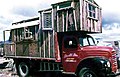 A very early seventies housetruck at Nambassa 1978.
 -
 1981 Mobile home at Nambassa.
 -
 Housetruck with development handmade wind-generator technology
 -
 1981 Nambassa.


Construction
[edit]

Most 1970s mobile homes were constructed from the chassis upwards utilising predominantly cheap recycled materials. Throughout this era house-truck rigs were constructed on the decks of old ex-farm trucks which could then be purchased for $500 to $2,500. House-buses were either stripped down to the chassis in preparation for construction or just added onto, to facilitate increased living areas. As opposed to the bright colourful American and British versions of the 1960s, many of the early Kiwi trucks were finished in earthy coloured timber exteriors. This was due to the use in the 1970s by Toyota of marine grade plywood for crates to import their vehicles from Japan. The crates came with good quality framed floors. This was suitable material to construct and clad a house truck. In the 1970s one could then purchase a complete car crate for around $25. An average size house-truck took around five car crates to build. In the 1970s a large number of derelict country farm houses from New Zealand's early colonial days were being demolished, these contained recyclable rare timbers such as kauri, totara and rimu. Other materials were purchased from timber recyclers and secondhand traders. Wood-fired potbelly stoves were used for cooking, heating hot water and warmth over the winter months. As most housetrucks parked in non-residential areas few of the early housetrucks were wired for mains electricity. Gas lighting and candles were the norm. Some trucks utilised a small gas or kerosene stove to supplement cooking over hot summer months. All these items were purchased second hand. Some early 1970s rigs experimented with homemade wind turbines for lighting; however these large units even though they were fastened to the roof during travel, proved awkward. Today, smaller modern units can be purchased at a reasonable price. Some housetruckers attached gas producer units to their rigs, effectively running their engines for free on charcoal gas.[1]
See also
[edit]References
[edit]- ^ a b c d e Nambassa: A New Direction, edited by Colin Broadley and Judith Jones, A. H. & A. W. Reed, 1979.ISBN 0589012169.
- ^ "Massey Magazine November 2001 | Educating Sonya". Archived from the original on 2018-02-19. Retrieved 2007-05-07.
- ^ Book Review – Home Free
- ^ Gypsy Fair
- ^ "Archived copy". Archived from the original on 2007-09-28. Retrieved 2007-05-07.
{{cite web}}: CS1 maint: archived copy as title (link) - ^ "Welcome to Visionz". Archived from the original on 2004-12-04. Retrieved 2007-05-07.
- ^ "www.aucklandfolkfestival.co.nz". Archived from the original on 2007-09-30. Retrieved 2007-05-07.
- ^ The 1960s Cultural Revolution by John C. McWilliams ISBN 0-313-29913-7 ISBN 978-0-313-29913-1
- ^ Feature film documentary, "Nambassa Festival", A Cannes Film Festival entry, 2 hour documentary-New Zealand, 1980. The New Zealand Film Archive / Ngā Kaitiaki O Ngā Taonga Whitiāhua Archived 2007-04-09 at the Wayback Machine
- ^ Warren, Troy (2012). Jester : Memoirs of a Retired Hippie. Publication Consultants. ISBN 9781594333057. OCLC 923342368.
External links
[edit]- 150 images of Housetrucks/bus at Nambassa Festivals. Archived from the original on 22 July 2016.
- HousetrucksNZ. Archived from the original on 11 October 2015.
- Official Nambassa website. Archived from the original on 22 March 2018.
Housetrucker
View on GrokipediaDefinition and Origins
Core Concept and Terminology
Housetruckers are individuals, families, or groups who convert heavy-duty trucks or buses into custom-built mobile dwellings for full-time nomadic habitation, prioritizing do-it-yourself (DIY) construction on salvaged chassis over commercial manufacturing.[5][8] These conversions transform vehicles like old Bedford trucks—common in New Zealand due to their robust frames from models produced between 1939 and 1953—into portable homes featuring living quarters, often with artistic embellishments.[9][10] The term "housetruck" specifically denotes the converted vehicle itself, derived from combining "house" and "truck," while "housetrucker" refers to the person or group inhabiting it, emerging as slang within New Zealand's 1970s countercultural communities.[2] This distinguishes housetrucks from mass-produced recreational vehicles (RVs) or motorhomes, which lack the bespoke, handcrafted nature and emphasis on repurposed heavy transport chassis.[5] Unlike van life practices, which typically involve lighter cargo vans or passenger vehicles adapted for minimalism, housetrucks rely on larger, truck-based platforms capable of supporting extensive structural modifications for self-sufficiency.[8] Housetruck terminology avoids broader labels like "tiny homes," which imply stationary or semi-permanent structures, or "off-grid living," which encompasses non-mobile setups; instead, it underscores inherent portability and mobility as core attributes.[11] In New Zealand contexts, housetrucks frequently utilize Bedford chassis for their load-bearing capacity, enabling elaborate builds documented in 1970s examples that integrate living spaces with rudimentary utilities.[9] This precise delineation maintains factual boundaries, separating housetruckers' practices from commercial RV culture or lighter nomadic adaptations.[5]Early Precursors and Global Roots
The practice of converting vehicles into mobile dwellings originated with 19th-century horse-drawn Romani vardos in Europe, which functioned as compact homes for itinerant traders, performers, and craftsmen pursuing seasonal work. These wagons, typically 10-12 feet long and adorned with carved panels and brass fittings, prioritized durability and portability for nomadic families, enabling self-contained living amid travel demands.[12] [13] Motorized precursors emerged in the early 20th century, as automobiles supplanted horses; in the United States, the 1915 Gypsy Van—built by New York financier Roland Conklin on a Pierce-Arrow truck chassis—represented one of the first self-propelled camping vehicles, equipped with bunks, a kitchen, and plumbing for extended road trips by affluent explorers.[14] By the mid-1950s, dedicated truck campers appeared, with manufacturers like Cree Truck Coach in Michigan producing slide-in units for pickup beds, initially designed for hunters, construction workers, and salesmen requiring on-site lodging amid economic booms in post-war mobility.[15] These conversions emphasized affordability and functionality, leveraging surplus wartime materials such as aluminum sheets from aircraft production to create lightweight, weatherproof shells.[16] Post-World War II vehicle surpluses further catalyzed such adaptations globally, as governments auctioned millions of military trucks— including U.S. Army GMC and International Harvester models—for civilian use at low costs, often under $500 per unit, enabling laborers and veterans to repurpose them into basic living quarters for remote jobs in logging, mining, and agriculture.[17] In the United States, this era saw school bus conversions gain traction among itinerant groups; a prominent example was author Ken Kesey's 1964 acquisition of a 1939 International Harvester school bus, customized as Furthur for the Merry Pranksters' transcontinental voyage, which highlighted psychedelic communal living but relied on bus frames rather than heavy-duty trucks favored in later regional variants.[18] [19] Such efforts remained niche outside North America, constrained by denser urban landscapes and early regulatory hurdles on vehicle modifications in Europe, where horse traditions persisted longer among traveling communities.[20]Historical Development
Countercultural Emergence in the 1960s and 1970s
The countercultural movement of the 1960s in the United States catalyzed the initial adoption of housetruck living as a rejection of post-World War II suburban conformity and institutional authority. Hippies and like-minded dissidents viewed fixed housing as emblematic of consumerist traps, opting instead for converted vehicles to enable nomadic self-reliance amid escalating social disruptions, including the Vietnam War draft that mobilized over 2.2 million men between 1964 and 1973. This mobility appealed to draft-eligible youth seeking to evade conscription or relocate freely for protests, while broader anti-establishment ethos—rooted in beats like Jack Kerouac's On the Road (1957)—promoted road-based autonomy over settled domesticity.[21] A landmark catalyst was author Ken Kesey's 1964 acquisition of a 1939 International Harvester school bus for $1,500, which his Merry Pranksters customized with bunks, a sound system, and psychedelic artwork before embarking on a cross-country LSD-fueled expedition to meet Neal Cassady and others. Dubbed "Furthur," the bus symbolized communal experimentation and directly inspired subsequent conversions, as Pranksters' accounts spread via media like Tom Wolfe's 1968 book The Electric Kool-Aid Acid Test, prompting thousands to transform surplus school buses—abundant from postwar school expansions—into rolling habitats. In the UK, parallel trends emerged with hippie conversions of Commer vans and old lorries, driven by similar rejection of rigid class structures and urban alienation, though on a smaller scale than American bus adaptations.[22][22] By the 1970s, economic pressures amplified this shift, with U.S. inflation surging to 5.7% in 1969 and peaking at 11% by 1974, eroding affordability of traditional housing for countercultural dropouts prioritizing minimalism over mortgages. An oversupply of decommissioned vehicles from expanding school districts and military surpluses facilitated cheap acquisitions—often under $500—enabling communes in regions like Northern California to experiment with bus-based mobility for agricultural labor or festival circuits. Unlike later eco-focused variants, these early housetrucks prioritized cost-saving detachment from utility grids and landlords, frequently guzzling gasoline in V8-powered chassis ill-suited for efficiency, underscoring a pragmatic pursuit of personal sovereignty over ideological environmentalism.[21][23]New Zealand-Specific Expansion and Nambassa Involvement
In New Zealand, the housetruck movement experienced a distinct expansion during the mid-1970s, driven by the affordability of surplus imported trucks like Bedford models, which were commonly adapted into mobile dwellings due to their robust chassis and availability from earlier commercial fleets.[10][3] This period aligned with economic strains, including oil shocks and a slowdown in traditional housing development following earlier booms, prompting some individuals to pursue self-built alternatives amid rising living costs.[24] The Nambassa festivals, organized from 1976 to 1981 on farms near Waihi in the Waikato region, emerged as key hubs for this community, attracting countercultural participants who traveled in housetrucks and formed visible encampments.[25] These events emphasized alternative lifestyles, arts, and music, with housetruck arrivals contributing to the festive atmosphere through improvised parking circles and shared spaces.[26] Notable gatherings included the 1978 event featuring early housetrucks alongside performances like the Mahana Roadshow, and the 1979 Roadshow Fayre, where large crowds of approximately 60,000 attendees witnessed housetruck clusters as integral to the scene.[26] The 1981 festival represented a culmination, with extensive documentation of housetruck formations highlighting their prominence before the movement's later shifts. Participation spread primarily through personal networks and festival word-of-mouth, rather than formalized promotion, amplifying visibility among like-minded travelers.[3]Post-1980s Evolution and Regional Variations
The housetrucking movement experienced a marked decline after the final Nambassa festival in 1981, as the countercultural momentum of the 1970s dissipated amid New Zealand's economic restructuring and regulatory changes.[27] The introduction of road user charges in 1978, followed by broader transport deregulation and vehicle weight limits revisions in the early 1980s, increased operational costs and compliance burdens for heavily modified housetrucks, which often struggled to meet evolving safety standards for brakes, dimensions, and roadworthiness.[28] These factors, combined with a shift toward urban employment amid the 1984 economic reforms, reduced the viability of full-time nomadic living, transitioning housetruckers from visible communes to more isolated or semi-permanent setups. Despite the national taper, housetrucking persisted in rural New Zealand regions like the Waikato and Bay of Plenty, where high rural land costs relative to urban housing—exacerbated by post-1980s property inflation—encouraged ongoing use of mobile dwellings for affordability.[29] Photographic documentation captures active housetruck communities into 1984, indicating continuity among dedicated practitioners who adapted to quieter lifestyles away from festival circuits.[30] Anecdotal estimates suggest participant numbers fell from hundreds in the late 1970s to dozens by the 1990s, reflecting a shift from mass countercultural participation to niche survival amid mainstream integration pressures. Regionally, New Zealand's housetrucking retained a distinct emphasis on self-built, festival-derived aesthetics, contrasting with Australia's more utilitarian adaptations influenced by outback mobility needs and cross-Tasman hippie migrations, though without the same scale. US West Coast remnants echoed early school-bus conversions but evolved into dispersed van-dwelling subcultures under looser rural zoning, while Europe's denser regulations and urban constraints confined similar practices to marginal traveler groups with minimal post-1980s expansion.[31] These variations stemmed from differing land availability and enforcement rigor, with New Zealand's rural persistence uniquely tied to its 1970s alternative legacy.Design and Construction Practices
Vehicle Selection and Basic Conversions
Housetruck conversions in New Zealand favored heavy-duty trucks as bases, particularly older Bedford models such as the J-series and TK variants, valued for their robust chassis and load-bearing capacity exceeding 6 tons in some cases.[8][32] International trucks were also commonly selected for similar durability attributes.[8] Lighter vehicles were generally avoided due to inherent stability deficiencies, as insufficient chassis strength led to frequent structural failures under the weight of added living structures.[33] The foundational conversion process emphasized engineering practicality, beginning with chassis reinforcement via welding supplementary steel frames to support the superimposed house load without exceeding axle weight limits.[33] This step ensured even weight distribution critical for roadworthiness, often utilizing salvaged materials to keep expenses minimal; base trucks could be acquired for as low as NZ$500 in later examples, reflecting the era's emphasis on economical repurposing during the 1970s countercultural movement.[34][8] Safety imperatives dictated strict adherence to axle load regulations and brake enhancements to accommodate the augmented vehicle mass, with New Zealand's elevated rollover rates—higher than in comparable nations—illustrating the hazards of overloaded or unreinforced setups in heavy vehicle operations.[33] Incidents involving improper load securing or stability lapses underscored the causal link between substandard conversions and accident risks, prompting builders to prioritize verifiable mechanical compliance over expediency.[33]Architectural Features and Self-Sufficiency Adaptations
Housetrucks incorporated wooden-framed walls and timber interiors to create habitable spaces resembling small cabins atop mobile chassis. These frames supported multi-level designs, including sleeping lofts and partitioned areas for cooking and storage, maximizing vertical space in conversions from trucks or buses.[5][35] Hardwood flooring, stained glass windows, and arched beam ceilings featured in many New Zealand examples, evoking craftsman aesthetics with handcrafted details.[5][35] Chimney vents protruded from roofs to accommodate wood-burning stoves, providing essential heating in off-grid settings; cast-iron models with oak adjuncts like iceboxes supported basic thermal needs.[5] Exteriors often included shingled roofs, bay windows, and porches or verandas, blending architectural whimsy with functionality, though such embellishments demanded ongoing maintenance to combat weathering and rot.[5] In contrast to minimalist American variants, New Zealand housetrucks emphasized ornate wooden siding and murals, reflecting local countercultural influences.[36] Self-sufficiency adaptations centered on rudimentary energy and waste systems suited to transient lifestyles. Handmade wind generators mounted on vehicles supplemented power needs in the late 1970s and early 1980s, predating common solar integration.[37] Generators and wood stoves addressed electricity and heat, but empirical constraints persisted: water storage typically ranged from 200 to 500 liters in period conversions, limiting prolonged isolation without resupply.[34] Composting toilets appeared in later adaptations for waste management, reducing reliance on external sanitation, yet historical setups often relied on portable solutions amid fuel-inefficient diesel engines that prioritized mobility over efficiency.[38] These features enabled short-term off-grid viability but underscored maintenance burdens, with surviving 1970s-era vehicles demonstrating longevity only through persistent repairs against environmental degradation.[5]Lifestyle and Daily Realities
Daily Operations and Mobility Challenges
Housetruck operations necessitate rigorous waste management to adhere to New Zealand's self-containment standards for freedom camping, which mandate fixed toilets, grey and black water tanks, and freshwater storage for vehicles on local authority land.[39] Dwellers must regularly transport waste to certified dump stations, as off-grid systems preclude indefinite retention without risking non-compliance or environmental harm.[39] Fueling demands frequent station visits owing to the high consumption rates of heavy, customized trucks, often derived from 1970s-era chassis like Bedfords, exacerbating operational costs.[40] Parking poses persistent logistical hurdles, confined largely to designated freedom camping zones, NZMCA parks, or negotiated private paddocks, with oversized dimensions—such as 4.2-meter heights—frequently barring access to standard sites or requiring escort vehicles for navigation.[41] Mobility is further strained by seasonal weather variability, compelling many to seek warmer North Island locales during June-to-August winters to mitigate exposure in under-insulated builds, though such migrations amplify fuel and mechanical wear.[41] Breakdowns recur from chassis overloads and rudimentary DIY engineering prevalent in 1970s conversions, where ad-hoc superstructures on vintage trucks led to frequent structural failures and towing incidents.[3] Sustaining operations requires housetruckers to possess practical skills in welding, plumbing, and engine repowering, as professional servicing proves impractical for remote, customized rigs—diverting substantial time from idealized nomadic pursuits to perpetual repairs.[41] For families, child education compliance under New Zealand law often hinges on homeschooling exemptions, demanding structured curricula amid constant relocation, which disrupts continuity and invites regulatory scrutiny.[41]Social Structures and Community Dynamics
Housetruck living in New Zealand predominantly revolves around individual families or small kinship groups, who prioritize mobility and self-sufficiency over permanent communal settlements. Families such as the Ashtons, traveling with children in their custom-built housetruck "Mim" since around 2020, exemplify this structure, treating the vehicle as a mobile home base for road citizenship rather than fixed collectives.[42] Similarly, groups like the Jansen family of five, including three children and a dog, operate in self-built housetrucks, emphasizing familial independence during travels across the country.[41] Occasional convoys form for practical purposes, such as joint travel to festivals or markets, but these are transient, reflecting a preference for autonomy amid the challenges of maintenance and road life.[5] Post-1980s, temporary social hubs emerged through events like the Gypsy Fair, established in 1991 by organizer Romain de Kerillis to showcase decorated housetrucks and house-buses while enabling owners to vend crafts and goods. These fairs serve as periodic gathering points for dispersed housetruckers, fostering short-term community bonds through shared displays and trade, with participants traveling nationwide to attend up to 32 events annually in some cases.[43] [5] The structure contrasts with larger intentional communities, as housetruckers maintain separate vehicles and itineraries, using fairs for economic and social exchange rather than ongoing cohabitation.[44] Community dynamics balance prized individualism with interpersonal frictions inherent to resource-scarce nomadic settings, though documented tensions remain anecdotal rather than systemic. Autonomy drives participation, with housetruckers valuing personal control over builds and routes, yet gatherings like Gypsy Fairs reveal cooperative elements in trading and mutual aid. Gender roles in vehicle construction and maintenance often align with traditional divisions, featuring male-led labor in heavy fabrication—mirroring broader patterns in New Zealand's hands-on trades—while women contribute to interiors, child-rearing, and vending. Isolation from prolonged road travel can exacerbate mental strains, as noted in personal accounts of housetruck realities diverging from idealized freedom, though empirical studies specific to this subculture are limited.[45] [46] These elements underscore a lifestyle where self-reliance tempers communal ideals, yielding resilient but non-utopian social fabrics.Cultural and Societal Impact
Influence on Alternative Living Movements
The housetruck movement of the 1970s, particularly through its visibility at New Zealand festivals like Nambassa, contributed to the DIY ethos underlying modern alternative living trends, such as van life and tiny homes on wheels, by demonstrating practical mobile self-sufficiency using repurposed vehicles.[5] These early conversions, often featuring handmade solar panels, composting toilets, and wood stoves, prefigured the customization and off-grid adaptations seen in 2010s van conversions, where enthusiasts prioritize minimalism and autonomy over conventional housing.[5] However, causal links are primarily anecdotal, with no empirical data showing widespread adoption; instead, the legacy manifests in niche persistence, such as New Zealand's Gypsy Fair events, which continue to exhibit heritage housetrucks and attract small audiences interested in nomadic self-reliance.[47] The movement's emphasis on handcrafted builds inspired self-sufficiency practices in subsequent off-grid communities, evident in resources like books on alternative shelter (e.g., those documenting 1970s-era conversions) that influenced later minimalism advocates.[7] In New Zealand, this ethos indirectly bolstered 2010s trends toward tiny homes amid housing affordability pressures, with housetrucks cited as "tiny homes of yesteryear" in local builds.[48] Yet, quantifiable impact remains limited—communities like the NZ Housetrucks Facebook group hovered around 780 members as of 2015, reflecting sustained but marginal interest rather than transformative scale.[5] Media portrayals often romanticize housetrucking's freedoms, attributing undue influence on broader movements while downplaying empirical challenges like mechanical failures and regulatory hurdles, which contributed to its decline post-1980s and tempered long-term emulation.[5] This overemphasis ignores higher attrition rates in DIY mobile living, where many early practitioners abandoned the lifestyle for stationary homes after 2–5 years, underscoring that while inspirational, housetrucks did not catalyze mass shifts in housing paradigms.[5]Interactions with Mainstream Society and Authorities
In the 1970s, housetruckers in New Zealand were often perceived by mainstream society as emblematic of the counterculture movement, embodying eccentric or disruptive lifestyles amid a predominantly conservative social fabric. Associated with hippie festivals like Nambassa, where thousands gathered in converted vehicles, housetruck living challenged conventional norms of settled housing and employment, leading to informal social frictions such as complaints over transient parking and communal gatherings in rural areas.[25] Authorities enforced road safety standards rigorously, requiring housetrucks to undergo warrants of fitness and comply with vehicle dimension and mass regulations under the Land Transport Act, with non-compliance risking fines for axle overloads starting at NZ$150 for excesses up to 500 kg.[49] Historical festival settings saw occasional police presence for crowd control, though Nambassa events were largely permitted without mass evictions, reflecting selective tolerance for organized alternative events. Land use restrictions emerged through local bylaws, prohibiting unauthorized camping to mitigate environmental impacts and neighbor disputes.[27] Contemporary interactions involve heightened regulatory scrutiny under the Freedom Camping Act 2011, which permits self-contained vehicles like housetrucks on public land unless locally prohibited, but councils frequently impose bans in sensitive zones to address waste dumping and visual clutter, resulting in infringement fines up to NZ$200 on-the-spot or NZ$10,000 via prosecution.[50] By 2025, mandatory green self-containment warrants ensure compliance with sanitation standards, integrating housetrucks into tourism frameworks while debunking notions of unregulated mobility.[51] Permitted holiday parks and Department of Conservation sites offer legal havens, yet persistent zoning conflicts—such as urban parking restrictions—underscore ongoing tensions between nomadic practices and municipal oversight.[52]Modern Practices and Revivals
Contemporary Adoption in New Zealand and Beyond
In New Zealand, housetrucking persists as a niche alternative amid ongoing housing affordability challenges, with small communities actively building and maintaining conversions into the 2020s. Families such as the Gallichans have documented their full-time housetruck lifestyle through YouTube vlogs, highlighting daily operations like heater installations during winter storms in May 2025 and emotional reflections on the realities of mobile living in August 2025.[53][54] These accounts illustrate motivations tied to escaping high property costs, as New Zealand's median house prices reached NZ$925,000 by mid-2024, exacerbating shortages in urban areas like Auckland.[55] Online forums sustain interest, with Facebook groups like NZ Housetrucks boasting over 4,400 followers sharing conversion projects and vintage restorations as of 2025.[56] Similarly, the New Zealand Housebus, Housetrucks group facilitates buying, selling, and discussions among enthusiasts focused on self-built mobile homes.[57] Adoption remains limited, with participant numbers estimated in the low hundreds nationwide, reflecting a revival among those seeking mortgage-free mobility rather than widespread mainstream uptake.[5] Boondocking practices, such as free camping on public lands, continue to enable this lifestyle, supported by New Zealand's geography of accessible rural areas and relatively permissive regulations compared to denser urban nations. Groups like House Truckers & Hippy's, with active posts on off-grid builds as recent as August 2024, underscore ongoing DIY efforts amid economic pressures.[58] Globally, housetrucking echoes faintly outside New Zealand, primarily as artisanal tiny home variants rather than a cultural mainstay. In Australia, isolated examples include custom wagons and truck-based dwellings marketed for off-grid appeal, but adoption lacks the organized communities seen in New Zealand due to stricter vehicle modification laws and urban sprawl.[59] The United States features sporadic builds, such as off-grid truck conversions showcased in 2025 vlogs, yet these align more with broader van life trends than dedicated housetruck movements, with New Zealand retaining the core due to its historical hippie origins and favorable terrain for low-impact travel.[60] Overall, international instances number fewer than in New Zealand, often blending into recreational RV culture without the same emphasis on permanent, self-sufficient housetruck living.Technological and Economic Updates
Post-2000 housetruck adaptations have incorporated advancements in off-grid power systems, including lithium iron phosphate (LiFePO4) batteries and flexible solar panels, enabling greater energy efficiency for lighting, appliances, and water pumping compared to earlier lead-acid setups.[61][62] These upgrades, often sourced from New Zealand suppliers like MEDA and Hitek Solar, allow for 200-500 watt arrays paired with MPPT charge controllers, supporting daily loads of 1-2 kWh in sunny conditions while reducing reliance on generators.[62] LED lighting retrofits further minimize consumption, dropping interior power needs by up to 80% versus incandescent bulbs used in pre-2000 builds.[63] Despite these efficiencies, propulsion remains predominantly diesel-based, with conversions typically using pre-2000 heavy trucks like Bedfords or HinOs due to their robust chassis and availability, limiting full electrification owing to high retrofit costs exceeding NZ$100,000 for battery packs and motors incompatible with mobile living weights.[64] Electric truck chassis, while emerging globally, face range limitations under 300 km per charge when loaded, making diesel's 800+ km refuel intervals more practical for nomadic use in New Zealand's rural terrains.[65] Economically, modern DIY housetruck builds offer initial capital savings, with total conversions ranging from NZ$10,000 to $50,000 including a base vehicle purchased for under $5,000, starkly lower than the NZ$500,000+ average for a 200 m² house.[34][66] However, hidden costs erode long-term viability, including annual repairs on aging diesel engines and chassis—often NZ$2,000-5,000 for rust mitigation and mechanical overhauls—compounded by inflation since 2000, where vehicle parts have risen 50-100% amid supply chain disruptions.[64] Fuel expenses average NZ$0.30-0.50 per km for loaded travel, versus negligible for stationary homes, questioning net savings over 10+ years without meticulous maintenance.[67] Navigation aids have evolved with GPS-enabled smartphone apps tailored for oversized vehicles, such as SmartTruckRoute, which factor in height, weight, and bridge clearances to prevent route errors common in pre-smartphone eras.[68] Online communities, including the Housetrucks NZ forum and Facebook groups like New Zealand Housebus, Housetrucks, facilitate design sharing, with members posting lithium wiring diagrams and cost breakdowns since the early 2010s, accelerating adaptations without formal engineering.[5][57] These platforms report build times reduced to 6-12 months via crowdsourced blueprints, though credibility varies as user-generated content often overlooks regulatory compliance variances across councils.[64]Criticisms and Empirical Challenges
Practical and Safety Drawbacks
Housetrucks, often constructed with exposed metal frames and DIY modifications, require intensive maintenance, particularly in New Zealand's humid and coastal environments where vehicle corrosion accelerates due to frequent exposure to moisture, rain, and salt-laden air.[69][70] Rust can compromise structural integrity, leading to frequent repairs of chassis, body panels, and undercarriage components, with owners reporting accelerated deterioration compared to standard vehicles.[71] Space limitations in housetrucks pose significant practical challenges for families, as confined interiors—typically under 30 square meters—restrict storage, sleeping arrangements, and personal privacy, exacerbating clutter and interpersonal tensions.[72] Families often face difficulties accommodating children's needs, such as dedicated play areas or quiet spaces, resulting in improvised solutions that strain daily routines.[73] Safety risks include heightened rollover potential from elevated centers of gravity, as housetrucks' added superstructures raise the vehicle's profile similar to RVs, increasing instability during turns or evasive maneuvers, especially at speeds above 55 km/h.[74][75] Empirical data on analogous vehicles show rollovers account for a disproportionate share of accidents in high-profile motorhomes due to this design flaw.[76] Fire hazards are amplified by makeshift wooden interiors, improvised electrical wiring, and propane systems common in conversions, which can ignite rapidly in enclosed spaces; reports from bus conversions document multiple total losses from electrical shorts or fuel leaks.[77][78] Poor ventilation and accumulated dust further elevate risks, with tiny mobile dwellings engulfing in flames within seconds of ignition.[79] Housetrucks exhibit lower structural longevity than stationary homes, typically lasting 10-20 years under nomadic use versus 50+ years for fixed dwellings, owing to constant road vibrations, weather exposure, and deferred maintenance.[80] Nomadic stressors associated with housetruck living, including frequent relocations and instability, correlate with elevated anxiety, fatigue, and isolation in empirical studies of mobile lifestyles, disrupting routines and social ties more than sedentary living.[81][82]Economic and Long-Term Viability Assessments
The housetruck lifestyle initially appealed economically by enabling avoidance of mortgage debt and high rental costs through DIY conversions of surplus trucks, often completed for under NZ$15,000 using reclaimed materials.[34] This approach allowed short-term financial flexibility during the 1970s oil crises and economic uncertainty in New Zealand, when participants could subsist on minimal incomes from crafts or seasonal work sold at festivals like Nambassa.[25] However, long-term asset depreciation eroded these gains, as converted vehicles typically lost 10-20% of value annually due to mechanical wear, rust, and regulatory non-compliance, unlike fixed housing that builds equity over time.[83] Ongoing operational costs further undermined viability, including fuel expenses averaging NZ$2,000-4,000 yearly for mobile living, plus repairs for engines, tires, and custom structures exposed to road vibrations and weather—expenses that frequently doubled initial build budgets within five years.[11] Nomadic patterns imposed opportunity costs, such as forfeited steady wages from inability to maintain fixed employment or access urban job markets, with many housetruckers reporting income instability below the national median of NZ$60,000 in equivalent periods.[41] By the late 1980s, economic liberalization under Rogernomics reduced welfare subsidies, compelling a high attrition rate as families prioritized child education and healthcare stability over transience.[84] Empirical evidence indicates the movement's unsustainability, with participation peaking around 1978-1984 before widespread abandonment; fewer than 1% of New Zealand's housing stock now consists of housetrucks, reflecting return to conventional dwellings amid rising family formation and regulatory enforcement on vehicle standards.[30] Scalability as a housing solution remains limited, as modular or transportable fixed homes offer superior durability and financing options, with costs 20-30% below traditional builds and potential for appreciation, per industry analyses.[85] Critics argue the lifestyle fosters dependency by de-emphasizing disciplined saving and career progression, attributing failures to personal choices like evading long-term planning rather than external barriers, evidenced by higher poverty persistence among extended nomadic groups compared to settled peers.[5]References
- https://en.wiktionary.org/wiki/housetrucker
- https://commons.wikimedia.org/wiki/File:1981_Housetruck_with_development_handmade_wind-generator_technology.jpg