


Community hub
Recent from talks
Contribute something
Nothing was collected or created yet.
Siphon (mollusc)
View on Wikipedia
A siphon is an anatomical structure which is part of the body of aquatic molluscs in three classes: Gastropoda, Bivalvia and Cephalopoda (members of these classes include saltwater and freshwater snails, clams, octopus, squid and relatives).
Siphons in molluscs are tube-like structures in which water (or, more rarely, air) flows. The water flow is used for one or more purposes such as locomotion, feeding, respiration, and reproduction. The siphon is part of the mantle of the mollusc, and the water flow is directed to (or from) the mantle cavity.
A single siphon occurs in some gastropods. In those bivalves which have siphons, the siphons are paired. In cephalopods, there is a single siphon or funnel which is known as a hyponome.
In gastropods
[edit]In some (but not all) sea snails, marine gastropod molluscs, the animal has an anterior extension of the mantle called a siphon, or inhalant siphon, through which water is drawn into the mantle cavity and over the gill for respiration.[1]
This siphon is a soft fleshy tube-like structure equipped with chemoreceptors which "smell" or "taste" the water, in order to hunt for food.[2][3][4] Marine gastropods that have a siphon are either predators or scavengers.[5]
Although in gastropods the siphon functions perfectly well as a tube, it is not in fact a hollow organ, it is simply a flap of the mantle that is rolled into the shape of a tube.[1]
In many marine gastropods where the siphon is particularly long, the structure of the shell has been modified in order to house and protect the soft tissue of the siphon. This shell modification is known as the siphonal canal. For a gastropod whose shell has an exceptionally long siphonal canal, see Venus comb murex.
In the case of some other marine gastropod shells, such as the volute and the Nassarius pictured to the right, the shell has a simple "siphonal notch" at the anterior edge of the aperture instead of a long siphonal canal.
The Aplysia gill and siphon withdrawal reflex is a defensive reflex which is found in sea hares of the genus Aplysia; this reflex has been much studied in neuroscience.
Siphon as a snorkel
[edit]Freshwater apple snails in the genera Pomacea and Pila have an extensible siphon made from a flap of the left mantle cavity. They use this siphon in order to breathe air while they are submerged in water which has a low oxygen content so they cannot effectively use their gill.[6]
Apple snails use the siphon in a way that is reminiscent of a human swimmer using a snorkel, except that the apple snail's siphon can be retracted completely, or extended to various lengths as needed.[6]
For these freshwater snails, the siphon is an anti-predator adaptation. It reduces their vulnerability to being attacked and eaten by birds because it enables the apple snails to breathe without having to come all the way up to the surface, where they are easily visible to predators.[6]
The shells of these freshwater snails have simple round apertures; there is no special notch for the siphon.
Paired siphons of bivalves
[edit]

Those bivalves that have siphons, have two of them. Not all bivalves have siphons however: those that live on or above the substrate, as is the case in scallops, oysters, etc., do not need them. Only those bivalves that burrow in sediment, and live buried in the sediment, need to use these tube-like structures. The function of these siphons is to reach up to the surface of the sediment, so that the animal is able to respire, feed, and excrete, and also to reproduce.[7][8]
The deeper a bivalve species lives in the sediment, the longer its siphons are. Bivalves which have extremely long siphons, like the geoducks pictured here, live very deeply buried, and are hard to dig up when clamming.[9]

Many bivalves that have siphons can withdraw them completely into the shell when needed, but this is not true of all species. Bivalves that can withdraw the siphons into the shell have a "pallial sinus", a sort of pocket, into which the siphons can fit when they are withdrawn, so that the two shell valves can close properly. The existence of this pocket shows even in an empty shell, as a visible indentation in the pallial line, a line which runs along parallel to the ventral margin of the shell.[10]
The bivalve's two siphons are situated at the posterior edge of the mantle cavity.[11] There is an inhalant or incurrent siphon, and an exhalant or excurrent siphon.[12] The water is circulated by the action of the gills. Usually water enters the mantle cavity through the inhalant siphon, moves over the gills, and leaves through the exhalant siphon. The water current is utilized for respiration, but also for filter feeding, excretion, and reproduction.
Feeding
[edit]Depending on the species and family concerned, some bivalves utilize their inhalant siphon like the hose of a vacuum cleaner, and actively suck up food particles from the marine substrate. Most other bivalves ingest microscopic phytoplankton as food from the general water supply, which enters via the inhalant siphon and reaches the mouth after passing over the gill.[13]
Please also see pseudofeces.
Hyponome of cephalopods
[edit]The hyponome or siphon is the organ used by cephalopods to expel water, a function that produces a locomotive force. The hyponome developed from the foot of the molluscan ancestor.[14]
Water enters the mantle cavity around the sides of the funnel, and subsequent contraction of the hyponome expands and then contracts, expelling a jet of water.
In most cephalopods, such as octopus, squid, and cuttlefish, the hyponome is a muscular tube. The hyponome of the nautilus differs however, in that it is a one-piece flap that is folded over. Whether ammonites possessed a hyponome and if so what form it may have taken, is as yet not known.[15]
Gallery
[edit]-
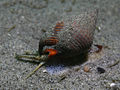 The sea snail Nassarius fossatus is a scavenger. Siphon on the left
 -
 Pomacea canaliculata, seen through glass, has reached its siphon up to the water surface to breathe air
 -
 Clam with its siphon out
 -
 The siphon of a large herbivore marine volute, Cymbiola magnifica
 -
 Nautilus belauensis seen from the front, showing the opening of the hyponome.
 -
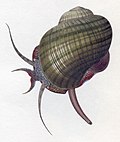 Engraving of Florida freshwater applesnail Pomacea paludosa; siphon on lower right
 -
 Four specimens of Panopea generosa in a seafood tank; the paired siphons (or "necks") of this species can be one meter long


References
[edit]- ^ a b Örstan A. 13 April 2007. Melongena's siphon. Snail's Tales.
- ^ Abbott, RT and Sandstrom, GF (2001) Seashells of North America Macmillan. ISBN 978-1-58238-125-1 Nassa mud snails, p. 142.
- ^ Cone snails Archived 25 May 2011 at the Wayback Machine. Hawaiian Marine Life. Accessed 18 November 2008.
- ^ Respiratory system. The apple snail website. Accessed 18 November 2008.
- ^ Los Marineros Marine Life. Caption Mollusca. Archived 3 October 2000 at the Wayback Machine Accessed 21 November 2008.
- ^ a b c Respiratory system. The apple snail website, http://www.applesnail.net, accessed 26 February 2009.
- ^ Bales, SL and Venable, S. 2007. Natural Histories: Stories from the Tennessee Valley. University of Tennessee Press. ISBN 978-1-57233-561-5. p. 66.
- ^ Barnes, H. (Ed.) 2008. Oceanography and Marine Biology CRC Press. ISBN 978-1-4200-6574-9. p. 77.
- ^ Washington Department of Fish and Wildlife. 2000. WDFW - Shellfish: Geoduck clam. accessed 26 February 2009.
- ^ M. Alan Kazlev. Palaeos Metazoa: Mollusca: Bivalvia: Bivalve Glossary Archived 6 November 2008 at the Wayback Machine. Page uploaded 11 January 2003, last change 7 July 2007, accessed 26 February 2009.
- ^ Anatomy of a Bivalve Archived 23 April 2009 at the Wayback Machine. accessed 26 February 2009.
- ^ Siphons Archived 12 March 2008 at the Wayback Machine. accessed 26 February 2009.
- ^ S. Peter Dance. 1977. The Encyclopedia of Shells. Blandford Press Limited, Poole, Dorset, ISBN 0-7137-0698-8, pp. 288, page 8.
- ^ Class Cephalopoda: the Head-Feet Archived 16 September 2008 at the Wayback Machine Accessed 21 November 2008.
- ^ Discussion. http://palaeo-electronica.org/ Accessed 21 November 2008.
External links
[edit]Cephalopod anatomy | ||||||||||||||
|---|---|---|---|---|---|---|---|---|---|---|---|---|---|---|
| Shell |
|    | ||||||||||||
| Mantle & funnel |
| |||||||||||||
| Head & limbs |
| |||||||||||||
| General |
| |||||||||||||
Developmental stages: Spawn → Paralarva (Doratopsis stage) → Juvenile → Subadult → Adult • Egg fossils • Protoconch (embryonic shell) | ||||||||||||||
Siphon (mollusc)
View on GrokipediaOverview
Definition and General Function
In molluscs, a siphon is defined as a tubular extension formed by fused layers of the mantle, functioning as a snorkel-like structure to channel water flow in aquatic species across classes such as Gastropoda, Bivalvia, and Cephalopoda.[5] This fleshy, muscular tube typically emerges from the mantle cavity and enables the mollusc to draw in and expel water while remaining partially concealed.[6] The primary functions of the siphon include facilitating respiration by inhaling water to oxygenate the gills and exhaling deoxygenated water, supporting filter-feeding by drawing in particulate food such as phytoplankton, and aiding in waste expulsion through the outflow of effluents and pseudofeces.[11] In addition, siphons contribute to locomotion via jet propulsion, where forceful expulsion of water generates thrust, particularly in cephalopods.[4] Siphons are most prevalent in infaunal or burrowing molluscs, where they allow extension beyond sediments or shells to access surface water without exposing the body to predators or environmental stresses.[5] This adaptation provides universal benefits, such as enhanced survival in hypoxic sediments by maintaining efficient water exchange and enabling sustained filter-feeding.[12]Evolutionary Origins
The siphons of molluscs trace their origins to the evolution of the mantle cavity in early representatives of the phylum, which emerged during the Cambrian period approximately 500 million years ago. Fossil evidence from middle Cambrian deposits, such as the Burgess Shale, reveals stem-group molluscs like Odontogriphus omalus that possessed a distinct mantle cavity surrounding the foot, providing a foundational space for respiratory and feeding currents that later adaptations like siphons would enhance.[13] Recent genomic analyses confirm the monophyly of major molluscan classes and support the deep evolutionary conservation of the mantle cavity as a foundational trait.[14] This cavity likely originated in a simple, worm-like ancestor, enabling the influx of oxygenated water and marking a key step in the diversification of molluscan body plans from Late Ediacaran precursors into the Cambrian explosion.[15] Siphons represent an adaptive radiation that occurred independently or convergently across molluscan lineages, particularly in response to the demands of benthic lifestyles where organisms needed to extend feeding or respiratory structures into the water column without fully exposing their bodies. In gastropods, the siphonate condition—manifested as elongated canals in the shell—arose multiple times during the Paleozoic era, with at least seven independent origins in the early to middle Paleozoic alone, allowing predatory or deposit-feeding species to probe sediments safely.[16] Fossil records preserve these as siphonal canals in Paleozoic gastropod shells, such as those from Ordovician and Devonian species, indicating early experimentation with infaunal burrowing. In cephalopods, the hyponome—a muscular siphon-like structure—appears in the Late Cambrian Plectronoceras, inferred from shell apertures that accommodated a funnel for jet propulsion, while in bivalves, mantle fusion to form siphons enabled deeper burrowing post-Paleozoic.[17][18] The primary evolutionary drivers of siphon development included escalating predation pressure, which favored burrowing behaviors to evade visual hunters, and the transition to infaunal habitats in oxygen-poor sediments, where siphons facilitated access to surface waters for respiration and feeding. In bivalves, this is exemplified by the post-Paleozoic radiation of infaunal forms, where siphon formation following mantle fusion allowed occupation of deeper, predator-safe niches and coincided with declining oxygenation in marine benthos during the Mesozoic.[19] Similarly, in gastropods, siphons evolved amid rising durophagous predation from fish and crustaceans, promoting selective advantages for concealed lifestyles.[16] For cephalopods, the hyponome's early emergence supported active swimming in oxygenated Paleozoic seas, reducing vulnerability to benthic predators. Siphons have profoundly influenced diversity in certain molluscan classes, such as the post-Paleozoic radiation of infaunal bivalves, enabling exploitation of diverse marine and freshwater ecosystems through specialized respiration, feeding, and locomotion without compromising protection. This adaptability underpins ecological success across the phylum's approximately 85,000–100,000 described extant species.[19][20]Anatomy
Basic Structure
The siphon in molluscs is a muscular, extensible tube formed from fused mantle tissue, serving as a conduit for water flow into and out of the mantle cavity. This structure is typically lined with ciliated epithelium and mucus-secreting cells, which facilitate the propulsion of water currents and the capture of suspended particles for feeding or filtration.[12][21] Key components of the siphon include its proximal attachment to the mantle cavity margin, where it integrates with the surrounding pallial tissues, and a distal opening that allows for the intake or expulsion of water. Directional control is often provided by valved structures or muscular sphincters near the distal end, enabling selective regulation of flow to support respiration, feeding, or locomotion.[22][21] The siphon's wall comprises distinct tissue layers that confer protection, flexibility, and functionality: an outer epithelium shields against environmental abrasion, a subepithelial connective tissue layer with hemolymph sinuses supports nutrient distribution, a prominent muscular layer (often with alternating longitudinal and circular fibers) enables extension and contraction, and an inner ciliated lining drives water pumping through coordinated ciliary action.[21][12] Size varies widely depending on species and habitat demands, from a few millimeters in small, non-burrowing forms to over one meter in large infaunal species like the geoduck bivalve (Panopea generosa), where elongated siphons extend to the sediment surface for feeding.[23][22] Sensory elements are integrated into the siphon, including chemoreceptors that detect dissolved chemicals in incoming water and mechanoreceptors that sense flow dynamics or mechanical disturbances, often manifested as ciliated sensory organs or small tentacular projections at the distal tip for environmental monitoring.[24][25]Variations Across Classes
Siphons exhibit significant anatomical diversity across the major classes of Mollusca, reflecting adaptations to different lifestyles and habitats. In Gastropoda, siphons are typically single and proboscis-like, serving as an extension of the mantle that draws water into the mantle cavity for respiration and feeding; these are often housed within shell features such as anterior canals or notches at the aperture margin, with variations including simple indentations in some species or elongated tubes in others.[26] In contrast, Bivalvia feature paired siphons—an incurrent tube for intake and an excurrent tube for outflow—that are formed by the fusion of mantle edges, sometimes completely united into a single siphonal tube; this arrangement is supported by a pallial sinus, an embayment in the pallial line that accommodates retractor muscles for pulling the siphons into the shell.[22] Cephalopoda possess a distinct structure known as the hyponome, a single, funnel-shaped organ formed by a fold of the mantle, which is highly muscular and capable of flexible contraction for jet propulsion; unlike the mantle-based siphons of other classes, the hyponome allows for directed water expulsion and is not retracted into a shell.[27][28] These variations highlight evolutionary divergences: gastropod siphons emphasize directed water flow in mobile, often predatory species, bivalve siphons facilitate stationary filter-feeding with protective retraction, and the cephalopod hyponome prioritizes locomotion in active swimmers. Rare transitional forms occur in some prosobranch gastropods, where unpaired siphons resemble simpler mantle extensions without extensive shell canals, while nautiloid cephalopods retain a complex, muscular hyponome akin to that in more derived coleoids.[26][27]| Class | Pairing | Structure | Muscularity | Protective Features |
|---|---|---|---|---|
| Gastropoda | Single | Proboscis-like mantle extension in shell canal or notch | Moderate, for extension/retraction | Shell canal or notch for housing; operculum for aperture closure[26] |
| Bivalvia | Paired (incurrent/excurrent), often fused | Mantle folds forming tubes; pallial sinus for retraction | Retractor muscles for pulling into shell | Periostracum layer; sometimes leathery or chitin-reinforced sheaths against abrasion[22][29] |
| Cephalopoda | Single (hyponome) | Funnel-shaped, mantle-derived tube | Highly muscular for jet propulsion and directionality | Flexible flaps; integrated with mantle locking apparatus[27][28] |