Recent from talks
Nothing was collected or created yet.
Sea silk
View on Wikipedia
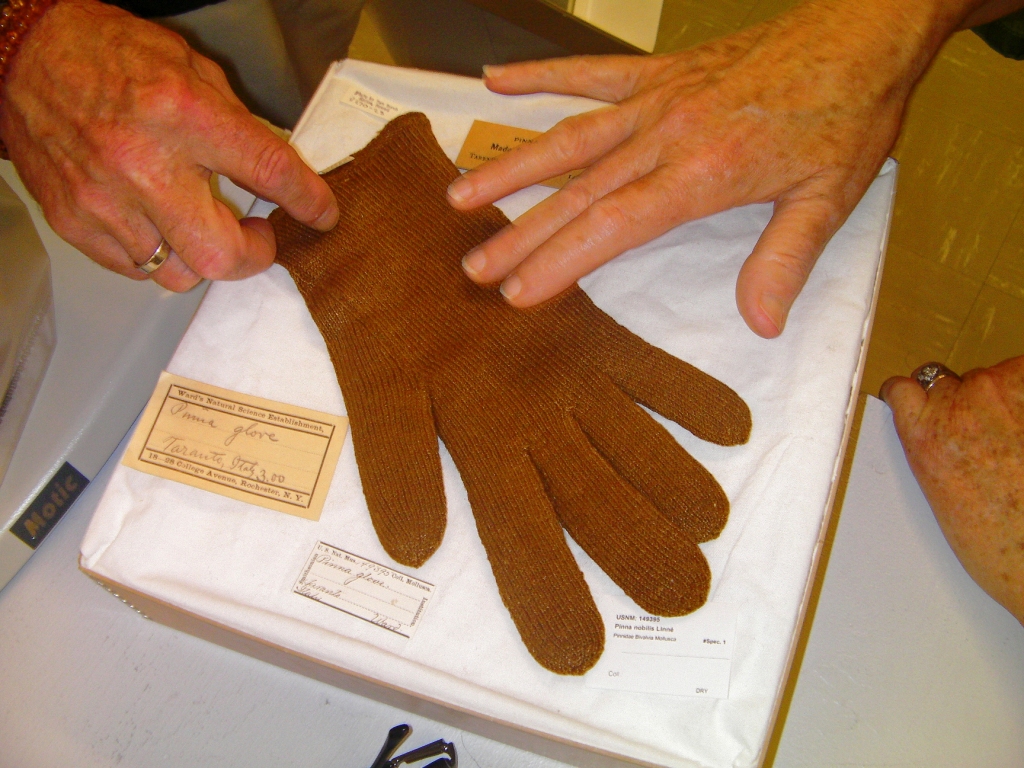
Sea silk is an extremely rare fabric that is made from the long silky filaments, or byssus, secreted by a gland in the foot of pen shells (in particular Pinna nobilis).[1] The byssus is used by the mussel to attach itself to the sea bed.[2] It was previously produced in Sardinia and Taranto until the early 20th century and is still made at small scale by a few people in Sardinia.[3]
The cloth produced from byssus is extremely light and warm. It is also often described as being very thin, although it is similar in thickness to other fibers such as silk.[4] Byssus was said to be so fine that a pair of women's gloves made from the fabric could fit into half a walnut shell and a pair of stockings in a snuffbox.[5] However, Helen Scales has put forward the idea that this idea actually refers to Limerick gloves made from a fine kid leather that were sold inside walnut shells as a marketing stunt, and over time, the walnut packaging and beliefs about byssus cloth were conflated.[6]
Production
[edit]Pinna nobilis produces a beard of about 1,000 fibers to attach itself to the sea floor, which are all attached to a central stem. They can be up to 20 centimetres (7.9 in) long.[3]
The removed beard is processed in several steps. First, it is rinsed in the sea to remove debris. It is then washed in fresh water and manually cleaned.[7] This may be followed by a third bath, again in fresh water.[8] After drying, it is carded and then spun by hand.[7] Beginning in the early 19th century, the beards were sometimes left intact after being cleaned and combed and then sewn together in a close, overlapping manner to produce an effect resembling fur.[8]
The fibers vary in color and have a unique egg-shaped profile when viewed under a microscope.[3][8] They are 10–50 microns in diameter, which is comparible to other natural fibers such as silk (11–15 microns), merino wool (18–25 microns) or mohair (20–40 microns).[4] It is not very strong, especially when wet, compared to other fibers.[9]
Bysus can be soaked in lemon juice for a few hours to produce a golden color.[7] There are no known historical examples of dyed sea silk, probably because the natural color was highly valued. Modern experiments with dyeing sea sillk have not shown dramatic color changes.[8]
While a few extant woven objects are known, most were knit, and many are gloves.[8] A knitted pair of gloves probably took the byssus from around 150 shells to produce.[3] There are historical reports of sea silk being mixed with silk, probably for economic reasons, and also with wool, though very few objects with mixed fibers are now known to exist. Sea silk fibers may also be used for embroidery.[8]
History
[edit]Tracing the history of sea silk is difficult in part because the word byssus originally referred to fine fabric made of linen or perhaps cotton, and in the Middle Ages, also to that made of silk.[10] The first written mentions of sea silk date to the 2nd century AD, and the oldest piece of sea silk that has been found dated to the 4th century AD; a fragment was discovered in a grave in Budapest in the remains of Aquincum. However, the fragment was lost during World War II.[3][11] The oldest surviving sea silk object is a knit hat from the 14th century, which was found in a waste pit near Paris.[12]
Egypt
[edit]The Greek text of the (196 BC) Rosetta Stone records that Ptolemy V reduced taxes on priests, including one paid in byssus cloth. This is thought to be fine linen cloth, not sea silk. In Ancient Egyptian burial customs, byssus was used to wrap mummies; this was also linen and not sea silk.[10]
Greece
[edit]The sophist author Alciphron first records "sea wool" in his (c. 2nd century AD) "Galenus to Cryton" letter.[13]
Sea silk has been suggested as an interpretation of the nature of the Golden Fleece that was sought by Jason and the Argonauts[14] but scholars reject this hypothesis.[15]
Roman Empire
[edit]The early Christian Tertullian (c. 160–220 AD) mentions it when justifying his wearing a pallium instead of a toga:
Nor was it enough to comb and to sew the materials for a tunic. It was necessary also to fish for one's dress; for fleeces are obtained from the sea where shells of extraordinary size are furnished with tufts of mossy hair.[16]
Several sources mention lana pinna ("pinna wool"). Emperor Diocletian's (301 AD) Edict on Maximum Prices lists it as a valuable textile.[17]
The Byzantine historian Procopius's c. 550 AD Persian War, "stated that the five hereditary satraps (governors) of Armenia who received their insignia from the Roman Emperor were given chlamys (or cloaks) made from lana pinna. Apparently only the ruling classes were allowed to wear these chlamys."[18]
Middle East
[edit]The Arabic name for "sea silk" is ṣūf al-baḥr ("sea wool"). The 9th-century Persian geographer Estakhri notes that a sea-wool robe cost more than 1000 gold pieces and records its mythic source:
At a certain period of the year an animal is seen running out of the sea and rubbing itself against certain stones of the littoral, whereupon it deposes a kind of wool of silken hue and golden colour. This wool is very rare and highly esteemed, and nothing of it is allowed to waste.[19]
Two 13th-century authors, Ibn al-Baitar and Zakariya al-Qazwini, repeat this inaccurate "sea wool" story.[20]
The city of Tinnis on the Nile Delta was known for its garments made of sea silk, called buqalamun from hypokalamon, the Greek name of the byssus mollusc.[21]
China
[edit]Beginning in the Eastern Han dynasty (25–220 AD), Chinese histories document importing sea silk. Chinese language names include "cloth from the west of the sea" and "silk knitted by mermaids".[22][23]
The 3rd century AD Weilüe or "Brief Account of the Wei", which was an unofficial history of the Cao Wei empire (220–265 AD), records haixi ("West of the Sea") cloth made from shuiyang ("water sheep"):[24]
They have fine brocaded cloth that is said to be made from the down of "water-sheep". It is called Haixi ("Egyptian") cloth. This country produces the six domestic animals [traditionally: horses, cattle, sheep, chickens, dogs and pigs], which are all said to come from the water. It is said that they not only use sheep's wool, but also bark from trees, or the silk from wild silkworms, to make brocade, mats, pile rugs, woven cloth and curtains, all of them of good quality, and with brighter colours than those made in the countries of Haidong (East of the Sea).[25]
The c. 5th century AD Hou Hanshu ("Book of the Eastern Han") expresses doubt about "water sheep" in the "Products of Daqin" section. "They also have a fine cloth which some people say is made from the down of 'water sheep,' but which is made, in fact, from the cocoons of wild silkworms".[26] The historian Fan Ye (398–445 AD), author of the Hou Hanshu, notes this section's information comes from the report that General Ban Yong (son of General Ban Chao, 32–102 AD) presented to the Emperor in 125. Both Bans administered the Western Regions on the Silk Road. Hill considered it likely that the original reports correctly referred to sea silk, and later cloth that was examined in China was made of the similar-looking wild silk, leading to earlier reports being dismissed.[27]
The (945 AD) Tang shu "Book of Tang" mentioned Haixi cloth from Folin (Byzantine Syria), which Emil Bretschneider first identified as sea silk from Greece. "There is also a stuff woven from the hair of sea-sheep, and called hai si pu (stuff from the western sea)". He notes, "This is, perhaps, the Byssus, a clothstuff woven up to the present time by the Mediterranean coast, especially in Southern Italy, from the thread-like excrescences of several sea-shells, (especially Pinna nobilis)."[28]
The early 6th century AD Shuyiji ("Records of Strange Things") mentions silk woven by Jiaoren, "jiao-dragon people", which Edward H. Schafer identifies as sea silk:
In the midst of the South Sea are the houses of the kău people who dwell in the water like fish, but have not given up weaving at the loom. Their eyes have the power to weep, but what they bring forth is pearls.[29]
This aquatic type of raw silk was called jiaoxiao, with the first character meaning "shark" and the second a form of raw silk, although it was also described in some sources as a high-quality muslin or chiffon.[23]
Modern Europe
[edit]Archbishop Giuseppe Capecelatro gave dignitaries gifts made of sea silk in the 1780s, hoping to encourage demand to help provide for sea silk producers in need of work. Sea silk objects began to be put on display internationally in the 19th century; it was shown at the Louvre in 1801 and at the Centennial Exposition in 1876.[3]
Sea silk was also mentioned in 19th century fiction. Alexander Serov's 1863 opera Judith includes an aria "I shall don my robe of byssus" (Russian: Я оденусь в виссон).[30] In Jules Verne's 1870 novel Twenty Thousand Leagues Under the Seas, the crew of the Nautilus wear clothes made of byssus (alternately translated as "seashell tissue" or "fan-mussel fabric").[31]
The sea silk industry in Taranto grew somewhat beginning in the 1920s with the advent of a private school run by Rita del Bene; however, it disappeared there with the onset of World War II and did not return after the war.[3] Also in the 1920s, Italo Diana began a school on the island of Sant'Antioco near Sardinia.[7]
Pinna nobilis has become threatened with extinction, due to overfishing, the decline in seagrass fields, and pollution. Since 2016, populations have also been attacked by a parasite called Haplosporidium pinnae, which has caused mass die-offs.[32] As it has declined so dramatically, the sea silk industry has almost disappeared, and byssus is difficult to come by; since 1992, it is illegal to harm or harvest living Pinna nobilis. The art is now preserved only by a few women in Sant'Antioco.[3]
"Project Sea-Silk" from the Natural History Museum of Basel, run by Felicitas Maeder, has been collecting extensive data and studies on the subject since 1997.[33][7]
Chiara Vigo has claimed in various media to be the sole person living today to master the art of working with byssus, and she runs the Sea Silk Museum in Sant'Antioco.[34][35] Maeder has accused Vigo of creating a false historical narrative about sea silk.[36] Vigo says she has a method to harvest bysus without harming the shells by trimming 10 centimetres (3.9 in) from the beard, although Scales expressed skepticism that this would produce the amount of byssus Vigo says she takes (600 grams (21 oz) per year; the intact beards of fifty shells produce 30 grams).[3]
A few other women also still produce and work with byssus in Sant'Antioco, such as the sisters Assuntina and Giuseppina Pes, who were taught the art by Efisia Murroni. Murroni, who was a pupil of Diana, died in 2013 aged 100.[3][36] The sisters use vintage byssus that has been donated to them,[32] and the byssus of Atrina pectinata, a shell in the same family, has been used by Arianna Pintus in her workshop in Tratalias as a substitute for Pinna nobilis.[7]
See also
[edit]- Coa vestis, a textile made in ancient Greece from wild silk.
Footnotes
[edit]- ^ "The Last Surviving Sea Silk Seamstress". BBC. 6 September 2017.
- ^ Webster's (Third New International Dictionary (Unabridged) ed.). G. & C. Merriam Co. 1976. p. 307.
- ^ a b c d e f g h i j Scales, Helen (2015). Spirals in time: the secret life and curious afterlife of seashells. Bloomsbury sigma. London, England: Zed Books. ISBN 978-1-4729-1136-0.
- ^ a b Maeder, Felicitas (1 January 2017). "Irritating Byssus – Etymological Problems, Material facts, and the Impact of Mass Media". Textile Terminologies from the Orient to the Mediterranean and Europe, 1000 BC to 1000 AD.
- ^ Oxford English Dictionary (1971), under Byssus.
- ^ Scales 2015, p. 151–152
- ^ a b c d e f Cubello, Stefania (2018). "From the Soul of the Sea" (PDF). Patek Philippe International Magazine. Geneva: Patek Philippe. pp. 35–39. Retrieved 17 August 2024.
- ^ a b c d e f Maeder, Felicitas. "Handicraft aspects". Muschelseide. Retrieved 6 July 2025.
- ^ Maeder, Felicitas. "Biological aspects". Muschelseide. Retrieved 6 July 2025.
- ^ a b Maeder, Felicitas. "Linguistic aspects". Muschelseide. Retrieved 6 July 2025.
- ^ Maeder, Felicitas. "Antiquity and late antiquity". Muschelseide. Retrieved 6 July 2025.
- ^ Maeder, Felicitas. "Middle Ages". Muschelseide. Retrieved 6 July 2025.
- ^ "Alciphron, Literally and Completely Translated From the Greek, with Introduction and Notes". Elfinspell. 1896. Retrieved 9 April 2018.
- ^ Verrill, A. Hyatt (1950). Shell Collector's Handbook. New York: Putnam. p. 77.
- ^ McKinley, Daniel (1999). "Pinna And Her Silken Beard: A Foray Into Historical Misappropriations". Ars Textrina. 29: 9–29.
- ^ Tr. Laufer 1915, p. 109.
- ^ Maeder 2002, p. 10.
- ^ Turner and Rosewater 1958, p. 294.
- ^ Tr. Laufer 1915, p. 111.
- ^ Laufer, Berthold (1915). "The Story of the Pinna and the Syrian Lamb". The Journal of American Folklore. 28 (108): 103–128. doi:10.2307/534505. ISSN 0021-8715.
- ^ Halm, Heinz (2003). Die Kalifen von Kairo: Die Fatimiden in Ägypten, 973–1074 [The Caliphs of Cairo: The Fatimids in Egypt, 973–1074] (in German). Munich: C. H. Beck. pp. 16–17. ISBN 3-406-48654-1.
- ^ Hill 2004
- ^ a b Almonte, Victoria (13 February 2017). "Identifying the Country of Meilugudun and the Significant Value of Zhou Qufei's Lingwai daida". Ming Qing Yanjiu. 21 (1): 1–43. doi:10.1163/24684791-12340012. ISSN 2468-4791.
- ^ In Modern Standard Chinese usage, Haixi denotes "western; foreign" names such as Haixi Jurchens and Haixi Mongol and Tibetan Autonomous Prefecture.
- ^ Tr. Hill 2004; probably referring to the region of Persis in modern-day Iran
- ^ Tr. Hill 2003.
- ^ Hill 2003
- ^ Tr. Bretschneider 1871, p. 24
- ^ Tr. Schafer 1967, p. 220–1.
- ^ Mikheeva, Lyudmila. "Опера Серова "Юдифь"" [Serov's opera "Judith"]. www.belcanto.ru (in Russian). Retrieved 9 April 2018.
- ^ Verne, Jules (1870). "Chapter 15: Une invitation par lettre". Vingt mille lieues sous les mers (in French). Paris: Hetzel. pp. 110–118.
- ^ a b Bassi, Margherita. "Preserving an Ancient Thread". Hidden Compass. Retrieved 6 July 2025.
- ^ Maeder, Felicitas. "Sea silk project". www.muschelseide.ch. Retrieved 6 July 2025.
- ^ Maeder, Hänggi, and Wunderlin 2004, pp. 68–71.
- ^ Paradiso, Max (2 September 2015). "Chiara Vigo: The last woman who makes sea silk". BBC News.
- ^ a b Maeder, Felicitas. "Sea silk in the new millennium (2000 to 2020)". Muschelseide. Retrieved 6 July 2025.
References
[edit]- Bretschneider, Emil. 1871. On the Knowledge Possessed by the Ancient Chinese of the Arabs and Arabian Colonies and Other Western Countries. Trubner.
- Hill, John E. (2009) Through the Jade Gate to Rome: A Study of the Silk Routes during the Later Han Dynasty, 1st to 2nd Centuries CE. John E. Hill. BookSurge, Charleston, South Carolina. ISBN 978-1-4392-2134-1. See Section 12 plus "Appendix B – Sea Silk".
- Hill, John E. 2004. The Peoples of the West. A draft annotated translation of the 3rd century Weilüe – see Section 12 of the text and Appendix D.
- Hill, John E. 2003. The Han Histories. See Section 12 of the text and Appendix B.
- Laufer, Berthold. 1915. "The Story of the Pinna and the Syrian Lamb", The Journal of American Folk-lore 28.108:103–128.
- McKinley, Daniel L. 1988. "Pinna and Her Silken Beard: A Foray into Historical Misappropriations". Ars Textrina: A Journal of Textiles and Costumes, Vol. Twenty-nine, June, 1998, Winnipeg, Canada, pp. 9–223.
- Maeder, Felicitas 2002. "The project Sea-silk – Rediscovering an Ancient Textile Material." Archaeological Textiles Newsletter, Number 35, Autumn 2002, pp. 8–11.
- Maeder, Felicitas, Hänggi, Ambros and Wunderlin, Dominik, Eds. 2004. Bisso marino: Fili d’oro dal fondo del mare – Muschelseide: Goldene Fäden vom Meeresgrund. Naturhistoriches Museum and Museum der Kulturen, Basel, Switzerland. (In Italian and German).
- Maeder, Felicitas. (2014). "Irritating Byssus – Etymological problems, material facts and the impact of mass media." Paper presented at: Textile Terminologies from the Orient to the Mediterranean and Europe 1000 BC – AD 1000. Copenhagen, 18–22 June 2014, pp. 1–17.
- Scales, Helen. 2015. Spirals in Time: The Secret Life and Curious Afterlife of Seashells. Bloomsbury Sigma.
- Schafer, Edward H. 1967. The Vermillion Bird: T'ang Images of the South. University of California Press.
- Turner, Ruth D. and Rosewater, Joseph 1958. "The Family Pinnidae in the Western Atlantic". Johnsonia, Vol. 3 No. 38, June 28, 1958, pp. 285–326.
Sea silk
View on GrokipediaBiological Basis
Origin in Pinna nobilis
, commonly known as the noble pen shell or fan mussel, is a large bivalve mollusk of the family Pinnidae and the primary biological source of sea silk, which consists of its byssus filaments.[5] This species is endemic to the Mediterranean Sea, where it inhabits coastal waters at depths ranging from 0.5 to 60 meters.[5] Adults can attain shell lengths of up to 1 meter, with a fan-shaped, thin, and fragile structure that features growth lines and, in juveniles, external spines.[5] The mollusk prefers soft-bottom substrates such as sandy or muddy seabeds, often within seagrass meadows like those dominated by Posidonia oceanica or Cymodocea species.[6] It positions itself partially buried, with up to one-third of the shell embedded in the sediment, while extending its inhalant siphon above the surface for filter-feeding on particulate organic matter.[7] Attachment to stable anchors like rocks, pebbles, or seagrass roots is achieved through a robust byssus apparatus, preventing dislodgement by currents.[7] The byssus of P. nobilis is a bundle of proteinaceous filaments secreted by a specialized gland in the foot, primarily composed of collagen-like proteins that harden upon exposure to seawater.[8] This structure functions as an organic anchor, comprising 20,000 to 30,000 individual threads that form adhesion plates at the distal ends for secure substrate attachment.[9] Individual threads exhibit an elliptical cross-section with major axes of 30 to 50 micrometers, and in harvested samples, they measure approximately 10 centimeters in length, though the full byssus can extend variably based on environmental needs.[1] The secretion process involves the extrusion of precursor material that cures into tough, insoluble fibers resistant to dissolution in water.[8]Byssus Formation and Function
Byssus threads in Pinna nobilis are secreted from specialized glands in the mollusk's foot, where proteins are assembled into filaments that extend and attach to substrates such as sand, pebbles, or seagrass via adhesive plaques.[10] The formation process involves the tight packing of longitudinal subfibrils, approximately 25 nm thick, into compact fascicles of parallel filaments, resulting in threads with an elliptical cross-section measuring 30–50 μm along the major axis and 20–25 μm along the minor axis.[1] These filaments exhibit strong inter-filament bonds, potentially cemented by glycoconjugates, enabling robust anchorage in soft-bottom habitats.[1] The biochemical composition of P. nobilis byssus primarily consists of non-collagenous globular proteins organized into a helical hierarchical superstructure embedded in an amorphous matrix, with positive staining for elastin and high proline content (14%) contributing to elasticity.[11] [1] Unlike collagen-rich byssus in mytilid mussels, P. nobilis threads lack detectable collagen, relying instead on this protein arrangement for mechanical performance, including partial self-healing after deformation and high energy dissipation (66%) under cyclic loading.[11] The helical structure allows stretching and unraveling, providing flexibility and adhesion without rigid crosslinking.[11] Functionally, the byssus serves as an attachment apparatus unique to bivalves, securing the sessile adult P. nobilis against dislodgement in turbulent coastal waters and seagrass meadows, where wave action and currents pose constant threats to positional stability.[12] Mechanical tests reveal a breaking stress of 54 MPa at 34% strain, with a Young's modulus of 560 MPa, enabling the threads to withstand repeated stresses while damping energy to prevent fatigue failure.[11] Evolutionarily, this adaptation enhances survival by maintaining substrate attachment in dynamic environments, reducing vulnerability to physical displacement that could expose the mollusk to predators or desiccation.[12] The hierarchical design reflects causal optimization for toughness in soft sediments, where alternative fixation methods are unavailable.[11]Material Properties
Physical Strength and Durability
Sea silk fibers, derived from the byssus threads of Pinna nobilis, exhibit tensile strengths of approximately 54 MPa under controlled testing conditions at high humidity, reflecting their adaptation for anchoring the mollusk against hydrodynamic forces.[11] This breaking stress surpasses that of some synthetic polymers like nylon (around 50-80 MPa) but falls below high-strength steels (400-1000 MPa); however, on a specific strength basis accounting for density (byssus ≈1.2 g/cm³ versus steel ≈7.8 g/cm³), the fibers achieve comparable load-bearing capacity per unit weight to mild steel.[11] The hierarchical structure, comprising helical arrangements of globular proteins, enables this performance by allowing initial elastic deformation through helix extension, followed by energy dissipation via sacrificial bonds and protein unfolding.[11] Elongation at break reaches 34 ± 7%, permitting significant strain before failure and contributing to a toughness of 11 MJ/m³, which exceeds that of many natural fibers like wool (≈5-10 MJ/m³) due to the viscoelastic damping properties that dissipate up to 66% of applied energy during cyclic loading.[11] The initial stiffness, quantified by a Young's modulus of 560 MPa, supports rapid energy absorption in dynamic marine environments, though this is lower than the 2-5 GPa of spider silk, highlighting trade-offs in extensibility over rigidity.[11] Durability stems from inherent chemical stability and self-healing mechanisms; threads demonstrate partial recovery of stiffness to 79% of original values after 20-22 hours of aqueous immersion following mechanical damage, attributed to reformation of non-covalent interactions in the protein matrix.[11] This resilience to saltwater exposure—without dissolution, as the hardened protein fibers resist hydrolysis—underpins their longevity in submerged artifacts, contrasting with degradable terrestrial silks. Empirical tests confirm no supernatural attributes, but rather biomolecular adaptations: non-flammable behavior akin to other proteinaceous byssal materials prevents ignition and melting under heat, while low thermal conductivity provides insulation comparable to polyurethane foams in mussel-derived analogs.[11] UV resistance remains underexplored for P. nobilis specifically, though the opaque protein composition likely mitigates photodegradation better than transparent synthetics.| Property | Value (Dry, High Humidity) | Notes |
|---|---|---|
| Tensile Strength | 54 ± 6 MPa | Breaking stress |
| Elongation at Break | 34 ± 7% | Strain before failure |
| Young's Modulus | 560 ± 120 MPa | Initial stiffness |
| Toughness | 11 ± 3 MJ/m³ | Energy absorption capacity |
| Energy Damping | 66 ± 3% | At 36% strain, cyclic tests |
Aesthetic Qualities and Coloration
Sea silk threads display a natural golden-brown coloration attributed to melanin-like pigments formed through tyrosinase-mediated oxidation in the protein matrix.[10] This inherent hue is enhanced by structural features, where light interference in the layered, helical protein superstructure contributes to iridescent effects observed in processed fibers.[11] Recent analyses of analogous byssus from related species confirm that such optical properties stem from nanoscale protein arrangements reflecting specific wavelengths, producing a shimmering luster without reliance on external dyes.[13] The extreme fineness of individual threads, often described as silk-like in texture, allows woven sea silk to exhibit translucency and a soft, resilient tactile quality.[14] This delicacy enables light transmission through the fabric, amplifying its luminous sheen while maintaining durability in handling.[15] Color variations in byssus threads occur due to environmental influences such as habitat location and mollusk age, leading to subtle shifts in golden intensity.[16] Historical production rarely involved dyeing, as the material's intrinsic aesthetic was prized for its unfading, natural vibrancy.[17]Traditional Production
Harvesting Techniques
Harvesting of byssus threads from Pinna nobilis traditionally occurred through free-diving in shallow coastal waters of the Mediterranean, particularly off Sardinia, where divers manually located and accessed the large bivalves embedded in seabed sediments such as Posidonia oceanica meadows.[18][19] This labor-intensive process, documented in Sardinian practices into the early 20th century, involved prying the mollusk open and severing the byssus bundle from its foot to obtain the filaments while attempting to leave the animal viable for attachment and regrowth.[16] Historical accounts describe techniques like inserting a stick into the gape to induce closure and facilitate thread extraction without immediate lethality, though biological realities—such as the mollusk's reliance on byssus for anchorage and vulnerability to predation or infection post-disturbance—likely resulted in variable survival rates, with many specimens ultimately harvested for meat as a primary resource.[18] Tools for collection included specialized iron implements, such as pernonico (semicircular bars approximately 9 inches in diameter) or forks, used from boats or by wading to loosen the mollusk without shattering the shell, which could otherwise damage the fibers or kill the animal outright.[16] Rakes were avoided, as they crushed specimens and rendered byssus unusable.[18] These methods prioritized fiber integrity over mollusk preservation in some cases, but the capacity of P. nobilis to regenerate byssus threads—secreted via the foot gland in response to substrate contact—enabled repeated harvesting from surviving individuals, contributing to localized population stability when not overshadowed by food-driven extraction.[1] Empirical observations from historical practitioners indicate that calm, clear conditions facilitated dives, aligning with peak byssus production during warmer months when mollusk metabolic rates and attachment needs increased.[18] Yields varied by specimen size and condition, with adult P. nobilis (up to 1 meter in length) producing bundles that, after processing, yielded modest quantities of workable fiber—historically reducing one pound of raw filaments to about 3 ounces of fine thread—necessitating extensive effort, such as 100 dives for 30 grams of usable strands in documented Sardinian traditions. This selectivity for live or recoverable mollusks, grounded in the causal link between byssus severance and rapid regrowth (typically within weeks under optimal conditions), supported sustainable yields historically by avoiding total population depletion, unlike indiscriminate killing which depleted stocks through compounded mortality from handling stress and secondary predation.[1]Fiber Extraction and Textile Processing
The byssus threads, consisting primarily of collagenous proteins, are initially cleaned by rinsing in seawater to remove adhering algae, sand, and other marine debris, followed by multiple immersions in fresh water to eliminate salts and organic residues.[16] This desalination step requires changing the water every few hours over approximately 25 days to prevent fiber crumbling from osmotic stress or incomplete removal of soluble impurities.[23] Subsequent brushing or carding with fine tools separates and aligns the filaments, reducing bulk significantly—for instance, 1 pound of raw byssus yields about 3 ounces of usable fine threads—while shade-drying between cloths preserves structural integrity against excessive dehydration.[16] To achieve the characteristic golden hue, the cleaned threads undergo sun-bleaching or immersion in a citric acid solution such as lemon juice for 24 to 36 hours, which oxidizes surface impurities and enhances elasticity through mild hydrolysis of protein cross-links, followed by final washing and combing for luster.[24] The threads are then hand-twisted into yarn using a small wooden spindle, typically employing a Z-twist configuration with 2–3 byssus filaments often combined with one silk thread for added cohesion, as the native fibers' low diameter (three times finer than human hair) and smooth surface promote slippage under tension.[16] [19] From 300 grams of raw material, this yields roughly 30 grams of clean, twisted yarn sufficient for 14 meters.[23] Weaving proceeds on simple handlooms or by manual intertwining with fingernails into lightweight textiles such as gloves or cloaks, where the yarn serves as weft against a linen warp, beaten into place with reed combs to maintain density.[19] Mechanically, the process is constrained by the threads' propensity to tangle due to minimal inter-fiber friction and vulnerability to hydrolytic degradation if exposed to prolonged moisture without prompt drying, necessitating immediate, dexterous handling that inherently limits production scale to small items requiring months to years of labor.[19] [25]Historical Development
Ancient Mediterranean and Near East
Archaeological excavations in the eastern Mediterranean have uncovered Pinna nobilis shells at Bronze Age sites, including Minoan settlements at Knossos on Crete dating to circa 2000–1450 BCE, indicating early exploitation of the mollusk likely for its meat or shells rather than confirmed byssus fiber use.[26] Similar shell remains appear at Mycenaean sites such as Mycenae (circa 1600–1100 BCE), suggesting collection practices extended across pre-classical networks, though no preserved sea silk textiles or processing tools from this period substantiate fiber extraction for cloth.[27] In the Near East, Phoenician maritime expansion from circa 1200 BCE involved coastal resource gathering, with evidence of P. nobilis harvesting inferred from the reuse of its large shells to cast lead ingots, as documented in Iron Age shipwrecks like Cabrera B and Agde K in the western Mediterranean (third century BCE).[28] These artifacts reflect systematic mollusk collection amid Phoenician trade routes, where the bivalve's habitat limitations—shallow, warm coastal waters with low population densities—and slow maturation (up to 10–15 years per individual) imposed inherent scarcity on byssus yields, elevating its potential role in elite exchanges despite the absence of direct fiber residues in early contexts.[29] Ancient textual references to "byssus" in Egyptian and Near Eastern sources, such as hieroglyphic notations from circa 2000 BCE, describe fine white linens used in burials, not verifiable sea silk, highlighting terminological confusion that persisted into later interpretations.[30] This distinction underscores reliance on empirical shell distributions over speculative attributions, as no biochemical analyses of pre-classical artifacts confirm byssus protein in textiles from the region.[31]Classical Antiquity
In ancient Greece, Aristotle described the Pinna nobilis mollusk and its byssus filaments in History of Animals (circa 350 BCE), likening the beard-like threads to hair that anchors the shellfish to substrates, harvested by divers alongside the edible flesh, though he did not document their processing into textiles.[32] Later Hellenistic and Roman sources, including Pliny the Elder in Natural History (circa 77 CE), referenced byssus from marine sources like Pinna as a fine, silk-like material, attributing to it properties of durability and luster, but often conflating it with linen or other fibers due to terminological ambiguities.[33] Empirical analysis indicates these accounts reflect knowledge of the raw byssus rather than widespread textile innovation, with production likely confined to coastal communities experimenting with rudimentary cleaning and twisting methods to yield thread for elite adornments.[34] Roman imperial society valued byssus for its rarity and golden sheen, incorporating it into luxury garments such as cloaks and veils for high-status individuals, though direct associations with emperors like Nero (r. 54–68 CE) pertain more to imported mulberry silk than confirmed sea silk use.[35] Archaeological claims of byssus fibers from Pompeii (destroyed 79 CE) have been debunked through microscopic examination, revealing them as sponge spicules rather than mollusk byssus, underscoring caution against overinterpreting fragile organic remains.[36] True sea silk textiles, when produced, required labor-intensive detangling and carding of the proteinaceous filaments, achieving weaves finer than contemporary wool but prone to degradation, limiting output to small-scale items for patrician consumption rather than mass production.[37] Trade centered on Mediterranean hubs like Tarentum (modern Taranto, Italy), where ancient authors noted the "Tarantinidion"—a diaphanous fabric possibly derived from byssus—augmented by local Pinna harvesting in the Gulf of Taranto, facilitating elite access via maritime routes but constrained by low yields (typically 50–100 meters of thread per mollusk) to sporadic, high-value exchanges rather than routine commerce.[3] This regional specialization highlights classical innovations in fiber manipulation, such as dyeing with natural pigments for iridescence, yet empirical evidence from preserved fragments confirms consumption remained niche, supporting only artisanal elites amid broader reliance on wool and linen.[38]Medieval and Early Modern Periods
Following the fall of the Western Roman Empire, sea silk production techniques were preserved in the Byzantine Empire, where the 6th-century historian Procopius described filaments harvested from the sea as a form of wool used in elite garments during the Gothic Wars.[17] This continuity is further evidenced by a 14th-century poem by Byzantine scholar Manuel Philes, which references the shimmering byssus fibers spun into thread.[39] Early medieval Western Europe also retained knowledge of the material, as indicated by a letter from Berta of Tuscany around 906 CE mentioning her possession of 20 robes dyed in rainbow colors from sea silk.[39] In Italy during the Renaissance and early modern periods, production shifted to southern regions, particularly Taranto in Apulia and Sardinia, where small-scale operations in convents and family workshops persisted from the 15th to 18th centuries.[17] Artifacts from these centers include knitted gloves, shawls, and caps crafted from the fine, golden filaments of Pinna nobilis, valued for their iridescence and rarity.[17] In Taranto, late 18th-century initiatives led by Archbishop Giuseppe Capecelatro promoted sea silk weaving to stimulate the local economy, leveraging ecclesiastical networks for distribution.[39] By the late 19th century, production waned as competition from more affordable cultivated silk reduced demand for the labor-intensive sea silk, compounded by overharvesting that depleted Pinna nobilis beds in the Mediterranean.[17] These factors signaled the end of organized manufacturing around 1900, with surviving items largely confined to museum collections.[39]Cultural and Symbolic Role
Luxury and Economic Value
In antiquity, sea silk commanded exceptional economic value, often exceeding that of gold by weight due to its extreme rarity and labor-intensive production. Roman sources, including the Edict of Diocletian from 301 CE, priced byssus fabrics at levels equivalent to gold, reflecting its status as a prestige commodity traded across Mediterranean networks from Egypt to Italy.[40] This high valuation stemmed from the need for thousands of Pinna nobilis mollusks to yield even small quantities of usable fiber—for instance, approximately 4,000 animals to produce 1 kg of pure sea silk—making it a marker of elite wealth in ancient economies.[41] The limited supply fostered secretive production practices, particularly in Italian regions like Taranto, where family-based operations restricted output to mere dozens of items annually, such as gloves or shawls, to maintain exclusivity and high prices. Economic incentives for secrecy arose from the fiber's scarcity, with harvesting requiring extensive manual effort—up to 100 dives for just 30 grams of strands—driving guilds and artisans to guard techniques against replication.[19] This controlled scarcity positioned sea silk as a superior alternative to land silk in Mediterranean trade, prized for its inherent golden iridescence, finer texture, and resistance to fading, which enhanced its appeal for high-status garments among maritime elites.[42]Religious and Mythological Significance
In Greek mythology, the golden sheen of sea silk has been proposed as a potential inspiration for the Golden Fleece sought by Jason and the Argonauts, with its lustrous, metallic appearance evoking tales of divine or enchanted fabrics.[24] This interpretation aligns with ancient descriptions of rare, shimmering textiles, though direct textual evidence linking the two remains speculative and unverified by primary sources. Biblical references to shesh or bûṣ—translated as "fine linen" in passages such as Exodus 25–28 detailing priestly garments and tabernacle furnishings—have sparked debate over whether they denote sea silk byssus or flax-derived linen. Proponents of a sea silk identification cite its rarity and fineness matching descriptions of elite fabrics used in Solomon's temple, but empirical linguistic and material analyses, including comparisons of Hebrew terms with Septuagint Greek equivalents like byssos, conclude that the biblical material refers to exceptionally thin vegetable linen rather than animal-derived byssus, which lacks the durability and bleachability of flax for ritual purification rites.[43][44] In Christian contexts, sea silk appears in preserved artifacts with potential relic associations, such as a 14th-century knitted cap from the Basilica of Saint-Denis in France, the oldest known surviving byssus object, possibly linked to veneration practices given the site's role as a royal necropolis and saint's shrine.[45] Its exceptional texture fueled perceptions of sea silk as a fabric fit for divine or saintly use, echoing broader medieval European traditions of employing rare materials in ecclesiastical items, though no contemporary records confirm its direct ritual employment. Eastern traditions reference sea silk metaphorically as "sea gold" or equivalent terms, with Chinese historical texts from the Eastern Han dynasty (25–220 CE) documenting imports of the fiber for its prized luster, sometimes exaggerated in accounts to emphasize exotic wealth.[46] In Islamic sources, it is termed ṣūf al-baḥr ("sea wool"), valued in medieval Arabic literature for its rarity, but scholarly assessments caution against hyperbolic claims of widespread mythological centrality, attributing such to the material's scarcity and limited production rather than pervasive sacred symbolism.[46]Decline and Conservation Challenges
Historical Overexploitation
Harvesting of Pinna nobilis for sea silk intensified from the Roman era onward, driven by elite demand for the fiber's unique golden sheen and durability in luxury textiles.[47] Ancient methods relied on free-divers who severed the byssus threads at the base, a technique that theoretically allowed the mollusk to survive and regenerate fibers, promoting a form of sustainable yield in low-pressure contexts.[18] However, as commercialization expanded in the Mediterranean—particularly in regions like southern Italy—extraction rates exceeded regenerative capacity, leading to early signs of strain on local beds.[5] By the 17th century, overharvesting had significantly reduced P. nobilis populations in key production areas, curtailing sea silk supply and contributing to the craft's decline alongside competition from cheaper imported silks.[48] Localized depletions were evident by the 18th century, with historical accounts and artistic depictions reflecting diminished abundance in once-prolific coastal habitats.[49] Mechanical disturbances exacerbated these pressures; anchors from fishing and trade vessels, common since antiquity, dislodged individuals and disrupted sedimentary habitats, while rudimentary dredging for shellfish further damaged beds through physical abrasion.[50] Sustainable live-harvesting practices, though achieved in isolated cases through selective byssus collection, ultimately failed against cumulative exploitation, as population recovery lagged behind intensified human activity and habitat fragmentation.[18] This pre-20th-century pattern underscores causal links between unchecked commercialization and ecological depletion, independent of later biological threats.[48]Modern Threats and Population Collapse
Since autumn 2016, populations of Pinna nobilis, the Mediterranean fan mussel from which sea silk is derived, have undergone a mass mortality event (MME) primarily driven by infection with the protozoan parasite Haplosporidium pinnae.[51][52] The outbreak originated in Spanish waters and rapidly spread eastward and northward across the Mediterranean basin, affecting nearly all known habitats by 2018.[4][53] Empirical surveys conducted via scuba diving and remote sensing documented mortality rates of 90-100% in infected populations, with entire meadows of adult specimens succumbing within months of symptom onset, characterized by tissue necrosis and shell gaping.[54][51] By 2020, systematic assessments in regions such as the western Mediterranean and Aegean Sea confirmed near-total collapse, with live individuals comprising less than 1% of pre-MME densities in surveyed areas exceeding 800 km of coastline.[55][56] Histological and genetic analyses consistently identified H. pinnae as the causative agent, with infection dynamics exhibiting high virulence in dense, susceptible host populations, akin to epizootics in other bivalve species.[57][58] While chronic anthropogenic stressors such as pollution, habitat degradation, and overfishing had previously reduced P. nobilis densities and may have heightened vulnerability, field data indicate these factors were secondary to the pathogen's acute lethality, as uninfected remnants persisted in isolated low-salinity refugia unaffected by broader environmental degradation.[47][56] The parasite's transmission, likely via waterborne spores from moribund hosts, amplified losses through rapid density-dependent spread rather than isolated human-induced insults, underscoring intrinsic disease ecology over singular external forcings.[59][53] Sporadic detections of co-occurring bacterial or viral agents post-2016 suggest possible opportunistic infections exacerbating primary haplosporidian pathology, but do not alter the event's pathogen-centric trajectory.[57]Contemporary Status and Innovations
Legal Restrictions and Traditional Practices
The harvesting of sea silk, derived from the byssus threads of the fan mussel Pinna nobilis, has been prohibited across the European Union since 1992 under Council Directive 92/43/EEC on the conservation of natural habitats and of wild fauna and flora, which lists P. nobilis in Annex IV as a species requiring strict protection, banning deliberate capture, killing, or disturbance.[60] This measure, implemented in member states including Italy, aimed to halt overexploitation amid declining populations, with subsequent reinforcement via Directive 2006/105/EC maintaining the harvest ban.[1] Enforcement realities vary, with illegal harvesting documented in Mediterranean hotspots, though traditional methods— involving free-diving to sever threads without necessarily killing the mollusk—have persisted on a negligible scale in isolated communities.[61] In Sardinia, particularly Sant'Antioco, oral transmission of sea silk knowledge endures through familial lineages, exemplified by artisan Chiara Vigo, who inherited the craft from her mother and grandmother in the late 20th century and has demonstrated spinning and weaving techniques using minute yields—typically under 1 gram per session from selective harvesting.[62] Vigo's outputs remain non-commercial, limited to ceremonial items like shawls or gloves donated to museums (e.g., her Byssus Museum) or gifted under a cultural taboo against sale, producing no more than a handful of artifacts annually without market distribution.[19] Her claimed non-lethal method, involving cutting threads at the base to allow regrowth, contrasts with historical practices that often killed the animal, yet it faces scrutiny for potential ecosystem disturbance prohibited under the directive, with no formal exemption granted despite advocacy.[63] Cultural preservation advocates, including ethnobiologists and Sardinian heritage groups, argue that such micro-scale traditions pose negligible impact—evidenced by regrowth potential in undisturbed threads and yields insufficient for trade—warranting allowances to safeguard intangible heritage under UNESCO frameworks, while strict conservationists, backed by IUCN assessments of P. nobilis as critically endangered post-2016 mass mortalities, prioritize absolute enforcement to avert further decline, noting even selective disturbance risks bacterial transmission in vulnerable populations.[64] Vigo's role, active into the 2020s but increasingly symbolic amid enforcement pressures, highlights tensions, with no verified expansion of training beyond her immediate circle, ensuring practices remain artisanal and localized rather than scalable.[65]Scientific Recreations and Alternatives
In June 2025, a research team at Pohang University of Science and Technology (POSTECH) in South Korea recreated sea silk fibers using byssal threads harvested as waste from farmed Atrina pectinata pen shells, a species phylogenetically related to the endangered Pinna nobilis.[2] Led by Professors Dong Soo Hwang and Jimin Choi, the process involved rinsing the threads in seawater followed by alkaline treatment to mimic ancient extraction methods, resulting in golden fibers with a hierarchical nanostructure that imparts structural coloration, lightfastness, and tensile strength comparable to historical sea silk.[66] [67] This biomimetic recreation leverages aquaculture byproducts, yielding fibers approximately 50-100 micrometers in diameter with iridescent properties derived from nanoscale ridges rather than pigments, enabling sustainable production without depleting wild stocks.[24] Laboratory analyses of Atrina pectinata byssus, including scanning electron microscopy and chemical composition studies, have revealed protein motifs and metal ion interactions that underpin the material's exceptional strength-to-weight ratio, exceeding 1 GPa in tensile modulus.[68] These insights have informed bioinspired synthetic analogs, such as recombinant protein fibers engineered to replicate sea silk's elasticity and durability, though full-scale analogs remain in early development stages as of 2025.[69] Interspecies comparisons of byssal threads confirm that Atrina variants achieve mechanical properties akin to Pinna nobilis, with histidine-metal coordination enhancing toughness by up to 20% under stress.[70] The Sea Silk Project, an ongoing initiative documenting byssal thread processing since its public launch, has advanced techniques for potential aquaculture integration by cataloging desalination and spinning protocols adaptable to farmed bivalves.[63] This includes empirical trials on thread yield optimization, projecting scalability for commercial alternatives through controlled cultivation, with preliminary data indicating 10-15% higher fiber uniformity in aquafarmed sources versus wild harvests.[71]Debates and Controversies
Identification in Ancient Artifacts
Scholarly identification of sea silk in ancient artifacts has centered on resolving long-standing debates over the material referred to as "byssus" in historical texts and archaeological finds, with empirical analyses often favoring plant-based fibers like flax over marine byssus from Pinna nobilis. In biblical references, such as Exodus 28:5 and Esther 8:15, "byssus" has been traditionally interpreted by some scholars as sea silk due to its described fineness and luster, but linguistic examinations reveal it typically denotes high-quality linen derived from flax (Linum usitatissimum), a common Levantine textile, rather than rare marine filaments; this confusion arises from etymological overlaps between ancient terms for fine cloths and later analogies to Pinna byssus by Renaissance naturalists.[33][72] Archaeological claims, including purported sea silk from Pompeii and other Roman sites, have been scrutinized via microscopy and histochemical tests, which frequently identify plant cellulose structures—characterized by cell walls and striations absent in animal byssus—indicating flax or hemp rather than Pinna fibers; these findings underscore misattributions driven by visual similarities post-degradation, where sea silk's protein matrix hydrolyzes to resemble vegetable fibers under basic light microscopy, necessitating advanced techniques like scanning electron microscopy (SEM) for distinction based on fibrillar morphology and absence of lignin.[73][1] Verified ancient examples remain scarce, with the earliest confirmed fragment dating to the 4th century CE from Aquincum (modern Budapest), where fiber analysis via transmitted and polarized light microscopy revealed Pinna nobilis byssus characteristics, including smooth, non-cellular filaments with a golden iridescence under specific lighting, providing the first archaeological proof of production in antiquity despite traditionalist assertions of broader Mediterranean use.[74][29] The oldest surviving complete item, a knitted cap from the 14th century found near the Basilica of Saint-Denis in France, has been authenticated through similar microscopic and structural examinations, confirming Pinna byssus via its unique proteinaceous composition resistant to standard plant fiber stains, though protein sequencing remains limited for such degraded samples due to contamination risks.[17] These identifications contrast with broader traditional claims of ubiquity in ancient luxury goods, highlighting how causal factors like rapid biodegradation in aerobic environments and historical conflation with silk or linen have led to overestimations, resolvable only through rigorous, multi-modal testing prioritizing empirical fiber diagnostics over anecdotal descriptions.[75]Ethical and Authenticity Issues
The harvesting of byssus from Pinna nobilis raises ethical questions due to the species' critically endangered status following mass mortality events triggered by the protozoan parasite Haplosporidium pinnae starting in 2016, which decimated over 90% of populations across the Mediterranean.[51] Traditional practices, however, involved minimal extraction—typically a few grams per mollusk without killing the animal—exerting negligible pressure compared to the parasite's systemic infections, which targeted connective tissues and caused rapid die-offs independent of human activity.[5] Prior to the outbreak, regulated small-scale harvesting coexisted with stable populations in areas like Sardinia, suggesting that anthropogenic overexploitation was not the dominant historical driver, though habitat degradation and bycatch contributed marginally.[76] Chiara Vigo, a Sardinian artisan claiming descent from ancient weavers, continues limited byssus production under local Italian permissions that allow cultural harvesting without commercialization, adhering to a family "Sea Oath" prohibiting sales and emphasizing non-lethal collection via free-diving.[62] Skeptics, including textile historians, challenge her assertions of being the sole guardian of the technique, noting that knowledge persisted communally on Sant'Antioco island until the mid-20th century and questioning the scale and purity of her output amid promotional narratives that may inflate rarity for cultural prestige.[77] These allowances reflect a balance favoring indigenous traditions over blanket prohibitions, yet handling risks—such as potential parasite transmission during collection—underscore tensions between heritage preservation and biosecurity in remnant populations.[78] Authenticity controversies extend to modern byssus-derived items, where unverified claims of "sea silk" products often involve adulteration with synthetic fibers or non-Pinna sources, eroding trust in provenance amid the material's scarcity.[17] Debates pit cultural entitlements to sustainable traditional use—empirically low-impact pre-parasite—against biodiversity imperatives, with critics arguing that any extraction endangers genetic diversity in survivors, while proponents contend bans misattribute causality to harvesting rather than the pathogen, ignoring evidence of localized resistant strains unaffected by limited artisanal activity.[79] The advent of synthetic mimics further diminishes imperatives for wild sourcing, yet fails to replicate intangible cultural values, prompting calls for targeted protections over indiscriminate restrictions that overlook the parasite's primacy.[64]References
- https://www.[bbc](/page/BBC).com/travel/article/20170906-the-last-surviving-sea-silk-seamstress
- https://muschelseide.[ch](/page/.ch)/en/handicraft-aspects/
- https://www.seasilkproject.com/[harvest](/page/Harvest)/