Hubbry Logo
GeoduckGeoduckMain
Open search
Geoduck
Community hub
Geoduck
logo
8 pages, 0 posts
0 subscribers
Be the first to start a discussion here.
Contribute something
Geoduck
Geoduck
from Wikipedia

Geoduck
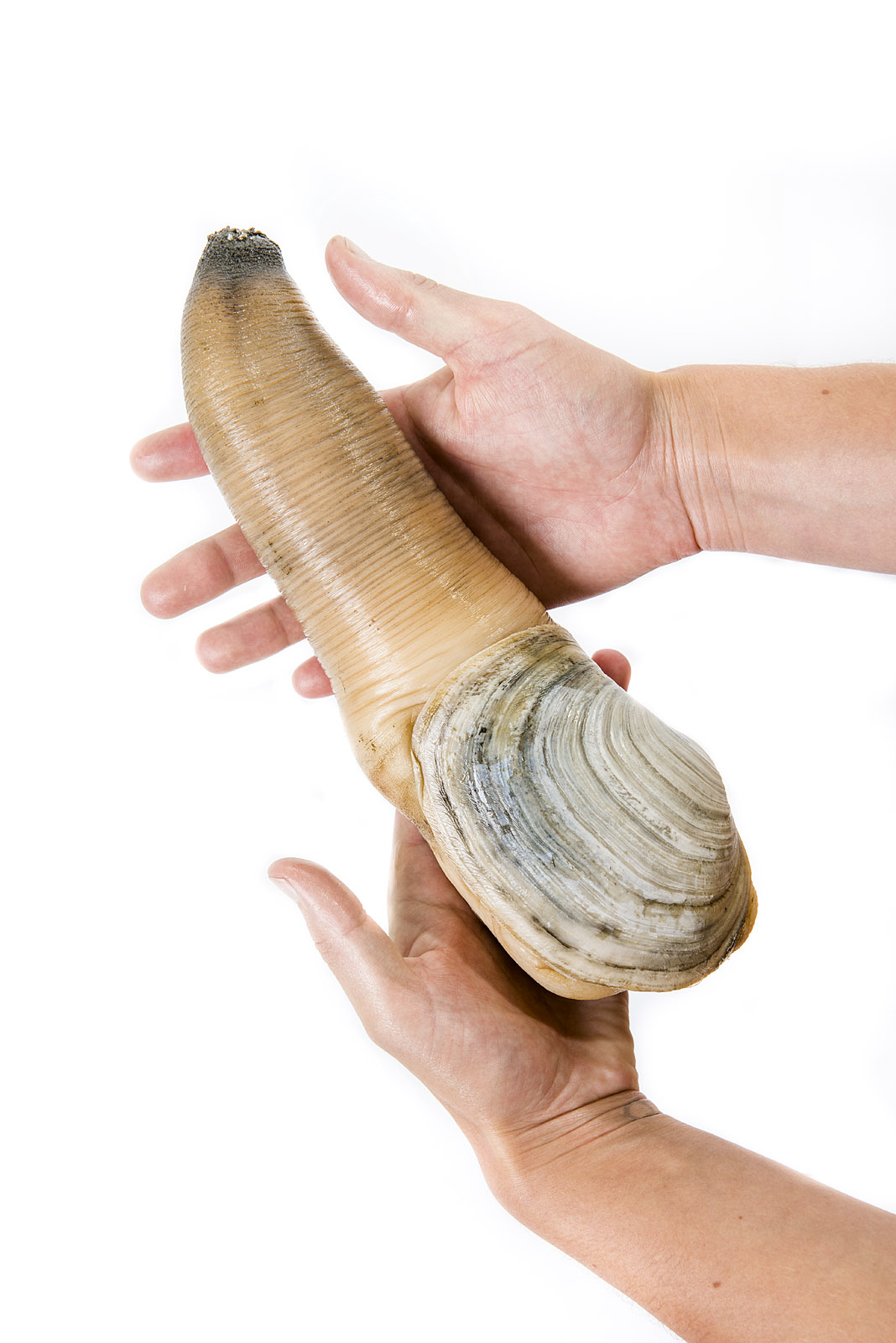
A live specimen of Panopea generosa
Scientific classification Edit this classification
Kingdom: Animalia
Phylum: Mollusca
Class: Bivalvia
Order: Adapedonta
Family: Hiatellidae
Genus: Panopea
Species:
P. generosa
Binomial name
Panopea generosa
Gould, 1850

The Pacific geoduck (/ˈɡiˌdʌk/ GOO-ee-duk; Panopea generosa) is a species of very large saltwater clam in the family Hiatellidae.[1][2] The common name is derived from the Lushootseed name, gʷidəq.

The geoduck is native to the coastal waters of the eastern North Pacific Ocean from Alaska to Baja California.[2] The shell of the clam ranges from 15 centimeters (6 in) to over 20 centimeters (8 in) in length, but the extremely long siphons make the clam itself much longer than this: the "shaft" or siphons alone can be 1 meter (3 ft 3 in) in length. The geoduck is the largest burrowing clam in the world.[3] It is also one of the longest-living animals of any type, with a typical lifespan of 140 years;[4] the oldest has been recorded at 179 years old.[5] The precise longevity of geoducks can be determined from annual rings deposited in the shell which can be assigned to calendar years of formation through crossdating.[6][7] These annual rings also serve as an archive of past marine variability.[5][8][9]

Geoduck growth increments

Etymology

[edit]
Geoduck for sale at Tsukiji fish market in Tokyo

The name Geoduck is derived from the Lushootseed name for the animal, gʷidəq.[10] The etymology of gʷidəq is disputed. According to a published dictionary of Lushotseed, the lexical suffix =əq means "many."[10] The Oxford English Dictionary says it is composed of a root word of unknown meaning and assigns to =əq the meaning "genitals" (referring to the shape of the clam),[11][12] while other researchers say it is a phrase meaning "dig deep".[13]

It is sometimes known as a mud duck, king clam or, when translated literally from Chinese, an elephant-trunk clam (Chinese: 象拔蚌; pinyin: xiàngbábàng; Jyutping: zoeng6 bat6 pong5).[14]

Between 1983 and 2010, the scientific name of this clam was confused with that of an extinct clam, Panopea abrupta (Conrad, 1849), in scientific literature.[2]

Biology

[edit]

Native to the west coast of Canada and the northwest coast of the United States (primarily Washington and British Columbia), these marine bivalve mollusks are the largest burrowing clams in the world, weighing in at an average of 0.7 kilograms (1+12 lb) at maturity. The largest ever weighed and verified by Washington Department of Fish and Wildlife biologists was an 8.16 pounds (3.70 kg) specimen dug near Adelma Beach in Discovery Bay.[15]

A related species, Panopea zelandica, is found in New Zealand and has been harvested commercially since 1989. The largest quantities have come from Golden Bay in the South Island where 100 tonnes (110 short tons) were harvested in one year. There is a growing concern over the increase of parasites in the Puget Sound population of geoduck. Whether these microsporidium-like parasitic species were introduced by commercial farming is being studied by Sea Grant. Research to date does indicate their presence.[16]

The oldest recorded specimen was 179 years old, but individuals usually live up to 140 years.[4] A geoduck sucks water containing plankton down through its long siphon, filters this for food and ejects its refuse out through a separate hole in the siphon. Adult geoducks have few natural predators, which may also contribute to their longevity. In Alaska, sea otters and dogfish have proved capable of dislodging geoducks; starfish also attack and feed on the exposed geoduck siphon.

Geoducks are broadcast spawners. A female geoduck produces about 5 billion eggs in her century-long lifespan. However, due to a low rate of recruitment and a high rate of mortality for geoduck eggs, larvae, and post-settled juveniles, populations are slow to rebound.[17] In the Puget Sound, studies indicate that the recovery time for a harvested tract is 39 years.[18]

Biomass densities in Southeast Alaska are estimated by divers, then inflated by twenty percent to account for geoducks not visible at the time of survey.[19] This estimate is used to predict the two percent allowed for commercial harvesting.[19]

Industry

[edit]

The world's first geoduck fishery was created in 1970, but demand was low at first due to its texture.[citation needed] As of 2011, these clams sell in China for over US$33 per kilogram or $15 per pound.[20][21]

The geoduck's high market value has created an $80-million industry, with harvesting occurring in the US states of Alaska, Washington, and Oregon and the Canadian province of British Columbia. It is one of the most closely regulated fisheries in both countries. In Washington, Department of Natural Resources staff are on the water continually monitoring harvests to ensure revenues are received, and the same is true in Canada where the Underwater Harvesters' Association manages the Canadian Fishery in conjunction with Canada's Department of Fisheries and Oceans. The Washington State Department of Health tests water and flesh to assure clams are not filtering and holding pollutants, an ongoing problem. With the rise in price has come the inevitable problem with poaching, and with it the possibility some could be harvested from unsafe areas.[22]

As of 2007, advances in the testing system for contaminated clams have allowed geoduck harvesters to deliver live clams more consistently. The new testing system determines the viability of clams from tested beds before the harvesters fish the area. Previous methods tested clams after harvest. This advance has meant that 90 percent of clams were delivered live to market in 2007. In 2001, only 10 percent were live.[23] Because geoduck have a much higher market value live, an additional $4.4 to $6.6 per kilogram or $2 to $3 per pound, this development has helped to stimulate the burgeoning industry.

The COVID-19 pandemic disrupted the geoduck industry. Given the near-shutdown of restaurants and seafood markets across the country, demand for live geoducks plummeted. Divers in Southeast Alaska who typically see prices of $11 to $22 per kilogram or $5 to $10 per pound for live geoducks reported prices as low as $2.2 per kilogram or $1 per pound, leading many to stop fishing temporarily.[24]

Environmental impact

[edit]

Geoduck farming grow-out and harvest practices are controversial,[25] and have created conflicts with shoreline property owners,[26][27][28][29] and concerns from nongovernmental organizations.[30] However, the Environmental Defense Fund has found that bivalves (oysters, mussels, and clams) are beneficial to the marine environment.[31] The water must be certifiably clean to plant geoducks commercially.[32] Regulation was mandated in 2007.[33][34] Studies have been funded to determine short- and long-term environmental and genetic impacts.[35] In southern Puget Sound, the effect of geoduck farming on large mobile animals is ambiguous.[36] A 2004 draft biological assessment, commissioned by three of the largest commercial shellfish companies in the Puget Sound region, identified no long-term effects of geoduck farming on threatened or endangered species.[37]

Culinary uses

[edit]

The large, meaty siphon is prized for its savory flavor and crunchy texture. Geoduck is regarded by some as an aphrodisiac because of its phallic shape.[3] It is very popular in China, where it is considered a delicacy,[3] mostly eaten cooked in a fondue-style Chinese hot pot. In Korean cuisine, geoducks are eaten raw with spicy chili sauce, sautéed, or in soups and stews. In Japan, geoduck is prepared as raw sashimi, dipped in soy sauce and wasabi. On Japanese menus in cheaper sushi restaurants, geoduck is sometimes substituted for Tresus keenae, a species of horse clam, and labeled mirugai or mirukuigai. It is considered to have a texture similar to an ark shell (known in Japanese as akagai). Mirugai is sometimes translated into English as "giant clam", and it is distinguished from himejako, which is made from Tridacna gigas.

[edit]

The Evergreen State College in Olympia, Washington, has a geoduck as its mascot named Speedy.[38][39]

Geoducks have also earned cultural interest due to their phallic appearance, status as a delicacy, and appearances in popular media.[40]

References

[edit]
[edit]
Revisions and contributorsEdit on WikipediaRead on Wikipedia
from Grokipedia
The Pacific geoduck (Panopea generosa), a bivalve in the Hiatellidae, is the largest known burrowing , characterized by its thick, rectangular shell reaching lengths of up to 25 centimeters and an extendable that can exceed one meter in length. Native to subtidal sandy and muddy sediments along the northeastern from to , it burrows to depths of up to one meter, using its to filter feed on while remaining anchored in place for decades. Individuals typically weigh 0.5 to 1.5 kilograms at maturity but can exceed 2 kilograms, with growth rates of about 30 millimeters per year initially slowing over time. Geoducks exhibit separate sexes and broadcast spawn in summer, with larvae settling into sediments after a planktonic phase, contributing to dense subtidal beds that support commercial fisheries. Their exceptional longevity, with verified ages up to 168 years determined via growth ring analysis in the shell, underscores their slow maturation and vulnerability to overexploitation without careful management. Commercially harvested since the 1970s primarily from Washington state, British Columbia, and Alaska, geoducks are diver-collected from wild stocks or farmed via aquaculture, yielding sustainable quotas based on biomass surveys to prevent depletion. The species holds significant economic value, especially in Asian markets where its meat is prized for its firm texture in dishes like hot pots and sashimi, driving exports that generate millions annually while regulated to maintain ecological balance.

Etymology and History

Etymology

The word geoduck originates from the Lushootseed language, a Salish dialect spoken by Coast Salish peoples indigenous to the Puget Sound region of Washington state, where the clam is abundant. It derives specifically from the term gʷidəq (or variants like gwidəq), which translates to "dig deep," alluding to the mollusk's burrowing behavior into intertidal sediments up to one meter deep. This etymological root reflects the clam's ecological niche and the challenges of harvesting it, as observed by local tribes. The term entered English around 1883, likely through interactions with Native American communities during early European settlement and resource exploration in the . Early spellings varied, including gwiduc, goeduck, gweduck, and gweduc, before standardizing as geoduck; the pronunciation "gooey-duck" approximates the original phonetics. The Nisqually tribe, speakers of a dialect, are often credited with the specific form gweduc, emphasizing the "dig deep" connotation tied to traditional harvesting methods. No alternative etymologies from European or other non-indigenous sources have been substantiated in linguistic records.

Indigenous and Early Harvesting

Indigenous peoples along the Pacific Northwest coast, particularly the First Nations including the Tseshaht, harvested geoducks for subsistence consumption dating back at least 1,000 years, as demonstrated by shell fragments and an intact valve uncovered in a shell midden on Keith Island (Kakmakimiłh) in . These artifacts, excavated from a pit over 1 meter deep and associated with communal feasting sites, date to 500–1,000 years ago and indicate harvesting from accessible intertidal or shallow subtidal zones without reliance on or powered tools. Traditional methods involved manual digging at low tides, targeting visible siphons protruding from sediment to extract the deeply burrowed clams, a practice reflected in Lushootseed-derived names like "gwidəq," meaning "dig deep." In the area, Lushootseed-speaking tribes such as the Suquamish and Tulalip engaged in similar low-tide harvesting for food, though direct archaeological confirmation is limited due to shell disintegration in marine environments and on-site processing washed away by tides. Historical accounts affirm that native populations subsisted on geoducks alongside other , with treaty rights later securing allocations equivalent to half of Washington State's harvest quota for certain tribes. Early non-indigenous harvesting by European-descended settlers emerged in the late , with the first documented reference in the New York Times on February 23, 1883, praising the geoduck as the "prince of clams." Settlers replicated indigenous low-tide digging techniques for personal use, focusing on siphon-protruding individuals in sandy substrates, but commercial interest was negligible due to the clam's tough texture and limited local markets. Over-harvesting fears led to a statewide ban in Washington in 1925, replaced in 1930 by regulations permitting only three geoducks per person daily for non-commercial purposes.

Commercial Development

The commercial geoduck fishery originated in Washington State, where the legislature established it in 1970 after state agency surveys in the late 1960s identified dense subtidal populations amenable to large-scale extraction. Harvesting employed scuba divers equipped with hand-held water jets to loosen clams from sediment at depths typically ranging from 18 to 70 feet below mean lower low water, enabling removal of individuals weighing up to several pounds each. Initial operations focused on state-owned aquatic lands in Puget Sound, with tracts delineated for targeted diving; the Washington Department of Natural Resources (DNR) auctioned harvest contracts to bidders, while the Department of Fish and Wildlife (WDFW) conducted pre-harvest biomass surveys using diver transects to estimate density and allowable yield. Early quotas were conservative, derived from equilibrium yield models calibrated to geoduck longevity and growth rates, limiting annual removals to percentages of estimated commercial biomass—e.g., 2.7% per management region by a 1997 state-tribal agreement. Average harvests reached 1.6 million pounds annually from 1990 to 1999 across six regions including and , reflecting expanded tract auctions and improved survey precision. A 1994 federal court ruling affirmed treaty tribes' 50% share of the fishery, integrating co-management that balanced state revenues from bids (often exceeding $100 per pound of quota) with tribal allocations. This framework emphasized sustainability, with post-harvest monitoring confirming recruitment recovery over decades due to geoducks' slow burrowing and low natural mortality. The Washington model's success spurred regional adoption: British Columbia initiated commercial diving in 1976, mirroring subtidal survey techniques, while Alaska issued its first permits in 1985 with a 300,000-pound five-year quota to test market viability. Demand from Asian markets, particularly for live exports, drove value growth, transforming geoducks from niche curiosities to high-value commodities by the 1980s, though poaching risks prompted enhanced enforcement like vessel tracking. By the early 2000s, the fishery supported quotas adjustable to 1.2–1.8% of biomass for ongoing stock stability.

Taxonomy and Biology

Taxonomy and Classification

The Pacific geoduck (Panopea generosa) is a large burrowing bivalve mollusk classified in the domain Eukarya, kingdom Animalia, phylum , class , subclass Autobranchia, infraclass , order Adapedonta, family Hiatellidae, genus Panopea, and species P. generosa. The species was first formally described by American naturalist Augustus Addison Gould in 1850 based on specimens from the Pacific coast of . The family Hiatellidae comprises bivalves characterized by elongated shells adapted for deep burrowing in soft sediments, with Panopea species representing the largest and longest-lived members, capable of extension exceeding 1 meter. Phylogenetic analyses place P. generosa within a monophyletic of Panopea that includes congeners such as P. abbreviata and P. globosa, supported by molecular markers like 18S rRNA and COI genes, distinguishing it from more divergent species like P. zelandica. Earlier classifications sometimes assigned the order as Myoida, but contemporary favors Adapedonta based on updated cladistic revisions of bivalve relationships. The genus Panopea encompasses at least 10 extant worldwide, primarily in temperate marine environments, with P. generosa endemic to the northeastern Pacific from to . No are currently recognized for P. generosa, though regional has been noted without taxonomic elevation.

Physical Characteristics

The geoduck (Panopea generosa) is a bivalve distinguished by its large size and unique morphology, featuring a relatively small, gaping shell and an exceptionally long . The shell is oblong, white with concentric growth rings, and covered by a thin, flaky brown periostracum at the edges; it typically measures 6 to 8 inches (15 to 20 cm) in length but can exceed 9 inches (23 cm). The shell is thin, lacks distinct teeth on the , and remains partially open in adults due to the oversized soft tissues. The most prominent feature is the extensible , or "neck," which can reach up to 3 feet (1 m) in length when fully extended, far exceeding the shell's dimensions. This comprises two fused tubes—an incurrent tube for inhaling and planktonic food, and an excurrent tube for expelling filtered and waste—allowing the geoduck to remain deeply burrowed while feeding at the surface. Unlike many bivalves, the cannot be fully retracted into the shell, leaving it vulnerable to predators. Internally, the geoduck possesses a muscular foot for burrowing and anchoring, mantle tissue that lines the shell and aids in respiration and shell formation, and gonads integrated into the body mass. The total body, from foot to tip of extended , can measure up to 59 inches (150 cm), with weights reaching a maximum of about 7 pounds (3.2 kg), though subtidal populations in regions like average around 2 pounds (0.9 kg) including the shell. The sexes are separate, with no external dimorphism, and the overall supports a sedentary, filter-feeding in subtidal sediments.

Life Cycle and Reproduction

Geoducks (Panopea generosa) are dioecious bivalves that reproduce through broadcast spawning, with males releasing into the water column in response to cues such as rising temperatures and photoperiod, thereby inducing nearby females to release eggs for . Spawning occurs annually from March to July, peaking in late spring and early summer, though timing varies slightly by latitude with southern populations potentially extending into later months. A single female produces 7 to 20 million eggs per event, with ripe gonads observed in individuals as young as 2 years and spawning possible up to 107 years of age, yielding billions of eggs over a lifetime. Fertilized eggs hatch into trochophore larvae within hours, advancing through veliger stages while feeding on in the planktonic environment. The free-swimming larval period lasts 40 to 50 days at temperatures up to 14°C, enabling dispersal before pediveliger larvae seek settlement substrates. Upon competence, larvae metamorphose, settle onto subtidal sandy or muddy sediments at depths of 10 to 20 meters, and transition to benthic juveniles that progressively deeper to evade predators. Initial post-larval burrows are shallow (1-5 cm), but survivors deepen to 30-100 cm by adulthood, with high early mortality from predation and abiotic factors limiting recruitment success to a tiny fraction of spawned eggs. is reached between 2 and 5 years, coinciding with shell lengths of approximately 5-7 cm, after which individuals contribute to populations for over a century.

Growth, Longevity, and Physiology

Geoducks (Panopea generosa) display characterized by annual increments in the shell plate, analogous to tree rings, which enable precise age determination through crossdating techniques validated by bomb-produced radiocarbon analysis. Growth is modeled using the , with parameters varying by population; for instance, in populations, asymptotic shell length (L) reaches approximately 123 mm, with a growth (k) of 0.33 year-1. Juveniles exhibit rapid growth, attaining 89-94% of maximum within the first 9-12 years in some southern populations, after which growth slows asymptotically. Individual growth profiling enhances model accuracy by incorporating early-age data, revealing variability influenced by environmental factors such as and food availability. Longevity in P. generosa exceeds 100 years, with crossdating methods confirming maximum ages beyond traditional counts, up to 140-160 years in wild populations, contributing to their classification among long-lived bivalves. This extended lifespan correlates inversely with early growth rates, as slower-growing individuals achieve greater ages, a pattern observed in related species like P. abrupta. In settings, geoducks reach commercial harvest sizes (shell lengths of 150-180 mm) in 6-7 years, far shorter than the decades required for maximum wild sizes due to optimized conditions. Physiologically, geoducks are infaunal with a low metabolic rate that supports , relying on allometric scaling where respiration and feeding rates increase sublinearly with body size. Their extensible , extending 4-5 times the shell length (up to 1 m), protrudes to the surface for inhaling and oxygen while the body remains burrowed deeply, often 60-90 cm. Burrowing employs via siphon contraction to expel water through the excurrent , aiding initial settlement and reorientation, though juveniles are particularly vulnerable to improper orientation affecting siphon function and survival. Stress responses, such as exposure to acidified , induce metabolic adjustments and compensatory shell growth, with recovery evident in restored oxygen consumption and growth rates post-exposure.

Habitat and Distribution

Geographic Range

The Pacific geoduck (Panopea generosa) is natively distributed along the northeastern Pacific coast, ranging from southeastern Alaska southward to Baja California, Mexico. Its northern limit extends to Forrester Island in Alaska, while the southern boundary reaches Punta Canoas or Scammon's Lagoon in the Baja California Peninsula. This range spans approximately 4,000 kilometers of coastline, primarily in temperate subtidal waters of the eastern North Pacific Ocean. Populations are concentrated in regions with suitable soft-sediment substrates, such as protected bays, inlets, and fjords, with notable densities in British Columbia, Washington state, and Puget Sound. Genetic studies indicate subtle clinal variation across this latitudinal gradient, with slower growth rates observed toward the southern limits in Baja California, potentially reflecting environmental gradients in temperature and productivity. No established wild populations exist outside this native range, though aquaculture efforts have introduced cultured geoducks to sites in Asia and South America for farming purposes, without evidence of naturalization.

Habitat Preferences and Ecology

Geoducks (Panopea generosa) inhabit soft, unconsolidated sediments including , , , and crushed shell, burrowing to depths of up to 1 meter to against tidal currents and predators. These preferences favor low-energy environments such as protected bays and coastal flats with minimal wave action, enabling stable siphon extension to the sediment-water interface for feeding and respiration. They occupy a broad depth range from the low to subtidal depths exceeding 100 meters, with optimal densities often in 10–40 meter waters where sediment stability supports juvenile settlement and adult persistence. Ecologically, geoducks function as infaunal suspension feeders, drawing in , , and particulate organic matter through their inhalant at rates that can process several liters of water per hour per individual, thereby contributing to and nutrient transfer to the . Larval stages also consume during their 40–50 day pelagic phase, linking offshore productivity to benthic recruitment. Their deep burrowing disturbs sediment layers, promoting bioturbation that enhances oxygen penetration and microbial activity, though at low population densities (typically 10–50 adults per square meter in prime beds), ecosystem-scale impacts remain modest compared to more abundant bivalves. Predation pressure shapes geoduck ecology, with juveniles vulnerable to epibenthic predators such as crabs (Cancer spp.), sea stars, gastropods, , and demersal fishes during early settlement when burial is shallow (under 60 cm after two years). Adults, protected by deeper burrows, face fewer threats but are consumed by and occasionally large fish or mammals, influencing and favoring habitats with refugia from otter foraging. Broadcast spawning from May to synchronizes gamete release, fostering dense pulses in suitable substrates and underscoring the species' dependence on consistent quality for larval retention and survival.

Commercial Industry

Wild Harvesting Methods

Wild geoduck (Panopea generosa) harvesting occurs exclusively through subtidal operations in regions such as , Washington, and coastal , where divers manually extract clams from sediment depths typically ranging from 3 to 12 meters. Prior to harvest, state or tribal biologists conduct SCUBA-based surveys to map geoduck density and biomass across designated tracts, ensuring extraction aligns with sustainable quotas. Divers, using surface-supplied air or SCUBA apparatus, descend to locate geoduck holes on the seafloor, then deploy a handheld, manually operated water jet—commonly called a ""—to fluidize surrounding sand and gravel, allowing the clam's long and body to be gently pulled free without mechanical dredging or suction pumps that could broadly disturb habitats. Extracted geoducks, averaging 1-2 kg each, are placed into onboard mesh bags or baskets for surfacing and processing, with harvest limited to opened tracts under strict daily quotas to prevent . This labor-intensive technique, initiated commercially in Washington in the early following 1969 legislative authorization, minimizes benthic disruption compared to intertidal digging methods used historically or recreationally. Regulations mandate non-mechanized tools and diver-guided control to protect integrity, with each harvested individually to avoid or resuspension beyond localized areas. In practice, teams of 2-4 divers per vessel operate during daylight hours in calm conditions, targeting soft or substrates where geoducks deeply.

Aquaculture Production

Geoduck aquaculture centers on bottom-culture methods for Panopea generosa, starting with production from wild to generate larvae that settle into juveniles. These juveniles, typically 3-5 mm in size, are outplanted at densities of 100-200 per square meter in intertidal (Washington) or subtidal () sediments, initially protected by 15-20 cm PVC tubes capped with HDPE netting to exclude predators like crabs, whelks, and sea ducks. After 12-24 months, when geoducks exceed predator vulnerability, tubes are removed, enabling burrowing and filter-feeding growth to harvestable size (1-2 kg and body) over a total cycle of 5-7 years. Harvest employs low-pressure water jets to excavate clams without machinery, minimizing disturbance. In Washington state, production occurs across roughly 100 farms on 100 hectares of private tidelands in Puget Sound, supported by seven licensed hatcheries (five active) yielding over 10 million juveniles annually. Output reached 776 metric tons in 2020, accounting for about 27% of the state's farmed shellfish value, with major operators including Taylor Shellfish Farms and Jamestown Seafood, a S'Klallam Tribe enterprise. Commercial farming commenced around 1995, evolving from experimental hatchery work in the 1980s to supplement declining wild stocks amid rising Asian demand. British Columbia's operations span 67 licensed subtidal sites on approximately 600 hectares, managed by four companies under the BC Shellfish Growers Association. Farmed geoduck harvest approximated 30 metric tons in 2022, generating CAD 1.3 million, with limited to 100-250 wild individuals yearly (2016-2020) to preserve via partial factorial spawning. No feeds, antibiotics, or pesticides are used, relying on natural filtration; challenges like and escapes are mitigated manually, though subtidal escapes pose higher interbreeding risks than Washington's intertidal setups. Globally, North American production constitutes the bulk of cultured geoducks, far below wild harvest volumes (e.g., Washington's wild fishery yields several thousand tons yearly), with emerging efforts in (P. zelandica) and remaining small-scale and experimental as of 2023. Yields vary by site quality, with optimal sandy substrates achieving 80-90% survival post-tubing, though predation and storm losses can reduce effective densities to 20-50 adults per square meter at harvest.

Trade, Markets, and Economic Impact

The primary market for geoduck is East Asia, with China consuming over 90 percent of exports from North American producers, driven by demand for live specimens in high-end cuisine. Washington State supplies nearly half of the global demand for Pacific geoduck through wild harvests and aquaculture. Retail prices in China can reach $30 per pound, reflecting the clam's status as a luxury seafood, though wholesale auction prices averaged $11.60 per pound from early 2023 through the third quarter of 2024. Trade volumes and values have fluctuated due to geopolitical tensions, including U.S.-China tariffs that reduced Washington State's geoduck harvest revenues to under $17 million in recent years, down from higher pre-tariff levels. In 2025, escalating tariffs and import restrictions further disrupted exports, leaving commercial divers idle and threatening aquaculture operations. These disruptions highlight the industry's vulnerability to foreign market access, as domestic U.S. consumption remains limited compared to Asian demand. Economically, geoduck harvesting and farming contribute to regional employment in the , supporting specialized roles in , processing, and export logistics within the broader $270 million annual shellfish industry. Auction revenues from state-managed wild stocks fund public programs in Washington, though declining export values have reduced these inflows. expansion offers potential resilience, with bottom-culture methods providing steady output less prone to wild stock variability, yet still tied to dynamics.

Management and Regulations

The wild geoduck fishery in Washington state is co-managed by the Washington Department of Fish and Wildlife (WDFW), the Department of Natural Resources (DNR), and treaty tribes, with the state and tribes each allocated 50% of the sustainable allowable catch determined through subtidal scuba surveys estimating abundance and biomass, which have been conducted annually since 1967. The DNR auctions tracts representing the state's share to licensed commercial divers, with harvest limited to designated tracts classified as safe for consumption by the Washington Department of Health based on biotoxin and bacterial monitoring. Sustainable harvest rates are negotiated at approximately 2.7% of surveyed biomass per region to maintain long-term stock health, with revenue from auctions funding habitat conservation and aquatic land management under the state's Habitat Conservation Plan. In , (DFO) oversees the fishery through an Integrated Fisheries Management Plan, conducting stock assessments via diver surveys to calculate a stock index (current relative to unfished levels), closing beds to if the index falls below 0.4, and setting allowable catches accordingly, as updated in annual reports such as the 2023 stock status. Commercial harvests require vessel registrations and adhere to quotas allocated by area, while recreational limits are set at 3 geoducks per day with hand-picking only. In , the Department of and Game establishes guideline levels based on pre- surveys for designated areas, with no minimum size limits and weekly trip limits of 1,000 pounds per permit holder to prevent . Aquaculture operations for geoducks are regulated separately from harvests to minimize interactions, with state and federal requirements in the U.S. mandating health monitoring for pathogens and biotoxins to ensure , including /transfer permits to prevent spread in Washington waters. In Washington, producers must obtain Aquatic Use Authorizations via the Joint Aquatic Resources Permit Application process for DNR-managed tidelands, while in , tenures are issued by DFO with conditions to avoid stock displacement. Management across jurisdictions emphasizes survey-based assessments accounting for detection probabilities (show-factors) during dives, with modeled recovery times for harvested tracts averaging 55 years at 0.03 geoducks per square meter annually.

Environmental Aspects

Sustainability Assessments

The wild geoduck fishery in Washington State is managed through biennial population surveys and tract-specific quotas calculated to maintain a stable age structure and prevent overexploitation, with sustainable annual yields estimated at approximately 2.5 to 3 million pounds based on density and biomass data from diver-led assessments. The Washington Department of Natural Resources (DNR) and Washington Department of Fish and Wildlife (WDFW) conduct environmental evaluations prior to harvest approvals, incorporating habitat conservation plans that limit extraction to less than 50% of legal-sized clams per tract to allow for recruitment and recovery. A 2021 analysis of 50 years of harvest and recovery data in Washington indicated that observed recovery rates in fished beds aligned closely with model predictions used for quota-setting, supporting the long-term viability of the fishery under current conservative management. In , (DFO) performs stock status updates using spatial-scale assessments across 2,951 documented geoduck sub-beds as of 2023, with allowable harvests set at levels projected to keep exploitation below 2% of total annually, ensuring populations remain above biomass reference points for . These assessments rely on historical survey data adjusted for show-factor variability—the probability of detecting buried geoducks during dives—which recent studies estimate seasonally between 20-40% to refine density extrapolations. No (MSC) certification has been achieved for geoduck fisheries, though management frameworks emphasize empirical stock modeling over third-party ecolabels. For farmed Pacific geoduck (Panopea generosa) in intertidal and subtidal bottom-culture systems in Washington and British Columbia, a 2024 Seafood Watch assessment rated the practice as a "Good Alternative" overall, citing low escape risks and minimal feed inputs but noting uncertainties in long-term benthic effects from high-density planting and potential genetic interactions with wild stocks. Aquaculture reduces harvesting pressure on wild populations by supplementing supply, with production focused on predator-protected juvenile rearing, though policy analyses highlight ongoing debates over cumulative ecosystem impacts in Puget Sound tidelands. Independent evaluations, such as those from government-leased aquatic land operations, confirm that geoduck farming avoids chemical additives and antibiotic use typical in higher-impact aquaculture, aligning with sustainability metrics for low trophic-level bivalves.

Harvesting and Aquaculture Impacts

Wild harvesting of geoducks (Panopea generosa) primarily occurs through diver-assisted methods using high-pressure water jets to excavate burrowed clams from subtidal sediments up to 1 meter deep, resulting in localized sediment disturbance and temporary displacement of infaunal communities. Studies indicate these effects are short-term, with benthic habitats recovering within months due to rapid recolonization by opportunistic species, and overall impacts classified as minimal on ecosystem structure. For instance, assessments in British Columbia intertidal and subtidal sites found no long-term alterations to sediment grain size, organic content, or macrofaunal diversity post-harvest, though immediate reductions in burrow-dwelling organisms occur. In some cases, harvest-induced sediment turnover may provide short-term benefits, such as enhanced foraging opportunities for flatfish by exposing prey. Aquaculture operations involve planting juvenile geoducks in subtidal or intertidal sediments protected by PVC pipes and netting for 1–2 years to deter predators, followed by removal of gear and a 3–5 year grow-out period before harvest using similar jetting techniques. The protective gear can alter local hydrodynamics and trap algae, temporarily reducing densities of certain epibenthic species like eelgrass-associated invertebrates, but these effects dissipate post-removal, with natural sediment dynamics often exceeding aquaculture-induced changes. Filter-feeding by farmed geoducks enhances water clarity by removing phytoplankton, potentially mitigating eutrophication, though increased biodeposition elevates sediment organic carbon, which supports microbial activity without evidence of anoxia in monitored Puget Sound sites. Modeling suggests ecosystem-level food web alterations only if aquaculture expands by over 120% from 2015 levels, remaining negligible at current scales. Harvest phase of mirrors wild methods in disruption but is confined to leased parcels, with studies showing spillover effects to adjacent areas limited to fine-scale infaunal shifts that recover within 1–2 years; no persistent changes in or trophic structure have been documented in southern . Broader assessments rate impacts as minor to moderate and ephemeral, confined to farm footprints, with no detected risks of amplification or genetic into wild stocks from hatchery-origin clams. Concerns over plastic debris from gear have prompted best-management practices, such as retrieval protocols, minimizing risks.

Controversies, Poaching, and Overexploitation

High demand for geoduck in Asian markets, where prices can exceed $100 per pound on the , has fueled extensive operations in Washington state's , undermining regulated harvests and tribal rights. Poachers often target state and tribal beds at night, using scuba gear to extract clams rapidly before enforcement patrols can respond, with harvested geoducks smuggled out via within hours to evade detection. Notable incidents include a 2002 Pierce County case where a poaching ring faced 41 felony counts for stealing and trafficking over 100,000 pounds of geoducks and crab, valued at millions, from protected areas. In the same year, Fife-based poachers distributed up to $3 million in illegally harvested geoducks across the U.S. and abroad before a federal bust. Douglas Tobin, operator of a syndicate, pleaded guilty in 2006 to unlawfully harvesting substantial quantities of geoduck from state and tribal (Puyallup, Nisqually, Squaxin) grounds in , resulting in court-ordered restitution exceeding $1 million. More recently, in 2014, a Port Orchard diver received a four-month jail sentence for poaching 300 pounds near Olympia and dumping ballast rock, which damaged habitats. In 2022, a Burien broker was sentenced to probation and fines for knowingly shipping geoducks from biotoxin-closed areas while falsifying harvest documents to deceive inspectors. Geoducks' biological traits—longevity up to 168 years, slow growth to harvestable size (3–5 years), low natural mortality, and clumped distribution—render wild populations susceptible to from both legal overharvest and , as variability exacerbates depletion risks in targeted beds. In Washington, legal fisheries maintain sustainable quotas (e.g., total allowable catch at ~2.7% of estimated ), preventing stock collapse, but unreported losses—estimated in thousands of pounds annually—erode these margins and complicate stock assessments. For the congeneric Panopea globosa in , , length-based assessments confirmed by 2020, with harvest rates surpassing management limits and reference points breached since 2018, highlighting serial depletion in less-regulated fisheries. Controversies arise from enforcement gaps, including understaffed detectives and cross-border , which some attribute to insufficient penalties relative to profits, though state and federal agencies have intensified stings and tribal collaborations to curb illicit trade.

Human Uses and Significance

Culinary Applications

Geoduck (Panopea generosa) is valued in for its sweet, briny flavor and distinctive texture, combining the chewiness of with the crispness of . The animal's elongated provides the bulk of edible , which requires careful : live geoducks are typically blanched in boiling water for 20-30 seconds to relax the adductor muscle, followed by removal from the shell, extraction of the gut, and thorough cleaning of the siphon and belly. The tough siphon is often thinly sliced for raw consumption or tenderized through pounding or brief cooking, while the tender belly suits or . In Asian cuisines, geoduck holds particular prominence, especially in where it features in hot pots, stir-fries with ginger and , and steamed preparations. Japanese preparations emphasize raw applications, such as mirugai or nigiri , highlighting the siphon's subtle sweetness. Western adaptations include , with citrus and herbs, fritters, and incorporation into chowders or soups, often treating the meat similarly to squid or scallops. Despite its versatility, geoduck's phallic appearance limits mainstream adoption in some markets, confining much consumption to specialty contexts. Nutritionally, geoduck offers low-calorie, high-protein content, with 100 grams providing approximately 74-85 calories, 12-17 grams of protein, and minimal fat (0.5-1 gram). It is also rich in iron (up to 44% of daily value per serving) and , supporting its role as a nutrient-dense option. Preparation methods preserve these qualities, though overcooking can toughen the texture without altering core nutritional benefits.

Cultural and Indigenous Importance

Geoducks have served as a traditional food source for Coast Salish peoples in the for millennia, harvested from intertidal and subtidal zones and incorporated into diets alongside other . Archaeological evidence from shell middens confirms their consumption, with the species referred to as "twisted mouth clams" in some Southern Coast Salish languages, though certain groups avoided eating them due to beliefs associating geoduck with misfortune. The name "geoduck" derives from the Nisqually term gweduc, meaning "dig deep," reflecting the effort required to extract the deeply burrowed clam, underscoring its integration into indigenous knowledge of marine ecosystems. Among Nuu-chah-nulth First Nations, such as the Tseshaht, geoduck harvesting evidence emerged from a 2019 excavation on Keith Island in British Columbia, where shells dated 500 to 1,000 years old were found in a shell midden, marking the first documented proof of ancient geoduck consumption in the region. This discovery, including charred fragments suggestive of clambakes, aligns with oral histories of prudent stewardship (hishukish tsawalk, or "everything is one") and challenges prior legal exclusions of geoducks from aboriginal food, social, and ceremonial rights affirmed in Canadian court rulings like the 2009 and 2018 Supreme Court decisions. In Washington state, tribes including the Tulalip and Suquamish continue ceremonial, subsistence, and commercial harvesting, viewing geoducks as a cultural and ecological treasure tied to ancestral practices. Treaty rights, upheld by the U.S. Boldt Decision in 1974, allocate approximately half of Washington's geoduck total allowable catch to treaty tribes, enabling economic participation while honoring historical sustenance roles; for instance, the have harvested since 1997, employing up to 60 members in a emphasizing and cultural continuity. These rights stem from 19th-century treaties reserving off-reservation fishing and shellfishing, positioning geoducks as symbols of resilience against colonial restrictions on indigenous marine resource access. The geoduck (Panopea generosa) has garnered niche recognition in popular culture, primarily due to its distinctive phallic and regional significance in the . At The Evergreen State College in , the geoduck embodies the mascot Speedy, adopted in 1968 to reflect the local marine environment and the institution's experimental ethos. The mascot's anthropomorphic portrayal features in campus events, including a costumed character that participates in athletics and traditions like delivering valentines on February 14, 2020. The college fight song, performed at games, humorously references the creature's anatomy with lyrics such as "Siphon high, squirt it out, swivel all about, let it all hang out," emphasizing its burrowing habits and siphon extension. Documentaries have highlighted geoduck harvesting's quirky subculture. The 2003 film 3 Feet Under: Digging Deep for the Geoduck, directed by Heather Trost and Sara Lee, profiles divers and the bivalve's economic role, earning festival awards and PBS airings for its portrayal of the labor-intensive pursuit. Television episodes have similarly showcased the process: Discovery Channel's Dirty Jobs featured host Mike Rowe as a geoduck farmer in a 2006 installment, detailing tidal flat dives and clam extraction techniques. Science Channel's How Do They Do It? Season 15, Episode 6 (2013), examined geoduck harvesting alongside steam train operations, focusing on the clam's global delicacy status. Fictional and comedic media occasionally reference the geoduck's appearance for humor. In the 2001 Love Mussel, directed by John Gilbert, the creature drives a satirical plot about a coastal town exploiting its purported properties for tourism. Comedian , on a 2017 episode of The Nightly Show with , described the geoduck's to chef , eliciting laughs over its suggestive form during a culinary segment. Earlier, the 1951 film Ma and Pa Kettle Back on the Farm included a Native American character nicknamed Geoduck, portrayed by as a Kettle family associate, nodding to indigenous ties without deeper bivalve focus. These depictions underscore the geoduck's blend of culinary prestige and visual oddity, though mainstream Hollywood portrayals remain absent.

References

Add your contribution
Related Hubs
Contribute something
User Avatar
No comments yet.