


Community hub
Recent from talks
Contribute something
Nothing was collected or created yet.
IWI Negev
View on Wikipedia
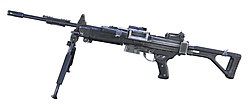
The IWI Negev (also known as the Negev NG-5) is a 5.56×45mm NATO light machine gun developed by Israel Weapon Industries (IWI), formerly Israel Military Industries Ltd. (IMI).
Key Information


In 2012, IWI introduced the Negev NG-7, a variant chambered in 7.62×51mm NATO. The NG stands for Next Generation. Both variants of the Negev are in service with the Israel Defense Forces.
Development
[edit]The Negev started development in 1985 by Israel Military Industries (now Israel Weapon Industries) to replace the then in service Galil ARM.[5] The Negev entered service with the IDF in 1997, after extensive testing conducted by the IDF Ordnance Corps.[6] The Negev is named after the Negev Desert in southern Israel.
Design details
[edit] | This section needs additional citations for verification. (January 2021) |
The Negev is a gas-operated, air-cooled, open bolt, select-fire, light machine gun (LMG) with a rotating bolt. The Negev uses a long-stroke gas piston system that runs under the barrel and is connected directly to the bolt carrier, the gas system comes with a three position gas regulator for use with different feed types and conditions.[7] The design was made to be reliable, especially in adverse conditions.[8] It was officially adopted by the Israeli Defense Forces (IDF) in 1997.
Barrel
[edit]The Negev has a quick-change chrome-lined cold hammer forged barrel. The barrel is fitted with a slotted flash suppressor and a folding ambidextrous carry handle, which is used to carry the weapon and remove the barrel of the Negev.[9]
During the weapon's initial development a barrel with a 1 in (25 mm) (1:12 in) rifling twist rate was also planned, adapted for the lightweight M193 cartridge. Additionally, a multifunction muzzle device was designed, used to launch rifle grenades.[10]
Sights and hardware
[edit]Sights
[edit]The Negev's iron sights (closed-type) consist of a front post (adjustable for both windage and elevation) and a rear aperture sight with an elevation adjustment drum, with 300 to 1,000 m range settings in 100 m increments. The sight line radius is 440 millimeters (17.3 in).[10] The Negev is equipped with tritium sights for night-time operations, the vials are embedded into the front and rear sights, with a night sight exposed on the rear aperture.
The Negev has its sight rail mounted to the frame of the gun, and not the feed top cover, which is detached when reloading. This allows it to stay zeroed for a longer period of time when mounting red-dot, reflex sights or other optics.[6]

The classic Negev did not possess the modern standardized Picatinny rail, and instead came with a welded adapter for an optical sight. The newer NG-5 and NG-7 have a standard picatinny rail, and in Israel are usually fitted with an optical scope similar to the standard scopes of Israeli assault rifles.
Stock
[edit]The full size Negev and Negev SF was originally manufactured with a metal-tube, fixed-length, folding (right) stock. This classic tube skeleton stock was a modified stock from the Galil rifle.[13] The design of the Negev's recoil springs and non-reciprocating handle, allow the Negev to fire with the skeleton stock folded; however during reload the bolt cannot be actuated with the stock folded.[13][14]
The Negev NG-5 came fitted with an adjustable length folding stock, that folds to the opposite direction to allow complete operation of the gun with the stock folded, with cheek well adjustment, allowing for easier fitting.[14][12]
Bipod
[edit]Every variant of the Negev can have a folding bipod, installed to the forward end of the handguard and folded under and becoming part of the handguard when stowed. The receiver also has slots and hooks used to secure the weapon to vehicle mounting hardware, including helicopters.[15][13]
The Negev SF 'Commando' variants also come with a 45 degree forward grip "assault handle", allowing controlled fire while not using the bipod. The assault grip and bipod can be installed together, however the bipod cannot be folded with the assault grip installed.[16][17]
The classic Negev could be fitted with mounting hardware on the handguard to allow users to mount a laser pointer.[15] Current Negev models come mounting positions for bipods and the "assault grip" as well as a number of picatinny rails, including on the handguard allowing users to mount other hardware, including: laser pointers or laser target and illumination devices.[16][14]
Ammunition
[edit].jpg)
The standard Negev is chambered in 5.56×45mm NATO, optimized for the SS109 cartridge. The Negev NG-7 and 7 ULMG variants are chambered in 7.62×51mm NATO.
The Negev feeds from an M27 disintegrating, open-link ammunition belt, carried in a 150-round fabric container that clips into the magazine well, or alternatively from a 35-round box magazine from the Galil assault rifle, or a 30-round STANAG magazine from the M16 rifle (with the use of an adapter). 200-round ammunition belt containers are also available. Belted ammunition is introduced into the feed tray port from the left side, while the magazine is inserted vertically into the magazine well at the base of the receiver.
The feed system, which loosely copies the Czechoslovakian Vz. 52[7] and the PK, uses a lever mounted on the left wall of the receiver and driven by a cam in the recoiling bolt carrier to turn a small feed pawl. The belt is pushed by the pawl only during the rearward movement of the bolt carrier.
The Negev 7 ULMG and ULMG SF, can be converted to 6.5mm Creedmoor cartridge by changing barrels; and feed from standard M13 disintegrating links.[18]
In late 2024, Vietnam revealed a local Negev variant, designated as the STrL-7,62VN (Vietnamese: Súng Trung Liên - 7,62mm Việt Nam, lit. 'Medium Machine Gun - 7,62mm Viet Nam'), being the first product utilizing the Negev platform but chambered in 7.62×39mm. Likely becoming the country's next standard-issued light machine gun succeeding the obsoleted RPD machine guns, STrL-7,62VN is compatible to both AK/STV/RPK's magazines and RPD's 100-round non-disintegrating belt, using a soft belt box instead of RPD's heavy metal drum container.[19]
Variants
[edit]- Negev (1997-2012) – Released in 1997. It has a barrel length of 460 mm (18.11 inches) and can be fired either in semi or fully automatic. The pre-NG Negev came with a folding, fixed length skeleton stock, that is still available.[14]
- Negev SF (1997-2012) – The Negev SF, or "Commando" version, is a compact variant of the Negev. It uses a shorter barrel and is primarily fitted with a side grip (NEGEV Assault Grip). It has a barrel length of 330 mm (12.99 inches).
- Negev (2012-present) – Previously named 'Negev NG-5' has been renamed the Negev.[14] The Negev is available with the original Galil-like stock, or an updated adjustable folding stock.[14]
- Negev SF (2012-present) – A compact variant of the Negev NG-5. It uses a shorter barrel and is primarily fitted with the Negev assault grip.[17] It has a barrel length of 330 mm (13 in). The Negev NG-5 SF has been renamed to the Negev SF.[14] The updated Negev SF has a folding adjustable stock, with adjustable cheek well.

- Negev NG-7 (2012-present) – Chambered for the 7.62×51mm NATO cartridge. It has a barrel length of 508 mm (20.0 inches) and is select-fire. It is fed by a 100- or 125-round assault drum magazine containing disintegrating M13 NATO standard ammunition belts or NATO standard ammunition belts and has two gas regulator settings as the possibility for box magazine feeding was omitted. The IWI eLog weapon-embedded sensor module was added to collect and store data on the actual use of the weapons for more efficient maintenance management and servicing by armourers.[20]
- Negev NG-7 SF (2012-present) – A compact variant of the Negev NG-7. It uses a shorter barrel and is primarily fitted with a side grip (Negev assault grip).[17] It has a barrel length of 420 mm (16.5 inches).
- Negev NG-7 SF 13 (2012-present) – Identical to the NG-7 SF but with a 330 mm (13.0 in) barrel.
- Negev 7 ULMG (2023-present) – Released in 2023, based on customer feedback for a lighter alternative to the NG-7. The ULMG is fitted with the same barrel as the NG-7 SF, a 420 mm (16.5 in) long barrel that is shorter than NG-7, and it is 1.4 kg lighter than the NG-7.[18] The ULMG can be converted to 6.5mm Creedmoor by changing barrels.
- Negev 7 ULMG SF – a compact variant of the Negev 7 ULMG, fitted with a 330 mm (13.0 in) long barrel.[18]
- STrL5.56 – a Vietnamese copy of the Negev NG-5, chambered in 5.56×45mm NATO. Product of Z111 Factory.[19]
- STrL-7,62VN – another Vietnamese Z111 copy of the Negev, however is chambered in 7.62×39mm. It is weighted 7.4 kg, featuring fluted quick-change barrel with an undisclosed length.[19]
Users
[edit]
 Azerbaijan[21]
 Brazil: Used by Military Police of São Paulo State,[22] Military Police of Amazonas State[23][24]
 Cameroon: Used by Battalion d'intervention rapide[25]
 Colombia[1]
 Costa Rica[1]
 Cyprus: Used by mechanised infantry, paratroopers and the Special Forces (SF and NG-7 SF versions).[26][27]
 Democratic Republic of Congo: Used by Presidential Guard units in 2010[28]
 Equatorial Guinea[28]
 Estonia[1][29]
 Georgia[30] Since May 2010, standard issue light machine gun of the GAF. Heavily used by Georgian units in Afghanistan.[31]
 India: 5.56 variant serving as standard issue LMG for Special Forces from earlier. An order for 16,479 NG-7s was placed in March 2020 to replace all the INSAS LMG present with the Indian Army,[32] which were subsequently delivered in February 2021.[33] Between 1 and 8 June 2025, the Indian Army, in partnership with BSS Materiel Limited, tested a modular AI-controlled Negev NG-7 capable of automatic target detection, friend-foe classification, and real-time engagement. The platform demonstrated semi-autonomous surveillance capability, adaptive fire-control system, and reliable target acquisition. The weapon system can autonomously identify and engage targets in challenging mountain environments with accuracy at 600 m (660 yd) and can identify and track targets up to 300 m (330 yd). The initial tests were conducted in Roorkee on April 5, followed by the high-altitude trials conducted at 14,500 ft (4,400 m). The AI is designed for perimeter security, convoy protection and military base defense. The weapon system incorporates an encrypted remote command link compatibility with ballistic adjustment that can compensate for wind, range and temperature variables, and a combination of thermal and optical sensors for precision targeting. Deployment options include static installations, on unmanned ground vehicles, tripods, and RCWS in armoured vehicles and naval platforms. For a maximum of 21 days, the system can operate independently in a bunker.[34][35]
 Israel: The Negev was adopted by the Israel Defense Forces in 1997[1][36] and the Negev NG-7 was adopted in 2012.[37] During the Gaza war, Israeli infantry brigades started transitioning to the NG-7 model.[38]
 Ivory Coast:[25]
 Kenya: Kenya Defense Forces[39]
 Mexico: Mexican Federal Police[40]
 North Macedonia:[41] Police Special Forces
 Paraguay: Paraguayan Army.[42]
 Philippines: Philippine National Police - Maritime Group.[43][44] Philippine Coast Guard
 Senegal: Used by special forces and commandos[25]
 Tanzania: Used by Tanzanian Special Forces.[25]
 Thailand: Purchased 1,000 machine guns in 2007, and another 550 in 2008.[45]
 Vietnam: In service with Naval Infantry.[46]
 Ukraine[47]


See also
[edit]References
[edit]- ^ a b c d e Kemp, Ian (March 2007). "Lightweight Firepower" (PDF). Asianmilitaryreview.com - Asian Military Review. Archived from the original on 7 July 2011. Retrieved 18 April 2010.
- ^ Vining, Miles (22 April 2016). "ISAF armament of BLS". Archived from the original on 20 August 2018. Retrieved 14 September 2018.
- ^ Peri, Dinakar (4 May 2017). "Punj Lloyd, IWI of Israel make small arms in India". The Hindu. Archived from the original on 4 May 2017. Retrieved 17 January 2018.
- ^ "Tavor in India : Israeli Assault Rifle's Journey and Prospects in India". 16 December 2017. Archived from the original on 22 December 2017. Retrieved 17 January 2018.
- ^ "IWI Negev". Weaponsystems.net. Retrieved 6 March 2024.
- ^ a b Hartman, Mike (28 May 2008). "NEGEV Light Machine GUN (LMG) 5.56 mm" (PDF). ndiastorage.blob.core.usgovcloudapi.net. Archived (PDF) from the original on 11 May 2021. Retrieved 10 November 2023.
- ^ a b "Negev - Modern Firearms". Modern Firearms. 27 October 2010. Archived from the original on 11 November 2023. Retrieved 11 November 2023.
- ^ James H. Willbanks, 2004.Machine Guns: An Illustrated History of Their Impact. ABC-CLIO. 2004. ISBN 9781851094806. Archived from the original on 1 April 2016. Retrieved 30 June 2015.
- ^ "Negev NG7 LMG | IWI US, Inc". IWI US, Inc. |. 13 June 2017. Retrieved 5 March 2024.
- ^ a b Shea, Dan (1 October 1997). THE ELUSIVE ISRAELI NEGEV LMG - Images not published 1997/028.jpg (JPG). Vol. 1. Small Arms Review. Archived from the original on 11 November 2023. Retrieved 11 November 2023.
- ^ "Mepro MOR PRO Sight With 2 Laser Pointers". Meprolight. Retrieved 5 March 2024.
- ^ a b "IWI NEGEV NG7 | NEGEV MACHINE GUN". iwi.net. Archived from the original on 5 February 2024. Retrieved 5 March 2024.
- ^ a b c McCollum, Ian (21 July 2019). Negev LMG: The Israeli Take on the SAW. Forgotten Weapons.
- ^ a b c d e f g "IWI Catalog 2020" (PDF). Point Trading. Archived (PDF) from the original on 11 November 2023. Retrieved 11 November 2023.
- ^ a b Hartman, Mike (28 May 2008). "NEGEV Light Machine GUN (LMG) 5.56 mm" (PDF). ndiastorage.blob.core.usgovcloudapi.net. Archived (PDF) from the original on 11 May 2021. Retrieved 10 November 2023.
- ^ a b "IWI Catalog 2021-2022". IWI.net. Archived from the original on 11 November 2023. Retrieved 11 November 2023.
- ^ a b c "NEGEV ASSAULT GRIP - IWI". IWI. Archived from the original on 13 July 2017. Retrieved 19 June 2017.
- ^ a b c "IWI unveils Negev 7 Ultra Light Machine Gun". Janes.com. Retrieved 11 November 2023.
- ^ a b c Onokoy, Vladimir (26 December 2024). "Vietnam Defence Expo 2024: Negev Machinegun Chambered For 7.62x39". thefirearmblog.com. Retrieved 27 December 2024.
- ^ Katoch, P.C. "Israeli Light Machine Guns are Coming". spslandforces.com. SP Guide Publications Ltd. Retrieved 11 February 2021.
- ^ "News.Az - Azerbaijan buys great deal of weapons from Israel last year". news.az. Archived from the original on 2 December 2014. Retrieved 24 May 2014.
- ^ "Rubens Valente - Ativista quer barrar importação de metralhadoras israelenses pela PM de SP". noticias.uol.com.br.
- ^ Ventura, Iolanda (11 May 2021). "PM no Amazonas recebe metralhadoras israelenses que disparam 700 tiros por minuto".
- ^ "Belarmino Lins destaca reforço à segurança no interior do Estado". Roteiro de noticias. 2021. Archived from the original on 24 September 2021. Retrieved 19 June 2023.
- ^ a b c d Binnie, Jeremy; de Cherisey, Erwan (2017). "New-model African armies" (PDF). Jane's. Archived from the original (PDF) on 22 June 2017.
- ^ Boguslavsky, Eyal (4 January 2021). "Cypriot paratroopers use Israeli weapons". Israel Defense.
- ^ admin (24 April 2025). "SPIKE LR2, AKERON MP αλλά και εγχώριας κατασκευής RPG-7 και όλμοι 60 χιλ. στην Εθνική Φρουρά". Δούρειος Ίππος. Retrieved 4 October 2025.
- ^ a b Wezeman, Siemon T. "Israeli arms transfers to sub-Saharan Africa" (PDF). SIPRI Background Paper. SIPRI. Archived from the original (PDF) on 15 December 2013.
- ^ "Eesti Kaitsevägi - 5,56 mm kergekuulipilduja Negev - Kaitsevägi". Mil.ee. Archived from the original on 4 March 2016. Retrieved 25 March 2016.
- ^ "Negev in Georgian army". Mod.gov.ge. Archived from the original on 19 February 2012. Retrieved 9 June 2012.
- ^ Vining, Miles (22 April 2016). "ISAF armament of BLS". Archived from the original on 20 August 2018. Retrieved 20 August 2018.
- ^ Bedi, Rahul (22 March 2020). "India signs USD117.8 million deal with IWI for LMGs | Jane's 360". Jane's Defence Weekly. Retrieved 14 April 2020.
- ^ Moss, Matthew (10 February 2021). "Indian Army Receives First Negev Light Machine Guns". The Firearm Blog.
- ^ Sharma, Shivani; Sinha, Sahil (9 June 2025). "India successfully tests AI-enabled light machine guns in high-altitude terrain". India Today. Retrieved 1 July 2025.
- ^ "Indian Army is testing an AI machine gun that can detect, decide and destroy enemy on its own: Watch live demo". The Economic Times. 24 June 2025. ISSN 0013-0389. Retrieved 25 June 2025.
- ^ Hogg, Ian (2002). Jane's Guns Recognition Guide. Jane's Information Group. ISBN 0-00-712760-X.
- ^ Negev NG7 Archived 18 May 2012 at the Wayback Machine - Israel-Weapon.com
- ^ "עוצמתי ומשמיד": מאחורי הנשק החדש של צה"ל | צפו inn.co.il
- ^ "Kenya Army's Negev light machine guns and Galil sniper rifles Delivered by Israel Weapon Industries (IWI) – Strategic Intelligence Service". 6 January 2012. Archived from the original on 11 January 2018. Retrieved 10 January 2018.
- ^ Mexican Federal Police Using IWI Negev Machine Gun Archived 29 October 2014 at the Wayback Machine - Thefirearmblog.com, 2 August 2013
- ^ McNab, Chris (2017). The FN Minimi Light Machine Gun: M249, L108A1, L110A2, and other variants. Weapon 53. Osprey Publishing. p. 78. ISBN 978-1-4728-1623-8.
- ^ "Paraguay Army Chooses IWI's "Negev"". Israel Defense. 1 August 2015.
- ^ https://dl.pnp.gov.ph/presentation-and-blessing-of-the-newly-procured-pnp-equipment/
- ^ Dela Rosa, Ronald (20 May 2017). "PNP Director General Dela Rosa's One Year Report for 2016-2017" (PDF). www.pnp.gov.ph. Archived (PDF) from the original on 28 August 2018. Retrieved 2 February 2018.
- ^ "Infantry Weapons: The Future Beckons for Asia" (PDF). Archived from the original (PDF) on 7 July 2011. Retrieved 18 June 2010.
- ^ "Những bức ảnh về Quân Đội Nhân Dân Việt Nam (Phần 4) - Trang 480". TTVNOL. Archived from the original on 18 April 2012. Retrieved 9 June 2012.
- ^ Boguslavsky, Eyal. "Ukraine's Tavors – a survey". Israel Defense.

External links
[edit]
IWI Negev
View on GrokipediaHistory and Development
Origins in IDF Requirements
The development of the Negev light machine gun originated in the late 1980s at Israel Military Industries (IMI, predecessor to Israel Weapon Industries), driven by Israel Defense Forces (IDF) requirements for an enhanced squad automatic weapon to fill gaps in fire support capabilities.[3] The Galil ARM, previously used in this role, suffered from barrel overheating during extended firing, prompting the need for a more durable alternative suited to infantry maneuvers.[3] Design efforts emphasized a belt-fed system chambered in 5.56×45mm NATO ammunition, ensuring logistical compatibility with standard IDF rifles such as the M16 while enabling higher volume of fire than magazine-fed predecessors.[11] Core IDF specifications prioritized lightweight construction—targeting under 8 kg unloaded for improved portability in dynamic operations—and mechanisms for rapid barrel exchange to sustain suppressive fire without thermal degradation.[5] Reliability in harsh environments, including sand and dust prevalent in regional terrains, was a foundational driver, with the weapon's name evoking the Negev Desert to symbolize its environmental resilience.[7] These attributes addressed practical combat demands for a weapon that could operate effectively amid the IDF's operational tempo, contrasting heavier or less adaptable systems.[5] Initial prototypes emerged in the early 1990s, incorporating gas-operated mechanisms tested for these criteria before advancing to production in 1995.[11] The focus remained on empirical performance in field-like conditions, prioritizing causal factors such as material durability and feed system robustness over abstract ergonomics at this stage.[12]Initial Adoption and Refinements
The Negev light machine gun was officially adopted by the Israel Defense Forces (IDF) in 1997, following field trials conducted in 1996 that highlighted its advantages in sustained fire performance over predecessor systems, including the Belgian FN Minimi, which had been evaluated but deemed insufficient for IDF operational needs.[13][14] Initial production scaled up under Israel Military Industries (IMI), the state-owned manufacturer at the time, to equip infantry units as the standard squad automatic weapon, replacing heavier general-purpose machine guns in light roles.[15] Early operational deployment in varied environments, including arid and urban settings, prompted iterative refinements by IMI in the late 1990s, focusing on enhancing reliability through better sealing against environmental contaminants and optimizing bipod deployment for stability during prolonged fire.[3] These adjustments addressed feedback from IDF units, improving the weapon's effectiveness without altering its fundamental design principles.[16] In 2005, the Israeli government privatized IMI's small arms division, rebranding it as Israel Weapon Industries (IWI), which assumed ongoing production of the Negev for domestic and export use.[17] While export variants received minor adaptations for compliance with international standards, such as rail interfaces for optics, the core IDF-issue model remained unchanged to preserve proven field performance.[17]Recent Upgrades and Procurements
In 2012, Israel Weapon Industries introduced the Negev NG7, a next-generation variant chambered in 7.62×51mm NATO to enhance penetration capabilities at extended ranges compared to the original 5.56mm model.[18] This upgrade featured a modular design with Picatinny rails for optics and accessories, along with improved gas regulation for reliability in adverse conditions.[19] The 7.62mm caliber addressed requirements for greater stopping power in urban and fortified environments, leading to its adoption by the Israel Defense Forces for specialized roles.[3] Building on this, IWI unveiled the Negev 7 Ultra Light Machine Gun (ULMG) in 2023, an evolution of the NG7 emphasizing reduced weight through a lighter adjustable buttstock and revised aluminum handguard while retaining 7.62mm performance.[20] Initial supplies went to an undisclosed European special forces unit, highlighting its appeal for mobile operations requiring suppressor compatibility and enhanced ergonomics.[21] The Negev's battlefield validation during the Swords of Iron War prompted a major Israeli Ministry of Defense contract in July 2025, valued at NIS 67 million (approximately $20 million), for thousands of Negev UX models.[22] Developed in collaboration with the IDF, the UX variant excelled in close-quarters combat against non-state actors due to its lightweight construction, semi-automatic mode, and maneuverability, with deliveries scheduled for 2026–2027.[23] Export successes underscored these enhancements, including India's March 2020 procurement of 16,479 NG7 units at a cost of approximately Rs 1,260 crore to modernize infantry squads with reliable belt-fed firepower.[24] Such orders reflect growing international demand for the Negev's adaptability, including quick-change barrels and compatibility with suppressors for sustained fire in diverse theaters.[25]Design and Operating Principles
Striker-Fired Mechanism and Gas Operation
The IWI Negev light machine gun operates via a long-stroke gas piston system located beneath the barrel, which drives the bolt carrier rearward upon firing to extract and eject the spent cartridge while chambering a new round.[26][4] This robust design, akin to that in AK-pattern rifles, enhances reliability in dusty or fouled environments by minimizing sensitivity to debris compared to short-stroke or delayed-blowback systems like roller-delayed mechanisms, which require more precise tolerances and are prone to failures under extreme abuse.[18] The weapon fires from an open-bolt position, with the bolt carrier serving as the striker; pulling the trigger releases the bolt forward under spring tension to strike the firing pin and ignite the primer, thereby reducing cook-off risks during prolonged automatic fire by allowing the chamber to cool between shots.[18] An adjustable gas regulator, featuring three positions, enables optimization for varying conditions: a standard setting for normal operation, a reduced-gas mode for suppressed firing or low-pressure scenarios, and an augmented setting for adverse environments such as heavy fouling or cold weather to ensure consistent cycling.[4][27] This adjustability controls the cyclic rate, typically between 650 and 950 rounds per minute across configurations, balancing controllability with suppressive fire volume while preventing over-gassing that could accelerate wear.[6] The forward-oriented ejection port directs spent cases and belt links away from the shooter, minimizing gas blowback and residue accumulation during prone-position firing.[12] Sustained operation is facilitated by a quick-change barrel system, secured via a latch mechanism that allows removal and replacement in approximately 1.3 seconds without tools, enabling barrel swaps to manage heat buildup during high-volume fire sequences.[13] This feature, combined with the piston's long-stroke simplicity, supports the Negev's emphasis on field maintainability, as fewer moving parts reduce the likelihood of breakage under combat stresses when compared to more complex locking systems.[7]Barrel, Regulator, and Heat Management
The IWI Negev features a quick-change barrel constructed from cold hammer-forged CrMoV steel with chrome lining in the bore and chamber to enhance durability and resist wear during prolonged firing sequences.[7][8] Standard barrel lengths measure 460 mm for the 5.56×45mm NATO variant and 508 mm for the 7.62×51mm NATO NG7 model, while compact configurations employ a shorter 330 mm barrel to support maneuverability in close-quarters or vehicle-mounted roles.[28][7] The barrel incorporates fluting along its exterior surface to increase surface area for convective heat dissipation, a design adaptation suited to high-ambient-temperature environments such as desert operations where the weapon originated.[18] The gas regulator, positioned near the fore-end and internally chrome-lined to withstand propellant gas temperatures, provides three-position adjustability for operational tuning: position 1 for standard conditions, position 2 for reduced gas flow under dusty or debris-laden environments to minimize fouling, and position 3 to seal the system for grenade launching or maintenance without gas exposure.[18] This configurability enables operators to optimize cyclic rate and reliability by compensating for environmental variables or ammunition variances, thereby preventing over-gassing that could accelerate barrel erosion.[3] Fixed-regulator variants exist for specialized mounts in vehicles or aircraft, where adjustability is unnecessary and a sealed design prioritizes compactness over field tuning.[5] Heat management relies on the quick-detach mechanism, allowing barrel swaps in under 10 seconds to mitigate thermal buildup during sustained automatic fire, supplemented by the open-bolt firing configuration that positions the bolt rearward when cocked to reduce cook-off risks.[3] Integrated handguards with ventilation channels further aid in channeling heat away from the operator's support hand, enabling effective performance in arid climates without rapid degradation in accuracy or function.[8] Field evaluations confirm the system's capacity for extended bursts—up to several hundred rounds—while maintaining group sizes suitable for suppressive roles, surpassing earlier fixed-barrel squad automatics in thermal resilience under Middle Eastern operational stresses.[29]Controls, Ergonomics, and Accessories
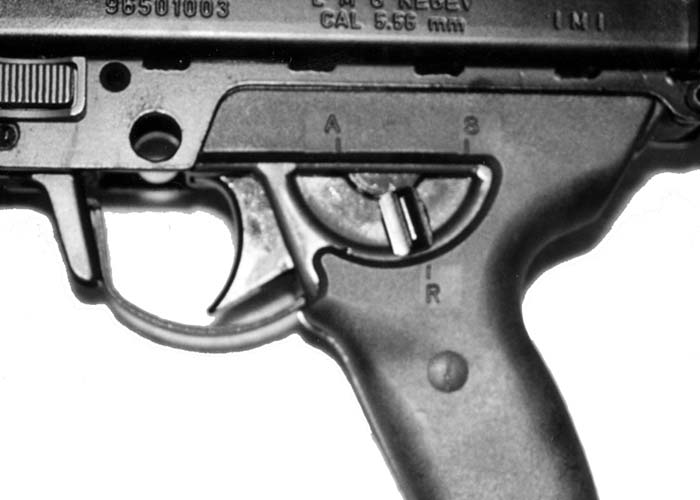
The IWI Negev employs a fire selector switch with safe, semi-automatic, and fully automatic positions to enable adaptive firing modes for close-quarters battle or sustained suppression.[1] Its non-reciprocating charging handle, located on the right side of the receiver, permits efficient cycling without reciprocation, supporting rapid chambering and clearing.[30] The integrated pistol grip facilitates instinctive control, while an optional assault foregrip enhances stability during unsupported or hip-fired operation in fluid infantry maneuvers.[30] A side-folding butt stock, available in fixed or telescopic configurations with an adjustable cheek rest on select models, allows compact carry and firing with the stock collapsed, prioritizing maneuverability over traditional prone setups.[1] The forward-mounted, foldable bipod features leg height adjustments for terrain adaptation, folding flush under the handguard to maintain a low profile during advancement.[30] [31] Picatinny rail interfaces on the top receiver, sides, and lower handguard support mounting of optics such as reflex sights, lasers, and night vision devices, enabling user-customized configurations without permanent modifications.[1] At 7.6 kg empty for short-barreled variants, the Negev's forward-biased yet balanced mass distribution—achieved through a quick-change barrel and polymer elements—reduces operator fatigue on prolonged foot patrols relative to bulkier belt-feds exceeding 10 kg.[30]Feeding and Ammunition
Belt and Magazine Compatibility
The IWI Negev employs a primary belt-feed system utilizing M27 disintegrating links, typically loaded in 150- or 200-round pouches that detachably attach beneath the receiver for squad-level sustained fire without requiring extensive resupply.[2] These non-disintegrating pouch designs maintain link integrity during transport while allowing quick belt changes.[15] The system's compatibility with standard NATO disintegrating links reduces residue accumulation compared to older metallic-link belts.[32] For versatility in low-intensity operations, the Negev supports feeding from 30-round STANAG-compatible magazines via an insertable adapter in the magazine well, aligning with existing small-arms logistics in allied forces.[5] This dual-feed mechanism, incorporating a covered feed tray, enables operators to alternate between belts and magazines mid-engagement, minimizing downtime.[33] The tray's design directs rounds reliably into the chamber, mitigating exposure to debris.[34] Post-initial development, refinements addressed early feed sensitivities to contaminants, with subsequent models demonstrating sustained performance in sand and dust per manufacturer environmental testing.[15][30] This adaptability supports modular sustainment across varied tactical profiles without overhauling ammunition supply chains.[8]Caliber Options and Performance Implications
The IWI Negev is chambered primarily in 5.56×45mm NATO, allowing machine gunners to carry in excess of 400 rounds due to the cartridge's low weight of approximately 12 grams per round, facilitating sustained fire and mobility in squad support roles. This caliber achieves a muzzle velocity of about 915 m/s from the Negev's barrel, enabling a relatively flat trajectory and effective point target engagement out to 600 meters with minimal drop.[35] The lighter recoil—around 5 ft-lbs in comparable systems—permits faster follow-up shots and reduced fatigue during prolonged bursts compared to heavier calibers.[36] In contrast, the 7.62×51mm NATO option provides roughly double the kinetic energy at the muzzle, enhancing terminal ballistics against personnel and approximately 30-50% greater barrier penetration at ranges like 600 meters, as evidenced by field comparisons favoring the heavier round for defeating light cover such as wood or sheet metal.[37] This comes at the cost of heavier ammunition—about 25 grams per round—limiting carry to fewer belts for equivalent weight, and increased recoil of 8-9 ft-lbs, which demands more robust control mechanisms and can elevate muzzle rise in automatic fire.[36] Muzzle velocity drops to around 850-860 m/s, resulting in a more arcing trajectory beyond 400 meters, though retained energy ensures superior stopping power against obscured or fortified targets.[35] Operationally, the 7.62mm chambering excels in scenarios requiring penetration of walls and rubble, as demonstrated in IDF engagements where it outperformed 5.56mm in breaching urban structures without excessive fragmentation loss, balancing defeat of cover with controlled overpenetration through soft targets.[38][39] Trade-offs in portability favor the 5.56mm for open-terrain maneuver warfare, while 7.62mm prioritizes raw lethality in contested environments, informed by ballistic gel and armor tests showing deeper wound channels and higher incapacitation probabilities for the larger bore.[37]Variants and Modernizations
5.56mm Variants
The IWI Negev, initially developed in the late 1980s and adopted by the Israel Defense Forces (IDF) in the early 1990s, serves as the baseline 5.56×45mm NATO variant, featuring a gas-operated, open-bolt design with a standard 508 mm chrome-lined barrel for sustained fire support.[2] This model emphasizes reliability in adverse conditions through quick-change barrels and compatibility with M27 disintegrating links, achieving a cyclic rate of 500–700 rounds per minute.[5] The Negev SF (Special Forces) variant, introduced around 1998 and integrated into IDF commando units by the mid-2000s, shortens the barrel to 330 mm to enhance close-quarters battle (CQB) maneuverability while retaining belt-feed capability and adding a vertical foregrip option.[3] This configuration reduces overall length to approximately 700 mm with the stock collapsed, prioritizing portability for urban and special operations without compromising the core gas-piston reliability.[15] The Negev NG5, launched in the 2010s as a next-generation evolution, incorporates polymer construction in the receiver and handguard to reduce weight by roughly 0.5 kg compared to the original (totaling about 7.6 kg unloaded), alongside full-length Picatinny rails for optics and accessories.[8] These upgrades maintain the 5.56mm chambering's ballistics while improving ergonomics, including an adjustable folding stock, and have been deployed in conflict zones for enhanced modularity without altering caliber-specific performance.[40] The Negev UX, refined in the early 2020s through IDF collaboration, builds on prior models with extended M-LOK and Picatinny rail integration for superior suppressor mounting and optics, alongside a telescopic stock for variable-length operations; a July 2025 IDF procurement of NIS 67 million worth underscores its field-proven reliability boosts in recent engagements.[41] This variant sustains incremental enhancements to heat dissipation and accessory compatibility, focusing on special forces needs while preserving 5.56mm velocity and controllability.[42]7.62mm Variants
The IWI Negev NG-7, chambered in 7.62×51mm NATO, serves as the principal 7.62mm variant optimized for sustained fire support with greater range and terminal ballistics compared to 5.56mm models.[7] Introduced in 2012, it retains the core gas-operated, open-bolt mechanism of the Negev family but features adaptations including a reinforced bolt carrier assembly to accommodate the elevated chamber pressures and recoil impulses of the heavier cartridge.[9] The design maintains a lightweight profile at approximately 7.95 kg unloaded, achieved through advanced polymer and alloy components, while supporting a cyclic rate of fire between 600 and 750 rounds per minute via an adjustable gas regulator.[9] Select-fire functionality, encompassing both full-automatic and semi-automatic modes, was incorporated in response to operational feedback emphasizing the need for precise suppressive fire in export-oriented applications.[7] The semi-automatic option enables controlled bursts for targeted engagements, enhancing versatility in roles demanding accuracy over volume. The NG-7 employs a 508 mm chrome-lined, cold hammer-forged barrel with four right-hand grooves, compatible with disintegrating M13-link belts holding up to 100 or 200 rounds, and includes a quick-change barrel system for prolonged engagements.[9] The variant underwent evaluation by the Indian Army, culminating in a 2020 procurement contract for 16,479 units to bolster infantry firepower against regional threats requiring deeper penetration.[43] This adoption highlights the NG-7's balance of portability and firepower, with the weapon's 1,100 mm overall length (stock extended) facilitating deployment by dismounted squads without sacrificing maneuverability.[7]Compact and Ultra-Light Models
The compact variants of the IWI Negev, including the SF (Special Forces) and Commando models, prioritize close-quarters battle and urban maneuverability through shortened barrels and reduced overall dimensions. The Negev Commando features a 330 mm barrel, enabling deployment by special operations units where space constraints limit standard-length light machine guns. These models replace the bipod with a vertical foregrip for one-handed control during assaults, while retaining belt-feed compatibility and gas-operated reliability for sustained fire in dynamic environments.[3] The Negev NG7 SF further adapts the 7.62×51mm platform with a 420 mm barrel and extended length of 1,012 mm, balancing compactness with enhanced penetration for squad support roles. Weighing approximately 7.5 kg empty, it addresses the need for portability in airborne insertions and vehicle dismounts, differing from bulkier general-purpose machine guns by facilitating rapid transitions between firing positions without compromising cyclic rates of 600–800 rounds per minute.[44] Introduced in 2023, the Negev 7 ULMG (Ultra-Light Machine Gun) advances weight reduction to 6.6 kg for the unloaded weapon, incorporating a length-adjustable buttstock and revised aluminum handguard based on operational feedback demanding lighter 7.62×51mm suppressive fire options. With a 420 mm barrel yielding retracted lengths as short as 920 mm, it suits high-mobility scenarios like urban patrols and airborne operations, where legacy systems impose excessive encumbrance on infantry squads. The design preserves semi-automatic and full-automatic modes alongside a quick-change barrel for heat management, enabling extended engagements without proportional bulk increases.[20][45]Operational Use and Users
Deployment in Israeli Defense Forces
The IWI Negev was adopted by the Israel Defense Forces (IDF) in 1997 as the primary light machine gun for infantry squads, serving in the squad automatic weapon role to deliver suppressive fire at effective ranges of 200 to 600 meters.[46][47] Its integration into IDF doctrine emphasized mobility and sustained firepower in urban and asymmetric warfare environments, replacing older systems like the FN MAG in lighter configurations.[3] During the Second Intifada (2000–2005) and Gaza operations such as Operation Cast Lead (2008–2009), the Negev provided critical area suppression against militant positions, contributing to IDF tactical advantages in close-quarters and defensive engagements.[48] In the Swords of Iron war commencing October 7, 2023, upgraded Negev NG7 and UX variants demonstrated effectiveness in tunnel clearance operations and direct confrontations with Hamas fighters, particularly due to their lightweight design, low recoil, and maneuverability in confined spaces.[22][23] This operational success prompted a July 2025 IDF procurement of additional Negev units valued at NIS 67 million (approximately USD 20 million), with deliveries scheduled for 2026–2027 to bolster ground forces' firepower capabilities.[41][49] IDF logistics and training protocols for the Negev prioritize barrel change procedures to support extended suppressive fire, enabling units to maintain fire superiority in prolonged engagements without overheating limitations.[5]International Adoption and Combat Roles
The IWI Negev has achieved export success to multiple nations, serving primarily as a light machine gun in infantry support roles within mixed-caliber forces. In March 2020, India signed a contract worth approximately $118 million with Israel Weapon Industries for 16,479 Negev NG7 units to equip Indian Army infantry battalions, enhancing firepower for border security operations along contested frontiers.[50][25] Other verified adopters include Georgia, where the Negev integrates into military units for squad-level automatic fire support.[4] Sales data from small arms monitoring organizations indicate presence in at least 14 countries, spanning Latin America, Africa, and Eastern Europe, often tailored for forces requiring reliable belt-fed weapons adaptable to NATO-standard ammunition.[51] Internationally, the Negev's full-auto capability supports suppressive fire in tactical maneuvers, while semi-automatic configurations enable law enforcement marksmanship training and precision engagements.[26] Export variants emphasize compatibility with diverse logistical setups, positioning it as a versatile option for armies transitioning from legacy systems.Performance Evaluation
Reliability in Harsh Environments
 The IWI Negev's open-bolt operating system enhances reliability by preventing ammunition cook-offs in high-temperature conditions, as the bolt remains rearward when at rest, avoiding sustained heat buildup in the chamber during pauses in fire.[18] A two-position gas regulator enables adjustment for contaminated environments, such as sand and dust, ensuring consistent cycling and extraction under fouling-heavy operations observed in IDF evaluations.[49][18] Chrome-lined bores, chambers, and gas systems provide resistance to abrasion and thermal degradation, supporting sustained performance in abrasive desert settings.[18] Metallic dust covers on ejection ports further mitigate debris ingress during sandstorm exposure.[18] IDF Ordnance Corps trials, culminating in the weapon's 1997 adoption, confirmed functionality across sand storms, mud, and extreme weather via iterative field testing with combat units over three years.[13][18] Quick-change barrels, replaceable in 1.3 seconds without tools, allow operators to manage heat buildup during extended firing in arid heat exceeding typical thresholds.[13] Field-level disassembly into primary groups supports rapid cleaning and reassembly in austere conditions, minimizing downtime.[5]Combat Effectiveness and Tactical Advantages
The IWI Negev demonstrated notable combat effectiveness during Operation Iron Swords, initiated on October 7, 2023, following Hamas attacks, where its lightweight design and high mobility served as a force multiplier for IDF ground forces in urban and complex environments.[42] This performance prompted the IDF to procure additional units worth NIS 67 million in July 2025, underscoring its role in enabling effective maneuvering against fortified positions held by asymmetric threats.[49] The Negev's reduced weight—approximately 6.8 kg for the 7.62mm UX variant—facilitated rapid repositioning by individual operators or small fireteams, contrasting with heavier static machine guns that require dedicated crews and limit offensive flexibility.[52] In urban operations, the Negev's semi-automatic and full-automatic firing modes, combined with low recoil, supported precise suppression fire, allowing troops to neutralize threats while advancing.[23] Its ability to deliver sustained bursts enhanced lethality against dispersed insurgents, contributing to causal advantages in close-quarters battles by maintaining fire superiority without compromising mobility.[22] Ammunition commonality with standard IDF rifle calibers, such as 5.56mm or 7.62mm NATO, streamlined resupply logistics during extended engagements, reducing logistical burdens and sustaining firepower in prolonged asymmetric conflicts.[53] This integration minimized disruptions, enabling continuous offensive operations against entrenched positions.Comparisons to Peer Systems
The IWI Negev, chambering 5.56×45mm NATO, offers a lighter alternative to the FN M249 SAW at approximately 7.2–7.6 kg unloaded compared to the M249's 7.5–8.1 kg, with both featuring quick-change barrels for sustained fire.[54][8][55] Unlike the M249, which prioritizes belt feed and exhibits unreliable magazine compatibility, the Negev reliably accepts standard AR-15 or Galil magazines alongside belts, simplifying logistics in squad-level operations.[54][56] Its spring-loaded dust cover over the feed tray provides superior protection against sand ingress relative to the M249's more exposed design, contributing to enhanced reliability in desert environments as evidenced by Israeli Defense Forces evaluations that rejected the FN Minimi precursor for insufficient robustness.[54][56] Effective range for point targets stands at 600–800 m for the Negev, marginally shorter than the M249's bipod-mounted 600–800 m without optical upgrades, though both extend to 1,000 m for area suppression.[8][55]| Feature | IWI Negev (5.56mm) | FN M249 SAW |
|---|---|---|
| Unloaded Weight | 7.2–7.6 kg | 7.5–8.1 kg |
| Feed Options | Belts or magazines (reliable) | Primarily belts; unreliable magazines |
| Dust Resistance | Spring-loaded cover | Minimal coverage |
| Cyclic Rate | 850–1,050 rpm | 750–1,000 rpm |