


Community hub
Imbaba
View on WikipediaImbaba (Arabic: إمبابة Imbāba, IPA: [emˈbæːbæ]) is a working-class neighbourhood in northern Giza, Egypt, located west of the Nile and northwest of and near Gezira Island and downtown Cairo, within the Giza Governorate. The district is located in the historic upper Nile Delta, and is part of the Greater Cairo metropolitan area. Imbaba is the most densely populated city subdivision in the world.
Key Information


Imbaba is also the name of an adjacent administrative centre (مركز) in rural Giza Governorate, which has 18 villages in its jurisdiction.[1]
Etymology
[edit]The origin of the name Imbaba is not certain. Some sources claim that it comes from the Amharic word for African fan palm (Amharic: ዘምባባ, romanized: zembaba) and that the area was called so by Ethiopian camel merchants and herders to describe the place where they met to do business.[1]
However, the fan palm does not grow in Egypt[2] and older versions of the name that do not correspond to the Amharic word are attested – Nababa (Arabic: نبابة)[3] and Ambuba (Arabic: امبوبه).[4]
History
[edit]For centuries Imbaba was the final destination for camels brought from as far as Sudan and the Horn of Africa, to be sold in the village's Friday market. The market still exists, but is no longer as important as it was up to the turn of the 20th century due to increasing urbanisation.[5][6]
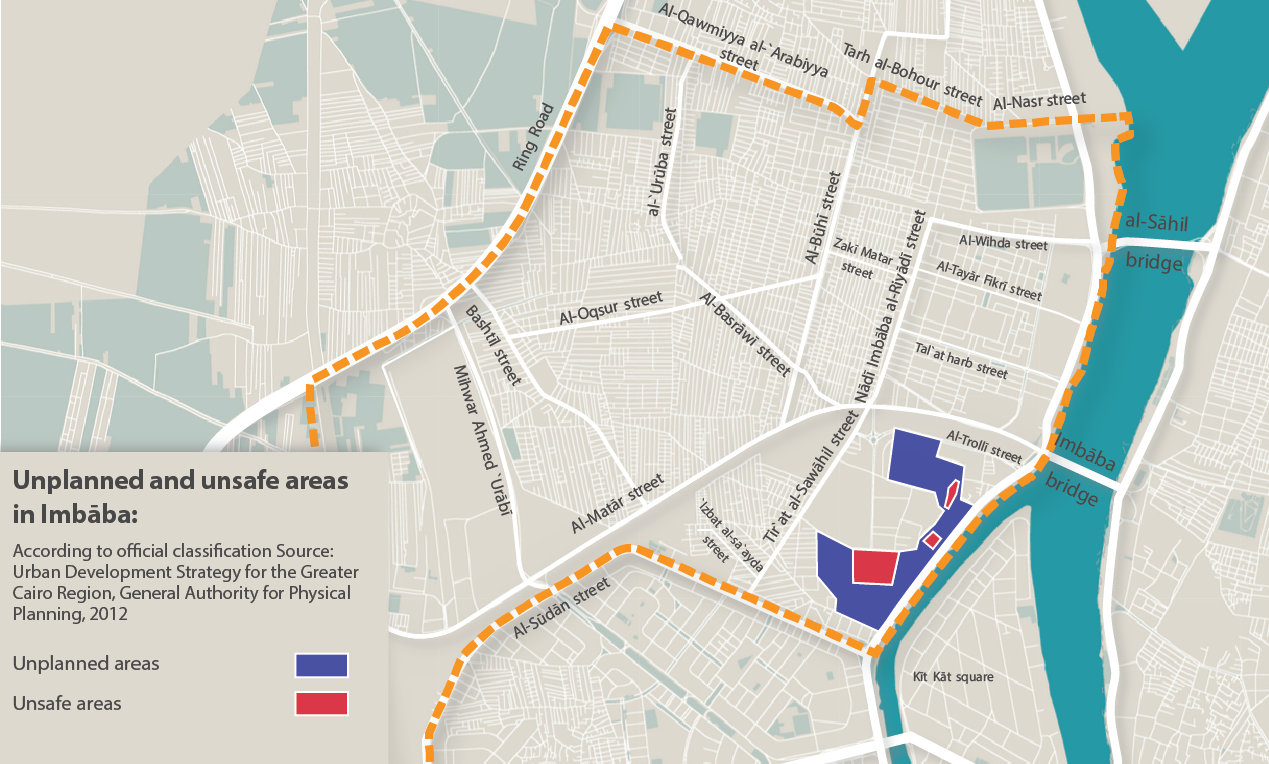
A map created by the General Authority for Physical Planning in 2012, shows details of areas within Imbaba which were unplanned, and that at the time, were considered unsafe. Imbaba is densely populated.[7][1]
Pigeon breeding is a favorite activity of some of the neighborhood residents with access to rooftops.[8][9]
Battle of the Pyramids
[edit]The Battle of the Pyramids, also known as the Battle of Embabeh, was a battle fought on July 21, 1798, between the French army in Egypt under Napoleon Bonaparte, and local Mamluk forces. It occurred during France's Egyptian Campaign and was the battle where Napoleon put into use one of his significant contributions to tactics, the massive divisional square. Napoleon named the battle after the Egyptian pyramids, although they were only faintly visible on the horizon when the battle took place.
Siege of Imbaba
[edit]In late 1992, the "Islamic Group" (al-Gama'a al-Islamiyya) expanded its influence in parts of Imbaba. In November, the group purportedly announced the establishment of the "Emirate of Imbaba" (some accounts claim that foreign news media coined the term, not the group itself). This challenge to the sovereignty of the Egyptian state triggered the siege of Imbaba, beginning on December 8. In its course, the government deployed over 12,000 police and state Security forces, along with one hundred personnel carriers and bulldozers, all of which put an end to the Emirate.[10][11][12]
Imbaba's districts
[edit]- Madinat Al-Umal
- Bashtil
- Madinat Al-Tahrir
- Al-Muniera
- Ard Al-Gameya
Notable people
[edit]- Ali El Haggar – singer
- Mohamed Henedi – actor
- Ibrahim Youssef – soccer player
- Ismail Youssef – soccer player
- Mohamed Esmat – aviation industry
See also
[edit]References
[edit]- ^ a b c d "Imbaba". tadamun.co.
- ^ "Borassus aethiopum Mart. | Plants of the World Online | Kew Science". Plants of the World Online. Retrieved 2023-02-23.
- ^ al-Idrisi. Nuzhat al-mushtaqft ikhtirdq al-afdq.
- ^ "Ministry of Finance, Egypt - Atlas of Egypt: Lower and Upper Egypt (1914)". Paths - the Archaeological Atlas of Coptic Literature.[permanent dead link]
- ^ Cowell, Alan (18 December 1989). "Imbaba Journal; Camels and Men: All Is Changing and Unchanged". NYT.
- ^ Khater, Akram (November 1989). "Imbaba". Saudi Aramco World. 40 (6): 36–40.
- ^ "Unplanned and Unsafe Areas in Imbaba map". tadamun.co.
- ^ Metcalfe, John (22 July 2014). "The Rooftop Homes of Cairo's Racing Pigeons". City Lab. Retrieved 11 December 2018.
- ^ Blechman, Andrew (2011). "Cairo's Fancy Fliers". Saudi Aramco World. Vol. 62, no. 2. Aramco Services Company. p. 9. Retrieved 11 December 2018.
- ^ Singerman, Diane. “The Siege of Imbaba, Egypt’s Internal ‘Other,’ and the Criminalization of Politics.” In Cairo Contested: Governance, Urban Space, and Global Modernity, ed. Diane Singerman, 111-144. New York, NY: The American University in Cairo Press, 2009. Pages 112-114.
- ^ "Church burning deepens tumult of Egypt transition". Fox News. Cairo. Associated Press. 8 May 2011. Retrieved 9 May 2011.
Islamic extremists declared the crowded district a state within a state in the 1990s, calling it "the Islamic Republic of Imbaba," one of the country's hottest spots of Islamic militancy.
- ^ Lindsey, Ursula (4 March 2010). "And then Cairo turned itself inside out". The National. Retrieved 9 May 2011.
At around the same time, the Islamist group Jama'a Islamiya took de facto control of Imbaba - creating what the foreign press quickly dubbed 'the Islamic Republic of Imbaba'. The government dispatched more than 12,000 soldiers to carry out a six-week siege, round up the Islamists, and reimpose its authority.
External links
[edit]
- "Few Focus on Religion in One Cairo Neighborhood" by Anthony Shadid, New York Times February 15, 2011.
Districts and suburbs of Greater Cairo | ||||||||||
|---|---|---|---|---|---|---|---|---|---|---|
| Cairo Governorate |
|   | ||||||||
| Giza Governorate |
| |||||||||
| Qalyubia Governorate |
| |||||||||
Imbaba
View on GrokipediaEtymology and Naming
Origins of the Name
The etymology of Imbaba remains uncertain, with historical records providing limited clarity on its precise origins. Medieval Egyptian chronicler Taqī al-Dīn al-Makrīzī (1364–1442), in his topographical works on Cairo and its environs, reportedly referenced an earlier form "Nabāba," from which "Imbāba" may derive through phonetic distortion over time.[1] Alternative explanations link the name to regional flora or migrant influences. Local traditions associate it with the Amharic term zembaba (ዘምባባ), signifying the doum palm (Hyphaene thebaica), a tree historically prevalent along the Nile in the area; this theory posits naming by Ethiopian or southern African arrivals, possibly reflecting the landscape's palm groves during early settlement.[1] No primary linguistic evidence confirms a direct Arabic root, though speculative ties to terms like bāb (gate) appear in some surname analyses without broader attestation for the place name.[6]Historical Linguistic Evolution
The toponym Imbāba (Arabic: إمبابة), denoting the district in northern Giza, Egypt, exhibits limited documented linguistic evolution, with primary historical attestation emerging in medieval Arabic sources. Egyptian historian Taqī al-Dīn al-Makrīzī (1364–1442), in his topographic compendium Al-Mawāʿiẓ wa-al-Iʿtibār fī Dhikr al-Khiṭaṭ wa-al-Āthār, referred to the area as Nabāba, a form posited by subsequent scholars as the phonetic precursor to Imbāba through gradual distortion in vernacular pronunciation and orthography during the Mamluk era (1250–1517). This shift likely reflects natural Arabic dialectal variations, where initial n- elision or assimilation to i- could occur in regional speech patterns, though direct manuscript evidence for intermediate forms remains scarce.[7] Earlier origins remain speculative, lacking attestation in ancient Egyptian hieroglyphic, Demotic, or Coptic records specific to the locale. Proposed Afroasiatic roots, such as derivations from Ethiopian Semitic languages—including Amharic zembaba (ዘምባባ) for the African fan palm (Borassus aethiopum), potentially alluding to prehistoric Nile floodplain vegetation—appear in folk etymologies but lack corroboration from archaeological or paleobotanical data tying them to the site's nomenclature. Similarly, phonetic parallels in Tigre and Tigrinya (Embaba) suggest possible migratory linguistic influences from the Horn of Africa, yet these hypotheses rely on modern linguistic comparison rather than historical texts. By the late 18th century, European accounts of the Battle of the Pyramids (July 21, 1798) consistently render the name as Embabeh or Imbaba, indicating stabilization in its Arabic form amid Ottoman-era usage.[8] The persistence of Imbāba into the modern era aligns with broader patterns of toponymic conservation in Egyptian Arabic, minimally altered by 19th- and 20th-century urbanization despite phonological pressures from Cairene dialects. No significant orthographic reforms or renamings are recorded post-Makrīzī, underscoring the name's resilience amid sociolinguistic shifts from classical to colloquial Arabic dominance in the region.Geography and Demographics
Location and Physical Features
Imbaba is a district in Giza Governorate, Egypt, positioned on the western bank of the Nile River, opposite the Zamalek area of Cairo Governorate. It lies within the Greater Cairo metropolitan area, approximately 4-5 kilometers northwest of central Cairo's Tahrir Square, at coordinates 30°04′46″N 31°11′54″E.[9] The district borders the Nile to the east, with extensions westward encompassing urbanized zones that were historically agricultural lands along the floodplain. The physical landscape of Imbaba consists of flat alluvial terrain typical of the Nile Valley, with elevations ranging from about 20 to 30 meters above sea level, conducive to dense settlement but prone to urban heat island effects due to extensive built-up areas.[10] This low-lying plain features informal urban morphology, including high-density residential clusters, narrow streets, and limited green spaces, overlaid on the former Imbaba Airport site—a 1.2 square kilometer expanse now slated for redevelopment into mixed-use urban facilities.[5] Key physical infrastructure includes the Imbaba Bridge spanning the Nile, facilitating connectivity to eastern Cairo, and proximity to Nile branches and irrigation canals that historically supported agriculture before urbanization intensified post-mid-20th century.[1]Population and Density Trends
Imbaba's population has exhibited steady growth over recent decades, driven primarily by rural-to-urban migration within Egypt and sustained natural increase. Official statistics from the Central Agency for Public Mobilization and Statistics (CAPMAS) record the population of Imbaba kism at 523,265 in the 1996 census, rising to 598,882 in 2006 and 632,599 in the 2017 census.[2] An estimate for 2023 places it at 682,349, reflecting an annual growth rate of 1.2% between 2017 and 2023.[2]| Census Year | Population |
|---|---|
| 1996 | 523,265 |
| 2006 | 598,882 |
| 2017 | 632,599 |
Historical Development
Pre-Modern and Early Modern Period
Imbaba, documented in medieval sources as Nabāba, emerged as a rural settlement on the Nile's western bank, first referenced by the 15th-century historian Taqī al-Dīn al-Makrīzī in his topographical compendium Al-Mawāʿiẓ wa-l-iʿtibār bi-dhikr al-khiṭaṭ wa-l-āthār.[1] The name likely evolved from terms linked to the doum palm (Hyphaene thebaica), evoking its position along the Darb al-Arbaʿīn caravan route, which facilitated trade from sub-Saharan Africa.[1] In the Mamluk era (1250–1517), Imbaba consisted of scattered agricultural hamlets, such as Kafr al-Sheikh Ismaīl, sustained by Nile-irrigated fields and proximity to Cairo's western periphery.[1] Its Friday market drew long-distance camel traders from Sudan and the Horn of Africa, establishing it as a commercial node for livestock exchange that endured across centuries.[1] Under Ottoman rule (1517–1798), Imbaba retained its agrarian character within Egypt's beylik system, where Mamluk beys held de facto control despite nominal suzerainty from Istanbul.[13] The village's landscape of clover fields and sand hills supported modest farming and pastoral activities, with religious sites like the mosque and dargah of Sufi sheikh Ismaīl al-Imbābī highlighting localized devotional networks.[1] Periodic Nile floods and caravan traffic shaped its economy, though broader Ottoman administrative neglect of rural peripheries limited infrastructural growth.[14]19th-Century Events and Growth
During the early 19th century, Imbaba functioned primarily as a rural agricultural village along the Nile, supporting local farming and serving as a key node in regional trade networks. It hosted a prominent camel market, Africa's largest, where caravans along the Darb al-Arba‘īn route brought livestock from Sudan and the Horn of Africa for sale on Fridays, sustaining economic activity amid Egypt's broader modernization under Muhammad Ali Pasha (r. 1805–1848).[15][1] This market, drawing on centuries-old overland commerce, integrated Imbaba into trans-Saharan exchanges, though the area remained clustered around villages like Kafr al-Shaykh Isma‘il with limited urban features.[1] Growth accelerated in the late 19th century with infrastructure projects that enhanced connectivity to Cairo and Giza. Construction of the Old Imbaba railway bridge began in 1890, spanning approximately 495 meters across the Nile with six fixed sections and one movable pivot section (21.5 meters wide) to accommodate river traffic, alongside a single rail track and pedestrian/vehicular paths.[16] Designed to link Giza station to Upper Egypt lines, the bridge—opened in 1892 under Khedive Abbas II—facilitated expanded rail and road traffic, boosting westward transport and marking Imbaba's emergence as a linked settlement rather than an isolated rural outpost.[16][1] By the century's close, these developments transformed Imbaba from a cluster of agrarian hamlets into a small town featuring shops, services, and increased prominence tied to the namesake railway bridge, laying groundwork for further urbanization while retaining its trade and agricultural base.[1] The bridge's role in Egypt's railway expansion exemplified khedival-era engineering, directly contributing to local economic integration without displacing core rural functions.[16]20th-Century Urbanization
Imbaba's urbanization gained momentum in the early 20th century through infrastructural developments that integrated it with Cairo. The construction of a railway bridge in 1890 improved connectivity across the Nile, followed by a new road bridge in 1925, which facilitated the influx of workers and commerce.[1] Industrial establishments emerged in the 1930s, including the Anglo-Egyptian Motors factory in 1937 and the Chourbagui Textile Factory in 1940, drawing labor from rural areas and spurring residential expansion.[1] Mid-century shifts marked a transition to predominantly informal growth amid Egypt's broader rural-urban migration. Planned laborers' housing began in the 1920s, with 1,106 units completed by 1950, and further developments like Madinat al-Taḥrīr between 1954 and 1958; however, these were insufficient for the surging population, leading to unauthorized settlements from the 1940s onward, particularly from Upper Egyptian migrants in areas likeIzbat al-Ṣaāyda.[1] [17] The establishment of Imbaba Airport in the 1940s initially surrounded by fields further enabled peri-urban sprawl, as agricultural land converted to haphazard housing to accommodate Cairo's demographic pressures.[1]
By the late 20th century, Imbaba exemplified Cairo's informal urbanization patterns, with spontaneous construction overwhelming planned efforts due to rapid population influx and limited formal housing supply. Informal areas proliferated in the 1950s and expanded significantly by the 1980s, coinciding with the ring road's construction, which enhanced accessibility but exacerbated overload on existing structures.[1] [18] This growth reflected Egypt's national trend, where Greater Cairo's population rose from approximately 10 million in the early 20th century to over 10 million by 1970, driven by high fertility and migration rather than industrial formalization alone.[19] Government responses remained reactive, prioritizing containment over comprehensive planning, as informal development accommodated the majority of urban expansion in districts like Imbaba.[20]