



Community hub
Recent from talks
Contribute something
Nothing was collected or created yet.
Integral symbol
View on Wikipedia| ∫ | |
|---|---|
Integral symbol | |
| In Unicode | U+222B ∫ INTEGRAL (∫, ∫) |
| Graphical variants | |
| Different from | |
| Different from | U+017F ſ LATIN SMALL LETTER LONG S U+0283 ʃ LATIN SMALL LETTER ESH |

The integral symbol (see below) is used to denote integrals and antiderivatives in mathematics, especially in calculus.
History
[edit]The notation was introduced by the German mathematician Gottfried Wilhelm Leibniz in 1675 in his private writings;[1][2] it first appeared publicly in the article "De Geometria Recondita et analysi indivisibilium atque infinitorum" (On a hidden geometry and analysis of indivisibles and infinites), published in Acta Eruditorum in June 1686.[3][4] The symbol was based on the ſ (long s) character and was chosen because Leibniz thought of the integral as an infinite sum of infinitesimal summands.
Typography in Unicode and LaTeX
[edit]Fundamental symbol
[edit]The integral symbol is U+222B ∫ INTEGRAL in Unicode[5] and \int in LaTeX. In HTML, it is written as ∫ (hexadecimal), ∫ (decimal) and ∫ (named entity).
The original IBM PC code page 437 character set included a couple of characters ⌠,⎮ and ⌡ (codes 244 and 245 respectively) to build the integral symbol. These were deprecated in subsequent MS-DOS code pages, but they still remain in Unicode (U+2320 and U+2321 respectively) for compatibility.
The ∫ symbol is very similar to, but not to be confused with, the letter ʃ ("esh").
Extensions of the symbol
[edit]Related symbols include:[5][6]
| Meaning | Unicode | LaTeX | ||
|---|---|---|---|---|
| Double integral | ∬ | U+222C | \iint
| |
| Triple integral | ∭ | U+222D | \iiint
| |
| Quadruple integral | ⨌ | U+2A0C | \iiiint
| |
| Contour integral | ∮ | U+222E | \oint
| |
| Clockwise integral | ∱ | U+2231 | ||
| Counterclockwise integral | ⨑ | U+2A11 | ||
| Clockwise contour integral | ∲ | U+2232 | 
|
\varointclockwise
|
| Counterclockwise contour integral | ∳ | U+2233 | 
|
\ointctrclockwise
|
| Closed surface integral | ∯ | U+222F | 
|
\oiint
|
| Closed volume integral | ∰ | U+2230 | 
|
\oiiint
|


Typography in other languages
[edit]
In other languages, the shape of the integral symbol differs slightly from the shape commonly seen in English-language textbooks. While the English integral symbol leans to the right, the German symbol (used throughout Central Europe) is upright, and the Russian variant leans slightly to the left to occupy less horizontal space.[7]
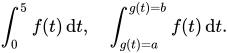
Another difference is in the placement of limits for definite integrals. Generally, in English-language books, limits go to the right of the integral symbol:
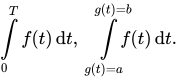
By contrast, in German and Russian texts, the limits are placed above and below the integral symbol, and, as a result, the notation requires larger line spacing but is more compact horizontally, especially when using longer expressions in the limits:
See also
[edit]Notes
[edit]- ^ Gottfried Wilhelm Leibniz, Sämtliche Schriften und Briefe, Reihe VII: Mathematische Schriften, vol. 5: Infinitesimalmathematik 1674–1676, Berlin: Akademie Verlag, 2008, pp. 288–295 Archived 2021-10-09 at the Wayback Machine ("Analyseos tetragonisticae pars secunda", October 29, 1675) and 321–331 Archived 2016-10-03 at the Wayback Machine ("Methodi tangentium inversae exempla", November 11, 1675).
- ^ Aldrich, John. "Earliest Uses of Symbols of Calculus". Retrieved 20 April 2017.
- ^ Swetz, Frank J., Mathematical Treasure: Leibniz's Papers on Calculus – Integral Calculus, Convergence, Mathematical Association of America, archived from the original on December 27, 2016, retrieved February 11, 2017
- ^ Stillwell, John (1989). Mathematics and its History. Springer. p. 110.
- ^ a b "Mathematical Operators – Unicode" (PDF). Retrieved 2013-04-26.
- ^ "Supplemental Mathematical Operators – Unicode" (PDF). Retrieved 2013-05-05.
- ^ "Russian Typographical Traditions in Mathematical Literature" (PDF). giftbot.toolforge.org. Archived from the original (PDF) on 28 September 2012. Retrieved 11 October 2021.
References
[edit]- Stewart, James (2003). "Integrals". Single Variable Calculus: Early Transcendentals (5th ed.). Belmont, CA: Brooks/Cole. p. 381. ISBN 0-534-39330-6.
- Zaitcev, V.; Janishewsky, A.; Berdnikov, A. (20 September 1999). Russian Typographical Traditions in Mathematical Literature (PDF). EuroTeX'99. EuroTeX'99 Proceedings. Heidelberg. Archived from the original (PDF) on 24 February 2017.
External links
[edit]| History |  | |
|---|---|---|
| Related branches | ||
| Formalizations | ||
| Individual concepts | ||
| Mathematicians | ||
| Textbooks | ||
Integral symbol
View on GrokipediaIntroduction
Symbol Description
The integral symbol, denoted as ∫, consists of an elongated "S" shape that is a stylized version of the Latin long s (ſ).[3] This form was chosen by Gottfried Wilhelm Leibniz to represent the concept of summation in calculus, originating as a stylized long s for "summa."[1] The symbol stretches vertically, with a continuous curve that evokes the original letter while providing space for notational elements such as limits. In typographic design, the integral symbol is elongated to be taller than surrounding text elements, positioning it among the tallest characters in mathematical fonts to accommodate upper and lower limits without overlap.[4] Its stem may appear slightly curved or more straight depending on the font style, such as in serif or sans-serif typefaces, ensuring readability and aesthetic integration in equations.[5] The core integral symbol is standardized in Unicode as U+222B (∫), belonging to the Mathematical Operators block. In HTML, it is represented by the named entity ∫, or numerically as ∫ (decimal) and ∫ (hexadecimal).[6] Historically, early computing environments used deprecated codes for integral representations with limits. In IBM PC code page 437, the top half integral was assigned code 244 (⌠, Unicode U+2320) and the bottom half integral code 245 (⌡, Unicode U+2321), allowing construction of bounded integrals in text-based displays.[7] These characters have since been superseded by the standard Unicode integral in modern typography.Role in Mathematics
The integral symbol ∫ primarily denotes the operation of integration in calculus, serving as a fundamental tool for computing antiderivatives and accumulations of functions. In the context of indefinite integrals, it represents the family of antiderivatives of a given function, expressed as ∫ f(x) , dx = F(x) + C, where F(x) is any antiderivative such that F'(x) = f(x) and C is an arbitrary constant of integration.[8][9] This notation emphasizes that the indefinite integral yields all possible functions whose derivative is f(x), capturing the inverse process of differentiation. For definite integrals, the symbol incorporates limits of integration to specify the interval over which the accumulation occurs, written as ∫_a^b f(x) , dx. Here, a denotes the lower limit, positioned below the ∫ symbol, and b the upper limit, placed above it, in accordance with standard Western mathematical notation.[10] This form computes the net signed area under the curve of f(x) from x = a to x = b, or more generally, the total change in the antiderivative F(x) evaluated as F(b) - F(a).[11] The definite integral functions as the continuous counterpart to the discrete summation symbol Σ, arising as the limit of Riemann sums that approximate the area under f(x) by partitioning the interval [a, b] into subintervals and summing rectangular areas.[12] As the partition width approaches zero, these sums converge to ∫_a^b f(x) , dx, bridging discrete addition with continuous accumulation.[13] In multivariable calculus, the integral symbol extends to higher-dimensional integrations, such as line integrals along a curve C, denoted ∫_C \mathbf{F} \cdot d\mathbf{r} for a vector field \mathbf{F}, which measures the work done along the path.[14] Similarly, surface integrals employ a variant like ∬_S for integration over a surface S, quantifying flux through the surface.[15]Historical Development
Origins with Leibniz
In 1675, Gottfried Wilhelm Leibniz introduced the integral symbol ∫ during his stay in Paris, marking a pivotal moment in the development of calculus notation. On October 29 of that year, he first employed it in an unpublished manuscript titled Analyseos tetragonisticae pars secunda, where it served as a shorthand for continuous summation in the context of infinite series.[1] The symbol originated from a stylized form of the long s (ſ), the archaic variant of the letter "s" used in 17th-century handwriting, chosen to represent "summa" (Latin for "sum"), evoking the idea of accumulating infinitesimal quantities into a whole.[1] Leibniz explicitly noted in the manuscript: "Utile erit scribi ∫ pro omnia, ut ∫ l = omn. l, id est summa ipsorum l," translating to "It will be useful to write ∫ for all, so that ∫ l = all l, that is, the sum of all the l's."[16] Philosophically, the symbol embodied Leibniz's conception of integration as the inverse of differentiation, forming a "whole" from differential parts, with "integral" deriving from the Latin integer meaning "untouched" or "whole." This contrasted sharply with his differential notation "d," which denoted infinitesimal changes, creating a paired system that highlighted the dynamic interplay between summation and differencing in calculus.[16] The integral sign thus encapsulated a holistic view of mathematical operations, where infinite series converged to represent areas, volumes, or other aggregates under curves, aligning with Leibniz's broader metaphysical ideas of continuity and infinity.[1] Leibniz's handwritten sketches from 1675 to 1676, preserved in manuscripts now held in Hannover and transcribed by Carl Immanuel Gerhardt, illustrate the symbol's early evolution. Initial forms appeared S-like, gradually elongating into the more fluid ∫ to better convey endless summation, as seen in notes from November 11, 1675, where it paired with "dx" for the first time in Methodi tangentium inversae exempla.[16] While Leibniz drew inspiration from predecessors—such as Bonaventura Cavalieri's 1635 method of indivisibles, which summed line elements to compute areas, and John Wallis's 1650s notations for infinite products and summations—his innovation lay in unifying these concepts into a compact, symbolic framework that facilitated algebraic manipulation of integrals.[1] This notational breakthrough, though initially private, laid the groundwork for modern calculus by prioritizing conceptual clarity over geometric description.[16]Early Publications and Adoption
The integral symbol first appeared in print in Gottfried Wilhelm Leibniz's article "De geometria recondita et analysi indivisibilium atque infinitorum," published in the June 1686 issue (volume 5, pages 292–300) of Acta Eruditorum in Leipzig by the publishers Johann Gross and Johann Friedrich Gletitsch.[17] On page 297, Leibniz employed the symbol ∫ to denote the inverse operation to differentiation, presenting it as a stylized long "s" for summa (sum), alongside examples such as ∫p dy = ∫x dx to illustrate its reciprocal relationship with the differential d.[17] This marked the symbol's debut in mathematical literature, following Leibniz's earlier unpublished manuscripts from 1675 where he sketched initial versions of the notation.[18] Initial reception of the integral symbol was mixed, as it competed with Isaac Newton's fluxional notation, which favored dotted symbols for rates of change (fluxions) and rectangular areas or barred variables for integrals, a system dominant in Britain and less intuitive for composition of operations.[1] Continental mathematicians gradually adopted Leibniz's more flexible and mnemonic notation, with full acceptance evident by the mid-18th century through the works of Leonhard Euler and Joseph-Louis Lagrange. Euler incorporated the ∫ symbol extensively in his Institutiones calculi integralis (1768–1770), using it to systematize integral calculus and introducing limits in brackets with Latin descriptors like ab and ad for bounds.[1] Lagrange similarly relied on it in his Théorie des fonctions analytiques (1797), praising its utility for expressing functional relationships and aiding the development of analysis.[1] By the 19th century, the integral symbol achieved greater standardization, particularly with its prominent use in authoritative textbooks that bridged continental and British traditions. William Thomson (later Lord Kelvin) and Peter Guthrie Tait's Treatise on Natural Philosophy (1867) exemplified this shift, employing Leibniz's notation throughout its discussions of dynamics and mechanics, which helped entrench the symbol's global use even in regions partial to Newton's methods.[19] This textbook's influence extended to education and research, promoting consistent application in physics and mathematics.[20] Early printing of the integral symbol posed significant challenges, as mathematical texts relied on hand-engraved plates or custom-cast type for non-standard characters, resulting in stylistic inconsistencies across editions. The elongated "s" form varied in curvature, thickness, and orientation—sometimes appearing more looped or straight—due to the limitations of 17th- and 18th-century typography, where printers like those of Acta Eruditorum adapted existing long "s" glyphs or engraved bespoke versions for each publication.[21] These variations persisted until the 19th century, when improved metal type and modular mathematical fonts enabled more uniform reproduction, aligning with broader typographic reforms in scientific printing.[21]Symbol Variants
Basic Integral Symbol
The basic integral symbol, denoted as ∫, is the Unicode character U+222B in the Mathematical Operators block, categorized as a math symbol (Sm). This fixed-width glyph represents the indefinite integral in calculus notation, typically appearing without extensions or modifiers in its standard form, as in expressions like ∫ f(x) , dx.[22] Approved in Unicode version 1.1 in 1993, it serves as the core operator for integration, emphasizing summation over a continuum. For definite integrals, limits of integration are attached as subscripts and superscripts to the right of the symbol, forming notations such as ∫_a^b f(x) , dx, where a denotes the lower bound and b the upper bound. In mathematical typesetting, these limits are positioned inline as sub- and superscripts in running text or stacked above and below the symbol in display mode for enhanced readability, though no distinct Unicode points exist for overlined or underlined variants of the basic symbol itself.[23] The symbol features a characteristic right-leaning slant, evoking an elongated "S" to symbolize summation, and is designed to stretch vertically in mathematical fonts when accommodating tall integrands or fractions. This extensibility ensures proportional scaling in complex expressions, maintaining legibility across varying heights.[24] In common font families, the symbol exhibits subtle proportional variations. Computer Modern, the default in LaTeX, renders it with a pronounced slant and extensible variants for precision in academic typesetting.[25] Times-derived math fonts, such as those in STIX, produce a more serifed, slightly wider form suited to printed books.[26] Sans-serif renders, like in DejaVu Sans or Inter, adopt a cleaner, less italicized profile with uniform stroke widths, prioritizing modern digital displays.[27]Multiple and Special Integrals
In mathematics, the double integral symbol ∬, encoded as U+222C in Unicode, represents the integration of a function over a two-dimensional region, commonly used to compute areas, masses, or other quantities in surface integrals.[28] This symbol is rendered in LaTeX using the command \iint, allowing for expressions such as the integral of a function over a domain : which quantifies the accumulated value across the region, as seen in applications like calculating the area of when . The triple integral symbol ∭, corresponding to Unicode U+222D, extends this to three dimensions for volume integrals, integrating a function over a solid region to determine volumes, centers of mass, or total charge distributions.[28] In LaTeX, it is produced with \iiint, for instance in the form where denotes the volume, providing a foundational tool in multivariable calculus for three-dimensional analysis. For integrals along paths, the contour integral symbol ∮, Unicode U+222E, denotes integration over a closed curve, essential in complex analysis and vector calculus for evaluating circulation, which measures the net flow of a vector field around a loop.[28] LaTeX implements this via \oint, as in for the circulation of along curve . A related variant is the surface integral symbol ∯, Unicode U+222F, used for flux through a closed surface, quantifying the net flow out of a volume enclosed by the surface.[28] Specialized contour variants include the clockwise contour integral ∲ (U+2232) and the anticlockwise contour integral ∳ (U+2233), which specify the orientation of the path traversal in integrals, particularly in contexts requiring directional consistency.[28] These symbols distinguish path direction in vector calculus applications, ensuring precise computation of flux and circulation without ambiguity in orientation.Typographic Standards
Unicode and HTML Encoding
The integral symbol is primarily encoded in the Unicode Mathematical Operators block (U+2200–U+22FF), with the code point U+222B assigned to ∫ (INTEGRAL). This block encompasses a range of symbols essential for mathematical notation, ensuring consistent representation across digital platforms. Variant and extended forms of the integral, such as the quadruple integral operator ⨌ at U+2A0C, reside in the Supplemental Mathematical Operators block (U+2A00–U+2AFF), which expands support for advanced and n-ary integral constructions.[29] In HTML, the basic integral symbol ∫ is rendered using the named entity ∫ or the hexadecimal numeric entity ∫. For specialized variants, the contour integral ∮ (U+222E) employs ∮ or ∮, while the surface integral ∯ (U+222F) uses ∯. These entities facilitate embedding mathematical symbols in web content without relying solely on font availability, promoting accessibility in markup languages. Unicode version 15.0, released in 2022, did not introduce new integral-specific code points but enhanced overall mathematical support through refinements in character properties and stability policies, building on prior additions like those in version 3.2 for core operators. Subsequent versions, Unicode 16.0 (September 2024) and 17.0 (September 2025), introduced additional mathematical operators (14 in 16.0) and Leibnizian symbols (8 in 17.0), respectively, but no new code points specific to integrals.[30][31] Scalable rendering has advanced with variable fonts such as Google Noto Sans Math, which includes comprehensive coverage of integral glyphs across weights and sizes for high-quality display in applications like web browsers and document processors. Browser compatibility for these Unicode mathematical operators is robust in contemporary environments: Chrome and Firefox offer full native support for rendering ∫ and variants, often augmented by MathML for structured equations or CSS properties like font-feature-settings for precise styling. In contrast, older versions of [Internet Explorer](/page/Internet Explorer) (pre-Edge) exhibited inconsistencies, frequently failing to display integral symbols correctly without supplementary fonts or ActiveX components.[32] Post-2020 developments in Unicode have addressed internationalization gaps for mathematical notation by expanding the Mathematical Alphanumeric Symbols block and integrating math-aware properties into more scripts, enabling better global font coverage and reducing rendering disparities in non-Latin environments.[33] This includes support in open-source fonts like Noto for diverse linguistic contexts, ensuring integrals render reliably in internationalized applications up to 2025 standards.LaTeX and Mathematical Typesetting
In LaTeX, the integral symbol ∫ is produced using the\int command within math mode, such as $ \int $ for inline usage or $$ \int $$ for display mode. Limits of integration are specified with subscripts and superscripts, for example, \int_{a}^{b} f(x) \, dx renders as . The \int command internally relies on the primitive \intop for the display-style variant, which automatically scales the symbol and positions limits above and below in larger sizes, while \nolimits can force inline-style placement.[34][35]
For multiple integrals and contour integrals, the amsmath package extends the core functionality with dedicated commands like \iint for double integrals (∫∫), \iiint for triple integrals (∫∫∫), and \oint for closed-path integrals (∮). These are loaded via \usepackage{amsmath} and support limits similarly, e.g., \iint_{D} f(x,y) \, dx \, dy for a region D. The package ensures consistent spacing and scaling in display environments, enhancing readability for complex expressions.[36]
Math fonts in LaTeX integrate the integral symbol through families like AMS Euler, designed by Hermann Zapf and adapted by Donald Knuth, or Latin Modern Math, a default OpenType extension of Computer Modern. The eulervm package replaces standard math italics with Euler Roman while adjusting operator symbols, including integrals, for stylistic harmony; for instance, \usepackage{eulervm} yields a less slanted ∫ better suited to Euler's aesthetic. Customization of variants, such as slant or size, can be achieved with low-level commands like \DeclareMathSymbol{\int}{\mathop}{operators}{"B} to redefine the glyph from a specific font family.[37][38]
The historical foundation traces to Knuth's 1978 development of METAFONT, where he parametrized the integral glyph in Computer Modern to allow parametric variation in slant and extension, influencing subsequent designs like the Euler-compatible integral introduced to address mismatches with Zapf's script. This parametric approach enabled scalable, high-quality rendering on raster devices.[38]
Modern LaTeX engines like XeLaTeX and LuaLaTeX, via the unicode-math package, support OpenType math fonts with enhanced variable integral stretching post-2020 updates, allowing dynamic glyph assembly from font tables for arbitrary heights while maintaining legibility. For example, \usepackage{unicode-math} with \setmathfont{Latin Modern Math} leverages the MATH table for extensible operators, improving over fixed PostScript outlines.[39][40]