


Community hub
Recent from talks
Contribute something
Nothing was collected or created yet.
 | |
| Acronym | ISSN |
|---|---|
| Organisation | ISSN International Centre |
| Introduced | 1976 |
| No. issued | > 2,500,000 |
| No. of digits | 8 |
| Check digit | Weighted sum |
| Example | 2049-3630 |
| Website | www |


An International Standard Serial Number (ISSN) is an eight-digit code to uniquely identify a periodical publication (periodical), such as a magazine.[1] The ISSN is especially helpful in distinguishing between serials with the same title. ISSNs are used in ordering, cataloging, interlibrary loans, and other practices in connection with serial literature.[2]
The ISSN system was first drafted as an International Organization for Standardization (ISO) international standard in 1971 and published as ISO 3297 in 1975.[3] ISO subcommittee TC 46/SC 9 is responsible for maintaining the standard.
When a serial with the same content is published in more than one media type, a different ISSN is assigned to each media type. For example, many serials are published both in print and electronic media. The ISSN system refers to these types as print ISSN (p-ISSN) and electronic ISSN (e-ISSN).[4] Consequently, as defined in ISO 3297:2007, every serial in the ISSN system is also assigned a linking ISSN (ISSN-L), typically the same as the ISSN assigned to the serial in its first published medium, which links together all ISSNs assigned to the serial in every medium.[5]
Code format
[edit]An ISSN is an eight-digit code, divided by a hyphen into two four-digit numbers.[1] The last digit, which may be zero through nine or an X, is a check digit, so the ISSN is uniquely represented by its first seven digits. Formally, the general form of the ISSN (also named "ISSN structure" or "ISSN syntax") can be expressed as follows:[6]
NNNN-NNNCwhere N is in the set {0,1,2,...,9}, a decimal digit character, and C is in {0,1,2,...,9,X}; or by a Perl Compatible Regular Expressions (PCRE) regular expression:
^[0-9]{4}-[0-9]{3}[0-9X]$.For example, the ISSN of the journal Hearing Research, is 0378-5955, where the final 5 is the check digit, that is C=5. To calculate the check digit, the following algorithm may be used:

The remainder of this sum modulo 11 is then calculated:

If there is no remainder, the check digit is 0; otherwise the remainder is subtracted from 11. If the result is less than 10, it yields the check digit:
Thus, in this example, the check digit C is 5.

To confirm the check digit, calculate the sum of all eight digits of the ISSN multiplied by their position in the number, counting from the right. (If the check digit is X, add 10 to the sum.) The remainder of the sum modulo 11 must be 0. There is an online ISSN checker that can validate an ISSN, based on the above algorithm.[citation needed]
In EANs
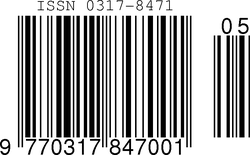
[edit]ISSNs can be encoded in EAN-13 bar codes with a 977 "country code" (compare the 978 "bookland" country code for ISBNs), followed by the 7 main digits of the ISSN (the check digit is not included), followed by 2 publisher-defined digits, followed by the EAN check digit (in most cases, this will not match the ISSN check digit, since they are each calculated in a different way).[7]
Code assignment, maintenance and look-up
[edit]ISSN codes are assigned by a network of ISSN National Centres, usually located at national libraries and coordinated by the ISSN International Centre (CIEPS[8]) based in Paris. The International Centre is an intergovernmental organization created in 1974 through an agreement between UNESCO and the French government.
Linking ISSN
[edit]ISSN-L is a unique identifier for all versions of the serial containing the same content across different media. As defined by ISO 3297:2007, the "linking ISSN (ISSN-L)" provides a mechanism for collocation or linking among the different media versions of the same continuing resource. The ISSN-L is one of a serial's existing ISSNs, so does not change the use or assignment of "ordinary" ISSNs;[9] it is based on the ISSN of the first published medium version of the publication. If the print and online versions of the publication are published at the same time, the ISSN of the print version is chosen as the basis of the ISSN-L.
With ISSN-L is possible to designate one single ISSN for all those media versions of the title. The use of ISSN-L facilitates search, retrieval and delivery across all media versions for services like OpenURL, library catalogues, search engines or knowledge bases.
Register
[edit]The International Centre maintains a database of all ISSNs assigned worldwide, the ISDS Register (International Serials Data System), otherwise known as the ISSN Register. At the end of 2016,[update] the ISSN Register contained records for 1,943,572 items.[10] The Register is not freely available for interrogation on the web, but is available by subscription.
- The print version of a serial typically will include the ISSN code as part of the publication information.
- Most serial websites contain ISSN code information.
- Derivative lists of publications will often contain ISSN codes; these can be found through on-line searches with the ISSN code itself or serial title.
- WorldCat permits searching its catalog by ISSN, by entering "issn:" before the code in the query field. One can also go directly to an ISSN's record by appending it to "
https://www.worldcat.org/ISSN/", e.g. n2:1021-9749 – Search Results. This does not query the ISSN Register itself, but rather shows whether any WorldCat library holds an item with the given ISSN.
Comparison with other identifiers
[edit]ISSN and ISBN codes are similar in concept, where ISBNs are assigned to individual books. An ISBN might be assigned for particular issues of a serial, in addition to the ISSN code for the serial as a whole. An ISSN, unlike the ISBN code, is an anonymous identifier associated with a serial title, containing no information as to the publisher or its location. For this reason a new ISSN is assigned to a serial each time it undergoes a major title change.
Extensions
[edit]Since the ISSN applies to an entire serial, other identifiers have been built on top of it to allow references to specific volumes, articles, or other identifiable components (like the table of contents): the Publisher Item Identifier (PII) and the Serial Item and Contribution Identifier (SICI).
Media versus content
[edit]Separate ISSNs are needed for serials in different media (except reproduction microforms). Thus, the print and electronic media versions of a serial need separate ISSNs,[11] and CD-ROM versions and web versions require different ISSNs. However, the same ISSN can be used for different file formats (e.g. PDF and HTML) of the same online serial.
This "media-oriented identification" of serials made sense in the 1970s. In the 1990s and onward, with personal computers, better screens, and the Web, it makes sense to consider only content, independent of media. This "content-oriented identification" of serials was a repressed demand during a decade, but no ISSN update or initiative occurred. A natural extension for ISSN, the unique-identification of the articles in the serials, was the main demand application. An alternative serials' contents model arrived with the indecs Content Model and its application, the digital object identifier (DOI), an ISSN-independent initiative, consolidated in the 2000s.
Only later, in 2007, ISSN-L was defined in the new ISSN standard (ISO 3297:2007) as an "ISSN designated by the ISSN Network to enable collocation or versions of a continuing resource linking among the different media".[12]
Use in URNs
[edit]An ISSN can be encoded as a uniform resource name (URN) by prefixing it with "urn:ISSN:".[6] For example, Rail could be referred to as "urn:ISSN:0953-4563". URN namespaces are case-sensitive, and the ISSN namespace is all caps.[13] If the checksum digit is "X" then it is always encoded in uppercase in a URN.
Problems
[edit]The URNs are content-oriented, but ISSN is media-oriented:
- ISSN is not unique when the concept is "a journal is a set of contents, generally copyrighted content": the same journal (same contents and same copyrights) may have two or more ISSN codes. A URN needs to point to "unique content" (a "unique journal" as a "set of contents" reference).
- Example: Nature has an ISSN for print, 0028-0836, and another for the same content on the Web, 1476-4687; only the oldest (0028-0836) is used as a unique identifier. As the ISSN is not unique, the U.S. National Library of Medicine needed to create, prior to 2007, the NLM Unique ID (JID).[14]
- ISSN does not offer resolution mechanisms like a digital object identifier (DOI) or a URN does, so the DOI is used as a URN for articles, with (for historical reasons) no need for an ISSN's existence.
- Example: the DOI name "10.1038/nature13777" can be represented as an HTTP string by
https://doi.org/10.1038/nature13777, and is redirected (resolved) to the current article's page; but there is no ISSN online service, likehttp://dx.issn.org/, to resolve the ISSN of the journal (in this sample 1476-4687).
A unique URN for serials simplifies the search, recovery and delivery of data for various services including, in particular, search systems and knowledge databases.[12] ISSN-L (see Linking ISSN above) was created to fill this gap.
Media category labels
[edit]The two standard categories of media in which serials are most available are print and electronic. In metadata contexts (e.g., JATS), these may have standard labels.
Print ISSN
[edit]p-ISSN is a standard label for "Print ISSN", the ISSN for the print media (paper) version of a serial. Usually it is the "default media" and so the "default ISSN".
Electronic ISSN
[edit]e-ISSN (or eISSN) is a standard label for "Electronic ISSN", the ISSN for the electronic media (online) version of a serial.[15]
ROAD
[edit]- ROAD: Directory of Open Access Scholarly Resources (est. 2013), produced by the ISSN International Centre and UNESCO[16]
See also
[edit]References
[edit]- ^ a b "What is an ISSN?". Paris: ISSN International Centre. Archived from the original on 16 July 2014. Retrieved 13 July 2014.
- ^ "Collection Metadata Standards". British Library. Archived from the original on 15 July 2014. Retrieved 14 July 2014.
- ^ "ISSN, a Standardised Code". Paris: ISSN International Centre. Archived from the original on 16 July 2014. Retrieved 13 July 2014.
- ^ ISSN InterNational Centre. "The ISSN for electronic media". ISSN. Archived from the original on 11 October 2017. Retrieved 3 April 2020.
- ^ "3". ISSN Manual (PDF). Paris: ISSN International Centre. January 2015. pp. 14, 16, 55–58. Archived from the original (PDF) on 12 July 2020. Retrieved 22 October 2018. HTML version available at www.issn.org Archived 18 October 2018 at the Wayback Machine
- ^ a b Thren, Slawek Rozenfeld (January 2001). Using The ISSN (International Serial Standard Number) as URN (Uniform Resource Names) within an ISSN-URN Namespace. Network Working Group. doi:10.17487/RFC3044. RFC 3044. Historic. Obsoleted by RFC 8254.
- ^ Identification with the GTIN 13 barcode. ISSN International Centre. Archived from the original on 29 June 2020.
- ^ From the French, Centre International d'Enregistrement des Publications en Série
- ^ "Linking ISSN (ISSN-L)". www.nationallibrary.fi. Archived from the original on 26 September 2015. Retrieved 23 December 2018.
- ^ "Total number of records in the ISSN Register" (PDF). ISSN International Centre. February 2017. Archived (PDF) from the original on 24 February 2017. Retrieved 23 February 2017.
- ^ "ISSN for Electronic Serials". U.S. ISSN Center, Library of Congress. 19 February 2010. Archived from the original on 17 February 2014. Retrieved 12 July 2014.
- ^ a b "The ISSN-L for publications on multiple media". ISSN International Centre. Archived from the original on 16 July 2014. Retrieved 12 July 2014.
- ^ Powell, Andy; Johnston, Pete; Campbell, Lorna; Barker, Phil (21 June 2006). "Guidelines for using resource identifiers in Dublin Core metadata §4.5 ISSN". Dublin Core Architecture Wiki. Archived from the original on 13 May 2012.
- ^ "MEDLINE/PubMed Data Element (Field) Descriptions". U.S. National Library of Medicine. 7 May 2014. Archived from the original on 27 April 2019. Retrieved 19 July 2014.
- ^ "La nueva Norma ISSN facilita la vida de la comunidad de las publicaciones en serie", A. Roucolle. "La nueva norma ISSN". Archived from the original on 10 December 2014. Retrieved 29 October 2014.
- ^ "Road in a nutshell". Road.issn.org. Archived from the original on 5 September 2017. Retrieved 12 September 2017.
External links
[edit]


 ISSN (P236) (see uses)

- ISSN International Centre
- ISSN Portal
- List of 63800 ISSN numbers and titles[self-published source]
- ISSN InterNational Centre (January 2015), ISSN Manual (PDF) (2015 ed.), Paris: ISSN InterNational Centre, archived from the original (PDF) on 12 July 2020, retrieved 22 October 2018.
- How U.S. publishers can obtain an ISSN, United States: Library of Congress.
- Canada, Library Archives (8 January 2020), ISSN Canada, Ottawa: Library and Archives Canada, retrieved 3 April 2020..
- Getting an ISSN in the UK, British Library, archived from the original on 15 July 2014, retrieved 8 October 2008.
- Getting an ISSN in France (in French), Bibliothèque nationale de France, 15 June 2023
- Getting an ISSN in Germany (in German), Deutsche Nationalbibliothek, archived from the original on 11 December 2017, retrieved 8 March 2012
- Getting an ISSN in South Africa, National Library of South Africa, archived from the original on 24 December 2017, retrieved 7 January 2015

| International | |
|---|---|
| National | |
| Other | |

Overview
Definition and Purpose
The International Standard Serial Number (ISSN) is an eight-digit code used to uniquely identify serial publications and other continuing resources, such as journals, magazines, newspapers, and periodicals, across all media including print and electronic formats.[1] It follows the structure NNNN-NNNC, where the first seven digits are sequential numbers assigned by the ISSN network and the eighth is a check digit (ranging from 0-9 or 'X' for 10) calculated via a modulus 11 algorithm to verify accuracy.[1] Defined and governed by the ISO 3297:2022 standard, the ISSN serves as a neutral, digital identifier without conveying information about the publication's origin, content, or ownership changes.[2] The primary purpose of the ISSN is to enable precise bibliographic control and global standardization for continuing resources, facilitating tasks such as cataloging in libraries, accurate citation in academic works, interlibrary loans, and digital discovery through searchable databases.[1] By ensuring each serial or ongoing resource receives a unique, persistent identifier regardless of format variations or editorial shifts, it supports efficient resource management and interoperability among international information systems.[2] This standardization, maintained by the ISSN International Centre and its network of national centers, promotes the grouping of related editions or versions under a common framework while upholding uniqueness.[13] In scope, the ISSN applies exclusively to continuing resources intended for indefinite publication through successive parts, whether issued at regular or irregular intervals, including serials like journals and integrating resources such as updating websites or databases.[1] It excludes one-off or finite publications, such as monographs or books, which fall under the International Standard Book Number (ISBN) system.[2] As of 2025, over 2.5 million ISSNs have been assigned worldwide, underscoring its critical role in enhancing scholarly communication, long-term preservation efforts, and access to global serial content.[9]History
The International Standard Serial Number (ISSN) system originated from efforts in the early 1970s to create a global identifier for serial publications, prompted by UNESCO's emphasis on international scientific cooperation and a 1971 feasibility study recommending a unified identification system for serials.[11] The standard was drafted that year by ISO Technical Committee 46 (ISO/TC 46) and published as ISO 3297 in 1975, marking the formal establishment of the ISSN as an international code for serials.[13] Concurrently, the ISSN International Centre—initially known as the International Serials Data System (ISDS)—was created in 1975 as an intergovernmental organization under a treaty between UNESCO and the French government, with its headquarters in Paris; an agreement signed in November 1974 formalized this setup, and it became operational in January 1976.[14][15] The first ISSNs were assigned starting in 1975, coinciding with the standard's publication and the Centre's launch.[11] The ISO 3297 standard underwent several revisions to address evolving publication formats and needs: the second edition in 1986 refined assignment rules; the third in 1998 expanded applicability; the fourth in 2007 broadened the scope to encompass serials and other continuing resources and introduced the Linking ISSN (ISSN-L) to connect versions across media; the fifth in 2017 removed references to business models; the sixth in 2020 added provisions for cluster ISSNs; and the seventh in 2022 further refined the standard.[16][17][18][19][20][2] Early operations faced challenges such as manual assignment processes in the pre-digital era, which limited efficiency, and geopolitical tensions like Cold War divisions that hindered cooperation between Eastern and Western countries.[11] The rise of electronic media in the 1990s necessitated adaptations, with the first ISSN for an online resource assigned in 1988 by the U.S. centre, prompting ongoing refinements to include digital formats.[21] Institutionally, the ISSN network grew from initial centers in countries like Canada (1973), Germany, and the UK (1974) to 23 member states by 1980, expanding steadily to include nations such as Romania (1990), Bulgaria (1991), and Russia (2016), reaching 95 national centers across countries by 2025.[11] The International Centre integrated with organizations like the International Federation of Library Associations and Institutions (IFLA), becoming a member and contributing to its committees, and joined the International Council for Scientific and Technical Information (ICSTI) to enhance metadata standards.[22][23] In recent milestones, the network marked its 50th anniversary in 2025 with celebrations highlighting its role in knowledge preservation, alongside the launch of the Action Plan 2025-2029, which outlines objectives for network expansion to 100 centers, metadata enhancements, service innovations like AI integration, and improved global bibliographic access for libraries and publishers.[11][24]Code Structure
Format and Check Digit
The International Standard Serial Number (ISSN) is an eight-character code consisting of seven digits followed by a check digit, formatted as four digits, a hyphen, and four characters (e.g., 1234-5678 or 1234-567X).[1] The hyphen is placed after the fourth character to separate the registration group identifier from the serial and check digits, ensuring a standardized presentation that facilitates readability and data processing.[25] The first seven characters are numeric digits (0-9), assigned sequentially by ISSN centers to uniquely identify serial publications, while the eighth character serves solely as a validation mechanism.[26] The check digit is computed using a modulus 11 algorithm to detect transcription errors and verify the ISSN's integrity. To calculate it, multiply the first seven digits (d1 to d7, from left to right) by decreasing weights from 8 to 2, sum the products, divide the sum by 11 to find the remainder, and subtract the remainder from 11 to obtain the check digit (with special handling for certain remainders). The formula is: The check digit is then , where if , the check digit is 0; if the result is 10, it is represented as 'X' (uppercase); otherwise, it is a digit from 1 to 9.[27] This weighted sum method, defined in ISO 3297, ensures that any single-digit error or transposition alters the check digit, allowing immediate invalidation. Validity of an ISSN requires adherence to strict structural rules: all characters must be digits 0-9 except for the eighth position, which may be 'X' only as the check digit to represent 10; the letter 'X' is not permitted elsewhere in the code.[27] The code must total exactly eight characters, including the hyphen in the specified position, and the check digit must match the computed value from the first seven digits. Leading zeros are permissible in the first four digits (the registration group), as assigned by national or international centers, though the overall code maintains numeric integrity without alphabetic characters beyond the check position.[26] For example, consider the ISSN 0317-8471. The first seven digits are 0, 3, 1, 7, 8, 4, 7. Applying the weights: . Then, remainder 10, so , confirming the check digit 1.[27] Another valid example is 0167-6423: digits 0, 1, 6, 7, 6, 4, 2 yield sum , , , matching the check digit 3. An invalid ISSN, such as 0167-6420, fails because the sum 118 modulo 11 gives remainder 8, requiring a check digit of 3, not 0.[27]Integration with Barcodes
The International Standard Serial Number (ISSN) is integrated into the EAN-13 barcode format, also known as the GTIN-13 under GS1 standards, to facilitate identification, distribution, and sales of print periodicals. This adaptation prefixes the ISSN with 977 for serial publications such as magazines and journals, followed by the first seven digits of the ISSN (excluding the check digit), two variable digits typically indicating the issue number or price code set by the publisher, and a final check digit calculated for the entire 13-digit sequence.[28] For supplements to serials that qualify as continuing resources, the same 977 prefix is used with their assigned ISSN, while monographic supplements may instead use an ISBN with the 978 prefix under Bookland conventions. The resulting 13-digit EAN-13 barcode enables automated scanning at points of sale for inventory and pricing, as well as in libraries for cataloging and circulation.[28] Optional 2-digit or 5-digit add-on barcodes can append further details like specific issue numbers. This barcode integration was introduced in the early 1980s following a 1983 contract between the International Serials Data System (ISDS, predecessor to the ISSN International Centre) and the European Article Numbering Association (EAN, now part of GS1), which allocated the 977 prefix exclusively for serials to support global supply chain efficiency.[29] It aligns with GS1's broader standards for product identification, promoting interoperability in printing, distribution, and retail sectors worldwide.[30] A representative example is the barcode 9770167640236, derived from ISSN 0167-6423 (e.g., for Science of Computer Programming), where 977 is the prefix, 0167642 are the first seven ISSN digits, 03 indicates the issue or price variant, and 6 is the check digit.[28]Assignment and Management
International and National Centres
The ISSN International Centre, based in Paris, France, was established in 1975 through an intergovernmental agreement between UNESCO and the French government, with official operations commencing in 1976. It serves as the central coordinating body for the global ISSN Network, developing and implementing policies for ISSN assignment, maintaining the master international register of all assigned ISSNs, and allocating registration group identifiers (ranging from 0000 to 9999) to national centres to ensure unique code prefixes for publications originating from specific countries or regions.[14] In October 2025, the network expanded with the opening of the United Arab Emirates ISSN National Centre.[31] The network comprises 96 national ISSN centres as of November 2025, each typically hosted by a national library or bibliographic agency, such as the Library of Congress in the United States, which handles assignments for U.S.-published serials. These centres are responsible for assigning ISSNs to continuing resources published within their jurisdictions, providing the service free of charge to publishers and libraries, and reporting all assignments to the International Centre for inclusion in the global register to maintain consistency and avoid duplicates.[32][33] Governed under the framework of ISO/TC 46 (Information and documentation), the ISSN system produces annual activity reports that document approximately 53,000–70,000 new ISSNs assigned worldwide each year, with over 53,000 added in 2024, reflecting the steady growth in serial publications. The International Centre's 2025-2029 strategic plan includes initiatives to expand the network toward 100 national centres by enhancing partnerships and support in underserved regions. National centres also contribute to quality control by verifying publication details, delivering training programs for staff and users, and integrating ISSN data with national bibliographic systems to facilitate resource discovery and preservation.[13][34][11][35]Application and Assignment Rules
The International Standard Serial Number (ISSN) is assigned exclusively to continuing resources, defined as serial publications—such as journals, magazines, and newspapers—or integrating resources like updating databases and websites that exhibit a diachronic character with an indeterminate plan of successive issues or ongoing updates.[6] Eligibility requires that the resource demonstrate a continuing intent, issued in successive parts or through ongoing updates without a predetermined conclusion, and be intended for public access rather than restricted internal use.[6] Ineligible items include monographs or books (which require an ISBN), one-time publications lacking seriality, personal resources like diaries, ephemeral content such as social media feeds, and non-serial websites or company portals without ongoing updates.[6] To apply for an ISSN, publishers submit a request to the relevant ISSN National Centre, determined by the country of publication, or to the ISSN International Centre for countries without a designated centre.[36] The application process involves registering on the ISSN Extranet portal and providing key details, including the publication's title, publisher information (name, address, contact), medium (print, online, CD-ROM, etc.), language, start date, frequency of issues, and—for online resources—a stable URL along with evidence such as a mock-up cover or homepage screenshot.[37] Required documents, uploaded in formats like JPEG, PNG, or PDF (up to 10 MB), typically include the title page, editorial details, or a sample issue; applications can be submitted up to three months before the first issue's release if sufficient evidence supports the continuing nature.[38] Processing generally takes 20 working days, though urgent requests (limited to five per day) can be handled in five days for an additional fee; some National Centres may charge 25–50 euros, while others process requests free of charge.[37] Assignment rules stipulate that a unique ISSN is granted to each distinct medium or version of the publication, even if the content is identical; for instance, a print edition requires a separate ISSN from its online counterpart, but all online formats (e.g., HTML, PDF) of the same version share one ISSN.[6] Retroactive assignment is permitted for existing or ceased serials upon specific request, using details from the earliest available issue, but is not granted to publications that have definitively ended unless they are revived with continuing intent.[6] The May 2025 ISSN Manual updates reinforce eligibility for open access and digital-first resources, provided they meet continuing resource criteria, and emphasize prominent display of the ISSN on the first and subsequent issues (e.g., on covers, title screens, or homepages) to ensure proper usage.[6] For example, a scholarly journal launching a print edition would successfully obtain a print ISSN by submitting title details and a sample cover to its National Centre, while a one-time newsletter distributed annually would be denied an ISSN due to lacking serial continuity.[37] Misleading submissions, such as inaccurate title or publisher information, may result in rejection or revocation of the assigned ISSN.[38]ISSN Register and Lookup Services
The ISSN Portal serves as the centralized global database for all assigned International Standard Serial Numbers (ISSNs), containing over 2.4 million bibliographic records as of 2025.[8] This repository includes essential metadata for each record, such as the publication title, publisher details, and country of origin, enabling users to access comprehensive information about serials and continuing resources worldwide.[8] The portal is searchable by ISSN, keywords in titles, or other bibliographic elements, facilitating efficient post-assignment verification and discovery.[39] Maintenance of the ISSN Portal is handled collaboratively by the ISSN International Centre and 96 national centres across member countries, ensuring regular updates to reflect new assignments, changes, and cessations.[11] It encompasses not only active serials but also discontinued ones, with approximately 169,000 legacy records preserved for historical reference.[8] For enhanced accessibility, the portal offers REST API services, available through subscription options tailored for libraries and institutions, allowing automated retrieval of metadata in formats like MARC 21 and UNIMARC.[40][41] Lookup tools on the ISSN Portal provide free online search capabilities to verify ISSN assignments and associated details without requiring registration for basic queries.[8] These tools integrate seamlessly with major bibliographic systems, including WorldCat and Crossref, supporting cross-referencing and discovery in library catalogs and scholarly databases.[42] For example, at the end of 2024, the portal held approximately 2.4 million confirmed records, with over 53,000 new ISSNs added that year.[35] Key features of the ISSN Portal include batch validation for uploading and checking multiple ISSNs simultaneously, which aids data maintenance projects, and export options for downloading records in various structured formats.[43] Additionally, it supports long-term preservation efforts through integration with the Keepers Registry, a collaborative initiative involving 20 archiving agencies that monitor the digital stewardship of over 103,000 ISSN-assigned titles as of 2025.[44] This functionality ensures that users can assess the archival status of serials, promoting sustainability in scholarly communications.[45]Linking and Versions
Linking ISSN (ISSN-L)
The Linking ISSN, or ISSN-L, is a specific variant of the International Standard Serial Number designated by the ISSN Network to serve as a unique identifier for the content of a continuing resource across its different medium versions, such as print and electronic formats. Introduced in the revised ISO 3297:2007 standard, the ISSN-L is selected from one of the existing version-specific ISSNs—typically the print ISSN (p-ISSN)—to enable the collocation of all related media under a single code, thereby distinguishing it from medium-specific identifiers like the electronic ISSN (e-ISSN).[6] In practice, the ISSN-L facilitates the linking of multiple versions of the same serial publication, resolving ambiguities in citations, bibliographic records, and database searches where different media formats might otherwise appear as separate entities. It maintains the standard eight-character ISSN format (e.g., XXXX-XXXX) and is used in cataloging systems, such as MARC 21 records via field 776, to interconnect related titles without altering their individual medium-specific codes. This linking mechanism supports seamless navigation between versions, enhancing interoperability in digital libraries and abstracting services.[46][6] Assignment of the ISSN-L occurs automatically through the International ISSN Centre's registration system, where it is designated based on the first ISSN recorded for a resource in the ISSN Register, ensuring one ISSN-L per continuing resource regardless of the number of versions. It becomes mandatory for all new continuing resources registered after the implementation of updated policies in the ISSN Manual (effective post-2020 revisions), even for single-medium publications, to promote consistent global management and future-proofing for potential multi-media expansions. The ISSN-L persists unless a major title change or cessation of all versions necessitates reassignment.[6][47] The primary benefits of the ISSN-L include improved discoverability and resource management in databases, as it allows users and systems to retrieve all formats of a serial under one identifier, reducing fragmentation in scholarly communication. For instance, the journal The Journal of Adhesion has ISSN-L 0021-8464 (as of November 2025), which links its print version (ISSN 0021-8464), online version (ISSN 1545-5823), and CD-ROM version (ISSN 1026-5414), enabling comprehensive access across platforms. This approach has been widely adopted to streamline citation practices and enhance the efficiency of the global ISSN Network.[6][48]Media-Specific Labels
Media-specific labels in the ISSN system allow for the precise identification of serial publications across different formats, particularly in hybrid print-digital environments where the same content may appear in multiple media. These labels consist of a prefix attached to the standard eight-digit ISSN code, enabling users to distinguish between versions without ambiguity. The system assigns separate ISSNs for each medium to reflect variations in access, distribution, and technical specifications, while maintaining the core purpose of unique identification as defined in ISO 3297.[4] The print ISSN, denoted as p-ISSN, is used for physical serial publications such as magazines, journals, and newspapers in tangible formats like paper. It functions as the default identifier for pre-digital or traditional print resources, where the publication is issued in successive physical parts. For instance, the journal Science of Computer Programming is identified by p-ISSN 0167-6423. Publishers must display the p-ISSN on the masthead or cover of print issues to facilitate cataloging and retrieval.[47] In contrast, the electronic ISSN, or e-ISSN, applies to digital or online-only versions of serials, including websites, e-journals, and resources on media like CD-ROMs or DVDs. An e-ISSN is assigned independently, even when the digital version mirrors the content of a print counterpart, to account for differences in medium-specific attributes such as URLs, update mechanisms, and accessibility. For example, a hypothetical digital counterpart might carry e-ISSN 1234-5678. This separation ensures that libraries and databases can track electronic resources distinctly, with the e-ISSN required on the homepage or digital label for online serials. Integrating resources, such as updating databases or loose-leaf services, typically receive an e-ISSN if electronic, or no prefix if unspecified, as they fall under the broader category of continuing resources.[4] The assignment rules emphasize issuing distinct ISSNs per medium to monitor format-specific evolutions and prevent confusion in bibliographic records. A major change occurred with the ISO 3297:2020 revision, which upholds medium-specific assignments but promotes the optional use of a Linking ISSN (ISSN-L) to unify related versions under a single content identifier, bridging the gap between p-ISSN and e-ISSN without replacing the labels themselves. This approach supports interoperability in digital ecosystems while preserving the granularity of media distinctions.[20][49]Cluster ISSNs and ISSN-H
Cluster ISSNs provide a mechanism for grouping related continuing resources under a single identifier, enabling the identification of interconnected serial publications such as supplements, sub-series, or successive titles that share conceptual or relational ties. Introduced in the ISO 3297:2020 standard, this approach allows the ISSN International Centre to assign a unique code to clusters of ISSN records, facilitating better organization and retrieval in bibliographic databases.[20][50] The concept was expanded in subsequent updates, including ISO 3297:2022, to encompass broader groupings like thematic families of publications, reflecting evolving needs in digital resource management as of 2025.[51] The ISSN-H, or History ISSN, represents a specific type of Cluster ISSN designed for publications with historical or successive relationships, such as title changes over time or related iterations not directly linked by medium variants. It is denoted by the prefix "ISSN-H" followed by an eight-character code consisting of two groups of four digits separated by a hyphen, drawn from a dedicated block of numbers (initially starting with 9) to distinguish it from standard ISSNs and ISSN-L codes.[6] Unlike the ISSN-L, which focuses on linking versions across media formats, the ISSN-H targets broader relational clusters, supporting metadata aggregation in ecosystems like library catalogs and preservation archives.[6] Development of the ISSN-H began in the 2020-2024 period with partial implementation in tools like the ISSN+ production system, and full rollout, including public availability in the redesigned ISSN portal, is scheduled for 2025-2029.[52][51] Assignment of Cluster ISSNs, including ISSN-H, is managed exclusively by the ISSN International Centre and its national centers for qualifying interconnected serials, following rules outlined in the ISSN Manual and ISO 3297 guidelines. These identifiers are recorded in MARC 21 field 023 and integrated into UNIMARC formats, ensuring compatibility with global cataloging standards validated in 2023-2024.[50][6] The process supports key functions like long-term preservation of serial histories and advanced analytics for publication trends, with cancelled ISSNs automatically removed from clusters to maintain accuracy.[6] Under the 2025-2029 strategic plan, ISSN-H integration will extend to the International Standard Name Identifier (ISNI) system, linking serial clusters to entity identifiers for publishers and organizations, enhancing interoperability in decentralized digital environments.[52] For instance, an ISSN-H might group a core journal with its annual supplements or evolved title variants, allowing users to trace a publication's lineage without navigating disparate records, as demonstrated in early implementations for tracking serial evolutions in the ISSN Register.[51] This structured grouping promotes efficiency in scholarly communication by enabling graphical family views in the forthcoming ISSN portal, where relationships are visualized for stakeholders like libraries and publishers.[6]Usage and Standards
In Uniform Resource Names (URNs)
The International Standard Serial Number (ISSN) is incorporated into Uniform Resource Names (URNs) to provide a persistent and location-independent identifier for serial publications and continuing resources in digital environments. The standard URN format for an ISSN is "urn:ISSN:NNNN-NNNN", where "NNNN-NNNN" represents the eight-character ISSN string, including the hyphen and check digit. For linking multiple versions of the same publication across media, the format "urn:ISSN-L:NNNN-NNNN" is used, where the ISSN-L serves as the designated linking identifier. This namespace was formally registered with the Internet Assigned Numbers Authority (IANA) in 2001 through RFC 3044, enabling standardized use within the URN framework for global interoperability.[53][54] Resolution of ISSN URNs occurs through dedicated services that map the identifier to authoritative metadata records, ensuring long-term accessibility without reliance on transient URLs. Specifically, a URN such as "urn:issn:0167-6423" resolves via the ISSN resolver at https://urn.issn.org to the corresponding entry in the ISSN Portal, which includes bibliographic details like title, publisher, country, and medium type for the journal Science of Computer Programming. This mechanism supports DOI-like persistence by directing users to stable metadata maintained by the ISSN International Centre and national centres, all provided as a free public service without assignment fees.[55][56] In practice, ISSN URNs are implemented in academic repositories, digital libraries, and metadata schemas to facilitate resource discovery and citation. For instance, they can be embedded in HTML metadata (e.g.,<meta name="Identifier" scheme="URN:ISSN" content="urn:issn:0167-6423">) or MARC records for seamless integration with library systems. This usage aligns with RFC 8141, which defines the syntax and services for URNs, allowing resolution through protocols like HTTP and NAPTR for enhanced interoperability in scholarly communication networks.[55]