


Community hub
Recent from talks
Contribute something
Nothing was collected or created yet.
Isuzu Gemini
View on Wikipedia| Isuzu Gemini | |
|---|---|
 Isuzu Gemini FF hatchback | |
| Overview | |
| Manufacturer | |
| Production | 1974–2000 (Japan) |
| Assembly |
|
| Body and chassis | |
| Class | Subcompact car |
| Layout |
|
| Chronology | |
| Predecessor | Isuzu Bellett |
The Isuzu Gemini is a subcompact car produced by the Japanese automaker Isuzu from 1974 until 2000. The same basic product was built and/or sold under several other names, sometimes by other General Motors brands, in various markets around the world. While the first generation was of a rear-wheel drive design, later versions were all front-wheel-drive, and the last two generations were no more than badge-engineered Honda Domani until the name was retired in 2000.
First generation (1974)
[edit]| First generation (PF) | |
|---|---|
 1975 Isuzu Bellet Gemini | |
| Overview | |
| Also called |
|
| Production | November 1974 – February 1987 |
| Body and chassis | |
| Body style | |
| Layout | FR layout |
| Platform | T-body |
| Related | |
| Powertrain | |
| Engine | |
| Dimensions | |
| Wheelbase | 2,405 mm (94.7 in) |
| Length | 4,135 mm (162.8 in) |
| Width | 1,570 mm (61.8 in) |
| Height | 1,365 mm (53.7 in) |
| Curb weight | 930 kg (2,050 lb) |
The first Gemini was initially sold as the Bellett Gemini to connect it to its predecessor when it was introduced in November 1974. The "Bellett" portion of the name was dropped in April 1975. It was based on the third-generation Opel Kadett C on the General Motors T-car platform and came in four-door sedan and two-door coupe body styles. The chassis code was PF50, although the later 1.8-liter versions were called PF60 and the diesels PFD60.[3]
In June 1977 the Gemini received its first, light, facelift. The bigger 1817 cc G180 series engine became available, fitted with rectangular headlights rather than the round units used on the 1600. This model offered 110 PS (81 kW), although this output dropped to 105 PS (77 kW) if an automatic transmission was fitted.[4] In November of the same year the 1600 was updated, now with square headlights and an engine with the I·CAS oxidation catalyst ("Isuzu Clean Air System") which could manage the 1978 emissions standards.[5] One year later the Gemini 1800's engine was also upgraded to meet the 1978 emissions standards.[6] Power remained unchanged, and the automatic now offered the same power as cars with manual transmission.[7] The ignition system was now of a transistor less type, and the trunk lid was now opened remotely (not added to the Gemini 1600 until the end of December). The Gemini Black and 1800 Minx were also added, the Minx with a two-tone paintjob and the Black with black paintwork and more sporty yet comfortable equipment including alloy wheels.[6]

In June 1979,[3] the Gemini received a new slant nose with rectangular headlights and a redesigned rear end. The changes were actually more comprehensive than that, also including a redesigned (longer) engine bay and a wider radiator opening for two new engines added in November (the twin cam G180W and the new 4FB1 diesel) which both required wider radiators for more air for cooling.[8]
In Japan, sports models were available originally with the "ZZ" name. Later, ZZ/L (1980), ZZ/R (1981), ZZ/T, and ZZ/E models were added. These were equipped with an Isuzu G180W 8-valve DOHC 1.8-liter engine, most commonly fuel-injected, producing 130 PS (96 kW) at 6400 rpm. These models also came with a shortened remote throw manual shift lever and optional factory LSD differential.[9] There was also a mildly sporting model of the OHC 1800, called the LS/G.
In October 1982 a version of the diesel with Bosch VE electronic fuel injection was also added; this provided 8% more power than the regular version (66 versus 61 PS) and was fitted to the LT-E and LJ-E models. For those who wanted more, a 73 PS (54 kW) turbo diesel appeared a month later. Also featuring electronic fuel injection, this model also received a standard rear anti-roll bar. Counterintuitively, the two more powerful diesels were never available with the coupé bodywork.[10]
The Gemini was complemented in 1981 by the Giugiaro-designed coupé Isuzu Piazza, based on the Gemini's platform, which was introduced in the United States in 1983 as the Isuzu Impulse and in Australia in 1986 as the Holden Piazza. After the front-wheel-drive second generation Gemini appeared in early 1985, the old rear-wheel drive version nonetheless continued to be built. The coupé model was discontinued, and a slimmed down sedan range (including the ZZ and diesel models) continued to be available. This diminished range was produced until February 1987, when the rear-wheel drive Gemini was laid to rest after 768,537 had been built.
In other markets
[edit].jpg)
- North America
The North American market version was originally sold as the "Opel by Isuzu" and then the Buick Opel (sometimes referred to as the "Buick Isuzu Opel"). It first appeared in late 1975, for the 1976 model year, and replaced the German-built Kadett which had become too expensive as a result of the weakening dollar and rising costs in Germany.[11] Road & Track decried the switch, stating that the Isuzu felt "built to a price" and that unlike the real Opel, it was "one of our least favorite cars."[12] In 1978 a "Sports Coupé" was added to the lineup, its changes being limited to the paint, different steel wheels, sporty mirrors, and a spoiler. For 1979 the car received a light cosmetic update with ribbed velour trim, a few new paint options, and rectangular headlights.[12]
18,801 model year 1978 Buick Opels were sold, followed by 17,564 in 1979.[13] In the middle of the calendar year the model was dropped, but supplies lasted long enough for another 950 cars to be sold during 1980.[13]
For the 1981 model year, the "Buick Opel" metamorphosed into the "Isuzu I-Mark".[14] Unlike the Buick-badged versions the I-Mark was also available with a diesel engine, but the standard engine was a 78 hp (58 kW) (SAE net) version of the 1.8 litre G180Z engine.[15] The diesel had a claimed 51 hp (38 kW) (SAE net) at an unusually high 5,000 rpm. The I-Mark was offered with four-door sedan or two-door coupé bodywork with either engine, in Deluxe or fully equipped LS (added for the 1982 model year) trim. A 5-speed manual or a 3-speed automatic were on offer. There was also a base diesel-engined coupé on offer, with a 4-speed manual transmission only.[16] The diesel gradually lost sales after USA's brief love affair with the diesel car came to an end in the early eighties, and eventually it was only available in a single coupé version.[14] For 1985, the rear-wheel-drive I-Mark's last year, only the Deluxe sedan version with the gasoline engine remained available.[17] Power remained at 78 hp (58 kW) at 4,800 rpm.[18]
- Australasia
Early Australian cars, from the 1975 launch, were badged Holden-Isuzu. In addition to sedan and coupé models, Holden in Australia produced the Gemini as a three-door station wagon and three-door panel van, which were derived from the Opel Kadett C Caravan and Vauxhall Chevette wagon, with Isuzu Gemini front panels. The panel van's side panels came from the Bedford Chevanne. The Australian Holden Gemini was fitted with an Isuzu G161Z petrol engine, although 1979 and later models were available with a 1.8-litre 8-valve SOHC diesel engine (4FB1). The more common G161Z was a 1.6-liter 8-valve SOHC fed by a Nikki carburettor. The Holden Gemini was Wheels Car of the Year for 1975.
It was also assembled and sold in New Zealand from 1977 to 1984. The car received Isuzu badging for the first few years in this market, as the brand had already been established by the earlier Bellett, which had also been assembled locally.
- Other markets
In Europe, the Gemini was equipped with the 1.6-liter engine which produced 68 PS (50 kW) DIN there; the discrepancy in stated power (down 32 percent) may have been entirely due to the differences to the SAE (gross) measuring system used on Japanese market cars.
Isuzu Gemini was also sold in South Korea as the Saehan Gemini, whose manufacturer became Daewoo Motors in 1982. It then became Daewoo Maepsy after 1982 and remained on sale (later as the Maepsy-Na after a facelift) until it was replaced by the Daewoo LeMans in 1986. It continued to be assembled as a taxi model called Maepsy Sigma until 1989.
Sold as:
- 1975–1984 – Holden Gemini – Australia, New Zealand, Indonesia, Kuwait
- 1975–1983 – Opel Gemini – Malaysia, Thailand
- 1976-1987 – Chevrolet Chevette – Brazil
- 1976–1979 – Opel Isuzu/Buick Opel – United States
- 1977–1982 – Saehan Gemini – South Korea ("Saehan Bird" in the export)
- 1982–1986 – Saehan/Daewoo Maepsy/Maepsy-Na/Maepsy Sigma – South Korea
- 1982–1988 – Saehan/Daewoo Max – pickup version, South Korea
- 1981–1984 – Isuzu I-Mark – North America
-
 Rear view of early Gemini four-door (Japan)
 -
 Post-1983 Gemini ZZ-R (PF60)
 -
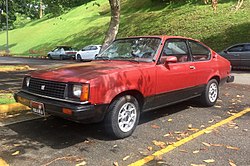 Isuzu I-Mark Coupé (North America)

.jpg)
.jpg)
Second generation (1985)
[edit]| Second generation | |
|---|---|
 | |
| Overview | |
| Also called |
|
| Production | 1985–1990 |
| Designer | Giorgetto Giugiaro |
| Body and chassis | |
| Body style | |
| Layout | FF layout |
| Platform | R-body |
| Powertrain | |
| Engine |
|
| Transmission |
|
| Dimensions | |
| Wheelbase | 2,400 mm (94.5 in) |
| Length |
|
| Width | 1,615 mm (63.6 in) |
| Height | 1,370–1,405 mm (53.9–55.3 in) |
| Chronology | |
| Predecessor |
|
| Successor |
|


_SLX_sedan_(2011-04-22)_02.jpg)


General Motors sought a replacement for their world car T-body Kadett / Gemini, and this time, instead of building one design on several continents, they decided to build a world car in one location and export it to several continents. As a considerable portion of the T-body manufacturing had been turned over to Isuzu in Japan for economic reasons, so would the manufacturing of the replacement. In 1984, Isuzu again commissioned Giorgetto Giugiaro who was responsible for the 117 Coupé and the Piazza. This time, he was to design an economy car on the new front-wheel drive R-body platform. The R-body featured a MacPherson strut front suspension and beam axle rear suspension, which foreshadowed most of GM's offerings through their current model lineup. Giugiaro's design followed the Piazza design very closely in shape and detail, though the proportions made the Gemini appear shorter and taller in its three-door version, and a four-door sedan (notch back) was also designed.
Unfortunately for everyone involved, Isuzu presented the designs to GM prior to freezing them, and GM ordered a number of detail changes to them without ever consulting the designer, Giugiaro, which was taken as an insult, and ended the long relationship between the noted Italian designer and Japan's second oldest car builder. The insult was serious enough to Giugiaro that he denied the design was his until a decade after the vehicle went out of production.
The R-body Gemini was introduced in May 1985 as the Gemini FF (after it had already gone on sale as a Chevrolet in the United States), with an all-new line of engines. In Japan, originally with chassis code JT150, it was available with a carburetted 1.5-liter SOHC engine. An also newly developed 1.5-liter inline four diesel engine (JT600) was added to the lineup in November. At the other end of the lineup, a 120 PS (88 kW) fuel-injected and turbocharged version of the 1.5-liter 4XC1 engine ("Irmscher") was added in May 1986. Originally, the transmission started out with a choice of a 5-speed manual or a 3-speed automatic, but NAVi5, an automated manual transmission, was added in 1986.
The FF Gemini underwent a facelift in February 1987, receiving a more aggressive front styling with wraparound headlight as well as other minor changes. At the same time, the "FF" moniker was dropped, as parallel production of the preceding RWD Gemini came to an end. In March 1987 the Gemini saw its European premiere, at the Geneva Motor Show. European sales of the already somewhat dated Gemini were disappointing, and Isuzu soon withdrew from the European passenger car market entirely.
A 1.6-liter DOHC engine with 135 PS (99 kW) was introduced in February 1988. Export versions were also available with a smaller 1.3-liter four to suit taxation systems based on displacement.[19] This offered 72 PS (53 kW), while export specification 1.5s had 76 PS (56 kW) on tap and the naturally aspirated diesel offered 52 PS (38 kW) outside Japan.[20] Trim levels were widely varied, from basic models ("C/C" in Japan, "LT" in general export markets, and "S" in the US) to Irmscher, ZZ, and Lotus Tuned versions, and plenty of optional equipment and dealer options were available.
A second minor change was released in February 1989 for Japan only. The position of the rear license plate garnish for the sedan model has been moved from the trunk lid to the center part of the bumper. Other differences include the amber turn indicators lens now having been dropped, and an addition of side marker lights. In total, 748,216 second generation Geminis (under all nameplates) were built. 150,873 of these were sold as Isuzu I-Marks in the United States, while 363,171 were sold under the Chevrolet and Geo badges.
North America
[edit]In the US, the vehicle was available from Chevrolet (and as a Geo beginning in mid-1988) as the Spectrum, or from Isuzu themselves, as the I-Mark. GM's Pontiac division sold the I-Mark as the Pontiac Sunburst in Canada from 1985 to 1988. Sales were limited to coastal markets initially, as import quotas restricted the number of cars General Motors could sell in the United States.[21] The Spectrum was presented at the end of November 1984, with cars initially going on sale in 16 eastern states. Isuzu's own I-Mark went on sale during the 1985 model year.[22] Due to the quotas, only 29,500 cars were available the first model year, about a quarter of what GM had hoped to be able to sell.[23]
The introductory model years featured a unique eggcrate grille flanked by single square sealed-beam headlights, but for 1987 the Spectrum (and I-Mark) received the restyled front end with "cat's eyes" headlights and 5-mph bumpers. The interior was also revamped, and the 105 hp (78 kW) Spectrum Turbo was added to the lineup. Isuzu's turbocharged version, dubbed RS, was a later introduction, arriving early in calendar year 1987.[24] The Spectrum Turbo was only available as a four-door sedan, while the I-Mark RS was only available as a hatchback.
US sales of the Isuzu I-Mark were down by half for the latter half of 1989, as a lengthy changeover to the new models slowed down production in Japan.[25] Isuzu was contractually obliged to supply a certain number of Geo Spectrums, meaning that there were very few I-Marks available for Isuzu's own dealers. With a delayed introduction of the upcoming Stylus (third generation Gemini), Isuzu largely abandoned the passenger car segment for nearly a year, selling mostly leftover stock of the old Impulse.[25]
GM Canada replaced the Sunburst with the Passport Optima for 1988. For GM, this was an entry-level vehicle to attract young buyers and to compete with Japanese midsize cars in the US market. Chevrolet's Spectrum lacked many of the options and equipment of the I-Mark, although with the exception of a brief run of decontented hatchbacks in 1988 dubbed "Spectrum Express" they were not as austere as the base trim levels of contemporary Dodge Colt, Toyota Tercel and Honda Civics. Both the Chevrolet and the Isuzu were available with the 70 hp (52 kW) 1.5-liter SOHC non-turbo and 110 hp (82 kW) turbo engines, but neither diesel engines nor NAVi5 were offered in the US. The turbocharged I-Mark was called the RS model in 1988 and then changed to the LS model in 1989. The I-Mark was available with the 125 hp (93 kW) 1.6-liter DOHC engine in 1989 only, as the RS model. In 1988 and 1989, the LS and RS models were offered with Lotus Tuned Suspension, the sportier suspension featuring more rigid dampers, alternate spring rates, and bigger sway bars.
For 1988, the Chevrolet Spectrum was available as the base model, with a better equipped LS package, or as the Turbo Sedan. There was also a Spectrum Sport Coupe package (hatchback only) on offer, using the standard engine combined with some of the Turbo's equipment, such as a sporty steering wheel, different rear view mirrors, a rear spoiler, fully body colored exterior (grille, bumpers, door handles, etcetera), and the uprated F41 suspension.[26] The 1989 Geo Spectrum (introduced in June 1988 as an early 1989 model year) was only available with the naturally aspirated 1.5-liter engine in a single equipment level, with either the three-door hatchback or four-door sedan bodywork.
Sold as:
- 1985–1989 Isuzu I-Mark – United States, Canada
- 1985–1990 Isuzu Gemini – Japan, Europe, Central America and Middle East
- 1985–1988 Chevrolet Spectrum – United States & Canada
- 1989 Geo Spectrum – United States
- 1985–1988 Pontiac Sunburst – Canada and Middle East
- 1985–1990 Holden Gemini – Australia, New Zealand and Indonesia
- 1985–1990 Chevrolet Gemini – Ecuador, Chile and Argentina
Third generation (1990)
[edit]| Third generation | |
|---|---|
_sedan_01.jpg) | |
| Overview | |
| Also called | Isuzu Stylus |
| Production | 1990–1993 |
| Body and chassis | |
| Body style | |
| Layout | Front engine, front-wheel drive / four-wheel drive |
| Platform | R-body |
| Related | |
| Powertrain | |
| Engine | |
| Transmission | |
| Dimensions | |
| Wheelbase | 2,450 mm (96.5 in) |
| Length | 4,185–4,195 mm (164.8–165.2 in) |
| Width |
|
| Height | 1,325–1,390 mm (52.2–54.7 in) |


The Gemini was redesigned for 1990, and the coupé version was now renamed the Gemini Coupé. The last models were produced in June 1993. The third generation sedan appeared in March 1990. Body size was wider than the previous generation. A liftback coupé was introduced in September 1990, with the three-door hatchback version added in March 1991. The last of the Isuzu-developed Geminis and its derivatives were sold as the Isuzu Impulse, Isuzu Piazza, Isuzu Gemini, Isuzu Stylus, Geo Storm, and Asüna Sunfire.
The Isuzu Gemini Coupé was the basis for the Isuzu Impulse and Geo Storm in the United States and Canada, and for the Asüna Sunfire which was sold in the Canadian market for the 1993 model year only. The Geo versions lacked some of the more expensive and advanced features of the Isuzu (and Asüna) versions. The 4-door sedan was sold as the Isuzu Stylus in the United States and Canada.
Model codes were JT151F for the front-wheel drive 1.5/1.6-litre gasoline versions, JT191F for the front-wheel drive 1600 DOHC model, and JT191S for the four-wheel drive, turbocharged "Irmscher R" version. Turbodiesels are JT641F/JT641S for front-wheel drive and four-wheel drive models respectively.
In North America, the base Stylus "S" model received a 95 hp (71 kW) 1.6 L SOHC version of the 4XE1, available in 5-speed manual or 3-speed automatic transmissions. The 1990 and 1991 top-line Stylus "XS" models had a 125 hp (93 kW) 4XE1-UW 1.6 L naturally aspirated DOHC engine only available with a 5-speed manual transmission when introduced, and received the 4XF1 140 hp (104 kW) 1.8 L naturally aspirated DOHC engine with the 5-speed manual in its final 1992 model year. The Stylus initially was offered in two trim levels in 1990 and 1991, the base Stylus "S" with a 1.6 L SOHC 12-valve 4XE1 engine, and the top-level "XS" with the DOHC engine and the Lotus-tuned suspension. The XS also offered an optional power equipment package, which included power windows, power door locks, power mirrors, and a sunroof. This XS "Power Package" would evolve into the 1.8 L "RS" trim level for 1992, slotting above the "XS" trim for 1992. The DOHC Stylus (both "XS" and "RS") would be dropped after 1992, leaving the lone SOHC "S" trim for the final 1993 model year to stand alongside the Geo Storm platform triplet. The third platform triplet, the Impulse, would also be withdrawn after 1992 and was sold in Canada for 1993 only as the Asüna Sunfire, as Isuzu was preparing its passenger car exit from the US market in July 1993.
The higher trim level packages offered "ZZ handling by Lotus" and "specification Irmscher" as the performance models in the lineup, but was carryovered from previous generations. The top model was the "Irmscher-R" JT191S type, equipped with a high-power turbocharged engine and full-time 4WD. The suspension packages that were installed on the second generation Isuzu Piazza were also shared on the Gemini sold in Japan, including the four-wheel steering setup.
North American sales of the sedan started from December 1990 under the name Isuzu Stylus. Initial orders were above target in Japan, but production lagged behind. Strong early sales began to slump within a year, however, and as the post-bubble recession began to take hold in Japan, Isuzu was particularly affected. After a corporate restructuring, Isuzu decided to abandon passenger car production and focus on commercial truck and SUV production, as the Trooper and the Rodeo found many buyers internationally, with badge engineered versions sold under a variety of brands and names across different markets.[27]
The total production volume of vehicles was 406,625 units at the end of the third generation (from HQ Isuzu), with 17,754 units sold in the United States (from Ward's Automotive Yearbook).
Fourth generation (1993)
[edit]| Fourth generation | |
|---|---|
 | |
| Overview | |
| Production | 1993–1997 |
| Body and chassis | |
| Body style | 4-door sedan |
| Layout | FF layout |
| Related | |
| Powertrain | |
| Engine | |
| Dimensions | |
| Wheelbase | 2,620 mm (103.1 in) |

In 1993, Isuzu halted production of the Gemini and replaced it with a rebadged version of the Honda Domani. Announced at the end of August it went on sale in early September 1993. Isuzu did not really advertise the new Gemini; it was mainly produced to be sold to existing customers of Isuzu's commercial vehicles. It was only available with the four-door sedan bodystyle and a limited number of engines; the Domani also came as a five-door hatchback.
The models at the time of introduction were the 1600 C/C, C/C 4WD, and the slightly more powerful and better equipped G/G model. Maximum power output is 120 PS (88 kW) at 6,300 rpm for the C/C and 120 PS (88 kW) at 6,400 rpm for the G/G. In May 1995 the E-VTEC equipped 1500 C/C model was added to the lineup; this fuel efficient, lean-burn model was aimed at capturing some of the old buyers of diesel-engined Geminis. Diesels had accounted for about half of Gemini sales for the previous generations. The 1500 C/C has a maximum power of 94 PS (69 kW) at 5,500 rpm.[28] In October 1995, the Gemini underwent some very minor changes in equipment and the 1600 C/C engine was lightly modified. Most notably, the "Gemini" sticker on the front doors was changed to a plastic emblem. Production of the fourth-generation Gemini ended in January 1997 and it was replaced the following month.
Fifth generation (1997)
[edit]| Fifth generation | |
|---|---|
 | |
| Overview | |
| Also called | |
| Production | 1997–2000 |
| Body and chassis | |
| Body style | 4-door sedan |
| Layout | FF layout |
| Related | |
| Dimensions | |
| Wheelbase | 2,620 mm (103.1 in) |

The fifth generation Gemini was a rebadged second generation Honda Domani sedan, a car which was also marketed as a Civic in Europe. Production of this model ceased in 2000. As usual, the Gemini was available in a much more limited lineup than that of the related Honda version, with only one bodystyle (four-door sedan) and either a 1.5- or a 1.6-litre engine.
Safety
[edit]In Australia, the 1982–1984 Holden Gemini was assessed in the Used Car Safety Ratings 2006 as providing "significantly worse than average" protection for its occupants in the event of a crash. The second generation Gemini (RB) rated better, at "worse than average".[29]
Related information
[edit]The first and second generation Isuzu Geminis, specifically the diesel ones, were the most popular taxicab models in the Philippines in the 1980s and early 1990s. Models were phased out and gradually replaced with newer models from Toyota and Nissan.
The Singapore Police Force used the Isuzu Gemini Fast Response Cars (FRCs) from 1991 until 1995 until they were phased out and replaced by the Subaru Impreza police cars.
The front-wheel drive Geminis (second and third generation) were marketed in Japan with the catch phrase "Shortstop of the streets" (街の遊撃手, Machi no yūgekishu), and television commercials featuring exciting driving stunts throughout the streets of Paris. With French professional stunt driver Rèmy Julienne mostly coordinating with all of the stunts, the Geminis enjoyed wide popularity.
References
[edit]- ^ "The Isuzu Gemini used to be common, but now it's truly rare". Visor. 2021-06-04. Retrieved 2024-09-24.
- ^ "1987 Isuzu Gemini [JT]". Imcdb.org. 2012-06-07.
- ^ a b Car Graphic: Car Archives Vol. 11, '80s Japanese Cars (in Japanese), Tokyo: Nigensha, 2007, p. 239, ISBN 978-4-544-91018-6
- ^ Lösch, Annamaria, ed. (1978). World Cars 1978. Pelham, NY: The Automobile Club of Italy/Herald Books. p. 351. ISBN 978-0-910714-10-5.
- ^ 自動車ガイドブック [Japanese Motor Vehicles Guide Book 1978/1979] (in Japanese), vol. 25, Japan: Japan Automobile Manufacturers Association, 1978-10-10, p. 109, 0053-780025-3400
- ^ a b 自動車ガイドブック [Japanese Motor Vehicles Guide Book 1979/1980] (in Japanese), vol. 26, Japan: Japan Automobile Manufacturers Association, 1979-11-01, p. 113, 053-790026-3400
- ^ Automobile Guide Book 1979/1980, p. 168
- ^ Yamaguchi, Jack K. (1980), Lösch, Annamaria (ed.), "Consummation of the Turbulent Decade", World Cars 1980, Pelham, NY: L'Editrice dell'Automobile LEA/Herald Books: 66, ISBN 978-0-910714-12-9
- ^ 絶版車カタログ 国産車編 Part3 1970~1979 [Japanese Historic Car Graffiti: Car Catalog part 3, 1970–1979]. Eichi Mook (in Japanese). Tokyo: Eichi Publishing (英知出版). 1997. p. 57. ISBN 978-4-89461-004-0.
- ^ World Cars 1984. Pelham, NY: L'Editrice dell'Automobile LEA/Herald Books. 1984. pp. 344–345. ISBN 978-0-910714-16-7.
- ^ Binder, Alan K.; Ferris, Deebe, eds. (2000). General Motors in the Twentieth Century. Southfield, MI: Ward's Communications. p. 130. ISBN 978-0-910589-52-9.
- ^ a b Road & Track's Road Test Annual & Buyer's Guide 1979, Greenwich, CT: CBS Publications, January–February 1979, p. 85
- ^ a b Stark, Harry A., ed. (1980). Ward's Automotive Yearbook 1980. Vol. 42. Detroit, MI: Ward's Communications, Inc. p. 203. LCCN 40-33639.
- ^ a b Flammang, James M. (1994). Standard Catalog of Imported Cars, 1946–1990. Iola, WI: Krause Publications, Inc. p. 308. ISBN 978-0-87341-158-5.
- ^ Büschi, Hans-Ulrich, ed. (March 10, 1983). Automobil Revue '83 (in German and French). Vol. 78. Berne, Switzerland: Hallwag, AG. p. 337. ISBN 978-3-444-06065-6.
- ^ 1982 Isuzu I-Mark (brochure), American Isuzu Motors Inc., October 1981, p. 12, AIMI-MKT-010
- ^ 1985 Isuzu Models Announced (Press Release), Whittier, CA: American Isuzu Motors Inc., September 1984
- ^ Binder, Alan (1985). "End of Restraints, New Entries Seen Bolstering Record-Setting Import Sales in 1985 and Beyond". Ward's Automotive Yearbook 1985. 47. Detroit, MI: Ward's Communications, Inc: 160. ISBN 0910589005.
{{cite journal}}: CS1 maint: ignored ISBN errors (link) - ^ Mastrostefano, Raffaele, ed. (1990). Quattroruote: Tutte le Auto del Mondo 1990 (in Italian). Milano: Editoriale Domus S.p.A. pp. 388–390.
- ^ Ruiz, Marco (1986). 'The Complete History of the Japanese Car: 1907 to the Present. Rome: ERVIN srl. p. 132. ISBN 978-0-517-61777-9.
- ^ Snyder, Jesse (1985-02-18). "Old name, new partner add up to new Nova". Advertising Age: 74.
- ^ Flammang, p. 309
- ^ Schuon, Marshall (1984-11-25). "About Cars; Chevrolet's Trio Challenge Imports". The New York Times.
- ^ Ceppos, Rich (November 1986). "Charting the Changes". Car and Driver. Vol. 32, no. 5. CBS Magazines. p. 60.
- ^ a b Stark, Harry A.; Bush, James W., eds. (1990). Ward's Automotive Yearbook 1990. Vol. 52. Detroit, MI: Ward's Communications, Inc. p. 117. ISBN 0910589010.
{{cite book}}: CS1 maint: ignored ISBN errors (link) - ^ 1988 Chevrolet Spectrum (brochure), General Motors Corporation, August 1987, p. 14, 4720
- ^ Organizational structure in the automobile industry revolution SFC Keio Keio University Shonan South Fujisawa Campus 1995 organizational behavior theory OB68 group REFERENCE FOUND ON JAPANESE WIKIPEDIA SITE #6 AND 7
- ^ "いすゞ ジェミニ 1993年式モデルの価格・カタログ情報" [Isuzu Gemini 1993 model price and catalog information]. MOTA Automobile Catalog (in Japanese). MOTA Corporation. Archived from the original on 2023-03-18.
- ^ Used Car Safety Ratings: 2006 Update (PDF), Lan Transport NZ, Australian Transport Safety Bureau, June 2006, p. 12, ISSN 1176-9890, archived from the original (PDF) on January 27, 2007 – via Vic Roads
External links
[edit]
- Development of the Isuzu Gemini from GM
- Isuzu Official Gemini article (Japanese) Archived 2018-04-08 at the Wayback Machine
- OzGemini.com
- HoldenGemini.net
- CanberraGeminiClub.com
- GemiSA Car Club (previously Just Gems of SA)
- Used Car Safety Ratings – Holden Gemini – Australia Only
- ISUZU Gemini Ads
Established in 1911, a division of General Motors since 1918 | |||||||||||||||||||||||||
| Current models |
| ||||||||||||||||||||||||
| Former models (by date of introduction)1 |
| ||||||||||||||||||||||||
| Concept cars |
| ||||||||||||||||||||||||
| Related topics | |||||||||||||||||||||||||


Isuzu Gemini
View on GrokipediaIntroduction and development
Origins and platform
The Isuzu Gemini originated as the direct successor to the Isuzu Bellett, a compact car produced from 1961 to 1973 that had established Isuzu's presence in Japan's passenger vehicle market. Launched in November 1974, the Gemini was positioned as a subcompact offering to capture demand in the segment adjacent to kei cars, emphasizing affordability, fuel efficiency, and urban practicality amid Japan's post-oil crisis economic shifts.[6][4][1] The first-generation Gemini was built on General Motors' T-car platform, a rear-wheel-drive unibody architecture originally designed by Adam Opel AG in Germany as the basis for the third-generation Opel Kadett C. This shared platform allowed for modular production and component commonality across GM's global lineup, with the Gemini serving as Isuzu's adaptation featuring a compact footprint suited to Japanese roads.[6][2][3] Development of the Gemini stemmed from a 1971 capital and technical partnership agreement between Isuzu and General Motors, aimed at enhancing Isuzu's engineering capabilities and enabling widespread export of the model under various badges, including the Holden Gemini in Australia and Chevrolet Chevette derivatives elsewhere. Isuzu handled final assembly and incorporated local adaptations to comply with Japan's stringent emissions regulations—such as the 1975 standards limiting CO, HC, and NOx outputs—and vehicle taxation rules favoring smaller displacements, while optimizing for right-hand drive and narrower urban navigation.[6][7][8] Subsequent generations marked a shift to front-wheel-drive layouts for improved space efficiency and handling, beginning with the second and third iterations (1985–1993) on General Motors' R-body platform—a collaborative FWD subcompact design developed jointly by Isuzu and GM to meet evolving global safety and efficiency mandates. By the fourth and fifth generations (1993–2000), Isuzu transitioned to a rebadged Honda Domani platform under a new 1993 partnership, prioritizing cost-sharing, parts commonality, and adherence to tightening Japanese emissions and fuel economy standards without in-house development.[9][4][10]Production overview
The Isuzu Gemini was manufactured from 1974 to 2000, with primary assembly at the company's Fujisawa Plant in Kanagawa Prefecture, Japan, which served as the main facility for passenger car production during this period.[11][12] Production of the first generation continued until 1987 to support ongoing export demands, while subsequent generations had shorter runs amid shifting consumer preferences toward sport utility vehicles in the late 1980s and 1990s.[4] Key developments included the introduction of diesel engine options in 1979, enhancing the model's appeal for fuel-conscious markets, followed by turbocharged variants in the 1980s that boosted performance without sacrificing efficiency.[13][14] In 1993, Isuzu entered a partnership with Honda for shared platform development, leading to fleet-oriented production of later Gemini models based on Honda designs.[11][15] Launched amid the 1973 oil crisis, the Gemini emphasized compact size and economical operation to align with Japan's push for energy-efficient vehicles during economic turbulence.[16] Production ceased in 2000 as Isuzu shifted focus to commercial vehicles and diesel engines, reflecting broader industry trends.[17] The model shared platforms with General Motors in early generations and Honda in later ones.[11]First generation (1974–1987)
Design and body styles
The first-generation Isuzu Gemini, introduced in November 1974 as the Bellett Gemini, adopted a boxy, angular aesthetic inspired by the third-generation Opel Kadett C on the General Motors T-car platform, with styling penned by Giorgetto Giugiaro at Italdesign for a clean, European-influenced subcompact profile.[4][18] Available in Japan with 2-door coupe and 4-door sedan body configurations, the design emphasized practicality and affordability, sharing the Kadett's 2,405 mm wheelbase for compact maneuverability.[7] The rear-wheel-drive chassis featured independent front suspension via MacPherson struts and a live rear axle with coil springs, contributing to its lightweight construction with curb weights typically under 950 kg for base models.[19][20] A 1977 facelift, coinciding with the model's renaming to simply Isuzu Gemini, introduced updated grille and taillight designs for a refreshed appearance while maintaining the core boxy silhouette.[18] Further revisions in 1979 brought aerodynamic enhancements, including a "slant-nose" front fascia with rectangular headlamps and revised taillights, alongside adaptations for diesel engine compatibility to broaden appeal in efficiency-focused markets.[4] These changes improved airflow and visual modernity without altering the fundamental structural layout. The interior prioritized functionality with analog instrument gauges, durable cloth upholstery on standard seats, and options like a tilting sunroof for enhanced comfort.[4] The coupe variant, particularly the sporty Gemini ZZ introduced in 1979, targeted Japan's youth market with distinctive trim elements such as body kits, alloy wheels, and a more dynamic cabin layout featuring bolstered seats and optional tachometer integration.[4] This model amplified the Gemini's appeal through its fastback-inspired roofline, echoing the Opel Manta's proportions while retaining the platform's economical ethos.[7] For export, the design was adapted as the Holden Gemini in Australia, with minor local tweaks including three-door station wagon and panel van body styles to suit regional preferences.[18]Powertrains
The first-generation Isuzu Gemini was powered by the LJ-series inline-four gasoline engine, a 1.6-liter single overhead camshaft (SOHC) unit producing 100 PS (74 kW; 99 hp), introduced at launch in 1974 to provide efficient performance suitable for the subcompact segment.[21] This engine featured a carbureted setup and was designed for reliability in urban driving, aligning with Japan's strict emissions standards of the era. In 1977, the powertrain received an upgrade to a 1.8-liter version of the same architecture, delivering 105 PS (77 kW; 104 hp) while maintaining similar torque characteristics for improved mid-range responsiveness without significantly increasing displacement to avoid higher kei-car tax penalties.[4] In 1979, Isuzu expanded the lineup with a diesel option, the 1.8-liter 4FB1 naturally aspirated inline-four engine rated at 67 PS (49 kW; 66 hp), targeted at economy-oriented buyers seeking lower operating costs in fleet and taxi applications.[22] This indirect-injection diesel emphasized fuel efficiency over outright power, achieving approximately 15-18 km/L in highway conditions, and was paired exclusively with manual transmissions to optimize its frugal nature.[23] All variants utilized rear-wheel drive for balanced handling, with transmission choices including a standard four-speed manual gearbox for precise control or a three-speed automatic for ease of use in city traffic.[24] The sportier ZZ models offered an optional limited-slip differential to enhance traction during spirited driving, particularly on wet or uneven surfaces common in Japanese roads. Overall fuel economy across gasoline models hovered around 10-12 km/L in mixed urban-highway cycles, a figure tuned to comply with Japan's progressive taxation on engines over 1.5 liters while supporting the oil crisis-era emphasis on conservation.[25]Global markets
In Japan, the first-generation Isuzu Gemini proved highly successful as an affordable entry-level family car, achieving total sales of 768,537 units through 1987.[26] It appealed to buyers seeking reliable subcompact transportation amid the growing demand for economical vehicles in the domestic market.[4] The Gemini entered the North American market as the Buick Opel by Isuzu from 1976 to 1979, marketed through Buick dealerships as a badge-engineered import to replace the German-built Opel Kadett.[7] Annual sales hovered around 20,000 units during this period, reflecting modest uptake amid intensifying competition from established Japanese imports.[27] From 1981, it transitioned to the standalone Isuzu I-Mark nameplate, continuing rear-wheel-drive production until 1985 with gasoline and diesel variants, contributing to an approximate total of 100,000 units sold across both phases.[7] However, stringent U.S. emission regulations posed significant challenges, requiring costly modifications that impacted performance and ultimately led to the early discontinuation of the rear-wheel-drive model in favor of front-wheel-drive successors.[28] In Australia and New Zealand, the Gemini was localized and assembled at Holden's Adelaide plant, sold as the Holden Gemini TX series from 1975 to 1978.[29] It garnered over 30,000 units in sales, earning acclaim as Wheels magazine's Car of the Year in 1975 for its nimble handling and value.[7] Other export markets included South Korea, where it was produced as the Saehan Gemini from 1977 to 1982 under license, serving as a foundational model for local assembly before evolving into the Daewoo Maepsy.[30] In Europe, sales were limited, with the Gemini occasionally appearing as a rebadged Opel Kadett variant through General Motors' networks, though the platform primarily supported the German-developed Kadett C.[7] The Gemini's global reach stemmed from its origins in a collaborative T-car platform developed with Opel.[28]Second generation (1985–1990)
Styling and engineering
The second-generation Isuzu Gemini, launched in May 1985, marked a significant evolution in design and mechanical layout, shifting from rear-wheel drive to front-wheel drive on the GM R-car platform (chassis codes JT150/JT190). This change enhanced interior space efficiency and handling for urban driving, with a MacPherson strut independent front suspension and a semi-independent torsion beam rear setup providing balanced ride quality. It incorporated Isuzu's NAVi5 five-speed manual transmission for precise shifting.[4] The model was offered in aerodynamic wedge-shaped hatchback and sedan body styles, prioritizing practicality with a compact footprint suited to city environments.[9] The exterior styling was initially penned by renowned designer Giorgetto Giugiaro of Italdesign, featuring a modern, trapezoidal profile with pop-up headlights on pre-facelift models (1985–1987) that contributed to its sleek, forward-leaning wedge aesthetic. However, General Motors' subsequent modifications to the design led to a rift with Giugiaro, resulting in a more conventional appearance than originally envisioned. Exported to North America as the Isuzu I-Mark, the Gemini's hatchback variant emphasized versatile cargo space for everyday use.[4][31] A major facelift in 1987 introduced flush-mounted headlights, revised bumpers for improved aerodynamics, and subtle exterior tweaks to enhance visual appeal, while interior modifications focused on better ergonomics through updated seating and controls. A further minor update in 1989 refined the cabin layout for greater driver comfort without major structural changes. The updated dimensions reflected a lengthened body at 3,995 mm overall and a 2,400 mm wheelbase, optimizing passenger room and maneuverability in dense urban settings.[32][31]Engine options
The second-generation Isuzu Gemini featured a variety of inline-four gasoline and diesel engines, emphasizing efficiency and performance for both domestic and export markets. The base gasoline option was a 1.3-liter SOHC unit producing 70 hp (52 kW), primarily offered in export models to meet local tax and emissions requirements.[33] A more common 1.5-liter carbureted SOHC engine delivered 73 PS (54 kW; 72 hp) at 5,600 rpm, providing adequate power for everyday driving in the standard sedan and hatchback variants.[32] For performance-oriented buyers, a turbocharged version of the 1.5-liter engine, available from 1987 in the JJ variant, boosted output to 110 hp (82 kW) at 5,400 rpm with electronic fuel injection, enhancing acceleration while maintaining compact dimensions.[34] Additionally, a 1.6-liter DOHC 16-valve gasoline engine, introduced in 1988, offered 120 hp (88 kW) for higher-trim models, featuring multi-point fuel injection for smoother operation and better high-rpm response.[35] Diesel powertrains were tailored for economy-focused export markets, with a 1.5-liter naturally aspirated inline-four engine (4EC1) producing 67 PS (49 kW), paired with a five-speed manual transmission to prioritize fuel savings over speed.[36] This engine used swirl-chamber indirect injection for reliable low-end torque suitable for urban commuting in regions like Europe and the Middle East.[37] Transmission choices included a standard five-speed manual gearbox for all engines, offering precise shifts and better control, while a four-speed automatic was available as an option for smoother city driving. Select performance models, such as the turbocharged JJ variant, could be equipped with an optional viscous limited-slip differential (LSD) to improve traction and handling on varied surfaces.[38] Fuel efficiency varied by engine and driving conditions, with base gasoline models achieving 12-14 km/L in mixed use, aided by lightweight construction and aerodynamic design. Turbocharged variants consumed more, rating 8-10 km/L due to the added boost, though electronic fuel injection introduced in 1987 helped optimize delivery and reduce emissions across the lineup. Diesel exports excelled in economy, often exceeding 15 km/L on highways.[36]Regional variants
In Japan, the second generation Isuzu Gemini achieved strong domestic sales, with a total of 748,216 units produced for both local and export markets, reflecting its popularity as a versatile subcompact. The JJ turbo variant, based on the JT150 model, was particularly favored for its performance enhancements and was homologated for motorsport applications, enabling participation in racing series like the Castor Cup.[39] This turbocharged version featured a tuned 1.5-liter engine and contributed to the model's appeal among enthusiasts seeking homologation specials for competitive events.[40] In North America, the Gemini was rebadged and adapted for local regulations, sold primarily as the Isuzu I-Mark with 150,873 units delivered between 1985 and 1989, emphasizing fuel efficiency and reliability in the subcompact segment.[41] It was also marketed through General Motors channels as the Chevrolet Spectrum from 1985 to 1988 and the Geo Spectrum in 1989, accumulating 363,171 units overall, with modifications including U.S.-spec emissions controls and a detuned 1.5-liter SOHC engine rated at around 70 horsepower to meet federal standards.[42] These variants shared the core front-wheel-drive platform with minor adjustments for handling and safety to suit American road conditions. The Gemini retained much of its Isuzu-specific engineering.[9] Australia received the model as the right-hand-drive Holden Gemini from 1985 to 1987, with local tuning for ride comfort and suspension suited to rougher roads, resulting in 16,263 units produced and sold despite a challenging market.[9][43] Assembled at Holden's Elizabeth plant, it featured the same 1.5-liter engine but with adaptations like revised gearing for better low-speed torque. In Canada, it was marketed as the Pontiac Sunburst (a rebadged I-Mark) from 1985 to 1988, with the Isuzu I-Mark also available, including winter package options such as heavier-duty heaters and all-season tires for harsh climates.[44] Production of the second-generation Gemini for export markets was phased out by 1990, largely due to escalating import tariffs and voluntary export restraints imposed on Japanese vehicles, which increased costs and reduced competitiveness against domestic alternatives.[9]Third generation (1990–1993)
Model features
The third-generation Isuzu Gemini, produced from 1990 to 1993, represented an evolution of the General Motors R-body platform with a focus on refined aesthetics and practicality. It was offered in multiple body styles, including a sportier liftback coupe in the Japanese market, alongside four-door sedans and three-door hatchbacks introduced progressively from March 1990 onward. The design adopted rounded styling to enhance aerodynamics, which contributed to improved fuel efficiency and highway stability.[45][46] Interior updates emphasized comfort and modernity, with power windows becoming standard on higher trims such as the RS and Irmscher variants. Options included a digital dashboard for enhanced readability and improved sound insulation materials to reduce road and wind noise, creating a quieter cabin environment compared to predecessors. These features catered to urban drivers seeking a more upscale subcompact experience.[45] For enhanced versatility in Japan's varied climates, an optional four-wheel-drive (4WD) system was available on select sedan models, derived from components shared with the Isuzu Impulse lineup and suited for winter conditions. Handling was further elevated on RS models through a Lotus-tuned suspension setup, which optimized ride quality and cornering responsiveness. Overall dimensions remained similar to the second generation in length and wheelbase (approximately 4,191 mm and 2,451 mm, respectively), but the body was widened to 1,679 mm with an increased track width (front: 1,430 mm; rear: 1,405 mm) for better stability and a planted stance.[47][48]Performance and options
The third-generation Isuzu Gemini featured a range of engine options designed to balance everyday usability with performance potential. The base powertrain included a 1.5-liter SOHC inline-four engine producing 105 horsepower, suitable for standard sedan and hatchback models.[49] Higher-trim variants utilized a 1.6-liter DOHC inline-four delivering 125 horsepower, while the sport-oriented Stylus XS model in the US market featured a naturally aspirated version of the 1.6-liter DOHC engine rated at 125 horsepower for enhanced acceleration (turbocharged 1.6-liter variants up to 180 PS were available in Japan).[50] A 1.7-liter diesel inline-four, offering 88 horsepower, was available for markets prioritizing efficiency and torque.[51] Transmission choices emphasized driver engagement and versatility, with a five-speed manual standard across most models and a four-speed automatic available for smoother urban driving.[52] Four-wheel-drive configurations, offered on select Japanese-market variants, included electronic traction control to improve stability on varied surfaces.[31] In the United States, where the model was marketed as the Isuzu Stylus from 1990 to 1993 (only as a 4-door sedan), a total of 17,754 units were sold, with marketing highlighting the car's sporty handling characteristics—bolstered by optional Lotus-tuned suspension—over fuel economy priorities.[53] Overall fuel efficiency ranged from 10 to 13 kilometers per liter depending on engine and driving conditions, while higher-performance models achieved 0-100 km/h acceleration in approximately 8.5 seconds.[54]Fourth generation (1993–1997)
Design updates
The fourth-generation Isuzu Gemini, launched in 1993, featured a sedan-only body configuration built on the Honda Domani platform, which shared mechanical underpinnings with the EG-generation Honda Civic. This design emphasized conservative styling suited to practical use, including a sloped nose for improved aerodynamics and integrated taillights that blended seamlessly into the rear fascia for a clean, understated appearance. Interior refinements focused on functionality and safety, with standard driver-side airbags across trims, enhanced heating, ventilation, and air conditioning (HVAC) systems for better climate control, and upgraded materials like durable fabrics and plastics to boost longevity and commercial viability. These changes targeted fleet operators and taxi services, where reliability was paramount. The wheelbase measured 2,620 mm, extending rear legroom compared to prior generations and supporting the model's emphasis on passenger comfort and robust construction for high-mileage applications.[55] A mid-cycle facelift in 1995 introduced minor aesthetic tweaks, such as a revised grille for a slightly more modern front profile, along with expanded color options to appeal to diverse buyers. Higher trims incorporated Honda's VTEC-E engine technology in the 1.5 L engine for improved fuel efficiency.[56]Specifications
The fourth generation Isuzu Gemini (1993–1997), built on the Honda Domani platform (model code MJ), offered engine options emphasizing efficiency and reliability for both personal and fleet use. The lineup included a 1.5 L VTEC-E inline-four engine, derived from the Honda D15B, which produced 105 PS (77 kW; 103 hp) while incorporating variable valve timing for improved low-end torque and fuel economy.[55] A more powerful 1.6 L SOHC inline-four option delivered 120 PS (88 kW; 118 hp), suitable for higher-performance variants.[57]| Engine | Displacement | Type | Power Output | Notes |
|---|---|---|---|---|
| D15B VTEC-E | 1.5 L | Inline-4 | 105 PS (77 kW; 103 hp) | Honda-sourced, multi-point fuel injection, VTEC-E for efficiency |
| SOHC (ZC/D16A) | 1.6 L | Inline-4 | 120 PS (88 kW; 118 hp) | Naturally aspirated, focused on mid-range torque |