Hubbry Logo
Opel CommodoreOpel CommodoreMain
Open search
Opel Commodore
Community hub
Opel Commodore
logo
8 pages, 0 posts
0 subscribers
Be the first to start a discussion here.
Opel Commodore
Opel Commodore
from Wikipedia

Opel Commodore
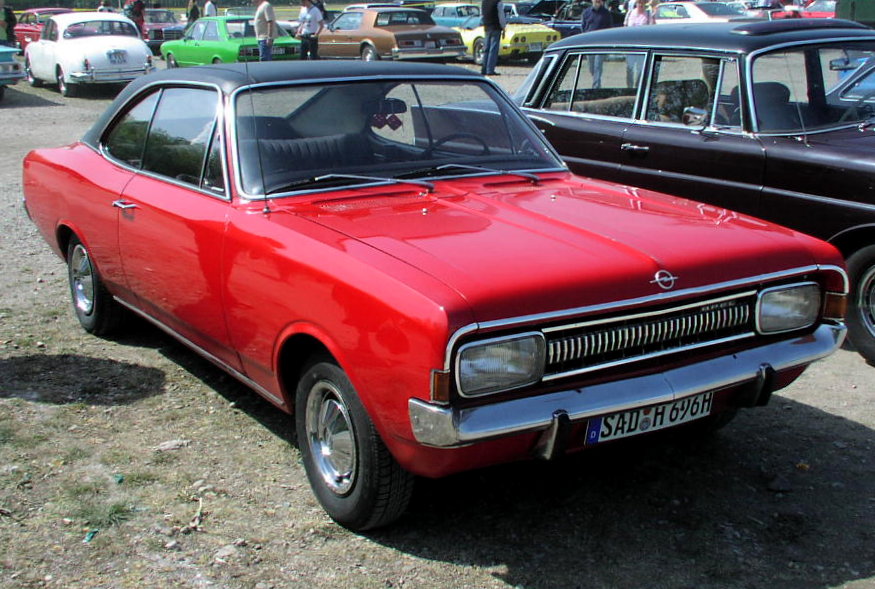
Opel Commodore A Coupé
Overview
ManufacturerOpel (General Motors)
Production1967–1986
Body and chassis
ClassExecutive car (E)
PlatformV body
RelatedHolden Commodore
Chronology
SuccessorOpel Omega

The Opel Commodore is an executive car (E-segment) produced by Opel from 1967 to 1986. It is the six-cylinder variant of the Rekord with styling differences. The Commodore nameplate was used by Opel from 1967 to 1982 in Europe and to 1986 in South Africa.[1] The Commodore nameplate was adopted by Holden in Australia, where it continued until 2020.[2] The last generation was sold in the United Kingdom primarily as the Vauxhall Viceroy although Opel-badged models were also sold there, and the Chevrolet Commodore in South Africa from 1978 to 1982, when it was renamed the Opel Commodore.

Commodore A (1967–1971)

[edit]
Commodore A
1970 Opel Commodore A Coupé
Overview
Production1967–1971
AssemblyGermany: Rüsselsheim
Body and chassis
Body style2-door saloon
4-door saloon
2-door fastback coupé
RelatedOpel Rekord C
Chevrolet Opala
Ranger
Powertrain
Engine2.2 L-I6:
95 PS (70 kW; 94 hp)
2.5 L-I6:
115 PS (85 kW; 113 hp),
120 PS (88 kW; 118 hp)
130 PS (96 kW; 128 hp)
150 PS (110 kW; 148 hp)
2.8 L-I6:
145 PS (107 kW; 143 hp)
Transmission4-speed manual
2- or 3-speed-automatic
Dimensions
Wheelbase2,668 mm (105.0 in)
Length4,574 mm (180.1 in)
Width1,754 mm (69.1 in)
Height1,445 mm (56.9 in)
Curb weight1,130–1,270 kg (2,491–2,800 lb)

The Opel Commodore A was manufactured from 1967 to 1971, based on the Rekord C. After having offered a Rekord-6 powered by a 2.6 L 6-cylinder engine (which originated in the Opel Kapitän, Admiral and Diplomat) since March 1964,[3] Opel in February 1967 launched the Commodore as a faster up-market version of the Rekord. The Commodore was initially available with the proven 2.2-litre six and a larger 2.5 L engine developing 115 PS (85 kW) with a single carburettor. The 2239 cc engine with which the Commodore was launched shared its 82.5 x 69.8 mm cylinder dimensions with the four-cylinder 1492 cc Rekord engine on which it was based. The unit was first seen in the short-lived six-cylinder version of the Opel Rekord towards the end of 1966, but ceased to be offered in the Rekord after July 1967 when it became the entry level power unit for the newly introduced Opel Commodore. Body styles comprised a two-door or four-door notchback saloon and a two-door hardtop/fastback coupé. In September 1967 the sporty Commodore GS offering 130 PS (96 kW) from a dual-carburettor 2.5-litre six was introduced.

For the 1969 model year, the carryover 2.2-litre six was dropped and the optional 2-speed Powerglide automatic was abandoned in favor of Opel's new 3-speed automatic transmission.

From September 1969, the base 2.5 L-engine was pumped up to 120 PS (88 kW); at the same time, both remaining engines received hydraulic lifters for smoother running, a new exhaust system and six camshaft bearings. The handbrake lever was moved from its position under the dash to a location between the front seats and the fuel tank was enlarged from 55 to 70 litres.

An even more sporty model than the GS, the Commodore GS/E, debuted in March 1970. It had a 2.5 L engine equipped with Bosch D-jetronic fuel injection system developing 150 PS (110 kW), which gave the car a top speed of 197 km/h (122 mph). The Commodore GS/E also had a career in motorsports, with a car prepared by Steinmetz. In April 1970 a Commodore with a detuned and carburetted 2.8 L-six giving 145 PS (107 kW) followed (GS 2800).

156,330 Commodore As were built, including 2,574 GS and GS/E variants.

The Rekord C/Commodore A "V body" platform was used by GM to produce other models in many markets, these include the Ranger sold in mainland Europe and also in South Africa, as well as the GM Opala which was built and sold in South America from 1968 through to 1992. Ranger and Opala production commenced two years after the Commodore A's debut in 1966.

GS/E History

All engines for the Commodore were 12 valve, CIH straight-six engines ranging from 2.2 to 2.8 litres. All but one engine option had single-barrel (2.2) or double-barrel (2.5; 2.8) downdraught carburetor. in 1970 the GS/E model was introduced which as its badge implies did not utilise carburetors, the "E" meaning Einspritzung or fuel injection in English.

Opels didn't have the reputation for performance cars in the period and they had seen the positive impact on sales for other race winning manufacturers on having performance models in their range of cars. Opel wanted to be in this area of the market and the results of this desire was the Commodore GS/E.

The carburettors were ditched in favour of a Bosch D-Jetronic, Bosch's first commercially produced electronic fuel injection system. Bosch D-Jetronic was a very early version of multi-point EFI, the “D” stood for “drucksensorgesteuert” (pressure sensor regulated). Unlike later Bosch fuel injection system, the injection was direct to the cylinder instead of via the Plenum inlets, which meant the a specific cylinder head was manufactured specifically for the engine, making this model unique and expensive to produce and purchase. Different from older mechanical injection systems, it incorporated taking input from the pressure inside the intake manifold. This is known as the Air Mass Sensor or in modern terms this would be known as the MAP-sensor (manifold absolute pressure), a part that's commonly found in more modern vehicles.

Bosch sold the patent to Japanese companies that continue to produce injection systems based on D-Jetronic.

D-Jetronic fuel injection was installed onto the 2.5 litre engine with the modified cylinder head, increasing power by 20 PS (15 kW), making it more powerful than the larger, 2.8-litre engine. The fuel injected engine, named 2500 E, now produced 150 PS (110 kW; 148 hp) at 5,800 rpm and 196 N⋅m (145 lb⋅ft) of torque at 4,500 rpm with an unchanged compression ratio of 9.5:1. For comparison, the base model Porsche 911T in 1970 had 25 PS (18 kW; 25 hp) less, but was more expensive[citation needed]. The GS/E could accelerate from 0–100 km/h (62 mph) in 9.5 seconds, a similar value to the same period Porsche 911.[citation needed] It could also reach a top speed of 192 km/h (119 mph).

The GS/E Coupe model is known affectionately as the "German Charger".[4]

Commodore B (1972–1977)

[edit]
Commodore B
Overview
Production
  • 1972–1977
  • 1973–1978 (South Africa)
  • 1974–1976 (Iran)
AssemblyGermany: Rüsselsheim
Iran: Tehran (GM Iran)
South Africa: Port Elizabeth (GMSA)
DesignerChuck Jordan
Body and chassis
Body style4-door saloon
2-door coupé
RelatedOpel Rekord D
Powertrain
Engine
Transmission
Dimensions
Wheelbase2,668 mm (105.0 in)
Length4,607 mm (181.4 in)
Width1,728 mm (68.0 in)
Height1,380–1,415 mm (54.3–55.7 in)
Curb weight1,210–1,305 kg (2,667.6–2,877.0 lb)

The Commodore B was based on the Rekord D, and launched in 1972. As in the previous generation, four models were offered: 2500 S, 2500 GS, 2800 GS, and 2800 GS/E, as a four-door saloon and two-door hardtop coupé (although the fastback design was replaced by a more conventional three-box design). Power of the 2.5-litre engine was 115 or 130 PS (85 or 96 kW) depending on the specifications (25S/25H), while carburetted 2.8-liters had 130 or 142 PS (96 or 104 kW). The fuel injected 2.8 used in the GS/E has 160 PS (118 kW).

The Rekord and Commodore were also assembled as CKD kits in Belgium and Switzerland in the 1970s. These cars carried the name Ranger and differed from the originals in having different grilles and trim. These cars were exported to various countries.

In 1974, due to new regulations regarding pollutant emissions, the 2.5-litre models were dropped and the 2.8 L models were detuned to 129 / 140 / 155 PS (95 / 103 / 114 kW). Commodore B production ended in 1977.

The Commodore B series was like the A series briefly used in motorsports, and the extreme "Jumbo" Commodore raced in the 1974 "interserie". It used a 6.0-litre V8 engine and had large wings which almost made it unrecognizable as an Opel. It never enjoyed much success despite its massive powerplant and impressive output.

Foreign assembly

[edit]

Opel Commodores were also built in Iran between 1974 and 1976 under the name Chevrolet Iran 2800, 2500, Royal and Custom with both 2.5 L and 2.8 L engines by Pars Khodro (General Motors Iran).[5][6] The first Royale, also the first Chevrolet car built in Iran, left the production line on 15 January 1974. The Royale sold well initially, but the car had not been re-engineered for Iranian conditions and the low ground clearance coupled with carburettor troubles led to its reputation quickly being tarnished. The car was withdrawn by early 1977, replaced by the locally-built versions of the Buick Skylark, Chevrolet Nova, and Cadillac Seville (American origins).[7]

It was also assembled in South Africa, where it was called the Chevrolet 2500, 3800, and 4100, and was a top seller in that market. These received inline-four or -six engines of Chevrolet origins, built locally.

Commodore C (1978–1986)

[edit]
Commodore C
Overview
Also calledChevrolet Commodore (South Africa)
Vauxhall Viceroy (United Kingdom)
Production1978–1986
AssemblyGermany: Rüsselsheim
South Africa: Port Elizabeth (GMSA)
Body and chassis
Body style2/4-door saloon
5-door estate
Related
Powertrain
Engine
Transmission
Dimensions
Wheelbase2,668 mm (105.0 in)
Length4,732 mm (186.3 in)
Width1,722 mm (67.8 in)
Height1,415 mm (55.7 in)
Curb weight1,200–1,310 kg (2,646–2,888 lb)
Chronology
SuccessorOpel Omega A

The Commodore C was first shown in late 1977, at the same time as the Rekord E. It only entered series production in October the following year, however. The South African version of this car, the Chevrolet Commodore,[8] was actually ahead of the European original model to enter production, in September 1978.[9] The Commodore continued to be a larger and more luxurious version of the Rekord. There was no coupé version of the Commodore C, as it was replaced by the Opel Monza, the coupé version of the Opel Senator, but a two-door notchback saloon was available until June 1981. The single engine used by the Commodore in Europe was the well-known straight-six 2.5-litre unit with 115 PS (85 kW; 113 hp) or 130 PS (96 kW; 128 hp) when fitted with fuel injection. It followed Holden's lead with the Holden Commodore (VB), which also combined the body of the Rekord with the front-end of the Senator.[10]

The Commodore C was never a success, occupying an uncomfortably narrow niche between the Rekord and Senator. Another concern was the fuel mileage, with a fuel injected Commodore taking considerably more fuel than the larger three-liter Senator.[11] The outdated engine also had little torque available at lower engine speeds, and was noisy.[12]

The new model featured a similar front end to the larger Senator. It was sold in the UK under the name Vauxhall Viceroy, with the Viceroy being a slightly more luxurious version of the Carlton. There was an estate version (dubbed the "Voyage" in Germany) offered in the Opel range from April 1981 until the end of production in 1982, which became a mainstay in the Holden range in Australia and was also available in the Chevrolet range in South Africa. It was never offered by Vauxhall in the UK as a Viceroy, although a one-off estate car was built in 1981 for Queen Elizabeth II, for her to carry her Corgi dogs. The car still survives today, one of only 15 Vauxhall Viceroys left registered in the UK, as of 2006.[citation needed]

The Commodore was dropped by Opel in Europe in 1982.

Manufacture elsewhere

[edit]

It was the Opel Commodore and Vauxhall Viceroy was sold in South Africa as the Chevrolet Commodore until 1982, when it was rebadged as an Opel. The South African Commodore was introduced in July 1978, at the same time as the Rekord E went on sale there.[13] These originally had Chevrolet engines, pushrod inline-sixes of 3.8 or 4.1 liters.[14] Sold as a standard or a GL (with the 4.1 only available as a sedan with automatic transmission), the South African version replaced the earlier Chevrolet 3800 and 4100, also based on the Commodore.[9]

However, in South Africa, General Motors South Africa (later Delta) offered a revised version of the Commodore until 1986, again combining the bodyshell of the Rekord with the front end of the revised Senator.[15] It was also sold there with the same 3-litre inline-six, producing 180 PS (132 kW).[16]

Sources

[edit]
  • Werner Oswald, Deutsche Autos 1945–1975. Motorbuch Verlag, Stuttgart 1975. ISBN 978-3-87943-391-9. (For Commodore A)
  1. ^ "Opel Rekord E2".
  2. ^ "Holden axes Commodore range to focus on SUVs and utes as sedan sales dwindle". ABC News. 10 December 2019. Archived from the original on 24 February 2020. Retrieved 25 April 2020.
  3. ^ Zink, Günther (2009). Oldtimer Katalog (in German). Vol. 23. Königswinter: HEEL Verlag GmbH. pp. 262–263. ISBN 978-3-86852-067-5.
  4. ^ "1970 Opel Commodore 2500 GS/E Coupé". Classic Driver. Archived from the original on 24 July 2022.
  5. ^ Wilson, Rodney (1979), The Economies of the Middle East, London: MacMillan Press Ltd., p. 6, ISBN 9781349034215
  6. ^ Mazur, Eligiusz, ed. (2002). "Katalog Samochody Świata 2003" [World Car Catalogue 2003]. Samochody Świata. Warsaw, Poland: Print Shops Prego - Polska Sp. z o.o.: 226. ISSN 1234-8198.
  7. ^ Qasemi, S.M. (5 October 2016). "شورولت رویال؛ خودرویی که از آغاز به پایان رسید!" [The Chevrolet Royale: A car that was finished from the beginning!]. jamejamonline (in Persian). Archived from the original on 2 May 2018.
  8. ^ Chevrolet Commodore, South Africa
  9. ^ a b Wright, Cedric, ed. (August 1978). "New models: Chevrolet Commodore on its way". CAR (South Africa). Vol. 22, no. 7. Ramsay, Son & Parker (Pty) ltd. p. 14.
  10. ^ Tuckey, Bill (1999). Commodore Lion King: Celebrating 21 Years. Middle Park, Victoria: Quil Visual Communications. p. 33. ISBN 0-646-38231-4. The Rekord with the Senator nose job [...] was so well proportioned that Opel later picked up the bastard child to fit between its Rekord and Senator on the European market...
  11. ^ Sundfeldt, Björn (13 January 1982). "Ljuva livet på vägen" [Life of delight on the road]. Teknikens Värld (in Swedish). Vol. 34, no. 3. Stockholm, Sweden: Specialtidningsförlaget AB. pp. 16–17.
  12. ^ Sundfeldt, p. 18
  13. ^ Chevrolet Commodore
  14. ^ Mastrostefano, Raffaele, ed. (1985). Quattroruote: Tutte le Auto del Mondo 1985 (in Italian). Milano: Editoriale Domus S.p.A. pp. 186–187. ISBN 88-7212-012-8.
  15. ^ 1984 Opel Commodore 3.0 E (South Africa)
  16. ^ Lösch, Annamaria, ed. (1985). World Cars 1985. Pelham, NY: The Automobile Club of Italy/Herald Books. p. 332. ISBN 0-910714-17-7.
[edit]
Revisions and contributorsEdit on WikipediaRead on Wikipedia
from Grokipedia
The Opel Commodore is a mid-size produced by the German automaker from 1967 to 1986, serving as the upscale, six-cylinder counterpart to the Rekord lineup with distinct styling cues, available in sedan and body styles across three generations (A, B, and C). Introduced in 1967, the first-generation Commodore A was based on the Rekord C platform and offered as a two-door saloon, four-door saloon, or two-door , seating four to five passengers with . It featured inline-six engines of 2.2 L (95 hp), 2.5 L (115–120 hp), and 2.8 L (130–143 hp), with the high-performance GS/E variant introducing Bosch D-Jetronic on a 2.5 L unit for 150 hp at 5,800 rpm and 196 Nm of torque at 4,500 rpm, enabling 0–100 km/h acceleration in 9.5 seconds and a top speed of 192 km/h. Transmission options included a four-speed manual standard, with two- or three-speed automatics available; over 150,000 units were built, including limited GS/E models prized for their sporty character. The second-generation Commodore B, launched in 1972 and based on the Rekord D, continued with four-door saloon and two-door bodies while adopting a more angular design, maintaining the rear-wheel-drive configuration and seating for four to five. Engine choices mirrored the prior model with 2.5 L and 2.8 L inline-sixes, the GS/E again delivering 160 hp via , paired to four-speed manuals or optional automatics; production exceeded 140,000 units, with variants like the Ranger assembled under license in and . Known for rust vulnerability in areas like sills and wheel arches, these models emphasized luxury and performance in the European market. The third-generation Commodore C, introduced in 1978 on the Rekord E platform and produced until 1986, retained saloon, , and estate styles with refined aerodynamics and interiors, also marketed as the in the . It offered updated inline-six engines including 2.5 L carbureted (130 hp) and electronic fuel-injected versions, plus a 3.0 L option in some markets, with four-speed manuals or three-speed automatics; the model bridged Opel's shift toward larger executive cars like the Senator, influencing designs such as the in .

Introduction

Development and positioning

The Opel Commodore was introduced in February 1967 as a successor to the six-cylinder variants of the , such as the Rekord 6 introduced in 1964, thereby addressing a market gap in Opel's lineup between the standard four-cylinder Rekord models and the more upscale and ranges. Positioned as an in the , the Commodore targeted business executives and luxury-oriented buyers across , emphasizing superior comfort, refinement, and performance compared to the entry-level Rekord while remaining more accessible than the V8-powered . Conceived in the mid-1960s during Opel's period of expansion under ownership, which had acquired the company in 1929 and supported its growth through new model introductions like the Kadett and , the Commodore was developed to challenge established competitors such as and in the mid-size luxury segment. This initiative built on Opel's post-World War II recovery, where production resumed in 1947 after wartime destruction of facilities, allowing the brand to reestablish itself as a volume producer by the 1950s and leverage the established Rekord C platform as a foundational base for the first-generation Commodore.

Design philosophy and shared components

The Opel Commodore embodied a design philosophy centered on delivering executive-level refinement and performance within a rear-wheel-drive architecture, prioritizing balanced handling, ride comfort, and durability for the European upper-middle-class market. This approach utilized an independent front suspension with double wishbones and coil springs, paired with a live rear incorporating a and stabilizer bar, allowing for responsive steering while maintaining stability under load. The layout emphasized mechanical simplicity and cost efficiency, drawing from ' global engineering principles to position the Commodore as a more upscale counterpart to the Rekord without reinventing core underpinnings. Styling evolved conservatively across generations, starting with a boxy three-box sedan profile in the late featuring prominent chrome accents, upright grilles, and subtle American influences under GM oversight, then shifting toward sleeker, more angular lines with improved by the early to meet changing tastes and efficiency demands. Distinctive elements like wider aluminum trim strips on taillights, enhanced chrome detailing on fenders, and optional vinyl roofs underscored the premium positioning, while interior layouts incorporated woodgrain accents and padded surfaces for a luxurious ambiance. This progression maintained Opel's tradition of understated elegance, avoiding radical departures to appeal to conservative buyers. The Commodore shared extensively with the Rekord series, utilizing the same unibody chassis and most body panels to streamline production and reduce development costs, with adaptations primarily at the front end including a longer hood and reinforced suspension mounts to accommodate the inline-six engines. Wheelbase remained identical to the Rekord's, but overall length increased slightly due to the extended front overhang, alongside unique badging, wheel covers, and interior trim for differentiation. Safety and technology features reflected period advancements, with front disc brakes standard from launch for superior stopping power over drum setups, progressing to ventilated discs and rear drums (or discs in performance variants) in later iterations, complemented by power-assisted braking and padded dashboards to enhance occupant protection. Power steering became available as an option or standard on higher trims, contributing to the model's luxury credentials alongside the shared six-cylinder cam-in-head (CIH) engine family for smooth power delivery.

First generation (Commodore A, 1967–1971)

Body styles and features

The first-generation A, launched in 1967, was offered in three primary body styles: a four-door sedan, a two-door sedan, and a two-door , all designed as five-seaters to appeal to executive buyers seeking a blend of luxury and practicality. The variant, particularly in GS trim, featured a pillarless configuration, providing a sleek, silhouette that enhanced its sporty appeal. These configurations shared the underlying platform with the C, allowing for efficient production while differentiating the Commodore through upscale detailing. Externally, the Commodore A adopted a boxy, American-influenced styling characterized by an elongated hood to accommodate its six-cylinder engines, a distinctive front grille with horizontal chrome slats, and subtle chrome accents along the body sides. The overall dimensions measured approximately 4.57 meters in length and 1.75 meters in width, contributing to its imposing road presence without excessive bulk. Optional features included a for added elegance, while GS models stood out with matte black grille surrounds and red-embossed "GS" lettering. A minor facelift in introduced revised taillights and reduced chrome trim for a more restrained look. Inside, the Commodore A emphasized comfort with options for or velvet cloth , woodgrain accents on the and door panels, and a wooden-rimmed in higher trims. Analog , including , , and temperature readout, provided straightforward operation, with GS variants adding a , , and oil pressure gauge for enhanced driver feedback. The cabin prioritized spacious rear seating with ample legroom and a padded center armrest, making it suitable for executive transport and family use alike.

Engines and transmission options

The Opel Commodore A utilized inline-six engines from Opel's cam-in-head (CIH) family, which featured overhead camshafts driven by gears for smoother operation and higher revving capability compared to traditional pushrod designs. These engines were carbureted in most variants, with the top model adopting electronic for improved performance and efficiency. The base engine was a 2.2-liter unit delivering 95 PS (70 kW) at 4,800 rpm and 160 Nm of at 3,200 rpm, providing adequate power for everyday driving with a top speed of approximately 170 km/h and 0-100 km/h acceleration in around 14 seconds. The majority of models were equipped with a 2.5-liter in various tunes: the standard version produced 115 PS (85 kW) at 5,200 rpm and 174 Nm at 3,800 rpm, while a single-carburetor setup raised output to 120 PS, and the GS variant with twin carburetors achieved 130 PS (96 kW) at 5,400 rpm and 187 Nm at 3,600 rpm. A 2.8-liter option was also available, producing 130 PS (96 kW) at 5,200 rpm and 187 Nm at 3,800 rpm in standard form, or up to 143 PS (105 kW) in GS tune, offering a top speed of around 185 km/h. The flagship GS/E, introduced in 1970, featured the same 2.5-liter displacement but with Bosch D-Jetronic electronic , boosting power to 150 PS (110 kW) at 5,800 rpm and to 197 Nm at 4,500 rpm; this enabled a top speed of 190 km/h and 0-100 km/h in about 10 seconds. All Commodore A models came standard with a four-speed , offering precise shifts suited to the engines' characteristics. An optional three-speed GM automatic was available, particularly popular on higher-trim sedans and coupes for smoother highway cruising, though it slightly reduced acceleration times. Fuel economy across the lineup typically ranged from 10 to 14 L/100 km in mixed driving, depending on the tune and transmission, reflecting the era's emphasis on performance over efficiency.

Production figures and variants

The Opel Commodore A was produced exclusively at the Rüsselsheim assembly plant in from August 1967 to July 1971, with no foreign assembly operations for this generation. Total output amounted to 156,467 units, broken down as follows:
Body StyleUnits Produced
Four-door sedan72,597
Two-door 70,333
Two-door sedan13,537
The variant lineup began with the entry-level 2.5-liter model, followed by the more upscale 2.5 S oriented toward luxury buyers with enhanced trim and comfort features. Sportier options included the GS trim, delivering 130 PS from a twin-carbureted 2.5-liter , and the GS/E, which produced 150 PS through Bosch D-Jetronic and incorporated premium appointments such as reclining front seats. Only 2,574 examples of the GS and GS/E performance variants were built in total. The GS/E, in particular, served as a performance highlight, offering brisk acceleration and handling suitable for enthusiastic drivers while maintaining executive refinement. Sales were robust in the domestic German market, where the Commodore A established Opel as a viable challenger to six-cylinder rivals like the 250, and it saw exports to select international markets including the . Despite this success, production concluded in 1971 amid stricter emissions regulations that accelerated the shift to the Rekord D-based Commodore B successor.

Second generation (Commodore B, 1972–1977)

Body styles and updates

The Opel Commodore B was available in two primary body styles upon its launch in 1972: a four-door sedan and a two-door , both sharing the underpinnings of the Rekord D platform. This generation introduced a more angular and modern exterior design compared to the boxier Commodore A, featuring wedge-shaped lines, a fastback roofline on the coupe, and integrated bumpers for a sleeker profile. The overall length measured 4.61 meters, with a width of 1.73 meters and a wheelbase of 2.67 meters, contributing to improved aerodynamics and greater highway stability. Inside, the Commodore B offered enhanced comfort through improved materials that reduced road and wind noise, along with optional features such as advanced controls for better passenger convenience. Mid-cycle updates were minimal, focusing on refinements to meet evolving emissions standards, while the model line continued without major stylistic overhauls until the coupe variant was discontinued in 1977 at the end of production.

Engines and performance variants

The Opel Commodore B lineup featured inline-six (I6) engines derived from the Camshaft in Head (CIH) design introduced in the preceding generation, with displacements of 2.5 liters and 2.8 liters. The base 2.5-liter I6 in the S variant produced 115 PS (85 kW) at 5,200 rpm and 174 Nm of torque at 3,800 rpm, while the higher-output 2.5 H variant delivered 130 PS (96 kW) at 5,400 rpm and 186 Nm at 4,200 rpm. The 2.8-liter I6 offered greater performance potential, starting with a carbureted version producing 129 PS (95 kW) at 5,400 rpm and approximately 200 Nm of . In the GS model, a twin-carburetor setup boosted output to 150 PS (110 kW), enhancing responsiveness for sportier driving. The flagship GS/E variant employed Bosch D-Jetronic electronic on the 2.8-liter engine, achieving 160 PS (118 kW) at 5,400 rpm and 229 Nm at 4,000 rpm, which provided smoother power delivery and better throttle response compared to carbureted options. All Commodore B models were equipped with and a choice of transmissions, including a standard four-speed manual gearbox or optional three- or four-speed automatic units. Performance varied by engine and configuration, with top speeds ranging from 170 km/h for the base 2.5 S to 195 km/h for the GS/E, and acceleration from 0-100 km/h improving from about 11 seconds in the 2.5 H to 9.3 seconds in the GS/E. The GS and GS/E represented the performance-oriented variants, featuring a sport-tuned suspension with firmer shocks and springs for improved handling, along with lightweight alloy wheels on the GS/E. As the top model, the GS/E included optional features like a to enhance traction during spirited driving, positioning it as a capable in its era. Fuel efficiency across the range typically ranged from 11 to 13 L/100 km in mixed driving conditions, with the 2.5-liter models achieving slightly better economy than the larger engine. In 1975, updates in select markets introduced catalytic converters to the , reducing emissions to meet emerging environmental regulations while maintaining performance levels.

Production, sales, and foreign assembly

The Opel Commodore B was produced from to 1977 at the company's main facility in Rüsselsheim, , with a total of 140,827 units built across sedan and coupe body styles. Sales were concentrated in during the model's run, with exports reaching the —where fewer than a few hundred examples were sold annually, making surviving units rare today—and limited volumes to through networks. The significantly impacted demand for mid-size executive cars like the Commodore B, leading to reduced sales in the latter half of the decade as fuel prices rose and consumer preferences shifted toward more efficient vehicles. Foreign assembly occurred using CKD kits in by , where the model was adapted and marketed primarily under the Chevrolet badge as the 2500, 3800, and 4100 variants to suit local preferences and regulations. The Commodore B was also assembled from CKD kits in and , where it was sold under the Ranger name and featured minor modifications for those markets. Special rally-prepared GS variants were produced to support Opel's entry into motorsport events, including the 1973 , where tuned examples competed in the hands of drivers like .

Third generation (Commodore C, 1978–1982)

Body styles and facelifts

The Opel Commodore C was introduced in 1978 primarily as a four-door sedan and two-door , with the coupe available until 1982. A five-door estate variant, known as the Commodore Voyage, was added in April 1981 and produced until the end of the model run. Drawing from the Rekord E platform, the Commodore C adopted a smoother, more rounded aesthetic compared to its angular predecessor, featuring flush-fitting door handles and optional aerodynamic spoilers to refine its profile. Measuring approximately 4.68 meters in length, the design prioritized improved airflow, attaining a of about 0.38 to support better fuel economy. The Commodore C did not receive dedicated facelifts; updates such as revised front , , enhanced , and wraparound taillights in 1982 and 1985 were applied to the related Rekord E model. The Commodore was discontinued in in 1982 as the Rekord moved upmarket.

Engines and drivetrain evolution

The Opel Commodore C retained the cam-in-head (CIH) inline-six engine architecture from preceding generations, emphasizing smooth performance in the executive segment. At launch in 1978, the base powertrain was the 2.5-liter CIH I6 (code 25S) with a single carburetor, producing 115 PS (85 kW) at 5,200 rpm and 176 Nm of torque at 3,600 rpm, paired with a 2-barrel Solex carburetor for reliable everyday driving. This engine enabled a top speed of approximately 180 km/h and 0-100 km/h acceleration in about 12 seconds, with combined consumption around 10.5 L/100 km under period testing conditions. In 1979, Opel introduced fuel injection to the 2.5-liter I6 (code 25E) via Bosch L-Jetronic electronic system, boosting output to 132 PS (97 kW) at 5,400 rpm and to 186 Nm at 4,200 rpm, marking a shift toward improved efficiency and response amid rising fuel costs. This variant achieved a top speed of 190 km/h and reduced 0-100 km/h time to 11 seconds, while models in the early 1980s refined fuel economy to 10-11 L/100 km through electronic ignition advancements. The injected engine also incorporated electronic ignition as standard from 1980, enhancing reliability and cold-start performance over the carbureted setup. A 3.0-liter CIH I6 (code 30E) with multi-point was available in select export markets, such as the Viceroy in the UK from around 1980 and the Chevrolet Commodore in from 1984, delivering 177 PS (130 kW) at 5,800 rpm and 248 Nm at 3,800 rpm. This engine provided a top speed of approximately 200 km/h and 0-100 km/h in about 9 seconds, though fuel consumption remained in the 11 L/100 km range. No diesel options were offered in the European Commodore C, distinguishing it from the four-cylinder-focused Rekord sibling, though some export markets explored turbo-diesel variants later in the decade. Drivetrain configurations emphasized rear-wheel drive for balanced handling, with a four-speed manual transmission standard on base models through 1981, offering precise shifts suited to the inline-six's torque curve. A three-speed automatic (THM-180) was optional from launch, providing smoother urban operation but slightly reduced acceleration. In 1982, a five-speed manual (ZF-derived) was added for better highway efficiency and sportier feel, particularly on injected models, while the automatic upgraded to four speeds in higher trims by 1982.
Engine VariantDisplacementPower/TorqueYears (Europe)Fuel SystemTransmission OptionsKey Performance
2.5 S2.5 L I6115 PS / 176 Nm1978-1982Carbureted4-speed manual; 3-speed autoTop speed: 180 km/h; 0-100 km/h: 12 s; Fuel: 10.5 L/100 km
2.5 E2.5 L I6132 PS / 186 Nm1979-1982-injected4/5-speed manual; 3/4-speed autoTop speed: 190 km/h; 0-100 km/h: 11 s; Fuel: 10-11 L/100 km
3.0 E3.0 L I6177 PS / 248 Nm1980-1982 (select exports)-injected5-speed manual; 4-speed autoTop speed: 200 km/h; 0-100 km/h: 9 s; Fuel: 11 L/100 km

Production, sales, and international manufacture

The Opel Commodore C was produced from 1978 to 1982 in , with primary assembly at Opel's Rüsselsheim and plants in . Total European production reached approximately 89,000 units, the majority of which were four-door sedans. This included 82,854 standard Opel Commodore C models, 3,648 Chevrolet Commodore (primarily ), and 2,299 units. Sales of the Commodore C remained steady in through the early , reflecting Opel's position in the executive segment, with annual figures peaking at around 40,000 units. Demand declined later as preferences shifted toward front-wheel-drive competitors like the Ford Granada and Audi 100. International manufacture expanded the model's reach, with full assembly in by (GMSA) from 1978 until 1986 (as Chevrolet Commodore), yielding about 15,000 units equipped with locally developed engines including later 3.0 L options. In , assembly continued until 1984 under the Opel 2.5E designation, with roughly 3,000 units produced to meet local market needs. The design directly influenced Holden's VB Commodore in , adapting the platform for right-hand-drive and local components starting in 1978, though no Opel-badged production occurred there.

Legacy and special models

Successors and market impact

The Opel Commodore was succeeded by the in 1986, which replaced both the Commodore and the parallel Rekord lineup as Opel's executive car offering. The Omega A introduced a more advanced rear-wheel-drive platform with options for inline-six and V6 engines, marking a shift from the Commodore's traditional straight-six focus. Prior to the Omega's arrival, the Rekord E continued to offer six-cylinder variants, absorbing the Commodore's positioning in Opel's portfolio. The Commodore played a key role in 's strategy within ' European operations during the 1970s, helping the brand emerge as GM's strongest European division by contributing to steady sales in the mid-size executive segment. Its design and engineering influenced GM's global approach to mid-size vehicles, notably inspiring the naming of the Australian , which adopted the badge from the Opel model while basing its first generation (VB, 1978) on the related Senator platform. Across its three generations, the Commodore achieved total production of approximately 380,000 units, fostering a lasting legacy with strong demand in collector markets today, where well-preserved examples often command prices exceeding €20,000. Economically, the Commodore supported Opel's profitability under GM ownership, with the brand reporting net income of $138 million in 1979 amid rising sales. However, its discontinuation in 1982 aligned with broader industry trends toward downsizing and improved in response to evolving regulations and consumer preferences, though production continued in as the Chevrolet Commodore until 1988.

Racing and tuned variants

The Opel Commodore, particularly the B and C generations, saw significant involvement in , especially in the (ETCC) during the 1970s. The GS models, equipped with inline-six engines, competed effectively in Division 3, securing 23 class victories between 1972 and 1977 across various rounds, including notable performances at tracks like the and Spa-Francorchamps. These cars achieved two outright wins and 12 podium finishes in ETCC events, demonstrating the platform's competitiveness in with tuned suspensions and enhanced power outputs from the 2.5L and 2.8L CIH engines. Tuning specialist Steinmetz played a key role in elevating the Commodore's racing potential through V8 engine swaps, often installing Chevrolet-sourced units for Group 5 competition. The Steinmetz Jumbo, based on the B-generation Commodore, featured a 6.0L Chevrolet V8 producing over 600 PS, with widebody modifications, aerodynamic enhancements, and a focus on endurance racing in series like the Interserie. These conversions, developed in the mid-1970s, prioritized raw power and track durability, though they achieved limited outright success due to reliability challenges in high-stakes events. Among tuned variants, the official Rallye Commodore, derived from the B generation, was a homologation special with a 2.8L inline-six tuned to approximately 170 PS for endurance racing, as seen in the 1973 . Third-party tuners like Mantzel offered performance kits for the Commodore's 2.8L and 3.0L engines, including cylinder head modifications and exhaust upgrades to boost output beyond stock levels, though turbocharger integrations were less common and typically custom for rally or track use. Special models included rare V8 conversions for drag and touring applications in the 1970s, often on A and B chassis, where tuners like Steinmetz and Irmscher fitted detuned Chevrolet V8s producing around 250 PS for street-legal performance. The Commodore's ETCC successes provided Opel with valuable touring car expertise, influencing later entries like the Omega in the Deutsche Tourenwagen Meisterschaft (DTM) starting in 1988, where the Omega 3000 Evo secured class competitiveness with evolved inline-six powertrains. Race-prepped GS and GS/E models retain strong collector appeal today, valued for their historical role in Opel's motorsport heritage and availability of period tuning parts.

References

Add your contribution
Related Hubs
User Avatar
No comments yet.