


Community hub
Recent from talks
Contribute something
Nothing was collected or created yet.
Joe Henry
View on Wikipedia
Key Information


Joseph Lee Henry (born December 2, 1960) is an American singer-songwriter, guitarist, and producer. He has released 15 studio albums and produced multiple recordings for other artists, including three Grammy Award-winning albums.[1][2]
Early life
[edit]Henry was born in Charlotte, North Carolina, the state where his parents, whom he described as devout Christians, were also from.[3] He grew up in Oakland Township, Michigan, and attended Rochester Community Schools. He graduated from Rochester Adams High School, then graduated from the University of Michigan.
Career
[edit]1985 to 2005
[edit]Henry moved to Brooklyn, New York in 1985 and began performing in local music venues. He released his first album Talk of Heaven in 1986. The album earned him a recording contract with A&M, which subsequently released the albums Murder of Crows in 1989 and Shuffletown in 1990. Shuffletown, produced by T Bone Burnett, represented a shift in musical direction towards the "alt country" genre.[citation needed] Henry's next two recordings, Short Man's Room (1992) and Kindness of the World (1993), featured members of the country-rock band the Jayhawks. The song "King's Highway" was recorded by Joan Baez in 2003 and Gov't Mule in 2005.[citation needed] For his 1996 album Trampoline, Henry incorporated guitarist Page Hamilton of Helmet and a reviewer at Trouserpress called the album "idiosyncratic broadmindedness."[4]
1999's Fuse was recorded with producers Daniel Lanois and T Bone Burnett. The album was called an "atmospheric marvel" by one reviewer[5] and Ann Powers of The New York Times wrote: Henry has "found the sound that completes his verbal approach."[6]
Scar, released in 2001, featured jazz musicians Marc Ribot, Brian Blade, Brad Mehldau and saxophonist Ornette Coleman on "Richard Pryor Addresses a Tearful Nation." According to AllMusic's Thom Jurek, the album is a "triumph not only for Henry—who has set a new watermark for himself—but for American popular music, which so desperately needed something else to make it sing again."[7]
2003's self-produced Tiny Voices album was Henry's first recording on Epitaph's Anti- label. AllMusic's Jurek described this album as "the sound of....electric guitars in an abandoned yet fully furnished Tiki bar in Raymond Chandler's Los Angeles."[8]
Henry's wife talked him into letting her send Madonna, who is her sister, a demo of his song "Stop," which was reworked and recorded as "Don't Tell Me" (from Madonna's 2000 album Music). Henry's own tango-tinged version of the song appeared on Scar and was featured in an episode of The Sopranos. Henry and his sister-in-law recorded a duet, "Guilty by Association," on the charity album Sweet Relief II: Gravity of the Situation, and collaborated on the songs "Jump" on Confessions on a Dance Floor, "Devil Wouldn't Recognize You" on Hard Candy, and "Falling Free" on MDNA.
In the early 2000s, Henry was an inaugural member of the Independent Music Awards' judging panel to support independent artists.[9]
2006 to present
[edit]
After producing the Grammy-award-winning album Don't Give Up on Me by Solomon Burke,[10] Henry produced additional records and in 2006 opened up a home studio where he often collaborates with recording engineer Ryan Freeland and Los Angeles-based musicians such as Jay Bellerose, Greg Leisz, David Piltch, Patrick Warren and Keefus Ciancia.[11] In September 2006, Henry and Loudon Wainwright III began composing the music for the Judd Apatow movie Knocked Up in Henry's home studio. Some instrumentals were used as background score for the film while other songs appeared on Wainwright's 2007 Strange Weirdos which Henry produced.
In 2007, Henry released Civilians, which was described as "a rich, acoustic affair that returns us to Henry's rootsier sounds".[12] The final track on the album, "God Only Knows," was used in a "TCM Remembers 2008" TV commercial. Bonnie Raitt's 2012 album Slipstream, which Henry produced, contained versions of two songs from Civilians.
In 2009, Henry released his ninth solo record, Blood from Stars which incorporates orchestral blues with guitarist Marc Ribot, pianist Jason Moran and his son, Levon Henry, on saxophone. The album focuses on facets of blues with a sprinkling of jazz, rock and pop and traces the rugged history of American storytelling."[13]
In May 2011, Henry released the album Reverie with simple acoustic instrumention on guitar, upright bass, piano and drums.[14] "When you listen to Reverie, especially on headphones, you can hear traffic in the background or a neighbor calling her dog. It's not always a pristine recording environment. Henry not only left the windows open at his basement studio, but also put microphones on them."[15] "But there was this singer-songwriter environment, this post-Dylan fallout, of people who think that pages of your diary set to music are songs, and that the more 'honest' songs are, the better they are. And that's the greatest misconception of American popular music: that if you're being honest, you're being entertaining."[16]
In June 2014, Henry released his thirteenth album, Invisible Hour. It was recorded at his LA home studio, The Garfield House, in 2013 with his regular band of musicians (Jay Bellerose, Jennifer Condos, Levon Henry, Greg Leisz, John Smith, and David Piltch). Guests providing backing vocals on the album included The Milk Carton Kids and Lisa Hannigan. Paste magazine described it as "11 impossibly beautiful songs" and "Joe Henry's masterpiece".[17]
In October 2017, Henry released Thrum.
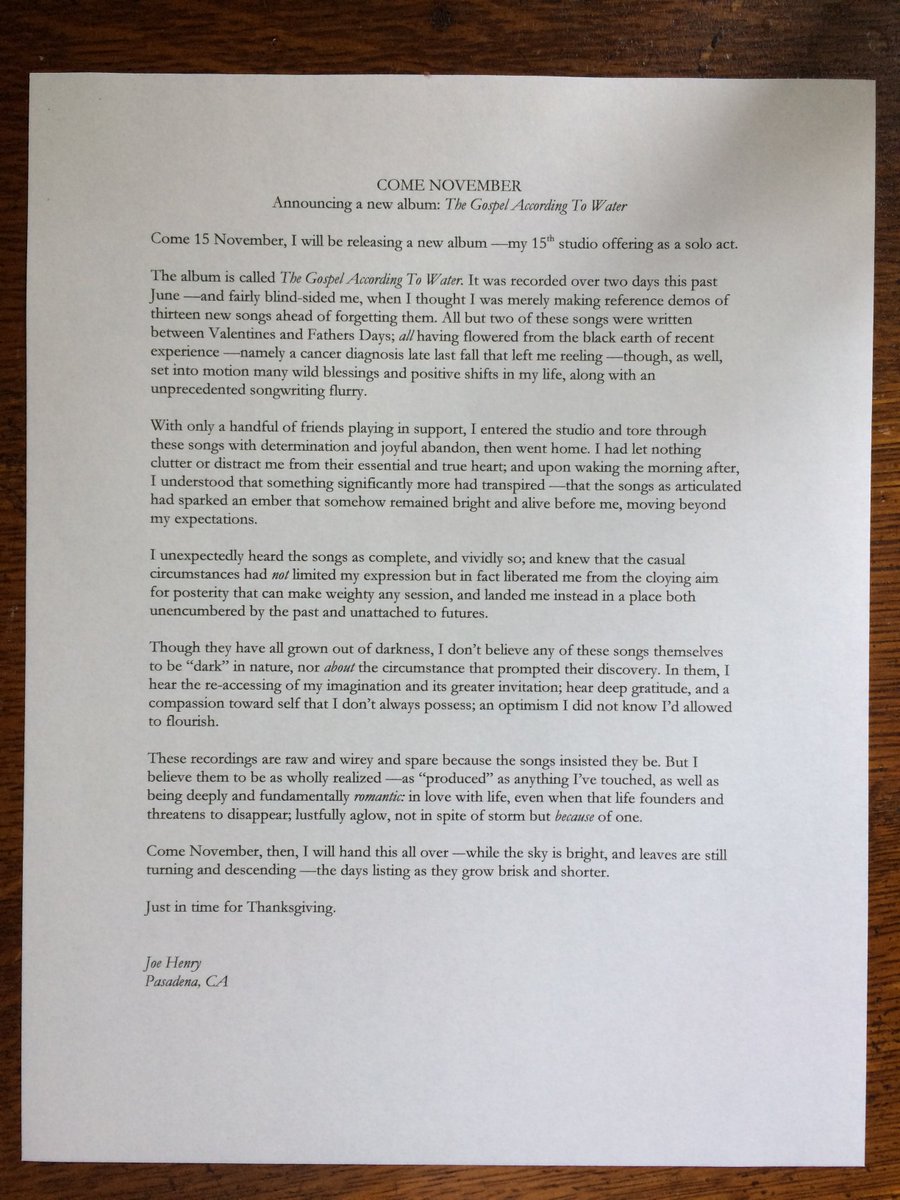
In June 2019, Henry recorded what was intended to be demos of 13 new songs. Those demos became his 15th studio album, "The Gospel According To Water", which was released on November 15, 2019.[18][19][20][21]
Henry was honored with a Lifetime Achievement Award at the 2025 Americana Music Honors & Awards on September 10, 2025.[22][23]
Reception
[edit]Henry has been described as "a modest-selling 'critic's darling' with a reputation for pushing the envelope"[24] and who writes "songs [that] don't fit into an easily defined box"[25] and instead is influenced by folk, blues, jazz, rock and country.
Personal life
[edit]Henry married Melanie Ciccone in 1987. They have two children.[26] Melanie is the sister of Madonna.
In 2013, Henry and his brother David released a biography of Richard Pryor, titled Furious Cool: Richard Pryor and the World That Made Him.[27]
Joe Henry and his family moved out of their home (and his long-time recording space), The Garfield House, in early 2015.[28]
In May 2019 Joe Henry revealed that a few months earlier he was diagnosed with stage four prostate cancer. He further advised that he has responded well to the treatment he has received, and that his prognosis for now is very encouraging.[29][30]
Discography
[edit]Studio albums
[edit]- Talk of Heaven (1986)
- Murder of Crows (1989)
- Shuffletown (1990)
- Short Man's Room (1992)
- Kindness of the World (1993)
- Trampoline (1996)
- Fuse (1999)
- Scar (2001)
- Tiny Voices (2003)
- Civilians (2007)
- Blood from Stars (2009)
- Reverie (2011)
- Invisible Hour (2014)
- Thrum (2017)
- The Gospel According to Water (2019)
- All the Eye Can See (2022)
- Blood from Stars (Expanded & Remastered) (2024)
Live albums
[edit]EPs
[edit]- Fireman's Wedding (1994)
Production credits
[edit]- Strange Angels by Kristin Hersh (co-producer, 1998)
- I Oughtta Give You a Shot in the Head for Making Me Live in This Dump by Shivaree (co-producer, 1999)
- Teddy Thompson by Teddy Thompson (co-producer, 2000)
- Dim Stars, Bright Sky by John Doe (co-producer, 2002)
- Don't Give Up on Me by Solomon Burke (producer, 2002)
- Drill a Hole in That Substrate and Tell Me What You See by Jim White (co-producer, 2004)
- Knuckle Down by Ani DiFranco (co-producer, 2005)
- The Forgotten Arm by Aimee Mann (producer, 2005)
- Hope and Desire by Susan Tedeschi (producer, 2005)
- I've Got My Own Hell to Raise by Bettye LaVette (producer, 2005)
- I Believe to My Soul by various artists (producer, 2005)
- Our New Orleans: A Benefit Album for the Gulf Coast by various artists (co-producer, 2005)
- The River in Reverse by Elvis Costello and Allen Toussaint (producer, 2006)
- Between Daylight and Dark by Mary Gauthier (producer, 2007)
- Strange Weirdos by Loudon Wainwright III (co-producer, 2007)
- Sex & Gasoline by Rodney Crowell (producer, 2008)
- Recovery by Loudon Wainwright III (producer, 2008)
- The Bright Mississippi by Allen Toussaint (producer, 2009)
- La Différence by Salif Keita (producer, 2009)
- A Stranger Here by Ramblin' Jack Elliott (producer, 2009)
- Genuine Negro Jig by Carolina Chocolate Drops (producer, 2009)
- The Way of the World by Mose Allison (producer, 2010)
- I Know I've Been Changed by Aaron Neville (producer, 2010)
- The Long Surrender by Over the Rhine (producer, 2011)
- Let Them Talk by Hugh Laurie (producer, 2011)
- Passenger by Lisa Hannigan (producer, 2011)
- Weather by Meshell Ndegeocello (co-producer, 2011)
- Slipstream by Bonnie Raitt (co-producer, 2012)
- Kin: Songs by Mary Karr & Rodney Crowell by various artists (producer, 2012)
- Devil In Me by Natalie Duncan (producer, 2012)
- Tooth & Nail by Billy Bragg (producer, 2013)
- Didn't It Rain by Hugh Laurie (producer, 2013)
- Meet Me at the Edge of the World by Over the Rhine (producer, 2013)
- The Wexford Carols by Caitríona O'Leary (producer, 2014)
- Worthy by Bettye LaVette (co-producer, 2015)
- Dig In Deep by Bonnie Raitt (co-producer, 2016)
- American Tunes by Allen Toussaint (producer, 2016)
- Dorado by Son of the Velvet Rat (producer, 2016)
- Real Midnight by Birds of Chicago (producer, 2016)
- Lovers and Leavers by Hayes Carll (producer, 2016)
- I Am the Rain by Chely Wright (producer, 2016)
- Whistle Down the Wind by Joan Baez (producer, 2018)
- The Nomad by Guy Pearce (producer, 2018)
- All the Things That I Did and All the Things That I Didn't Do by The Milk Carton Kids (producer, 2018)
- There Is No Other by Rhiannon Giddens (producer, 2019)
- Speak to Me by Julian Lage (producer, 2024)
- The Living Kind by John Smith (folk musician) (producer, 2024)
Songwriting credits
[edit]- "Don't Tell Me" by Madonna (co-writer, 2000; based on his song "Stop")
- "Hope Against Hope" by Rosanne Cash (co-writer, 2003)
- "Jump" by Madonna (co-writer, 2005)
- "Devil Wouldn't Recognize You" by Madonna (co-writer, 2008)
- "Love and Treachery" by Madeleine Peyroux (co-writer, 2009)
- "Falling Free" by Madonna (co-writer, 2012)
- "At the Heart of Me" by Chely Wright (co-writer, 2016)
- "Holy War" by Chely Wright (co-writer, 2016)
- "See Me Home" by Chely Wright (co-writer, 2016)
References
[edit]- ^ Don't Give Up On Me by Solomon Burke (Best Contemporary Blues Album, 2002), A Stranger Here by Ramblin' Jack Elliott (Best Traditional Blues Album, 2009), Genuine Negro Jig by Carolina Chocolate Drops (Best Traditional Folk Album, 2010). See grammy.com.
- ^ Unknown (November 10, 2011)Joe Henry and Eclectic and Raucous Reverie NPR, retrieved June 30, 2012
- ^ "Joe Henry - The Mystery and Adventure of Life and Songwriting". On Being with Krista Tippett. Archived from the original on November 28, 2016. Retrieved June 17, 2015.
- ^ "Joe Henry". Trouserpress.com. Retrieved December 8, 2019.
- ^ Moerer, Keith (1999). "Fuse (Amazon.com description)". Amazon.
- ^ Powers, Ann (March 16, 1999). "Pop Review; When the Main Event is Metaphor, t's Easy to Get Lost". The New York Times.
- ^ "Scar - Joe Henry | Songs, Reviews, Credits". AllMusic. Retrieved December 8, 2019.
- ^ "Tiny Voices - Joe Henry | Songs, Reviews, Credits". AllMusic. Retrieved December 8, 2019.
- ^ "Independent Music Awards – Past Judges". Archived from the original on July 13, 2011.
- ^ "Awards Nominations & Winners". GRAMMY.com. April 30, 2017.
- ^ Schultz, Barbara. "Meshell Ndegeocello". Electronic Musician. Archived from the original on January 22, 2013.
- ^ Marshall, Claudia. "Joe Henry Returns to His Roots". NPR.org. National Public Radio.
- ^ "Joe Henry: Feeling a Darkness". NPR.org. National Public Radio.
- ^ "Reverie: Album Credits". AllMusic. Retrieved December 8, 2019.
- ^ "Joe Henry's Raw, Raucous 'Reverie'". NPR.org. National Public Radio.
- ^ DeCurtis, Anthony. "Regarding (joe) Henry". Orlando Sentinel. Archived from the original on March 4, 2016.
- ^ Whitman, Andy (June 3, 2014). "Joe Henry: Invisible Hour Review". Paste Magazine.
- ^ "COME NOVEMBER, Announcing a new album: The Gospel According To Water", the announcement, as it was published by Joe Henry on September 26, 2019 in his official Twitter account
- ^ An unusual video, which was created to accompany the song “Bloom” - the first offering from the new album, was presented by Joe Henry on October 10, 2019, "with love and squalor". See "'Bloom' music video out now" (retrieved October 19, 2019)
- ^ The album's tracks, as they were gradually presented by Joe Henry's friends (retrieved December 21, 2019)
- ^ An elaborated interview with Joe Henry, unfolding the creative and personal process behind "The Gospel According To Water" - Joe Henry Shares a Romantic 'Gospel' In the Wake of Cancer Diagnosis, as published on November 6, 2019 in Billboard website (retrieved November 11, 2019)
- ^ Grein, Paul (September 9, 2025). "Sierra Ferrell, Billy Strings & More Nominated for 2025 Americana Honors & Awards: Full List". Billboard.
- ^ Hollabaugh, Lorie (September 5, 2025). "Americana Music Association Reveals 2025 Lifetime Achievement Honorees". MusicRow.
- ^ Scoppa, Bud (February 2, 2006). "Production Notes: Joe Henry". Paste Magazine.
- ^ Whitman, Andy. "A Very Personal, Highly Idiosyncratic Musical Overview of the Aughts". Paste Magazine.
- ^ "6501 - Listen to Free Radio Stations - AccuRadio". Archived from the original on October 28, 2017. Retrieved August 27, 2004.
- ^ Watkins, Mel (January 3, 2014). "Man on Fire (Published 2014)". The New York Times.
- ^ "The Garfield House | Joe Henry". joehenrylovesyoumadly.com. Archived from the original on August 7, 2016. Retrieved October 6, 2016.
- ^ Thus, during a special performance he played at Largo (followed by an interview with The LA Times). "He came to the conclusion that 'it would be disingenuous not to say anything' in public about his situation, and so he booked the Largo show — in part to share his experience with others who are going through the same thing or who have loved ones who are." Joe Henry reveals cancer diagnosis at Largo concert: ‘This is my journey’, an article published on May 13, 2019 in the Los Angeles Times website (retrieved October 20, 2019)
- ^ Henry, Joe. "Joe Henry's Next Second Chance". Npr.org. Retrieved December 8, 2019.
External links
[edit]

Joe Henry
View on GrokipediaBiography
Early life and education
Joe Henry was born Joseph Lee Henry on December 2, 1960, in Charlotte, North Carolina, to devout Christian parents originally from the region.[13][14] The family briefly relocated to Atlanta, Georgia, following the assassination of President Kennedy, before moving to Oakland Township, Michigan, where Henry's father worked for Chevrolet.[14] He spent much of his childhood in this Detroit suburb, attending Rochester Adams High School, where he first connected with peers who shared his emerging artistic interests, including a future family tie to the music world through his eventual marriage to Melanie Ciccone, sister of singer Madonna.[15][5] As a teenager, Henry discovered a passion for music amid his devout household, where biblical stories from his mother paralleled the narrative power he found in songs.[14] Self-taught on guitar, he learned by ear using a Sears Harmony flattop, playing along to records by folk and country icons like Bob Dylan, Woody Guthrie, Johnny Cash, and Ray Charles, as well as vocalists such as Dusty Springfield and Bobbie Gentry.[6][4] These early encounters exposed him to diverse American genres—folk, blues, jazz, rock, and country—shaping his emotional and creative foundation without formal training.[6] Henry pursued higher education at the University of Michigan, graduating with a major in English, which deepened his appreciation for literary storytelling that would later inform his songwriting.[16]Personal life
Joe Henry married Melanie Ciccone, the sister of singer Madonna, in 1987.[5][17] The couple has two children, Levon and Lulu.[17][18] They have maintained a relatively private family life, with Henry's marriage to Ciccone occasionally influencing his career opportunities, such as early production work with Madonna.[5] Henry and his family resided for many years in South Pasadena, California, where in 2006 they purchased and restored the historic Garfield House, a 1904 Arts and Crafts-style home originally built for Lucretia Garfield, widow of President James A. Garfield.[19][20] The property served as both their residence and a renowned recording studio until it was sold in 2015.[21][22] They continued to maintain a home studio in the Pasadena area until relocating to Harpswell, Maine, in 2021.[17][4] Beyond his musical endeavors, Henry co-authored the 2013 biography Furious Cool: Richard Pryor and the World That Made Him with his brother David Henry, drawing on personal connections to explore the comedian's life and cultural impact.[23][24] In late 2018, Henry was diagnosed with stage-four prostate cancer that had metastasized to his bones, receiving an initial prognosis of three to seven months to live.[25][5] Opting against surgery, chemotherapy, or radiation, he pursued hormone deprivation therapy, to which he responded strongly; by 2019, the cancer was in remission, and as of 2023, he reported feeling immensely better with no symptoms and an encouraging long-term outlook.[25][17][4]Career
Early career (1985–2000)
In 1985, Joe Henry relocated to Brooklyn, New York, with his wife, Melanie Ciccone, to pursue a career in music full-time, performing in local venues while working odd jobs to support himself.[5] His debut album, Talk of Heaven, was released in 1986 on Profile Records, marking his entry into the singer-songwriter scene with introspective folk-influenced tracks co-produced by Henry himself.[26] This was followed by Murder of Crows in 1989 on A&M Records, which continued his rootsy, narrative-driven style but achieved limited commercial success, leading to his departure from the label. By 1990, Henry signed with Mammoth Records and released Shuffletown, produced by T Bone Burnett, which signaled a stylistic shift toward alt-country, incorporating jazz and blues elements with contributions from trumpeter Don Cherry.[21] This evolution reflected influences from his upbringing immersed in folk and blues traditions. Subsequent albums on Mammoth further developed this hybrid sound: Short Man's Room (1992), self-produced by Henry; Kindness of the World (1993), also self-produced and recorded at Daniel Lanois' New Orleans studio; Trampoline (1996), co-produced with Pat McCarthy and featuring guitarist Page Hamilton of Helmet; and Fuse (1999), self-produced with mixing assistance from Lanois and Burnett, including guest appearances by Jakob Dylan and the Dirty Dozen Brass Band.[26] During this period, Henry began contributing as a songwriter for other artists, notably with "King's Highway" from Short Man's Room, which later gained wider recognition through covers by Joan Baez and Gov't Mule.[27] His initial forays into production included serving as production assistant to T Bone Burnett on Bruce Cockburn's Nothing but a Burning Light (1991), an experience that honed his skills behind the board while he continued self-producing his own work.[28]Mid-career developments (2001–2010)
In the early 2000s, Joe Henry continued to evolve his songwriting and performance style, releasing Scar in May 2001 on Mammoth Records, an album that incorporated orchestral arrangements and explored themes of regret and resilience through tracks like the title song and "Stop."[29][30] This record marked a deepening of his Americana roots with jazz and blues influences, produced in collaboration with Craig Street.[31] Henry's transition to the independent Anti- label began with Tiny Voices in September 2003, his first release on the imprint, which featured a more intimate, jazz-inflected sound captured in a single room with live band performances.[32] The album emphasized narrative-driven songs like "Sold" and "Loves You Madly," blending confessional lyrics with subtle sonic textures.[33] By 2007, Civilians further solidified his mid-career voice on Anti-, showcasing ensemble playing with guest contributions from Loudon Wainwright III on vocals and guitar, as well as instrumentalists Bill Frisell and Van Dyke Parks.[34][35] Parallel to his solo work, Henry's production career gained significant traction, beginning with co-production and co-writing on Madonna's "Don't Tell Me" from her 2000 album Music, a track adapted from his own composition "Stop" and which achieved commercial success in the early 2000s, peaking at No. 4 on the Billboard Hot 100.[36] His production on Solomon Burke's Don't Give Up on Me (2002, Fat Possum Records) earned a Grammy Award for Best Contemporary Blues Album in 2003, featuring original songs like "Flesh and Blood" co-written by Henry and emphasizing raw, soulful performances.[26] This acclaim led to expanded collaborations, including co-writing "Hope Against Hope" for Rosanne Cash's Rules of Travel (2003, Capitol Records) and producing elements of Madeleine Peyroux's Bare Bones (2009, Rounder Records), where he co-wrote "Love and Treachery" with Larry Klein.[34] Henry's self-produced Blood from Stars (2009, Anti-) culminated this period, recorded at his newly established home studio, The Garfield House in South Pasadena—a historic property built in 1904 for President James A. Garfield's widow—fusing orchestral blues and jazz in tracks like "The Man I Keep Hid."[37][20] This shift to independent labels and his dedicated recording space allowed greater artistic control, prioritizing genre-blending experimentation in both his performances and productions.[19]Recent work (2011–present)
Joe Henry's solo album career continued into the 2010s with a series of introspective works emphasizing live-band dynamics and raw emotional depth. His 2011 release Reverie, recorded entirely acoustically in a single room with minimal overdubs, captured a raucous, immediate energy through performances by a tight ensemble, exploring themes of time's relentless flow and elusive personal transformation.[38][39] Three years later, Invisible Hour (2014) delved into the nuances of love and commitment, presented in a subdued folk style and tracked live to tape for an intimate, unpolished feel that highlighted relational complexities amid hope and melancholy.[40][41] The momentum carried forward with Thrum (2017), where Henry and a five-piece band improvised across four live sessions to analog tape, yielding a collection of 11 tracks inspired by mystic poets like Rilke and grappling with existential inquiries in a deep, shadowy tone.[42][43] His final solo effort to date, The Gospel According to Water (2019), adopted a spare yet tonally rich arrangement—primarily guitar, bass, and drums recorded live— to weave poetic reflections on mortality, spirituality, and human resilience through stark, narrative-driven songs.[44][45] In 2023, Henry released All the Eye Can See on earMUSIC, his sixteenth studio album featuring over 20 musicians including Bill Frisell, Marc Ribot, and Allison Russell. The record unfolds cinematically, exploring themes of despair, hope, loss, and love through spacious, enigmatic songs that refuse easy resolution.[46][47] In 2024, earMUSIC issued a vinyl reissue trilogy of three acclaimed albums—Civilians (2007), Blood from Stars (2009), and Invisible Hour (2014)—each expanded with previously unheard bonus tracks and packaged in gatefold editions to introduce these works to new formats and audiences.[48] That same year, Henry took on the role of NYU Steinhardt–Americana Music Foundation Artist-in-Residence for 2024–25, engaging students and faculty during visits including November 11–13, 2024, through workshops, discussions, and a public performance.[49] Henry's first new music since 2019 arrived as the collaborative album Life and Time with songwriter Mike Reid, released September 5, 2025, on Work Song Inc. via Thirty Tigers; the 12-track set, rooted in piano-driven ballads augmented by upright bass and pedal steel, marked a return to original material blending their shared Americana sensibilities.[50] Following his 2019 album, Henry paused solo touring due to health challenges, with no solo dates scheduled as of late 2025.[51][17]Production and collaborations
Key production projects
Joe Henry's production work is renowned for its emphasis on raw, intimate performances, often captured live in the studio to preserve emotional authenticity and organic textures. Much of his output during the 2000s and 2010s was recorded at his home studio, The Garfield House in South Pasadena, California—a historic Victorian residence that lent a warm, resonant acoustic environment conducive to his signature sound blending roots music traditions with subtle modern sensibilities.[19][7] One of his landmark projects was producing Solomon Burke's 2002 album Don't Give Up on Me for Fat Possum Records, which featured Burke interpreting new songs by songwriters such as Bob Dylan, Van Morrison, and Tom Waits in a stripped-down, live-to-tape session over four days. The album's success marked a significant revival in Burke's career, earning widespread critical acclaim for its soulful depth and leading to a Grammy Award for Best Contemporary Blues Album in 2003.[52][53] Henry's collaborations extended to folk and blues legends, including his production of Ramblin' Jack Elliott's 2009 album A Stranger Here on Anti- Records, where he assembled a ensemble of roots musicians to frame Elliott's storytelling vocals in a timeless, acoustic-rich setting that won the Grammy for Best Traditional Blues Album in 2010. Similarly, for Mose Allison's The Way of the World (2010, Anti- Records), Henry co-wrote the title track and guided the sessions to highlight Allison's wry jazz-blues style with minimal instrumentation, resulting in a critically praised return for the veteran pianist after a long hiatus.[26][54] In the realm of New Orleans music, Henry co-produced Allen Toussaint's The River in Reverse (2006, Verve Forecast) alongside Elvis Costello, pairing Toussaint's piano-driven compositions with Costello's arrangements in the wake of Hurricane Katrina to create a poignant blend of jazz, R&B, and social commentary that underscored Toussaint's enduring influence. Henry's later productions included Carolina Chocolate Drops' Genuine Negro Jig (2010, Nonesuch Records), where he helped the young string band revive old-time African American fiddle traditions with innovative energy, earning a Grammy for Best Traditional Folk Album in 2011, and Joan Baez's Whistle Down the Wind (2018, Proper Records), a reflective collection of covers produced with Baez's input to emphasize her interpretive power in intimate settings.[55] Henry also contributed to mainstream pop through his songwriting involvement on Madonna's Music (2000, Maverick Records), co-writing tracks like "Don't Tell Me"—adapted from his own demo "Stop"—which fused electronic beats with acoustic guitar elements under producers Madonna and Mirwais Ahmadzaï, showcasing his ability to bridge genres.[36][34]Notable songwriting contributions
Joe Henry's songwriting extends beyond his solo work, encompassing co-writes and original compositions for numerous artists across genres, with over 50 credits documented in his catalog, often emphasizing narrative-driven themes rooted in Americana, introspection, and emotional depth.[56] One of his most prominent contributions came in 2000 with the co-writing of "Don't Tell Me" for Madonna's album Music, adapted from Henry's earlier song "Stop" and co-credited with Mirwais Ahmadzaï; the track achieved commercial success, topping charts in Italy, Romania, Spain, and other European markets while reaching No. 7 on the UK Singles Chart and No. 27 on the US Billboard Hot 100.[56][57] Henry also co-wrote "Jump" with Madonna and Stuart Price for her 2005 album Confessions on a Dance Floor, which peaked at No. 1 on the US Billboard Dance Club Songs chart and No. 9 in the UK.[56] Earlier in his career, Henry's composition "King's Highway," originally from his 1992 album Short Man's Room, gained wider exposure through covers by other artists. Folk icon Joan Baez recorded it for her 2003 album Dark Chords on a Big Guitar, incorporating it into her interpretive style of American roots music. Southern rock band Gov't Mule included a version on their 2005 EP Mo' Voodoo, blending it with their jam-oriented sound and highlighting its road-weary narrative. In the 2000s and 2010s, Henry contributed to projects in the Americana sphere, co-writing "Hope Against Hope" (with Jakob Dylan) for Rosanne Cash's 2003 album Rules of Travel, a poignant track reflecting themes of resilience and longing that fit Cash's songbook tradition.[56] For Madeleine Peyroux's 2009 album Bare Bones, he co-wrote "Love and Treachery," a brooding exploration of regret and desire that underscored Peyroux's jazz-inflected storytelling.[56] Later, on Chely Wright's 2016 album I Am the Rain, Henry co-wrote three songs—"At the Heart of Me" (with Wright and Rodney Crowell), "Holy War," and "See Me Home"—infusing Wright's country-folk sound with introspective lyrics on personal struggle and redemption, earning praise for deepening her artistic evolution.[56] In more recent years, Henry co-wrote songs for artists such as Madison Cunningham ("Bound", 2019) and Aoife O'Donovan ("Town of Mercy", 2022). In 2025, he released the collaborative album Life and Time with Mike Reid on Work Song Records.[12] These collaborations exemplify Henry's ability to craft evocative, character-focused songs that resonate critically and connect with diverse audiences.Legacy
Critical reception
Joe Henry's early work garnered praise as a "critic's darling" for its innovative contributions to alt-country, particularly with albums like Shuffletown (1990) and Fuse (1999). Critics highlighted Shuffletown's poetic and evocative qualities, produced by T-Bone Burnett, where Henry's plain yet confident voice conveyed haunted lyrics amid casual instrumental excellence reminiscent of prime Van Morrison, establishing him as a fresh voice in the genre's rustic and bluegrass-inflected edges.[58] Similarly, Fuse was lauded for its unique blend of moody laments and jazz elements, with tracks like "Curt Flood" featuring wailing guitar and rhythmic depth that captured universal emotional wounds, marking Henry's evolution toward more introspective singer-songwriter territory.[59] These albums drew attention from major outlets, with The New York Times noting the sharp, biting sensibility beneath Henry's soft, reverie-like surfaces.[60] In his mid-career phase, Henry received acclaim for albums influenced by his growing role as a producer, such as Scar (2001) and Civilians (2007), which showcased genre-blending experimentation and literary depth. Scar was praised for merging rustic roots with jazz, hip-hop, funk, tango, and soul, featuring Ornette Coleman's solos on tracks like "Richard Pryor Addresses a Tearful Nation," creating grown-up music that balanced melancholy and youthful energy through rich, intense imagery.[61] Civilians further solidified this reputation, with Pitchfork describing its lyrics as Henry's poetic best—drawing from hardboiled fiction and the Beats—set against a warm, ensemble-driven sound blending rock, folk, and jazz, emphasizing themes of memory and human conflict.[62] These works highlighted Henry's ability to craft nonlinear yet evocative narratives, earning consistent approval for their emotional and sonic sophistication. Later albums like Invisible Hour (2014) and The Gospel According to Water (2019) continued to earn positive reviews for their emotional intimacy and spiritual undertones. Invisible Hour was celebrated as a masterpiece of poetic singer-songwriter fare, with closely-miked production capturing raw vulnerability and the transformative alchemy of long-term relationships, offering luminous lyrics on psychic wounds and hard-won hope.[63] In The Gospel According to Water, critics noted its stark, sanguine exploration of mortality and redemption, influenced by Henry's cancer experience, with tracks like "Bloom" evoking Taoist-inspired compassion and universal forgiveness amid melancholy spirituality.[5] Henry's 2023 album All the Eye Can See received acclaim for its meditative and enigmatic qualities, with reviewers praising its lyrical density, understated instrumentation, and themes of revelation and loss.[64] In 2025, his collaborative album Life & Time with Mike Reid was lauded for classic storytelling in piano-driven ballads, blending emotional resolution and sparse arrangements.[65] Overall, Henry has cultivated a reputation as an under-the-radar artist profoundly influencing Americana, often compared to Tom Waits for his archetypal, surreal songcraft and to Leonard Cohen for erudite, transcendent lyrics that stand alone yet thrive in eclectic musical blends.[66][6] While mainstream coverage has been limited, niche outlets like No Depression have consistently addressed this gap, reviewing his evolution from alt-country roots to brainy, genre-defying introspection across albums like Tiny Voices and Scar.[67][68] The New York Times has echoed this view, portraying his discography as a trove of sturdy, mysterious songs that prioritize depth over accessibility.[69]Awards and honors
Joe Henry has earned three Grammy Awards as a producer, recognizing his contributions to acclaimed albums in blues and folk genres. In 2003, he won the Grammy for Best Contemporary Blues Album for producing Solomon Burke's Don't Give Up on Me, an effort that revived Burke's career with original songs from notable songwriters including Bob Dylan and Tom Waits. In 2010, Henry received the award for Best Traditional Blues Album for his production of Ramblin' Jack Elliott's A Stranger Here, featuring intimate performances that highlighted Elliott's storytelling legacy.[70] His third win came in 2011 for Best Traditional Folk Album, producing the Carolina Chocolate Drops' Genuine Negro Jig, which celebrated early 20th-century Black string band traditions through energetic arrangements.[71] Henry has also received multiple Grammy nominations for his production and songwriting work. Notable among these is the 2007 nomination for Best Pop Vocal Album for The River in Reverse, a collaboration between Elvis Costello and Allen Toussaint that addressed Hurricane Katrina's aftermath, with Henry handling production duties.[72] In 2009, he earned a nomination for Best Jazz Instrumental Album, Individual or Small Group, for producing Allen Toussaint's The Bright Mississippi, a tribute to New Orleans jazz influences.[73] In September 2025, Henry was honored with a Lifetime Achievement Award at the Americana Music Honors & Awards, presented by the Americana Music Association in recognition of his enduring impact as a songwriter, producer, and performer in the genre.[11] This accolade underscores his role in shaping contemporary Americana through decades of influential recordings and collaborations. During the 2024–2025 academic year, Henry served as the NYU Steinhardt–Americana Music Foundation Artist-in-Residence, engaging with students and faculty through workshops, masterclasses, and public performances from November 11–13, 2024, to inspire the next generation of musicians.[49] Henry has garnered additional honors for his songwriting, including an ASCAP Pop Music Award in 2002 for co-writing Madonna's "Don't Tell Me," which celebrated its widespread commercial success and cultural resonance.[74] He has also received nods from the Americana Music Association over the years, culminating in his 2025 lifetime recognition for contributions that bridge folk, blues, and roots music traditions.Discography
Solo studio albums
Joe Henry's debut solo studio album, Talk of Heaven, released in 1986 on Profile Records, showcased his early pop-folk leanings with reverb-heavy vocals influenced by Bob Dylan and Tom Waits.[75][76] With Murder of Crows (1989, A&M Records) and Shuffletown (1990, A&M Records), Henry shifted toward rootsy Americana, incorporating shadowy country vibes, live-recorded country-rock elements, and pensive storytelling evoking late-night small-town atmospheres.[77][76] Subsequent releases Short Man's Room (1992, Mammoth Records), Kindness of the World (1993, Mammoth Records), Trampoline (1996, Work), and Fuse (1999, Mammoth Records) further explored folk-country characters, atmospheric alt-pop textures, and off-kilter rock with heavy beats and buried meanings, blending straightforward storytelling with genre-defying experimentation.[76] Scar (2001, Mammoth Records) delved into dark, jazz-kissed storytelling with modern jazz, Cuban, and torch song influences, supported by an elite band for complex, rewarding narratives.[76] Tiny Voices (2003, Epitaph) marked a jazziest turn with discordant, unpolished production, minimal melodies, and emotional depth that challenged listeners through ambling tempos and genre-defying creaky jazz elements.[78][79] Civilians (2007, Anti-) continued Henry's introspective style with classy, well-crafted midnight moods and urban folk narratives.[80] Blood from Stars (2009, Anti-) echoed the moody introspection of prior works like Civilians and Tiny Voices, featuring the same atmospheric depth and subtle jazz undertones in songs exploring despair and resilience.[80][81] Reverie (2011, Anti-) presented intimate, cinematic explorations of loss, love, and solitude, unfolding as spacious scenes with wandering melodies that refuse easy resolutions.[82] Invisible Hour (2014, Spitfire/earMUSIC) emphasized warm guitar tones, emotional intimacy, and heartfelt lyrics centered on personal vulnerability and quiet beauty. Thrum (2017, earMUSIC) built on Henry's signature blend of Americana and jazz, delivering relaxed, skillful tunes with touching, narrative-driven content. The Gospel According to Water (2019, Coolabies) offered a meditative reflection on life's currents, with simple yet evocative arrangements highlighting themes of flow, redemption, and human connection. All the Eye Can See (2023, earMUSIC) features poetic reflections on memory, loss, and resilience, blending intimate vocals with subtle orchestral arrangements and roots-infused instrumentation.[83] In 2024, select albums including Civilians, Blood from Stars, and Invisible Hour received vinyl reissues via earMUSIC, featuring remastered audio, bonus tracks, and 180g double-vinyl pressings to make these acclaimed works available in their original configurations for the first time on vinyl.[84][48]Collaborative albums
Joe Henry's collaborative albums highlight his ability to blend his introspective songwriting with the distinct voices and perspectives of fellow artists, fostering intimate creative partnerships that yield unique sonic landscapes. In 2016, Henry joined forces with British folk musician Billy Bragg for Shine a Light: Field Recordings from the Great American Railroad, a collection of 13 reinterpreted American folk, blues, and country songs tied to railroad history. Recorded during a cross-country train journey, the album emphasizes acoustic simplicity and historical resonance, with Henry contributing guitar, banjo, and harmonies alongside Bragg's vocals and guitar, capturing the nomadic spirit of early 20th-century music.[85] Henry's most recent collaborative effort, Life and Time (2025, Thirty Tigers), pairs him with Grammy-winning songwriter Mike Reid in a co-writing and performance venture across 12 piano-driven tracks that meditate on impermanence, love, and human frailty. The duo's process involved Reid's baritone delivering raw emotional depth against Henry's poetic lyrics and production, enriched by subtle instrumentation like upright bass and pedal steel, creating an elegiac yet affirming narrative arc.[86][87]EPs and live recordings
Joe Henry's output in extended plays and live recordings remains notably sparse compared to his extensive studio discography, reflecting his focus on full-length albums and production work. His primary EP release, Fireman's Wedding (1994), is a five-track collection that includes the title song from his album Kindness of the World (1993), along with covers and originals performed in an intimate, acoustic style.[88] Earlier in his career, he issued several promotional singles that function as mini-EPs, such as Here and Gone (1989, CD promo) and She Is Sleeping (1989, CD promo), which featured alternate mixes and B-sides to support his debut albums.[13] These releases, distributed primarily through labels like A&M Records, were limited in circulation and aimed at radio and industry promotion.[13] No full-length live albums appear in Henry's catalog, underscoring his preference for capturing live energy within studio environments rather than traditional concert documentation. For instance, his 2017 album Thrum was recorded and mixed live to 1/2-inch analog stereo tape over four days at United Recording Studio B in Hollywood, emphasizing spontaneous band interplay without overdubs.[89] Similarly, sessions at his home studio, the Garfield House in South Pasadena—a historic 1904 residence once belonging to President James Garfield's widow—often incorporate ambient elements like street sounds and natural acoustics to evoke a live, unpolished atmosphere, as heard in albums like Reverie (2011).[20] While no unreleased live recordings from the Garfield House have been formally issued, the space has hosted intimate sessions for artists including Loudon Wainwright III and Rodney Crowell.[20] Henry has made notable appearances in live radio and broadcast sessions, contributing to compilations of performance archives rather than standalone live releases. Examples include his 2011 NPR Tiny Desk Concert, featuring acoustic renditions from Reverie, and a 2014 full-set performance on KEXP, showcasing tracks from Invisible Hour.[90] These sessions highlight his prowess as a live performer in Americana and roots music circles, though they remain episodic rather than compiled into broader tribute or festival anthologies. In recent years, post-2010 digital singles like "Weather Rose" (2025) have emerged as standalone releases tied to collaborative projects, but they do not constitute formal EPs.[91] Overall, the scarcity of dedicated EPs and live material underscores Henry's emphasis on conceptual, tape-recorded studio work over conventional live output.Production credits
Joe Henry has produced albums for a wide array of artists across genres, often blending roots, folk, and Americana influences while incorporating his songwriting in select projects. His production work emphasizes intimate, live-in-the-room recordings that highlight the performers' raw talents.[26] Some of these efforts overlap briefly with his songwriting contributions, such as co-writing tracks on produced albums.[26] The following table highlights key production credits up to 2019, focusing on full albums or major projects:| Artist | Album Title | Year | Notes |
|---|---|---|---|
| Solomon Burke | Don't Give Up on Me | 2002 | Grammy Award winner for Best Contemporary Blues Album.[26] |
| Aimee Mann | The Forgotten Arm | 2005 | Concept album narrated as a boxing story.[26] |
| Elvis Costello & Allen Toussaint | The River in Reverse | 2006 | Post-Hurricane Katrina collaboration.[26] |
| Ramblin' Jack Elliott | A Stranger Here | 2009 | Grammy Award winner for Best Traditional Blues Album.[26] |
| Carolina Chocolate Drops | Genuine Negro Jig | 2010 | Grammy Award winner for Best Traditional Folk Album.[26] |
| Mose Allison | The Way of the World | 2010 | Co-wrote title track.[26] |
| Hugh Laurie | Let Them Talk | 2011 | Debut album of New Orleans standards.[26] |
| Hugh Laurie | Didn't It Rain | 2013 | Follow-up with gospel and blues covers.[26] |
| Joan Baez | Whistle Down the Wind | 2018 | Grammy nomination; features songs by Tom Waits and others.[26] |