Hubbry Logo
Jon Lee AndersonJon Lee AndersonMain
Open search
Jon Lee Anderson
Community hub
Jon Lee Anderson
logo
8 pages, 0 posts
0 subscribers
Be the first to start a discussion here.
Jon Lee Anderson
Jon Lee Anderson
from Wikipedia

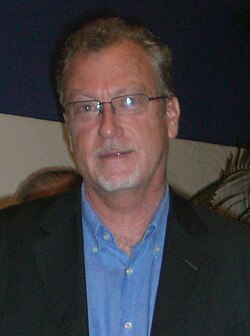
Jon Lee Anderson (born January 15, 1957) is an American journalist, investigative reporter, author, biographer, war correspondent, and staff writer for The New Yorker, reporting from war zones such as Afghanistan, Iraq, Uganda, Palestine, El Salvador, Ireland, Lebanon, Iran, and throughout the Middle East, as well as during Hurricane Katrina and Hurricane Katrina disaster relief efforts with K38 Water Safety as documented in The New Yorker article "Leaving Desire". Anderson has also reported or written for the Lima Times, Harper's Magazine, Life, and The Nation. Anderson has profiled various political leaders, such as Hugo Chávez, Fidel Castro, Che Guevara, and Augusto Pinochet.[1]

Key Information

Early life and career

[edit]

Anderson is the son of Joy Anderson, a children's book author and University of Florida professor, and of John Anderson, a diplomat and agricultural adviser for USAID and the Peace Corps. He was raised and educated in South Korea, Colombia, Taiwan, Indonesia, Liberia, England, and the United States. In the early 1970s, he attempted to hitchhike to Togo but ultimately ended up at Las Palmas in the Canary Islands, Spain, for months, unable to secure passage to the African coast. After living on the streets, going without food for days at a time, and coming down with scurvy, he reunited by happenstance with his sister at the city's U.S. Consulate and returned to the United States.[2] His brother is Scott Anderson, a novelist and journalist, and they have co-authored two books.[3][4]

Anderson began working as a reporter in 1979 for the Lima Times in Peru. During the 1980s, he covered Central America, first for the syndicated columnist Jack Anderson,[5] and later for the Lima Times, Life, The Nation, and Harper's.[6] Anderson is also the author of a biography of Che Guevara called Che Guevara: A Revolutionary Life, first published in 1997. While conducting research for the book in Bolivia, he discovered the hidden location of Guevara's burial from where his skeletal remains were exhumed in 1997 and returned to Cuba.[7]

Literary reception

[edit]

Che Guevara: A Revolutionary Life has received widespread acclaim,[8][9] resulted in many reprints, and was named a New York Times Notable Book of the Year,[10] In her 1997 critique of the book, Jane Franklin wrote that "Anderson never quite communicates an understanding of why Guevara remains such a powerful presence. Relying too much on secondary sources for his knowledge of Cuban history, he fails to grasp the nature of the revolution for which Guevara, Fidel Castro and so many others were willing to die."[11] Conversely, Peter Canby wrote that "Anderson does a masterly job in evoking Che's complex character, in separating the man from the myth and in describing the critical role Che played in one of the darkest periods of the cold war. Ultimately, however, the strength of his book is in its wealth of detail."[8] In Washington Monthly, Matthew Harwood praised The Fall of Baghdad, writing that "his crisp and lush prose reads more like a work of literature than like reportage. But for all its literary beauty, the book's real power lies in its narrative strategy."[12] According to Keane Bhatt writing in NACLA Report on the Americas, Anderson's coverage of Chávez and Venezuela was rife with errors and distortions.[13]

Personal life

[edit]

Anderson resides in Dorset, England, with his wife Erica and their three children: Bella, Rosie and Máximo.[14]

See also

[edit]

References

[edit]
[edit]
Revisions and contributorsEdit on WikipediaRead on Wikipedia
from Grokipedia

Jon Lee Anderson (born January 15, 1957) is an American journalist, author, biographer, and war correspondent renowned for his extensive reporting on political violence and revolutionary movements, particularly through his role as a staff writer for The New Yorker since 1998 and his acclaimed biography Che Guevara: A Revolutionary Life.
Anderson began his reporting career in 1979 in Peru, followed by coverage of Central America's civil wars for outlets including Time magazine, establishing a focus on conflict zones that later expanded to wars in Iraq, Afghanistan, Syria, Lebanon, Libya, Angola, Somalia, and elsewhere.
His investigative work has included profiling authoritarian leaders such as Augusto Pinochet, Fidel Castro, Hugo Chávez, and Nicolás Maduro, as well as on-the-ground dispatches from events like the fall of Baghdad and the Haitian earthquake.
A defining achievement was his research uncovering Che Guevara's burial site in Bolivia, contributing to the biography's status as a national bestseller and definitive account that demystifies the revolutionary figure.
Anderson has been honored with the Overseas Press Club citation for excellence and Columbia University's 2013 Maria Moors Cabot Prize for outstanding reporting from Latin America and the Caribbean, though some of his pieces, such as those on Venezuela, have drawn criticism for factual errors that he later acknowledged.

Early Life and Education

Childhood and Upbringing

Jon Lee Anderson was born on January 15, 1957, in , to parents whose careers facilitated a nomadic lifestyle. His father worked as an agriculture expert for the U.S. Foreign Service, often requiring overseas postings, while his mother authored children's books, exposing the household to creative storytelling. The family included biological siblings—an older sister, Michelle, born in , and a younger brother, Scott, also born in —as well as two adopted sisters, one from and another from , creating a multicultural environment marked by racial and national diversity. Frequent relocations defined Anderson's early years; by age 18, he had lived in eight countries, including , , , , and . These moves began shortly after his brother's birth, with the family settling briefly in before proceeding to other posts, rarely remaining in the United States beyond summers spent in California's High Sierra region. At age three, Anderson visited the separating North and South Korea, an early encounter with geopolitical tension. By age nine in , he produced his own rudimentary , reflecting an nascent interest in writing influenced by his mother's profession. Further experiences reinforced a global perspective: at ages 11–12, he spent time on a in Australia's , and at 13, he resided with geologist relatives in , traveling through rural bush areas and . In 1968, around age 11, Anderson marched alongside his father in anti-Vietnam War protests upon a temporary return to the U.S., coinciding with the national upheaval following 's assassination, which he later recalled as a pivotal moment of political awareness. His father's adventurous disposition, characterized by a propensity for wandering and embracing foreign postings, modeled resilience and toward international cultures and events.

Formal Education and Early Influences

Anderson briefly attended the in Gainesville, enrolling for one semester around 1984 before dropping out to pursue independent travels and experiences. His decision to leave formal academia reflected a preference for over structured coursework, influenced by his nomadic upbringing across multiple continents. Prior to university, Anderson's education occurred in international schools in countries such as , , , , , and , owing to his father's career as a U.S. and USAID agricultural adviser. This disjointed yet globally oriented schooling exposed him to diverse political and cultural environments from an early age, instilling a toward abstracted narratives and a inclination toward on-the-ground verification in analyzing international dynamics. His mother's role as a children's book author and literature instructor may have further encouraged an early appreciation for narrative precision and factual storytelling, though she primarily influenced literary circles rather than his direct path. Lacking a completed degree, Anderson's intellectual formation emphasized self-reliant , drawing from real-world encounters rather than texts or academic mentors during his brief collegiate stint. This foundation oriented his early aspirations toward fields demanding empirical rigor, such as foreign correspondence, where causal chains in conflicts could be traced through direct observation rather than secondary sources or institutional dogma.

Journalistic Career

Early Reporting and Freelance Work

Anderson commenced his journalistic career in the early 1980s as a freelance reporter, focusing on the civil wars engulfing Central America, including conflicts in El Salvador, Nicaragua, and Guatemala, where insurgencies and government counterinsurgency operations resulted in tens of thousands of civilian deaths. He contributed dispatches to TIME magazine and other periodicals, honing skills in on-the-ground sourcing amid environments marked by ambushes, disappearances, and restricted access to combatants on both sides. This period exposed him to the logistical perils of war reporting, such as navigating checkpoints controlled by irregular forces and verifying accounts from displaced populations without institutional support, relying instead on persistent fieldwork and cross-referenced eyewitness testimonies to counter propaganda from state and rebel entities. In 1986, Anderson co-authored Inside the League: The Shocking Exposé of How Terrorists, Nazis, and Latin American Death Squads Have Infiltrated the World Anti-Communist League with his brother Scott Anderson, an investigative account based on archival records, interviews with league affiliates, and analysis of membership rosters revealing ties to post-World War II fugitives and paramilitary operatives. The book documented how the league, ostensibly an anti-communist alliance founded in the 1960s, harbored figures linked to atrocities, including Argentine death squad leaders responsible for up to 30,000 disappearances during the 1976–1983 military junta and ex-Nazis evading Nuremberg-era justice. Their methodology emphasized tracing financial flows and organizational overlaps, such as shared conference attendance between league chapters and extremist groups, to substantiate claims of ideological contamination without relying on unverified intelligence leaks. Building on this, Anderson and his brother published War Zones: Voices from the Global Killing Grounds in 1988, compiling firsthand narratives from five conflict zones, including El Salvador's FMLN guerrilla fronts and Northern Ireland's sectarian clashes, where they embedded with locals and fighters to capture unfiltered perspectives on violence's human toll. The work underscored empirical immersion—conducting interviews under fire and mapping casualty patterns through survivor logs—contrasting sanitized official tallies, such as El Salvador's government underreporting of over 75,000 war deaths from 1980 to 1992. These freelance endeavors established Anderson's approach to volatile reporting: prioritizing direct observation over remote analysis, often at personal risk in regions where journalists faced , as evidenced by the murders of over 20 Salvadoran reporters during the decade.

Affiliation with The New Yorker and Major Assignments

Jon Lee Anderson began contributing to in 1998, marking a pivotal shift in his career toward at one of the premier American magazines. His debut piece, "The Plague Years," published in the January 26, 1998, issue, recounted personal experiences amid Cuba's economic hardships following the Soviet Union's collapse. This initial contribution coincided with David Remnick's ascension to editor that year, under whose leadership Anderson's output expanded to encompass foreign reporting. By 1999, Anderson had advanced to status, a role that afforded greater institutional support for extended fieldwork. Anderson's tenure at The New Yorker featured assignments emphasizing immersive, on-site analysis, including early dispatches from volatile regions that honed his approach to conflict zones. Notable among these were reports from , where he arrived within 48 hours of the September 11, 2001, attacks to cover the impending U.S.-led intervention. In Iraq, he embedded in ahead of the March 2003 invasion, filing pieces such as "The Bombing of Baghdad" on March 31, 2003, amid the initial airstrikes. These undertakings, spanning preparation phases to active hostilities, solidified his profile as the magazine's lead , with over 50 contributions by the . The editorial framework at , particularly Remnick's emphasis on narrative depth and verification, shaped Anderson's pieces through iterative revisions that prioritized granular detail over expediency. This process, involving multiple layers of scrutiny, aligned with Anderson's method of extended immersion, enabling dispatches that integrated firsthand observation with broader contextual analysis while minimizing reliance on official narratives. Such dynamics contributed to the publication's reputation for pieces that withstood subsequent scrutiny, as evidenced by Anderson's sustained access to restricted areas in subsequent assignments.

Coverage of Key Conflicts

Anderson's reporting on Afghanistan began in the late 1980s but intensified following the , 2001, attacks, with him arriving in the country ten days before U.S. airstrikes commenced against and al-Qaeda targets. His dispatches, compiled in The Lion's Grave: Dispatches from (2002), detailed the initial U.S.-led invasion's ground realities, including advances and retreats, while highlighting early insurgent resilience and civilian displacements estimated at over 1.5 million by the High Commissioner for Refugees by mid-2002. These accounts emphasized the decentralized survival tactics, drawing on interviews with fighters and locals to underscore causal factors like porous borders with enabling regrouping, rather than accepting official narratives of swift victory. In , Anderson covered the 2003 U.S. invasion and its aftermath without embedding, prioritizing independent access to and insurgent-held areas to document post-invasion chaos. His book The Fall of Baghdad (2004) chronicled the April 9, 2003, toppling of Saddam Hussein's statue as a symbolic but fleeting event, followed by empirical evidence of policy failures: by 2004, insurgent attacks had surged to over 1,000 monthly, per U.S. military data, exacerbating that displaced 1.6 million civilians internally by year's end, according to the . Anderson's New Yorker pieces critiqued the Coalition Provisional Authority's de-Baathification and disbanding of the Iraqi army—decisions affecting 400,000 personnel— as accelerating unemployment-driven radicalization, supported by on-the-ground observations of militia recruitment spikes. Turning to the Arab Spring uprisings, Anderson reported from in 2011, embedding with rebels during the NATO-backed campaign that ousted on October 20, 2011, after 42 years in power. His accounts detailed the siege's toll, where rebel forces, aided by airstrikes destroying over 6,000 Gaddafi loyalist targets per NATO logs, suffered 1,000+ deaths amid , but noted post-victory fragmentation: by 2012, rival militias controlled oil fields, halving production to 800,000 barrels daily from pre-war levels, per data, fostering a causal chain of state collapse. In , his 2012 New Yorker dispatch "The War Within" examined rebel factionalism amid the conflict's escalation, where by August 2012, the UN documented 18,000 deaths and 1.5 million displacements, attributing intensified jihadist recruitment—such as Jabhat al-Nusra's rise—to regime barrel bombings and opposition infighting, based on interviews with defectors and Islamist commanders. Anderson's coverage extended to Latin American political upheavals, particularly Venezuela's 2002 coup attempt against and subsequent crises. Reporting on the April 11-13, 2002, events, he documented opposition strikes paralyzing oil production—dropping exports by 60% temporarily, per records—and military defections, but highlighted Chávez's reinstatement via loyalist counter-mobilization, with civilian deaths totaling 19 amid sniper fire disputes. Later dispatches tracked economic contractions, where hit 1.7 million percent annually by 2018, per IMF estimates, linking it to expropriations displacing 4 million emigrants by 2019, drawing on smuggler and exile interviews to illustrate policy-induced scarcities over external sanctions as primary drivers. More recently, Anderson has reported from since Russia's February 24, 2022, invasion, focusing on frontline dynamics in where Ukrainian forces, bolstered by Western arms, inflicted 500,000+ Russian casualties by mid-2024 per U.S. leaks, while documenting civilian impacts like Mariupol's siege reducing its from 450,000 to under 100,000 amid artillery barrages destroying 90% of . In , his 2025 compilation To Lose a War: The Fall and Rise of the synthesizes decades of dispatches, critiquing the August 2021 U.S. withdrawal's haste—evacuating 123,000 but abandoning intact to capture—as enabling their swift consolidation, with empirical data showing 2.6 million internal displacements post-takeover and a 20% GDP contraction in 2022 per World Bank figures, underscoring missed opportunities for negotiated power-sharing amid corruption eroding Afghan forces' cohesion.

Major Works and Publications

Biographical Works

Anderson's foremost biographical endeavor is Che Guevara: A Revolutionary Life, published in 1997 by . The 814-page volume draws on extensive primary sources, including Guevara's personal diaries, unpublished family letters, and access to Cuban state archives previously unavailable to outsiders. Anderson supplemented these with over 200 interviews of Guevara's associates, family members, and adversaries across , , and the , enabling a reconstruction grounded in direct testimony rather than secondary interpretations. The counters romanticized portrayals of Guevara prevalent in certain academic and media circles by emphasizing empirical details of his actions, such as his command of fortress in from January to June 1959, where he authorized the execution of at least 55 individuals accused of crimes under the prior regime, often via expedited revolutionary tribunals lacking standard judicial safeguards. Eyewitness accounts and contemporaneous records cited by Anderson illustrate Guevara's hands-on role in these proceedings, including his public defense of summary justice as necessary for consolidating revolutionary power, diverging from hagiographic narratives that omit or minimize such episodes. This approach prioritizes causal sequences derived from archival evidence over ideological exonerations, highlighting how Guevara's ideological commitments drove post-victory purges independently of mythic heroism. Anderson has pursued a biography of , announced in 2014 following decades of reporting on , including three years of residence there in the early for prior investigations. The project incorporates declassified materials and interviews with Cuban officials and dissidents to dissect Castro's decision-making, aiming to dismantle uncritical adulations through scrutiny of primary documents on events like the and internal purges. As of October 2025, however, the full biography remains unpublished, with Anderson's related Castro profiles appearing instead in .

Books on War and Insurgencies

Guerrillas: Journeys in the Insurgent World (1992) examines five distinct insurgent movements through direct engagement with fighters, emphasizing their operational tactics, daily deprivations, and ideological commitments amid oppression. Anderson profiles the Afghan mujahedin, employing close-quarters combat against Soviet forces; the Salvadoran FMLN, which established rural liberated zones for sustained guerrilla operations; the Burmese Karen, relying on jungle mobility to counter superior ; the in , utilizing desert fortifications and mobile warfare; and Palestinian militants in Gaza, focused on urban hit-and-run violence during the . The book analyzes structural determinants of insurgent persistence or collapse, such as logistical vulnerabilities and adaptive community structures, rather than ideological purity, noting empirical patterns like the FMLN's eventual political gains despite military setbacks and the mujahedin's cyclical territorial control amid factional infighting. In The Lion's Grave: Dispatches from Afghanistan (2002), Anderson documents the initial U.S.-led campaign against and forces following the , based on reporting from front lines starting ten days before bombing commenced. He tracks advances, retreats, and the asymmetries of modern aerial bombardment versus entrenched insurgent defenses, highlighting how tribal alliances and rugged terrain enabled partial evasion despite rapid regime collapse in by November 2001. The narrative underscores causal factors in early coalition successes, including precision strikes disrupting command structures, while foreshadowing insurgency revival through overlooked local power vacuums and Pashtun resentment, drawn from on-the-ground interviews with commanders and civilians. The Fall of Baghdad (2004) offers a ground-level of the 2003 U.S. and Saddam Hussein's , centered on Iraqi civilians' experiences from pre-war preparations through urban combat and in 2003. Anderson critiques coalition planning flaws, such as inadequate post-invasion security leading to Ba'athist remnant mobilization and spikes, evidenced by firsthand accounts of unchecked arms depots and improvised explosive emergence. Iraqi perspectives reveal ambivalence toward Saddam's fall—relief from repression tempered by fears of —while structural analyses point to growth from disbanded military units (over 400,000 personnel demobilized without pensions) and delayed governance, contributing to over 1,000 insurgent attacks by mid-2003. Across these works, Anderson prioritizes verifiable field data on patterns, revealing how insurgencies endure via exploitation and social cohesion but falter against coordinated state responses or internal divisions.

Recent Publications and Compilations

In 2025, Anderson published To Lose a War: The Fall and Rise of the , a compilation of his reporting from spanning nearly three decades, with a focus on the U.S.-led occupation from 2001 to 2021 and the subsequent resurgence. The volume draws primarily from his New Yorker dispatches, highlighting empirical failures in strategies, such as inadequate understanding of local tribal dynamics and overreliance on corrupt Afghan proxies, which enabled the 's territorial gains despite trillions in U.S. expenditures. Anderson incorporates on-the-ground accounts of military operations and impacts, underscoring causal links between policy missteps—like insufficient troop commitments post-2009 surge—and the 2021 collapse of the government. No major revisions to original pieces are noted, though the anthology frames them chronologically to trace the arc of strategic defeat. That same year, Anderson contributed to Guerra, paz y periodismo (War, Peace, and ), a Spanish-language issued by the magazine 5W as part of its "Voces" series, compiling select articles on global conflicts and journalistic practice. The collection reflects his ongoing coverage of insurgencies and political upheavals, including Latin American contexts like Venezuela's crisis, emphasizing firsthand observations over institutional narratives often skewed by ideological filters in regional media. It builds on his prior reporting without new empirical additions, serving as an accessible retrospective for Spanish-speaking audiences on themes of failed interventions and authoritarian resilience.

Reception, Impact, and Criticisms

Awards and Professional Recognition

Anderson received the Overseas Press Club's award in 2009 for his New Yorker article "Gangland," which examined the entrenched power of drug trafficking organizations in Rio de Janeiro's favelas through on-the-ground reporting amid Brazil's escalating urban violence. This recognition highlighted his ability to navigate high-risk environments to the socioeconomic and criminal dynamics fueling dominance, contributing to broader awareness of Latin American insurgencies beyond traditional warfare. In 2013, he was granted the Maria Moors Cabot Prize by Columbia University's Graduate School of , the oldest international award in American , specifically for distinguished reporting from ; the prize cited his sustained coverage of regional political upheavals, including guerrilla movements and state responses in countries like and . That same year, Anderson earned the Overseas Press Club's Robert Spiers Benjamin Award for "Slumlord," a piece exposing the exploitative housing practices and informal economies in urban slums, underscoring his focus on underreported structural factors in conflict zones. These honors, drawn from journalism organizations emphasizing empirical fieldwork and firsthand sourcing, affirmed Anderson's methodological rigor in conflict and regional reporting, facilitating expanded opportunities for long-form investigations in subsequent assignments. The Overseas Press Club has additionally cited him for excellence in coverage from war-torn areas, reflecting consistent peer validation of his causal analyses of insurgencies and governance failures.

Literary and Journalistic Reception

Anderson's biography Che Guevara: A Revolutionary Life (1997) garnered widespread acclaim for its exhaustive research and nuanced depiction of Guevara's multifaceted character, emphasizing psychological depth and separating historical fact from romanticized myth rather than endorsing simplistic narratives of unyielding ruthlessness. Reviewers in The New York Times praised its mastery in evoking complexity, while Foreign Affairs highlighted its tracing of Guevara's path from privileged youth to revolutionary misadventures. The book achieved national bestseller status, with over 250,000 copies sold worldwide. His journalistic output, particularly long-form pieces in on conflicts in , , and , has been lauded for immersive, firsthand reporting that captures granular human and strategic dynamics. Compilations like The Fall of Baghdad (2004) and To Lose a War (2025) drew positive assessments for providing detailed accounts of U.S.-involved wars, balancing initial noble intentions against operational failures without embedding reliance, which Anderson favors for broader independence. noted the characteristic slow-unfurling style of his essays, effective for depth but occasionally critiqued for deliberate pacing over concision. Some conservative commentators have questioned whether his focus on American policy shortcomings in these works unduly amplifies U.S. errors at the expense of insurgent agency or geopolitical complexities, though such views remain secondary to broad professional regard for evidentiary rigor.

Controversies and Debates Over Reporting

Anderson's 2013 New Yorker profile of , titled "Slumlord," drew criticism from left-leaning outlets for allegedly misrepresenting Chávez's rise to power and implying illegitimacy through phrases like Chávez having "put himself in power" via a coup-like process, despite his victory observed as free and by international monitors including the Carter Center. FAIR, a media watchdog with a progressive orientation, highlighted these as evidence of politicized bias against Chávez's legitimacy, while Anderson responded that the wording critiqued Chávez's post-election consolidation of power through extralegal means, not the initial vote, and cited empirical data on subsequent electoral irregularities verified by organizations like the OAS. Counterarguments emphasized Chávez's early democratic mandate, with turnout exceeding 60% and opposition acceptance, though later referenda showed declining transparency per electoral audits. In his 2018 reporting on 's protests against Daniel Ortega's government, published in as "Fake News and Unrest in Nicaragua," Anderson faced accusations of opposition for emphasizing regime suppression tactics, including over 300 protester deaths documented by groups like and the , while downplaying opposition violence. Critics from pro-Sandinista perspectives, such as outlets aligned with Ortega's base, argued the piece amplified unverified "" narratives and ignored context like U.S.-backed opposition funding, portraying Anderson as echoing imperial critiques rather than balanced analysis. Defenses rested on on-the-ground sourcing of regime actions, including sniper fire and roadblocks confirmed by multiple eyewitness accounts and forensic reports, privileging causal evidence of state-initiated escalation over narrative symmetry. Anderson's 2017 New Yorker dispatch on Catalonia's was critiqued in Letras Libres for factual distortions, including overstating police restraint and underplaying irregularities in an illegal vote ruled unconstitutional by Spain's , with only 43% participation amid boycotts and logistical failures. The analysis accused him of sympathetic framing toward separatists, misrepresenting clash dynamics where Catalan authorities blocked polling access, leading to 90% reported yes votes but contested validity per official audits showing ballot stuffing in some precincts. Anderson's reporting highlighted Madrid's heavy-handed response, aligning with empirical video evidence of baton charges, but critics contended it privileged emotional narratives over legal context and data on non-binding results lacking broader Catalan support. Debates over Anderson's portrayal of Che Guevara's command at prison in his 1997 biography "Che Guevara: A Revolutionary Life" center on execution numbers, estimated at 55 to 144 Batista-era officials via summary , with Anderson contextualizing them as revolutionary justice against documented war crimes while noting procedural flaws like coerced confessions. Some view this as softening Che's , given his oversight of dawn executions and rejection of appeals, but Anderson balanced it with showing convictions based on of torture and killings under the prior regime, avoiding . Broader accusations portray Anderson as exhibiting an anti-left tilt in Latin American coverage, particularly against socialist leaders like Chávez and , yet this overlooks his consistent critiques of U.S. interventions, such as in where he documented civilian casualties exceeding 100,000 by 2006 per Lancet estimates, prioritizing empirical war outcomes over ideological alignment. Such claims often stem from sources sympathetic to targeted regimes, underscoring tensions between on-site causal reporting and partisan interpretations of data.

Personal Life and Views

Family and Residences

Anderson is married to and has three children, now adults in their thirties. The family maintains a residence in Dorset, , where Anderson met his wife and established a home base amid his peripatetic career. This arrangement has enabled extended assignments in and conflict zones, such as and , without relocating dependents, though Anderson has stated that family obligations intensified his risk-taking in war reporting to secure : "I had a family and that pushed me into war... I just escalated the risks to try to make more money."

Political Perspectives and Public Statements

Jon Lee Anderson has expressed a liberal worldview shaped by his upbringing with socially and politically progressive parents, influencing his reporting on global conflicts and authoritarianism. He has profiled revolutionary figures like Che Guevara and Fidel Castro, acknowledging their anti-imperialist appeal while critiquing the authoritarian outcomes of their regimes, as seen in his biographical works and dispatches from Latin America. Anderson's statements often emphasize the dangers of unchecked power, drawing parallels between historical dictators such as Augusto Pinochet and Hugo Chávez and contemporary populists. In public interviews, Anderson has been vocally critical of Donald Trump, describing him as a "rich bully" and "predator" who seeks to transform the U.S. government into a "monarchy at his service." He has warned of Trump's vengeful nature and anti-democratic tendencies, stating in December 2024 that "he's a vengeful guy, that has always been his way of conducting himself... anti-democratic, he's a danger." Anderson has linked Trump's rhetoric to heightened U.S. polarization, noting his exploitation of societal prejudices and predicting potential violence, including an inability to rule out civil war given America's high armament levels and the three million veterans with combat experience from Iraq and Afghanistan. He attributes part of Trump's 2016 rise to media amplification of his "populist, racist discourse," particularly against Hispanics and Mexicans, which prompted Anderson to increase his reporting in the region. On U.S. , Anderson has maintained skepticism toward military interventions since his early career in the post-Vietnam era, avoiding embeds with U.S. forces and highlighting operational failures in places like . His 2025 compilation To Lose a War documents the 20-year U.S. occupation of as a noble but ultimately disastrous endeavor, marked by missteps that enabled the Taliban's resurgence despite initial successes in dispersing . He has critiqued the militarization of American diplomacy, arguing it persists without significant reform, as evidenced by ongoing engagements in and elsewhere. Anderson identifies a global "era of the bullies," where authoritarian traits converge across ideologies, citing Latin American leaders like El Salvador's and Argentina's as "clones" of Trump-style that erode democratic norms by targeting media and institutions. He has condemned Nicaragua's as "cruel" toward his populace, church, and civic groups, while praising Guatemala's as a democratic . In Venezuela, Anderson has reported on Nicolás Maduro's contested 2024 election claim as exacerbating the contest between and . He advocates for journalists to combat such trends "tooth and nail" by pursuing impartial truth amid proliferating falsehoods.

References

Add your contribution
Related Hubs
User Avatar
No comments yet.