
.jpg/250px-Jewish_tawnhall_(Prague).jpg)


.jpg/1324px-Jewish_tawnhall_(Prague).jpg)
Community hub
Recent from talks
Contribute something
Nothing was collected or created yet.
Josefov
View on Wikipedia
Key Information

.jpg)
.svg)

Josefov (also Jewish Quarter; German: Josefstadt) is a town quarter and the smallest cadastral area of Prague, Czech Republic, formerly the Jewish ghetto of the town. It is surrounded by the Old Town. The quarter is often represented by the flag of Prague's Jewish community, a yellow Magen David (Star of David) on a red field.
History
[edit]Jews are believed to have settled in Prague as early as the 10th century. The first pogrom was in 1096 (the first crusade) and eventually they were concentrated within a walled Ghetto. In 1262, Přemysl Otakar II issued a Statuta Judaeorum which granted the community a degree of self-administration. The ghetto was most prosperous towards the end of the 16th century when the Jewish Mayor, Mordecai Maisel, became the Minister of Finance and a very wealthy man. His money helped develop the ghetto.
In 1850, the quarter was renamed "Josefstadt" (Joseph's City) after Joseph II, Holy Roman Emperor who emancipated Jews with the Edict of Tolerance in 1782. Two years before Jews were allowed to settle outside of the city, so the share of the Jewish population in Josefov decreased, while only Orthodox and poor Jews remained living there.
Most of the quarter was demolished between 1893 and 1913 as part of an initiative to model the city on Paris. What was left were only six synagogues, the old cemetery, and the Old Jewish Town Hall (now all part of the Jewish Museum in Prague and described below).

Currently Josefov is overbuilt with buildings from the beginning of the 20th century, so it is difficult to appreciate exactly what the old quarter was like when it was reputed to have over 18,000 inhabitants. Medieval Josefov is depicted in the 1920 film The Golem, composed of cramped, angular, squinted buildings, but this impression is used purely to convey the expressionist nature of the film.
Demographics
[edit]
|
| |||||||||||||||||||||||||||||||||||||||||||||||||||
| Source: Censuses[2][1] | ||||||||||||||||||||||||||||||||||||||||||||||||||||
Historical sites
[edit]
- Franz Kafka's birthplace.
- High Synagogue (Vysoká synagoga): 16th-century synagogue.
- Jewish Town Hall (Židovská radnice): 18th-century Rococo town hall.
- Klausen Synagogue (Klausová synagoga): 16th-century Baroque synagogue.
- Maisel Synagogue (Maiselova synagoga): 16th-century synagogue destroyed by fire, now used as a museum.
- Pinkas Synagogue (Pinkasova synagoga): 16th-century synagogue, now a memorial to Holocaust victims.
- Spanish Synagogue (Španělská synagoga): 19th-century synagogue with Moorish interior.
- Old Jewish Cemetery (Starý židovský hřbitov): 15th- to 18th-century cemetery. Europe's oldest surviving Jewish cemetery.
- Old New Synagogue (Staronová synagoga): 13th-century Gothic synagogue.
- Ceremonial Hall of the Prague Jewish Burial Society (Obřadní síň): 20th-century neo-Renaissance hall.
Further reading
[edit]- Všetečka, Jiří; Kuděla, Jiří (1993). The fate of Jewish Prague. Grafoprint-Neubert. ISBN 80-901208-5-7
- Prague City Tourism (2017). Prague: Jewish. Prague City Tourism.
Gallery
[edit]-
 Jewish Cemetery and surrounding buildings
 -
 The cemetery itself
 -
 The surrounding buildings
 -
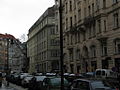 A few steps apart
 -
 A monument of a pregnant woman made of mirrors


See also
[edit]References
[edit]- ^ a b "Results of the 2021 Census - Open data". Public Database (in Czech). Czech Statistical Office. 2021-03-27.
- ^ "Historický lexikon obcí České republiky 1869–2011 – Praha" (in Czech). Czech Statistical Office. 2015-12-21. Archived from the original on 2021-08-17. Retrieved 2024-10-11.
External links
[edit]
- Jewish Museum in Prague Archived 2011-04-23 at the Wayback Machine
- Prague Tours

| International | |
|---|---|
| National | |
| Other | |

Josefov
View on GrokipediaGeography and Urban Context
Location and Boundaries
Josefov occupies a compact position in the historic core of Prague, Czech Republic, within the Prague 1 municipal district. It lies in a pronounced bend of the Vltava River, which forms its northern and western boundaries, providing natural hydrological limits. To the south, it adjoins the Staré Město (Old Town), while the eastern edge aligns with Pařížská Street, delineating its separation from adjacent urban areas.[1][10][11] This cadastral territory represents Prague's smallest administrative subdivision, encompassing roughly 0.09 square kilometers of densely built land.[12] The area's topography features gently sloping terrain rising from the Vltava's banks, with elevations averaging approximately 188 meters above sea level near key structures like the Jewish Town Hall.[13] Such riverine positioning historically contributed to containment through the Vltava's meander, acting as a defensive moat-like barrier while allowing controlled access via bridges.[10] Josefov's southern proximity to the Charles Bridge, spanning the Vltava just beyond the Old Town interface, underscores its strategic placement for riverine trade connectivity amid relative isolation from broader Prague expanses.[1] The confined footprint, hemmed by water and urban divides, amplified its role as a self-contained enclave in the city's medieval layout.[14]Integration with Prague
Josefov lost its autonomous status upon incorporation into the Prague municipality in 1850, becoming fully integrated as a district within the expanded city administration.[15] This merger aligned its governance with broader Prague structures, ending prior self-administration tied to its historical role as a segregated Jewish enclave.[16] Urban renewal efforts from the 1890s to the 1910s further embedded Josefov infrastructurally into Prague's fabric through the asanace (clearance) project, initiated by city council decisions in 1893.[17] These works involved demolishing overcrowded buildings and constructing wide boulevards, including 28. října, which enhanced connectivity to adjacent Old Town areas and promoted standardized urban planning.[1] The process, resuming after a World War I interruption, replaced narrow medieval streets with modern avenues suited to Prague's growing metropolitan needs.[18] In contemporary Prague, Josefov operates as the smallest cadastral area under the city's unified zoning framework, blending residential apartments, commercial spaces, and protected heritage sites.[6] Governed by the Metropolitan Plan, it prioritizes preservation of its UNESCO-listed historic core while allowing upscale development, reflecting its evolution into an affluent neighborhood seamlessly linked to central Prague.[19][20]Historical Development
Medieval Foundations and Early Settlement
Jewish merchants are recorded in Prague as early as the 10th century, contributing to the city's emergence as a trade hub along key European routes.[21] Initial settlements likely occurred near Prague Castle on the left bank of the Vltava River, drawn by economic opportunities in commerce.[22] By the mid-12th century, following localized violence and pogroms, the community relocated and consolidated on the right bank, forming the core of what became the Old Jewish Town (Stará Židovská), a distinct settlement area.[23] The growth of this settlement prompted the establishment of the New Jewish Town (Nová Židovská) in the early 13th century, expanding housing and infrastructure to accommodate increasing numbers while maintaining spatial separation from Christian districts.[24] These dual enclaves merged administratively over time, laying the foundations for a cohesive Jewish quarter amid Prague's urban development. Jews engaged primarily in international trade, crafts, and—owing to ecclesiastical bans on Christian usury—moneylending, roles that supplied vital credit to merchants, nobles, and the crown, thereby securing royal protection despite underlying social hostilities.[16] In 1254, King Přemysl Ottokar II issued a charter (Statuta Judaeorum) granting Jews specific privileges, including safeguards against arbitrary violence, rights to property ownership, and limited self-governance in communal and judicial affairs internal to the community.[25] [16] This document, modeled on earlier imperial edicts, affirmed Jews' status as royal servants useful for fiscal and economic functions, permitting residence in designated areas while imposing taxes and obligations in exchange for legal protections—a framework that endured with modifications for centuries.[26] These early grants underscored the pragmatic calculus of rulers, who valued Jewish financial expertise for state revenues, even as they navigated clerical and popular prejudices.[27]Establishment as Ghetto and Restrictions
In the mid-18th century, under Habsburg Empress Maria Theresa, Prague's Jewish quarter faced intensified restrictions following the expulsion of Jews from Bohemia in 1744–1745, which was reversed in 1748 only upon payment of a substantial levy, confining returning Jews to the overcrowded area as a means of centralized administrative control and fiscal extraction.[28] This segregation aligned with broader Habsburg policies aimed at isolating Jewish populations for religious separation—rooted in Catholic doctrine viewing Jews as potential threats to Christian society—and pragmatic governance, allowing the empire to negotiate collectively with community leaders rather than individuals while imposing imperial taxes and military quotas.[29] The quarter's boundaries, enforced by gates locked at night and badges or hats required for Jews venturing outside during the day, reflected Europe-wide practices of residential confinement to minimize social friction and ritual contamination fears, not isolated malice but systemic categorization of Jews as a distinct, taxable estate.[28] Emperor Joseph II's 1781 Patent of Toleration granted Jews civil rights like education and trade access but retained residential confinement to the quarter, which he renamed Josefov in 1784 to honor his reforms, formalizing its ghetto status until abolition in 1850 amid revolutionary pressures.[30] Confinement decrees prohibited Jews from owning property outside Josefov or marrying without imperial permits under the Familiants Law (1726, enforced strictly post-1748), limiting families to eldest sons and capping Bohemian Jewish households at 8,541, which exacerbated internal pressures while enabling Habsburg oversight.[29] The kahal, or Jewish communal council, retained autonomy in internal taxation, religious judiciary, and welfare distribution—serving as an intermediary for imperial levies—but this structure heightened vulnerability to state demands, such as disproportionate conscription during wars, and sporadic violence, as seen in the 1389 Easter pogrom where confinement failed to prevent mob attacks amid blood libel accusations.[31] By the early 19th century, Josefov's area of approximately 0.3 square kilometers housed over 7,000 residents, yielding extreme density that fostered sanitation crises, including frequent epidemics like cholera outbreaks in the 1830s due to inadequate sewage and layered burials in the Old Jewish Cemetery.[32] These conditions stemmed causally from enforced segregation compounding natural population growth and immigration from rural Bohemia, with narrow alleys and multi-story tenements promoting disease transmission unchecked by external urban planning, underscoring the ghetto's role as a contained fiscal and social unit under Habsburg realpolitik rather than deliberate extermination policy.[28]Emancipation under Joseph II
In 1781, Holy Roman Emperor Joseph II issued the Patent of Toleration specifically for Jews in Bohemia, including the Prague Jewish community, on October 13, granting limited civil rights as part of his broader Josephinist reforms aimed at rationalizing state administration and enhancing economic productivity.[29] These edicts permitted Jews to reside outside designated ghettos—subject to local approval—attend secular schools with instruction in German to facilitate cultural assimilation, engage in certain crafts and agriculture previously restricted, and enlist in the military, thereby integrating them more directly into Habsburg societal structures for state utility rather than full equality.[29] However, core limitations persisted, such as the unabolished Familiants Laws capping Jewish family numbers and residence quotas in Bohemia, alongside ongoing guild exclusions and special taxes, underscoring the reforms' pragmatic focus on fiscal and administrative efficiency over unqualified emancipation. The shift in nomenclature from "Jewish Town" (Židovské město) to Josefov, formalized in 1850, retroactively honored Joseph II's policies as a symbolic gesture toward equality rhetoric, reflecting the community's recognition of his role in easing prior confinements despite incomplete implementation during his reign (1780–1790).[33] This renaming encapsulated the edicts' intent to recast Jews as productive citizens aligned with Enlightenment principles of utility, though social barriers like antisemitic prejudices and incomplete legal parity endured.[34] Economically, the reforms facilitated Jewish advancement in finance and trade, with Prague's Jewish merchants serving as key creditors to the Habsburg state amid ongoing wars and fiscal strains, exemplified by the rise of banking houses that provided loans indispensable for imperial solvency.[34] Yet, these gains coexisted with enforced acculturation pressures, including mandates for German-language use over Yiddish or Hebrew in official contexts, which aimed to erode distinct cultural practices without eradicating underlying discriminatory frameworks. Overall, Joseph II's measures marked a transitional liberalization driven by state-centric rationalism, yielding partial integration but deferring fuller emancipation to subsequent eras.[33]19th-Century Reconstruction and Demolition
In the late 19th century, Josefov was subject to a major urban renewal project known as the asanace, a city-wide sanitation initiative to address overcrowding, dilapidated housing, and public health risks in Prague's historic core. A redevelopment law enacted in February 1893 empowered authorities to demolish structures in the former Jewish Quarter, which, despite emancipation and population outflows since 1850, remained densely packed with narrow streets and substandard buildings prone to disease transmission during industrial-era urbanization.[6][35] Demolition commenced in 1895 and extended through 1913, razing 247 houses in Josefov alone—part of a broader clearance of 469 structures across Prague by 1914—and eliminating most medieval and baroque-era layouts except for preserved landmarks.[36] The effort prioritized hygiene imperatives over historical fidelity, as the district's irregular alleys and multi-story tenements exacerbated sanitary issues in a period of rising urban epidemics, though the project overran its initial 1903 deadline amid logistical challenges.[18][6] Key Jewish monuments, including six synagogues and the Old Jewish Cemetery, were exempted from demolition to safeguard cultural heritage, reflecting a deliberate balance between modernization and preservation amid the Jewish community's advocacy.[5] The resulting streetscape shifted dramatically, with rebuilt blocks featuring uniform Art Nouveau facades inspired by Parisian models, yielding an elegant but reconstructed aesthetic that obscured the site's organic medieval origins.[37][38]World War II and Holocaust Impact
The Jewish community in Bohemia and Moravia, including Prague's Josefov quarter, was highly assimilated prior to World War II, with most Jews speaking Czech as their primary language, identifying culturally with Czech society, and experiencing relatively lower levels of antisemitic violence compared to communities in Vienna or Berlin, where ethnic German nationalism fueled more intense prejudice.[39][40] In 1930, the population numbered 117,551 Jews across the region, with Prague alone hosting around 35,000, many residing or maintaining ties to the historic Josefov area despite its earlier ghetto associations.[39][40] Following the German occupation of the Protectorate of Bohemia and Moravia in March 1939, Nazi authorities under Reinhard Heydrich implemented systematic anti-Jewish measures, including property confiscation, forced labor, and registration, culminating in mass deportations starting in November 1941.[39] Local Czech gendarmerie units facilitated the process by rounding up Jews from homes, synagogues, and assembly points in Prague—often utilizing facilities in the Josefov district for initial concentration due to its central Jewish institutions—before transporting them by rail to the Theresienstadt ghetto, approximately 60 kilometers north of Prague.[39] From there, the majority were forwarded in organized convoys to extermination sites such as Auschwitz or killing operations in the Baltic states and Lublin district, with logistical efficiency achieved through centralized SS coordination and minimal disruptions from organized resistance in the initial phases.[39] Between 1941 and 1944, authorities deported 73,603 Jews from Prague and other cities like Brno and Ostrava, part of a total of 82,309 from the Protectorate.[39] The deportations decimated the community, with approximately 71,000 Protectorate Jews killed in the Holocaust and another 7,000 executed by occupation forces or local collaborators; only about 14,000 survived within Czech lands by war's end, including roughly 5,000 returnees to Prague from camps and 227 who evaded capture underground.[39][40] Approximately 30,000 had emigrated prior to the deportations, but the remaining population faced near-total eradication through this mechanized process, leaving Josefov and broader Jewish sites intact under Nazi plans to repurpose them as a preserved "museum of an extinct race."[39][1]Post-1945 Revival and Modern Era
Following the devastation of the Holocaust, which reduced Prague's Jewish population from over 90,000 pre-war to roughly 5,000 survivors by 1945, the communist regime established in 1948 further eroded community vitality in Josefov.[29] State control nationalized Jewish properties, including synagogues and the Jewish Museum, leading to neglect of sites and suppression of religious practice amid anti-Semitic campaigns, such as Stalinist show trials targeting Jewish communists in the 1950s.[41] By the 1980s, active Jewish presence in the quarter was negligible, with emigration—accelerated after the 1968 Prague Spring invasion—reducing numbers to a few hundred, as religious expression remained stifled under socialism.[42] The Velvet Revolution of November 1989 dismantled communist authority, enabling restitution of Jewish communal assets and a modest institutional revival.[43] The Prague Jewish Community reorganized with new leadership, regaining oversight of synagogues previously under state administration, while the Jewish Museum in Prague expanded through privatized funding, undertaking major restorations like the Spanish Synagogue, completed in the 1990s after decades of disuse.[44] This period marked a shift toward heritage preservation, though efforts prioritized public access over residential resettlement, coinciding with commercialization of Josefov as a tourist draw.[45] In the 21st century, Josefov's synagogues, cemetery, and town hall contribute to Prague's Historic Centre, designated a UNESCO World Heritage Site in 1992 for its architectural and cultural integrity.[20] Yet Jewish repopulation has remained limited, with Prague's resident community numbering under 2,000 as of recent estimates, constrained by emigration incentives—including economic opportunities in Western Europe and Israel's Law of Return encouraging aliyah—and pervasive secularization among descendants of survivors, many of whom assimilated during decades of state-enforced atheism.[46][43] This contrasts with vibrant cultural programming but underscores a demographic stagnation rooted in historical disruptions rather than robust communal regrowth.[47]Demographics and Social Composition
Pre-Modern Population Dynamics
The Jewish quarter of Prague, known as Josefov, maintained a predominantly Jewish population from its medieval origins through the 18th century, enforced by strict residency laws confining Jews to a segregated area on the Vltava River's right bank, with gated access and prohibitions on Christian settlement within its bounds.[16][28] This legal framework ensured near-total Jewish composition, with estimates placing the community at around 600 residents in 1522, rising to approximately 1,200 by 1541 amid inflows of refugees fleeing expulsions from Moravia, Germany, Austria, and Spain following the 1492 Alhambra Decree.[16][28][29] Population growth accelerated in the 16th and 17th centuries, reaching over 3,000 by 1599 and exceeding 6,000 during Emperor Rudolf II's reign (1576–1612), supported by imperial privileges for trade and finance that attracted further migrants despite periodic restrictions.[29][16] By the late 17th century, the figure surpassed 11,600, culminating in a peak of about 12,000 in the early 18th century, when Jews comprised roughly one-quarter of Prague's total inhabitants and formed Europe's largest Ashkenazi community.[16][22] These expansions were punctuated by sharp declines from external shocks, including the 1389 Easter pogrom, which killed an estimated 3,000 Jews—nearly the entire community—forcing survivors to flee to Poland and Hungary.[29][28][23] Subsequent recoveries demonstrated resilience, as post-pogrom protections under Habsburg rulers drew new settlers, though plagues and fires imposed recurrent losses; the 1680 epidemic alone claimed over 3,500 lives, and the 1689 fire destroyed 318 houses.[16][29] Temporary expulsions, such as those in 1543–1545 and 1559–1562, further depleted numbers, yet the quarter's population rebounded to 10,507 adults across 2,335 families by the 1729 census, even under the restrictive Familiants Law of 1726–1727, which limited marriages to eldest sons to cap family sizes.[16] This pattern of policy-driven inflows and catastrophe-induced outflows underscored a stable Jewish majority, fluctuating between roughly 3,000 and 12,000 residents from the 16th to 18th centuries, amid Europe's broader antisemitic pressures.[16][28][29]19th-20th Century Shifts
Following the abolition of the Prague ghetto in 1852, which granted Jews the legal right to reside and own property outside Josefov, a substantial portion of the Jewish population dispersed to surrounding Prague districts and suburbs.[29][28] This exodus was driven primarily by economic incentives, as integration into wider Czech society—through secular education, adoption of the Czech language, and entry into professions previously barred to Jews—offered pathways to improved livelihoods beyond the overcrowded, restrictive confines of the former ghetto.[48] By the late 19th century, this voluntary assimilation had markedly reduced the density of Jewish residency in Josefov, shifting the community's social composition toward a more urban, professional elite dispersed across the city. In the interwar period, Prague's Jewish population stabilized at approximately 40,000 by the 1930s, comprising about 7% of the city's total inhabitants and dominated by middle-class professionals in commerce, law, medicine, and industry.[49][50] Census data from 1921 and 1930 highlighted this occupational shift, with Jews overrepresented in white-collar roles relative to their numbers, reflecting the long-term success of emancipation-era strategies for socioeconomic advancement through cultural adaptation rather than isolation.[51] The Nazi occupation from 1939 onward led to the near-total evacuation and destruction of Prague's Jewish community, with over 80,000 individuals—many from Josefov and surrounding areas—deported to concentration camps like Theresienstadt and Auschwitz, where most perished.[52] Only around 5,000 survivors returned to Prague by 1945, leaving Josefov's Jewish demographic footprint decimated and unlikely to recover.[40] Under communist rule after 1948, the remnant population faced state-enforced secularization, surveillance, and emigration pressures, resulting in negligible demographic refilling of Josefov; many survivors concealed their identity or left for Israel and the West, prioritizing economic survival over communal revival.[28][53] By the 1950s, Czechoslovakia's overall Jewish numbers had dwindled to under 55,000, with Prague's share similarly minimal and increasingly assimilated into the broader populace.[51]Contemporary Residents and Visitors
Josefov has undergone significant gentrification in the 21st century, transforming into one of Prague's most upscale districts characterized by Art Nouveau apartment buildings, luxury boutiques, and high-end residences that primarily attract affluent Czech professionals and expatriates rather than a concentrated Jewish community.[6] The permanent Jewish population residing specifically within the quarter remains sparse, reflecting a shift away from communal revival toward elite residential and commercial use, with Prague's overall Jewish community estimated at approximately 3,500 individuals dispersed across the city.[43] In stark contrast, Josefov draws substantial transient foot traffic from tourists seeking its preserved Jewish heritage sites, such as synagogues and the Old Jewish Cemetery. Pre-COVID-19, Prague hosted 6 to 8 million visitors annually, with a significant share engaging in guided heritage tours of the Jewish Quarter, underscoring its role as a key cultural draw amid the city's broader tourism boom.[54] This influx has bolstered local economies through site admissions and nearby commerce, though it emphasizes sightseeing over sustained residency. Antisemitic incidents in the Czech Republic, including Prague, remain relatively low in physical manifestations compared to many Western European counterparts, with government reports noting only 25 such events nationwide in 2022, fostering a secure environment for both the limited permanent inhabitants and the predominantly non-local visitors.[55] While online antisemitism has risen sharply—reaching over 4,000 registered cases in 2023—the district's day-to-day safety profile aligns with broader Czech trends of minimal street-level hostility.[56]Cultural and Religious Heritage
Jewish Religious Institutions
The synagogues of Josefov have historically served as the core of Jewish liturgical practice and social cohesion, hosting daily prayers, Sabbath services, and major festivals that reinforced communal bonds amid external pressures. The Old-New Synagogue, constructed in the 1270s, stands as Europe's oldest continuously functioning synagogue, maintaining Orthodox rites including High Holiday observances that draw participants from the diminished local population and visitors, symbolizing enduring religious continuity despite medieval pogroms, expulsions, and ghetto confinements.[57][58] In the 19th century, the Spanish Synagogue, erected in 1868 for a Reform congregation, introduced innovative liturgical elements such as an organ to accompany prayers, reflecting adaptation to Enlightenment influences while sustaining community gatherings until its repurposing as a museum in 1955 following wartime confiscations and postwar secularization.[59][60] The Holocaust reduced Prague's Jewish population from approximately 92,000 in 1930 to under 4,000 survivors by 1945, severely limiting minyan formation for traditional services and eroding institutional vitality. Postwar revival efforts faced further challenges under communist rule, with religious observance remaining sparse among the largely secular remnant community of around 4,000 today. Orthodox continuity relies heavily on Chabad-Lubavitch, which organizes daily minyans, Shabbat services, and holiday liturgies at its center in Josefov, compensating for low local participation in historic venues like the Old-New Synagogue.[61][62][63]Intellectual and Economic Contributions
The Jewish community in Josefov emerged as a hub for rabbinic scholarship during the 16th century, exemplified by Rabbi Judah Loew ben Bezalel (c. 1520–1609), the Maharal of Prague, who served as chief rabbi and advanced Talmudic analysis through innovative commentaries like Gur Aryeh, a supercommentary on Rashi's Torah exegesis that delved into philosophical and mystical dimensions of rabbinic texts.[64][65] His yeshiva emphasized methodical, first-principles engagement with sources, cultivating autodidactic habits among students by prioritizing logical deduction over rote memorization, which sustained intellectual output amid communal constraints.[66] Complementing this scholarship, Josefov pioneered Hebrew printing in Central Europe, with the first press operational by 1512 under Gershom ben Shelomoh ha-Kohen, producing a siddur that initiated widespread dissemination of liturgical and rabbinic works previously limited to manuscripts.[67][68] By the mid-16th century, Prague's output included foundational texts like Passover Haggadot, establishing the district as a key node for textual preservation and scholarly exchange across Ashkenazi networks, directly enabled by Jews' literacy and exclusion from guild-dominated trades.[69] Economically, residential and vocational restrictions funneled Josefov's Jews into moneylending, exploiting a market gap created by Christian usury bans that prohibited intra-Christian loans while permitting lending to non-Christians, thus supplying vital credit to Bohemian nobility, merchants, and the crown from the medieval period onward.[29] This specialization generated substantial wealth, as evidenced by 16th-century tax ledgers showing Jewish financiers underwriting imperial ventures and outpacing guild artisans in liquidity, though it provoked resentment from competitors barred from similar roles by their own regulations.[29]Folklore and Symbolic Legends
The legend of the Golem, a clay figure animated through kabbalistic rituals to defend Prague's Jewish community, centers on Rabbi Judah Loew ben Bezalel (c. 1525–1609), known as the Maharal of Prague, who purportedly created it in the late 16th century amid threats of blood libels—false accusations of ritual murder leveled against Jews.[70] According to the tale, Loew molded the creature from Vltava River clay, inscribed the Hebrew word emet ("truth") on its forehead or inserted a parchment with God's name into its mouth to instill rudimentary life, tasking it with patrolling Josefov to thwart antisemitic violence and expose libels.[71][72] When the Golem grew uncontrollable, rampaging through the ghetto, Loew deactivated it by erasing the aleph from emet to form met ("death"), then hid its remains in the attic of the Old-New Synagogue, where searches such as one in 1883 yielded no physical evidence.[73] This folklore, lacking empirical artifacts or contemporary 16th-century documentation beyond later rabbinic embellishments, reflects Jewish aspirations for self-reliance and defensive ingenuity during eras of recurrent persecution, rather than endorsement of supernatural intervention; the Maharal himself, a historical Talmudic scholar and communal leader in Josefov, emphasized rational Torah study over mysticism in his writings.[70][74] Tied to verifiable elements like the Old Jewish Cemetery's burial rituals—where Loew officiated and which supplied symbolic precedents for animation rites in the myth—the narrative underscores causal responses to real historical pressures, such as the 1590s expulsions and libels under Habsburg rule, without fabricating events.[75][66] The Golem motif extended culturally beyond Josefov, influencing 20th-century modernist literature through Prague's German-Jewish milieu, where Franz Kafka (1883–1924), raised in the city's Jewish intellectual circles, echoed themes of artificial, uncontrollable creation and alienation in works like The Trial, paralleling the legend's warnings against unchecked power despite no direct textual reference.[76][77] Scholarly analyses attribute this resonance to shared folklore reservoirs, positioning the Golem as a symbol of human limits in confronting systemic threats, a motif that persisted in literary adaptations without altering its folkloric, non-historical core.[78]Key Historical Sites
Synagogues and Prayer Halls
The Old New Synagogue, constructed around 1270 in early Gothic style with a twin-nave design and high saddle roof, serves as Europe's oldest surviving synagogue and remains in active use as the central place of worship for Prague's Jewish community.[79][57] The Pinkas Synagogue, completed in 1535 in late Gothic style with Jagiellonian vaults, originated as a private house of prayer for the Horowitz family and was later converted into a memorial featuring the inscribed names of approximately 78,000 Bohemian and Moravian Jews perished in the Holocaust.[80][81] The High Synagogue, erected in 1568 and funded by philanthropist Mordechai Meisel, exhibits late Gothic architecture adapted for private use by the rabbinical court and Jewish council, distinguishing it from communal synagogues through its donor-specific endowment.[82][83] The Maisel Synagogue, built between 1590 and 1592 under a privilege from Emperor Rudolf II and initiated by Mayor Mordecai Maisel, underwent reconstruction in neo-Gothic style in 1893 following earlier damages; it currently functions as an exhibition space for the Jewish Museum's collection on Jewish history and culture.[84][85] The Klausen Synagogue, rebuilt in early Baroque style in 1694 after a ghetto fire destroyed its predecessor from the 1570s, operated as the second-largest prayer hall in the quarter and primary site for the Burial Society; today, it hosts displays of Jewish ceremonial objects and ritual artifacts.[86][87]Old Jewish Cemetery
The Old Jewish Cemetery in Prague's Josefov district, established in the early 15th century, served as the primary burial ground for the local Jewish community from approximately 1439 until 1787.[3] During this period spanning the 15th to 18th centuries, over 100,000 individuals were interred, with approximately 12,000 tombstones remaining visible today.[88] [3] Due to severe space constraints imposed by the confined ghetto boundaries and Jewish religious prohibitions against exhuming or disturbing graves, burials were conducted in multiple layers, reaching depths of up to 12 layers in some areas.[88] [89] Expansions were repeatedly denied by authorities, necessitating this vertical stacking practice, which exemplifies the community's adaptive continuity amid restrictive urban policies.[3] Tombstones feature Hebrew inscriptions quoting scripture, prayers, and epitaphs honoring rabbis, scholars, and philanthropists, with many eroded by time but preserving symbolic motifs like the hands of kohanim or lions for the Maharal.[88] Burials ceased in 1787 following a decree by Emperor Joseph II prohibiting interments within inhabited city areas for public health reasons, after which a new cemetery was opened outside the walls in Žižkov.[4] During World War II, the site was spared destruction as the Nazis, who occupied the Jewish Museum in 1942, preserved it alongside other Josefov artifacts for their envisioned "Museum of an Extinct Race," an ironic testament to their genocidal ideology that contrasted with the liquidation of Jewish populations elsewhere.[90] This preservation allowed the cemetery's layered structure and inscriptions to endure as physical evidence of pre-modern Jewish resilience in Prague.[91]Museums and Memorials
The Jewish Museum in Prague, founded in 1906 by historians Salomon Hugo Lieben and Augustin Stein, preserves over 40,000 Judaica artifacts documenting two millennia of Jewish life in Bohemia and Moravia, forming one of Europe's most extensive such collections.[92][93] These holdings encompass textiles, ceremonial objects, manuscripts, and historical documents, many acquired or safeguarded during the early 20th century amid demolitions and Nazi confiscations that expanded the inventory to include ritual items from across Czechoslovakia.[92] The institution, operating as a non-state entity under the Federation of Jewish Communities since 1994, relies primarily on private donations, grants, and admission revenues rather than direct government subsidies, distinguishing it from state-maintained heritage sites.[94][95] Exhibits within the museum's Josefov buildings highlight tangible aspects of Jewish practice, such as the Klausen Synagogue's displays of liturgical silverware, Torah scrolls, and ritual implements used in worship, Sabbath observance, and festivals, illustrating everyday religious customs through preserved 16th- to 19th-century items.[86][87] These collections underscore the material continuity of Jewish traditions despite historical disruptions, with artifacts like embroidered Torah covers and circumcision sets providing evidence of communal resilience.[96] Memorials in Josefov focus on Holocaust deportations, particularly the Pinkas Synagogue, where walls bear the inscribed names of 77,297 Bohemian and Moravian Jews killed by the Nazis between 1941 and 1945, quantifying losses from transports to camps like Theresienstadt, Auschwitz, and others where over 80% perished.[97] Originally inscribed from 1945 to 1954, the memorial suffered flood damage in 1960 and subsequent deterioration under communist rule, but was meticulously restored post-1989 Velvet Revolution, with names recopied by 1992 to reaffirm the numerical toll—approximately 118,000 Czech Jews deported in total, of whom fewer than 10% survived.[98] This privately stewarded commemoration contrasts with state-era suppressions, emphasizing verified victim counts derived from pre-war censuses and Nazi records over narrative approximations.[80]Preservation, Tourism, and Economic Role
Conservation Efforts and Challenges
Following the devastating floods of August 2002, which inundated the low-lying Josefov district with up to 1.5 meters of water in some areas, restoration efforts focused on repairing damage to key sites including synagogues and the Old Jewish Cemetery. The Pinkas Synagogue, severely affected with water damage to its memorial inscriptions, underwent extensive renovation and reopened to the public in September 2003.[99] [100] The Jewish Museum in Prague coordinated clean-up and structural repairs across affected properties, supported by international aid such as detergent supplies from Israel for sewage-contaminated artifacts.[101] In response, the City of Prague accelerated the implementation of flood defenses, including reinforced barriers along the Vltava River, to mitigate future risks to heritage sites in vulnerable zones like Josefov.[102] Subsequent conservation has drawn on national and European funding for synagogue refurbishments, with the Jewish Museum undertaking projects such as the reconstruction of interiors in the Spanish Synagogue, completed to house new exhibitions on Bohemian Jewish history.[103] Post-2004 EU accession, programs like the "10 Stars" initiative provided grants totaling approximately €11 million for restoring historic synagogues nationwide, indirectly benefiting Prague's Jewish heritage through shared expertise and standards.[104] The UNESCO-listed Historic Centre of Prague, encompassing Josefov, receives support via Ministry of Culture grant schemes and city allocations, such as the CZK 3 million awarded in recent years for monument repairs in the district.[20][105] Ongoing challenges include material degradation from intensive visitor traffic, particularly at layered sites like the Old Jewish Cemetery, where footfall exacerbates erosion of tombstones and soil instability.[106] To address preservation without compromising authenticity, initiatives like the 2016 digitization project have cataloged gravestones and inscriptions, enabling virtual access while reducing physical wear.[107] Balancing original fabric retention against adaptive measures for safety and inclusivity persists, compounded by environmental threats like recurrent flooding, necessitating sustained funding and technical innovation grounded in heritage economics.[108]Tourism Development and Impacts
Following the Velvet Revolution in 1989, tourism in Josefov experienced rapid growth as restrictions on access to historical Jewish sites lifted and international visitors surged amid Prague's broader post-communist economic liberalization. Visitor numbers to the Jewish Museum in Prague, which administers key Josefov sites including synagogues and the Old Jewish Cemetery, reached 721,193 in 2018, reflecting the quarter's appeal as a preserved testament to Jewish history.[109][110] By 2019, attendance stood at 677,499, underscoring sustained demand despite minor fluctuations.[111] This boom aligned with Prague's overall tourism expansion from 1.6 million arrivals in 1989 to over 8 million annually by the 2020s, positioning Josefov as a central draw within the city's Old Town core.[112] Ticket revenues from these visits have directly supported preservation efforts, with the Jewish Museum generating CZK 180,259,385 in 2023—a 55% increase from 2022—funding maintenance, restorations, and educational programming for sites like the Maisel Synagogue and Pinkas Synagogue memorial.[113] Such income has enabled upgrades, including extended operating hours into evenings during peak seasons, as implemented citywide in 2025 to accommodate higher volumes and promote "quality tourism" over mass influxes.[114] However, this commercialization has introduced souvenir vendors and guided tour operations that sometimes prioritize volume over reverence, diluting the solemnity of sites commemorating historical traumas like the Holocaust, where exhibitions in the Pinkas Synagogue list over 77,000 Czech Jewish victims.[94] Overcrowding poses sustainability risks, with Prague's central districts—including Josefov—experiencing peak-season congestion that strains infrastructure and erodes visitor experience, as evidenced by reports of throngs impeding movement at the Old Jewish Cemetery.[115][116] City initiatives in 2025 aim to mitigate this through augmented reality tools and dispersal to less-visited areas, but with Czechia projecting record tourism levels—including longer stays and overseas growth—Josefov's annual footfall could exceed pre-pandemic highs, potentially accelerating wear on fragile artifacts without proportional conservation scaling.[117][112] Local assessments indicate that while economic benefits persist, unchecked growth risks transforming the quarter from a site of historical reflection into a commodified spectacle, prompting calls for visitor caps akin to those debated in other European heritage zones.[118]Current Economic Significance
Josefov's integration into Prague's historic core has elevated its real estate to among the most valuable in the Czech Republic, with the quarter noted for commanding the highest prices per square meter nationwide due to scarcity and proximity to landmarks like the Old Town Square. Within encompassing Prague 1, average residential selling prices hit CZK 194,400 (USD 8,223) per square meter in 2025, reflecting sustained demand for luxury apartments in preserved Art Nouveau buildings. This market dynamism generates property taxes and investment flows, underscoring adaptive repurposing of the former ghetto into high-value residential assets that bolster local fiscal contributions without relying on industrial output. Tourism sustains service-oriented employment in Josefov, where guides lead paid tours of synagogues and the Old Jewish Cemetery, while restaurateurs operate venues including kosher options like the 5th District by King Solomon, serving heritage-focused visitors. The Jewish Museum, administering core sites, reported CZK 148 million in revenue in 2022 from admissions and related activities, signaling robust post-pandemic recovery in visitor spending that supports ancillary jobs in hospitality and retail. These inflows exemplify monetization of cultural assets, feeding into Prague's broader tourism economy—2.36% of Czech GDP (CZK 180 billion) in 2023—via targeted niche appeal to Jewish genealogy seekers and general sightseers. Unlike historical periods of Jewish mercantile dominance in trade and finance, contemporary Josefov exhibits scant productive Jewish economic activity, with Prague's Jewish population estimated at around 5,000 and minimal residency within the district itself amid its gentrified profile. Economic vitality now derives primarily from non-local investors and transient tourism rather than endogenous community enterprises, marking a shift to heritage commodification over self-sustaining commerce.Controversies and Historical Debates
Antisemitism and Pogroms
The Jewish Quarter in Prague, later known as Josefov, experienced severe pogroms in the late medieval period, often ignited by overlapping Christian Easter and Jewish Passover observances, which heightened religious tensions and accusations of ritual offenses against sacred elements. On April 18, 1389 (Easter Sunday), a mob incited by Passion Week sermons and clerical agitation stormed the quarter, massacring an estimated 1,500 to 3,000 residents—figures drawn from contemporary chronicles that describe the ghetto's partial destruction by fire and the slaughter of inhabitants seeking refuge in synagogues.[23][26][119] This event, one of the deadliest anti-Jewish outbreaks in Bohemian history prior to the modern era, reflected broader patterns where economic grievances—such as Christian debtors' resentment toward Jewish moneylenders, who were confined to that role by guild monopolies and landownership bans—intersected with dogmatic portrayals of Jews as perpetual adversaries to Christianity.[120] The 15th century brought further violence amid the Hussite Wars (1419–1434), where initial pragmatic alliances between radical Hussites and Jews—based on shared opposition to Catholic ecclesiastical power—eroded under mutual suspicions. In 1421, as Catholic forces under King Sigismund recaptured Prague, Jews were targeted for alleged arms supplies to Hussite rebels, leading to burnings at the stake, mass executions, and an expulsion decree that scattered survivors, many to Poland.[121][29] A follow-up pogrom in 1422 compounded the devastation, destroying community structures and prompting royal intervention only after the fact to seize Jewish assets.[29] These episodes underscored causal dynamics: guild-enforced occupational restrictions funneled Jews into trades and finance that provoked artisan envy, while papal bulls and local clergy reinforced theological hostilities, framing violence as justifiable retribution rather than mere opportunism.[121] Despite sporadic royal protections, such as charters from Wenceslaus IV limiting blood fines, the pogroms decimated Prague's Jewish population, reducing it from thousands to a fraction and reinforcing ghetto isolation as a defensive measure.[120]Blood Libel Accusations and Trials
Blood libel accusations against Jews in Prague's Josefov quarter, like those elsewhere in Europe, alleged ritual murder of Christian children to use their blood in religious rites, claims historically devoid of empirical evidence and rooted in antisemitic folklore rather than verifiable acts. These fabrications often served as pretexts for economic exploitation, enabling authorities and mobs to seize Jewish property and communal assets following convictions or pogroms. Trial records from affected regions, including Bohemia, consistently reveal procedural flaws, coerced testimonies, and absence of physical or forensic proof linking defendants to purported rituals, underscoring the accusations' basis in prejudice over causal reality.[122][123] In medieval Prague, intertwined charges of blood libel and host desecration emerged as early as the 14th century, fueling violent outbursts against the Josefov community. The 1389 Easter pogrom, triggered by rumors of Jews desecrating consecrated hosts—myths symbolically linked to blood libels depicting Jews as profaning Christian sacraments—resulted in the massacre of up to 3,000 Jews, with survivors facing forced conversions or expulsion and their properties confiscated by the crown. No formal trial preceded the violence, but subsequent ecclesiastical inquiries affirmed the host miracle narrative without forensic scrutiny, perpetuating the libel motif despite lack of contemporary Jewish ritual evidence. Bohemian rulers, such as Wenceslaus IV, exploited these events to extract fines and seize estates, illustrating how accusations facilitated fiscal gains under guise of justice.[119][123] By the early modern period, blood libel claims persisted in Prague, with one notable accusation during the lifetime of Rabbi Judah Loew (the Maharal, d. 1609), alleging ritual murder amid heightened tensions, though communal defenses and lack of substantiation prevented execution. Such cases rarely proceeded to full trials in Prague itself, often dissolving into local inquisitions favoring accusers. Comparative analysis of Bohemian records shows these pretexts enabled periodic property seizures, contrasting with rarer acquittals elsewhere in German lands where ecclesiastical courts dominated.[124] The most documented trial impacting Prague's Jews was the 1899-1900 Hilsner affair in nearby Polná, Bohemia, where Jewish laborer Leopold Hilsner was accused of ritually murdering 19-year-old Anežka Hrůzová, her throat slit in a manner sensationalized as fulfilling blood libel tropes. Prosecutors presented no direct evidence of Jewish ritual involvement, relying on circumstantial claims and antisemitic expert testimonies, amid a media frenzy in Prague and Czech press that amplified prejudice akin to the Dreyfus affair. Convicted and initially sentenced to death—commuted to life imprisonment—Hilsner's case drew defenses from Prague intellectuals, including Tomáš Masaryk, whose investigation exposed evidentiary inconsistencies and fabricated motives, arguing the murder stemmed from mundane criminality, not rite. Bohemian courts' allowance for appeals and Masaryk's influence reflected relative procedural fairness versus unchecked convictions in some contemporaneous German trials, culminating in Hilsner's 1918 pardon by Masaryk as president; he died months later. The affair's spillover fueled antisemitic agitation in Josefov, heightening emigration fears, yet underscored blood libels' evidentiary bankruptcy through post-trial debunkings.[125][126][127]Modern Antisemitic Incidents and Responses
In the communist era following World War II, antisemitism in Czechoslovakia manifested through state-sponsored purges rather than overt pogroms, exemplified by the 1952 Slánský trial in Prague, where 14 high-ranking Communist officials—11 of Jewish origin—were convicted on fabricated charges of "Zionist conspiracy" and treason, leading to 11 executions and reflecting Stalinist antisemitic policies imported from the Soviet Union.[128] This trial, held in a Prague court, targeted the Jewish intellectual and political elite, with defendants coerced into confessions amid quotas limiting Jewish advancement in party and state roles during the 1950s.[129] After the 1989 Velvet Revolution, physical antisemitic incidents in the Czech Republic, including Prague's Josefov quarter, have remained infrequent compared to other EU countries, owing to the small size of the assimilated Jewish community (fewer than 4,000 members), robust police monitoring of extremists, and cultural aversion to Holocaust-era violence.[130] The Federation of Jewish Communities (FJC) documented 347 antisemitic manifestations in 2018, mostly verbal or online harassment rather than violence against sites like synagogues or the Old Jewish Cemetery in Josefov, with physical attacks numbering under 10 annually.[131] By 2021, total incidents rose to 1,128, but again predominantly digital, amid a broader EU trend; Czech physical rates stayed below the continental average per EU Agency for Fundamental Rights data.[132] A notable recent episode occurred in September 2025, when a Jewish-owned Judaica shop in Prague's Vinohrady district—near Josefov—was vandalized for the third time that summer, with perpetrators spraying "Holocaust 2025" alongside anti-Israel slogans and urinating on the entrance, captured on security footage showing a man in a sombrero.[133] [134] Though not directly in Josefov, the incident heightened alerts for Jewish heritage sites, as the shop sells kosher goods tied to the broader community. Czech responses emphasize proactive measures: police units monitor neo-Nazi groups, such as through annual extremism reports tracking gatherings and online radicalization, while the FJC maintains vigilance networks and collaborates with authorities for swift investigations, as seen in the 2025 case where vandalism was condemned publicly and probes launched within hours.[135] [136] These efforts, including bans on fascist symbols and community education, have kept violent incidents against Josefov's preserved sites—bolstered by tourism security—minimal, contrasting with higher rates in neighboring Poland or Hungary.[137]References
- https://www.wikidata.org/wiki/Q753292