Hubbry Logo
Joseph WardJoseph WardMain
Open search
Joseph Ward
Community hub
Joseph Ward
logo
8 pages, 0 posts
0 subscribers
Be the first to start a discussion here.
Joseph Ward
Joseph Ward
from Wikipedia

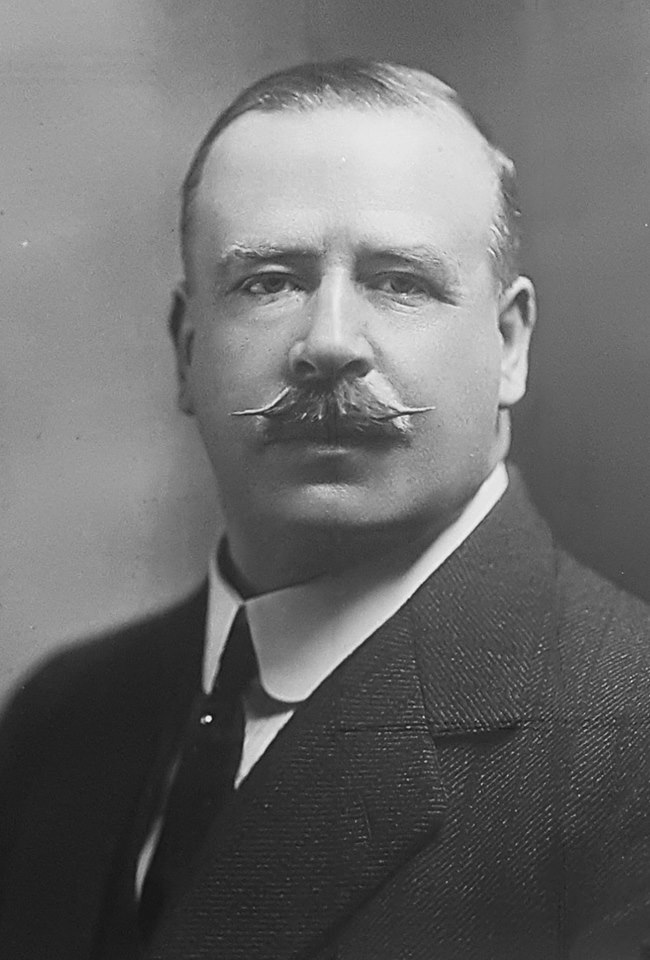
Sir Joseph George Ward, 1st Baronet, GCMG, PC (26 April 1856 – 8 July 1930) was a New Zealand politician who served as the 17th prime minister of New Zealand from 1906 to 1912 and from 1928 to 1930. He was a dominant figure in the Liberal and United ministries of the late 19th and early 20th centuries.

Key Information

Ward was born into an Irish Catholic family in Melbourne, Victoria. In 1863, financial hardship forced his family to move to New Zealand, where he completed his education. Ward established a successful grain trade in Invercargill in 1877 and soon became prominent in local politics. He became a Member of Parliament in 1887. Following the election of the Liberal Government in 1891, Ward was appointed as Postmaster-General under John Ballance; he was promoted to Minister of Finance in the succeeding ministry of Richard Seddon.

Ward became Prime Minister on 6 August 1906, following Seddon's death two months earlier. In his first period of government, Ward advocated greater unity within the British Empire, led New Zealand to Dominion status, and increased New Zealand's contribution to the Royal Navy. His government faced strong opposition from the Reform Party and the newly formed socialist parties. He led the Liberal Party to two election victories, in 1908 and 1911, albeit with a one-seat majority in the latter. He resigned as head of government on 28 March 1912.

During the First World War, Ward led his party in a coalition with the Reform Party. As co-leader of the government, Ward had a strained working relationship with Prime Minister William Massey. The coalition was dissolved in 1919 and Ward resigned as Liberal leader.

After a six-year absence from national politics, Ward returned to parliament in 1925. He became Prime Minister on 10 December 1928, as leader of the United Party, which had formed from the remnants of the former Liberal Party. Ward attempted to rejuvenate liberal support in New Zealand but his party lost ground to the New Zealand Labour Party. Failing health forced his retirement from leadership on 28 May 1930.

Early life

[edit]
Ward and his family, around 1905

Ward was born in Melbourne on 26 April 1856 to a Roman Catholic family of Irish descent. His father, William, died in 1860, aged 31 – Ward was raised by his mother, successful businesswoman Hannah Ward Barron. In 1863, the family moved to Bluff (then officially known as Campbelltown), in New Zealand's Southland region, seeking better financial security – Hannah Ward Barron established a shop and a boarding house.[1]

Ward received his formal education at primary schools in Melbourne and Bluff. He did not go to secondary school. He did, however, read extensively, and also picked up a good understanding of business from his mother. In 1869, Ward found a job at the Post Office, and later as a clerk. Later, with the help of a loan from his mother, Ward began to work as a freelance trader, selling supplies to the newly established Southland farming community.[1]

Early political career

[edit]
New Zealand Parliament
Years Term Electorate Party
1887–1890 10th Awarua Independent
1890–1893 11th Awarua Liberal
1893–1896 12th Awarua Liberal
1896–1897 13th Awarua Liberal
1897–1899 13th Awarua Liberal
1899–1902 14th Awarua Liberal
1902–1905 15th Awarua Liberal
1905–1908 16th Awarua Liberal
1908–1911 17th Awarua Liberal
1911–1914 18th Awarua Liberal
1914–1919 19th Awarua Liberal
1925–1928 22nd Invercargill Liberal
1928 Changed allegiance to: United
1928–1930 23rd Invercargill United

Ward became involved in local politics very quickly. He was elected to the Campbelltown (Bluff) Borough Council in 1878, despite being only 21 years old – at age 25 he became Mayor, the youngest in New Zealand. He also served on the Bluff Harbour Board, eventually becoming its chairman. In 1887, Ward stood for Parliament, winning the seat of Awarua.[2] Politically, Ward was a supporter of politicians such as Julius Vogel and Robert Stout, leaders of the liberal wing of Parliament – Ward's support was unusual in the far south.[citation needed]

Ward became known as a strong debater on economic matters. In 1891, when the newly founded Liberal Party came to power, the new Prime Minister, John Ballance, appointed Ward as Postmaster General. Later, when Richard Seddon became Prime Minister after Ballance's death, Ward became Treasurer (Minister of Finance). Ward's basic political outlook was that the state existed to support and promote private enterprise, and his conduct as Treasurer reflects this.[3]

Ward's increasing occupation with government affairs led to neglect of his own business interests, however, and his personal finances began to deteriorate. In 1896, a judge declared Ward "hopelessly insolvent". This placed Ward, as Treasurer, in a politically difficult situation, and he was forced to resign his portfolios on 16 June. In 1897, he was forced to file for bankruptcy, which legally obligated him to resign his seat in Parliament. A loophole meant that there was nothing to stop him contesting it again, however. In the resulting by-election he was elected with an increased majority. Ward gained considerable popularity as a result of his financial troubles – he was widely seen as a great benefactor of the Southland region, and public perceptions were that he was being persecuted by his enemies over an honest mistake.[citation needed]

Gradually, Ward rebuilt his businesses, and paid off his creditors. Seddon, still Prime Minister, quickly reappointed him to Cabinet where he served as Minister of Railways and Postmaster-General. On 19 June 1901, on the occasion of the visit of TRH the Duke and Duchess of Cornwall and York (later King George V and Queen Mary) to New Zealand, he was knighted as a Knight Commander of the Order of St Michael and St George (KCMG) for overseeing the introduction of the Penny Post throughout New Zealand.[4][5]

Ward gradually emerged as the most prominent of Seddon's supporters, and was seen as a possible successor. As Seddon's long tenure as Prime Minister continued, some suggested that Ward should challenge Seddon for the leadership, but Ward was unwilling. In 1906, Seddon unexpectedly died. Ward was in London at the time. It was generally agreed in the party that Ward would succeed him, although the return journey would take two months – William Hall-Jones became Prime Minister until Ward arrived. Ward was sworn in on 6 August 1906.[1]

The New Zealand Observer (1907) shows Ward as a pretentious dwarf beneath a massive "dominion" top hat. The caption reads: The Surprise Packet:
Canada: "Rather large for him, is it not?"
Australia: "Oh his head is swelling rapidly. The hat will soon fit."

First premiership

[edit]
The Seddon Ministry in 1900. Ward is second from the right in the bottom row.

Ward was not seen by most as being of the same calibre as Seddon. The diverse interests of the Liberal Party, many believed, had been held together only by Seddon's strength of personality and his powers of persuasion – Ward was not seen as having the same qualities.[6] Frequent internal disputes led to indecision and frequent policy changes, with the result being paralysis of government.

The Liberal Party's two main support bases, left-leaning urban workers and conservative small farmers, were increasingly at odds, and Ward lacked any coherent strategy to solve the problem – any attempt to please one group simply alienated the other. Ward increasingly focused on foreign affairs, which was seen by his opponents as a sign that he could not cope with the country's problems.[1]

In 1901, Ward established the world's first Ministry of Health and Tourism, and became the British Empire's first Minister of Public Health.[1] On 26 September 1907, Ward proclaimed New Zealand's new status as a Dominion.[7] He presided over a period of economic prosperity and provided state funds to help new settlers to the country. Public works schemes continued under his government with new infrastructure being built.[6]

In the 1908 election the Liberals won a majority, but in the 1911 election Parliament appeared to be deadlocked. The Liberals survived for a time on the casting vote of the Speaker, but Ward, discouraged by the result, resigned from the premiership in March the following year. The party replaced him with Thomas Mackenzie, his Minister of Agriculture, whose government survived only a few more months.[8]

Ward, who most believed had finished his political career, returned to the back benches and refused several requests to resume the leadership of the disorganised Liberals. He occupied himself with relatively minor matters, and took his family on a visit to England, where he was created a baronet by King George V on 20 June 1911.[9]

Leader of the Opposition

[edit]
A portrait of Ward by Sir William Orpen

On 11 September 1913, however, Ward finally accepted the leadership of the Liberal Party once again.[10] Ward extracted a number of important concessions from the party, insisting on a very high level of personal control – he felt that the party's previous lack of direction was the primary cause for its failure. He also worked to build alliances with the growing labour movement, which was now standing candidates in many seats. Ward lead the Liberals into the 1914 election and gained two seats. Despite the gains the Reform government was reduced to a bare minimum majority and when a by-election in Dunedin Central was triggered early the next year there was much at stake. The Liberal Party chose not contest the election themselves but Ward actively toured the electorate holding meetings to encourage the electors to vote for the Labour candidate Jim Munro. In the event of a Labour victory it was conceivable for Ward to form a minority government with Labour support. Ward had made preparation for a return to power, but the Reform Party managed to hold the seat.[11]

On 12 August 1915, Ward and accepted a proposal by William Massey and the governing Reform Party to form a joint administration for World War I. Ward became deputy leader of the administration, also holding the Finance portfolio. Relations between Ward and Massey were not good – besides their political differences, Ward was an Irish Catholic, and Massey was an Irish Protestant. The administration ended on 21 August 1919 following a decision made by caucus to do so two months earlier.[12]

In the 1919 election Ward lost the seat of Awarua, and left Parliament. In 1923, he contested a by-election in Tauranga, but was defeated by a Reform Party candidate, Charles Macmillan.[13] Ward was largely considered a spent force. In the 1925 election, however, he narrowly returned to Parliament as MP for Invercargill.[2] Ward contested the seat under the "Liberal" label, despite the fact that the remnants of the Liberal Party were now calling themselves by different names – his opponents characterised him as living in the past, and of attempting to fight the same battles over again. Ward's health was also failing.

In 1928 the remnants of the Liberal Party reasserted themselves as the new United Party, focused around George Forbes (leader of one faction of the Liberals), Bill Veitch (leader of another faction), and Albert Davy (a former organiser for the Reform Party). Forbes and Veitch both sought the leadership, and neither gained a clear advantage. Davy invited Ward to step in as a compromise candidate, perhaps hoping that Ward's status as a former Prime Minister would create a sense of unity.

Second premiership

[edit]
Official portrait for the 1928 election campaign

Ward accepted an offer from Albert Davy and became leader of the new United Party, fighting off three other contenders.[14] His health, however, was still poor, and he found the task difficult. In the 1928 election campaign, Ward startled both his supporters and his audience by promising to borrow £70 million in the course of a year to revive the economy – this is believed to have been a mistake caused by Ward's failing eyesight. Despite the strong objections his party had to this "promise", it was sufficient to prompt a massive surge in support for United – in the election United gained the same number of seats as Reform.

With the backing of the Labour Party, Ward became Prime Minister again, 22 years after his original appointment. He also briefly served as Minister of External Affairs in 1929.[15] Ward was also attempting to rejuvenate liberal support in New Zealand. His cabinet was rather youthful, with only two members (Thomas Wilford and Āpirana Ngata), other than himself, having held ministerial portfolios before.[16] Ward, as Finance Minister, passed a mini-budget at the end of 1928 appropriating £1,175,000 for public works construction.[17] In 1929 the government reneged on the £70 million borrowing promise and introduced a watered down land tax. In October, under increasing pressure from Labour, Ward made moves to reduce the growing unemployment numbers.[18]

Health and death

[edit]
Statue of Ward in Bluff by W.H. Feldon

Ward's health continued to decline. From late-September 1929 Ward seldom attended debates in the House and from March 1930 Ward was too ill to even hold meetings of the Cabinet.[19] He suffered a number of heart attacks, and soon it was George Forbes who was effectively running the government. Ward was determined not to resign, and remained Prime Minister until well after he had lost the ability to perform the role effectively. On 28 May 1930, Ward succumbed to strong pressure from his colleagues and his family, and passed the premiership to Forbes.[20] Ward had been promoted to Knight Grand Cross of the Order of St Michael and St George in the 1930 New Year Honours.[21]

Ward remained a member of the cabinet as a Minister without Portfolio, but died shortly afterwards, on 8 July. He was given a state funeral with a Requiem Mass celebrated on 9 July at the Basilica of the Sacred Heart, Hill St, Wellington. Ward had been an active worshipper there (and at its destroyed predecessor, St Mary's Cathedral) for all of his thirty-seven years as an MP.[22]

The Mass was celebrated by Bishop O'Shea (the Coadjutor Archbishop of Wellington), and Archbishop Redwood, 1st Archbishop of Wellington, delivered the panegyric.

Ward was buried with considerable ceremony in Bluff. His son Vincent was elected to replace him as MP for Invercargill.[1]

Arms

[edit]
Coat of arms of Joseph Ward
Crest
A demi-griffin Azure in front of two keys in saltire wards upwards Or.
Escutcheon
Azure a cross moline Argent between four keys wards upwards Or.
Motto
Animo Et Fide[23]

References

[edit]

Bibliography

[edit]
[edit]
Revisions and contributorsEdit on WikipediaRead on Wikipedia
from Grokipedia
Sir Joseph George Ward, 1st Baronet GCMG PC (26 April 1856 – 8 July 1930), was a politician who served as the 17th from 6 August 1906 to 12 March 1912 and from 10 December 1928 to 28 May 1930. Born in , , to Irish immigrant parents William Thomas Ward and Hannah Dorney, Ward moved to with his family at age three, where he began as a telegraph boy before building a successful merchant business in Southland. Entering in 1887 as a Liberal, he became Minister of Finance under and , holding the post for much of the next two decades and overseeing and borrowing that fueled but also drew scrutiny for increasing national debt. Succeeding Seddon as premier in 1906, Ward's first term emphasized social reforms including the National Provident Fund and widows' pensions, alongside defence preparations like compulsory military training, though his government was criticized for vague policy promises amid prosperity. Returning to power in 1928 via a coalition with the Reform Party, his brief second ministry grappled with the onset of the until his death in office. Ward was knighted and created a in 1911 for services to the , reflecting his advocacy for closer imperial ties and 's contributions to naval defence.

Early Life and Background

Family Origins and Immigration

Joseph George Ward was born on 26 April 1856 in , Victoria, , to Irish immigrants William Ward, a clerk, and Hannah (née Dorney Ward), who operated a liquor shop. The family endured significant hardship, with ten children born but seven dying in infancy, leaving Ward as the youngest of three survivors—sisters Mary (known as Mina) and brother William. William Ward's death in 1860, at age 31 from due to , exacerbated the family's economic precarity in . Hannah Ward assumed responsibility as breadwinner, remarrying John Barron, an English butcher, on 31 December 1862—a union that quickly dissolved. In September 1863, Hannah Ward Barron immigrated to with her three surviving children, settling in Bluff (then Campbelltown) in the . This relocation aligned with Southland's colonial expansion as a port area, offering prospects amid gold rushes and agricultural development, though the family initially faced ongoing financial strains that underscored themes of resilience and self-reliance in Ward's upbringing.

Education, Early Employment, and Initial Business Ventures

Ward received his at Spring's Academy in prior to his family's in 1863, followed by attendance at Campbelltown School in Bluff until 1869, when he was 13 years old. At the school, he demonstrated early entrepreneurial initiative by organizing fellow students to sell toetoe grass to local sailors, fostering basic trading skills through practical experience rather than formal instruction. His formal schooling ended at this point, with subsequent knowledge acquisition relying on self-directed efforts, including independent mastery of and . In 1869, Ward entered employment as a messenger boy for the Bluff within the New Zealand Post and Telegraph Department, a role that exposed him to basic administrative duties but ended abruptly due to his dismissal for impudence toward a superior. He then secured a position as a at Samuel Nichol's general store on the Bluff waterfront, where he remained until 1876, handling mercantile tasks that built foundational knowledge in commerce and inventory management. Briefly in 1876, he served as chief for the Public Works Department, overseeing ship loading and unloading operations, which further honed his logistical acumen without reliance on advanced credentials. Ward launched his initial business ventures in 1877–1878 by borrowing £800 from his mother to construct waterfront storage sheds in Bluff, enabling small-scale mercantile operations focused on purchasing local produce such as , , and skins from farmers. He supplemented this by selling agricultural supplies, including grass seed and , to Southland producers, emphasizing verifiable trade cycles and cash-based stability to avoid indebtedness. These efforts, conducted primarily in Bluff during the late 1870s, marked his transition from wage labor to independent enterprise through accumulated practical expertise rather than external financing or .

Business Career and Financial Controversies

Merchant Activities in Southland

In 1877, Joseph Ward established himself as an independent in , Southland, by constructing storage sheds on the waterfront with a of £800 from his mother, initially focusing on the . This venture capitalized on the region's agricultural output, allowing Ward to purchase grain directly from local farmers for export. Ward expanded his operations to include trading in , skins, and other farm produce, while also supplying farmers with essential goods such as seeds, fertilizers, and equipment. By acquiring shipping agencies, he facilitated efficient transport of commodities to ports like Bluff, enhancing connectivity between Southland producers and international markets without reliance on government intervention. These market-driven activities contributed to Ward's personal wealth accumulation, reportedly reaching substantial levels by the mid-1880s through reinvested profits and volume-based trade. His enterprises supported Southland's by providing stable outlets for farmers' goods amid fluctuating prices, employing local labor in warehousing and , and stimulating ancillary services like transport and brokerage. Ward's approach emphasized private risk-taking, as evidenced by his early success in scaling from small-scale dealings to a diversified mercantile network serving the province's and arable sectors.

Freezing Works Involvement and 1890s Scandals

In the early 1890s, amid New Zealand's ongoing characterized by weak export prices for agricultural commodities, Joseph Ward invested in the meat freezing industry as part of his broader merchant activities in Southland. He played a key role in establishing the Ocean Beach Freezing Works near Bluff around 1891–1892, serving as chairman of the associated company and leveraging his position to secure advances for construction and operations. This venture aligned with the nascent frozen meat export trade, which had expanded from 4,311 carcasses shipped in 1882 to significant volumes by the mid-1890s, though profitability remained elusive due to international oversupply and depressed prices. The freezing works' finances intertwined with Ward's J.G. Ward Farmers' Association, which borrowed heavily from the Colonial Bank to fund operations, including promissory notes tied to Ward's personal guarantees. By 1895, as global meat prices continued to slump—reflecting the broader Long Depression's impact on New Zealand exports from the late 1870s to mid-1890s—the association faced insolvency, exacerbated by the Colonial Bank's own collapse and refusal to honor its debts post-acquisition by the Bank of New Zealand. Creditors initiated liquidation proceedings, alleging misuse of funds advanced for the freezing works, including claims of improper payments to Ward personally and insider dealings that prioritized association debts over bank obligations. Ward countered these accusations by attributing the failure primarily to external rather than malfeasance, pointing to the sharp decline in export realizations that rendered over-leveraged operations unviable despite initial optimism in refrigeration technology. He pursued legal defenses, including challenges to claims in , and was ultimately discharged from on 5 November 1897 after friends and family repurchased assets from the official assignee. While some conservative critics viewed the episode as emblematic of reckless under Liberal-era borrowing enthusiasm—warning against conflating entrepreneurial risk with systemic safeguards— of sustained price weakness, with frozen meat trade not turning consistently profitable until after 1895, supports over-extension amid uncontrollable global conditions as the dominant causal factor over deliberate . The scandals, amplified by political opponents amid Ward's rising Liberal Party profile, paradoxically garnered regional sympathy by framing the works as a bold, if ill-timed, effort to bolster Southland's export infrastructure, transforming personal financial ruin into a of resilience against economic adversity.

Entry into Politics

Election to Parliament and Liberal Party Alignment

Ward contested and won the Awarua electorate in the 1887 New Zealand general election, securing his first seat in the at age 31. His victory drew on extensive merchant networks cultivated in Southland, where he had built a prosperous in , , skins, and shipping agencies, positioning him as a self-made for regional economic interests against more established political elites. Initially, Ward aligned with the Stout–Vogel ministry, standing out as one of the few Southland representatives to back its borrow-and-build program amid widespread calls for fiscal retrenchment during economic downturns. This stance reflected his expansionist outlook, prioritizing infrastructure like railway completion to restore business confidence rather than measures. With the rise of John Ballance's Liberal faction around 1890, Ward shifted toward its platform of —aimed at subdividing large estates for small farmers—and progressive economic policies, but interpreted through a pro-business lens emphasizing private enterprise and efficient state facilitation over collectivist redistribution. His involvement in ventures like the Bluff Harbour Board (chairman 1883–1888) and support for freezing works underscored this practical alignment, appealing to Southland's agricultural exporters while avoiding radical ideological commitments. Ward quickly rose in prominence via targeted parliamentary interventions, including 1888 tariff debates where he pushed for restructured mail shipping contracts to enhance value for public expenditure, and his endorsement of the 1892 budget, which highlighted his command of intricacies. These speeches differentiated him from both conservative retrenchers and emerging socialist radicals by advocating technocratic fiscal prudence geared toward growth-oriented investments.

Ministerial Positions under Richard Seddon

Joseph Ward entered the Liberal cabinet as Postmaster-General and Commissioner of Telegraphs in January 1891 under Prime Minister John Ballance, positions he maintained following Richard Seddon's ascension to the premiership in 1893. As Seddon's trusted lieutenant, Ward oversaw expansions in postal and telegraph services, culminating in the introduction of universal penny postage on 1 January 1901, which lowered letter rates from 2d to 1d and spurred commercial correspondence across the colony and to Britain. This reform, advocated by Ward to enhance trade efficiency, marked New Zealand as a pioneer in affordable imperial communication. In 1896, Ward assumed the role of Colonial Treasurer, a post he held until 1906, focusing on prudent fiscal management amid public works demands. He facilitated overseas loan flotations in to finance , including extensions that connected remote regions and boosted export capacities, while implementing rate reductions to increase usage and revenue. These measures reflected Ward's emphasis on debt-funded development under controlled borrowing, aligning with Seddon's vision of state-led progress without unchecked fiscal expansion. Ward also briefly held the Railways portfolio after the 1899 election, reorganizing accounting systems and adjusting freight charges to promote efficiency and growth. His advocacy for imperial trade preferences, prioritizing British markets over full , positioned him as Seddon's protégé in foreign economic policy, though it elicited reservations from protectionist elements within the Liberal Party who viewed it as excessively oriented toward metropolitan interests.

First Premiership (1906–1912)

Ascension following Seddon's Death

Richard Seddon, the long-serving Liberal Premier, died suddenly on 10 June 1906 aboard the steamer SS Oswestry Grange while returning from Australia, leaving a power vacuum within the Liberal Party. At the time, Joseph Ward, Seddon's deputy and Minister of Finance, Postmaster-General, and Telegraph, was attending an Imperial Conference in London. William Hall-Jones, as Public Works Minister, assumed the role of interim Premier from 10 June to 6 August 1906, managing the transition until Ward's return. Ward was formally appointed Premier by Governor Lord Plunket on 6 August 1906, despite some expectations that Hall-Jones might retain the position longer, reflecting Seddon's prior designation of Ward as successor but complicated by Ward's absence and internal party discussions. Upon assuming office, Ward prioritized stability by retaining much of Seddon's cabinet structure while conducting minor reshuffles, including appointing figures like John Andrew Millar to portfolios such as labour and , to maintain administrative continuity amid a fractious Liberal caucus of nearly 60 members in a House of 80. This approach aimed to bridge factional divides within the party, which had grown under Seddon's dominant , but exposed Ward to accusations of lacking bold leadership. The Reform Party, emerging as the main opposition, criticized Ward's rapid ascension as opportunistic, portraying it as exploiting Seddon's legacy without substantive ideological commitment, a charge amplified by Liberal internal divisions that hindered unified decision-making. Ward consolidated his leadership through the November 1908 , where the Liberal Party secured an outright victory, retaining power despite losses in rural farming districts and the defeat of key minister Robert McNab. This win underscored Ward's success in emphasizing policy continuity over radical shifts, though it masked underlying party factionalism that would later erode support.

Domestic Reforms: Social Welfare and Public Health

The National Provident Fund Act of 1910 established a state-subsidized scheme to promote voluntary contributions for old-age pensions, sickness benefits, and life annuities, extending the Liberal government's earlier old-age pension system introduced under in 1898 by incentivizing personal savings with government matching funds. The fund offered contributors options for deferred annuities starting at age 60 or 65, with subsidies scaling by contribution level—up to 100% for low earners—aiming to reduce future reliance on means-tested aid amid rising elderly populations. Initial uptake included thousands of depositors, though exact figures varied; by the early , it supplemented existing pensions, with government outlays reflecting subsidies that critics later highlighted as contributing to budgetary pressures without fully offsetting long-term fiscal demands. The Widows' Pensions Act 1911 provided means-tested weekly payments of up to £1 to eligible widows with dependent children under 14 (or 16 if incapacitated), effective from 1 1912, targeting those previously reliant on charitable or institutional care. Administered through local magistrates with income and asset tests, it supported approximately 2,000 recipients in its first year, costing the state around £100,000 annually by 1913, and represented an empirical step toward alleviating by enabling family maintenance outside workhouses. These expansions under Ward advanced principles, reducing destitution rates among targeted groups, yet entailed rising public expenditure—widows' pensions alone added to the £1.5 million yearly welfare outlay by 1912—prompting opposition claims of fostering dependency over self-provision, as articulated by Party advocates favoring private charity and market incentives. In , Ward's tenure as Minister saw the Hospitals and Charitable Institutions Act 1909 centralize oversight by dividing into 37 hospital districts, each governed by elected boards funded via local rates (one-quarter of costs), capitation , and patient contributions, streamlining distribution and previously fragmented under 1885 legislation. This facilitated hospital expansions, with total beds increasing from about 2,500 in 1906 to over 3,000 by 1912, alongside sanitation drives enforcing water purity and waste disposal under the Act amendments. Empirical data showed correlated improvements, including urban dropping from 70 per 1,000 live births in 1906 to around 55 by 1912 in major centers like and , attributable in part to better maternal care access and enforcement amid broader socioeconomic gains. These measures prioritized preventive interventions over curative alone, yielding verifiable mortality reductions, though fiscal strains from subsidized care—exceeding £500,000 annually by 1910—drew critique for expanding state roles at potential expense of local autonomy and individual thrift.

Economic Policies: Infrastructure, Trade, and Fiscal Management

Ward's government pursued infrastructure expansion through targeted public borrowing, focusing on railways to integrate remote agricultural regions with export ports. The completion of the railway on 6 November 1908, marked by Ward driving the ceremonial silver spike at Manganuioteao, connected and over 700 kilometers, reducing transport costs and enabling efficient movement of , meat, and timber to coastal facilities. This extension added to the national network's mileage, which grew from approximately 2,100 miles in 1906 to over 2,300 by 1912, supporting productivity gains in farming districts by improving . Overseas loans funded these projects, reflecting Ward's view that state investment in capital-intensive works generated long-term economic returns superior to private alternatives, though critics contended it prioritized political over fiscal restraint. In trade policy, Ward emphasized to bolster New Zealand's position within the , advocating reciprocal reductions on colonial goods during London visits in 1907, 1909, and 1911. This approach complemented existing technologies, sustaining volumes of frozen meat—which rose from 160,000 tons in to over 200,000 tons by 1911—and , primarily to Britain, where they comprised 90% of total exports. While not pure , preference mitigated global competition vulnerabilities, fostering trade surpluses averaging £4-5 million annually in the period, driven by agricultural booms rather than . Opponents, including emerging interests, argued it exposed the economy to imperial market fluctuations without diversifying sufficiently. Fiscal management under Ward balanced expansionist borrowing with post-recession prudence, as the global credit contraction halved activity and strained revenues. Public debt climbed to £70 million by 1912, with 88% of new loans from 1909-1913 allocated to non-defense works like railways and harbors, yet budgets achieved surplus after 1909 through expenditure cuts and land sale proceeds. This realism countered charges of unchecked spending, as investments correlated with recovery, averting deeper ; conservative analyses, however, highlighted rising debt-to-revenue ratios—nearing 10:1—as risking future solvency amid commodity price cycles, underscoring trade dependence over domestic fiscal buffers.

Foreign Policy: Imperial Ties and Defense Initiatives

Ward maintained a staunch commitment to strengthening ties with the , viewing imperial unity as essential for 's security and prosperity. During his premiership, he championed and attended key conferences in , including in 1909 and 1911, where he advocated for coordinated defense and mechanisms across the dominions. This stance reflected a causal prioritization of collective imperial strength against rising naval threats from , rather than , which Ward argued would leave vulnerable given its reliance on British naval protection. A of Ward's defense initiatives was the naval contribution announced in March 1909, amid the British dreadnought crisis. The government offered to fund two dreadnought battleships for the Royal Navy, or equivalent financial support, underscoring Ward's belief in direct contributions to imperial naval supremacy; this ultimately materialized as funding for the battlecruiser HMS New Zealand, commissioned in 1912. Complementing this, the Defence Act 1909 established compulsory military training for males aged 12 to 25, replacing the volunteer-based system with a capable of mobilizing up to 23,000 men, thereby building domestic readiness linked to imperial defense needs. Ward also pushed for imperial preferential tariffs to bolster intra-Empire trade, aligning with New Zealand's economic dependence on Britain, which absorbed approximately 80 percent of its exports—primarily agricultural products—during this era. These policies aimed to enhance economic resilience through protected imperial markets, though they drew criticism from emerging nationalist and left-wing voices who decried them as subservient, arguing that to imperial commitments diverted funds from local priorities and fostered undue reliance on Britain. Pacifist opposition, manifesting in the Passive Resisters' Union formed post-1909, highlighted conscientious objections to compulsory training as imperial overreach, yet empirical outcomes validated Ward's approach: the reforms facilitated New Zealand's rapid mobilization in , contributing over 100,000 troops to imperial forces.

Opposition Period (1912–1928)

Electoral Defeat and Leadership of the Liberal Remnant

In the December 1911 , the Liberal Party under Joseph Ward's leadership lost its parliamentary majority, resulting in a with neither the Liberals nor the opposing Party securing a clear win. The contest, held on 7 and 14 December for general electorates, reflected growing rural discontent with Liberal policies, including high public spending on social welfare programs that had accumulated fiscal strains during a period of economic slowdown and rising union unrest. When convened on 15 1912, the tied vote was resolved by the Speaker's in favor of Ward's government, but this precarious hold lasted only until 28 March 1912, when Ward resigned as Prime Minister amid defections, allowing Reform's Thomas Mackenzie to form a minority administration. The defeat stemmed from voter shifts, particularly among farmers who gravitated toward Reform's promises of land freehold reforms and reduced government intervention, contrasting with the Liberals' emphasis on state advances and leasing systems that were seen as burdensome amid agricultural grievances. Internal Liberal analyses attributed the loss to the cumulative costs of expansive welfare measures—such as old-age pensions and —coupled with policy inconsistencies and public skepticism toward Ward's ambitious imperial gestures, like funding the HMS New Zealand battleship, which drew ridicule for fiscal extravagance. While exact vote shares varied by electorate under the first-past-the-post system, the Liberals' national support eroded sufficiently to cede effective control, with Reform consolidating rural bases that prioritized economic over progressive reforms. Ward maintained leadership of the diminished Liberal opposition by leveraging his personal popularity and loyal Southland constituency, where his merchant background and advocacy for secured seats like Awarua and bolstered a core remnant of 20-30 parliamentarians. Rather than overhauling party platforms, Ward relied on his charismatic oratory and courteous demeanor to rally supporters, fending off internal challengers through sheer force of personality amid the party's fragmentation. This approach sustained his position as until a formal 1913 party ballot on 11 September, where he reclaimed explicit authority over strategy, preventing total dissolution despite ongoing economic critiques. By July 1912, when Liberal defectors bolstered Reform's into full power, Ward's tenacity had preserved a viable, if reduced, Liberal faction centered on his regional stronghold.

Internal Party Struggles and Coalition Negotiations

During the First World War, internal divisions within the Liberal Party intensified over New Zealand's military commitments, particularly Ward's endorsement of conscription as part of the 1915 wartime coalition with Prime Minister William Massey's Reform Party. Ward, resuming Liberal leadership in 1913, supported the coalition's formation in August 1915, viewing it as essential for imperial loyalty and national unity amid the conflict, but this pragmatic alignment alienated pacifist and anti-conscription factions within the party, many of whom sympathized with emerging labour movements opposing compulsory service introduced in 1916. These tensions exacerbated the Liberals' electoral setbacks, as radical elements defected toward the newly formed Labour Party, which campaigned vigorously against conscription and positioned itself as the true heir to progressive reform. The wartime National government, lasting until its dissolution in July 1919, highlighted Ward's conservative against the party's more isolationist or domestically focused wings, with personal frictions—such as Ward's reported disdain for Massey—further straining Liberal cohesion. Post-war, Ward's leadership emphasized fiscal prudence and private enterprise support over radical redistribution, clashing with reformers advocating expanded social welfare amid economic readjustment. Negotiations for renewed coalitions faltered; talks with between 1919 and 1925 collapsed over ideological divergences, including Liberals' lingering commitment to versus Reform's farmer-centric policies, compounded by mutual distrust from the coalition's acrimonious end. Attempts to align with Labour similarly failed, as Ward rejected the 's socialist agenda—such as pushes—prioritizing instead moderate that preserved market incentives, a stance rooted in his pre-war finance ministry balancing budgets without heavy state intervention. By the mid-1920s, these rejections underscored Ward's resistance to party radicalization, but critics within the Liberals, including younger MPs, lambasted his prolonged tenure since as fostering stagnation, arguing it blocked adaptation to voter shifts toward Labour's militancy and Reform's rural appeal, contributing to the party's organizational decay and repeated electoral losses in , , and 1925. This internal critique, voiced in party caucuses and public commentary, portrayed Ward's as a barrier to renewal, though he defended it as safeguarding the Liberals' foundational against unproven ideological drifts.

Formation of the United Party and Strategic Realignment

In the mid-1920s, the Liberal Party faced severe decline, reduced to 11 seats in the 1925 general election amid the dominance of the Reform Party (37 seats) and the rise of Labour (12 seats), prompting internal splits between nationalists led by George Forbes and die-hard Liberals. This erosion reflected the Liberals' failure to adapt to shifting voter priorities, including rural discontent and urban labour mobilization, necessitating a strategic pivot to consolidate moderate, pro-business elements disillusioned with Reform's . Ward, who had distanced himself from party affairs during overseas travels in the early 1920s, emerged as a unifying figure for this realignment, leveraging his reputation as a pragmatic financier and former premier to appeal beyond the Liberal base. The United Party formed in 1927 from Liberal remnants, incorporating independents and moderate ex-Reformers to position itself as a centrist alternative emphasizing fiscal prudence and imperial ties over ideological purity. At a unity conference in , Ward was selected as leader on 17 September 1928, marking his tactical return to domestic politics after years abroad and endorsing the merger's aim to revive Liberal fortunes by diluting strict free-trade dogma in favor of broader electoral viability. This realignment succeeded in aggregating pro-business moderates but drew criticism from traditionalists for compromising the party's original anti-protectionist stance, as Ward prioritized coalition potential against Reform over doctrinal consistency.

Second Premiership (1928–1930)

1928 Election Victory and Coalition Government

The 1928 New Zealand general election, held on 14 November, resulted in the United Party, under Joseph Ward's leadership, winning 27 seats in the 80-member , with the Party securing 28 seats and the Labour Party 19. Unable to form a independently, Ward, aged 72, leveraged his extensive experience from the earlier Liberal administrations to negotiate a coalition agreement with leader Gordon Coates, aimed at blocking Labour from power. This pact enabled Ward to be sworn in as on 10 December 1928, marking his return to office after 16 years. Ward's advanced age was dual-edged: proponents highlighted his seasoned judgment and financial acumen as stabilizing forces amid economic uncertainties, while critics noted his frailty as a potential hindrance to vigorous . The coalition's formation reflected strategic realignment between the centrist United remnants of the Liberals and the agrarian-focused , prioritizing continuity over ideological purity to counter Labour's rising urban support. The resulting cabinet balanced factional interests, incorporating key Reform figures such as Sir James Allen as Minister of Defence, William Nosworthy for , and others to ensure parliamentary support without ceding overall control to United ministers. This arrangement promised enhanced governmental stability following the single-party Reform tenure under Coates, fostering initial optimism for collaborative policy-making and economic prudence.

Policy Priorities amid Economic Downturn

Upon assuming office in December 1928, Ward's prioritized large-scale public borrowing to fund resumption and schemes, echoing Liberal traditions from his first premiership, with an initial campaign pledge to secure £70 million from overseas markets within the year to stimulate and economic activity. However, the Wall Street Crash of October 1929 triggered a global credit contraction, rendering most of the promised loans unattainable as international lenders tightened terms amid falling commodity prices for New Zealand's key exports like and products. Ward defended adherence to the gold standard as essential for maintaining stability and investor confidence, resisting early calls for that might have eased import costs but risked and further . This stance aligned with orthodox but drew criticism for prolonging deflationary pressures, as export revenues declined by over 20% in 1929-1930 while import prices remained rigid under the fixed parity. Efforts at trade diversification, including exploratory overtures to non-British markets, yielded minimal results due to protective tariffs abroad and New Zealand's entrenched reliance on imperial preferences, with programs scaled back as borrowing stalled. Empirically, these priorities faltered against the downturn's momentum: registered , already climbing from seasonal lows in 1928, surged through 1929 and exceeded 10% by mid-1930 as construction and export sectors contracted, with contracting by approximately 5-7% over the period. Critics, including Party figures, argued that the heavy emphasis on state-led borrowing overlooked signals of shortages and overcapacity in primary industries, perpetuating an interventionist model ill-suited to the credit famine. Ward countered that sustained infrastructure investment offered the surest path to recovery, though actual disbursements fell far short of projections, highlighting the causal disconnect between pre-crash optimism and post-1929 realities.

Administrative Challenges and Health Deterioration

Ward's second administration encountered significant administrative hurdles, exacerbated by the onset of the global economic downturn in , which amplified domestic and fiscal pressures. Despite electoral promises of expansive funded by £70 million in overseas borrowing—announced in August 1928 to stimulate and —the achieved little , hampered by logistical skepticism, inadequate , and internal paralysis. Ward's reliance on deputies such as George Forbes, leader of the coalition partner Reform Party, for day-to-day political management fostered cabinet frictions and diffused accountability, resulting in delayed responses to emerging crises like collapsing prices. These governance inefficiencies were compounded by Ward's deteriorating health, which began manifesting acutely in September 1929 with symptoms of advanced physical decline, including a series of heart attacks that necessitated hospitalization and confined him to limited duties. Medical assessments at the time described him as being in "the last stages of decrepitude," directly impairing his capacity for decisive and contributing to stagnation during a period of mounting economic distress. Critics within political circles argued that Ward's persistence in office, despite evident incapacity, placed undue strain on United-Reform coalition, as his fatigue-induced inertia hindered adaptive measures against the Depression's early impacts, such as rising joblessness exceeding 10% by mid-1930. This reluctance to delegate fully or step aside earlier, even under pressure from colleagues, underscored a causal link between personal frailty and administrative , prioritizing nominal continuity over effective governance.

Death, Succession, and Legacy

Final Illness and Death in Office

Ward's health deteriorated markedly after the 1928 election victory, compounded by longstanding issues including heart disease, , and impaired vision. By September 1929, he endured a series of heart attacks that necessitated hospitalization and prompted descriptions of him as being in advanced physical decline. Initial suggestions of resignation were rebuffed as Ward sought to maintain leadership amid economic pressures, but repeated episodes of illness confined him to bed and intensified concerns within his cabinet. On 14 May 1930, yielding to insistent appeals from family members and senior colleagues, he publicly declared his intent to retire from the premiership; power transitioned smoothly to coalition partner George Forbes on 28 May, with Ward retaining a nominal position as to ensure administrative continuity. Ward died on 8 July 1930 at his residence, aged 74, from heart-related complications following this brief post-resignation period. His passing prompted a procession marked by formal honors, culminating in burial at Bluff Cemetery alongside his wife. , already installed as , assumed immediate caretaker duties without disruption to government operations.

Immediate Political Aftermath

Ward died on 8 July 1930, less than two months after resigning as on 28 May due to deteriorating health, leaving the United Party without its longstanding charismatic leader who had personally bridged ideological gaps within the coalition. His death intensified perceptions of fragility in the United- partnership, as Ward had served as the primary stabilizing force amid pre-existing factional distrust between the liberal-leaning United remnants and the more conservative elements. Under new United leader and George Forbes, the government navigated initial post-death continuity but confronted escalating Depression-era pressures, including rising and financial instability, which exposed policy divergences and prompted a formal deepening of the with on 22 September 1931 to share responsibility for measures. Gordon Coates, as Reform's key figure and minister of , assumed greater influence in cabinet dynamics, yet the absence of Ward's unifying appeal contributed to underlying tensions that undermined cohesive decision-making. The secured re-election on 2 1931, gaining substantial support despite Labour's vote surge driven by economic discontent, but this victory highlighted short-term erosion: independents and splinter sentiments fragmented the anti-Labour vote, signaling the coalition's reliance on Ward's personal authority had ended, leaving exposed divisions that fragile economic policies would further strain.

Long-Term Assessments: Achievements, Criticisms, and Historiographical Debates

Ward's contributions to , particularly railways, left a lasting imprint on New Zealand's connectivity and economic integration. As Minister of Railways, he accelerated the line, culminating in its completion and ceremonial opening on 6 1908, which linked to and boosted freight transport for agricultural exports. Under the Liberal governments from 1891 to 1912, during which Ward served key roles, the railway network expanded significantly, with open mileage increasing from approximately 1,842 miles in 1891 to over 2,500 miles by 1912, doubling effective capacity through relaying and new lines that supported . Complementary policies, such as the introduction of penny postage in 1901, spurred communication growth, with letter volumes rising by 13 million in the first year, while subscribers grew from 3,811 in 1893 to 37,257 by 1912. These initiatives underpinned pre-World War I prosperity, as New Zealand's GDP advanced rapidly during the Liberal boom until 1908, driven by export-led growth in refrigerated and , positioning the country among the world's wealthiest by living standards. Critics, including historian Michael Bassett, have highlighted Ward's fiscal imprudence as a core weakness, pointing to his in amid £100,000 in debts from speculative ventures, which reflected a pattern of overextension mirrored in . Public borrowing escalated under Liberal administrations to fund and early welfare measures; the 1895 Government Advances to Settlers Act of £1.5 million was oversubscribed fivefold in , but such overseas financing accumulated debt that strained finances post-boom, with total public liabilities rising amid commitments to superannuation schemes for civil servants (1893) and railway workers (1902), which some later analyses view as precursors to by prioritizing state provision over self-reliance. Bassett further critiques Ward's 1928 election pledge of a £70 million for , which largely went unraised amid economic contraction, exacerbating without addressing structural inefficiencies. Allegations of lax oversight in financial scandals, such as the Colonial Bank's collapse tied to Ward's earlier dealings, fueled perceptions of inadequate accountability in his administrations. Historiographical debates center on Ward's imperial orientation versus New Zealand's evolving autonomy, with his advocacy for , trade preferences, and contributions like funding HMS New Zealand in 1909 exemplifying loyalty to Britain, yet yielding limited practical gains as status advanced independently by 1907. Modern assessments rank Ward mid-tier among New Zealand prime ministers, crediting his adaptability in coalition-building and endurance across four decades but faulting a lack of bold innovation, with longevity often prioritized over transformative reforms in evaluations by historians comparing him to figures like Seddon. Bassett's biography underscores this ambivalence, portraying Ward as an entrepreneurial optimist whose infrastructure legacies endured but whose verbose style and indecisiveness hampered decisive leadership during downturns. These views challenge earlier hagiographic Liberal narratives by emphasizing empirical outcomes, such as stalled borrowing promises and debt burdens, over rhetorical promises of progress.

Personal Life and Honors

Family, Character, and Private Interests

Joseph Ward married Theresa Dorothea de Smidt on 4 December 1883 in . The couple had five children: , , Gladstone, Awarua Patrick, and . Four of the children spent their early years in Bluff before attending private schools, reflecting the family's relocation and Ward's rising status. Theresa played a supportive role in Ward's career, particularly during personal and financial adversities, until her death in 1927. Ward was noted for his courteous demeanor, optimism, and exceptional retentive memory, which allowed him to recall and deploy statistics effectively in public addresses. Contemporaries described him as engaging and impeccably dressed, though later assessments critiqued him as increasingly pompous and paranoid following financial setbacks. In private life, Ward developed an interest in , taking it up during a 1912 holiday in and later serving as patron of the Wellington Golf Club. He demonstrated resilience amid the 1897 bankruptcy stemming from business failures, rebuilding his finances with family assistance and being discharged on 5 November 1897; Theresa's support was instrumental in maintaining family stability during this period.

Titles, Baronetcy, and Heraldic Arms

Ward received the Knight Commander of the Order of St Michael and St George (KCMG) in 1901 for his role in implementing the penny postage system across , a that enhanced imperial communication links. He was appointed to the British in 1907, recognizing his contributions to dominion governance and imperial conferences. These honors underscored Ward's alignment with British imperial structures, though his enthusiasm for titles drew criticism from egalitarian factions in New Zealand's democratic polity as emblematic of aristocratic pretensions. On 20 June 1911, during the of King George V, Ward was created the 1st Ward, of in , the second such hereditary baronetcy awarded to a New Zealander after William Lee. This baronetcy acknowledged his services to the , including financial leadership and promotion of dominion autonomy within imperial unity, yet provoked backlash in for introducing hereditary privilege into a colonial context wary of feudal remnants; opponents labeled it incompatible with the country's progressive ethos. Ward's pro-Empire orientation, evident in his advocacy for closer imperial ties, contrasted with growing republican sentiments, rendering the baronetcy a rare distinction among New Zealand prime ministers. The baronetcy included a grant of heraldic arms from the , featuring a shield with elements symbolizing Ward's commercial origins and fidelity to the Crown, though specific blazons emphasized loyalty and maritime reflective of his Southland business roots._Achievement.png) These arms, matriculated for the Ward family, were displayed in official contexts to affirm the baronet's status within British heraldic tradition.

References

Add your contribution
Related Hubs
User Avatar
No comments yet.