Hubbry Logo
search
logo
1110853

Katepano

logo
Community Hub0 Subscribers
Read side by side
from Wikipedia
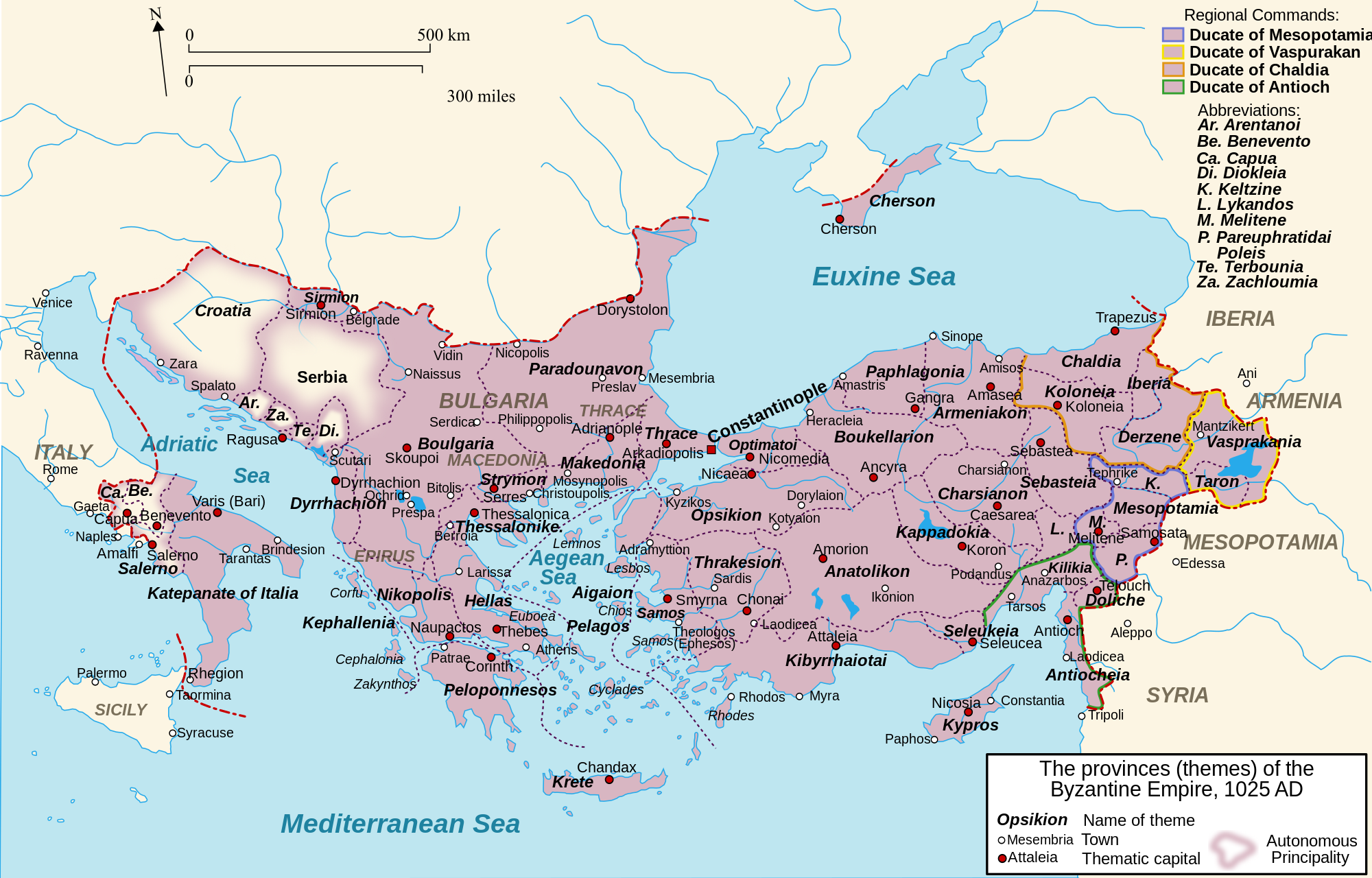
Map of the administrative structure of the Byzantine Empire in 1025. The regional eastern commands, variously under doukes or katepano, are outlined. Southern Italy was under the authority of the katepano of Italy, while Bulgaria, Serbia and Paristrion were often under the authority of a single katepano.

The katepánō (Greek: κατεπάνω, lit.'[the one] placed at the top' or 'the topmost') was a senior Byzantine military rank and office. The word was Latinized as capetanus/catepan, and its meaning seems to have merged with that of the Italian "capitaneus" (which derives from the Latin word "caput", meaning head). This hybridized term gave rise to the English language term captain and its equivalents in other languages (Capitan, Kapitan, Kapitän, Capitán, Capitano, Kapudan Pasha, etc.)

History

[edit]

The katepáno first appears in the 9th century, when it was used in the generic sense of "the one in charge" by two officials: the head of the basilikoi anthrōpoi ("imperial men"), a class of low-level court functionaries, and the head of the Mardaites marine detachments of the Byzantine naval theme of the Cibyrrhaeots in southern Asia Minor.[1] On the eve of the great eastern conquests of the 960s, however, the title acquired a more specific meaning.

The reconquered frontier zones were divided into smaller themata, and grouped together to form large regional commands, headed either by a doux ("duke") or a katepanō.[2] These were the ducates/katepanates[3] of Antioch, covering the south-eastern frontier in northern Syria, of Mesopotamia in the east around the Euphrates, and of Chaldia in the north-east.[4] During the reign of Emperor Basil II (r. 976–1025), the eastern border was further expanded, and the katepanate of Iberia was established in 1022.

In the West, the most famous katepanate, that of southern Italy, is attested in the Escorial Taktikon, a list of offices compiled circa 971–975, and after the successful conclusion of the Byzantine–Bulgarian Wars, a katepanō of Bulgaria is also attested.[4] A Serbian catepanate is also attested, which was known as the "katepano of Ras".[5]

With the catastrophic territorial losses suffered during the 11th century, the office disappears in the sense of the overall military commander, but is retained in a more local level: during the Komnenian and Palaiologan periods, the term katepanikion thus comes to denote low-level administrative areas, both in Asia Minor (including the Empire of Trebizond) and Europe.[1]

These were small subdivisions of the earlier themata, and consisted of little more than a fortified capital (the kastron) and its surrounding territory. In the Palaiologan era, the katepanikion was governed by a kephalē (Greek: κεφαλή, "head"), who had supreme civil and military authority within its bounds.[6] Like many other Byzantine institutions, the katepanikion as an administrative subdivision was also adopted in the Second Bulgarian Empire.

See also

[edit]

References

[edit]

Sources

[edit]
  • Bartusis, Mark C. (1997). The Late Byzantine Army: Arms and Society 1204–1453. Philadelphia, Pennsylvania: University of Pennsylvania Press. ISBN 0-8122-1620-2.
  • Haldon, John (1999). Warfare, State and Society in the Byzantine World, 565–1204. London: UCL Press. ISBN 1-85728-495-X.
  • Holmes, Catherine (2005). Basil II and the Governance of Empire (976–1025). Oxford: Oxford University Press. ISBN 978-0-19-927968-5.
  • Kazhdan, Alexander, ed. (1991). The Oxford Dictionary of Byzantium. Oxford and New York: Oxford University Press. ISBN 0-19-504652-8.
  • Krsmanović, Bojana (2008). The Byzantine Province in Change: On the Threshold Between the 10th and the 11th Century. Belgrade: Institute for Byzantine Studies. ISBN 9789603710608.
  • Ostrogorsky, George (1956). History of the Byzantine State. Oxford: Basil Blackwell.
  • Runciman, Steven (1988) [1929]. The Emperor Romanus Lecapenus and His Reign: A Study of Tenth-Century Byzantium. Cambridge University Press. ISBN 9780521357227.

Further reading

[edit]
Revisions and contributorsEdit on WikipediaRead on Wikipedia
from Grokipedia
The katepánō (Greek: κατεπάνω, derived from the adverb epano, meaning "above") was a senior Byzantine office introduced in the 9th century to designate officials holding top-level authority in military and administrative hierarchies.[1] The term literally denotes "the one placed at the top" or "the uppermost," reflecting the holder's preeminent position.[2] Katepanoi exercised combined civil and military governance over provinces, coordinating defenses and administration against external threats, with the most prominent application in the Catepanate of Italy from circa 965 to 1071, where they oversaw southern Italian territories including Calabria, Longobardia, and Lucania from the capital at Bari.[2] The office also governed other frontier regions, such as the katepanate of Vaspurakan established in 1021/22 after Byzantine acquisition of lands south and east of Lake Van, underscoring its role in consolidating imperial control until setbacks like the Battle of Manzikert.[3]

Etymology and Terminology

Linguistic Origins and Evolution

The term katepanos (Greek: κατεπανός) originates from the Byzantine Greek adverbial compound katepánō (κατεπάνω), formed by the prefix kata- (from κατά, denoting position or accordance) and epanō (ἐπάνω, "above" or "on top"), yielding a literal sense of "placed above" or "the uppermost." This etymology reflects a descriptive emphasis on hierarchical supremacy, as analyzed in philological studies of medieval Greek administrative lexicon. Early usages retained an adverbial flexibility, applying to various superiors rather than a fixed office, before semantic specialization occurred. Attestations of katepánō emerge in 9th-century Byzantine fiscal and bureaucratic texts, initially as a generic descriptor for "the one in charge," such as in references to heads of imperial departments like the basilikoi anthrōpoi. By the early 10th century, amid administrative reforms under emperors like Romanos I Lekapenos (r. 920–944), the term evolved into a nominalized title denoting a consolidated provincial authority, marking a shift from ad hoc superiority to institutionalized command.[4] This development paralleled broader trends in Byzantine Greek, where compound terms adapted classical roots to denote novel offices amid territorial reorganizations. In Western contacts, particularly Italian chronicles from the 11th century onward, katepánō underwent Latinization as catepanus or capetanus, preserving the "topmost" connotation while influencing vernacular forms like Italian capitano.[5] This adaptation occurred without substantive semantic alteration, though later Romance derivatives occasionally broadened to generic captaincy roles, distinct from the Byzantine specificity.[2] Philological evidence from seals and documents underscores continuity in core meaning across linguistic boundaries.

Definition and Hierarchical Position

Rank Within Byzantine Administration

The katepano (Greek: katepanō, denoting a position "placed at the top") represented a senior military office in the Byzantine administrative hierarchy, typically exercising supervisory authority over thematic governors (strategoi) or elite tagmata units in consolidated commands. This rank superseded the standard strategos of individual themes, particularly in civil-military administrations spanning multiple provinces, as indicated by its assignment to holders of high court dignities such as patrikios or proedros.[6][7] Such appointments underscored the katepano's integration into the upper echelons of the imperial bureaucracy, where military command intertwined with oversight of fiscal and judicial functions under direct imperial delegation. Sigillographic evidence, including lead seals from the 11th century, illustrates the katepano's precedence, with inscriptions combining the title with specific jurisdictions like Melitene and Lykandos or broader thematic clusters. These artifacts, preserved in collections such as Dumbarton Oaks, reveal the office as an ad hoc imperial commission rather than a fixed or hereditary rank, often bestowed on proven administrators bearing additional honorifics like vestes or protospatharios.[7][4] The variability in titulature across seals confirms the katepano's adaptability within the hierarchy, prioritizing merit and loyalty over rigid precedence, though consistently above mid-level provincial commanders.[8]

Distinctions from Similar Titles

The katepano held a superior position to the strategos, who commanded a single thema (provincial military-administrative district), by exercising authority over multiple themata or enlarged frontier zones, coordinating their forces under unified command for major campaigns or defenses. This functional hierarchy reflected the mid-10th-century shift toward consolidated regional commands to address expansive threats, such as Arab incursions, where a katepano could supersede local strategoi in operational decisions.[9] In contrast to the domestikos (or domestikos ton thematon), who primarily led elite tagmatic field armies or supervised thematic troops in specific eastern groupings as part of reorganizations under Emperor Nikephoros II Phokas (r. 963–969), the katepano emphasized broader oversight of provincial structures, integrating military, fiscal, and logistical elements across diverse territories like the Italian catepanate. Phokas's reforms centralized eastern commands under domestikoi for efficiency in Anatolia, but katepano appointments, often ad hoc for western or peripheral theaters, allowed flexibility in delegating "top-level" (katepano literally implying "placed above") authority without the tagmatic focus.[10][8] Byzantine military manuals, such as the Taktika tradition, underscore these variances by prioritizing hierarchical clarity in ranks, with katepano reserved for elevated, often temporary commands to prevent fragmentation seen in earlier thematic autonomy, distinguishing it from routine strategos or domestikos roles tied to fixed units or regions.[9]

Duties and Responsibilities

Military Command Structure

The katepano exercised direct command over composite military forces within a katepanate, integrating thematic levies from subordinate provinces with detached tagmata units from the imperial reserves. These included professional heavy cavalry (kataphraktoi and klibanophoroi), lighter horse archers, and infantry cohorts equipped for both defensive stands and maneuvers, structured hierarchically into tourmai (divisions of ~5,000 men), droungoi (regiments of ~1,000–2,000), and banda (companies of ~300–400). The commander possessed authority to conscript and train local peasant-soldiers as supplementary forces during mobilizations, ensuring logistical flexibility for sustained operations.[11][12] In defensive roles, the katepano orchestrated frontier surveillance, fortification repairs, and rapid counter-raids against incursions, leveraging the katepanate's geographic cohesion to concentrate forces at vulnerable passes or coasts. Offensively, he directed expeditionary campaigns, coordinating multi-theme assaults with naval support where applicable, as exemplified by mid-10th-century operations in southern Italy repelling Arab emirates from Calabria and Apulia. Against Bulgarian threats in the Balkans, katepano-led armies combined thematic infantry with tagmatic elites for thrusts into hostile territory, emphasizing tactical envelopments and supply-line interdictions per period military doctrine.[2][13] While bound by imperial oversight on grand strategy and resource allocation, the katepano retained field-level discretion for tactical decisions, enabling adaptive responses to enemy movements without awaiting Constantinople's approval; this balance mitigated delays inherent in centralized command while preserving ultimate loyalty to the throne.[11]

Civil Governance Aspects

The katepano, as a provincial governor, held significant civil authority over fiscal administration in assigned regions, including the supervision of tax collection to support both military needs and imperial revenues. This role integrated elements of the thematic system, where governors ensured the allocation of local resources for defense while remitting surplus to Constantinople. Evidence from administrative practices indicates that katepanos directed the assessment and gathering of taxes, such as the kapnikon hearth tax and land dues, often leveraging military structures to enforce compliance.[14] In judicial matters, katepanos exercised oversight of local courts and dispute resolution, frequently combining military command with legal responsibilities. Seals of officials like Michael vestes, identified as both judge (kritēs) and katepano of Cyprus in the eleventh century, demonstrate this dual role, reflecting a system where provincial leaders adjudicated civil cases ranging from property disputes to minor criminal offenses. Similarly, Basil Machetaris served as vestes, judge, and katepano in Melitene and Lykandos, underscoring the katepano's authority in appointing or supervising subordinate judicial personnel.[15][7] Civil infrastructure maintenance, including roads and fortifications with civilian utility, fell under katepano purview as part of broader regional stability efforts, though primary emphasis remained on fiscal and judicial functions to sustain administrative control. Provincial records and seals imply that katepanos delegated such tasks to local officials, blending centralized imperial directives with on-site pragmatism. However, this fusion of military and civil duties occasionally engendered tensions, with military exigencies prioritizing troop provisioning over equitable tax burdens, as inferred from patterns in Byzantine administrative critiques.[16]

Historical Origins and Early Usage

Emergence in the 9th Century

The title katepanos (κατεπάνω), denoting "the one placed above," emerged in the mid-9th century as a descriptive designation for senior overseers within the Byzantine court hierarchy. It initially applied to the head of the basilikoi anthropoi, a corps of imperial officials, attendants, and palace personnel responsible for ceremonial and logistical functions in Constantinople.[17] Epigraphic evidence from a lead seal of Theoktistos, bearing the titles imperial protospatharios and katepano of the basilikoi anthropoi, confirms this usage during the 9th century, likely under the Macedonian dynasty's early consolidation efforts.[18] This development aligned with broader administrative centralization following the Second Iconoclastic Council's resolution in 843, which ended theological strife and enabled emperors Michael III (r. 842–867) and Basil I (r. 867–886) to reassert imperial control over provincial themes and court structures weakened by prior civil wars and Arab incursions.[19] The katepanos role, often held by eunuchs or trusted palace insiders, bridged ceremonial oversight of guards and basilikoi with emerging field coordination needs, as later codified in the Escorial Taktikon (late 9th century) and De Ceremoniis of Constantine VII, which describe the position's precedence in processions and its aides like the domestikos.[20] Such titles reflected experimental elevations in command to manage distributed military resources amid ongoing Arab threats in Anatolia, where theme strategoi required superior coordination without full provincial autonomy, laying groundwork for the katepanos as a supra-thematic authority in subsequent decades.[16]

Initial Applications in Military Tags

The title katepanos emerged in the 9th century as a designation for commanders of elite central tagmata units, the professional mobile forces stationed near Constantinople for rapid response and imperial protection. A lead seal belonging to Theoktistos, identified as imperial protospatharios and katepano of the basilikoi anthropoi (imperial men), attests to this early application, likely involving oversight of specialized palace or tagmatic personnel distinct from provincial thematic troops.[18] These tagmata, including infantry formations like the Optimatoi, emphasized internal security against rebellions and quick deployment to frontier crises, contrasting with the static, locally recruited armies of the themes under strategoi.[21] Sigillographic evidence from the late 9th and 10th centuries documents the title's association with specific tagmata, reflecting its role in a centralized command structure amid efforts to bolster the field army. Seals indicate katepano appointments to units such as the Optimatoi, an elite infantry tagma reformed for versatility in both defensive and offensive operations. By the 11th century, this usage persisted, as seen in the seal of Leo Arianites, proedros and katepano of the Optimatoi, underscoring continuity from 9th-century precedents where the title denoted tactical leadership over professional regiments rather than broad provincial governorships.[22][23] Military reforms under Emperor Basil I (r. 867–886) contributed to the title's proliferation, as sigillographic corpora reveal increased attestations of high-ranking katepano amid tagmatic expansions to counter Arab incursions and internal threats. This period saw rank inflation in the bureaucracy, with titles like katepano assigned to manage augmented elite forces, transitioning from purely palace-based roles toward limited provincial extensions while retaining focus on mobile tagmata detachments. Empirical data from seals, rather than narrative sources prone to imperial propaganda, confirm this evolution, highlighting the title's utility in a system prioritizing causal effectiveness in rapid force projection over thematic decentralization.[11]

Peak Usage and Regional Commands

The Catepanate of Italy (c. 965–1071)

The Catepanate of Italy was established circa 965 under Emperor Nikephoros II Phokas, who consolidated the existing themes of Longobardia and Calabria with the newly formed theme of Lucania into a unified military district, elevating the strategos of Bari to the rank of katepano to coordinate defenses against Lombard principalities to the north and persistent Arab raids from Sicily.[2] The katepano's headquarters remained in Bari, which served as the administrative and military hub for Byzantine operations in the region, enabling more effective mobilization of thematic troops and naval support from the Adriatic fleet.[2] Early challenges included the revolt led by Melus of Bari, a Lombard noble, who on 9 May 1009 incited an uprising against Byzantine rule, capturing Bari and extending control to Ascoli and Troia by 1010 before the arrival of reinforcements under Catapan Basil Mesardonites suppressed the initial phase by 1011.[24] Melus fled to seek aid from Holy Roman Emperor Henry II but renewed the rebellion around 1017, allying with Norman mercenaries, though Catapan Basil Boioannes decisively defeated the rebels at the Second Battle of Cannae in 1018, restoring Byzantine dominance in Apulia during the 1010s.[24] Boioannes, serving as katepano from 1017 to 1027, further secured the province through campaigns that repelled Norman incursions and stabilized frontiers, marking a peak of Byzantine military effectiveness in Italy.[2] Administrative oversight involved subordinate commanders, often titled dukes, managing sub-themes like Apulia and Calabria, with the katepanate granted fiscal measures to sustain local garrisons independently of Constantinople's direct treasury.[25] Cultural policies promoted Hellenization, particularly in Calabria where Greek language and Orthodox rites supplanted Latin influences, though Longobardia retained more Latin customs and private law, fostering a hybrid Greco-Lombard society amid efforts to align local elites with Byzantine imperial norms.[26] The catepanate's decline accelerated with escalating Norman expeditions under leaders like Robert Guiscard, who besieged Bari from 1068, culminating in the city's surrender in April 1071 after a prolonged defense by the last katepano, Stephen Pateranos, thereby terminating organized Byzantine authority in southern Italy after over a century of intermittent control.[27] This loss stemmed from internal revolts, overreliance on thematic levies vulnerable to desertion, and the Normans' superior adaptability in feudal warfare, as chronicled in contemporary accounts emphasizing the strategic erosion of Byzantine coastal strongholds.[27]

Applications in Other Provinces

In the Balkan provinces, particularly along the Bulgarian frontier in the theme of Paristrion, the katepano title was employed in the 11th century to command defenses against nomadic threats, such as Pecheneg raids across the Danube. A lead seal belonging to Constantine *polites, patrikios, and katepano of Dristra (Dorostolon, modern Silistra), datable to the 11th century, attests to this usage, reflecting the office's role in administering a strategeia established after the Byzantine reconquest of the region in 971.[28] Dristra served as a key residence for the katepano of Paristrion, facilitating imperial oversight of frontier fortifications and interactions with neighboring powers amid ongoing instability.[29] Further east, during the territorial expansions of the early to mid-11th century, the katepano appears in the Antiochene theme, where it overlapped with the doux in governing a volatile border zone facing Fatimid and later Seljuk pressures. Chronicles record a katepano active in Antioch around 1016, underscoring the title's adaptability for combined military-civil authority in high-threat eastern commands, though less frequently than in western applications.[30] The scope of such katepanoi was calibrated to immediate dangers, granting broader operational latitude in Armenia-adjacent themes during Basil II's campaigns (976–1025), but evidence remains primarily sigillographic and sporadic, tied to transient needs rather than permanent structures.[31] This flexibility distinguished provincial katepanoi from more centralized roles, prioritizing rapid response to incursions over standardized governance.

Decline and Later Instances

11th–12th Century Transformations

The Byzantine defeat at the Battle of Manzikert on August 26, 1071, precipitated profound disruptions in the empire's military-administrative framework, rendering the katepano's role—originally designed for overseeing expansive, self-sustaining thematic armies—increasingly untenable amid territorial losses and fiscal strain. Anatolia's rapid Seljuk infiltration dismantled core themes, fragmenting unified commands and compelling a pivot from centralized provincial governorships to more flexible, localized defenses.[32][33] Alexios I Komnenos' ascension in 1081 initiated reforms that integrated surviving katepano functions into the emerging pronoia system, whereby military elites received conditional land grants (pronoiai) tied to service obligations, supplanting reliance on thematic tax revenues that had eroded post-1071. This causal shift prioritized aristocratic loyalty and rapid mobilization over the katepano's traditional bureaucratic oversight, as pronoiars assumed de facto command in frontier zones. Concurrently, the doux title proliferated for regional governance, often absorbing katepano duties in Balkan and residual Anatolian sectors, reflecting decentralization to counter nomadic incursions.[32][34][35] Sigillographic evidence underscores the title's dilution, with katepano seals persisting sporadically into the early 12th century—such as those attesting holders in Dyrrachion and Iberia—but in diminished frequency and scope, signaling a transition to ad hoc, family-held commands amid imperial retrenchment. By circa 1100, administrative seals increasingly favored Komnenian innovations like sebastokrator-linked offices, evidencing the katepano's marginalization as pronoia entrenched hereditary military hierarchies.[36][37]

Factors Contributing to Obsolescence

The conquest of the Catepanate of Italy by Norman forces culminated in the fall of Bari on 16 April 1071, stripping the katepano title of its most prominent territorial application and thereby undermining its administrative prestige within the empire's hierarchy.[38] This event coincided with broader territorial contractions in the 11th century, which diminished the scope for deploying high-ranking provincial overseers responsible for coordinating multiple themes or tagmata units.[38] Under Emperor Alexios I Komnenos (r. 1081–1118), administrative reforms prioritized the centralization of military authority through the reorganization of the tagmata—the professional field armies—into more directly emperor-controlled formations, reducing reliance on semi-autonomous super-provincial commands like the katepano.[9] These changes, necessitated by fiscal strains and the need for loyalist forces amid civil strife, shifted emphasis toward pronoia land grants to individual magnates rather than expansive thematic governorships, rendering the katepano's integrative role increasingly redundant.[33] The progressive fragmentation of themes into smaller administrative units, exacerbated by the 12th-century rise of hereditary magnates who consolidated local power through familial estates, further obviated the need for overarching katepanoi to manage large regional conglomerates.[38] This devolution aligned with economic expansions favoring private landholdings over imperial thematic structures, as great estates proliferated and eroded centralized fiscal-military integration.[39] Sigillographic evidence reflects this trajectory, with attestations of katepano seals and inscriptions showing marked rarity after 1100, indicative of the title's displacement by Komnenian-era ranks such as doux and sebastokrator.[40]

Notable Holders

Prominent Figures and Their Tenures

Basil Mesardonites held the office of katepano of Italy from 1010 until his death in 1016 or 1017.[41] During his tenure, he focused on administrative consolidation, including renovations to the governor's palace in Bari, as recorded in a Greek epigraph from the site.[42] His leadership followed the suppression of rebellions under his predecessor, marking a period of relative stabilization before renewed Lombard and Norman pressures.[41] Basil Boioannes succeeded Mesardonites as katepano of Italy, arriving with reinforcements in December 1017 and serving until 1027.[41] He conducted successful campaigns in Apulia against Lombard rebel Melus of Bari, capturing him by 1019, and later repelled early Norman incursions, earning promotions to patrikios and anthypatos for his defensive efforts.[41] Boioannes reorganized provincial defenses, integrating local forces more effectively against external threats.[41] Later holders included Symeon, identified as protospatharios epi tou koitonos and katepano of Italy around 1061–1062 based on seal evidence, potentially the figure recorded as Siriano in the Annales Barenses.[43] In other regions, Leo Arianites served as proedros and katepano of the Optimatoi theme in the 11th century, as attested by his personal seal bearing the inscription of his titles and lineage.[22] These appointments reflect the title's extension beyond Italy amid the empire's administrative adaptations.[22]

Military Achievements and Failures

Basil Boioannes, serving as katepano from 1017 to 1027, secured key victories that temporarily bolstered Byzantine holdings in southern Italy. He recaptured Bari from rebels in 1011–1018 campaigns and decisively defeated the Lombard leader Melus and his Norman allies at the Battle of Cannae on 28 May 1018, where Byzantine forces under his command routed an estimated 3,000 Norman cavalry and Lombard infantry, killing Norman leader William Iron Arm.[44] [35] These successes, achieved through disciplined tagmata units and tactical maneuvers exploiting enemy overextension, restored control over Apulia and Calabria, enabling tribute collection and fortifications until the mid-1020s.[45] Earlier katepanoi mishandled the Melus rebellion, which erupted in 1009 amid local grievances over heavy taxation and cultural impositions. Basil Mesardonites, katepano in 1010–1011, suffered a major defeat at Cannae in 1011 against Melus's forces bolstered by Norman mercenaries, losing much of his army and allowing the revolt to spread.[35] This initial failure stemmed from inadequate intelligence and reliance on unintegrated Lombard levies, prolonging instability until Boioannes's arrival.[46] Michael Dokeianos's tenure as katepano from 1040 to 1041 marked stark failures against resurgent Norman-Lombard coalitions. He was defeated at Olivento on 17 March 1041 by Norman forces under William Iron Arm's successors, followed by annihilation at Montemaggiore on 1 May 1041, where approximately 6,000 Byzantine troops, including Varangian guards, were killed or captured due to poor coordination and numerical inferiority.[47] [46] These losses, attributed by contemporaries to Dokeianos's arrogance and reprisal executions that alienated allies, accelerated the catepanate's fragmentation. Overreliance on transient mercenaries—Normans initially hired for Boioannes's campaigns but later turning adversarial—and logistical strains from distant supply lines across the Adriatic contributed to these mixed outcomes. Expeditionary forces often arrived understrength, with thematic soldiers in Italy dwindling to under 10,000 by the 1040s due to unpaid stratiotai desertions and vulnerability to Adriatic piracy disrupting grain and arms shipments from Constantinople.[48] [35] Such factors eroded the katepano's ability to project sustained power, favoring short-term tactical wins over long-term strategic dominance.

Legacy and Influence

Impact on Medieval European Titles

The Latinized form catepanus, derived from the Byzantine Greek katepánō, evolved in Norman Italy into capitaneus, denoting a senior military leader and contributing to the etymological roots of "captain" in Romance languages for commanding officers. This transformation is attested in the nomenclature of the Capitanata region in Apulia, which preserved the legacy of the Catepanate's governance.[49] The term's adoption reflected the Normans' pragmatic integration of Byzantine military terminology after their conquest of Bari in 1071, facilitating command structures in newly subdued territories.[35] In the Kingdom of Sicily, formalized under Roger II in 1130, the katepano's model of unified civil-military administration influenced provincial oversight, where Norman counts and justiciars adapted Byzantine fiscal and judicial mechanisms to administer multicultural domains, including Greek Orthodox populations. Such hybrid systems retained elements of thematic governance, emphasizing centralized control over diverse ethnic groups, though subordinated to feudal vassalage.[50] This adaptation prioritized administrative continuity over wholesale innovation, as evidenced by the persistence of Greek notaries and tax practices in Sicilian charters from the 12th century.[51] Broader European adoption remained circumscribed, with no widespread titular emulation outside Italo-Norman spheres; nonetheless, structural parallels emerged in Venetian maritime commands, where capitani oversaw fleets and outposts in a manner akin to katepano oversight of themes, informed by Byzantine-Venetian commercial and military pacts from the 11th century onward.[35] In Crusader states, analogous roles for military governors in Antioch and Edessa drew indirect inspiration from Byzantine precedents encountered during alliances, though Latin feudal titles predominated without explicit derivation.[52] These instances underscore limited diffusion, constrained by Western Europe's decentralized feudalism contrasting the katepano's centralized imperial ethos.

Scholarly Interpretations and Debates

Scholars have long debated the balance between civil and military authority vested in the katepano, with earlier historiography, such as that influenced by 19th-century accounts, portraying the office predominantly as a military commandership overseeing thematic troops in frontier defense.[53] Vera von Falkenhausen challenged this view, arguing through examination of administrative documents and imperial chrysobulls that the katepano under Basil II (r. 976–1025) integrated fiscal oversight, judicial functions, and local governance, effectively functioning as a hybrid provincial governor rather than a pure stratēgos equivalent, thereby stabilizing Byzantine control amid Lombard and Arab pressures.[54] This interpretation privileges primary fiscal and legal records over narrative emphases on campaigns, highlighting the office's role in revenue collection and thematic reorganization. Sigillographic evidence from Byzantine lead seals has introduced discrepancies with narrative sources in reconstructing katepano tenures, often identifying holders or dates absent from chronicles like those of Skylitzes or Lupus Protospatharius. For instance, seals attest to early katepanoi such as Theodore, patrikios and katepano (ca. 10th–11th century), whose tenure lacks corroboration in textual histories, suggesting narrative accounts' selectivity or loss of detail.[55] These artifacts, bearing official formulae and dates, provide verifiable prosopographical data that revises inflated or conflated lists from later compilations, underscoring sigillography's value in resolving chronological ambiguities where literary sources prioritize dramatic events over administrative continuity.[8] Critiques of overemphasizing Italian exceptionalism in the katepano's application argue that portrayals of the office as uniquely adaptive to western Latin contexts undervalue its alignment with the thematic system's provincial evolution elsewhere, such as in the Balkans or Anatolia. Falkenhausen and others contend that while Italy's geographic isolation prompted centralized oversight, the katepano's structure mirrored standard Byzantine practices of combining military command with civil administration, as evidenced by parallel titles like those in the theme of Thessaloniki, rather than constituting a bespoke innovation.[54] This perspective, grounded in comparative analysis of imperial appointments, counters narratives of cultural divergence by emphasizing systemic pragmatism over regional anomaly.

References

User Avatar
No comments yet.