Hubbry Logo
Overseas RailroadOverseas RailroadMain
Open search
Overseas Railroad
Community hub
Overseas Railroad
logo
8 pages, 0 posts
0 subscribers
Be the first to start a discussion here.
Overseas Railroad
Overseas Railroad
from Wikipedia

Overseas Highway and Railway Bridges
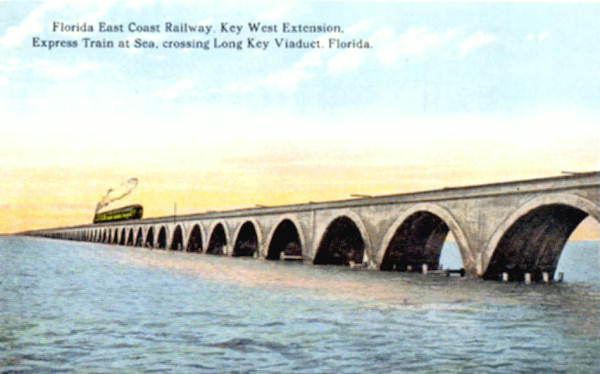
Florida East Coast Railway
Key West Extension
express train at sea
crossing Long Key Viaduct
Overseas Railroad is located in Florida
Overseas Railroad
Overseas Railroad is located in the United States
Overseas Railroad
LocationBridges on U.S. 1 between Long and Conch Key, Knight and Little Duck Key, and Bahia Honda and Spanish Key, Florida Keys, Florida
Coordinates24°42′42″N 81°7′23″W / 24.71167°N 81.12306°W / 24.71167; -81.12306
Area30.2 acres (12.2 ha)
Built1905–1912
ArchitectFlorida East Coast Railway; Overseas Highway & Toll Bridge Comm.
Architectural styleArch, Girder & Truss Spans
NRHP reference No.79000684[1]
Added to NRHPAugust 13, 1979

The Overseas Railroad (also known as Florida Overseas Railroad, the Overseas Extension, and Flagler's Folly) was an extension of the Florida East Coast Railway to Key West, a city located 128 miles (206 km) beyond the end of the Florida peninsula. Work on the line started in 1905[2] and it operated from 1912 to 1935, when it was partially destroyed by the Labor Day Hurricane. Some of the remaining infrastructure was used for the Overseas Highway.

Background

[edit]

Henry Flagler (1830–1913) was a principal in Rockefeller, Andrews & Flagler and later a founder of Standard Oil during the Gilded Age in the United States. The wealthy Flagler took an interest in Florida while seeking a warmer climate for his ailing first wife in the late 1870s. Returning to Florida in 1881, he became the builder and developer of resort hotels and railroads along the east coast of Florida.

Beginning with St. Augustine, he moved progressively south. Flagler helped develop Ormond Beach, Daytona Beach, and Palm Beach, and became known as the father of Miami, Florida.

Flagler's rail network became known as the Florida East Coast Railway (FEC). By 1904, the FEC had reached Homestead, south of Miami.

Key West Extension

[edit]
Bahia Honda Bridge

After the United States announced in 1905 the construction of the Panama Canal, Flagler became particularly interested in linking Key West to the mainland. Key West, the United States' closest deep-water port to the Canal, could not only take advantage of Cuban and Latin American trade, but the opening of the Canal would allow significant trade possibilities with the West Coast.

Initially called "Flagler's Folly", the construction of the Overseas Railroad required many engineering innovations as well as vast amounts of labor and monetary resources. Once the decision was made to move forward with the project, Flagler sent his engineer William J. Krome to survey potential routes for the railroad. The initially favored route extended the railroad from Homestead southwest through the Everglades to Cape Sable, where it would then cross 25 miles (40 km) of open water to Big Pine Key and then continue to Key West. However, it was quickly determined that it was more feasible to run the railroad south to Key Largo and follow the islands of the Florida Keys. Krome then surveyed routes to Key Largo, including one over Card Point (which would become the first roadway to the Keys) and Jewfish Creek, which was the selected route.[3]

At one time during construction, four thousand men were employed. During the seven year construction, three hurricanes—one in 1906, 1909, and 1910—threatened to halt the project. The project cost was more than $50 million.

Despite the hardships, the final link of the Florida East Coast Railway to Trumbo Point in Key West was completed in 1912. In this year, a proud Henry Flagler rode the first train into Key West aboard his private railcar, marking the completion of the railroad's oversea connection to Key West and the linkage by railway of the entire east coast of Florida. It was widely known as the "Eighth Wonder of the World".[4]

Operations

[edit]
First Florida East Coast Railway train arriving in Key West

During its years of operation, freight traffic volume on the single-track overseas extension was disappointing, as the anticipated growth in Panama Canal cargo shipping through Key West failed to materialize. Local Key West and online freight consisted of coal, fruit, and building materials. Trains of tank cars brought potable water to Key West from mainland Florida.

Before the Great Depression hit, passenger traffic consisted of both local and long distance trains. In 1929, the Havana Special was the premier train, providing year-round coach and sleeping car service between New York and Key West, daily except Sundays, with connecting ferry service beyond to the Cuban capital. With speed restricted to 15 miles per hour (24 km/h) on the long bridges, it took a leisurely four and a half hours to travel the distance between Key West and Miami: northbound, the Havana Special departed Key West at 6 p.m., for a 10:45 p.m. departure from Miami.[5] Another train, the Over-Sea, operated locally between Miami and Key West during daylight hours, leaving Miami at 11:05 a.m. and arriving at Key West 4:35 p.m.[6] During the winter months, the Over-Sea's consist included a deluxe parlor-observation car. It was a popular train for vacationers traveling to the various fishing camps in the Keys. The Caribbean Mail also operated over the line.

Demise

[edit]

Much of the Overseas Railroad in the Middle Keys was heavily damaged and partially destroyed in the Labor Day Hurricane of 1935, a Category 5 hurricane which is often called "The Storm of the Century". The storm killed more than 400 people and devastated Long Key and adjacent areas. The FEC's Long Key Fishing Camp was destroyed, as was an FEC rescue train which, with the exception of steam locomotive 447, was overturned by the storm surge at Islamorada. Over 40 miles (64 km) of track were washed away by the hurricane, two miles of which ended up washing ashore on the mainland at Cape Sable.[3]

Already bankrupt, the Florida East Coast Railway was financially unable to rebuild the destroyed sections. The roadbed and remaining bridges were sold to the State of Florida, which built the Overseas Highway to Key West, using much of the remaining railway infrastructure. Many of the original bridges were replaced during the 1980s. The Overseas Highway (U.S. 1, which runs from Key West to Fort Kent, Maine) continues to provide a highway link to Key West. Many old concrete bridges of the Overseas Railroad remain in use as fishing piers and pedestrian paths called the Florida Keys Overseas Heritage Trail.[7]

It was added to the National Register of Historic Places in 1979 as Overseas Highway and Railway Bridges.

[edit]

References

[edit]

Further reading

[edit]
[edit]
Revisions and contributorsEdit on WikipediaRead on Wikipedia
from Grokipedia
The Overseas Railroad, officially the Key West Extension of the , was a 128-mile (206 km) engineering feat that connected the mainland at to the island city of , completed in 1912 after seven years of construction led by industrialist Henry Morrison Flagler. Flagler, a co-founder of who had already extended rail service along Florida's east coast to boost tourism and agriculture, envisioned the Overseas Railroad as a vital link to —the southernmost U.S. deepwater port—anticipating its role in trade with and once the opened in 1914. Construction began in April 1905 from Homestead southward, employing up to 4,000 workers who moved 17 million cubic yards of material to build viaducts, bridges, and fills across the challenging island chain, at a cost exceeding $50 million (equivalent to about $1.25 billion in 2019 dollars). The project faced severe setbacks from natural disasters, including three hurricanes during building—one in 1906 that killed 164 people and destroyed early work south of —but innovative engineering, such as arches and spans, allowed completion on January 22, 1912, when Flagler himself arrived by train in at age 82. Dubbed the "" upon opening, the railroad revolutionized access to the , carrying passengers, freight, and mail on daily trains that crossed 42 bridges and trestles, including the iconic , while promoting Flagler's luxury resorts and spurring economic growth in the region. It operated successfully for over two decades, integrating Key West into the network from Jacksonville, until the catastrophic Labor Day Hurricane of September 2–3, 1935—a Category 5 storm with winds up to 200 mph—devastated the line, washing away sections of track and bridges and killing hundreds, rendering repairs uneconomical amid the . In the aftermath, the sold the remnants to the state of and Monroe County for $640,000 in 1938, paving the way for the (U.S. Route 1), which repurposed the railroad's right-of-way and surviving bridges to create the first vehicular link between the mainland and . Today, segments of the original infrastructure, including the Long Key Channel, Knight's Key (Seven Mile), and Bahia Honda Channel bridges, are preserved on the (listed in 1979 and expanded in 2004), serving as relics of Flagler's ambitious vision and the railroad's enduring legacy in Florida's transportation history.

History

Origins and Planning

Henry Morrison Flagler, a co-founder of and a pioneering developer of Florida's east coast, played the central role as financier and promoter of the Overseas Railroad, envisioning it as the culmination of his ambitious railroad expansions. Having already extended the southward to reach in April 1896, Flagler sought to further capitalize on the region's tourism and trade potential by connecting the mainland to the . The primary economic motivations for the project centered on linking Key West's natural deep-water port to the mainland, facilitating efficient trade with , , and beyond, particularly in anticipation of increased shipping traffic following the start of construction in 1904. , as Florida's southernmost point, offered the shortest overland route for goods from northern U.S. rail networks to markets, bypassing longer sea voyages and positioning the port as a vital hub for coaling and . Early proposals for a railroad to dated back to 1883, when former Confederate General obtained a franchise from the to construct a line from Georgia through the state to the island, but the effort was abandoned before any significant work reached . Interest revived in the 1890s amid Flagler's growing influence; on April 29, 1893, the granted his Jacksonville, St. Augustine and Indian Railroad a for the extension, along with enhanced land grants of up to 8,000 acres per mile of track to incentivize development. Flagler formally revived the project in 1905 by acquiring necessary rights and initiating construction from Homestead southward, marking the practical start after years of preliminary planning. Financing relied heavily on Flagler's personal fortune, with his total investments in Florida railroads, hotels, and related infrastructure exceeding $50 million by 1912, much of it directed toward the Overseas extension without substantial federal aid. The state provided supportive measures through land grants and legislative charters, though the challenging Keys terrain required Flagler to purchase or lease much of the right-of-way independently; bond issuances by the supplemented funding for equipment and operations. Key to the preparatory phase was engineer William J. Krome, whom Flagler hired in 1902 to lead surveys identifying the optimal route across the and Keys, culminating in detailed assessments by 1905 that guided the project's engineering decisions.

Construction

Construction of the Overseas Railroad began in April 1905, with initial work starting from Homestead, Florida, and extending southward across the Florida Keys toward Key West. Groundbreaking ceremonies occurred on November 2, 1905, at Mile Marker 0 in Key West, marking the symbolic start of the ambitious project spearheaded by Henry Flagler to connect the mainland to the island city. Progress was incremental, with the first major section from Homestead to Jewfish Creek completed by February 1907, allowing limited rail access. By January 1908, the line reached Knight's Key, enabling Flagler to ride the first train from Miami across the newly built Long Key Viaduct, and passenger service commenced between Miami and Knight's Key, supplemented by steamer connections to Key West. The workforce comprised over 4,000 laborers, many of whom were Black workers recruited from and , enduring grueling conditions in remote work camps scattered across the Keys, such as Camp No. 10 on Vaca Key established in the summer of 1905. These camps provided basic shelter amid harsh tropical environments, with workers facing dangers including accidents, disease, and supply shortages; for instance, a in April 1907 killed two and injured seven, while a dynamite blast in May 1909 claimed seven lives. Materials logistics posed significant challenges, as vast quantities of native —blasted from the right-of-way for roadbeds on keys like and Long Key—along with steel for bridges and imported sand, gravel, and cement from distant sources like the and , were transported primarily by barges, lighters, and steamboats across open water. Supply chains were vulnerable to weather and distance, requiring monthly shipments of 4,500,000 gallons of fresh water alone, initially hauled by boat before rail support improved distribution. Construction faced repeated interruptions from hurricanes, which devastated progress and necessitated extensive rebuilds. The October 17, 1906, storm destroyed sections south of , killing 164 workers and injuring 81 at Long Key, forcing reconstruction of the Long Key Viaduct and delaying the overall timeline. A major hurricane on October 10–11, 1909, further postponed completion by approximately two years, claiming 13 lives on the tugboat Sybill, while the October 17–18, 1910, storm damaged the Seven Mile Bridge and tracks under construction. Despite these setbacks, work advanced, with the Bahia Honda Bridge announced complete in August 1911 and the final 27 miles of track laid by December. The project culminated on January 22, 1912, when the first train arrived in Key West carrying Flagler and his wife Mary Lily Kenan, an event that celebrated the railroad as the "" for its engineering triumph over the sea.

Engineering and Infrastructure

Route Overview

The Overseas Railroad, formally known as the Key West Extension of the , extended 128 miles (206 km) from the railhead at Homestead in Miami-Dade County to , marking Mile Marker 0 at its southern terminus in the city and beginning at the mainland railhead near present-day Mile Marker 128. This ambitious route traversed the archipelago, a chain of over 1,700 islands, by island-hopping via elevated viaducts, fills, and bridges that linked the keys across shallow waters and open ocean stretches. The path followed a generally straight alignment southward, curving gently around the keys' contours to maintain efficiency while avoiding deep channels and coral reefs. Major segments of the route included the initial mainland portion from Miami through Homestead, followed by the true "overseas" sections beginning at Key Largo (approximately Mile Marker 104) and continuing to Knight's Key (Mile Marker 47), where much of the track spanned open water via long viaducts. In total, the railroad incorporated 32 bridges and viaducts covering about 42 miles of open water, connecting islands such as Tavernier, Windley Key, and Lower Matecumbe Key through the Upper Keys, then progressing to the Middle and Lower Keys via spans like the Seven Mile Bridge between Knight's Key and Little Duck Key. These structures facilitated travel over Florida Bay's shallow bays, mangrove swamps, and hurricane-vulnerable tidal zones, with the terrain remaining predominantly at sea level and presenting challenges from shifting sands, tidal surges, and exposure to Atlantic and Gulf influences. Key stations along the route served as vital stops for passengers and freight, including at Mile Marker 105.6, Islamorada spanning Mile Markers 82 to 91, Marathon near Mile Marker 50, and Big Pine Key at Mile Marker 30.2, before reaching the grand Key West station at Mile Marker 0. The entire 128-mile line featured minimal grades, rarely exceeding 1% to accommodate heavy loads and high speeds, with curvature limited to broad sweeps that ensured smooth passage across the low-lying, subtropical landscape.

Key Structures and Innovations

The Overseas Railroad featured innovative viaduct designs that exemplified early 20th-century concrete engineering, particularly in the Long Key Viaduct and the Seven Mile Bridge. The Long Key Viaduct, spanning approximately 2.5 miles between Long Key and Conch Key, consisted of 180 reinforced-concrete spandrel arches, each with a 50-foot span and rising 30 feet above mean low-water level, replacing initial wooden trestles for enhanced durability over shallow waters 10 to 30 feet deep. Similarly, the Seven Mile Bridge incorporated concrete-arch spans totaling about 1.7 miles within its overall 7-mile length, including 210 arches in the Pacet Channel Viaduct section with 35-foot clear spans and 43-foot pier spacing, designed to traverse open ocean channels. These structures relied on cofferdams—temporary enclosures of wood and metal rings pumped dry via centrifugal pumps—to create stable underwater foundations on limestone bedrock, allowing precise pier construction in tidal environments. Material innovations were central to the project's feasibility, with steam-powered concrete mixers enabling on-site production of large volumes of using specialized cements like German Alsen for underwater pours and American Alsen or for above-tide sections, minimizing transportation challenges across the Keys. Steam-powered pile drivers hammered creosoted timber piles—up to 24 per —into the seabed to anchor structures against currents, while local limestone quarries on Windley Key supplied crushed rock for embankments and bridge approaches, providing a readily available, durable fill excavated via steam shovels. Reinforcing rods were minimally used in arches to prevent in the salty environment, with joints formed by dove-tailing for seamless integration. To address the Keys' environmental challenges, engineers incorporated adaptations such as tapered piers and arch forms lifted by tidal action into position, ensuring stability amid fluctuating water levels and potential surges. Labor-saving technologies accelerated island-to-island , including Bucyrus steam shovels for and embankment building, alongside rail-mounted excavators and floating derricks for , which allowed crews to progress efficiently over unstable and terrain. The engineering scale was immense, with bridges alone consuming a substantial portion of the overall $50 million project budget—equivalent to over $30 million invested directly by —highlighting the financial commitment to these pioneering spans designed to endure the region's harsh marine conditions.

Operations

Passenger Services

The Overseas Railroad provided daily passenger service between and from 1912 to 1935, with express trains covering the 128-mile route in approximately 5 to 7 hours. The flagship service, known as the Over-Sea Limited, operated as a luxury all-Pullman train featuring dining cars that served meals emphasizing local tropical fare such as citrus fruits and seafood. This train connected with longer-distance services like the Havana Special, which departed New York at 10:05 PM and arrived in approximately 37 hours later, allowing seamless transfers in . Local daylight trains, including the Over-Sea, ran between and with similar timings, such as a 6:30 AM departure from arriving by 11:45 AM. Passenger amenities emphasized comfort and luxury to appeal to tourists, including Pullman sleeping cars for overnight segments from northern cities, observation decks offering panoramic views of the Keys' waterways, and onboard lounges with separate areas for men and women, baths, and soda fountains. Dining cars provided full meals throughout the journey, while entertainment options included attendants and leisure spaces in parlor-observation cars. Round-trip fares for the Miami-Key West segment were affordable at $4.75 daily or $2.50 on Sundays, making the service accessible, though full-service luxury options from farther afield could reach $20-30 including accommodations. The railroad played a pivotal role in the tourist boom of the , promoted as an engineering marvel and scenic wonder that brought thousands of visitors annually to experience the island chain's natural beauty and tropical allure. Post-World War I, the saw a surge in ridership amid Florida's land boom, with special excursions catering to the fishing and sponging industries, including trips to resorts like the Long Key Fishing Club. Connections to Peninsular & Occidental Steamship Company vessels facilitated popular extensions to , , with round-trip fares from at $5.00, drawing a significant number of travelers yearly by the late and transforming into a premier vacation destination. Safety measures included advanced signal systems to manage the challenging over-water route, ensuring reliable operations across viaducts and bridges, though the unique maritime environment required vigilant maintenance.

Freight and Economic Role

The Overseas Railroad facilitated the transport of key local commodities from the to mainland markets, including sponges from the thriving Key West sponging industry, pineapples and limes cultivated on islands like Plantation Key and Elliott Key, and iced fish from the expanding sector. These exports were vital for the Keys' economy, with the railroad enabling faster and more reliable shipment compared to previous sea routes, though it also introduced from mainland produce that eventually diminished local farming. Inbound freight included construction materials like and heavy machinery destined for the Key West port, supporting infrastructure and industrial needs. In the , the line handled substantial daily freight volumes, bolstering the East Coast Railway's operations and generating meaningful revenue streams from cargo fees, though exact figures varied with economic conditions. This freight activity transformed into a prominent trade hub, particularly for commerce with via connecting services that carried loaded rail cars across the straits, fostering exchanges of goods and enhancing regional connectivity ahead of the Canal's full impact. The railroad spurred growth in fishing and citrus exports by providing direct access to northern markets, diversifying the Keys' economy beyond tourism and cigars. The line's integration with military infrastructure was evident during , when it supplied expansions at the Key West naval base, delivering essential materials and personnel to bolster the U.S. Navy's southernmost outpost amid heightened Caribbean operations. However, transporting perishable goods over the extensive water viaducts posed ongoing challenges, as delays or rough seas increased spoilage risks despite innovations like icing for fish shipments. By the late , rising competition from trucking on Florida's improving mainland roads began eroding the railroad's freight dominance for shorter hauls, contributing to financial strains even before the .

Decline and Demise

Operational Challenges

The Overseas Railroad faced significant maintenance demands due to its exposure to the harsh marine environment of the . The viaducts and embankments were particularly vulnerable to salt corrosion from sea spray and tidal erosion from waves and storms, necessitating the use of marine marl as a protective layer during and ongoing repairs thereafter. Constant upkeep was required for the 128-mile route, much of which spanned open water on wooden trestles and arches, with early hurricanes in , , and highlighting the chronic vulnerability to washouts and structural damage that persisted into operations. Financial strains intensified after the death of in 1913, leaving the (FEC) with substantial debts from the extension's construction costs of over $27 million. The from 1929 to 1935 exacerbated these issues, as reduced and economic downturn led to a sharp drop in revenue; the FEC defaulted on mortgage bond interest in September 1931 and entered shortly after. Labor issues plagued operations in the 1920s, including participation in the nationwide , which involved shopmen and maintenance workers protesting wage cuts and involved arrests of striking employees at . Worker safety incidents were frequent, with track washouts from tidal surges and storms causing derailments and endangering crews, as seen in earlier hurricane damages that required repeated repairs. Competition from emerging automobile ferries, introduced in 1928 to carry vehicles across gaps in the Keys, began eroding the railroad's passenger and freight dominance by offering a more flexible alternative for motorists. This shift contributed to declining ridership in the early 1930s, as highways and ferries appealed to the growing automobile culture. Regulatory hurdles included oversight by the for interstate rates and operations, alongside elevated insurance premiums due to the line's exposure to hurricane risks in a coastal zone.

The 1935 Labor Day Hurricane

The , a Category 5 storm, struck the upper near Islamorada on September 2, 1935, with maximum sustained winds estimated at 185 mph and a record-low central pressure of 892 millibars. This unprecedented event generated a massive of 18 to 20 feet that overwhelmed the low-lying islands and viaducts, flooding communities and infrastructure far beyond normal high-tide levels. The hurricane's and direct hit on the Keys amplified its devastation, making it one of the most intense storms to affect the continental on record. The Overseas Railroad bore the brunt of the destruction, with over 40 miles of track washed out, twisted, or completely obliterated, particularly between Lower Matecumbe Key and Knights Key. Key structures, including the Knights Key Bridge and adjacent viaducts, collapsed under the force of the surge and winds, as concrete sections were uprooted and scattered across the sea. A relief train dispatched from to evacuate workers and residents was caught in the surge near Islamorada; its 11 cars were derailed and destroyed, with only the locomotive remaining intact, resulting in numerous fatalities among the passengers, primarily veterans trapped in labor camps due to delayed warnings and evacuation efforts. The engineer of the train was among those killed as the surge swept the cars off the elevated tracks. The human toll was staggering, with 409 confirmed deaths—244 known and 165 missing—mostly from drowning in the Keys, exacerbated by inadequate preparations and the failure to timely evacuate vulnerable populations like the veterans working on federal relief projects. Property damage across the region exceeded $6 million, but for the financially strained , the cost to repair the Overseas extension alone was estimated at over $27 million, rendering reconstruction unfeasible amid the . In response, the railroad company abandoned the line, effectively ending 23 years of service in September 1935.

Legacy

Conversion to Overseas Highway

Following the destruction wrought by the , which severely damaged the Overseas Railroad and led to its abandonment, the State of Florida's Overseas Road and Toll Bridge Commission acquired the railroad's right-of-way and bridges from the bankrupt for $640,000, coupled with the forgiveness of certain tax debts. The project received substantial federal support through a $3.5 million loan from the , contributing to a total cost of approximately $8 million. Construction was managed by the Florida State Road Department, with labor provided through private contractors and state efforts to clear debris and prepare the infrastructure. Construction commenced in 1937, focusing on paving the existing railroad roadbed with a two-lane surface and repurposing the viaducts for automotive use. More than 40 original railroad bridges were adapted, including the addition of steel I-beams and concrete slabs to widen structures like the from 13 feet to 20 feet, accommodating 9-inch curbs for vehicle traffic while rails were removed and some arch supports retained. Where needed, new concrete bridges on timber piles were built over channels, such as at Tavernier, Snake, and Whale Harbor, ensuring the 113-mile route's continuity. The highway opened to traffic in stages, with the full Miami-to-Key West connection operational by March 29, 1938, followed by an official dedication on July 4. Widening and other enhancements persisted into the early 1940s to handle growing demand. This transformation spurred a surge in auto tourism, making the accessible by car and reducing time to 4-5 hours, while bus service began in 1938 to support visitors. By the early 1940s, daily vehicle traffic exceeded 1,000, fostering through increased and . President Franklin D. Roosevelt's drive along the route in 1939 underscored its national significance.

Historical and Cultural Impact

The Overseas Railroad, completed in 1912 under the vision of industrialist , played a pivotal role in Florida's development by transforming the isolated into an accessible destination for and , symbolizing the era's expansive ambitions. This extension of the facilitated rapid population growth and economic diversification in the region, turning into a strategic port linked to global shipping routes. Its engineering achievements, including over 40 miles of bridges spanning open water, earned it recognition as one of the most ambitious private projects in American history, often hailed as the "." Preservation efforts have sustained the railroad's physical legacy through state-led initiatives, such as the integration of its former right-of-way into protected areas like Curry Hammock State Park, where restored sections highlight original construction techniques amid ecosystems. Annual commemorations of the opening, including centennial events organized by historical societies, underscore ongoing tributes to its builders and impact, with reenactments and exhibits drawing public attention to the project's human and technical challenges. These activities, coordinated by institutions like the Key West Art & Historical Society, emphasize the railroad's role in shaping local heritage. In popular culture, the Overseas Railroad has been vividly depicted in Les Standiford's 2002 book Last Train to Paradise: Henry Flagler and the Spectacular Rise and Fall of the Railroad That Crossed an Ocean, which chronicles its construction triumphs and 1935 hurricane-induced collapse as a of and resilience. This narrative has influenced the Keys' identity as "railroad islands," evoking a romanticized era of connectivity that bridged fragmented coral keys into a unified chain, forever altering perceptions of the region as a of . Today, remnants of the railroad bolster modern via the Overseas Heritage Trail, a planned 106-mile multi-use path (over 90 miles complete as of 2025) utilizing the old right-of-way for biking and pedestrian access, attracting adventurers to explore historic bridges and viaducts. This infrastructure contributes to the Keys' $3.5 billion annual economy, supporting over 24,000 jobs through visitor spending on eco-tours and heritage sites. On a broader scale, the railroad endures as a symbol of American engineering ambition, exemplifying early 20th-century ingenuity in overcoming natural barriers, while its destruction by the offers enduring lessons on the vulnerability of coastal infrastructure to , informing contemporary adaptations to rising levels and storms.

References

Add your contribution
Related Hubs
User Avatar
No comments yet.