Hubbry Logo
Marquesas KeysMarquesas KeysMain
Open search
Marquesas Keys
Community hub
Marquesas Keys
logo
8 pages, 0 posts
0 subscribers
Be the first to start a discussion here.
Marquesas Keys
Marquesas Keys
from Wikipedia

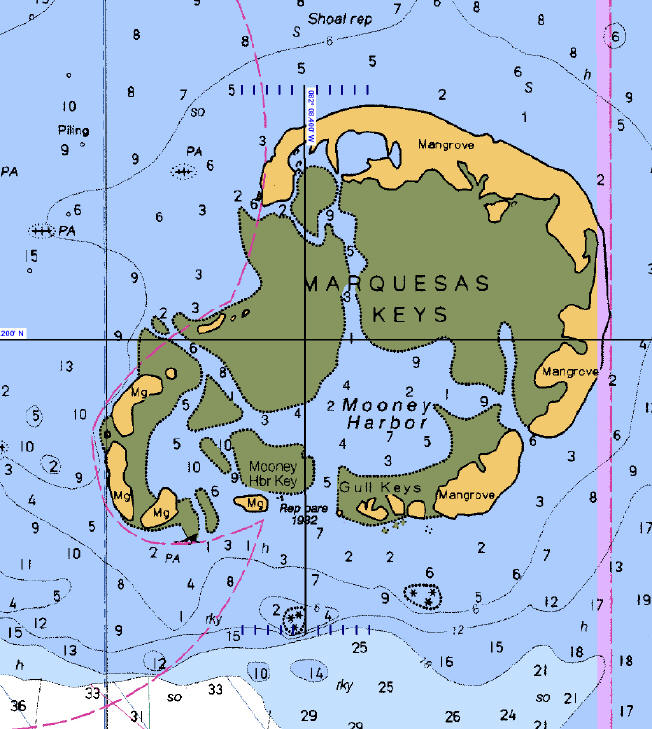
The Marquesas Keys form an uninhabited island group about 20 miles (32 km) west of Key West, four miles (6 km) in diameter, and largely covered by mangrove forest. They are an unincorporated area of Monroe County, Florida and belong to the Lower Keys Census County Division.[1] They are protected as part of the Key West National Wildlife Refuge.[2] The Marquesas were used for target practice by the military as recently as 1980.

Key Information

Satellite image of the Marquesas Keys

Overview

[edit]

The total area, including the lagoon, measures 29.37 km2 (11.34 sq mi). The land area, according to the United States Census Bureau, is 6.58 km2 (2.54 sq mi) (exactly 6,579,703 m2), the water area 0.17 km2 (0.066 sq mi) (165,744 m2), giving a combined area of 6.75 km2 (2.61 sq mi), not counting water areas with connection to the open sea, but including small landlocked lakes on the Keys. The group is located at coordinates 24°34′19″N 82°07′10″W / 24.57194°N 82.11944°W / 24.57194; -82.11944.

The islands are part of the Florida Keys, separated from the rest of the Florida Keys, which are farther east, by the Boca Grande Channel, which is 6 miles (9.7 km) wide until Boca Grande Key, the westernmost of the Mule Keys. Only the Dry Tortugas are farther west, 36 miles (58 km) west of the Marquesas Keys.

The central lagoon is called Mooney Harbor. The northernmost key is the largest and has a strip of sandy beach free of mangrove. In the past it was known as "Entrance Key". It surrounds the lagoon in the north and east. Adjoining in the south are smaller keys such as Gull Keys, Mooney Harbor Key, and finally about four unnamed keys in the southwest corner of the group. Older charts show that two of these keys once were named "Button Island" and "Round Island".[3]

Six miles (10 km) west of the Marquesas Keys is Rebecca Shoal.

While the islands are uninhabited by humans, rays, sharks, sea turtles, and bird life abound. The Florida Keys National Marine Sanctuary has designated no-motor and no-access areas to protect nesting, feeding, and roosting birds and nesting turtles.[4]

The islands are also known for sport fishing.[citation needed]

See also

[edit]

References

[edit]
[edit]
Revisions and contributorsEdit on WikipediaRead on Wikipedia
from Grokipedia
The Marquesas Keys are an uninhabited chain of low-lying, subtropical islands located approximately 25 miles west of , , within the , encompassing about 2,019 acres of land amid 208,308 acres of surrounding open waters and serving as a critical protected for diverse marine and avian species. Geographically, the archipelago consists of multiple small islands, including those west of Mooney Harbor and Gull Key, characterized by dense mangrove forests, hardwood hammocks, sandy beaches, dunes, and subtidal zones, with no native terrestrial mammals and accessibility limited to boat travel. Established on August 8, 1908, by President through 923 to safeguard native bird breeding grounds, the Marquesas Keys were later designated as federal under 93-632 in 1975, reflecting their historical role in early conservation efforts. Ecologically, the keys are home to numerous bird species, including the largest wintering population of piping plovers and the primary colony in the , while providing essential nesting and foraging grounds for threatened sea turtles such as (Chelonia mydas), loggerhead, and hawksbill species, as well as serving as one of the few remaining habitats for the critically endangered Miami blue (Cyclargus thomasi bethunebakeri) and rare like Garber’s spurge. Recent studies as of 2025 highlight the impacts of hurricanes and on species like the Miami blue, with ongoing refuge addressing these threats. Managed by the U.S. Fish and Wildlife Service as part of the Lower National Wildlife Refuges Complex and overlapping with the National Marine Sanctuary, the area enforces strict regulations including no-entry zones around key islands, idle-speed restrictions in tidal creeks, and seasonal closures to prevent habitat disturbance, vessel impacts, and overcrowding during peak periods like .

Geography

Location and Extent

The Marquesas Keys are an uninhabited chain of small islands located in the , approximately 25 miles (40 km) west of , as part of the broader archipelago. The central position of the island group is at coordinates 24°34′19″N 82°07′10″W. They form a roughly circular cluster about 4 miles (6 km) in diameter, primarily covered by forests and enclosing a central known as Mooney Harbor. The Marquesas Keys consist of 14 islands. The total land area of the islands is approximately 5.66 km² (1,398 acres or 2.18 sq mi). To the east, the group is separated from the nearer Mule Keys by the Boca Grande Channel, a approximately 6 miles (10 km) wide that connects the with waters farther east. Administratively, the Marquesas Keys are an unincorporated area within , falling under the Lower Keys Census County Division, and are managed primarily as federal lands within the Key West National Wildlife Refuge. This positioning places the keys within the segment of the chain, distant from mainland and accessible only by boat.

Physical Features

The Marquesas Keys comprise a roughly circular, atoll-shaped cluster of 14 low-lying islands spanning about 4 miles (6 km) in diameter, composed primarily of sands forming a crescentic ring. At the center of this formation lies Mooney Harbor, an enclosed that serves as a central basin encircled by the islands. The islands are predominantly mangrove-dominated and exhibit minimal topographic variation, with the majority rising only slightly above the surrounding waters. The northernmost island, Long Beach Key, stands out with its expansive sandy beach stretching approximately 2.5 miles (4 km) along the shoreline, providing a rare non-mangrove within the group. Elevations throughout the Marquesas Keys remain generally near , with the highest points reaching only 6–10 feet (1.8–3 m) above and no prominent peaks present. The surrounding features shallow bays and interconnected channels, including serpentine waterways within and around Mooney Harbor, which support with typical depths of 4–9 feet (1.2–2.7 m).

Geology

Formation and Composition

The Marquesas Keys originated from the growth of coral reefs and the deposition of limestone during the Pleistocene epoch, specifically the Sangamonian interglacial stage approximately 125,000 years ago. During this period, sea levels rose to 6–10 meters above present, enabling extensive coral reef development on the shallow, tectonically stable Florida carbonate platform in warm subtropical waters. Large head corals, such as Montastraea annularis and Colpophyllia natans, constructed asymmetrical reef tracts up to 30 meters high, forming the foundational structures that would become the Keys. This process parallels the formation of the broader Florida Keys, with the Marquesas representing a distal, atoll-like extension built in a shallow, circular bedrock depression. The primary composition comprises limestone, dominated by oolitic limestone of the Miami Formation and coralline limestone akin to the Formation, both dating to the (100,000–250,000 years ago). These fossilized coral structures and oolitic deposits form the , which lies 1–12 meters below and is overlain by thin sediments (0–12 meters thick), including mangrove-derived peats and sands rich in fragments (comprising about 48% of sediments) and coral debris (17%). The surface is generally flat, capped by calcrete layers, with non-oolitic sands filling lows up to 3 meters deep. Subsequent sea level fluctuations, including a fall of over 120 meters during the (around 20,000 years ago) and a post-glacial rise, led to the emergence of the Marquesas Keys by exposing the Pleistocene limestone ridge above water. The Gulf of Mexico's tectonic stability, characterized by minimal vertical movement on the passive Platform over the past 150,000 years, has allowed these structures to persist without significant alteration. This stability contrasts with more active margins and has preserved the keys' low-relief profile. Prominent geological features include topography, with the soluble prone to dissolution by acidic rainwater and , resulting in numerous localized solution holes and depressions scattered across the relatively flat bedrock. The Marquesas Keys connect to the broader ridge system as its westernmost segment of the approximately 30-kilometer-long and 10-kilometer-wide Marquesas-Quicksands limestone ridge, which rises from the surrounding seafloor.

Habitat Types

The Marquesas Keys, a chain of small islands in the , feature a variety of interconnected types shaped by their subtropical marine environment and low-lying . These habitats include extensive forests, limited sandy beaches, shallow lagoons and bays, transitional zones between terrestrial and aquatic areas, and diverse benthic environments, all contributing to the ecological mosaic of the region. Mangrove forests dominate the landscape of most islands in the Marquesas Keys, forming dense coastal fringes that stabilize shorelines and trap sediments to promote island accretion. These forests thrive in the sheltered, brackish conditions around the island chain, providing essential barriers against and storm surges while creating protected inland waterways. Sandy beaches are scarce and primarily confined to the northernmost key, where thin strips of sand form along the shoreline, often fringed by coastal berms and influenced by tidal currents that deposit from nearby reefs. These beaches represent dynamic zones of accumulation, contrasting with the pervasive cover elsewhere in the chain. Shallow lagoons and bays, such as Mooney Harbor at the center of the island cluster, characterize the interior waters of the Marquesas Keys, featuring calm, low-energy basins with depths ranging from a few feet to deeper channels. These areas support beds and scattered patches, fostering environments shaped by tidal flows and dynamics within the enclosed basin. Transitional zones occur at the interfaces between mangrove forests and open water, where tidal influences create hybrid areas of fluctuating and exposure, blending rooted vegetation with emergent aquatic features. These zones are particularly evident around the island edges, where prop roots extend into shallow bays, facilitating sediment deposition and habitat connectivity. Benthic environments in the inter-island channels and surrounding shelf include extensive mudflats composed of fine, unconsolidated sediments in low-energy settings near mangroves, as well as areas of shell deposits and hardbottom features. These seafloor habitats cover large portions of the Marquesas region, with mudflats predominating in protected channels and supporting sediment-based communities influenced by tidal and current patterns.

History

Early Exploration and Naming

The first European encounter with the , including the area encompassing the Marquesas Keys, is attributed to Spanish explorer during his 1513 expedition, when he sighted the chain of islands and named them Los Mártires, or "The Martyrs," due to their elongated, prostrate appearance resembling suffering figures from a distance. This naming reflected early Spanish perceptions of the archipelago's silhouette against the horizon, though specific details on the Marquesas Keys themselves from this voyage are limited, as Ponce de León's focus was on the broader Gulf Coast exploration. Subsequent Spanish expeditions in the continued mapping efforts in the region, but the Marquesas Keys remained a remote, hazard-strewn outpost amid the treacherous reefs and shallows of the Quicksands area. The Marquesas Keys received their current name in the early , derived from the Marquis de Cadereita, who commanded the 1622 Tierra Firme treasure fleet; a devastating hurricane scattered and sank several ships near the keys, prompting his oversight of salvage operations in the vicinity. An alternative early designation for parts of the group was "Los Mártires," echoing the broader Keys nomenclature, while older nautical charts from the period also referred to individual islets as "Button Island" and "Round Island," reflecting rudimentary surveys of the mangrove-fringed atoll-like formation. Prior to European arrival, the islands likely saw sporadic use by indigenous groups such as the or for seasonal fishing and resource gathering, given their position within the southern coastal zone; however, archaeological evidence remains sparse, consistent with the keys' uninhabitable terrain of dense mangroves and limited freshwater. By the , the Marquesas Keys were more systematically charted through U.S. Coast Survey efforts, which produced detailed maps extending from to the Marquesas, aiding navigation amid the persistent shipwreck risks. These surveys highlighted the keys' isolation, with no records of or human habitation prior to 1900, as the area offered scant or reliable water sources, serving primarily as a transient for mariners.

Military and Modern Use

During , the U.S. military designated the Marquesas Keys as a bombing range for training purposes, with the surrounding waters used for aerial gunnery and exercises. This utilization continued into the period, as evidenced by the establishment of formal danger zones under 33 CFR 334.620, which outlined a circular target area immediately west of the keys with a two-nautical-mile radius for bombing and rocket exercises. In 1959, the U.S. Navy expanded the facility by constructing a new target area and observation towers at the site to support high-altitude live bombing operations. The range remained active for target practice until around 1980, during which periods nearby waters were evacuated to ensure safety for civilian boaters and fishermen. Following the cessation of military activities around 1980, the Marquesas Keys transitioned to under the Key West National Wildlife Refuge, which had encompassed the area since its founding in 1908. In contemporary times, the Marquesas Keys serve primarily as a destination for recreational activities, attracting visitors for sport fishing targeting species such as and on the surrounding flats. is also popular, with sites featuring coral reefs and historical remnants accessible via guided charters. Access is restricted to day use only, reachable by boat from approximately 25 miles away, with camping prohibited to minimize environmental impact. Motorized vessels are banned in core no-motor zones to protect sensitive habitats, enforceable under Florida Keys National Marine Sanctuary regulations. The area's undeveloped status bolsters the broader tourism economy of the , contributing to the region's annual $3.5 billion in visitor spending through low-impact activities like and diving charters, without the need for on-site infrastructure.

Ecology

Flora

The of the Marquesas Keys is predominantly characterized by communities, which form dense forests covering the vast majority of the uninhabited islands' land area. The three dominant species—red (), black (), and white mangrove (Laguncularia racemosa)—thrive in the intertidal zones, with red mangroves typically fringing the shorelines and black and white mangroves occupying slightly higher, inland positions. These species create extensive swamp habitats on the inner mud flats, contributing to sediment stabilization and coastal protection. In the limited sandy areas, particularly on the northern exposures of some keys, beach vegetation includes salt-tolerant species such as sea oats () and railroad vine (), which help bind dunes and prevent erosion, though detailed surveys of these upland zones remain sparse. Within the shallow lagoon waters of Mooney Harbor, seagrass meadows dominate the submerged flora, featuring dense beds of turtle grass () up to 14 feet deep, alongside sparser stands of manatee grass (Syringodium filiforme) and shoal grass (Halodule wrightii). These seagrasses grow on substrates of accumulated algae like Halimeda opuntia. Mangrove species in the Marquesas Keys exhibit key adaptations to the harsh saline and low-oxygen environments, including specialized root systems that exclude or excrete excess salt and pneumatophores—vertical —emerging from black mangrove sediments to facilitate in anaerobic soils. Red mangroves further employ arching prop roots for anchorage in soft substrates. Limited botanical surveys suggest potential for rare or endangered plants, such as the Key tree-cactus (Pilosocereus robinii), though no confirmed populations have been documented in the Marquesas specifically. The threatened Garber’s spurge (Chamaesyce garberi), a low-growing endemic to the , occurs in coastal habitats including sandy beaches and hammocks on the islands.

Fauna

The Marquesas Keys support a rich array of animal life, shaped by their remote mangrove islands and surrounding shallow waters within the Florida Keys ecosystem. This biodiversity includes marine species that thrive in the seagrass beds and reefs, avian populations utilizing the islands for nesting and foraging, limited terrestrial mammals adapted to island conditions, and a variety of invertebrates in coastal habitats. Marine fauna in the Marquesas Keys is particularly diverse, with abundant elasmobranchs and reptiles frequenting the shallow bays and flats. Southern stingrays (Hypanus americanus) are commonly observed foraging in the sandy bottoms, often burying themselves during the day to ambush prey like crustaceans and small fish. Nurse sharks (Ginglymostoma cirratum) and lemon sharks (Negaprion brevirostris) patrol the nearshore waters, with juveniles using the area as a nursery; studies have documented ontogenetic growth variations in lemon sharks specifically around the Marquesas, highlighting its role in their early development. Sea turtles are especially prominent, with the region hosting the densest population in the Florida Keys; green sea turtles (Chelonia mydas) forage extensively on seagrasses here, while loggerhead sea turtles (Caretta caretta) utilize nearby beaches for nesting and the surrounding waters for feeding. Avifauna is a key component of the Marquesas Keys' wildlife, with the mangrove islands serving as nesting and roosting sites for several species. The area supports over 250 bird species and hosts the largest wintering population of piping plovers (Charadrius melodus) in the Florida Keys, as well as the primary nesting colony for white-crowned pigeons (Patagioenas leucocephala). Brown pelicans (Pelecanus occidentalis) are resident breeders, diving for fish in the surrounding shallows, while ospreys (Pandion haliaetus) construct nests on elevated perches and hunt over the bays. Wading birds such as roseate spoonbills (Platalea ajaja) forage in the tidal flats for crustaceans and small fish, their pink plumage distinctive against the green mangroves. The keys also function as a stopover for migratory birds, with seasonal influxes enhancing local diversity. Terrestrial mammals are scarce on the Marquesas Keys due to their small size and isolation, but transients occasionally visit from nearby islands. Raccoons (Procyon lotor), including local adapted to the lower Keys, may swim across to forage in the mangroves for fruits and . Invertebrates contribute significantly to the ecological web, particularly in the mangrove fringes and adjacent reefs. Diverse crustaceans, such as crabs and shrimp, inhabit the prop roots and mudflats, serving as prey for fish and birds; species like the mangrove tree crab () feed on leaf litter in the canopy. Mollusks, including snails and bivalves, are prevalent in the intertidal zones, with some associating with coral structures nearby. Coral-associated fish, such as snappers and grunts, interact with these in the shallow reefs, maintaining dynamics. The endangered Miami blue butterfly (Cyclargus thomasi bethunebakeri) has significant populations on the islands, dependent on nickerbean host plants in coastal areas. The isolation of the Marquesas Keys fosters high animal densities for certain species, such as sea turtles, by limiting human disturbance and providing protected foraging grounds. Seasonal migrations, particularly of birds, peak in winter, when northern species arrive to overwinter in the mild subtropical climate, boosting overall avian populations from December through February.

Conservation

Protected Status

The Marquesas Keys are fully encompassed within the Key West National Wildlife Refuge, established by President in 1908 to serve as a preserve and breeding ground for colonial nesting birds and other wildlife amid threats from . This refuge, administered by the U.S. Fish and Wildlife Service, spans over 375 square miles of open water and includes the Marquesas Keys along with 13 other islands, providing comprehensive protection for the entire chain. In 1975, Congress designated the refuge's islands—excluding —as part of the under the of 1964, enhancing federal safeguards for their undeveloped character and ecological integrity. The surrounding waters of the Marquesas Keys fall under the Florida Keys National Marine Sanctuary, designated on November 16, 1990, by the U.S. Congress to protect the unique ecosystems, beds, and marine biodiversity of the region spanning approximately 2,900 square miles. Managed by the (NOAA), the sanctuary includes no-take zones within its network of marine protected areas, prohibiting fishing and extraction activities to preserve habitat connectivity and species replenishment around the keys. Joint federal oversight by the U.S. Fish and Wildlife Service and NOAA ensures coordinated regulation of terrestrial and marine components, prohibiting activities that could harm protected habitats. Additionally, the Marquesas Keys Wildlife Management Area, co-managed by the Florida Fish and Wildlife Conservation Commission in partnership with federal agencies, imposes restricted public access to minimize disturbance to sensitive habitats. This includes no-entry zones with a 300-foot buffer around key nesting islands and idle-speed/no-wake restrictions in designated tidal areas, aligning state regulations with and refuge protections to limit human impacts.

Management and Threats

Management practices in the Marquesas Keys Wildlife Management Area include designated no-entry zones and idle-speed areas to safeguard nesting sea turtles and birds. A 300-foot no-entry buffer surrounds smaller islands in Mooney Harbor and a mangrove island west of Gull Key, prohibiting vessel access to minimize disturbance during breeding seasons. Annual monitoring surveys, coordinated through the National Marine Sanctuary, track habitat conditions, wildlife populations, and compliance with access restrictions to inform . Invasive species removal efforts target non-native plants like Australian pine (), which outcompete native vegetation and alter ecosystems; these actions are part of broader initiatives to restore upland and coastal habitats. Climate change poses significant threats, particularly sea level rise, which erodes mangrove fringes and inundates low-lying islands critical for wildlife. NOAA projections indicate a potential sea level rise of 0.5 to 2.1 meters (1.6 to 7 feet) by 2100 relative to 2000 levels in the Florida Keys, depending on greenhouse gas emissions scenarios, exacerbating salinity intrusion and habitat loss in the Marquesas Keys, where elevations average below 5 feet. This could convert mangrove-dominated shorelines to open water, reducing carbon sequestration and storm protection capacities. Human activities contribute additional pressures, including illegal anchoring that scars beds essential for nurseries and . Despite regulations prohibiting anchoring in sensitive areas, enforcement challenges persist, leading to degradation across shallow flats. remains a concern in surrounding waters, straining populations of key species even with existing no-take zones and size limits, as recreational and commercial efforts exceed sustainable yields in some sectors. Restoration initiatives focus on enhancing reef resilience through coral propagation projects initiated around 2010, involving the fragmentation and outplanting of threatened species like staghorn coral (Acropora cervicornis) to bolster and structural complexity. Complementary efforts include USGS-led benthic mapping from 2005-2006, which provides baseline data for targeting restoration sites and monitoring changes in seagrass, hardbottom, and coral distributions. Looking ahead, the Marquesas Keys are integrated into Florida's State Wildlife Action Plan, which emphasizes building ecosystem resilience through habitat connectivity, invasive control, and climate adaptation strategies to sustain amid ongoing environmental pressures. In December 2024, NOAA finalized a Restoration Blueprint for the National Marine Sanctuary, aiming to enhance habitat restoration and resilience. However, in March 2025, Florida Governor rejected the accompanying management plan, citing concerns over regulatory burdens, potentially affecting implementation of new protections and restoration efforts in areas like the Marquesas Keys.

References

Add your contribution
Related Hubs
User Avatar
No comments yet.