Hubbry Logo
KiangKiangMain
Open search
Kiang
Community hub
Kiang
logo
8 pages, 0 posts
0 subscribers
Be the first to start a discussion here.
Kiang
Kiang
from Wikipedia

Kiang
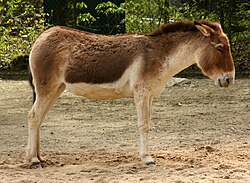
At Hellabrunn Zoo, Germany
CITES Appendix II (CITES)[2]
Scientific classification Edit this classification
Kingdom: Animalia
Phylum: Chordata
Class: Mammalia
Order: Perissodactyla
Family: Equidae
Genus: Equus
Subgenus: Asinus
Species:
E. kiang[1]
Binomial name
Equus kiang[1]
Moorcroft, 1841
Range map

The kiang (Equus kiang) is the largest of the Asinus subgenus. It is native to the Tibetan Plateau in Ladakh India, northern Pakistan, Tajikistan, China and northern Nepal. It inhabits montane grasslands and shrublands. Other common names for this species include Tibetan wild ass, khyang and gorkhar.

Characteristics

[edit]
Kiang of Tibet from The Great and Small Game of India, Burma, and Tibet (1900)

The kiang is the largest of the wild asses, with an average height at the withers of 140 cm (55 in). They range from 132 to 142 cm (52 to 56 in) high at the withers, with a body 182 to 214 cm (72 to 84 in) long, and a tail of 32 to 45 cm (13 to 18 in). Kiangs have only slight sexual dimorphism, with the males weighing from 350 to 400 kg (770 to 880 lb), while females weigh 250 to 300 kg (550 to 660 lb). They have a large head, with a blunt muzzle and a convex nose. The mane is upright and relatively short. The coat is a rich chestnut colour, darker brown in winter and a sleek reddish brown in late summer, when the animal moults its woolly fur. The summer coat is 1.5 cm (0.6 in) long and the winter coat is double that length. The legs, underparts, end of the muzzle, and the inside of the ears are all white. A broad, dark chocolate-coloured dorsal stripe extends from the mane to the end of the tail, which ends in a tuft of blackish brown hairs.[3]

Evolution

[edit]
Skull of a giant extinct horse, Equus eisenmannae

The genus Equus, which includes all extant equines, is believed to have evolved from Dinohippus, via the intermediate form Plesippus. One of the oldest species is Equus simplicidens, described as zebra-like with a donkey-shaped head. The oldest fossil to date is about 3.5 million years old from Idaho, US. The genus appears to have spread quickly into the Old World, with the similarly aged Equus livenzovensis documented from western Europe and Russia.[4]

Molecular phylogenies indicate the most recent common ancestor of all modern equids (members of the genus Equus) lived about 5.6 (3.9–7.8) million years ago (Mya). Direct paleogenomic sequencing of a 700,000-year-old middle Pleistocene horse metapodial bone from Canada implies a more recent 4.07 Mya for the most recent common ancestor (MRCA) within the range of 4.0 to 4.5 Mya.[5] The oldest divergencies are the Asian hemiones (subgenus E. (Asinus), including the kulan, onager, and kiang), followed by the African zebras (subgenera E. (Dolichohippus), and E. (Hippotigris)). All other modern forms including the domesticated horse (and many fossil Pliocene and Pleistocene forms) belong to the subgenus E. (Equus) which diverged roughly 4.8 (3.2–6.5) Mya.[6]

Skull of Equus kiang held at World Museum, National Museums Liverpool (NML-VZ 1982.1100)

Taxonomy

[edit]

The kiang is closely related to the onager (Equus hemionus), and in some classifications it is considered a subspecies, E. hemionus kiang. Molecular studies, however, indicate that it is a distinct species.[7] An even closer relative, however, may be the extinct Equus conversidens of Pleistocene America,[8] to which it bears a number of striking similarities; however, such a relationship would require kiangs to have crossed Beringia during the Ice Age, for which little evidence exists. Kiangs can crossbreed with onagers, horses, donkeys, and Burchell's zebras in captivity, although, like mules, the resulting offspring are sterile. Kiangs have never been domesticated.[3]

Three kiang subspecies are currently recognised:[1][3][9]

  • E. k. kiang — western kiang in Tibet, Ladakh and southwestern Xinjiang
  • E. k. holdereri — eastern kiang in Qinghai and southeastern Xinjiang
  • E. k. polyodon — southern kiang in southern Tibet up to northern Nepal

The eastern kiang is the largest subspecies; the southern kiang is the smallest. The western kiang is slightly smaller than the eastern and also has a darker coat. However, no genetic information confirms the validity of the three subspecies, which may simply represent a cline, with gradual variation between the three forms.[2][9]

Distribution and habitat

[edit]
Wild kiang in Changtang
A small group of Kiangs in the vicinity of Tso Moriri Lake

The kiang is distributed from the Kunlun Mountains in the north, the Tibetan Plateau to the Himalayas in the south. It occurs mostly in China, but about 2,500–3,000 kiangs are thought to inhabit the Ladakh, Himachal Pradesh, and Uttarakhand regions of India, and smaller numbers along the northern frontier of Nepal.[9]

Kiang herds inhabit alpine meadows and steppe country between 2,700 and 5,300 m (8,900 and 17,400 ft) elevation. They prefer relatively flat plateaus, wide valleys, and low hills, dominated by grasses, sedges, and smaller amounts of other low-lying vegetation. This open terrain, in addition to supplying them with suitable forage absent in the more arid regions of central Asia, may make it easier for them to detect, and flee from, predators.[10]

Behavior and ecology

[edit]

The kiang is a herbivore, feeding on grasses and sedges, especially Stipa, but also on other plants such as bog sedges, true sedges, and meadow grasses. When little grass is available, such as during winter or in the more arid margins of their native habitat, kiangs have been observed eating shrubs, herbs, and even Oxytropis roots dug from the ground. Although they do sometimes drink from waterholes, such sources of water are rare on the Tibetan Plateau, and they likely obtain most of their water from the plants they eat, or possibly from snow in winter.[3]

Kiangs sometimes gather in large herds, which may number several hundred individuals. However, these herds are not permanent groupings, but temporary aggregations, consisting either of young males only, or of mothers and their foals. Older males are typically solitary, defending a territory of about 0.5 to 5 km2 (0.19 to 1.93 sq mi) from rivals, and dominating any local groups of females. Territorial males sometimes become aggressive towards intruders, kicking and biting at them, but more commonly chase them away after a threat display that involves flattening the ears and braying.[3]

Reproduction

[edit]

Kiangs mate between late July and late August, when older males tend reproductive females by trotting around them, and then chasing them prior to mating. The length of gestation has been variously reported as seven to 12 months, and results in the birth of a single foal. Females are able to breed again almost immediately after birth, although births every other year are more common. Foals weigh up to 35 kg (77 lb) at birth, and are able to walk within a few hours. The age of sexual maturity is unknown, although probably around three or four years, as it is in the closely related onager. Kiang live for up to 20 years in the wild.[3]

In culture

[edit]

Natural historian Chris Lavers points to travellers' tales of the kiang as one source of inspiration for the unicorn, first described in Indika by the Ancient Greek physician Ctesias.[11]

Ekai Kawaguchi, a Japanese monk who traveled in Tibet from July, 1900 to June 1902, reported:

As I have already said, khyang is the name given by the Tibetans to the wild horse of their northern steppes. More accurately it is a species of ass, quite as large in size as a large Japanese horse. In color it is reddish brown, with black hair on the ridge of the back and black mane and with the belly white. To all appearance it is an ordinary horse, except for its tufted tail. It is a powerful animal, and it is extraordinarily fleet. It is never seen singly, but always in twos or threes, if not in a herd of sixty or seventy. Its scientific name is Equus hemionis, but is for the most part called by its Tibetan name, which is usually spelled khyang in English. It has a curious habit of turning round and round, when it comes within seeing distance of a man. Even a mile and a quarter away, it will commence this turning round at every short stage of its approach, and after each turn it will stop for a while, to look at the man over its own back, like a fox. Ultimately it comes up quite close. When quite near it will look scared, and at the slightest thing will wheel round and dash away, but only to stop and look back. When one thinks it has run far away, it will be found that it has circled back quite near, to take, as it were, a silent survey of the stranger from behind. Altogether it is an animal of very queer habits.[12]

Kiangs at the Prague Zoo

Thubten Jigme Norbu, the elder brother of Tenzin Gyatso the 14th Dalai Lama, reporting on his trip from Kumbum Monastery in Amdo to Lhasa in 1950, wrote:

The kyangs or wild asses, live together in smaller groups, each headed by a stallion, lording it over anything from 10 to 50 mares. I was struck by the noble appearance of these beasts, and in particular, by the beautiful line of head and neck. Their coat is light brown on the back and whitish below the belly, and their long, thin tails are almost black; the whole representing excellent camouflage against their natural background. They look wonderfully elegant and graceful when you see them darting across the steppes like arrows, heads stretched out and tails streaming away behind them in the wind. Their rutting season is in the autumn, and then the stallions are at their most aggressive as they jealously guard their harems. The fiercest and most merciless battles take place at this time of the year between the stallion installed and interlopers from other herds. When the battle is over, the victor, himself bloody and bruised from savage bites and kicks, leads off the mares in a wild gallop over the steppe. We would often see kyangs by the thousand spread over the hillsides and looking inquisitively at our caravan; sometimes they would even surround us, though keeping at some distance.[13]

References

[edit]

Further reading

[edit]
Revisions and contributorsEdit on WikipediaRead on Wikipedia
from Grokipedia
The kiang (Equus kiang), also known as the Tibetan wild ass, is the largest species of wild ass and a member of the horse family (Equidae), native to the high-altitude plateaus and steppes of the Tibetan region. It inhabits open, arid grasslands and alpine meadows at elevations ranging from 2,700 to 5,400 meters, primarily in China, but also in parts of India, Nepal, and Pakistan. Adults typically measure 210 cm in body length, stand 140 cm at the shoulder, and weigh 250–440 kg, with a short, reddish-brown summer coat that thickens and darkens to brown in winter, featuring white underparts, a dark dorsal stripe, and a prominent tail tuft. The kiang's geographic range centers on the , where it occupies vast, undulating terrains including desert steppes and montane grasslands with low annual precipitation of 60–70 mm. In , which hosts over 90% of the global population, key areas include , , , and the , with smaller populations in (), northern , and . The species exhibits seasonal movements rather than true migration, traveling long distances in search of , and is well-adapted to extreme cold and low oxygen levels at high altitudes. Socially, kiangs form cohesive herds of 5 to 400 individuals, often led by an experienced , with subgroups including mother-foal units, territorial males, and bachelor groups; they travel in single file and maintain minimal physical contact. Their diet consists primarily of grasses such as Stipa species (comprising 65% in summer and over 90% in winter) and sedges, supplemented by forbs, allowing them to gain significant weight during peak forage seasons. Breeding occurs in August–September, with a period of about 12 months, resulting in single foals born from July to ; young are weaned by one year and reach around two years, with a lifespan of up to 20 years in the wild. Predators like wolves pose threats, but kiangs are known for their defensive group behaviors and swimming abilities in summer rivers. Conservationally, the kiang is classified as Least Concern on the , with a global population estimated at 60,000–70,000 individuals, though it faces risks from , competition with , disease transmission from domestic animals, and . It is protected under national laws in (Class I), (Schedule I), and , and is listed on Appendix II; subspecies distinctions (western E. k. kiang, eastern E. k. holdereri, and southern E. k. polyodon) are recognized but debated. Ongoing monitoring emphasizes reducing human-wildlife conflicts in this remote, ecologically sensitive region.

Classification

Taxonomy

The kiang (Equus kiang) belongs to the family within the order , genus Equus, and is recognized as a distinct species described by William Moorcroft in 1841 based on specimens from the eastern parts of . This classification places it among the wild asses of the subgenus , separate from domesticated horses and zebras in the same genus. Three subspecies are commonly recognized, distinguished primarily by geographic distribution and subtle morphological variations such as skull proportions and body dimensions, though some studies suggest these form a cline with minor differences. The nominate subspecies, E. k. kiang (western kiang), inhabits the western , including (), northern , and parts of western (, , ), and is characterized by shorter skull elements. E. k. holdereri (eastern kiang), found in the eastern , primarily in (, , , ), exhibits the largest size with longer nasals, toothrow, and . The southern subspecies, E. k. polyodon, occurs in the southern , including southern (), (), and northern , and is the smallest with color patterns similar to holdereri. Common names for the kiang include Tibetan wild ass, khyang, and gorkhar, reflecting its native Tibetan and regional linguistic contexts. Genetic studies, including chromosomal analyses and from the late 20th and early 21st centuries, confirm the kiang's species-level distinction from the (Equus hemionus), despite close relation; for instance, the kiang's (2n=51 or 52, due to Robertsonian polymorphism) features additional fusions (e.g., 8q/15 and 7/25) not present in the onager's (2n=54–56), and phylogenetic analyses show divergence with but clear separation. A 2023 chromosome-level assembly (25 autosomal pairs + ) further supports this, estimating divergence ~0.266–0.392 million years ago and highlighting adaptations to high altitude via genes like EPAS1.

Evolution

The genus Equus originated in North America approximately 4.5–5.6 million years ago during the late Miocene to early Pliocene, evolving from earlier hipparionin ancestors adapted to open grasslands. Early species dispersed across Beringia into Eurasia around 2–3 million years ago, facilitating the radiation of equids into diverse Asian environments, including the emerging high-altitude plateaus. This migration set the stage for the diversification of the Asinus subgenus, to which the kiang (Equus kiang) belongs, as ass-like equids adapted to arid and montane habitats. The evolutionary lineage leading to the kiang traces back to the split within Equus that separated caballine (horse-like) and non-caballine (ass- and zebra-like) clades around 4.0–4.5 million years ago. Within the non-caballine group, African and Asiatic wild asses shared a common ancestor approximately 2.3 million years ago, marking the divergence of lineages adapted to continental steppes and plateaus. The kiang's specific ancestry within the Asiatic wild ass complex (Equus hemionus group) reflects isolation on the Tibetan Plateau, with phylogenetic analyses indicating a divergence from the broader onager (E. hemionus) lineage driven by geographic barriers such as the Himalayan uplift, estimated around 0.3–0.5 million years ago based on mitochondrial and genomic data. Fossil evidence for the kiang remains sparse, underscoring its specialized high-altitude niche, but records from provide key insights into its precursors. Equids morphologically similar to early kiang, such as Equus sivalensis from the Siwalik Hills of and (dated ~3.6–1.5 million years ago), exhibit traits like robust metapodials suited to rugged terrain, suggesting ancestral adaptations to proto-Himalayan environments. Later Pleistocene fossils attributed to Equus cf. kiang, including metatarsals from Alaskan and sites (~50,000–11,700 years ago), indicate that kiang-like populations may have ranged farther north during expansions before retreating to the . These records highlight the kiang's evolutionary trajectory toward extreme-altitude tolerance, with no confirmed pre-Pleistocene fossils directly from the Tibetan region. Pleistocene glaciations profoundly influenced the kiang's distribution and genetic structure, promoting isolation in refugia across the Himalayan Plateau during glacial maxima. Cyclic cooling and expansion of ice sheets ~2.6 million–11,700 years ago fragmented populations, fostering among groups now recognized as through reduced and local adaptations to varying altitudes. This period of climatic instability likely reinforced the kiang's separation from lowland populations, contributing to its current restricted range and monotypic status within high-elevation ecosystems.

Physical characteristics

Morphology

The kiang (Equus kiang) is the largest of the wild asses, characterized by a robust, stocky build with long limbs, a short body, and a large head featuring a convex nose and thick rostrum. Adults measure 132–142 cm in shoulder height, 182–214 cm in head-body length, and 32–45 cm in tail length, with hind foot lengths ranging from 41–54 cm. Males exhibit , weighing 350–400 kg, while females are smaller at 250–300 kg. The kiang's is chestnut-brown on the upper parts, including the thighs, back, flanks, hind legs, , cheeks, and , with white undersides, , and insides of the ears. Coloration varies seasonally: the summer is paler and more reddish, with hairs 14–16 mm long, while the winter is thicker, darker, and 35–46 mm long. A prominent dark brown dorsal stripe runs from the mane to the tail, and the legs are generally white, occasionally light brown on the front with a thin dark stripe above the hooves. Distinctive features include large ears measuring 22 cm in length, a longer and more erect mane than in related species like E. hemionus, and a white wedge-shaped marking behind the shoulder along with a prominent white throat. The build is broader and more robust than that of the (E. hemionus), with broad, round hooves and a narrow, steeply descending rump adapted for high-altitude movement, complemented by seasonal moulting that sheds the thicker winter pelage. Subspecies show minor variations in overall size, with E. k. holdereri being the largest.

Adaptations

The kiang (Equus kiang) has evolved specialized physiological traits to thrive in the hypoxic conditions of the at elevations up to 5,300 m. A 2023 chromosome-level genome assembly identified expanded gene families related to hypoxia response and positively selected genes, such as in the hypoxia-inducible factor 1 pathway, along with structural variations in genes like PIK3CB and AKT, enabling efficient oxygen utilization and energy production under low . These adaptations support sustained activity in oxygen-poor environments without pronounced hematological changes seen in some low-altitude acclimators. Thermoregulation in the kiang is achieved through seasonal pelage modifications and behavioral adjustments. During winter, the coat thickens with hairs measuring 35–46 mm, providing insulation against subzero temperatures, while the summer coat is shorter (14–16 mm) and paler, reducing heat absorption; this facilitates cooling in warmer months. Individuals often ascend to higher elevations during the day in summer to exploit cooler air, minimizing overheating in the intense solar radiation of the plateau. Locomotion adaptations equip the kiang for the rugged, uneven of its highland . Broad, horse-like hooves and muscular legs provide traction and stability on rocky steppes and slopes, enabling efficient navigation across alpine meadows and avoiding predators in open areas. The can attain speeds of up to 70 km/h, supporting rapid escapes over long distances. Sensory capabilities are finely tuned for vigilance in expansive, treeless landscapes. Keen eyesight allows detection of threats at great distances across the plateau's horizons, complemented by acute hearing that picks up subtle sounds like predator footfalls or herd movements; these traits, combined with vocal alerts such as snort puffs, enhance group survival in predator-prone environments.

Range and habitat

Geographic distribution

The kiang (Equus kiang), also known as the Tibetan wild ass, is endemic to the in , where its primary range spans high-altitude grasslands and steppes. The species occupies an area bounded by the to the north and the to the south, with elevations typically ranging from 2,700 to 5,400 meters above sea level. The vast majority of its distribution—approximately 90%—lies within , particularly in the and Province, with smaller populations extending into northern (primarily ), northern (including Khunjerab National Park), and (regions such as and ). Marginal presence has also been reported in possibly , though these are less confirmed and represent peripheral extensions of the core range. Three subspecies are recognized based on morphological variations and geographic separation, though their distinctiveness is debated as potentially representing a cline rather than discrete taxa; recent genetic analyses support this view. The western subspecies (E. k. kiang) inhabits central and western , in , and southwestern in . The eastern subspecies (E. k. holdereri) is distributed in eastern and southeastern , . The southern subspecies (E. k. polyodon) occupies southern near the border and adjacent Himalayan foothills. Historically, the kiang's range was broader across the , but it has contracted due to human activities including hunting, military conflicts (such as the 1962 in ), and expanding livestock grazing in the mid-20th century. Recent surveys, including a 2023 survey in Shiqu County, Province, on peripheral populations indicate fragmented distributions with ongoing pressures from , estimating a local of about 1,395 individuals.

Habitat requirements

Kiangs inhabit high-altitude ecosystems such as alpine meadows, montane steppes, and river valleys characterized by short grasses, where they can access open terrain for movement and foraging. These environments typically feature flat plateaus, wide valleys, and low rolling hills at elevations ranging from 2,700 to 5,400 meters, overlapping with their broader geographic distribution across the Tibetan Plateau. The vegetation in these habitats is dominated by Stipa grasses, sedges, and forbs, providing sparse but nutrient-rich cover adapted to the short . Kiangs exhibit seasonal movements to follow the green-up of vegetation, particularly during the May-to-August period when plant growth peaks, allowing them to exploit fresh growth in mesic and xeric patches. Abiotic conditions in kiang habitats include a , arid climate with minimal annual , often below 600 mm, and extreme fluctuations, such as annual ranges exceeding 20°C. These animals avoid dense forests and steep cliffs, favoring open, gently sloping areas that facilitate their grazing and escape from predators. Recent habitat suitability models, including a 2024 study using MaxEnt modeling, estimate approximately 3,402 km² of suitable area for kiangs in peripheral regions like those in the eastern , influenced primarily by proximity to sites, around 4,000 m, and variability. These models highlight fragmented distributions in grassland-dominated zones with higher vegetation cover.

Behavior and ecology

Social structure

The kiang (Equus kiang) maintains a fission-fusion characterized by temporary, fluid groupings rather than stable , allowing individuals to join or leave based on resource availability and season. During the breeding season, territorial males temporarily groups of 5–20 females with their foals, which are led by an experienced female, while separate groups of young or subordinate males range from 2–10 animals. Solitary individuals, often older or transient males, are also common outside of breeding periods. Adult males exhibit pronounced territorial behavior during late summer (late July–August), defending non-overlapping areas of 0.5–5 km² through aggressive displays, such as raising the head with ears , wheezing vocalizations, and chasing intruders. Territories are marked via marking, including at communal dung piles and , to signal ownership and deter rivals. These behaviors facilitate access to females passing through the area, though groupings remain loose and non-permanent. Social dynamics vary seasonally, with groups dispersing into smaller units (averaging 6–11 individuals) during summer to access high-elevation pastures, reducing . In non-breeding periods, particularly fall and winter, kiangs form larger aggregations of up to 500 individuals in resource-rich basins, promoting shared opportunities and predator vigilance without fixed leadership. Communication among kiangs relies on vocalizations, visual displays, and olfactory cues to maintain bonds and resolve conflicts. The distinctive "shrieking bray"—a loud, high-pitched call—serves for long-distance signaling during territorial disputes or alarms, accompanied by snort-puffs for immediate threats. Body postures, such as ear positioning and tail raising, convey dominance or submission, while scent marking reinforces social hierarchies and group cohesion.

Foraging and diet

The kiang (Equus kiang) is primarily herbivorous, with its diet consisting mainly of grasses such as Stipa spp., alongside sedges like Kobresia and Carex, and herbs including Poa and Elymus. In summer, approximately 65% of the diet comprises Stipa spp., supplemented by smaller amounts of forbs and occasional shrubs, while winter forage shifts to over 90% Stipa spp., with rare instances of root digging for plants like Oxytropis. This grass-dominated intake reflects adaptation to the nutrient-poor alpine meadows of the Tibetan Plateau, where graminoids provide the bulk of available biomass. Foraging occurs in distinct daily bouts, peaking in the early morning (8:00–10:30), (14:30–15:30), and around sunset, allowing kiangs to exploit cooler periods for grazing while minimizing heat stress and predation risk. Kiangs exhibit flexible strategies, selecting sites with high plant biomass and green foliage, and undertake seasonal migrations to higher pastures in summer for fresher growth, returning to lower xeric plains in winter when is sparser. These movements enable access to optimal quality amid the plateau's harsh, variable conditions. As fermenters, kiangs efficiently digest fibrous, low-quality plants through microbial activity in the caecum, supported by a dominated by Bacteroidetes and Firmicutes that enhances breakdown and energy extraction from arid-adapted . In water-scarce environments, they derive most hydration from plant moisture and rather than free-standing sources, reducing dependence on rare waterholes. Kiang foraging overlaps with domestic livestock such as sheep, , yaks, and , leading to for limited grasses and sedges in shared rangelands; estimates indicate kiangs consume only 3–11% of total in key areas like the Changthang Plateau, where livestock account for 89–97%. This rivalry intensifies in sedge meadows during peak periods, potentially displacing kiangs from preferred feeding sites.

Reproduction

The kiang exhibits a distinct breeding season from late July to late August, aligned with the rains that enhance growth and resource availability on the . This timing ensures that foaling occurs during periods of abundant , supporting the nutritional demands of lactating females and growing offspring. is polygynous, characterized by territorial stallions defending areas and forming temporary harems with receptive females, often through displays of vocalization and aggressive interactions with rival males. Females typically give birth every 2 years under favorable conditions. Gestation in kiang mares lasts approximately 12 months, culminating in the birth of a single , with twins being exceptionally rare as in most equids. Births typically take place in late summer, between mid-July and mid-August, when environmental conditions are favorable for newborn survival. Foals are precocial, able to stand and follow their mothers within hours of birth, and they are weaned at around 12 months of age, transitioning to a fully herbivorous diet of grasses and sedges. Parental care is primarily provided by females, who form stable mother-offspring bonds and protect foals from threats for 1 to 2 years until the young achieve independence and integrate into larger herds. Stallions may contribute indirectly by defending group territories against predators during this vulnerable period. is notably high, largely attributable to predation by Tibetan wolves (Canis lupus chanco), which target young kiangs in open habitats despite herd defense strategies like circling and kicking. Kiangs attain around 3 years of age, allowing females to participate in breeding cycles every 2 years under optimal conditions. In the wild, their lifespan is up to 20 years, though many succumb earlier to environmental stressors or predation.

Conservation

Status and threats

The kiang (Equus kiang) is classified as Least Concern on the , with the assessment originally conducted in May 2008 and the status reaffirmed in subsequent specialist group reports through 2023. It is also listed under Appendix II of the Convention on in Endangered Species of Wild Fauna and Flora (), which regulates to prevent . The kiang is protected under national laws, including Class I status in , Schedule I of the Wildlife Protection Act in , and protected status in . Primary anthropogenic threats to the kiang include caused by activities and development, such as across the , which disrupts migration routes and access to foraging areas. for meat, hides, and medicinal uses remains a concern in remote regions, despite legal protections, contributing to localized population declines. Additionally, competition with domestic yaks for resources in shared high-altitude pastures exacerbates resource scarcity, particularly during seasonal migrations. Natural threats encompass predation primarily by Tibetan wolves (Canis lupus chanco) and snow leopards (Panthera uncia), which target kiang calves and weakened adults, though herd defense behaviors mitigate some risk. Disease transmission from sympatric livestock, including potential pathogens like Mycobacterium avium, poses an ongoing risk due to increasing overlap between wild and domestic herds. Recent studies indicate that is altering vegetation patterns on the , with projections suggesting the kiang may lose 30–50% of its current range under future warming scenarios, potentially reducing suitable habitat availability. Overall population trends appear stable, though monitoring is essential amid these pressures.

Population estimates

The global population of the kiang (Equus kiang) is estimated at 60,000–70,000 individuals based on surveys conducted up to the early , with the overall trend described as stable but fragmented across its range. Approximately 90% of this population, or 56,500–68,500 individuals, occurs in , where the largest concentrations are found in the Tibetan Autonomous Region (37,000–48,000), Qinghai and provinces (around 15,000), and (recent surveys suggest over 10,000, with older estimates at 4,500–5,500). For instance, in the Arjin Mountains in , surveys from 2011–2012 estimated 8,500–9,500 kiangs across 45,000 km², representing a significant portion of the regional total. Outside , populations are smaller and more isolated. In , estimates for indicate 1,500–1,600 individuals as of the mid-1990s, with more recent assessments suggesting a range of 2,500–3,000, primarily in the Changthang region. Smaller groups persist in , with around 37 individuals reported in , and fewer than 100 overall; in and , numbers are minimal or unconfirmed, with only 20–25 recorded in Pakistan's Khunjerab . Population monitoring relies on methods such as line transects and camera traps, particularly in protected areas like India's , where vehicle-based and foot transects have been used to estimate densities including kiangs. These techniques help track group sizes and distributions, with camera traps providing supplementary data on presence in remote habitats. Demographic trends show slow growth in core protected areas, such as Tibet's Chang Tang Nature Reserve, where numbers have increased due to reduced poaching. However, peripheral populations face declines from habitat isolation, leading to fragmentation and limited gene flow across the species' range.

Human relations

Cultural role

The kiang holds a place in Tibetan mythological traditions through its association with unicorn legends, stemming from ancient travelers' tales on the plateau. Natural historian Chris Lavers identifies the kiang as a key inspiration for the classical Greek unicorn described by Ctesias around 400 BCE, combining its equine form and swiftness with traits from the chiru antelope and yak to form a chimeric beast of ferocity and purity. In the indigenous religion, the kiang, known locally as kyang, features as a symbolic mount for protective deities, embodying strength and traversal of rugged terrains. For instance, the Bon protector goddess Machig Lhamo is depicted riding a kyang, underscoring its role in spiritual iconography as a vehicle for divine intervention and guardianship. This portrayal extends to Bon artistic traditions, where indigenous animals like the kyang appear more frequently than in , symbolizing harmony with the natural world. Nineteenth-century explorer journals provide early documented accounts of the kiang, capturing its significance in the remote Himalayan landscapes. William Moorcroft, during his 1820–1825 expeditions through and , described the kiang's reddish-brown coat, robust build, and in detail, distinguishing it from domestic asses and noting its to high-altitude grazing. These observations, published posthumously in Travels in the Himalayan Provinces (1841), highlighted the animal's elusive nature and role in local ecosystems. Within Tibetan nomadic herding lore, the kiang represents the endurance and independence of life on the plateau, often invoked in oral traditions as a counterpart to domesticated yaks and horses that nomads rely upon for mobility and survival. Its ability to thrive in extreme conditions mirrors the resilience required by herders navigating seasonal migrations across barren highlands. The kiang thus symbolizes the untamed and unyielding spirit of high-altitude cultures, evoking themes of perseverance amid isolation and harsh weather.

Interactions and management

Human-kiang interactions often involve conflicts arising from competition between the wild asses and domestic for resources in shared rangelands. In 's Changthang Plateau, pastoral communities perceive the kiang population as overstocking the area, leading to forage shortages for their such as sheep, , and yaks, which exacerbates tensions and threatens conservation efforts. Emerging infrastructure development, including new roads in , has raised concerns about increased risks to high-altitude wildlife from vehicle traffic and off-road activities, including potential collisions and disturbance for like the kiang, as reported in 2024 assessments of linear impacts on landscapes. Management strategies for kiang conservation emphasize protected areas and enforcement measures to mitigate human-wildlife conflicts. In , the Arjin Mountain Nature Reserve serves as a key , supporting a stable kiang population through habitat monitoring and restrictions on mining activities that degrade rangelands. In , the protects kiang subpopulations via regulated grazing zones and anti-poaching patrols conducted by local wildlife authorities to prevent illegal hunting and encroachment. These patrols, often involving community rangers, have helped maintain population stability in core areas by addressing immediate threats like unauthorized livestock herding. Ecotourism presents opportunities to support kiang conservation by generating funds for habitat protection and fostering positive human interactions. Guided wildlife viewing tours in reserves like Changthang allow visitors to observe kiang herds in their natural environment, with revenues directed toward and rangeland restoration initiatives. Community education programs integrated into these efforts promote awareness of kiang among local pastoralists, reducing conflicts through sustainable practices and highlighting the species' role in . Cultural reverence for the kiang further aids tolerance in these programs. Ongoing research initiatives post-2020 focus on genetic and studies to inform translocation planning and long-term viability. A 2023 chromosome-level assembly of the kiang revealed adaptations to high-altitude environments, providing genetic markers for assessing and potential reintroduction sites to bolster fragmented herds. surveys in Changthang since 2021 have mapped suitable translocation areas, evaluating availability and human disturbance to guide interventions that enhance connectivity between subpopulations. A 2024 study assessed the peripheral population status and suitability of the kiang in the Mt. Qomolangma National Nature Reserve, , estimating an area of suitable habitat at 3402.45 km² and highlighting needs for enhanced protection in border regions.

References

Add your contribution
Related Hubs
User Avatar
No comments yet.