



Community hub
Recent from talks
Contribute something
Nothing was collected or created yet.
Kingsbarns
View on Wikipedia


Kingsbarns is a village and parish in Scotland lies near the eastern coast of Fife, in an area known as the East Neuk, 6.5 miles (10.5 km) southeast of St Andrews and 3.6 miles (5.8 km) north of Crail. The name derives from the area being the location of the barns used to store grain before being transported to the Palace at Falkland.
The coast around Kingsbarns is also known as a challenging surfing area.
Pitmilly, a former estate that was owned by the Monypenny family for over seven centuries, is located about 1.5 miles from Kingsbarns on the road to St Andrews. Ruins of two mills and the Bronze Age tumulus, Pitmilly Law, are still evident. Little remains of Pitmilly House.
The civil parish has a population of 443 (in 2011).[1]
Amenities
[edit]An inn existed in Kingsbarns for centuries, previously offering a place of refuge for pilgrims to St Andrews Cathedral.[2] However, the 18th-century coaching inn standing on the previously established site has reopened recently under new management

Barns Cottage in the Square is an historic building that includes the former infants' school.[3]
The village also has a church and primary school.
Notable residents
[edit]- Robert Arnot (1744–1808), Presbyterian minister, Moderator of the General Assembly of the Church of Scotland, and professor of Divinity at St. Andrews University, lived in Kingsbarns from 1800 until his death.
- Charlton Monypenny (1867-1947), world record-holding sprinter, rugby player and businessman, Laird of Pitmilly.
- Douglas Monypenny, (1878-1900), Scottish international Rugby player
- Alexander Peebles (1856–1934), New Zealand prospector and mine owner, born in Kingsbarns[4]
- James Yorkston (b. 1971), musician and writer, grew up in Kingsbarns[5]
- Vic Galloway (b. 1972), DJ, radio and TV presenter and journalist, grew up in Kingsbarns[6]
Golf
[edit]The forming of the Kingsbarns Golfing Society in 1793 began the village's long association with golf, with the course, laid upon land leased from the Cambo Estate, being in use until around 1850 when it was returned to farming. In 1922, Kingsbarns Golf Club was founded, and a nine-hole course designed by Willie Auchterlonie was laid out, but in 1939 the land was mined to prevent the Germans landing on the coast.
Kingsbarns Golf Links is a man-made links course designed by architect Kyle Phillips, and developed by Mark Parsinnen. Opened in 2000, it has co-hosted the European Tour's Dunhill Links Championship along with the Old Course at St Andrews and Carnoustie since 2001. Kingsbarns hosted the St Andrews Trophy in 2007, the Jacques Léglise Trophy in 2008, and the Women's British Open in 2017.
-
 Start
Start -
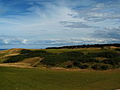 Golf Course
 -
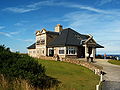 Club House


Whisky
[edit]A Scotch whisky distillery opened in November 2014 and began filling barrels of spirit the following March. Kingsbarns distillery was founded by a local golf caddie who wished to convert a historic and semi-derelict farm-steading into a distillery.
Notes
[edit]- ^ Census of Scotland 2011, Table KS101SC – Usually Resident Population, publ. by National Records of Scotland. Web site http://www.scotlandscensus.gov.uk/ retrieved March 2016. See "Standard Outputs", Table KS101SC, Area type: Civil Parish 1930
- ^ "About the Barns at Kingsbarns - boutique hotel, restaurant and bar just outside of St Andrews, the home of Golf". Archived from the original on 5 November 2011. Retrieved 12 July 2011., The Barns at Kingsbarns, retrieved 12 July 2011.
- ^ "Barns Cottage". British Listed Buildings.
- ^ Heath, Alison B. "Peebles, Alexander – Biography". Te Ara Encyclopedia of New Zealand. Retrieved 16 February 2013.
- ^ Galloway, Vic (8 July 2013). Songs in the Key of Fife: The Intertwining Stories of The Beta Band, King Creosote, KT Tunstall, James Yorkston and the Fence Collective. Birlinn. ISBN 9780857902313 – via Google Books.
- ^ "Vic Galloway :: Authors :: Birlinn Ltd". Birlinn.co.uk. Retrieved 28 March 2015.
External links
[edit]
- Kingsbarns – information centre
- Kingsbarns Golf Links – official site
- The Barns at Kingsbarns – official site
56°18′N 2°40′W / 56.3°N 2.66°W
| International | |
|---|---|
| National | |

Kingsbarns
View on GrokipediaGeography and Demographics
Location and Topography
Kingsbarns is a village and parish in the East Neuk region of Fife, Scotland, positioned along the eastern coastline facing the North Sea. It lies approximately 6.5 miles southeast of St Andrews and 3.6 miles north of Crail, with central coordinates at 56.3°N 2.66°W.[6][13][14] The topography of Kingsbarns features a coastal landscape characterized by sandy soils and undulating dunes along the shoreline, with the area exposed to consistent North Sea winds that shape its environmental features. Fine fescue turf dominates the links terrain, contributing to the region's distinctive low-lying, open character at elevations around 92 feet. Inland from the village, approximately 1.5 miles toward St Andrews, the Pitmilly estate preserves ruins of two historical mills and the prominent Bronze Age tumulus known as Pitmilly Law, a burial barrow now topped with trees.[15][16][17][18] This coastal setting, with its dynamic wave patterns and tidal influences, also renders the shoreline a challenging venue for surfing, particularly during mid-to-high tides on falling cycles when fast-breaking waves form. As a small coastal community, Kingsbarns maintains a close connection to its maritime environment.[19][20][21][22]Population
According to the 2011 Census conducted by the National Records of Scotland, Kingsbarns had 213 households.[2] Mid-year population estimates from the same source indicate a total of 477 residents in 2021, reflecting slight growth and stability in this small rural community.[2] By 2022, the number of households had increased to 285, according to Fife Council's Housing Tenure Database.[2] The demographic profile of Kingsbarns underscores its rural character, with 13.4% of the population aged 0-15 years, 61.0% in working age (16-64 years), and 25.5% aged 65 and over as of 2021.[2] This distribution highlights a relatively aging population alongside families and retirees, with low population density consistent with other East Neuk parishes in Fife. Limited migration patterns are evident, influenced by the village's coastal location near St Andrews, which draws residents seeking rural seaside living. Housing in Kingsbarns consists of a mix of traditional stone cottages, modern homes, and estate properties, supporting the community's small-scale residential fabric.[13] Notable examples include Barns Cottage, a Category C listed building on The Square that served as the former infants' school and is now a residential property.[23] In 2011, household sizes were predominantly one or two persons (40.1% and 41.3%, respectively), with 88.2% having access to at least one car or van, reflecting self-sufficient rural living.[2]History
Etymology and Early History
The name Kingsbarns originates from the Old English-derived "Kingis-bernis," first recorded in a 1519 charter, referring to royal barns used for storing grain harvested in the area to supply the palaces at Falkland and Crail under the oversight of Scottish monarchs.[13] These structures trace back to the 11th century, when the village served as a key agricultural outpost for the crown, with the barns forming part of a network of granges supporting royal estates.[8] Archaeological evidence indicates prehistoric occupation in the vicinity, including Bronze Age cists uncovered at Kingsbarns Law in 1873 and a 4,000-year-old pottery vessel discovered at the Pitmilly estate.[13] The prominent Pitmilly Law, a burial tumulus dating to the Bronze Age, stands as a visible remnant of early funerary practices in the region.[13] A 9th/10th-century Pictish symbol stone was discovered at Kilduncan in 2003.[13] Additionally, medieval fortifications may have existed along the coastal strip, suggested by the remains of a possible defensive castle structure with secure storage buildings near the harbor.[24] During the medieval period, Kingsbarns formed part of the East Neuk of Fife's network of fishing and farming communities, with its harbor documented in 1537 for collecting royal taxes on coastal trade.[13] The area was originally a chapelry under the parish of Crail until it gained independent parish status in 1631, reflecting its growing role in local ecclesiastical and economic affairs.[13] The nearby Pitmilly estate, acquired by the Monypenny family in 1211 from the prior of St Andrews, remained in their possession for over 700 years, beginning in the early 13th century when Ricardus de Monypennie established the lineage there; notable family members, such as John Monypenny, swore fealty to Edward I of England in the 1296 Ragman Roll.[25] Early settlement patterns centered on agriculture, with the village emerging around three fermtouns—Kingsbarns, North Quarter, and South Quarter—organized under a runrig system of shared arable land that persisted into the early modern era.[13] This focus on grain production and milling is evidenced by the ruins at Pitmilly, where the site's name derives from "Pit Mille Burne" on an 1745 map, indicating early water-powered mills for processing local crops, alongside remnants of a threshing mill at North Quarter.[13] The coastal position facilitated limited trade in fish and agricultural goods, contributing to the parish's self-sustaining rural economy.[13]18th to 20th Centuries
In the 18th century, Kingsbarns emerged as a notable stop along regional coaching routes, with the establishment of an inn that served travelers between St Andrews and Crail.[26] This coaching inn, dating to the period, facilitated transport and trade in the East Neuk of Fife, reflecting the village's growing connectivity amid its agricultural focus.[27] Concurrently, recreational activities took root with the formation of the Kingsbarns Golfing Society on September 4, 1793, as recorded in the minutes of the neighboring Crail Golfing Society; members initially played on nearby links land, marking one of Scotland's early organized golf groups.[28] The society's activities underscored a shift toward leisure pursuits in this rural parish, though agriculture remained dominant, with the village's name rooted in its medieval role storing royal grain supplies.[20] By the 19th century, land use priorities led to the decline of local golf, as the original links were plowed for farmland around 1844, placing the society in abeyance by 1850 to prioritize arable cultivation.[29] Farming continued to define the parish economy, with tenant operations on estates like Pitmilly—held by the Monypenny family since the 12th century—focusing on grain and livestock amid broader agricultural improvements in Fife.[30] The Monypenny influence began waning during this era, as family holdings fragmented through sales and entailments, though Pitmilly retained its status as a key historical landmark near the village.[31] Ecclesiastical developments included expansions to the parish church, originally built in 1631 and partly rebuilt in 1811 to accommodate growing congregations, with further Victorian-era alterations enhancing its T-plan structure.[6] Population levels peaked at 937 in 1861 before a gradual decline to 753 by 1891, driven by rural economic pressures and migration to urban centers.[27] The 20th century brought relative stability to Kingsbarns as a quiet agricultural parish, though it experienced population fluctuations aligned with Scotland's broader rural depopulation trends, including out-migration due to mechanized farming and industrial opportunities elsewhere.[32] Golf saw a brief revival in 1922, when Lady Erskine of the Cambo Estate sponsored the re-establishment of the Kingsbarns Golf Club, with course designer Willie Auchterlonie laying out a nine-hole layout on estate links leased for the purpose.[28] This initiative, supported by local dignitaries, offered temporary recreational resurgence but did not alter the village's agrarian character, as farming estates like Pitmilly persisted as enduring fixtures despite the Monypenny family's estates being fully divested by mid-century.[30] The parish maintained its focus on traditional agriculture through the interwar and postwar periods, with the church serving as a community anchor amid these changes.[6]Community and Amenities
Facilities and Services
Kingsbarns provides essential everyday amenities through its village shop and post office, which serve the daily needs of residents by offering groceries, household items, and postal services in a compact facility integrated into the local community hub.[33] The historic 18th-century inn, known as The Inn at Kingsbarns, originally functioned as a coaching stop and continues to operate as a pub, providing meals, beverages, and a social gathering space for locals while accommodating community events.[34][35] Public services in Kingsbarns include the Kingsbarns Primary School, a local institution educating young children from the village and surrounding areas, and the Kingsbarns Memorial Hall, which hosts community meetings, classes, and social activities as a versatile venue for residents.[36][37] Medical care is accessed primarily through facilities in nearby St Andrews, such as the St Andrews Community Hospital, which offers outpatient services, minor injury treatment, and general practitioner support for Kingsbarns residents via road travel.[38][39] Accommodation options consist of the family-run The Inn at Kingsbarns, featuring en-suite rooms suitable for short stays, alongside several guesthouses that provide lodging for both locals needing temporary housing and brief visitors, emphasizing comfortable, home-like settings.[34][40] Transportation relies on limited public bus services, including the Stagecoach line 95 connecting Kingsbarns to St Andrews and Crail for routine travel, with no local railway station available and dependence on regional roads for further connectivity.[41][42] The village's small population of 477 residents (as of 2021) supports these streamlined services tailored to essential needs.[37]Education and Religion
Kingsbarns Primary School, established in 1822, is the oldest surviving primary school in Fife and serves children from the village and surrounding areas up to age 12, covering primary levels P1 through P7 as part of the Fife Council education system, with a current roll of 41 pupils (as of 2025).[43][36][44] The school is located at 8 Main Street and features facilities including a tarmac playground, playing field, and outdoor shelters to support learning and play.[36] Historically, education in the village included Barns Cottage in the Square, an early 19th-century listed building originally comprising three cottages, with the easternmost serving as the infants' school; it has since been converted to residential use.[45] Kingsbarns Parish Church, affiliated with the Church of Scotland, traces its origins to a 1631 structure, with the current tower base as a surviving element; it underwent major rebuilding in 1810–1811 under architect Robert Balfour and further alterations including the addition of the tower's top stage and octagonal spire in 1865–1866 by George Rae.[46] The T-plan church features traditional interior elements such as galleries on three sides, a central pulpit, and an organ installed in 1964, and it holds Sunday services at 9:45 a.m.[46] In this small community, the primary school and parish church function as key social hubs, fostering local engagement through educational programs and religious gatherings that connect residents to broader Fife networks.[36][46]Tourism and Economy
Golf
Kingsbarns has a rich golfing heritage dating back to the late 18th century. The Kingsbarns Golfing Society was first recognized in 1793, when neighboring Crail Golf Society permitted its members to play alongside them at Balcomie Links.[7] In 1815, the society was officially established, and members laid out a 9-hole course on the Cambo Estate links, where they played until around 1850, when the land was ploughed over for farming by a tenant, leading to a decline in activity.[7] The club revived in 1922 under Lady Erskine, with Willie Auchterlonie designing a new 9-hole layout; however, it closed again during World War II due to defensive mining and post-war reversion to pasture, prompting partnerships with nearby courses like Crail.[7] The modern era began in 1997 with construction led by developers Mark Parsinen and Art Dunkley, culminating in the July 2000 opening of Kingsbarns Golf Links, the first new major links course in Scotland in over 70 years, designed by American architect Kyle Phillips.[7][8] The resulting 18-hole championship course is a par-72 links layout stretching 7,125 yards from the tips, characterized by sandy, undulating terrain along 1.8 miles of North Sea coastline, offering sweeping sea views on nearly every hole.[47][48] Phillips' design incorporates strategic challenges, including firm, fast-running fairways bounded by deep fescue rough, pot bunkers, and greens that demand precise approach shots, evoking classic Scottish links while blending seamlessly with the landscape.[49] Upon opening, it was hailed as the best new golf course of the 21st century, earning spots in global top-100 rankings, such as 94th worldwide by GOLF in 2025–26 and 14th in the UK & Ireland by Golf Monthly.[50][51][52][53] Kingsbarns has hosted major professional tournaments since its inception, elevating its status. It has been a co-venue for the Alfred Dunhill Links Championship, a DP World Tour event, since 2001, rotating with the Old Course at St Andrews and Carnoustie Golf Links in a pro-am format that draws top players like Rory McIlroy and celebrities such as Samuel L. Jackson.[54][55] Other notable events include the 2017 Ricoh Women's British Open, won by In-Kyung Kim, and Open Championship local final qualifying in 2010, alongside collaborations like the R&A-supported Kingsbarns Scheme for amateur access in partnership with St Andrews Links Trust.[54][56] As a premier tourism magnet, Kingsbarns drives significant economic activity in Fife and Scotland's golf sector, with golf tourism generating around £300 million annually as of 2025.[57] The course's high demand—reflected in advance reservations often booked a year ahead and 4.8/5 Tripadvisor ratings from hundreds of reviewers—contributing to the revival of modern links development and attracting international visitors who spend substantially on accommodations, dining, and related services.[58][59]Whisky Distillery
Kingsbarns Distillery was founded by Douglas Clement, a former golf caddie at the nearby Kingsbarns Golf Links, who conceived the idea in 2009 as a means to revive whisky production in the East Neuk of Fife.[60] The distillery, operated by The Kingsbarns Company of Distillers, opened on November 30, 2014, following the acquisition of a controlling stake by the Wemyss family in 2013; it was converted from an 18th-century farm steading on the site of East Newhall Farm.[61][62] This establishment marked the return of whisky distillation to the Fife Lowlands after an absence of nearly a century, with an initial annual capacity of 200,000 liters of spirit.[63] The distillery specializes in lowland-style single malt Scotch whisky, crafted using barley sourced from local Fife farmers and water drawn from an aquifer beneath the site, emphasizing a light, fruity profile influenced by the region's maritime climate.[64] The first casks were filled in March 2015, primarily in ex-bourbon barrels, with maturation occurring on-site in a bonded warehouse.[65] The inaugural release, "Dream to Dram," a vatted malt of three-year-old spirit, launched in August 2018, followed by subsequent expressions like the sherry-matured "Balcomie" in November 2018; the first age-stated whisky, a 10-year-old lowland single malt, was released in September 2025.[66][67] The facility includes a visitor center housed in the restored farm buildings, offering guided tours, whisky and gin tastings, a cafe, and a retail shop open daily from 10 a.m. to 5 p.m., which has become a key draw for tourists exploring the area.[10] Sustainability is integral to operations, with practices including local barley procurement to support Fife agriculture, by-product waste management for animal feed and biogas, and a shift to cartonless packaging to reduce environmental impact.[68][69] Since its opening, the distillery has expanded significantly, including a seven-figure investment in 2024 for new production facilities to ramp up output and maturation capacity, employing fewer than 25 staff and contributing to local job creation in a rural community.[70][71] This growth has diversified the local economy by attracting visitors alongside the adjacent golf course, fostering integrated tourism in Kingsbarns.[72]Other Attractions
Kingsbarns' coastline attracts experienced surfers seeking challenging conditions along its rugged shores. The beach features a combination of beach breaks and reef options, offering quality waves that peak during northerly swells with offshore west winds, typically in the autumn and winter months when storm systems bring larger, more powerful sets. Local surf spots like Kingsbarns Reef provide left and right a-frames suitable for advanced riders, though the cold North Sea waters and occasional strong currents demand respect and proper equipment.[73][21][22] Nearby gardens and estates offer serene escapes with deep historical roots. Cambo Gardens, located just adjacent to Kingsbarns on the Cambo Estate, spans a picturesque landscape developed by the Erskine family since the late 18th century, featuring walled gardens, mixed woodlands, and formal terraces that reflect the era's model estate design. Visitors can explore heritage structures such as the stables, dovecote, and mausoleum, all set within a designed landscape recognized for its biodiversity and scenic beauty. Further inland, the Pitmilly Estate provides tranquil walks through its working farm and holiday resort grounds, managed to enhance wildlife habitats with wildflower meadows and newly planted woodlands; the estate traces its origins to the 12th century under the Monypenny family, with remnants like a ruined salmon bothy highlighting its fishing heritage.[74][75] The area's natural topography supports diverse outdoor pursuits, particularly along the East Neuk's coastal paths. The Fife Coastal Path runs through Kingsbarns, offering undulating dune-backed trails ideal for hiking, with rolling sands and sea views stretching for miles. Birdwatching enthusiasts find rich opportunities in the vicinity, especially at Cambo Sands and the Cambo Estate walks, where species such as divers, grebes, seaducks, and occasional rarities like Pallas’s Warbler can be observed during migration seasons. These paths connect to broader habitats that foster a variety of coastal and woodland birds, making the region a rewarding spot for nature observers.[76] Cultural events in Kingsbarns emphasize community spirit and local traditions. The village hosts seasonal fetes and church-linked festivals, often centered around St Serf's Church, which draw residents and visitors for celebrations of Fife's heritage through music, crafts, and communal gatherings. These events tie into the broader East Neuk calendar, providing a platform for storytelling and arts that resonate with the nearby St Andrews literary scene, where proximity fosters occasional cross-community participation in regional poetry and book-related activities.[33]Notable People
Historical Figures
The Monypenny family held the Pitmilly estate, located within the parish of Kingsbarns, for over seven centuries, from at least the late 13th century until the early 20th century, exerting considerable influence on local land management and feudal structures in Fife. Tracing their origins to Norman settlers, the family first appears in records with John de Monypenny swearing fealty to Edward I of England in 1296 via the Ragman Rolls, marking their establishment as landed gentry in the region.[25] Through strategic marriages and inheritances, they maintained control of Pitmilly, a key property encompassing fertile lands near the coast, which supported agricultural development and contributed to the economic stability of the Kingsbarns area during medieval and early modern periods.[25] Notable members included David Monypenny (1769–1827), an eminent lawyer and judge who rose to the bench as Lord Pitmilly, influencing legal precedents in Scottish courts while overseeing estate improvements such as enclosure and crop rotation in the late 18th century.[25] The family's tenure ended with the sale of Pitmilly in the 1930s, but their legacy underscores Kingsbarns' ties to enduring aristocratic land stewardship. Alexander Peebles (1856–1934), born at Boghall farm in Kingsbarns to a farm laborer family, exemplified the village's exploratory and entrepreneurial spirit through a career spanning multiple continents and industries in the 19th and early 20th centuries. Peebles emigrated to New Zealand in 1860 at age 4 with his family, where he adapted to frontier life by working as a shepherd boy and later as a carrier transporting goods. He engaged in prospecting for gold and mining operations in the Coromandel region.[77] He later transitioned to farming, acquiring land in the Bay of Plenty and establishing successful dairy and citrus operations that bolstered local agriculture.[77] Politically active, Peebles served on the Coromandel County Council in the 1880s and the Whakatāne Road Board from 1896, advocating for infrastructure development and community services in his adopted home.[77] His business ventures extended to mercantile trade, reflecting the broader pattern of Kingsbarns natives seeking opportunities in colonial expansion while maintaining roots in Fife's farming heritage.[77]Contemporary Residents
James Yorkston (born 21 December 1971) is a Scottish folk musician, singer-songwriter, and author closely associated with Kingsbarns, where he grew up in the East Neuk of Fife.[78] His work draws on the region's creative traditions, with albums like When the Haar Rolls In (2004) and The Route to the Harmonium (2020) blending introspective lyrics and acoustic instrumentation, earning acclaim for contributing to Fife's folk scene.[79] Yorkston's ties to the local artistic community underscore Kingsbarns' role in nurturing talents connected to Scotland's broader indie and literary circles.[78] Vic Galloway (born 4 August 1972), a BBC Radio Scotland DJ and broadcaster, also grew up in Kingsbarns, shaping his deep engagement with Scottish music programming.[80] Hosting his self-titled show since 2007, Galloway spotlights emerging indie and alternative artists, including Fife-based acts, through sessions and interviews that promote the region's vibrant sound.[81] His books, such as Songs in the Key of Fife (2011), further highlight the area's musical heritage, reflecting personal roots in the village's coastal environment.[82] Douglas Clement, founder of Kingsbarns Distillery, transitioned from a career as a golf caddie at the nearby Kingsbarns Golf Links to establishing a modern whisky operation in 2014.[60] Inspired by visitors' interest in Scotland's whisky culture during his caddying years—having looped over 4,000 rounds—Clement identified a gap for a local distillery and rallied community support to convert a derelict farm into the facility.[83] His entrepreneurial story bridges Fife's golfing prominence with its distilling revival, serving as visitors' center manager and embodying the village's innovative spirit. Kingsbarns' coastal setting continues to attract artists and creators drawn to its serene, inspiring landscape.[78]References
- https://commons.wikimedia.org/wiki/File:Pitmilly_Law%2C_near_Boarhills%2C_Fife%2C_Scotland.JPG