


Community hub
Recent from talks
Contribute something
Nothing was collected or created yet.
Pączki
View on Wikipedia
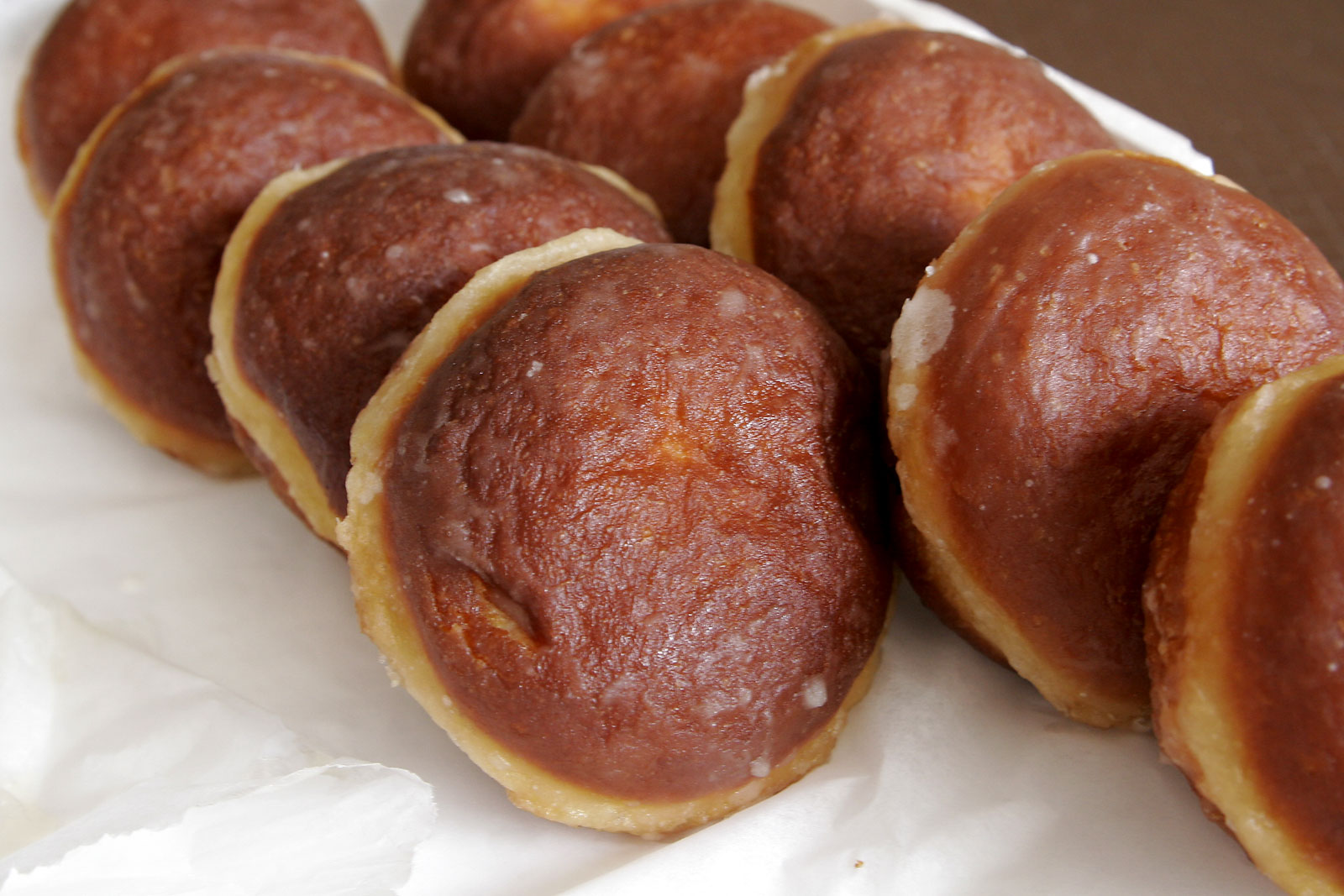
 Glazed pączki | |
| Alternative names | kreple, pùrcle |
|---|---|
| Type | Doughnut |
| Place of origin | Poland |
| Region or state | |
| Main ingredients | Yeast-based dough, grain alcohol, confiture or other sweet filling, powdered sugar, icing, glaze, or bits of dried orange zest |


Pączki (Polish: [ˈpɔ̃t͡ʂkʲi] ⓘ; sg.: pączek, Polish: [ˈpɔ̃t͡ʂɛk]; Kashubian: pùrcle Kashubian: [ˈpwʉrt͡slɛ]; Old Polish and Silesian: kreple Silesian: [ˈkrɛplɛ]) are filled doughnuts found in Polish cuisine.
Description
[edit]A pączek is a deep-fried piece of dough shaped into a flattened ball and filled with confiture or other sweet filling. Pączki are usually covered with powdered sugar, icing, glaze, or bits of dried orange zest. A small amount of grain alcohol (traditionally rectified spirit) is added to the dough before cooking; as it evaporates, it prevents the absorption of oil deep into the dough.[1] Pączki are commonly thought of as fluffy but somewhat collapsed, with a bright stripe around them; these features are seen as evidence that the dough was fried in fresh oil.[2][3]
Although they look like German berliners (bismarcks in North America) or jelly doughnuts, pączki are made from especially rich dough containing eggs, fats, sugar, yeast, and sometimes milk. They feature a variety of fruit and creme fillings and can be glazed, or covered with granulated or powdered sugar. Powidła (stewed plum jam) and wild rose petal jam[1][4] are traditional fillings, but many others are used as well, including strawberry, Bavarian cream, blueberry, custard, raspberry, and apple.[5]
Pączki have been known in Poland at least since the Middle Ages. Jędrzej Kitowicz wrote that during the reign of Augustus III, under the influence of French cooks who came to Poland, pączki dough was improved so that pączki became lighter, spongier, and more resilient.[citation needed]
-
 Pączki displayed for sale
 -
 Traditional pączki serowe (curd-based pączki) or oponki
 -
 Home-made glazed pączki
 -
 American-made pączki


Etymology, spelling, and pronunciation
[edit]The Polish word pączek [ˈpɔ̃t͡ʂɛk] (plural: pączki [ˈpɔ̃t͡ʂkʲi]) is a diminutive of the Polish word pąk [ˈpɔŋk] "bud".[6] The latter derives from Proto-Slavic *pǫkъ, which may have referred to anything that is round, bulging and about to burst (compare Proto-Slavic *pǫknǫti "to swell, burst"), possibly of ultimately onomatopoeic origin.[7][8] From Polish the word has been borrowed into several other Slavic languages, where the respective loanwords (ponchik,[a] ponchyk[b] or ponichka[c]) refer to a similar ball-shaped pastry.[9][10][11]
English speakers typically use the plural form of the Polish word in both singular and plural. They pronounce it as /ˈpʊntʃki, ˈpʊnʃ-, ˈpʌntʃ-, ˈpɒntʃ-/[d] and often write it as "paczki", i.e., without the ogonek (hook-shaped diacritic).[12][13][14][15] This should not be confused with the unrelated Polish word paczki [ˈpat͡ʂkʲi], which is the plural form of paczka [ˈpat͡ʂka], meaning "package" or "parcel".[16]
Pączki Day
[edit]| Sunday | Monday | Tuesday | Wednesday |  Fat Thursday Fat Thursday(Tłusty Czwartek) |
Friday | Saturday | ||
| Sunday | Monday |  Fat Tuesday Fat Tuesday(Pączki Day) |
Ash Wednesday | Thursday | Friday | Saturday | ||
| ||||||||
In Poland, pączki are eaten especially on Fat Thursday (Tłusty Czwartek), the last Thursday prior to Ash Wednesday and the beginning of Lent.[17] The traditional reason for making pączki was to use up all the lard, sugar, eggs and fruit in the house, because their consumption was forbidden by Christian fasting practices during the season of Lent.[18]
In North America, particularly the large Polish communities of Chicago, Detroit, Milwaukee, and other large cities across the Midwest and Northeast, Paczki Day is celebrated annually by immigrants and locals alike. The date of this observance merges with that of pre-Lenten traditions of other immigrants (e.g., Pancake Day, Mardi Gras) on Fat Tuesday. With its sizable Polish population, Chicago celebrates the festival on both Fat Thursday and Fat Tuesday.[19] Pączki are also often eaten on Casimir Pulaski Day. In Buffalo, Toledo, Cleveland, Detroit, Grand Rapids, St. Louis, South Bend, Louisville, and Windsor, Pączki Day is celebrated on Fat Tuesday.[citation needed]
The Pączki Day celebrations in some areas are even larger than many celebrations for St. Patrick's Day.[citation needed] In Hamtramck, Michigan, an enclave of Detroit, there is an annual Pączki Day (Shrove Tuesday) Parade,[5] which has gained a devoted following. Throughout the Metro Detroit area, it is so widespread that many bakeries attract lines of customers for pączki on Pączki Day.[20] In suburban Cleveland, Eastern European bakery Rudy's Strudel hosts a large indoor and outdoor Paczki Day party in conjunction with neighboring record store, The Current Year. It is called "the Mardi Gras of the Midwest".[21]
In some areas, Pączki Day is celebrated with pączki-eating contests.[citation needed]
United States
[edit] | This article needs additional citations for verification. (February 2018) |
These pastries have become popular in the United States as a result of Polish immigrants and marketing by the bakery industry. Sold in bakeries mainly on both Fat Tuesday and Fat Thursday throughout Detroit and Chicago, they are particularly popular in areas where there is a large concentration of Polish immigrants: Milwaukee, Northcentral and Southeastern Wisconsin, Chicago, Northern Illinois, Northwest Indiana, Metro Detroit, Greater Grand Rapids, Mid Michigan, Greater Buffalo, New York, Greater Rochester, New York, Toledo, Greater Cincinnati, Greater Cleveland, Youngstown, Philadelphia, Pittsburgh, Scranton/Wilkes-Barre, Northern and Central New Jersey, Central Connecticut, and Western Massachusetts.
See also
[edit]
Explanatory notes
[edit]- ^ Russian: пончик.
- ^ Ukrainian: пончик, Belarusian: пончык.
- ^ Bulgarian: поничка.
- ^ Respelling: PUUNCH-kee, PUUNSH-, PUNCH-, PONCH-.
Citations
[edit]- ^ a b Strybel, Robert & Strybel, Maria (2005). Polish Heritage Cookery. Hippocrene. p. 270. ISBN 9780781811248.
- ^ Karolinas. "Skąd wziął się Tłusty Czwartek? Skąd wziął się Tłusty Czwartek?". Tipy.pl (in Polish). Grupa Interia.pl. Retrieved 2016-02-03.
- ^ Anna Hudyka (2009-02-18). Magda Głowala-Habel (ed.). "Tłusty Czwartek". Interia360.pl (in Polish). Grupa Interia.pl. Retrieved 2016-02-03.
- ^ "Pączki? Hard to say, culinary Lenten treat made by nuns". Catholic News Service. Archived from the original on February 28, 2014. Retrieved November 23, 2009.
- ^ a b "Pazcki day- eat and celebrate". City of Hamtramck. Archived from the original on March 15, 2008.
- ^ Żmigrodzki, "pączek".
- ^ Bralczyk (2014), p. 127.
- ^ Derksen (2008), pp. 416–417.
- ^ Ushakov (1940), пончик.
- ^ Boldyrev (2003), p. 514.
- ^ Georgiev (1999), p. 517.
- ^ Dictionary.com, paczki.
- ^ American Heritage Dictionary, paczki.
- ^ Barber 2004, paczki.
- ^ Edge (2006), chapter 7.
- ^ Żmigrodzki, "paczka".
- ^ Barbara Ogrodowska (1996). Święta polskie: tradycja i obyczaj (in Polish). Alfa. p. 124. ISBN 9788370019488.
- ^ Brinn, Janis (9 February 2023). "Pączki Day: A Polish tradition becomes an American tradition". 4-H Global & Cultural Education. Michigan State University. Retrieved 24 June 2025.
- ^ Lukach, Adam (23 February 2017). "Paczki day specials from 33 Chicago restaurants and bakeries". Chicago Tribune. Retrieved 26 February 2017.
Whether you celebrate Paczki day on Fat Thursday or Fat Tuesday, or both, area bakeries are ready with thousands of the filled treats.
- ^ "Fat Tuesday Can Be Paczki Pandemonium". Southfield, MI: WWJ-TV. Retrieved 21 February 2012.
- ^ "Rudy's Strudel announces 2022 Paczki Day details". Cleveland, OH: Cleveland.com. Retrieved 27 February 2022.
General and cited sources
[edit]- "American Heritage Dictionary of the English Language". Retrieved 2018-02-02.
- Bańkowski, Andrzej, ed. (2000). Etymologiczny słownik języka polskiego [Polish etymological dictionary] (in Polish). Vol. 1. Wydawnictwo Naukowe PWN.
- Barber, Katherine, ed. (2004). The Canadian Oxford Dictionary (2nd ed.). Oxford University Press. doi:10.1093/acref/9780195418163.001.0001. ISBN 978-0-19-541816-3. Retrieved 2016-12-23.
- Bizzarri, Amy, ed. (2016). Iconic Chicago Dishes, Drinks and Desserts. Charleston, SC: American Palata. ISBN 978-1-46713-551-1.
- Boldyrev, R. V. (2003). Melnichuk, O. S. (ed.). Etimologichnyi slovnyk ukrayinskoi movi Етимологічний словник української мови [Etymological Dictionary of Ukrainian Language] (in Ukrainian). Vol. 4. Kyiv: Naukova dumka. ISBN 966-00-0590-3.
- Bralczyk, Jerzy (2014). Jeść!!! [Let me eat!] (in Polish). BOSZ. ISBN 978-83-7576-218-1.
- Czerniecki, Stanisław (1682). Compendium ferculorum, albo Zebranie potraw [A Collection of Dishes] (in Polish). Kraków: Drukarnia Jerzego i Mikołaja Schedlów.
- "Dictionary.com Unabridged". Random House. Retrieved 2018-02-02.
- Doroszewski, Witold, ed. (1969). "Słownik Języka Polskiego" [Polish Dictionary] (in Polish). Warszawa: Państwowe Wydawnictwo Naukowe.
- Dumanowski, Jarosław; Jankowski, Rafał, eds. (2011). Moda bardzo dobra smażenia różnych konfektów [A Very Good Way of Frying Various Confections]. Monumenta Poloniae Culinaria (in Polish). Vol. 2. Warszawa: Muzeum Pałac w Wilanowie. ISBN 978-83-60959-18-3.
- Dumanowski, Jarosław (2016). "Pączki z przeszłości, czyli tłusty czwartek historycznie" [Pączki of the past, or Fat Thursday in history]. naTemat.pl. Retrieved 2018-02-06.
- Edge, John T., ed. (2006). Donuts: An American Passion. New York: G.P. Putnam's Sons. ISBN 978-1-440-62864-1.
- Georgiev, Vladimir Ivanov (1999). Blgarski etimologichen rechnik Български етимологичен речник [Bulgarian Etymological Dictionary] (in Bulgarian). Vol. 1. Marin Drinov. ISBN 978-95-4430-315-0.
- Kitowicz, Jędrzej (1840). Opis obyczajów i zwyczajów za panowania Augusta III [Description of customs and habits under Augustus III] (in Polish). Poznań: Edward Raczyński.
- Kuroń, Maciej (2004). Kuchnia polska: Kuchnia Rzeczypospolitej wielu narodów [Polish Cuisine: Cuisine of a Commonwealth of Many Nations] (in Polish). Czarna Owca. ISBN 83-89763-25-7.
- Lemnis, Maria; Vitry, Henryk (1979). W staropolskiej kuchni i przy polskim stole [Old Polish Traditions in the Kitchen and at the Table] (in Polish). Warszawa: Interpress.
- "Lista produktów tradycyjnych" [List of traditional products] (in Polish). Ministerstwo Rolnictwa i Rozwoju Wsi. Archived from the original on 2018-05-24. Retrieved 2016-06-15.
- Łozińska, Maja; Łoziński, Jan (2013). Historia polskiego smaku: kuchnia, stół, obyczaje [History of the Polish Taste: Kitchen, Table, Customs] (in Polish). Warszawa: Wydawnictwo Naukowe PWN. ISBN 978-83-7705-269-3.
- Mish, Frederick C. (2004). Merriam-Webster's Collegiate Dictionary (11th ed.).
- Neilson, William Allan; Knott, Thomas A.; Carhart, Paul W. (1947) [1934]. Webster's New International Dictionary (2nd ed.).
- Strybel, Robert; Strybel, Maria (2005) [1993]. Polish Heritage Cookery. New York: Hippocrene Books. ISBN 0-7818-1124-4.
- Szymula, Elzbieta (2012). "Polish Diet". In Thaker, Aruna; Barton, Arlene (eds.). Multicultural Handbook of Food, Nutrition and Dietetics. Wiley-Blackwell. pp. 277–295. ISBN 978-1-4051-7358-2.
- Szymanderska, Hanna (2010). Kuchnia polska: Potrawy regionalne [Polish Cuisine: Regional Dishes] (in Polish). Warszawa: Świat Książki. ISBN 978-83-7799-631-7.
- Ushakov, Dmitry Nikolayevich (1940). "Tolkovy slovar russkogo yazyka" Толковый словарь русского языка [Explanatory Dictionary of the Russian Language]. Akademik (in Russian). Moskva: Sovetskaya entsiklopediya.
- Żmigrodzki, Piotr (ed.). "Wielki Słownik Języka Polskiego" [The Great Polish Dictionary] (in Polish). Instytut Języka Polskiego PAN.
External links
[edit]- Paczki Day PSA, an account of Detroit area Paczki Day traditions in 2008
- Paczkis Video produced by Wisconsin Public Television
| Sweet |  | ||||
|---|---|---|---|---|---|
| Savory |
| ||||
| Companies | |||||
| Lists | |||||
| See also |
| ||||

Pączki
View on GrokipediaOverview
Description
Pączki are round, yeast-leavened dough balls, typically measuring 7-8 cm in diameter, filled with fruit preserves such as prune, rose petal jam, or poppy seed paste, and finished with a topping of powdered sugar or icing.[6][7][8] The basic composition consists of a yeast dough enriched with eggs, milk, butter, and sugar, which is deep-fried to achieve a golden brown exterior while maintaining a soft, airy interior.[6][7] This frying process, traditionally done in lard but sometimes in oil, contributes to the pastry's rich and sweet flavor profile.[8][9] As a filled doughnut variant, pączki resemble the German Bismarck in their jelly-filled, fried form but feature a richer dough due to higher proportions of eggs and butter, and differ from the Israeli sufganiyot primarily in the use of lard for frying and specific Polish fillings like rose petal jam.[10][11] Pączki hold cultural importance on Fat Thursday, a pre-Lent observance in Poland.[1]Etymology and Pronunciation
The word pączki is the plural form of the Polish noun pączek, which serves as a diminutive of pąk, meaning "bud" or "knob," evoking the rounded, budding shape of the pastry. This etymological root traces back to the older Polish form pęk, denoting a "cluster," "bundle," or "swelling," derived from the Proto-Slavic pǫkъ, referring to something plump or bursting, such as a budding cluster in nature. The nasal vowel in pączki (represented by the ogonek diacritic ą) reflects this historical evolution from Old Polish influences, where the term shifted to describe the dough's puffed appearance during frying. In Polish orthography, pączki includes essential diacritics: the nasal ą and the soft ć (a voiceless alveolo-palatal affricate). However, in anglicized contexts, it is often simplified to "paczki" without accents, leading to variant spellings like "ponchki" or "punchkey," which approximate the sound but omit the precise Polish phonetics.[12] These adaptations arose from transliteration challenges in non-Polish languages, particularly in immigrant communities where the original diacritics were unavailable in standard typewriters or early printing. The standard Polish pronunciation of pączki is /ˈpɔ̃t͡ʂkʲi/ in the International Phonetic Alphabet (IPA), with primary stress on the first syllable, a nasalized open-mid back vowel for ą (similar to the French "on" in "bon"), and a soft, affricated ć akin to "ch" in "church" but more palatalized. In English approximations, it is commonly rendered as "poonch-kee" or "pownch-kee," emphasizing the nasal quality and avoiding common mispronunciations like "punch-key," which flatten the Polish consonants. Related terms in other Slavic languages highlight shared culinary concepts for fried dough pastries, such as Ukrainian pampushky, small plump buns or doughnuts derived from pampukh meaning "chubby" or "puffed," reflecting analogous Proto-Slavic roots for rounded, yeast-risen foods.[13]History
Origins in Poland
The origins of pączki trace back to the Middle Ages in Poland, where early forms of fried dough pastries emerged as part of pre-Lenten traditions to utilize rich ingredients like lard and fats before the fasting period of Lent. These initial versions were typically savory, filled with pork fat, meat, or bacon, and fried in animal fat, reflecting the culinary practices of the time when sweets were less common due to limited access to sugar.[14] By the 16th century, pączki had gained prominence in Polish cuisine, initially known as kreple, a term borrowed from the German Krapfen, indicating Germanic influences through trade and cultural exchanges in Central Europe. This period marked the beginning of their evolution into more structured pastries, with yeast-based dough becoming standard. The first detailed historical documentation appears in 18th-century accounts, such as those by historian Jędrzej Kitowicz, who described pączki preparation during the reign of King Augustus III (1733–1763), noting their frying in lard and, under the influence of French cooks at the royal court, the dough becoming lighter and yeast-based with filling with jams as a staple in royal courts and among the nobility. These descriptions highlight pączki's role in courtly feasts and folk customs, where the round, bud-like shape—derived from the Polish word pączek meaning "bud"—symbolized spring renewal and abundance at the end of winter.[1][1] In the 17th and 18th centuries, pączki evolved further with the incorporation of fillings tied to agricultural advancements and expanding trade networks, shifting from simple fried dough to more elaborate versions with sweet fillings, such as rose petal jam—influenced by Eastern trade routes including Ottoman preserves—appearing by this period. Regional baking traditions in areas like Silesia reinforced this development, where kreple became synonymous with local yeast pastries influenced by neighboring Germanic customs. This transition to fruit-based fillings aligned with increased availability of lard, eggs, and seasonal fruits in rural and urban households, solidifying pączki as a national staple in both elite and everyday Polish culinary life.[1][15][16]Global Spread
The spread of pączki beyond Poland began in the 19th century through waves of Polish emigration driven by the partitions of Poland (1772–1795), economic hardship, and political instability, with significant migrations to the United States, Canada, and Brazil. In the United States, Polish immigrants arriving in the late 19th and early 20th centuries established vibrant communities in industrial cities, introducing pączki as a cherished tradition in enclaves like Chicago's "Polish Downtown" and Detroit's Hamtramck neighborhood by the 1910s, where local bakeries began producing them commercially. Similarly, in Canada, Polish settlers in regions such as Ontario and Manitoba brought the pastry with them from the 1880s onward, integrating it into community gatherings in places like Windsor and Toronto. In Brazil, over 200,000 Polish immigrants arrived between 1869 and the early 20th century, primarily in southern states like Paraná and Santa Catarina, contributing to the adoption of filled doughnut variants influenced by Polish culinary practices amid the larger diaspora. These migrations correlated with the growth of the global Polish diaspora, estimated at over 20 million people today.[17][18] Following World War II, the displacement of millions of Poles led to further dissemination of pączki through refugee communities in Western Europe and Australia, where over 50,000 Polish displaced persons resettled between 1947 and 1954, often preserving culinary traditions in exile. In the United Kingdom, post-war Polish veterans and families numbering around 120,000 by 1946 maintained cultural ties, including the preparation of pączki in community centers and households. Australia saw similar patterns, with Polish refugees establishing patisseries that continue to offer authentic pączki, incorporating them into multicultural events like ethnic food festivals in cities such as Melbourne and Sydney. These groups adapted the pastry to local ingredients while retaining its role in pre-Lent observances, fostering its integration into broader diaspora celebrations.[19][20][21] In the 21st century, globalization has amplified pączki's reach through digital platforms and expanded trade. Online recipes and food media, popularized on sites like Food Network and The Spruce Eats, have democratized access, enabling non-Polish audiences worldwide to recreate the pastry and raising awareness beyond traditional communities. Poland's accession to the European Union in 2004 facilitated commercial exports of baked goods, including pączki, with the value of agri-food shipments to EU markets surging over 11-fold by 2023, supporting availability in supermarkets across Western Europe. Additionally, variants of pączki appear in neighboring cuisines, such as Lithuania's spurgos—jam-filled doughnuts influenced by shared historical ties—and similar fried pastries in Ukrainian traditions, reflecting cultural exchanges within the region.[22][7][23][5]Cultural Role
Pączki Day Traditions
Pączki Day, known as Tłusty Czwartek or Fat Thursday in Poland, is observed annually on the Thursday before Ash Wednesday, marking the final day of feasting during the Carnival period that precedes the Lenten fast in the Catholic tradition.[24] This custom traces its roots to medieval Europe, where communities indulged in rich foods to consume perishable items like lard, eggs, and sugar before the 40 days of abstinence required by the Church.[25] In Polish rituals, the consumption of pączki is tied to folk superstitions believed to ensure good fortune; a traditional proverb warns that those who fail to eat at least one pączek on this day will face bad luck or an unproductive year, such as "empty barns" symbolizing scarcity.[26] Eating contests are a popular feature at local festivals, where participants compete to devour the most pączki in a set time, celebrating the day's theme of excess.[27] Folk practices often involve pairing pączki with faworki, thin strips of fried dough dusted with powdered sugar, enjoyed during family gatherings that emphasize communal indulgence.[25] In cities like Kraków and Warsaw, market stalls and renowned pastry shops such as Michałek and Zagoździński draw long queues, with Poles collectively consuming over 100 million pączki on this day—averaging more than 2.5 per person.[24][28] Symbolically, pączki represent the pinnacle of indulgence and prosperity on the eve of restraint, with their round shape and fillings evoking abundance; some interpretations link these customs to pre-Christian spring rites honoring fertility and renewal, later adapted into Christian observance.[29]Observance in the United States
Pączki arrived in the United States through waves of Polish immigrants in the late 19th and early 20th centuries, particularly settling in industrial Midwest cities with strong manufacturing jobs. In these communities, the tradition adapted to the American calendar, shifting observance from Poland's Fat Thursday (Tłusty Czwartek) to Fat Tuesday (Mardi Gras), aligning with broader Carnival celebrations ahead of Lent. This adaptation is most prominent in areas like Hamtramck, Michigan—a historic Polish enclave—and Chicago, Illinois, where sales peak dramatically on Fat Tuesday, drawing crowds reminiscent of New Year's Eve rushes at local bakeries. For instance, family-owned establishments like New Palace Bakery in Hamtramck report selling thousands of pączki daily in the lead-up to the holiday, with lines forming hours before opening.[3][2][30][31] Contemporary celebrations feature long queues at traditional Polish delis and even mainstream chains, reflecting pączki's mainstream appeal. Bakeries and delis often sell out by midday, prompting pre-orders weeks in advance. Cultural events enhance the festivities, including polka music performances and eating contests that have become staples since the late 20th century; for example, annual pączki-eating competitions in places like Hamtramck and Ansonia, Connecticut, challenge participants to consume dozens in timed rounds, fostering community spirit. These gatherings, often held at veterans' halls or cultural centers, blend Polish heritage with American festivity, featuring live polka bands to accompany the indulgence.[32][33][34][35] Observance is strongest in states with large Polish-American populations, such as Illinois (approximately 790,000 residents of Polish ancestry) and Michigan (about 744,000), where the treat integrates into regional Mardi Gras customs while retaining ethnic roots. Chicago's Polish neighborhoods host pop-up sales and community drives, while Detroit-area events emphasize family gatherings. This concentration underscores pączki's role in preserving cultural identity amid assimilation.[36][2][3] Economically, Fat Tuesday generates significant activity for local businesses, with estimates suggesting millions of pączki sold across the Great Lakes region annually, particularly in high-density areas like metro Detroit. This surge supports small bakeries and boosts regional economies through increased foot traffic and related sales, though exact figures vary by year due to fluctuating ingredient costs like eggs.[37][38]Preparation and Varieties
Traditional Ingredients and Methods
Traditional pączki are prepared using a rich yeast dough enriched with eggs and butter, fried in lard to achieve a golden, crisp exterior while maintaining a soft interior. The core ingredients for the dough typically include 500 grams of all-purpose or bread flour, 25 grams of fresh yeast (or about 7 grams of dry yeast), 250 milliliters of warm milk, 6 egg yolks (or whole eggs in some variations), 100 grams of softened butter, 50 grams of sugar, a pinch of salt, and optionally a tablespoon of rum or vodka to enhance tenderness and flavor.[39][40] For fillings, 300 grams of prune lekvar (a thick plum jam) or wild rose petal jam is traditional, providing a tart contrast to the sweet dough. Lard is the preferred fat for frying, as it imparts a distinctive flavor and helps use up rich fats before Lenten fasting.[39][9] Preparation begins by activating the yeast in warm milk with a teaspoon of sugar, allowing it to foam for about 10 minutes. The flour is sifted and combined with the remaining sugar and salt in a large bowl, followed by the addition of the yeast mixture, egg yolks, softened butter, and rum if using. The dough is kneaded gently for 8-10 minutes until smooth and elastic, taking care to avoid over-kneading, which can toughen the texture; some recipes incorporate a small amount of potato starch (about 50 grams mixed into the flour) to promote extra tenderness and lightness.[41][42] The dough is then placed in a greased bowl, covered, and allowed to rise in a warm spot for 1-2 hours until doubled in size. After the first rise, it is punched down, rolled out to about 1/2-inch thickness, and cut into 3-inch rounds; a small amount of filling is placed in the center of half the rounds, which are then topped with plain rounds and sealed by pinching the edges. The filled dough balls undergo a second proofing for 30-60 minutes until puffy.[40][41] Frying occurs in a deep pot of heated lard (or vegetable oil as a modern substitute, though lard is traditional for authentic flavor) at 175°C (350°F), where the pączki are added in small batches to avoid crowding. Each side fries for 2-3 minutes until deep golden brown, then they are removed and drained on paper towels to absorb excess fat. Finally, the warm pączki are rolled in granulated or powdered sugar for a sweet coating.[7][39] This method yields approximately 20-30 pączki, depending on size, and they are best enjoyed fresh on the day of preparation, as the dough softens over time; leftovers can be stored in an airtight container for up to one day. Historically, pączki were fried in heavy pots over wood-fired ovens or hearths in Polish homes, contributing to their even cooking and smoky undertones in rural settings.[43][39]Regional and Modern Variations
In Poland, regional differences in pączki preparation reflect local tastes and traditions, with fillings varying by area. In Warsaw, wild rose petal jam remains a preferred traditional filling, often celebrated in local bakeries for its floral notes, while in Warsaw, vanilla custard (budyń) is more commonly favored for its creamy texture.[44][45] Among Polish diaspora communities, adaptations incorporate local ingredients and preferences. In the United States, particularly in Midwest cities with large Polish-American populations like Detroit and Chicago, pączki often feature Bavarian cream or raspberry fillings, diverging from stricter traditional jams to appeal to broader palates.[43][46] Modern innovations have expanded pączki's accessibility through dietary accommodations and creative flavors. Since the 2010s, vegan versions have gained popularity, substituting eggs with aquafaba and dairy with plant-based milks like almond or oat, allowing inclusive enjoyment during Fat Thursday celebrations.[47] Gluten-free adaptations, using rice flour or almond blends, emerged around the same period to cater to those with celiac disease, maintaining the dough's richness without wheat.[48] In trendy urban bakeries, gourmet fillings like salted caramel have appeared, offering a contemporary twist on the classic pastry for upscale markets.[49]Nutritional and Commercial Aspects
Nutritional Profile
A typical pączki provides 300-400 calories per serving, derived primarily from 15-20 grams of fat (much of it saturated due to deep-frying), around 40 grams of carbohydrates, and approximately 5 grams of protein.[50][51][52] The exact values vary by size and filling; for instance, a prune-filled version adds 1-2 grams of dietary fiber from the fruit, contributing to a slightly more balanced macronutrient profile compared to custard-filled options.[53] Pączki contain common allergens including gluten from wheat flour, eggs, and dairy products such as milk or butter, making them unsuitable for those with celiac disease, egg allergies, or lactose intolerance.[54][55] The high sugar content, often 15-20 grams per piece, can cause rapid blood sugar spikes with a moderate to high glycemic impact similar to other fried pastries.[56] Traditional frying in lard increases saturated fat intake, though it produces fewer trans fats than partially hydrogenated oils used in some commercial frying.[57] Despite their indulgent nature, pączki offer some nutritional positives from the yeast-leavened dough, which contributes B vitamins like thiamine, riboflavin, and niacin that support energy metabolism.[58] Fruit-based fillings, such as prune or rose petal jam, provide trace antioxidants and vitamins; prune fillings, in particular, deliver fiber and polyphenols that aid digestion and cellular health. Compared to standard American doughnuts, pączki are denser due to extended yeast rising, resulting in a richer texture with potentially less absorbed oil per bite, though both warrant moderation as occasional holiday treats.[59][60]Production and Availability
In Poland, artisanal production of pączki remains centered in small, family-owned bakeries that employ traditional handmade methods, involving manual dough preparation, filling, and frying to preserve the pastry's characteristic fluffiness and flavor. These operations see dramatic seasonal spikes on Tłusty Czwartek, with nationwide consumption exceeding 100 million units, leading to extended hours and queues at local establishments to accommodate the surge.[61] [25] Industrial scaling has emerged to meet broader demand, particularly for supermarket supply, with factories utilizing automated machinery for dough mixing, filling, and frying processes that have evolved since the late 20th century. Companies produce large volumes of pączki at relatively low unit costs, enabling consistent availability beyond peak seasons. As of 2025, rising ingredient costs have increased retail prices to an average of around 4.60 PLN per pączek in bakeries, though demand on Tłusty Czwartek remains robust.[62] [63] In the United States, firms like Baker Boy manufacture frozen pączki dough for wholesale distribution to bakeries and retailers, facilitating efficient scaling for commercial use.[64] Pączki are distributed through diverse channels, including major supermarkets such as Tesco in Poland, where they are sold fresh or pre-packaged in assorted flavors, and Jewel-Osco in the United States, offering options like raspberry, Bavarian cream, and lemon varieties year-round or seasonally. Online platforms like Uber Eats provide convenient delivery from participating bakeries and stores, supporting same-day access in urban areas. Exports from Poland to the United States cater to Polish-American communities, though production is largely localized to meet cultural demand on Pączki Day.[65] [66] [67] [68] Market trends since the mid-2010s reflect growing availability of pre-packaged pączki in retail settings, driven by supermarket chains' in-house or outsourced production to capitalize on both traditional and emerging consumer interest.[69]References
- https://en.wiktionary.org/wiki/paczki