Hubbry Logo
Trapezium ClusterTrapezium ClusterMain
Open search
Trapezium Cluster
Community hub
Trapezium Cluster
logo
8 pages, 0 posts
0 subscribers
Be the first to start a discussion here.
Trapezium Cluster
Trapezium Cluster
from Wikipedia
Trapezium
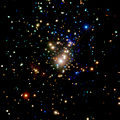
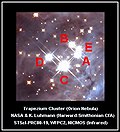
Trapezium in optical (left) and infrared light (right) from Hubble. NASA photo
Observation data (J2000 epoch)
Right ascension05h 35.4m
Declination−05° 27′
Distance1,344±20 ly (412 pc[1])
Apparent magnitude (V)4.0
Apparent dimensions (V)47 (seconds of arc)
Physical characteristics
Radius10 ly
Estimated age300,000 years
Associations
ConstellationOrion
See also: Open cluster, List of open clusters
Three of the main stars of the Trapezium, with the triple star in the top right, as sketched by Galileo. The letters do not correspond to the current designations.

The Trapezium or Orion Trapezium Cluster, also known by its Bayer designation of Theta1 Orionis1 Orionis), is a tight open cluster of stars in the heart of the Orion Nebula, in the constellation of Orion. It was discovered by Galileo Galilei. On 4 February 1617 he sketched three of the stars (A, C and D), but missed the surrounding nebulosity.[2][3][4] A fourth component (B) was identified by several observers in 1673, and several more components were discovered later like E, for a total of eight by 1888. Subsequently, several of the stars were determined to be binaries. Telescopes of amateur astronomers from about 5-inch (130 mm) aperture can resolve six stars under good seeing conditions.[5]

The Trapezium is a relatively young cluster that has formed directly out of the parent nebula. The five brightest stars are on the order of 15 to 30 solar masses in size. They are within a diameter of 1.5 light-years of each other and are responsible for much of the illumination of the surrounding nebula. The Trapezium may be a sub-component of the larger Orion Nebula Cluster, a grouping of about 2,000 stars within a diameter of 20 light-years.

Identification

[edit]

The Trapezium is most readily identifiable by the asterism of four relatively bright stars for which it is named. The four are often identified as A, B, C and D in order of increasing right ascension. The brightest of the four stars is C, or Theta1 Orionis C, with an apparent magnitude of 5.13. Both A and B have been identified as eclipsing binaries.

Infrared images of the Trapezium are better able to penetrate the surrounding clouds of dust, and have located many more stellar components. About half the stars within the cluster exhibit circumstellar disks that are dwindling, a likely precursor to planetary formation. In addition, brown dwarfs and low-mass runaway stars have been identified.

Possible black hole

[edit]

A 2012 paper suggests an intermediate-mass black hole with a mass more than 100 times that of the Sun may be present within the Trapezium, something that could explain the large velocity dispersion of the stars of the cluster.[6]

List of objects

[edit]
Star Spectral class Stellar components Designations Notes
A B0.5V 3 41 Orionis A, HD 37020, V1016 Orionis Algol variable
B West X-ray source N/A COUP 766, MAX 97
B B1V 5 41 Orionis B, HD 37021, BM Orionis Algol variable
B East X-ray source N/A COUP 778, MAX 101
C O6Vp + B0V 2 41 Orionis C, HD 37022 suspected variable, most massive
D B1.5Vp 2 41 Orionis D, HD 37023 suspected variable
E G2IV 2 41 Orionis E, COUP 732 Algol variable + T Tauri star
F B7.5p 2
G K8.5 1 LV 2, COUP 826 has a protoplanetary disk, associated with HH 726
H K5.5 + K6.5 2 WDS J05353-0523H
I 1

References

[edit]

Further reading

[edit]
[edit]
Revisions and contributorsEdit on WikipediaRead on Wikipedia
from Grokipedia
The Trapezium Cluster is a young open embedded at the core of the (Messier 42) in the constellation Orion, situated approximately 1,344 light-years from . Named for the distinctive trapezoidal arrangement of its four brightest, massive O- and B-type stars—known as θ¹ Orionis A, B, C, and D—the cluster was first observed by in 1617, who sketched it as a triple system. With an estimated age of about 1 million years and a population of roughly 1,000 very young stars crowded into a compact region a few light-years across, it represents one of the Milky Way's most active stellar nurseries. These central Trapezium stars, among the hottest and most luminous in the cluster, emit intense that ionizes the surrounding , producing the nebula's characteristic glow and driving photoevaporation of protoplanetary disks around nearby lower-mass stars. The cluster hosts a diverse array of objects, including hundreds of pre-main-sequence stars, protostars, and at least 50 newborn detected via observations, offering critical insights into the mechanisms of star and planet formation. Its proximity to and high concentration of X-ray-emitting young stars have made it a prime target for multiwavelength studies, from imaging to X-ray observations and recent views of protoplanetary disks, revealing dynamical interactions and a potential within the system.

Discovery and Identification

Historical Discovery

The Trapezium Cluster was first observed through a by on February 4, 1617, when he resolved three bright stars—later identified as θ¹ Orionis A, C, and D—embedded within the . Using one of his early refracting s with a of about 20x, Galileo sketched these stars in his , accurately capturing their relative positions despite separations as small as 13 arcseconds, which highlighted the revolutionary resolving power of telescopic observation compared to naked-eye viewing. This documentation, preserved in his personal records, marked the initial telescopic identification of the cluster's prominent members, though Galileo did not recognize the surrounding nebulosity or the full grouping as a cluster. Nearly four decades later, Italian astronomer Giovanni Battista Hodierna independently observed the region in 1654 using a modest and included a illustration of three stars in the Trapezium configuration in his De systemate orbis cometici, deque admirandis coeli characteribus. This early depiction, though limited by instrumental constraints, contributed to the growing catalog of deep-sky objects and demonstrated the Trapezium's trapezoidal asterism to subsequent observers. The fourth key star, θ¹ Orionis B, was discovered on , 1673, by French astronomer during observations in with a mural quadrant and , completing the classic four-star pattern that defines the cluster's appearance; independently recovered this star in 1684. In the late 18th century, British astronomer William Herschel advanced the recognition of the Trapezium as a true star cluster during his systematic sky sweeps. On October 16, 1784, using his pioneering 20-foot (6.1-meter) reflecting telescope with an 18.7-inch aperture, Herschel cataloged the Orion Nebula (as his H III.37) and described the embedded stellar grouping, including the four bright Trapezium stars, as a resolvable cluster of faint stars amid nebulosity, famously calling it "altogether the most wonderful object in the heavens." Herschel's work, detailed in his 1789 paper in Philosophical Transactions, emphasized the stellar composition and laid the groundwork for understanding the Trapezium as a compact open cluster rather than a mere asterism. He had earlier applied the name "Trapezium" to the four stars in his 1782 double-star catalog.

Visual Identification and Naming

The Trapezium Cluster is visually recognized as a distinctive asterism formed by four bright stars arranged in a trapezoidal pattern, located at the core of the Orion Nebula (M42). This configuration makes it a striking feature in the , appearing as a hazy, star-like patch within the hazy glow of when viewed with the under dark conditions. The cluster's overall is 4.0, rendering it accessible to unaided observers in rural or low-light-pollution sites, where it contributes to the subtle nebulosity outlining the hunter constellation's belt and sword. The name "Trapezium" originates from the geometric shape of these four prominent stars, a term reflecting their trapezoid-like alignment that was noted by early astronomers. Hodierna included a of three of these stars in his 1654 work De systemate orbis cometici, deque admirandis coeli characteribus, marking one of the earliest visual records, while documented the feature during his observation on , 1769, describing it as part of the nebula's bright . The cluster spans an angular size of just 47 arcseconds, emphasizing its compact nature and ease of resolution even in modest optical instruments. Astronomically designated as θ¹ Orionis under the Bayer system, the primary components of the asterism are labeled A, B, C, and D, with their positions forming the defining trapezoid. Amateur astronomers often target the Trapezium as an introductory multiple-star system, where even small telescopes with apertures of 2 to 3 inches can separate the four stars clearly against the backdrop of faint surrounding nebulosity, revealing its dynamic structure without requiring advanced equipment.

Physical Characteristics

Location and Distance

The Trapezium Cluster is located at 05h 35m 16.5s and −05° 23′ 14″ (J2000 ). It resides at the core of the (M42) and forms part of the Orion OB1 association, specifically within subgroup d. Parallax measurements from Gaia DR3 yield a distance of 393 ± 13 pc (approximately 1,281 ± 42 light-years) to the Trapezium Cluster. This value aligns closely with the distance to the surrounding , supporting their shared spatial extent within the complex. Prior to Gaia's precise , distance estimates to the region varied, often placing the Trapezium Cluster at around 1,600 light-years (490 pc), as derived from spectroscopic and photometric methods. Subsequent trigonometric measurements refined this to about 414 pc in the mid-2000s, with Gaia's data releases providing higher accuracy and confirming the cluster's proximity at roughly 390–400 pc through improved precision.

Age, Size, and Composition

The Trapezium Cluster is remarkably young, with an estimated age of approximately 300,000 years (0.3 Myr). This age is derived primarily from fitting pre-main-sequence stellar models to the Hertzsprung-Russell diagram of its members, which reveals a narrow age distribution consistent with recent . Independent confirmation comes from lithium depletion boundaries in low-mass stars (masses ~0.1–0.6 M⊙), where the absence of significant burning indicates ages below 1 Myr, supporting the young isochronal fits. The cluster spans a physical radius of about 10 light-years (~3 pc), encompassing roughly 2,000 stars with masses extending down to 0.02 M⊙, including a substantial population of low-mass stars, protostars, and brown dwarfs. Its mass distribution is heavily skewed toward higher masses in the core, dominated by five massive O- and B-type stars (15–30 M⊙) confined within 1.5 light-years (~0.46 pc) of the center, which account for a significant fraction of the cluster's total stellar mass despite comprising only a small number of members. Stellar density peaks centrally at ~10⁴ stars pc⁻³, dropping radially outward as the cluster embeds within the surrounding , fostering ongoing but diminishing . Dynamically, the system shows a velocity dispersion of ~5–7 km s⁻¹, indicative of gravitational binding and subvirial conditions that promote stability over its short lifetime.

Stellar Population

The Four Trapezium Stars

The four Trapezium stars, θ¹ Ori A, B, C, and D, form the prominent asterism at the heart of the cluster and are its most massive and luminous members. These young, hot O- and B-type stars collectively ionize much of the surrounding through their intense radiation. θ¹ Ori A is a triple system dominated by a B0.5 V primary star with an effective temperature of approximately 30,000 K and a mass of 14 M_⊙. The primary is an eclipsing binary with a cooler secondary companion, and the system includes a T Tauri-type tertiary; together, they contribute significantly to the nebula's illumination via their combined output. θ¹ Ori B, also known as BM Ori, is a B1 V primary with a mass of about 7–10 M_⊙ in a complex quadruple (or higher multiplicity) system featuring faint companions, some of which exhibit excess indicative of circumstellar material. The primary displays photometric variability and typical early B-star lines, including strong He I absorption. θ¹ Ori C is the dominant member, an O6–O7 Vp with a primary of 38 M_⊙ and of 39,000 K, orbited by an O9.5 V companion of roughly 9 M_⊙ at a separation of about 15–20 AU. The primary's strong UV emission makes it the chief ionizing agent of the , with variable features linked to a 15.4-day period and possible magnetic activity. θ¹ Ori D comprises a B1.5 Vp primary of 15–18 M_⊙ in a multiple system with fainter companions, including redder, lower-mass stars; the primary has an around 32,000 K and is a prominent source, likely due to magnetospheric interactions or wind shocks. Together, these stars provide a total bolometric on the order of 10⁵ L_⊙, with the cluster's core age estimated at 0.3–1 Myr based on pre-main-sequence evolutionary tracks. Their properties align with the mass-luminosity relation for massive O/B stars, LM3.5,L \propto M^{3.5}, which governs their high outputs relative to mass.

Additional Cluster Members

The Trapezium Cluster includes several fainter stars beyond the four brightest members, such as θ¹ Ori E, a double-lined spectroscopic binary classified as G2IV with components each having an intermediate mass of approximately 2.8 M⊙. This star exhibits photometric variability on a 9.9-day period due to eclipses, and its effective temperature of around 5150 K. It is a pre-main-sequence intermediate-mass binary member of the cluster with X-ray emission indicative of a magnetically confined corona. Other notable fainter members include θ¹ Ori F, a B8-type star located approximately 4.5 arcseconds southeast of θ¹ Ori C, with a visual magnitude of about 10.1 and evidence of chemical peculiarities in its spectrum. θ¹ Ori G, classified as K0.7, is positioned about 25 arcseconds south of the trapezium, appearing as a young stellar object with associated infrared excess suggesting ongoing accretion. Further out, θ¹ Ori H and I are later-type stars contributing to the cluster's intermediate-mass population. The low-mass stellar population dominates the cluster, comprising approximately 1000 T Tauri stars identified through optical and infrared surveys, many displaying classical T Tauri characteristics like strong Hα emission and lithium absorption indicative of youth. These are accompanied by numerous Herbig-Haro objects, such as HH 529, which trace outflows from embedded protostars interacting with the surrounding nebula. Infrared observations have also revealed around 100 brown dwarfs, with spectral types later than M6 and masses below the hydrogen-burning limit, detected via their mid-infrared excesses and proper motions aligning with the cluster. Protoplanetary disks are prevalent among the cluster members, observed around roughly 50% of stars and using Spitzer and data, with typical dust masses ranging from 0.5 to 80 masses and inclinations often edge-on due to the illuminating radiation from central massive stars. These compact, irradiated disks show evidence of photoevaporation, truncating at distances of 10-50 AU from their host stars. High-velocity runaway stars, such as JW 349 and JW 355, have been identified through proper motion studies, with velocities of 38–90 km/s suggesting dynamical ejections from n-body interactions in the dense core, tracing the cluster's violent early evolution. Recent Gaia DR2 analyses have identified additional potential runaways extending this understanding.

Scientific Significance

Role as a Stellar Nursery

The Trapezium Cluster is embedded within the dense of the , part of the larger , where ongoing continues in regions such as the nearby BN/KL flow. This environment facilitates active stellar birth through of gas clumps, potentially augmented by triggers like past supernovae from earlier generations of massive stars in the complex or cloud-cloud interactions that compress material into dense cores. The massive stars in the Trapezium Cluster emit intense that ionizes the surrounding neutral gas, forming an expansive and driving photoevaporation of nearby protoplanetary disks. This process strips outer layers from circumstellar disks, limiting their lifetimes to approximately 1-3 million years for those in close proximity to the ionizing sources, thereby influencing the efficiency of planet formation. A key manifestation of this is the presence of proplyds—ionized protoplanetary disks—where photons create teardrop-shaped structures with luminous heads and tails of evaporating material; surveys have identified around 150 such proplyds in the , providing direct evidence of triggered and disk evolution under external . Observations of the cluster reveal a range of evolutionary stages, from embedded protostars classified as Class 0 and I—characterized by thick envelopes of gas and dust—to more evolved pre-main-sequence stars following tracks toward the . Color-magnitude diagrams constructed from near- photometry highlight this progression, showing a well-defined pre-main-sequence locus for low-mass members with infrared excesses indicative of circumstellar disks, underscoring the cluster's role in tracing the initial phases of stellar and planetary development. Seminal Hubble observations in the 1990s, led by C. Robert O'Dell, first revealed the fragmentation and photoionized structures of these disks, establishing proplyds as laboratories for understanding disk dispersal. More recently, data from 2022-2025, including the PDRs4All program, have uncovered water ice in the outer regions of Orion proplyds, such as disk 114-426, illuminating early chemical processes in planet-forming environments despite intense .

Evidence for a Central Black Hole

A 2012 study proposed the existence of an (IMBH) with a mass exceeding 100 M⊙ at the center of the Trapezium Cluster, based on dynamical simulations of the Cluster (ONC) core. The analysis interpreted the high velocity dispersion observed among the inner stars, particularly the Trapezium quartet, as evidence of an unseen massive object stabilizing the system against dynamical ejection. measurements indicated a line-of-sight dispersion of approximately 4.6 km/s for these stars, implying a three-dimensional dispersion of about 7.9 km/s, derived from assuming isotropic velocities. This hypothesis relied on proper motion data from the , which complemented observations to reveal elevated internal motions in the cluster's core (radius ~0.1 pc). Applying the , the dynamical was estimated using the formula M=σ2RG,M = \frac{\sigma^2 R}{G}, where σ\sigma is the velocity dispersion, RR is the core radius, and GG is the . For σ710\sigma \approx 7-10 km/s and R0.0250.1R \approx 0.025-0.1 pc, this yielded a total bound of 200-500 M⊙, exceeding the visible stellar of ~90 M⊙ by a factor of 2-5, suggesting the presence of a ~150-200 M⊙ as the dominant unseen component. Subsequent simulations from 2018 to 2023 challenged this interpretation, demonstrating that the observed dispersion could arise from anisotropy, binary interactions, or dynamical relaxation in a young, unbound core without requiring an IMBH. N-body models indicated that the Trapezium system's high velocities result from recent formation processes, such as core collapse and mass segregation, leading to temporary elevated dispersions that dissipate over ~10^5 years. DR3 proper motions (released in 2022) further weakened the case, revealing a lower root-mean-square dispersion of ~2.3 km/s in the inner ONC (within 4 arcmin of the center), consistent with a subvirial state (virial ratio ~0.85) and no significant excess mass. Recent (JWST) and imaging of the ONC core, obtained in 2022-2024, show no strong central stellar concentration or point-like source indicative of an IMBH's gravitational influence, favoring models without a central . These observations, combined with refined estimates (~414 pc), align the dynamical mass more closely with the visible stellar content, reducing the need for dark mass. If an IMBH were confirmed, it would likely represent a remnant of direct stellar collapse in the dense protocluster environment, analogous to proposals for the cluster in the , where similar velocity anomalies suggest a ~100-500 M⊙ object. However, the current consensus leans against its presence in the Trapezium, attributing dynamics to the cluster's youth and ongoing evolution.

References

Add your contribution
Related Hubs
User Avatar
No comments yet.