Hubbry Logo
LafiaLafiaMain
Open search
Lafia
Community hub
Lafia
logo
8 pages, 0 posts
0 subscribers
Be the first to start a discussion here.
Lafia
Lafia
from Wikipedia

Lafia is a city in Nigeria's North Central region. It is the capital and largest city of Nasarawa State, with a population of 509,300 inhabitants as of the 2021 census. And it's the Headquarter of Lafia Emirate Council.

Key Information

History

[edit]
Lafia Emir's Palace

Lafia, also known as Lafian bare-bari, is the capital city of Nasarawa State, North Central Nigeria. Founded by Muhammadu Dunama in late 18th century on the site south of Shabu village. The town now has its 17th Emir in the person of Hon. Justice Sidi Bage Muhammad I JSC rtd. Lafia became the capital of a prominent local chiefdom in the late 19th century. During the rule of Mohamman Agwai (1881–1903), the Lafia market became one of the most important in the Benue Valley, and a trade route was opened to Loko (56 mi [90 km] southwest), a Benue River port. In 1903, the British, who controlled Northern Nigeria recognized Chief Musa as Lafia's first emir. The emirate formed the major part of the Lafia Division of Benue province. In 1967, the town became part of Benue-Plateau state, and in 1976, it was allocated to Plateau state. The original inhabitants of Lafia are mainly by the Kanuri, Fulani Gwandara, Alago, Migilli (Koro). It also has large populations of Hausa. This is due to the hospitable nature of the indigenes and has made the city a miniature Nigeria.

Modern Lafia aside from being an administrative and educational centre, it is also a collecting point for sesame seeds, soybeans, and is a trading centre for yams, sorghum, millet, and cotton. Besides farming, cotton weaving and dyeing are traditionally important activities of the town's inhabitants. Livestock farming is also a prominent activity especially amongst the Fulani herdsmen.

The two royal families of Ari and Dallah Dunama of the Kanuri people (Bare-Bari) are the ruling houses of the Lafia Emirate. The current Emir is Sidi Bage, from the Dallah Dunama royal family. He succeeded the longest reigning Emir, HRH Isa Mustapha Agwai I (1976–2019).[2][3][4]

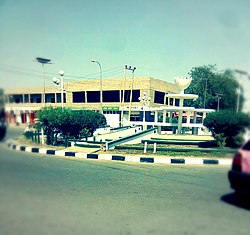
Lafia Central Mosque

[edit]

The Lafia Central Mosque (Arabic: النصراوا لافيا), also known as the Nasarawa State Mosque, is the state mosque of Nasarawa. The mosque was built in 1971[1] and is open to the non-Muslim public, except during congregational prayers.

Institutions

[edit]

Lafia is home to the Federal University of Lafia, Nasarawa State University Faculty of Agriculture Lafia Campus, Isa Mustapha Agwai I Polytechnic Lafia, School of Nursing And Midwifery, School of Health Technology LAFIA, College of Agriculture Lafia, and a study centre of the National Open University of Nigeria. It has a large number of primary and secondary schools. The St Williams Cathedral, situated along Jos Road, is the headquarters of the Lafia diocese and still under construction.

It is situated on the trunk railway from Port Harcourt and on the main highway between Makurdi and Jos. The population per the 2006 census in Lafia local government area was estimated as 330,712.[5]

Climate

[edit]

Lafia has hot, humid, partly cloudy dry seasons, oppressive, overcast rainy seasons, with temperatures that range from 64°F to 97°F all year round. It rarely gets below 59°F or rises over 103°F.[6][7][8]

Climate data for Lafia (1991–2020)
Month Jan Feb Mar Apr May Jun Jul Aug Sep Oct Nov Dec Year
Record high °C (°F) 40
(104)
42
(108)
42.2
(108.0)
42
(108)
40
(104)
36.8
(98.2)
34.5
(94.1)
41
(106)
35
(95)
37
(99)
40
(104)
39
(102)
42.2
(108.0)
Mean daily maximum °C (°F) 35.6
(96.1)
37.6
(99.7)
38.2
(100.8)
36.2
(97.2)
33.5
(92.3)
31.6
(88.9)
30.6
(87.1)
30.0
(86.0)
30.8
(87.4)
32.4
(90.3)
35.2
(95.4)
35.6
(96.1)
33.9
(93.0)
Daily mean °C (°F) 27.3
(81.1)
30.1
(86.2)
32.0
(89.6)
30.9
(87.6)
29.0
(84.2)
27.6
(81.7)
26.9
(80.4)
26.5
(79.7)
26.8
(80.2)
27.8
(82.0)
28.1
(82.6)
26.8
(80.2)
28.3
(82.9)
Mean daily minimum °C (°F) 19.0
(66.2)
22.6
(72.7)
25.8
(78.4)
25.7
(78.3)
24.5
(76.1)
23.5
(74.3)
23.2
(73.8)
23.0
(73.4)
22.9
(73.2)
23.2
(73.8)
21.0
(69.8)
18.0
(64.4)
22.7
(72.9)
Record low °C (°F) 11
(52)
10.8
(51.4)
15
(59)
18
(64)
17
(63)
16
(61)
19.7
(67.5)
18.2
(64.8)
19
(66)
17
(63)
13.5
(56.3)
10.5
(50.9)
10.5
(50.9)
Average precipitation mm (inches) 1.6
(0.06)
4.8
(0.19)
12.4
(0.49)
87.2
(3.43)
157.1
(6.19)
214.8
(8.46)
239.1
(9.41)
309.0
(12.17)
235.7
(9.28)
143.6
(5.65)
5.1
(0.20)
0.1
(0.00)
1,410.4
(55.53)
Average precipitation days (≥ 1.0 mm) 0.1 0.3 0.8 4.4 7.9 10.1 12.1 14.4 13.4 8.0 0.5 0.0 72.1
Average relative humidity (%) 37.4 38.8 52.4 69.0 78.6 82.7 84.7 86.3 85.6 82.9 63.3 45.1 67.2
Source: NOAA[9]

Temperature

[edit]

From January through April, Lafia endures a hot season with daily highs typically exceeding 94°F. The hottest month is March, which averages highs of 97°F and lows of 75°F. Highs below 86°F are experienced for 4.0 months during the chilly season. The coldest month is December, which has highs of 90°F and lows of 65°F.[6][7]

Growing Period

[edit]

In Lafia, the term "growing season" refers to the longest stretch of time of the year during which temperatures are not below freezing (32°F). With a base of 50°F and a top of 86°F, growing degree days are a measurement of yearly heat accumulation used to forecast plant and animal development.[6]

Sports

[edit]
Lafia city stadium

Lafia is the location of Nasarawa United, a football club whose stadium is Lafia Township Stadium.

Transportation

[edit]

Lafia is served by the main narrow gauge railway from Port Harcourt.

See also

[edit]

References

[edit]
Revisions and contributorsEdit on WikipediaRead on Wikipedia
from Grokipedia
Lafia is the capital and largest city of in central Nigeria's North Central geopolitical zone. Designated as the state capital upon 's creation from on 1 October 1996, it functions as the primary administrative, commercial, and educational hub for the region, hosting institutions such as the Federal University of Lafia and serving as a focal point for diverse ethnic groups including the Eggon and Hausa. The city's economy revolves around agriculture and trade, with the broader state relying on subsistence farming for over 70% of its populace and potential in crops, , and minerals like barytes. Recent population estimates place Lafia at approximately 403,000 residents, reflecting steady urban growth amid challenges like intercommunal tensions over land use between farmers and herders.

Geography

Location and Topography


Lafia serves as the capital of Nasarawa State in Nigeria's North Central region, positioned at approximately 8°30′N latitude and 8°31′E longitude. The city lies about 129 kilometers northeast of Abuja, the national capital, facilitating connectivity via road networks.
The topography of Lafia consists of gentle undulating terrain in the guinea savanna zone, with elevations generally below 400 meters, sloping toward the Benue plain. This landscape is influenced by river systems including the Mada River and its tributaries such as Gwayaka, which contribute to drainage but also expose areas to seasonal flooding. Peri-urban expansion has accelerated, with built-up areas increasing from 1.56% of in 1986 to 15% by 2014, driven by urban growth and reducing cover from 25% to 12% over the same period. Soils in the region are predominantly lateritic, comprising both in-situ autochthonous formations and transported allochthonous materials, which support due to their permeability but heighten to and formation. Empirical assessments indicate moderate to high risk in parts of Lafia, exacerbated by rainfall and changes, alongside recurrent flooding in low-lying suburbs.

Climate

Lafia exhibits a tropical savanna climate characterized by distinct wet and dry seasons, with the wet season spanning April to October and the dry season from November to March. This pattern supports rain-fed agriculture but introduces variability in water availability. Historical meteorological data indicate an average annual rainfall of approximately 1,200 to 1,500 mm, with yearly totals ranging from 1,138 mm in 2008 to 1,596 mm in 2007 and 2009 based on records from the Nigerian Meteorological Agency (NiMet). Peak monthly rainfall occurs in August, often exceeding 200 mm, while the dry season receives negligible precipitation, heightening risks of water scarcity for irrigation-dependent activities. Temperatures remain elevated year-round, with average daily highs of 35–38°C during the (peaking in February–April) and lows around 20–24°C; extremes occasionally surpass 39°C or dip below 18°C. The brings slightly moderated highs below 30°C due to increased cloudiness and , though overall thermal ranges show a gradual upward trend, with mean maximum temperatures rising by 0.168°C and minima by 0.413°C over 2001–2015. These conditions facilitate a growing period of roughly 180–210 days aligned with the rainy season, enabling cultivation of staples like yam, though erratic onset or cessation of rains—varying by 10–20 days annually—can disrupt planting and yields. Rainfall variability, evidenced by fluctuations of over 400 mm between low- and high-rain years, directly influences in Lafia's savanna ecosystem, where over 80% of farming relies on seasonal precipitation. While such patterns pose risks to through crop failures during deficits, analyses attribute only weak positive correlations ( of 0.079) to yield outcomes, underscoring that institutional factors like seed access and market infrastructure play larger roles in mitigating climatic impacts than alone would suggest.

History

Pre-Colonial Foundations

Lafia's origins trace to the late , when Muhammadu Dunama, a leader of Kanuri descent from the Bare-bari subgroup associated with the Bornu Empire, established the settlement known as Lafian Bare-bari south of Shabu village. Dunama and his followers migrated to the area after conflicts in their prior territories, founding an initial community that integrated elements of Hausa-Fulani pastoral and trading practices with local dynamics. This establishment marked the beginning of a structured system under Islamic influence, though the site's strategic position along trade routes facilitated early interactions rather than immediate dominance. The pre-colonial society featured ethnic mixtures, with indigenous farming communities such as the Eggon, Gwandara, and Mada peoples occupying the surrounding hills and plains, engaging primarily in and ironworking. Hausa-Fulani settlers introduced cattle herding and long-distance trade in goods like salt, kola nuts, and , creating economic interdependence but also tensions over lands and . These groups coexisted in a patchwork of villages, where Fulani pastoralists negotiated access to farmlands during dry seasons, though records indicate recurring disputes rooted in competition for fertile riverine areas rather than ideological clashes. Resource-based conflicts, including a notable civil war in 1873 within the emerging Lafia Emirate, underscored pre-colonial inter-group frictions over land control, predating colonial administration and highlighting indigenous mechanisms like alliances and tribute systems for resolution. Such disputes arose from the pressures of and environmental variability on the valley, where herders' seasonal migrations often overlapped with sedentary farming territories held by Eggon and Mada clans. These dynamics shaped early governance, with emirs mediating through councils that balanced Fulani mobility against local territorial claims, fostering a resilient but contested .

Colonial Era and Early Administration

Lafia came under British colonial administration in 1901 as part of the , following the consolidation of control over northern emirates and chiefdoms through military expeditions. The town served as a key outpost in the Benue Province, where British officials established district offices to oversee taxation, labor recruitment, and pacification of local groups resistant to external authority. The implementation of , systematized under figures like Frederick Lugard, utilized the existing Lafia structure, with the appointed as Native Authority head to administer , collect taxes, and maintain order via traditional councils. This approach empowered Fulani-dominated emirate hierarchies, often at the expense of indigenous non-Muslim communities such as the Eggon and Gwandara, by centralizing allocation under emirate control and granting concessions that prioritized pastoral mobility over settled farming rights—laying groundwork for resource-based frictions that colonial records noted but rarely resolved through equitable reforms. British interventions, including the 1903 deposition of Mohamman Agwai amid internal strife and the installation of Chief Musa, further entrenched this favoritism toward compliant Islamic elites to minimize direct governance costs. Colonial infrastructure focused on connectivity for administrative efficiency and extraction of agricultural produce like groundnuts and , with roads such as the Akwanga-Lafia route completed by the early to integrate the area into broader provincial networks. Population enumerations under colonial censuses, beginning with the 1911 imperial effort, registered modest inflows of Hausa traders and Fulani herders into Lafia, reflecting migration patterns induced by tax incentives and policies, though data precision was limited by undercounting of rural non-emirate groups. These shifts, while enabling economic extraction, amplified ethnic imbalances by concentrating authority and resources in ways that disregarded pre-colonial decentralized land customs.

Post-Independence Development and State Creation

Following Nigeria's independence in 1960, Lafia initially fell under the Northern Region before the 1967 state creation decree reorganized it into Benue-Plateau State, where it served as a divisional headquarters. This administrative shift aimed to address regional imbalances but maintained Lafia's role as a secondary urban center amid broader national centralization efforts under military rule. By 1976, the division of Benue-Plateau into Benue and Plateau States placed Lafia within Plateau State, fostering modest growth tied to agricultural administration rather than autonomous development. The pivotal change occurred on October 1, 1996, when General Sani Abacha's regime carved from the western portion of , designating Lafia as its capital to decentralize governance and stimulate local economies. This elevation triggered rapid urban expansion, with surging from approximately 10,000 in 1950 to over 400,000 by 1991, accelerating further to around 374,000 in the metro area by 2023 due to influxes of rural migrants seeking administrative and commercial opportunities. Statehood spurred initial infrastructure initiatives, including road networks and public buildings in the late and , though implementation lagged behind population pressures, highlighting federal policies' emphasis on political units over ethnic compatibilities. Persistent communal conflicts, rooted in land disputes and tribal rivalries among groups like the Eggon, Alago, and Hausa-Fulani, have undermined post-statehood progress, exacerbating uneven development despite federal allocations. These tensions, often intensified by resource competition in a multi-ethnic setting, reveal causal shortcomings in Nigeria's federal structure, which imposes artificial boundaries ignoring historical incompatibilities and local failures, leading to stalled projects and insecurity that deter sustained . Empirical outcomes show that while capital status boosted short-term migration, long-term growth remains constrained by these unresolved frictions rather than integrated policy reforms.

Demographics

Lafia's has expanded dramatically since the mid-20th century, reflecting broader Nigerian patterns driven by and natural increase. In 1950, the city's population stood at approximately 9,120 residents. By 2006, the Lafia recorded a figure of around 110,000, though urban estimates for the core city were lower amid Nigeria's challenges. Recent projections place Lafia's 2023 urban at approximately 374,000 to 500,000, varying by source due to the absence of a national since 2006 and reliance on extrapolations from state-level data. This growth stems primarily from a combination of high fertility rates and substantial rural-urban migration, with Nasarawa State's overall annual population increase averaging 2.8% to 3.0% between 2006 and recent projections. In Lafia specifically, migration from surrounding rural areas has accelerated since the state's creation in 1996, as individuals seek , , and administrative opportunities in the capital, leading to peri-urban expansion and informal settlements. Satellite-based analyses and local studies indicate sprawl into adjacent wards, exacerbating demands on housing and utilities without proportional infrastructure scaling. Projections forecast Lafia's reaching 402,000 to 403,000 by 2025, assuming sustained 3-3.7% annual urban growth amid ongoing migration inflows. This trajectory intensifies resource strains, including , , and , as rapid influxes outpace planned urban development, contributing to formation and service overloads observed in migrant-heavy neighborhoods. Such pressures highlight the need for data-driven planning, though official estimates remain provisional pending Nigeria's next .

Ethnic and Religious Composition

Lafia exhibits a diverse ethnic composition reflective of Nasarawa State's broader dynamics, with Hausa-Fulani communities holding prominence in urban and administrative spheres due to historical structures, alongside indigenous groups such as the Eggon, Gwandara, Mada, Alago, and smaller populations of Tiv, Koro, Gbagyi, and Kanuri. The Eggon, often regarded as one of the largest indigenous ethnicities in the region, maintain distinct cultural practices and settlements, while Gwandara and Mada groups contribute to the rural-urban ethnic mosaic. This multiplicity fosters , particularly through shared marketplaces where inter-ethnic trade promotes daily coexistence, though it has also led to perceptions of resource allocation favoring Hausa-Fulani interests in local governance. Religiously, Lafia approximates a balance between and , with comprising a slight statewide at around 61% based on estimates derived from 2006 population figures, while —predominantly among Eggon, Gwandara, and Mada communities—form a near-parity share, supplemented by residual animist practices. Hausa-Fulani populations are overwhelmingly Muslim, anchoring Islamic institutions like the Lafia Council, whereas indigenous groups exhibit higher Christian adherence, often through Protestant and Catholic denominations, as evidenced by the of Lafia's Catholic population of approximately 124,000 out of 1.2 million in its jurisdiction as of 2020. This religious distribution supports parallel community structures in urban enclaves, where mosques and churches serve as focal points, enabling functional coexistence amid occasional tensions over perceived favoritism in public appointments and land use.

Economy

Agricultural Base

Agriculture forms the cornerstone of Lafia's , with farming activities concentrated in the rural hinterlands surrounding the urban center. Principal subsistence crops include yams and , while seeds serve as a key , reflecting the region's reliance on both and export-oriented production. Over 70% of Nigeria's , including substantial portions in where Lafia is located, engages in , predominantly at smallholder subsistence levels that prioritize staple production for local consumption. Crop yields in Lafia exhibit variable technical efficiency, averaging 69.6% with a range of 32.7% to 89.4%, influenced primarily by farm size and inputs rather than exogenous factors like alone. production, a major , achieves average yields of 500 kg per under prevailing small-scale conditions, contributing to net farm incomes exceeding ₦178,000 per after costs. and yam cultivation similarly supports household staples, though overall output remains constrained by rain-fed systems and inconsistent input management, leading to heightened vulnerability during dry spells attributable more to suboptimal practices than deterministic environmental limits. Despite these challenges, bolsters regional by supplying essential cereals and tubers that meet local and reduce import dependence. Low persists due to fragmented holdings and limited access to , hindering , yet the sector's arable potential—supported by Nasarawa's fertile soils—underpins Lafia's role in state-level staple provision.

Trade, Migration, and Emerging Sectors

Lafia's principal markets, including the Lafia Modern Market, serve as vibrant hubs for inter-ethnic trade, where merchants from neighboring states exchange agricultural produce, minerals, and consumer goods, fostering economic linkages across the region. The Market Management Bureau has initiated upgrades to modernize these facilities, aiming to enhance standards for traders and boost operational efficiency as of May 2024. Migration to Lafia has contributed positively to secondary economic activities, with migrants predominantly engaging in petty , informal services, and small-scale trading that integrate them into the urban economy. A 2025 survey found that a substantial of migrants reported stable and sufficient incomes, with over half experiencing post-migration increases, enabling household improvements and local consumption. These inflows support inter-ethnic market dynamics, as migrants leverage diverse networks for , though their remains partial, challenging assumptions of systemic exclusion. Emerging sectors in Lafia reflect efforts toward non-oil diversification, particularly in mineral processing and services linked to its proximity to Abuja. By October 2025, lithium mining and refining had attracted over $850 million in private investments from global and local firms, transforming Nasarawa into Nigeria's primary hub for processed lithium exports rather than raw materials. Small-scale manufacturing and real estate services have also grown, benefiting from spillover demand in the Federal Capital Territory, with state initiatives like the One State One Product program promoting industrialization of local outputs for export. However, these developments face constraints from heavy reliance on federal revenue transfers, limiting sustained private sector expansion amid persistent regional insecurities.

Government and Institutions

Administrative Structure

Lafia functions as the capital of and the headquarters of Lafia Local Government Area (LGA), one of the state's 13 LGAs. The state's executive branch is headed by the , who leads the Executive Council comprising the deputy governor, secretary to the state government, and commissioners responsible for policy implementation across sectors. The House of Assembly, a unicameral legislature, oversees legislation and budgetary approval, working in conjunction with the executive to govern from Lafia. Traditional rulers, including the Emir of Lafia, play an advisory role in governance, with the approving appointments of chiefs to maintain cultural and communal harmony. Key institutions in Lafia include the and the State Secretariat Complex, established in 1996 as the central administrative hub housing ministries and parastatals. Local councils under Lafia LGA handle grassroots administration, though their autonomy is constrained by state oversight through mechanisms like joint accounts. Nasarawa's 2025 budget totals ₦384.3 billion in expenditure, with allocations for and services, yet studies highlight persistent gaps in Lafia LGA service delivery due to implementation inefficiencies. The creation of in 1996 has been credited with improving ethnic representation in governance, enabling groups like the Eggon to gain visibility. However, critics point to systemic and ethnic in appointments, which undermine and divert resources from development priorities. Nigeria's federal structure exacerbates these issues by limiting LGA financial independence, as states often control federal allocations intended for local use, hindering direct to residents.

Educational and Healthcare Facilities

Lafia hosts the Federal University of Lafia (FULafia), a public institution established in 2011 as part of Nigeria's initiative to expand federal universities, with a focus on teaching, research, and across faculties including sciences, arts, and social sciences. The university, located in the state capital, has grown its infrastructure and student population but faces typical challenges in Nigerian higher education, such as funding constraints limiting research output and facility upgrades. Additionally, the College of Agriculture, Science and Technology (COAST) Lafia offers programs in agronomy, applied sciences, management technology, and , aiming to support regional agricultural development through practical training. , Keffi, maintains a Lafia campus primarily for its Faculty of Agriculture, contributing to local postsecondary access since the state's creation in 1996. Primary and in Lafia suffers from systemic issues, including shortages, inadequate , and low enrollment in technical subjects, particularly among female students in sciences, as evidenced by studies in the local government area attributing these to socioeconomic barriers and insufficient government investment. Public primary schools exhibit poor learning outcomes, with national rates hovering around 62-65% reflecting broader North-Central Nigerian trends of underperformance tied to mismanaged and rural-urban disparities, though state-specific data underscores Lafia's struggles with delivery. Expansion of facilities post-1996 statehood has increased school numbers, but outcomes remain hampered by priorities favoring recurrent over , leading to persistent low proficiency in core skills. Healthcare infrastructure includes the Federal University Teaching (FUTH) Lafia, established to provide advanced services, , and in with FULafia, located on Shendam Road with aims for world-class standards despite operational strains. The Dalhatu Araf Specialist (DASH), previously the Nasarawa Specialist , serves as the primary public tertiary facility, handling general and specialized care established by the state government to address regional needs. Private options like City International and Agu supplement public services, but overall access is limited by , with studies showing no significant correlation between and facility utilization in Nasarawa due to high out-of-pocket costs and distance barriers. Maternal and primary healthcare outcomes in Lafia reveal underperformance, with socioeconomic and socio-cultural factors—such as low levels and traditional practices—restricting utilization, particularly in rural outskirts where facilities like PHC Azuba Bashayi exist but face staffing and supply shortages. Disease prevalence, including and , correlates with poor access, exacerbated by governance failures in funding primary health centers, resulting in reliance on informal care and higher mortality risks despite national pushes for universal coverage. Expansion of clinics post-state creation has not translated to equitable outcomes, highlighting mismanagement in over infrastructure investment.

Infrastructure

Transportation Networks

Lafia's transportation infrastructure is predominantly road-based, with the city serving as a key node on the Abuja-Keffi-Akwanga-Lafia-Makurdi federal highway, a 227.2-kilometer that facilitates connectivity to Nigeria's capital and northern regions. This route, undergoing expansion and tolling initiated in February 2025 to repay loans from Exim Bank, handles the bulk of passenger and goods movement, including buses from via Keffi and Akwanga, covering approximately 150 kilometers to the capital. Complementary state projects, such as the 65-kilometer Kwandere-Garaku linking Lafia to Keffi, are under with tolling planned upon completion to enhance flows, though funding delays have extended timelines. Informal modes like motorcycles (okadas) and minibuses dominate intra-city and rural links, compensating for unpaved feeder roads but contributing to congestion and accident risks. The absence of operational rail lines isolates Lafia economically, as no dedicated connects the to national networks, forcing reliance on trucked goods that inflate costs amid Nigeria's broader deficits. Similarly, the Lafia Cargo Airport, a ₦15 billion state-funded facility spanning 1,000 hectares and commissioned under former President Buhari, remains largely idle despite its intent to export solid minerals, now federally managed as a "" project due to insufficient operational funding and demand. Recent initiatives, including a planned Lafia Bus Terminal and an underpass-flyover bridge commissioned in June 2025, aim to alleviate bottlenecks, yet poor maintenance—evident in pothole-riddled sections like the Lafia-Shendam road—exacerbates vulnerabilities, enabling bandit ambushes that disrupt trade and raise transport expenses by up to 30% in affected corridors. This road-centric system causally links to economic isolation, as degraded delays perishable agricultural exports and deters , with governments in Lafia citing network deficiencies as primary barriers to rural . Insecurity amplifies these effects, with bandits exploiting unlit, unmaintained stretches for kidnappings, as reported on routes like Abuja-Keffi, compounding high operational costs and breakdowns for farmers. State efforts for sustainable upgrades, such as vocational for youth in operations, face persistent funding shortfalls, limiting scalability amid national infrastructure gaps.

Urban Development and Challenges

Lafia has experienced significant peri-urban expansion since the late , driven by its designation as Nasarawa State's capital in 1996, which accelerated migration and settlement growth. analysis using Landsat imagery reveals that built-up areas expanded from 1.56% of the city's in 1986 to 15% by 2014, primarily converting farmland and into residential and commercial zones. Vegetation cover correspondingly declined from 25% in 1986 to 12% in 2014, indicating uncontrolled sprawl that encroaches on agricultural peripheries without integrated planning. This growth manifests in informal housing proliferation, particularly in peripheral wards like Ciroma, where rapid influxes of migrants from rural areas and neighboring states have outpaced formal development, leading to overcrowded, substandard settlements lacking basic amenities. Studies identify weak enforcement and speculative land conversion as root causes, resulting in unserviced expansions that strain urban resources. Slum-like conditions prevail in many low-income areas, characterized by inadequate and structural vulnerabilities, exacerbating vulnerability to environmental hazards. Waste management challenges compound these issues, with generation inadequately handled due to insufficient collection and public disposal facilities in urban and peri-urban zones. Open dumping and irregular pickups contribute to , including and waterway from unchecked refuse accumulation, as evidenced by the absence of waste bins within reasonable distances in much of Lafia's . Poor planning has led to broader ecological impacts, such as reduced green spaces and increased flood risks from impervious surfaces replacing permeable farmland.

Culture and Society

Religious Sites and Practices

The Lafia Central Mosque, also known as the Mosque, stands as the primary Islamic worship site in the city, accommodating large congregations for prayers and major observances. Renovation of the mosque was initiated by the late Agwai and completed for public use on May 3, 2019, with commissioning by the state governor. This structure reflects the emirate's Islamic administrative heritage, dating to the formal recognition of the Lafia Emirate in 1903 under British colonial oversight, where the emir served as a custodian of Muslim traditions amid a multi-ethnic populace. Christian religious sites include the Cathedral of St. William, the episcopal seat of the , which oversees pastoral activities across and hosts key liturgies such as and sacraments for the local faithful. The , established in 1999 within the , operates from the city and emphasizes evangelical outreach, with Bishop Miller Maza leading services that draw from the broader Protestant tradition in the region. These churches conduct regular Sunday worship and seasonal rites, including commemorations of Christ's . Religious practices in Lafia encompass daily rituals like the five Islamic prayers (salat) at mosques and weekly Christian services, alongside communal festivals that foster participation. The Durbar festival, featuring equestrian parades in traditional attire, marks celebrations, as observed in Lafia on April 1, 2025, blending ic observance with cultural displays tied to northern Nigerian heritage. While and predominate, residual traditional practices among groups like the Eggon involve ancestral veneration at shrines, though these are less centralized and often integrated with dominant faiths in community life.

Social Dynamics and Traditions

Lafia's are shaped by systems prevalent among ethnic groups like the Eggon, who form a significant portion of the , fostering communal support through shared responsibilities in childcare, elder care, and resource pooling during economic hardships. These structures provide resilience against individual vulnerabilities but can reinforce patriarchal norms, where male heads dominate decision-making. Traditional practices, such as Eggon wrestling, play a central role in cultural preservation and social cohesion, serving as communal events that build physical prowess, discipline, and inter-generational ties while simulating skills in peacetime. Hausa-influenced crafts, including leatherwork and , persist in local markets, where artisans transmit skills across generations, blending utility with amid urbanization pressures. Gender roles in Lafia adhere to traditional divisions, with men primarily engaged in formal and , while women handle domestic duties alongside informal , contributing to but facing barriers to equal economic due to entrenched social norms. migration, driven by limited local opportunities, enables through ; surveys indicate that migrants in Lafia, often young arrivals, achieve median monthly incomes of ₦50,000–₦100,000 via petty , surpassing rural baselines and supporting remittances for family upliftment. While communal ethnic networks offer strong mutual aid—evident in collective responses to personal crises—tribal loyalties frequently prioritize indigeneity over merit in resource allocation and appointments, as seen in political competitions where ethnic mobilization undermines competence-based selections, potentially stalling broader socioeconomic advancement. This dynamic highlights a tension between cultural solidarity and meritocratic progress, with calls for reforms emphasizing competence to enhance state development.

Security and Conflicts

Ethnic and Communal Clashes

Ethnic and communal clashes in Lafia have primarily involved the Eggon, the largest indigenous group, against neighboring ethnicities such as the Gwandara and Alago, often triggered by disputes over land ownership, chieftaincy stools, and access to political influence in the multi-ethnic capital. These tensions escalated following Nasarawa State's creation in 1996, as competition for state resources and administrative control intensified among groups vying for indigeneity status and representation, with Eggon communities asserting historical primacy against perceived encroachments by others. Eggon leaders have framed such conflicts as defensive responses to marginalization and land grabs, while Gwandara and Alago counterparts accuse Eggon militants, including elements linked to the Ombatse group, of aggressive expansionism aimed at consolidating political dominance. A notable escalation occurred in September 2013 in Assakio, headquarters of Lafia East Development Area, where clashes between Eggon and Alago over territorial control resulted in at least 31 deaths, with violence spilling into Obi . In the same year, Eggon attacks on Gwandara settlements in Kwandere and Deddere, Obi LGA—adjacent to Lafia—stemmed from accusations that Gwandara harbored external threats and from a fatal farmland dispute in Deddere, leading to multiple killings, the burning of houses, shops, and a , and widespread displacement of Gwandara residents. These incidents reflected deeper chieftaincy rivalries, such as Gwandara efforts to rename and control Eggon-claimed areas like Tunare to Kwandare, exacerbating perceptions of cultural erasure among Eggon. By April 2014, further Eggon-Gwandara confrontations over farmland in Igga and surrounding areas claimed at least five lives, while broader state-wide ethnic violence, including in Lafia environs, contributed to over 534 deaths between December 2012 and March 2014. In Lafia proper, ethno-religious targeting of Christian-majority areas from November 2014 to April 2015 resulted in 121 deaths (59 men, 40 women, 22 children) and 249 injuries, amid claims of political orchestration under Umaru Tanko Al-Makura's administration. Political motivations underpinned many clashes, including Eggon support for candidates like Solomon Ewuga, which fueled retaliatory violence and highlighted how electoral stakes amplified ethnic agency beyond mere resource scarcity. State responses have included security deployments and commissions of , such as post-2013 probes into Assakio and Kwandere incidents, but of recommendations has been inconsistent, with white papers often ignored due to perceived governmental favoritism toward dominant ethnic blocs. (ADR) mechanisms, including peace committees, have faltered from mutual distrust and failure to address root political inequities, perpetuating cycles of retaliation despite temporary ceasefires.

Herder-Farmer Violence and Resource Disputes

Herder-farmer conflicts in Lafia and surrounding areas of have intensified since the early , stemming from competition over arable land and water as Fulani pastoralists migrate southward into territories traditionally used by sedentary farming communities such as the Eggon, Gwandara, and Mada ethnic groups. These disputes often arise when livestock stray into crop fields, prompting retaliatory actions that escalate into armed confrontations, with herders citing damage to animals by farmers and farmers alleging deliberate destruction of harvests by . The degradation of established grazing corridors, originally designated during colonial times to facilitate seasonal migrations, has exacerbated tensions as expanding settlements block these routes. Environmental pressures, including and recurrent droughts in northern , have driven nomadic expansion into the , including Nasarawa, where and weak systems fail to demarcate exclusive property rights, allowing open grazing to persist amid rising human-livestock densities. Empirical assessments indicate that incursions destroy thousands of hectares of farmland annually in the region, prompting farmers to arm themselves or form vigilante groups, while herders invoke customary mobility entitlements under traditional Fulani . Critiques of government policies highlight resistance to mandatory ranching, viewed by pastoralists as an infringement on their livelihoods without adequate compensation or , perpetuating reliance on contested communal lands rather than privatized enclosures. By 2023, farmer-herder violence across North Central Nigeria, including Nasarawa, had displaced an estimated 300,000 individuals and contributed to broader fatalities exceeding 15,000 nationwide since 2010, with half occurring after 2018. In Nasarawa specifically, clashes have disrupted agricultural output, reducing yields and forcing farmers to abandon fields near Lafia, while herders face livestock losses from reprisals. Efforts at resolution, such as state-level peace committees brokered by traditional rulers and elites, have faltered due to inconsistent enforcement, ethnic mistrust, and inadequate judicial mechanisms for resolving resource claims. Underlying causal factors—demographic surges outpacing land availability and governance failures in titling private holdings—underscore that ad hoc truces overlook structural incentives for recurrent disputes. In 2025, Lafia has experienced a surge in kidnappings, with incidents escalating to the point where residents in the state capital have been forced to remain indoors due to fear of abduction using evolving criminal tactics. The Nasarawa State House of Assembly raised alarms in August 2025 over the rising cases of kidnapping and other insecurity, highlighting threats to lives and investment in the area. Armed robberies have also persisted, contributing to a broader pattern of violent crimes that plague urban areas, with residents facing heightened vulnerability to victimization amid inadequate deterrence. Responses have centered on police operations, including the Police Command's arrest of two kidnapping suspects in September 2025 and 25 individuals linked to kidnappings and armed robbery in October 2025. Despite these interventions, the persistence of crime waves indicates limitations in enforcement, often attributed to systemic challenges within the such as resource shortages and operational inefficiencies rather than solely socioeconomic drivers. Vigilante groups have emerged as supplementary community-based efforts to fill policing gaps, providing localized patrols but raising concerns over potential abuses and lack of oversight that can exacerbate tensions. Broader initiatives include calls for to enable more responsive local security architectures, as advocated by northern governors amid federal forces' over-reliance, though implementation faces hurdles related to funding and accountability. Community participation through vigilantes offers pros in rapid response and local knowledge but cons in unregulated that risks extrajudicial actions, underscoring the need for structured reforms over ad hoc measures to address root causes like enforcement lapses.

Sports and Recreation

Local Teams and Facilities

Nasarawa United F.C., the primary professional football club based in Lafia, competes in the Nigeria Premier Football League (NPFL), having joined in the 2004–05 season after the government acquired and rebranded Black Stars FC from Gombe. The club has maintained a presence in the top tier, with a historical league record showing 176 wins in 436 matches as of recent tallies, reflecting competitive but inconsistent performance marked by strong home results (73% win rate in 218 home games). One notable achievement includes qualifying for the in 2006, representing an early continental foray that boosted local pride amid resource constraints. The team's home matches are hosted at Lafia Township Stadium, a multi-use venue with a capacity of approximately 5,000 spectators, primarily utilized for football and serving as a hub for despite ongoing maintenance challenges like overgrown pitches and inadequate facilities. Local identity ties strongly to the club, with supporters viewing it as a symbol of Nasarawa resilience, though instability from funding shortages has led to player payment delays and operational disruptions. Criticisms of Nasarawa United center on financial mismanagement and security lapses, exemplified by a 2025 NPFL sanction that banished the club to play home games in Gombe and imposed a N6 million fine for repeated failures to control unruly fans and ensure pitch standards. These issues have contributed to poor form, prompting warnings, and highlight broader resource limitations that hinder talent retention and consistent league standing, despite occasional standout individual performances like top scorer awards. Community-level football occurs on informal grounds around Lafia, fostering participation but lacking structured for development beyond the club's efforts.

Government Initiatives

In December 2024, the government announced plans to construct a mini-stadium in Lafia, as part of broader upgrades to sporting facilities across areas (LGAs), aiming to enhance grassroots sports access amid fiscal constraints typical of Nigerian states. This initiative extends to proposals for up to five or six mini-stadiums statewide, outlined in the state's 2024 Citizens Budget and ministry plans, with construction tied to post-rainy season investments following Abdullahi Sule's 2024 commitments for Lafia enhancements and facilities in at least two to three additional LGAs. These efforts are explicitly linked to youth engagement strategies for promoting and reducing restiveness, with officials positioning as a tool for development and security in a region prone to communal tensions. The Ministry of Youth and Development has emphasized empowerment programs, including cash rewards of ₦75 million distributed in July 2025 to athletes and coaches for competitive successes, alongside inter-agency tournaments fostering unity among . However, delivery track records raise questions about efficacy in resource-limited settings, where prior projects like the Akwanga Sports Academy have faced infrastructure decay and encroachment despite allocations, as highlighted in a March 2025 assessment urging urgent intervention. While proponents view such initiatives as genuine avenues for talent nurturing and social stability—evidenced by state contingents' participation in national festivals—critics, including legislative calls from 2023, argue they risk serving as distractions from deeper economic and security failures without sustained funding and oversight, given inconsistent project completions in Nasarawa's budget implementations.

References

Add your contribution
Related Hubs
User Avatar
No comments yet.