


Community hub
Recent from talks
Contribute something
Nothing was collected or created yet.
Laguindingan
View on Wikipedia | This article needs additional citations for verification. (July 2014) |
Laguindingan, officially the Municipality of Laguindingan (Cebuano: Lungsod sa Laguindingan; Tagalog: Bayan ng Laguindingan), is a municipality in the province of Misamis Oriental, Philippines. According to the 2020 census, it has a population of 26,363 people.[5]
Key Information


.svg)

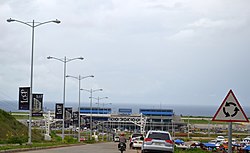
Its most notable landmark is the Laguindingan Airport, located between Cagayan de Oro and Iligan.
History
[edit]Laguindingan used to be called "Daligdigan" coined from the words "daligdig", meaning trickling water from Soloan Creek, and "digan", a buri plant, which was used by the early settlers as roofing and walling materials. The name later evolved into "Laguindingan" because it is easier to pronounce and has a melodious sound.
The presence of an old Spanish port "Moog" at Punta Sulawan manifest the claim that before the settlers came to Laguindingan, the place was the hideout of robbers, pirates and bandoleros because of the once thick forest cover of the municipality. A brave man named Calixto Caseres together with his family moved in from Alubijid and settled for good. Other settlers (including migrants from Luzon and Visayas) followed and soon the place became a thriving community. A number of Cagayan de Oro civilians and government officials hide in Laguindingan during the second world war. Blocking force was established in Laguindingan that let Japanese soldiers to use boat instead going to Iligan. The Philippine Independent Church was the first religious order established in the early community. The religious presence was evidenced by the Chapel erected on the highest promontory now known as Salcedo's Hill. The cross still stand today. The silent witness of the establishment of the now growing town.
Laguindingan, was a sitio of Alubijid under the municipality of Cagayan de Oro. The first Barrio Teniente was Mariano Salcedo (from Kauswagan, Cagayan de Oro) which was appointed by the Alcalde de Cagayan. When Alubijid became a municipality, Proceso Pacana became the first Barrio Lieutenant until the end of World War II. Later a move to make Laguindingan a municipality was spearheaded by Glicerio Salcedo (Teniente del Barrio) who became the first Municipal Mayor of the town. The barangays that joined the move for township was known as the Sulawan Block namely: Kibaghot, Sinai, Mauswagon, Moog, Gasi, Aromahon, Tubajon, Sambulawan, Lapad and Liberty. On June 23, 1963, through House Bill No. 5612, President Diosdado Macapagal signed RA 3824, creating the municipality of Laguindingan.
Sambulawan derived from the word "Sulawan" because the place is situated on a hill or in Bisaya "ilaya" going up where the sun rises its bright lights is glaring to the eye, thus "Sulaw" in bisaya. The place is also known as a place of "sabungan" or where cock fights are held.
Geography
[edit]Barangays
[edit]Laguindingan is politically subdivided into 11 barangays. Each barangay consists of puroks while some have sitios.
- Aromahon
- Gasi
- Kibaghot (San Isidro)
- Lapad
- Liberty
- Mauswagon
- Moog
- Poblacion
- Sambulawan
- Sinai
- Tubajon
Climate
[edit]| Climate data for Lagindingan, Misamis Oriental | |||||||||||||
|---|---|---|---|---|---|---|---|---|---|---|---|---|---|
| Month | Jan | Feb | Mar | Apr | May | Jun | Jul | Aug | Sep | Oct | Nov | Dec | Year |
| Mean daily maximum °C (°F) | 28 (82) |
28 (82) |
29 (84) |
30 (86) |
30 (86) |
29 (84) |
29 (84) |
29 (84) |
29 (84) |
29 (84) |
28 (82) |
28 (82) |
29 (84) |
| Mean daily minimum °C (°F) | 24 (75) |
23 (73) |
23 (73) |
24 (75) |
25 (77) |
25 (77) |
25 (77) |
25 (77) |
25 (77) |
24 (75) |
24 (75) |
24 (75) |
24 (76) |
| Average precipitation mm (inches) | 271 (10.7) |
217 (8.5) |
193 (7.6) |
178 (7.0) |
344 (13.5) |
423 (16.7) |
362 (14.3) |
358 (14.1) |
329 (13.0) |
320 (12.6) |
322 (12.7) |
260 (10.2) |
3,577 (140.9) |
| Average rainy days | 23.2 | 19.5 | 22.0 | 22.8 | 29.6 | 28.9 | 30.3 | 29.8 | 28.1 | 28.8 | 26.1 | 24.1 | 313.2 |
| Source: Meteoblue[6] | |||||||||||||
Demographics
[edit]Population census of Laguindingan | ||||||||||||||||||||||||||||||||||||||||
|
| |||||||||||||||||||||||||||||||||||||||
| Source: Philippine Statistics Authority[7][8][9][10][11] | ||||||||||||||||||||||||||||||||||||||||
In the 2020 census, the population of Laguindingan was 26,363 people,[12] with a density of 600 inhabitants per square kilometre or 1,600 inhabitants per square mile.
Visayans form a majority in Laguindingan, whose ancestors came from Cebu, Bohol, Siquijor as well as Negros, Panay and Leyte who migrated to the area long before the Spaniards arrived, while the indigenous Higaonons and Binukid dwell in the municipality's remote interior. Bicolanos, Ilocanos, Kapampangans and Tagalogs from Luzon form another significant minority in Laguindingan, though in recent years after the airport was completed, many people from Luzon, Visayas and other parts of Mindanao as well as foreigners settle in the municipality in various numbers, doubling its local population. This waves of migrations have turned Laguindingan into a melting pot of cultures due to its nickname "the Gateway to Northern Mindanao".
The main language spoken in Laguindingan is Cebuano while Higaonons have their own eponymous language and it is still spoken among them, with Cebuano being their second language. Tagalog/Filipino and English are also spoken and utilized in media, business and government affairs. Other languages spoken varyingly include Bicolano, Ilocano, Hiligaynon, Kapampangan as well as Maranao, Maguindanaon and Tausug.
Economy
[edit]Poverty incidence of Laguindingan
44.59
41.23
32.60
52.22
35.41
36.44
15.16
23.61
Source: Philippine Statistics Authority[13][14][15][16][17][18][19][20]
Laguindingan, Misamis Oriental is now the new gateway to Northern Mindanao, where the new Laguindingan Airport is located replacing the old Lumbia Airport of Cagayan de Oro. The Cooperative that has a mission or Rural Electrification sits here which is MORESCO-1 Head Office. It has a power distribution franchise for the west part of Misamis Oriental from the towns of Opol to Lugait . It operates in 15 barrios of Cagayan de Oro and the whole town and barangays of Talakag, Bukidnon and portions of barangays in Iligan City. Another growing industry is the hand crafted silk. The Mindanao silk which is woven by members of Ayala Beneficiaries Association Inc., based in Laguindingan affected by the construction of the airport. Today commercial enterprises is a thriving industry for heavy equipment, machinery and transport vehicles merchandise. Lohas Hotel and Moresco lodge are the new tourist inns available. Also beach and swimming pool is another attraction for the local which are located on Mauswagon to Tubajon road side resorts. Another tourist attraction is the Balsa of Laguindingan, the floating cottages that fuel the local economy. It had made the Town the Balsa Capital of Mindanao.
Laguindingan is also well known for its famous sea food every Saturday Market also known as "tabu" in Cebuano. Here visitors and locals can buy and eat sea urchins in bottles, sea weeds, sea clams and snails, and the famous cure for arthritis the sea cucumber with the barbecue fish on sticks also known in Visayan as "tinap-an" and the delicious fish rich in Omega 3 oil also known as "pinyahin". Fishes from neighboring towns are also brought here for trading.
The common agricultural produce aside from corn, cassava and copra is the "finest tobacco". This has driven the town to progress and its neighboring towns for decades. The tobacco industry prior to the advent of Laguindingan Airport is also an attraction for entrepreneurs.
The Saturday market had also made the town famous for the lives stock industry were poultry and livestock were traded. Neighboring towns Alubijid and Libertad had benefited from this trading as well as Cagayan de Oro, where here the lechon entrepreneurs get those young pork here.
Today another flourishing industry for beach tourism being developed is also the scuba diving where the rich exotic sea creatures are found in the coastal barangay Tubajon.
Tourism
[edit]- Balsa sa Laguindingan
Located at Birhen sa Moog Bay near the punta sulawan point. It is floating cottages where groups or families can enjoy swimming and take shelter in these floating huts which can accommodate up to 30 persons. You have to ride a bangca to get there. Its docking point is now located at Moog Bay where an environment fee is collected for the municipality to sustain environment clean up.
- Binitinan Islet located at Mauswagon it is a rock formation which form like the head of a snake(bitin) with soil and trees where it is surrounded by sea.
- Tagbabanga Spring a place in Sinai where you walk distance from the National Highway. This spring is the source of potable water that is the source of drinking water not only in Barangay Sinai but to some neighboring barangays as well.
- Balete Hill also known as'Hill Top' (Buntod) a place where the old Iglesia Pilipina Independente Church site before it transferred. It is visible to everybody during Holy Week season where the people will walk towards the Holy Cruz.
- My Relaxing Terrace site in Tubajon a beach where many mangrove trees cited, the sand like Boracay sand.
- Berhen Milagrosa a place in Moog where it miracles it is site beside the sea, many people will Church there during Sunday it also become a tourist spot.
- La Cueva Con Agua Locally known as "Liyang", site in Mauswagon nearby the Barangay Hall, it is known as a place of enchanto, a cave that has water and being protected by Municipality of Laguindingan due to some superstitious belief.
- Tubajon Mang Groves
- Laguindingan Watchtower, an 18th-century watchtower built by the Spanish during the colonial era.
- Sambulawan Sinai Tagbabanga Spring and Water fall located in a river from Gitagum Misamis Oriental towards Aromahon Laguindingan Misamis Oriental.
- Our Lady of Fatima- Located in baranggay Sambulawan Laguindingan Misamis Oriental a 50 foot tall statue facing the east side to the Divine Mercy in El Salvador.
Town events
[edit]There are several notable events in the town. Each barangays or barrios has its own feast locally known as Fiesta literally as festivals honoring their patron saints after achieving recognition in their own rights.
- Tobacco Festival is a one-day festival celebration of Laguindinagan, held every month of July 12. Tobacco is Laguindinganon's center of commodity where immigrant from other province's and cities made their purchased of Tobacco every Sunday.
- Charter Day is the town's celebration of its townhood established on July 12, 1963. It is a non-working holiday and a roster of special activities is lined up annually to mark this special occasion.
- A Holy-Week Trek March or April (Movable) on the eve of Good Friday (Thursday evening), where hundreds of Laguindinganon trek towards the old Municipal Hall in "Balete Hill" for the annual Via crucis or way of the cross. This event is the town's catholic devotees in observation of the holy week.
- Miss Laguindingan (July 8) is a beauty pageant presenting the native beauty of Laguindingan ladies. It is one of the most prestigious beauty pageants in the Town.
- Town Fiesta April 20 the original town fiesta of Laguindingan. Majority of the people of Poblacion celebrating the fiesta.
Transportation
[edit]Laguindingan does not have sea transportation facilities. Nearby Cagayan de Oro is the main entry point to Misamis Oriental. From there, one would then take a bus or jeepneys from the Westbound-Bulua Integrated Bus and Jeepney Terminal.
- By land
- Habal-habal is the transportation in town for inner most barangays when you are in a hurry.
- Tricab is now the king of the urban road where the neighboring towns benefitted from it. It has become a local transport industry and increase commerce and had contributed to cheaper cost of transport for both neighboring and hinterland barangays.
- Laguindingan Integrated Bus Terminal is now operational since June 15, 2016, known as Laguindingan Transport Terminal since it was recently inaugurated. It caters buses to and from Iligan/Cagayan de Oro as well as the new route Balingasag town to Laguindigan direct.
- By air
- Laguindingan Airport is the air transportation in town.[21] The new airport is in barangay Moog, Laguindingan, and is expected to become a major hub for export of agricultural and trade products, and for the import of tourists to the areas around Cagayan de Oro and Iligan City. There are plans by the Philippine National Railways to connect Laguindingan to Cagayan de Oro city.
Education
[edit]Public schools:
Elementary
- Laguindingan Central School
- Aromahon Elementary School
- Gasi Elementary School
- Kibaghot Elementary School
- Lapad Elementary School
- Liberty Elementary School
- Mauswagon Integrated School
- Moog Elementary School
- Sambulawan Elementary School
- Sinai Elementary School
- Tubajon Integrated School
Secondary
- Laguindingan National High School
- Kibaghot National High School
- Mauswagon Integrated School
- Tubajon Integrated School
See also
[edit]- Metro Cagayan de Oro, fourth largest metropolitan area in the Philippines.
References
[edit]- ^ Municipality of Laguindingan | (DILG)
- ^ "2015 Census of Population, Report No. 3 – Population, Land Area, and Population Density" (PDF). Philippine Statistics Authority. Quezon City, Philippines. August 2016. ISSN 0117-1453. Archived (PDF) from the original on May 25, 2021. Retrieved July 16, 2021.
- ^ "2024 Census of Population (POPCEN) Population Counts Declared Official by the President". Philippine Statistics Authority. July 17, 2025. Retrieved July 18, 2025.
- ^ "PSA Releases the 2021 City and Municipal Level Poverty Estimates". Philippine Statistics Authority. April 2, 2024. Retrieved April 28, 2024.
- ^ "2024 Census of Population (POPCEN) Population Counts Declared Official by the President". Philippine Statistics Authority. July 17, 2025. Retrieved July 18, 2025.
- ^ "Lagindingan: Average Temperatures and Rainfall". Meteoblue. Retrieved April 29, 2020.
- ^ "2024 Census of Population (POPCEN) Population Counts Declared Official by the President". Philippine Statistics Authority. July 17, 2025. Retrieved July 18, 2025.
- ^ Census of Population (2015). "Region X (Northern Mindanao)". Total Population by Province, City, Municipality and Barangay. Philippine Statistics Authority. Retrieved June 20, 2016.
- ^ Census of Population and Housing (2010). "Region X (Northern Mindanao)" (PDF). Total Population by Province, City, Municipality and Barangay. National Statistics Office. Retrieved June 29, 2016.
- ^ Censuses of Population (1903–2007). "Region X (Northern Mindanao)". Table 1. Population Enumerated in Various Censuses by Province/Highly Urbanized City: 1903 to 2007. National Statistics Office.
- ^ "Province of". Municipality Population Data. Local Water Utilities Administration Research Division. Retrieved December 17, 2016.
- ^ "2024 Census of Population (POPCEN) Population Counts Declared Official by the President". Philippine Statistics Authority. July 17, 2025. Retrieved July 18, 2025.
- ^ "Poverty incidence (PI):". Philippine Statistics Authority. Retrieved December 28, 2020.
- ^ "Estimation of Local Poverty in the Philippines" (PDF). Philippine Statistics Authority. November 29, 2005.
- ^ "2003 City and Municipal Level Poverty Estimates" (PDF). Philippine Statistics Authority. March 23, 2009.
- ^ "City and Municipal Level Poverty Estimates; 2006 and 2009" (PDF). Philippine Statistics Authority. August 3, 2012.
- ^ "2012 Municipal and City Level Poverty Estimates" (PDF). Philippine Statistics Authority. May 31, 2016.
- ^ "Municipal and City Level Small Area Poverty Estimates; 2009, 2012 and 2015". Philippine Statistics Authority. July 10, 2019.
- ^ "PSA Releases the 2018 Municipal and City Level Poverty Estimates". Philippine Statistics Authority. December 15, 2021. Retrieved January 22, 2022.
- ^ "PSA Releases the 2021 City and Municipal Level Poverty Estimates". Philippine Statistics Authority. April 2, 2024. Retrieved April 28, 2024.
- ^ Town In Misamis Oriental Is Best Site For New Airport In Northern Mindanao
External links
[edit]- Philippine Standard Geographic Code
- Philippine Census Information
- Local Governance Performance Management System Archived March 3, 2016, at the Wayback Machine
Places adjacent to Laguindingan | |
|---|---|


 Province of Misamis Oriental Province of Misamis Oriental | |
|---|---|
Cagayan de Oro (capital and largest city) | |
| Municipalities | |
| Component cities | |
| Highly urbanized city |
|

Laguindingan
View on GrokipediaHistory
Founding and colonial era
The coastal area of present-day Laguindingan fell under Spanish colonial administration as part of the broader Misamis territory, which was initially a subprovince of Cebu before being organized as a corregimiento in 1818, divided into four partidos including that of Misamis.[5] In the 18th century, Spanish authorities erected a watchtower near Punta Sulawan to monitor and alert against Moro pirate raids, a common defensive measure in Mindanao's frontier regions; the structure's ruins, identified through archaeological assessment as a modest fortification likely no larger than 3 meters in diameter, persist as the primary relic of this era.[6][7] The site's prior use as a vantage point aligns with Spanish strategies to secure coastal trade routes amid intermittent raids, though the surrounding interior remained largely indigenous and undeveloped under direct colonial control.[7] Under American colonial rule following the 1898 conquest, Laguindingan emerged as a sitio affiliated with Alubijid municipality (then under Cagayan de Oro), marking the onset of organized Christian settler communities drawn from nearby Visayan populations.[8] Mariano Salcedo, originating from Kauswagan in Lanao, served as the inaugural barrio teniente, overseeing local affairs amid gradual homesteading and agricultural expansion.[8] By the interwar period, Proceso Pacana had assumed the role, sustaining community leadership through the Japanese occupation and World War II, during which the area functioned intermittently as a refuge for evacuees fleeing urban combat in Cagayan de Oro.[9]Post-independence development
Following Philippine independence in 1946, the territories that later formed Laguindingan operated as rural barrios under the Municipality of Alubijid, sustaining an agriculture-based economy centered on rice, corn, and subsistence farming amid national postwar reconstruction.[10] A major administrative milestone occurred on June 22, 1963, when Republic Act No. 3824 created the independent Municipality of Laguindingan, carving out the barrios of Liboron (as the poblacion), Candiis, Tuburan, Balacanas, Sinkanan, Gumaod, and Lapad from Alubijid.[11] The act appointed interim officials, including Pedro B. Roa as mayor, to administer the new entity with a land area of approximately 44.23 square kilometers, fostering localized decision-making for infrastructure and services previously managed at the municipal level.[12] This separation spurred modest socioeconomic progress, evidenced by population expansion from 10,292 residents in the 1970 census to 16,085 by 1990, driven primarily by natural growth and internal migration within Northern Mindanao.[1] Agricultural output, including tobacco cultivation by immigrant farmers, became a cornerstone, with the crop's economic viability supporting household incomes in line with regional patterns where tobacco contributed significantly to rural earnings.[13] Basic infrastructure, such as roads and barangay health stations, developed incrementally under local governance, though constrained by the Philippines' broader agrarian challenges and limited central funding until later decades.Airport establishment and expansion
The development of Laguindingan Airport originated from studies conducted by the Philippine government in the late 1980s and early 1990s to establish a new regional aviation hub for Northern Mindanao.[14] In 1993, President Fidel V. Ramos approved its inclusion as a major infrastructure project, aiming to replace the aging Lumbia Airport in Cagayan de Oro and accommodate growing air traffic demands.[15] Groundbreaking ceremonies occurred on January 10, 2006, under President Gloria Macapagal Arroyo, marking the formal start of construction despite prior conceptualization.[16] The project faced significant delays, extending over two decades from initial planning, due to funding issues and bureaucratic hurdles, positioning it as one of the Philippine government's most protracted infrastructure initiatives.[15] Construction progressed under the Department of Transportation and Communications, with the airport designed to serve as the primary gateway for Cagayan de Oro, Iligan, and surrounding areas. President Benigno Aquino III inaugurated the facility on June 13, 2013, and it officially opened for commercial operations on June 15, 2013, immediately succeeding Lumbia Airport, which ceased passenger services that day.[17] Initially equipped with a single runway and terminal capable of handling domestic flights, the airport boosted regional connectivity but soon encountered capacity constraints from rising passenger volumes.[18] Post-opening expansions addressed operational bottlenecks. In February 2024, the Civil Aviation Authority of the Philippines initiated a 720-square-meter modular terminal expansion to alleviate congestion, completed and operational by September 2024, increasing pre-departure capacity from 500 to 860 passengers. [19] A landmark public-private partnership agreement worth P12.75 billion was signed in October 2024 with Aboitiz InfraCapital, facilitating handover by April 2025 and initiating Phase One upgrades to double capacity to 3.9 million passengers annually, including enhanced terminal facilities and runway extensions.[20] [21] This deal, endorsed by President Ferdinand R. Marcos Jr., underscores commitments to Northern Mindanao's infrastructure growth.[22] Further developments include plans for international status, with conversion efforts targeting operations by mid-2025 to accommodate global routes, aligning with the airport's evolution into a premier regional hub.[23] These enhancements, driven by sustained traffic growth since 2013, have positioned Laguindingan Airport as the sixth-busiest in the Philippines, supporting economic expansion in Misamis Oriental and adjacent provinces.[24][18]Geography
Location and terrain
Laguindingan is a coastal municipality in the province of Misamis Oriental, Northern Mindanao region (Region X), Philippines.[1] It is positioned at approximately 8°34′ North latitude and 124°26′ East longitude, bordering the Mindanao Sea to the north.[1] [25] The total land area spans 44.23 square kilometers (17.08 square miles).[1] The terrain of Laguindingan is characterized by gentle to undulating and rolling topography, featuring ridges as topographic highs and valleys with plains as lows.[26] This landscape is drained by several rivers, contributing to its hydrological features.[26] Elevations vary, with an average of about 71 meters above sea level across the municipality, though specific points like the poblacion reach around 138 meters.[27] [28] The underlying geology includes ultramafic rocks, the Opol Formation, and Indahag Limestone formations.[26]Barangays
Laguindingan is politically subdivided into 11 barangays, the smallest administrative divisions in the Philippines.[1] These barangays collectively house the municipality's population of 26,363 as recorded in the 2020 Census conducted by the Philippine Statistics Authority.[1] The barangays vary in population size, with Kibaghot having the highest at 4,016 residents and Moog the lowest at 1,176. Poblacion serves as the central barangay, encompassing the municipal hall, commercial areas, and key administrative functions.[1] [29]| Barangay | Population (2020) |
|---|---|
| Aromahon | 1,502 |
| Gasi | 1,944 |
| Kibaghot | 4,016 |
| Lapad | 1,387 |
| Liberty | 1,841 |
| Mauswagon | 3,519 |
| Moog | 1,176 |
| Poblacion | 3,744 |
| Sambulawan | 1,741 |
| Sinai | 2,427 |
| Tubajon | 3,066 |
Climate and environment
Laguindingan exhibits a tropical rainforest climate (Köppen classification Af), characterized by high temperatures, abundant rainfall, and minimal seasonal temperature variation due to its low elevation of approximately 6 meters above sea level.[30] Annual average temperatures range from 26°C to 27°C, with daily highs typically between 29°C and 31°C and lows around 24°C to 25°C throughout the year.[31] The hottest months occur from March to May, with peaks near 31°C, while humidity remains consistently high, often exceeding 80%, contributing to an oppressive feel.[32] Rainfall averages over 2,000 mm annually, distributed relatively evenly but with peaks during the wetter months of June to October, influenced by the southwest monsoon and occasional tropical cyclones affecting Mindanao.[33] Dry periods are shorter and less pronounced compared to northern Philippine regions, with February to April seeing the lowest precipitation, around 90-100 mm per month.[34] Sunshine hours vary from 128 in January to over 200 in March, though cloud cover predominates year-round.[34] The local environment encompasses coastal and inland features, including gentle to undulating terrain drained by multiple rivers that feed into Macajalar Bay.[26] Extensive mangrove forests and 165 hectares of seagrass beds support biodiversity, particularly avifauna, with planted mangroves hosting at least eight bird species and correlating positively with overall bird diversity.[35] These ecosystems face threats from sea-level rise and altered rainfall patterns due to climate change, exacerbating vulnerability in low-lying coastal areas.[36] Geological substrates include ultramafic rocks and limestone formations, which influence soil stability and contribute to risks of landslides and flooding during heavy rains.[26]Demographics
Population statistics
As of the 2020 Census of Population and Housing conducted by the Philippine Statistics Authority, Laguindingan had a total population of 26,363 persons.[37] This figure represented an increase from 24,405 in the 2015 census. The annual population growth rate between 2015 and 2020 was 1.6%.[37] Earlier census data show steady growth: the 2010 census recorded 21,822 residents, yielding an approximate annual growth rate of 2.3% from 2010 to 2015.[37]| Census Year | Population |
|---|---|
| 2010 | 21,822 |
| 2015 | 24,405 |
| 2020 | 26,363 |
Ethnic and linguistic composition
The population of Laguindingan is predominantly composed of ethnic Cebuanos, who constitute the primary ethnic group in Misamis Oriental province and speak Cebuano as their mother tongue and lingua franca.[38] Cebuano speakers form the vast majority in the municipality, consistent with regional patterns in Northern Mindanao where this Visayan language dominates daily communication, education, and local governance.[39] A notable minority consists of the indigenous Higaonon people, an ethnic group native to interior areas of Misamis Oriental, who maintain their distinct Higaonon language alongside Cebuano for intergroup interactions.[40] The Higaonon, known for their traditional practices tied to mountainous terrains, represent a smaller but culturally significant segment, though exact proportions at the municipal level remain undocumented in census breakdowns; provincial estimates suggest indigenous groups like the Higaonon comprise under 5% of the broader population.[41] Other linguistic influences, such as Tagalog and English due to national media and migration, are secondary and not native.[42]Government and Administration
Local government structure
The local government of Laguindingan operates under the framework established by the Local Government Code of 1991 (Republic Act No. 7160), which decentralizes authority to municipalities as the primary units for local administration in the Philippines. Executive authority resides with the municipal mayor, elected to a three-year term, who holds responsibility for enforcing municipal ordinances, managing administrative operations, preparing the annual budget, and overseeing public services including health, education, and infrastructure maintenance. The mayor appoints key administrative officials, such as the municipal treasurer, budget officer, accountant, assessor, engineer, and health officer, with appointments requiring confirmation by the legislative body. Legislative functions are performed by the Sangguniang Bayan, comprising the vice mayor as presiding officer and eight regular members (councilors) elected at-large for three-year terms, reflecting the municipality's population of 26,363, which falls below the 100,000 threshold for additional seats under the Code. [2] The council enacts ordinances on local taxation, revenue generation, land use, and public welfare, while approving the mayor's appointments and budget proposals; it also includes sectoral representatives from women, agriculture, and, if applicable, indigenous communities. Laguindingan is subdivided into 11 barangays, the smallest administrative units, each governed by an elected punong barangay (village chief) and a seven-member Sangguniang Barangay, which handles grassroots services like peacekeeping, basic health, and community development under municipal oversight.[1] Barangay officials, including a Sangguniang Kabataan chairperson for youth affairs, coordinate with the municipal government on resource allocation and policy implementation, ensuring localized responsiveness within the hierarchical structure.Recent elections and leadership
In the 2022 Philippine local elections, Diosdado T. Obsioma was elected mayor of Laguindingan, succeeding in the municipal race alongside vice mayor Roy I. Macua, with both officials assuming office for the term 2022–2025.[43] The 2025 local elections, held on May 12, saw a shift in leadership as former vice mayor Roy I. Macua, running under the Nacionalista-United People's banner (NUP), defeated incumbent Diosdado T. Obsioma's endorsed candidate Donsals Ellarina of Lakas-CMD. Macua secured 11,030 votes, representing 52.21% of the counted precincts, while Ellarina received 7,371 votes or 34.89%.[44] For vice mayor, Cherwin B. Gabutin (NUP) won with 10,863 votes (51.42%), edging out Baneng San Jose of the Nacionalista Party (NP) who garnered 7,042 votes (33.33%).[44] These results, based on 100% of precincts reporting, were proclaimed by the Commission on Elections (COMELEC), with Macua and Gabutin officially sworn in during August 2025.| Position | Candidate | Party | Votes | Percentage |
|---|---|---|---|---|
| Mayor | Roy I. Macua | NUP | 11,030 | 52.21% |
| Donsals Ellarina | Lakas-CMD | 7,371 | 34.89% | |
| Vice Mayor | Cherwin B. Gabutin | NUP | 10,863 | 51.42% |
| Baneng San Jose | NP | 7,042 | 33.33% |