Hubbry Logo
Lake AssadLake AssadMain
Open search
Lake Assad
Community hub
Lake Assad
logo
8 pages, 0 posts
0 subscribers
Be the first to start a discussion here.
Lake Assad
Lake Assad
from Wikipedia

Redirect to:

Revisions and contributorsEdit on WikipediaRead on Wikipedia
from Grokipedia
Lake Assad (Arabic: بحيرة الأسد, Buhayrat al-Asad) is 's largest artificial reservoir, situated on the River in in northern . Formed by the damming of the at the , construction of which began in 1968 and was completed in 1973 with Soviet assistance, the lake extends approximately 80 kilometers upstream from the dam and serves as a critical component of 's water infrastructure. The reservoir has a maximum surface area of 630 square kilometers and a storage capacity of 11.7 billion cubic meters, enabling it to support extensive irrigation across more than 640,000 hectares of farmland, generate 880 megawatts of hydroelectric power, and provide via to the city of . Named after , the lake's creation submerged numerous villages and archaeological sites, displacing thousands and altering local ecosystems, while its strategic value has made the a focal point of contention during the , with control contested by government forces, ISIS militants, and Kurdish-led .

Geographical and Hydrological Overview

Location and Physical Extent

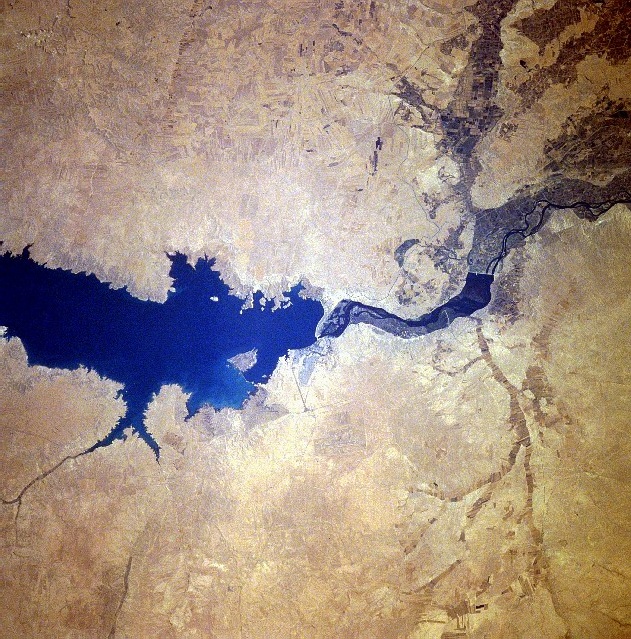
Lake Assad, Syria's largest reservoir, is situated in the northern part of the country within , formed by the impoundment of the River behind the . The lake's approximate central coordinates are 36°00′N 38°10′E, extending along the river valley in a predominantly arid region characterized by and landscapes. The stretches approximately 80 kilometers (50 miles) upstream from the , with an average width of 8 kilometers (5 miles), though it narrows in some sections and widens to a maximum of about 10 kilometers. Its maximum surface area reaches 610 square kilometers (235 square miles) at full capacity, encompassing a narrow, elongated shape that follows the ' meandering course. The lake's volume at maximum fill is 11.7 cubic kilometers (2.8 cubic miles), though operational levels have varied significantly due to hydrological fluctuations, dam management, and regional water-sharing agreements with upstream countries like .

Formation and Water Dynamics

Lake Assad formed through the impoundment of the River by the , an earth-fill structure completed in 1973 following construction that began in 1968 with Soviet assistance. The reservoir reached operational status in 1974, submerging approximately 650 square kilometers of land and creating Syria's largest artificial lake with a maximum storage capacity of 11.7 billion cubic meters, though effective usable volume is around 9.6 billion cubic meters due to and operational constraints. The primary water inflow to Lake Assad derives from the River upstream of the dam, with average annual discharges historically ranging from 20 to 30 billion cubic meters before significant upstream damming in reduced flows. Outflows are regulated via the dam's spillways, turbines, and releases, maintaining downstream flow for generation—up to 800 megawatts—and agricultural demands, while has progressively diminished storage over decades. In the arid Syrian climate, evaporation represents a major water loss mechanism, estimated at 1.3 billion cubic meters annually from the surface, which spans up to 624 square kilometers at full pool elevation of 305 meters above . Water levels exhibit seasonal fluctuations tied to in the headwaters, peaking during spring melts and declining in summer due to high and irrigation withdrawals; recent droughts and upstream Turkish dams have caused multi-year lows, with levels dropping below dead storage thresholds at times during the , limiting power output and exposing historical sites.

Historical Development

Planning and Construction of the Tabqa Dam

The concept of a dam on the Euphrates River in Syria emerged in the 1930s under the French Mandate, primarily to irrigate 100,000 hectares of arid land. Feasibility studies followed, including a commission to an English firm on March 30, 1947, evaluating water use for irrigation and hydroelectric power supply to Aleppo. Syria pursued international partnerships in the mid-20th century, signing an initial agreement with the on November 28, 1957, for $270 million in aid, which facilitated site selection at Tabqa after research from 1957 to 1960. A 1963 offer from for $88 million in funding was abandoned amid technical and financial disagreements. This led to a comprehensive -Soviet accord effective December 18, 1966, providing a $133 million at 2.5% interest—repayable over 12 years post-completion—for Soviet-led design, supervision, equipment, and expertise, with Syria supplying local labor and materials. Construction began in 1968, bolstered by Soviet technical assistance. The workforce comprised approximately 11,000–12,000 Syrian laborers and 700–1,000 Soviet engineers and specialists, working in continuous 24-hour shifts and sustaining a site community of 40,000 including families. Over 10,000 families were displaced and resettled with new housing provisions. The project reached completion in 1973, with President sealing the diversion canal on July 5, 1973, diverting the river and halting its natural flow for the first time. Reservoir filling commenced immediately, achieving full capacity by 1975.

Pre-Flooding Archaeological Salvage Efforts

In 1963, Syria's Directorate General of Antiquities and Museums, in collaboration with , initiated a salvage program to survey and excavate sites along the Middle Euphrates threatened by the planned . This effort was prompted by the dam's construction, which commenced in 1968 and concluded in 1973, creating the Lake Assad reservoir that submerged approximately 800 square kilometers of the valley floor. International teams, funded primarily by , conducted systematic excavations at around 20 sites between the late 1960s and early 1970s, alongside a comprehensive regional survey to document the archaeological landscape. Key excavations targeted prehistoric and early historic settlements, revealing evidence of some of the earliest transitions to and in the . At , British-led teams under Andrew Moore excavated from 1972 to 1973, uncovering Natufian (Epipaleolithic) layers dating to circa 13,000–11,000 BCE, followed by occupations with domesticated and other cereals by around 11,000 BCE, prior to the site's inundation in 1974. Similarly, French archaeologists, including Cauvin, worked at Mureybet from 1964 to 1974, exposing a sequence from Natufian phases (circa 10,200 BCE) to early villages with early and symbolic artifacts, before the site vanished under the reservoir waters. Later prehistoric and proto-urban sites also received attention, such as Habuba Kabira, Jebel Aruda, and Sheikh Hassan, which yielded Uruk-period (late 4th millennium BCE) remains indicative of Mesopotamian colonial expansion into northern Syria. tells like Tell Hadidi and Tell es-Sweyhat provided stratified evidence of Early (circa 3000–2000 BCE) fortifications and ceramics linking regional sequences. These operations prioritized rapid documentation and artifact recovery, though resource constraints limited full exploration of all identified mounds, with subsequent studies relying on declassified to map unexcavated features post-flooding. The salvage work preserved critical data on Euphrates Valley prehistory, informing debates on the despite the irreversible loss of physical sites to the reservoir.

Engineering Features

Dam Specifications and Design

The , which impounds Lake Assad, is an earthen embankment structure featuring an impermeable central core of clay to ensure water tightness. This design utilizes locally available gravel, sand, and clay for the bulk fill, prioritizing safety through the core's impermeability and the homogeneity of materials, which minimized risks associated with the site's geological conditions. The provided the engineering design, supervision, and heavy equipment, while Syrian labor executed the construction using predominantly local materials to reduce costs and logistical challenges. Key structural dimensions include a total length of 4,500 meters, incorporating the northern embankment; a maximum height of 60 meters; a crest width of 19 meters; and a base width of 512 meters. The dam body comprises approximately 41 million cubic meters of fill material, compacted in layers to achieve stability. proceeded from to 1973, with the earthen fill allowing phased building that accommodated the River's flow via temporary diversions. Engineering features integrate multi-purpose functionality, including flood control and generation. The , located on the northern embankment, consists of eight automatic radial gates (loopholes) capable of discharging up to 19,000 cubic meters per second to protect downstream areas from extreme floods. The powerhouse is embedded in the southern embankment, housing eight 100-MW turbines operating initially at a 300-meter , with provisions for expansion to 1,100 MW at 320 meters, facilitating efficient water passage for power production without compromising structural integrity. The design supports staged reservoir filling, starting at 300 meters, to mitigate seismic and settlement risks inherent to the region's .

Reservoir Capacity and Operational Parameters

Lake Assad possesses a maximum storage capacity of 11.7 billion cubic meters (11.7 km³), making it Syria's largest artificial reservoir. At full capacity, the lake covers a surface area of approximately 625 square kilometers and extends upstream for about 80 kilometers along the Euphrates River valley. The reservoir began filling in 1973 following the completion of the , with initial operations leading to reduced downstream flows into by up to 25%, prompting diplomatic tensions. Full operational status was achieved by the mid-1970s, enabling regulated storage for seasonal demands and generation. The design incorporates a system that activates automatically when water levels reach +300 meters above sea level to prevent overtopping. Operational parameters prioritize multi-year flow regulation, with water levels fluctuating based on inflows, which have been influenced by upstream Turkish dams such as Atatürk since the 1990s. Typical management aims to maintain levels sufficient for downstream release via the dam's turbines and canals, though actual volumes have varied due to hydrological variability and regional conflicts, occasionally dropping below two-thirds of capacity. No publicly detailed breakdown of usable live storage versus dead storage is available from records, but the total capacity supports an annual loss estimated at 1.3 billion cubic meters under design conditions.

Socio-Economic Contributions and Costs

Irrigation Expansion and Hydropower Output

The Tabqa Dam's creation of Lake Assad enabled major irrigation expansion in northern as part of the Basin development scheme, launched in the late to irrigate up to 640,000 hectares of arid land along the river valley. This network of primary and secondary canals, drawing from the reservoir, targeted , , and other crops on both banks, effectively doubling Syria's irrigated area in the basin and supporting agricultural mechanization and . By the , initial phases had brought thousands of hectares under cultivation, though full implementation faced delays from technical issues, upstream water disputes, and later disruptions. The dam's facilities provide substantial energy output, with an installed capacity of 824 megawatts from eight turbines, positioning it as Syria's primary hydroelectric source. Designed for annual generation of approximately 1.6 billion kilowatt-hours, the plant exceeded this target in its early operations, producing 2 billion kWh in alone through regulated releases. This output powered industrial growth in Raqqa province and national grids, though actual yields have fluctuated due to variable inflows, maintenance challenges, and conflict-related damage since 2011.

Population Displacement and Resettlement Outcomes

The construction of the Tabqa Dam and the subsequent filling of Lake Assad between 1973 and 1974 submerged 66 villages and 126 hamlets along the Euphrates River banks, displacing approximately 60,000 people from fertile agricultural lands in Raqqa Governorate. These inundated settlements were primarily inhabited by Arab farming communities reliant on riverine agriculture, leading to the loss of traditional livelihoods centered on date palms, cereals, and livestock grazing. The Syrian government under the Baathist regime initiated resettlement programs, relocating many displaced families to newly constructed "model villages" equipped with modern housing, irrigation infrastructure, and access to state-managed collective farms as part of broader agrarian reforms. Compensation included land allocations in irrigated areas downstream or in the , with thousands of Arab families—estimated at around 4,000 households—directed toward Kurdish-majority areas to support demographic engineering policies like the Arab Belt initiative. These efforts aimed to integrate the maghmurin (displaced persons) into mechanized and hydropower-supported economies, theoretically improving productivity through Soviet-assisted planning. Outcomes of resettlement were uneven, with short-term benefits in and access overshadowed by long-term socioeconomic challenges. Many resettled communities experienced cultural , reduced self-sufficiency due to dependence on state farms, and conflicts over land quality compared to submerged floodplains; adaptation to collective systems often resulted in lower yields and persistent for former smallholders. The policy's linkage to exacerbated ethnic tensions, as Arab settlers in Kurdish zones faced resistance and contributed to enduring grievances, though empirical data on sustained agricultural gains from resettled populations remains limited by regime opacity and subsequent disruptions. Documented accounts, such as those in restricted Syrian films, highlight villager dissatisfaction with unfulfilled promises of equivalent prosperity, underscoring causal disconnects between top-down relocation and local economic realities.

Environmental Consequences

Ecological Transformations and Biodiversity

The impoundment of Lake Assad following the completion of the in 1974 transformed the River's middle reach from a flowing riverine into a lentic environment, submerging approximately 640 square kilometers of valley floor and displacing terrestrial and adapted to riparian and conditions, such as drought-resistant grazed by sheep, camels, and donkeys. This shift facilitated the establishment of aquatic habitats, promoting the growth of submerged and emergent plants alongside planktonic and nektonic communities suited to standing waters. Initially, the bolstered production through natural colonization and deliberate stocking, achieving yields exceeding 500 tons of fresh per year by 1979, supported by introductions of species like (Oncorhynchus mykiss) and . The middle Euphrates system in Syria sustains a diverse freshwater ichthyofauna, encompassing 46 species across four orders, 12 families, and 24 genera, including cyprinids dominant in the native assemblage. Reservoir formation likely disrupted migratory routes for potamodromous and anadromous fishes, favoring lentic-tolerant species while potentially reducing diversity of rheophilic (flow-dependent) taxa; aquaculture initiatives, such as tilapia (Oreochromis niloticus) farming and rainbow trout culture from 1979 to 1989, augmented stocks but introduced non-native elements that could alter trophic dynamics. Over time, nutrient enrichment from agricultural runoff and wastewater has fostered eutrophic conditions, evidenced by persistent algal proliferations that diminish water transparency and primary productivity patterns. Contemporary stressors have accelerated erosion, with untreated sewage from and oil refinery effluents via the Taban spring contaminating the reservoir, elevating organic loads and promoting hypoxic zones via algal decomposition. By 2023, fish catches had plummeted to fractions of prior abundances, linked to receding water levels from recurrent droughts, reduced inflows due to upstream Turkish impoundments, , and compounded , which collectively shrink habitable volumes and intensify interspecies competition. since 2011 has further impaired ecological integrity through sabotage, unchecked effluents, and severed hydrological connectivity, yielding widespread degradation and documented declines in aquatic across 's northern basins.

Sedimentation, Water Quality, and Sustainability Issues

Sedimentation in Lake Assad occurs primarily from suspended loads carried by the River, with pre-construction assessments estimating an annual accumulation rate of approximately 140 million metric tons, though upstream dams in , such as the Atatürk Dam, trap a substantial portion of the river's total load—estimated at 90-100 million tons annually basin-wide—before it reaches Syrian territory, thereby reducing in the reservoir. Comprehensive hydrological studies conducted prior to impoundment in the 1970s concluded that this rate would not lead to rapid reservoir filling, projecting a usable lifespan of over 500 years before significant capacity loss, based on the lake's morphology and settling patterns. Nonetheless, accumulated silt contributes to long-term storage reduction, exacerbates , and diminishes downstream delivery, which historically enriched Mesopotamian floodplains but now promotes erosion and salinization in lower reaches. Water quality in Lake Assad has been compromised by multiple anthropogenic and environmental factors, including upstream agricultural runoff laden with fertilizers and pesticides from Turkish and Syrian , as well as untreated industrial effluents and discharges along the river basin. Local reports from fishermen around the highlight acute episodes, correlating with sharp declines in fish catches—down to a fraction of pre-conflict levels—attributed to chemical contaminants and hypoxic conditions from organic waste. High , amplified by the reservoir's shallow average depth of 16 meters and arid climate, concentrates dissolved salts, with levels in adjacent reclaimed soils already elevating risks for return flows. Conflict-related disruptions since 2011 have further impaired monitoring and treatment, though peer-reviewed basin analyses note persistent nutrient enrichment fostering algal blooms and potential . Sustainability challenges for Lake Assad center on chronic water deficits driven by upstream flow reductions—Turkey's dams and diversions have cut Syria's share below the 1987 protocol's 500 cubic meters per second minimum during dry periods—and compounded by regional droughts since 2006, which have halved inflows in peak deficit years. The reservoir's nominal capacity of 11.7 billion cubic meters has seen operational volumes drop to 10.5 billion cubic meters by mid-2023, with levels falling six meters since 2020, rendering pumping stations inoperable and slashing output by up to 80% at low heads. Annual losses, estimated at 1,500 million cubic meters due to high surface area (790 square kilometers) and temperatures exceeding 40°C in summer, further erode usable storage, while over-extraction for —serving 640,000 hectares—accelerates drawdown without corresponding inflow replenishment. These dynamics, rooted in hydrological over-optimism during design and geopolitical asymmetries, underscore the reservoir's vulnerability, with projections indicating potential dead storage thresholds by the absent cooperative basin or adaptive like desilting or deepened outlets.

Geopolitical and Strategic Dimensions

International Disputes over Euphrates Flows

The , originating in and flowing through and , lacks a comprehensive for equitable water allocation among the riparians, leading to persistent disputes exacerbated by upstream infrastructure development. 's (GAP), initiated in the 1980s, includes 22 dams and 19 hydroelectric plants, with the —completed in 1990—storing significant volumes that regulate downstream flows into 's Lake Assad reservoir behind the . This has reduced average annual inflows to by an estimated 30-40% compared to pre-GAP levels, prompting accusations from and of unilateral control prioritizing Turkish irrigation and over downstream needs. A pivotal bilateral emerged on , 1987, when and signed a protocol committing to release a minimum average flow of 500 cubic meters per second (m³/s) from the into , equivalent to about 40% of the river's mean discharge at the border, as an interim measure pending a final tripartite accord. This agreement, part of broader economic cooperation, indirectly benefited through a subsequent Syrian-Iraqi understanding on downstream sharing, but it remains non-binding and contested, with no enforcement mechanism or provisions for drought variability. Historical flashpoints underscore the fragility: in 1975, Syria's impoundment of water for Lake Assad's initial filling reduced flows to by up to 75% temporarily, prompting to mobilize troops and threaten airstrikes on the , averting conflict only through . Recent decades have seen repeated Syrian and Iraqi claims of Turkish non-compliance, particularly during low-flow periods when releases have fallen below 200 m³/s—less than half the threshold—severely impacting Lake Assad's levels, which dropped to historic lows of around 305 meters above by May 2021, the shallowest since the reservoir's 1976 completion. attributes reductions to climatic and increased domestic demand rather than deliberate withholding, asserting its sovereign rights as the basin's headwaters state and rejecting historical riparian doctrines in favor of equitable utilization principles under . has escalated diplomatic protests, including UN complaints in 2021 and 2023, warning of humanitarian crises affecting millions reliant on irrigation, while Syria's has compounded vulnerabilities by disrupting operations and local water management. These tensions highlight broader geopolitical frictions, with downstream states viewing Turkish as tools for leverage amid regional instability, though no violent escalation has occurred since the due to mutual and occasional ad hoc releases during crises. Efforts toward resolution, such as tripartite technical committees formed in the 1990s and 2000s, have yielded data-sharing protocols but stalled on allocation formulas, as Turkey insists on basin-wide needs assessments accounting for its 70% share of the versus Syria's 30% and Iraq's minimal upstream portion. As of 2025, ongoing droughts and GAP expansions continue to strain Lake Assad's inflows, fueling calls from and for binding arbitration, while promotes joint monitoring as a alternative.

Role in Regional Conflicts and Water Weaponization

Control of the , which forms , shifted multiple times during the starting in 2011, underscoring its strategic value for , , and water supply to major cities like . In February 2013, Syrian opposition forces captured the dam from government control, but the () seized it in early 2014 as part of its rapid expansion in province. utilized the dam as a , for hostages, and site for leaders, leveraging its position to dominate the Valley. ISIS employed water from Lake Assad as a tactical weapon, including shutting off major flows from the to in 2014–2017, exacerbating shortages in regime-held areas and contributing to the city's . The group also manipulated reservoir levels by partially opening spillway gates in 2017, causing flooding downstream to hinder advancing (SDF). In May 2017, U.S.-backed SDF forces fully captured Tabqa city and the dam after intense fighting, eliminating ISIS's territorial hold there and securing a key node en route to . Upstream, has been accused of weaponizing flows into Lake Assad by reducing releases from its , such as Atatürk, particularly since 2019, to pressure Kurdish-led administrations in northeast controlling the Tabqa facility. These reductions have lowered water levels in Lake Assad, 's largest reservoir and primary drinking water source for , intensifying shortages amid drought and conflict. Turkish strikes on related in 2023 further disrupted operations at Tabqa and downstream Tishrin dams, halting for hundreds of thousands in Kurdish-held areas. -backed factions have similarly constructed earth on tributaries like the Khabur River since 2021, indirectly straining -dependent systems including Lake Assad by limiting overall regional water availability. Post-2017, SDF control of Tabqa has intertwined Lake Assad's management with broader U.S.-Turkey tensions and the Assad regime's limited influence, with water releases often negotiated amid accusations of politicization from and . These dynamics highlight water infrastructure's dual role as a conflict multiplier and potential leverage point in Syria's fragmented geopolitics.

Recent and Ongoing Challenges

Fluctuations in Water Levels Due to Drought and Upstream Controls

The water levels of Lake Assad, the reservoir impounded by the Tabqa Dam on the Euphrates River, have declined markedly since 2020, reaching 298.45 meters above sea level by August 2023—approaching the operational critical threshold of 296 meters that risks halting hydropower generation and irrigation pumping. This drop, amounting to approximately six meters from pre-2020 levels, stems from compounded effects of regional droughts and diminished inflows controlled by upstream Turkish infrastructure. By May 2025, levels stood at 298.32 meters, over 5.5 meters below typical operational norms, exacerbating shortages for downstream agriculture and urban supply in Raqqa and Deir ez-Zor provinces serving more than five million people. Prolonged droughts have intensified and curtailed local , with recording its lowest rainfall on record in 2021, sharply reducing tributary contributions and reservoir recharge. The 2020–2023 period saw climate-driven conditions amplified by elevated temperatures, drying soils and diminishing surface flows across the basin. A severe persisting into 2025, described as the worst in decades for the , has further strained levels by slashing wheat yields and , with regional rainfall deficits exceeding 50% in some areas. Upstream controls by , which manages about 90% of the ' headwaters through dams like the Atatürk facility as part of the , have systematically reduced releases into since February 2020, often to less than half the 500 cubic meters per second stipulated in bilateral protocols. Syrian authorities attribute these cuts—averaging below 200 cubic meters per second at times—to deliberate prioritization of Turkish and needs over agreed shares, though Turkish officials cite domestic shortfalls and maintenance. Temporal data from 2002 onward show synchronized fluctuations between the Atatürk and Assad reservoirs, with Syrian levels lagging due to these inflows, underscoring the hydraulic dependency. Such reductions have prevented recovery during wetter intervals, perpetuating a downward trend amid ongoing basin-wide .

Infrastructure Damage and Management Post-Civil War

The Tabqa Dam, impounding Lake Assad, experienced significant infrastructure stress during the 2017 Battle of Tabqa, when ISIS held control from 2014 to 2017 and used the facility strategically, including threats of sabotage to flood downstream areas. US-led coalition airstrikes on March 26, 2017, targeted ISIS positions at the dam, which was listed on a no-strike roster due to its civilian importance; the blasts damaged the exterior, control room, and knocked personnel to the ground but did not compromise the dam's structural integrity, averting catastrophic failure. ISIS propaganda subsequently displayed images of the superficial damage to underscore coalition actions. Following the ' (SDF) capture of the dam in May 2017 as part of the campaign, control shifted to the Autonomous Administration of North and East Syria (AANES), enabling restoration of basic operations for generation and release. No extensive structural repairs to the dam itself have been publicly detailed, though surrounding infrastructure, such as bridges linking Tabqa to , underwent rehabilitation starting in 2022 to alleviate traffic disruptions from war-related destruction. Management under SDF/AANES has prioritized maintaining water flows amid reduced inflows from upstream Turkish dams and regional droughts, with the reservoir's operational capacity supporting downstream regulation despite episodic low levels. As of 2025, following the fall of the Assad regime in late 2024, the remains under exclusive SDF control, resisting integration into centralized Syrian authority amid ongoing negotiations and offensives in eastern ; this has sustained localized management but heightened geopolitical tensions over shared resources. AANES officials have issued warnings of critical water shortages in Lake Assad, attributing them to upstream controls and variability rather than further infrastructural decay. The dam's enduring functionality underscores resilient engineering from its 1976 completion, though sustained conflict has deferred comprehensive modernization for enhanced seismic and operational safeguards.

References

Add your contribution
Related Hubs
User Avatar
No comments yet.