Hubbry Logo
McCoy Air Force BaseMcCoy Air Force BaseMain
Open search
McCoy Air Force Base
Community hub
McCoy Air Force Base
logo
8 pages, 0 posts
0 subscribers
Be the first to start a discussion here.
McCoy Air Force Base
from Wikipedia

McCoy AFB (1940–1947, 1951–1975) is a former U.S. Air Force installation located 10 miles (16 km) southeast of Orlando, Florida. It was a training base during World War II. From 1951 to 1975, it was a frontline Strategic Air Command (SAC) base during the Cold War and Vietnam War. It was Orlando's biggest employer and economic backbone prior to the opening of Walt Disney World in 1971.

Key Information

With McCoy's closure as an active USAF facility in 1975, the site was redeveloped and is known today as Orlando International Airport, which continues to carry the base's original FAA LID airport code of MCO (i.e., McCoy) and ICAO airport code of KMCO.

Over the course of its existence the installation had several names, including Orlando Army Air Field #2, Pinecastle Army Airfield, and Pinecastle Air Force Base.

History

[edit]

McCoy Air Force Base was named for Colonel Michael Norman Wright McCoy (1905–1957) on 7 May 1958.[1] Seven months earlier on 9 October 1957, McCoy was killed in the crash of a B-47 Stratojet (DB-47B-35-BW), AF Serial No. 51-2177, of the 447th Bombardment Squadron, 321st Bombardment Wing.[2][3] The six-engine bomber suffered wing failure northwest of downtown Orlando while taking part in a practice demonstration during the annual Strategic Air Command Bombing Navigation and Reconnaissance Competition at Pinecastle Air Force Base. McCoy was the aircraft commander during the flight and the mishap aircraft was one of two at Pinecastle that had been modified to carry the GAM-63 RASCAL air-to-surface missile.

At the time of his death, McCoy was the commander of the 321st Bombardment Wing,[2] the host wing of Pinecastle AFB. A hugely popular figure in Central Florida, he was buried at Arlington National Cemetery in a funeral that included a flyover of multiple B-47s.

World War II

[edit]
1947 aerial photo of Pinecastle Army Airfield

The facility originally was built in 1940 as a replacement civilian airport after the takeover and conversion of the Orlando Municipal Airport (present day Orlando Executive Airport) to Orlando Army Air Base by the United States Army Air Corps. However, with the expansion of Orlando AAB following establishment of the Army Air Forces School of Applied Tactics (AAFSAT) in 1942, the new civilian airport was also leased by the now-renamed U.S. Army Air Forces, initially being designated as Orlando Army Air Field #2 and becoming a sub-base of Orlando AAB. On 1 January 1943, it was renamed as Pinecastle Army Airfield.

Pinecastle AAF was aimed to support the training mission of Orlando AAB. Two bomb squadrons of the 9th Bombardment Group at Orlando AAB, the 5th, equipped with B-24 Liberators and the 99th, with B-25 Mitchells, B-26 Marauders and B-17 Flying Fortresses, operated from Pinecastle during the war. The squadrons had the mission of training future combat aircrews for a wide variety of bombing missions in advanced combat techniques.

In addition to the training mission, beginning in 1943, Pinecastle AAF was used as the AAFSAT Technical Center, operating an Air Force General Maintenance and Supply Depot facility. On 1 June 1944, the 901st Army Air Forces Base Unit (Heavy Bombardment), took over the bomber training mission with two squadrons, "G" and "H".

Records indicate that aircraft from Pinecastle AAF performed test bombing of chemical munitions at one of Pinecastle's numerous bombing and gunnery ranges. It is uncertain whether the chemical warfare materials used in these tests were stored at Pinecastle Army Airfield or transported from the Orlando Toxic Gas and Decontamination Yard at Orlando AAB a few hours before a practice bombing run.

With the drawdown and closure of wartime airfields after the German capitulation in May 1945, units from other bases in Florida were consolidated at Pinecastle AAF. On 1 July 1945, jurisdiction of the field was transferred to Air Proving Ground Command at Eglin Field, Florida. The 901st AAFBU was inactivated and replaced by the 621st Base Unit.

Postwar years

[edit]

In August 1945, under the Proving Ground Command (PGC), the base was used for testing of the B-32 Dominator bomber, although operations in 1945 at the field were severely curtailed due to personnel shortages caused by post-war demobilization. Weapons tests of the VB-6 Felix infrared heat seeking and VB-3 Razon radio-controlled gliding bombs were also carried out.

Beginning in January 1946, Bell Aircraft Corporation's chief test pilot Jack Woolams tested the X-1 supersonic aircraft, originally designated the XS-1, at the airfield because of the area's then-remote location and 10,000-foot runway.

In March 1946, the X-1 program was relocated to Muroc Army Air Field, California. The move was a logistics issue as much as anything, as Pinecastle was deemed not suitable for the X-1 project. A move to the remote California desert ensured the X-1 project team could maintain secrecy, an important issue considering the project was highly classified at the time. In addition, Muroc had an expansive landing area, thanks to the surrounding dry lakebeds, and better visibility. The X-1's high sink rate and the problems of keeping the plane in sight amid Florida's frequent clouds also added two more votes in favor of the Army Air Force's decision to go to Muroc.

This aircraft, later flown by then-Captain (Brigadier General, USAF, Retired) Chuck Yeager, would be the first aircraft in history to successfully exceed the speed of sound in level flight. With the X-1 project transferred, Pinecastle AAF was closed and the entire site was transferred to the City of Orlando in 1947 with a reversal clause for future military use if deemed to be necessary for national defense purposes.

Cold War

[edit]

Air Training Command

[edit]

As a result of the outbreak of the Korean War, the United States Air Force's Air Training Command (ATC) reacquired and reactivated the facility, renaming it Pinecastle Air Force Base on 1 September 1951. ATC immediately began a $100 million military construction (MILCON) program at the World War II facility, to include lengthening the existing north–south runway and constructing a parallel north–south runway, both over 12,000 feet in length. Actual flight training operations, however, did not begin until early 1952.

The 3540th Flying Training Wing (later redesignated the 4240th Flying Training Wing) was activated at the base for the purpose of training personnel in Strategic Air Command's (SAC) new Boeing B-47 Stratojet medium jet bomber. Eighty-four B-47s were allocated for the training, and SAC transferred thirty experienced aircraft commanders to Pinecastle to serve as instructors. According to the basic plan, ATC would train forty-nine crews by the end of 1952. But from the beginning, mechanical problems with the B-47 and a lack of equipment prevented training. In addition, the base was inadequate at the time with regards to training facilities. The first B-47 class arrived at the base on 6 November 1952 and the first B-47 crew training program started a few weeks later when Class 53-6A entered combat crew training on 22 December 1952. The first trained B-47 crews graduated from training during the first half of 1953.

On 1 January 1954, ATC transferred both the B-47 crew training mission at Pinecastle AFB and jurisdiction of the base to the Strategic Air Command.

321st Bombardment Wing and 19th Bombardment Wing

[edit]
Postcard from Pinecastle AFB in the mid-1950s, showing the Pinecastle AFB control tower and a Boeing
B-47E-90-BW Stratojet, AF Ser. No. 52-0477, of the 321st Bomb Wing on the ramp. This B-47 was sent to AMARC in November 1964.
The control tower would continue to be used by McCoy AFB and as the first control tower for Orlando International Airport.

On 15 December 1953, the 321st Bombardment Wing (Medium) was activated at Pinecastle AFB, absorbing all B-47 bombers and KC-97 tankers at the base. The B-47 combat crew training mission was also transferred from ATC to SAC. Colonel Michael N.W. McCoy, previously commander of the 306th Bombardment Wing at MacDill Air Force Base, Florida, was appointed commander of the 321st Bombardment Wing on 24 May 1954, having earned the unofficial distinction of being the "dean" of the Strategic Air Command's B-47 Stratojet aircraft commanders.

In July 1954, the 19th Bombardment Wing joined the 321st at Pinecastle AFB and the two units came under the control of the 813th Strategic Aerospace Division.[4] The 813th was subsequently inactivated in the summer of 1956 when the 19th Bomb Wing moved to Homestead Air Force Base, Florida.

In November 1957, the base was host to the medium and heavy bombers participating in the annual Strategic Air Command Bombing Navigation and Reconnaissance Competition. During the competition, a B-47 aircraft mishap north of downtown Orlando took the lives of Colonel McCoy, Group Captain John Woodroffe of the Royal Air Force, Lieutenant Colonel Charles Joyce, and Major Vernon Stuff during preparations for the event. Despite this tragedy, the 321st Bomb Wing, under the direction of its new commander, Colonel Robert W. Strong, Jr., won the top honors of the meet, including the coveted Fairchild and McKay trophies, distinguishing the 321st as the top B-47 Wing in SAC.

76th Fighter Interceptor Squadron

[edit]

Another distinguished unit assigned to Pinecastle AFB in November 1957 was the Air Defense Command's 76th Fighter Interceptor Squadron (76 FIS).[5] A descendant of the famous World War II "Flying Tigers," the 76 FIS was commanded by Major Morris F. Wilson and flew the F-89H "Scorpion" all-weather fighter-interceptor. One of the last squadrons to fly the Scorpion, the 76 FIS was transferred from McCoy to Westover AFB, Massachusetts on 1 February 1961.

McCoy AFB

[edit]

On 7 May 1958, Pinecastle AFB was renamed McCoy Air Force Base in memory of the late Colonel Michael N. W. McCoy. Formal dedication ceremonies were held on 21 May 1958 in conjunction with a mammoth base open house, during which an estimated 30,000 Floridians attended.

In the summer of 1961, a complete reorganization of the base began in order to convert the base from the B-47 Stratojet medium jet bomber to the Boeing B-52 Stratofortress heavy bomber. As part of this program, the 321st Bomb Wing began phasing out its operations in June 1961 and was inactivated in October 1961.

4047th Strategic Wing

[edit]
Postcard from McCoy AFB in the early 1960s, showing the McCoy AFB control tower and base operations building, Boeing B-52D-5-BW Stratofortress, AF Ser. No. 55-5054, and Boeing KC-135A-BN Stratotanker, AF Ser. No. 57-1506, of the 4047th Strategic Wing.

On 1 July 1961, the 321st was replaced by the 4047th Strategic Wing (Heavy), which was designated and organized under its first commander, Col Francis S. Holmes, Jr. The 4047th was part of SAC's "Strategic Wing" concept, which was to disperse its medium and heavy bombers and tanker aircraft over a larger number of bases, thus making it more difficult for the Soviet Union to knock out the entire fleet with a surprise first strike. All of the Strategic Wings had one squadron of B-52s, containing 15 aircraft, and most also had a squadron of fifteen KC-135 tanker aircraft. Half of the bombers and tankers were maintained on fifteen-minute alert, fully fueled, armed, and ready for combat, while the remainder were used for training in bombardment missions and air refueling operations.

In August 1961, the first B-52D Stratofortresses were assigned to the new wing, and on 1 September 1961 the 347th Bombardment Squadron was reassigned from Westover AFB, Massachusetts to McCoy AFB as the wing's operational flying squadron for the heavy bombers. On 15 September, the 321st Combat Support Group was also organized and on that same date Colonel William G. Walker, Jr., assumed command of the 4047th Strategic Wing.

966th Airborne Early Warning and Control Squadron

[edit]
USAF EC-121D Warning Star, AF Ser. No. 53-0536, of the 551st AEW&CW at Otis AFB

The 966th Airborne Early Warning & Control Squadron was activated on 18 December 1961 and was organized two months later at McCoy AFB as a geographically separated unit (GSU) of the 551st Airborne Early Warning and Control Wing at Otis AFB, Massachusetts. While at McCoy, the squadron flew the propeller-driven EC-121 Warning Star radar surveillance aircraft in its EC-121D and EC-121Q variants. The squadron changed its parent wing on 1 May 1963, coming under the 552nd Airborne Early Warning and Control Wing, headquartered at McClellan AFB, California. The mission of the 966th Airborne Early Warning and Control Squadron covered a broad spectrum of responsibilities. As an Air Defense Command,(later Aerospace Defense Command) (ADC) unit, the 966th also supported Strategic Air Command and Tactical Air Command (TAC) operations, assisted U.S. Navy P-2 Neptune and P-3 Orion aircraft in anti-submarine and maritime surveillance patrols, and developed weather information. It also furnished airborne radar surveillance and technical control in support of global air defense and Joint Chiefs of Staff contingency operations. 966th aircrews also frequently deployed to distant operational locations including Southeast Asia. The squadron was inactivated on 31 December 1969, although detachments from other EC-121 squadrons would continue to operate at McCoy AFB throughout the early 1970s.

Joint Civil-Military Use: McCoy AFB and the Orlando-McCoy Jetport

[edit]

In the early 1960s, the then-Orlando Herndon Airport began to start providing commercial jet service. However, its World War II era 6,000-foot runways were dangerously short to handle the new Boeing 707, Convair 880 and Douglas DC-8 commercial passenger jets. In addition, the air terminal built in 1951 was inadequate to accommodate the increasing number of passengers. McCoy Air Force Base, with its two 12,000-foot runways, was more than capable of safely accommodating the passenger jets.

In 1962 an agreement was worked out between the Air Force and the City of Orlando for the joint-use of one of the runways (18L/36R) for airline operations, and the purchase of two former AGM-28 Hound Dog missile storage hangars in the northeast corner of the installation by the city for conversion into a passenger air terminal for use by Delta, Eastern, and National Airlines. The Orlando-McCoy Jetport opened in 1964, with Delta Air Lines being the first airline to offer jet passenger service to the new Orlando-McCoy Jetport with Delta's DC-8 Fanjet aircraft. By 1968, all airline operations had moved from Herndon Airport to the new Orlando-McCoy Jetport.

With the opening of Walt Disney World in 1971, the amount of air traffic increased substantially, especially with Boeing 727, Boeing 737 and Douglas DC-9 aircraft. As a result, the agreement with the Air Force was amended to allow for an expansion of the civil airport facilities. Additional acreage was provided to Orlando east of the airfield in 1972 and two modern airport terminals were constructed between 1978 and 1981, along with improved parking and other infrastructure. With the improved civil airport at McCoy, the new wide-body Boeing 747, Douglas DC-10, and Lockheed L-1011 TriStar airliners began scheduled service.[6]

Cuban Missile Crisis

[edit]

On 14 October 1962, a Lockheed U-2 from the 4080th Strategic Reconnaissance Wing at Laughlin Air Force Base, Texas piloted by Major Richard S. Heyser, USAF, launched from Edwards AFB, California for a high altitude reconnaissance flight over Cuba. Arriving over the island an hour after sunrise, Heyser photographed the Soviet military installing nuclear armed SS-4 medium range and SS-5 intermediate range ballistic missiles in Cuba, thereby precipitating the Cuban Missile Crisis.

U-2A, similar to U-2Fs operating at McCoy AFB in 1962, in the collection of the National Museum of the U.S. Air Force

Heyser concluded this flight at McCoy AFB and the 4080th subsequently established a U-2 operating location at McCoy AFB, launching and recovering numerous flights over Cuba for the duration of the crisis. On 21 October, Attorney General of the United States Robert F. Kennedy; United States Secretary of Defense Robert McNamara; Chairman of the Joint Chiefs of Staff, General Maxwell Taylor, USA; and General Walter C. Sweeney, Jr., USAF met with President John F. Kennedy concerning a military contingency plan regarding this development. The 4080th's operating location at McCoy AFB, designated OL-X, operated two U-2 aircraft and flew at least 82 missions over Cuba from McCoy AFB from 22 October – 6 December 1962.

General Sweeney, as Commander of Tactical Air Command (TAC), proposed an operational plan which first called for an air attack on the surface-to-air missile (SAM) sites in the vicinity of known medium range (MRBM) and intermediate range ballistic missile (IRBM) launchers by eight fighter-bombers per SAM site. Concurrently, each of the Cuban MiG airfields thought to be protecting MRBM/IRBM sites were to be struck by at least twelve fighters. Following the air strikes on SAM sites and MiG fighter airfields, each MRBM and IRBM launch site was to be attacked by at least twelve aircraft. General Sweeney's plan was accepted and, additionally, Cuban Ilyushin Il-28 "Beagle" medium bomber airfields were added to the target list.

To support this plan, the USAF deployed the following TAC units to McCoy AFB while simultaneously dispersing the 4047th Strategic Wing's B-52 and KC-135 aircraft:

F-100, AF Ser. No. 56-3869, of the 354 TFW at McCoy AFB, October 1962

On the morning of 27 October, a U-2 piloted by Major Rudolf Anderson, Jr., USAF, departed McCoy AFB on yet another Cuban overflight mission. A few hours into his mission, Anderson's aircraft was engaged by a Soviet-manned SA-2 Guideline surface-to-air missile site in the vicinity of Banes, Cuba. Hit by two of three SA-2 missiles fired, the aircraft was shot down over Cuba, killing Major Anderson.

A week following the shoot down, Major Anderson's remains were turned over to a United Nations representative and returned to the United States. Major Anderson became the first recipient of the Air Force Cross, the U.S. Air Force's second highest decoration for valor after the Medal of Honor, which was awarded to him posthumously.

The Cuban missile confrontation was ultimately resolved and the air strikes, which would have been followed by an invasion of Cuba, were never launched. However, all of the aforementioned squadrons and detachments except one remained at McCoy until the end of November 1962. The 4080th at Laughlin AFB and its successor unit, the 100th Strategic Reconnaissance Wing at Davis-Monthan AFB, Arizona, would continue to maintain a permanent operating location at McCoy AFB for U-2 detachment operations monitoring Cuba through 1973, when it relocated to nearby Patrick AFB. In later years, these operations would occasionally be augmented by SR-71 detachments from the 9th Strategic Reconnaissance Wing at Beale AFB, California.

306th Bombardment Wing

[edit]

SAC's Strategic Wing concept was phased out in early 1963. In most cases, the aircraft and crews remained at the same base, but the wing (and its bomb squadron) were given new designations. On 1 April 1963, the 306th Bombardment Wing (306 BW), a B-47 Stratojet unit originally scheduled for inactivation, moved on paper from MacDill AFB, Florida to McCoy AFB, converting to a B-52D Stratofortress and KC-135A Stratotanker wing by absorbing the assets and personnel of the 4047th Strategic Wing. With this standup of the 306 BW, the 4074th Strategic Wing was inactivated.

KC-135A AF Ser. No. 60-0347 refuels B-52D AF Ser. No. 55-0057 of the 306 BW. This B-52D is now preserved on display at Maxwell AFB, Alabama

.

In addition to its "host wing" responsibilities for operating and maintaining the installation, the 306th's primary operational mission at McCoy AFB was deterring nuclear attack on the United States by maintaining constant ground alert and flying frequent cycles of airborne alert.

During the 1960s and 1970s, the 306th and McCoy AFB was a frequent host for the annual Strategic Air Command Bombing and Navigation Competition between SAC wings operating B-52, FB-111 and KC-135 aircraft from throughout the Strategic Air Command, competing for the prestigious Fairchild Trophy. Vulcan B.2 bombers and Victor K.2 tankers from the Royal Air Force (RAF) Strike Command would also travel to McCoy AFB from their home bases in the United Kingdom to participate in this multi-week competition.

Vietnam War
[edit]

In 1966, the 306 BW began preparing and training for deployment to the Western Pacific in support of Projects Arc Light & Young Tiger. In September 1966, the wing deployed to Andersen AFB, Guam and Kadena Air Base, Okinawa. Its mission while in the Western Pacific was to "...Conduct bombing raids in support of US and allied ground forces fighting in the Vietnamese War." Later, the wing also operated from U-Tapao Royal Thai Navy Airfield, Thailand as U.S. forces built up in the Vietnam theater. In 1967, the 919th Air Refueling Squadron (919 ARS) was also reassigned to the 306th Bomb Wing.

B-52D, AF Ser. No. 55-0100, of McCoy AFB's 306th Bomb Wing while deployed to Southeast Asia. In 1972, it was one of the three final aircraft to bomb North Vietnam during Operation Linebacker II.

When not forward deployed for operations over Vietnam, the 306th continued to operate out of McCoy AFB for both training evolutions and in its stateside strategic nuclear alert role. In January 1968, the 306 BW received another Air Force Outstanding Unit Award for this "double-duty" for combat operations in Southeast Asia while maintaining an alert status for SAC.

In 1971, the 919 ARS was inactivated and its personnel and aircraft merged into the 306th Air Refueling Squadron (306 ARS). In 1972, the 306 BW would be part of the heavy bombing raids Linebacker I and Linebacker II over North Vietnam. The 306 BW returned to McCoy AFB from its final Southeast Asia deployment in early 1973 after the Paris Peace Accords ended American involvement in the conflict.

From 1971 through 1973 other training activities at McCoy AFB included KC-135Q instruction by the 306 ARS and KC-135A instruction by the 32d Air Refueling Squadron (32 ARS). Whereas KC-135A aircraft typically carried JP-4 jet fuel, KC-135Q aircraft were specifically modified and equipped to offload JP-7 fuel and supported worldwide in-flight refueling requirements for USAF SR-71 reconnaissance aircraft.

55th Aerospace Rescue and Recovery Squadron

[edit]

In February 1970, following the transfer of Kindley AFB, Bermuda to the United States Navy and its redesignation as NAS Bermuda, McCoy AFB briefly became home to the 55th Aerospace Rescue and Recovery Squadron (55 ARRS) and its HC-130 Hercules aircraft. Assigned to Military Airlift Command (MAC) and its subordinate sub-command, the Aerospace Rescue and Recovery Service, the squadron relocated from McCoy AFB to Eglin AFB, Florida in June 1971.[7]

42nd Air Division

[edit]

In 1971, the 42d Air Division,[8] was transferred from Blytheville Air Force Base, Arkansas and headquartered at McCoy AFB. In September 1973, with the force reduction-directed closure of McCoy AFB in progress, the air division headquarters was transferred back to Blytheville (later renamed Eaker AFB).

B-52 crash at McCoy AFB

[edit]

On 31 March 1972, a 306th Bombardment Wing B-52D, AF Serial Number 56-0625, sustained multiple engine failures and an engine pod fire shortly after takeoff from McCoy AFB on a routine training mission. Not carrying any weapons, the eight-engine bomber immediately attempted to return to the base, but crashed 3,220 feet (980 m) short of Runway 18R in a civilian residential area immediately north of the airfield, destroying or damaging eight homes. The crew of seven and a 10-year-old boy on the ground were killed.[9][10][11][12][13] An Orange County historical marker honoring the flight crew was placed adjacent to the crash site in 2012.[14]

Major commands to which assigned

[edit]
Air Defense Command / Aerospace Defense Command (Tenant activity; attached 1 March 1957 – 1 February 1961; 1 February 1962 – 31 December 1973)

World War II units assigned

[edit]

Major USAF units assigned

[edit]

Realignment and closure

[edit]

In April 1973, following the cease fire agreement with North Vietnam, the return of all American prisoners of war, and anticipated reduced defense budgets, the Secretary of Defense (SECDEF) announced the closure of more than forty (40) bases as part of a post-Vietnam reduction in force (RIF).

Included were the major SAC installations of Ramey AFB, Puerto Rico; Westover AFB, Massachusetts; Kincheloe AFB, Michigan; and McCoy AFB, Florida. In making this announcement, SECDEF Elliot Richardson noted that Ramey was on the Caribbean island of Puerto Rico and Westover and McCoy near the east coast of the United States and therefore, as a rationale for their closure, were "...subject to short warning time attacks by (Soviet) submarine-launched ballistic missiles." Richardson's decision was consistent with earlier SAC guidance, issued in 1954, to avoid basing strategic bomber forces within 250 miles of the Atlantic or Gulf Coasts, although this guidance had never been implemented.[15]

However, the 250 mile rationale had been partially employed (in addition to other factors, ranging from the retirement of SAC B-47s in the early 1960s to the costs of maintaining SAC B-52 units in Southeast Asia in support of the Vietnam War in the late 1960s) in the earlier transitioning of MacDill AFB and Homestead AFB in Florida from SAC bomber/tanker bases to TAC fighter bases, the removal of a tenant SAC bomb wing at Eglin AFB, Florida to also be replaced by a TAC fighter wing, the turnover of Turner Air Force Base, Georgia to the United States Navy and its redesignation as Naval Air Station Albany, and the turnover of Hunter Air Force Base, Georgia to the U.S. Army and its redesignation as Hunter Army Airfield.[16]

Westover AFB would transition to Westover Air Reserve Base, an airlift installation under Air Force Reserve control, initially for C-123 Provider and C-130 Hercules aircraft, and eventually for C-5 Galaxy aircraft. Ramey AFB, Kincheloe AFB, and McCoy AFB were destined for civilian airport status, although Ramey would become home to Coast Guard Air Station Borinquen with HH-3F Pelican and continuing today with HH-65C Dolphin helicopters and as a periodic operating location for USAF KC-135 Stratotanker aircraft.[17]

With the announcement of McCoy AFB's closure, it was also announced that the 306th Bombardment Wing would also be inactivated. The 306th Bombardment Wing (Heavy) inactivated in July 1974 as activities at the base were phased down prior to the closure, while its personnel, along with its B-52D and KC-135A aircraft assets, were redistributed to other SAC bomb wings. However, this inactivation was short-lived, when the 306th was reactivated in 1975 as the 306th Strategic Wing at RAF Mildenhall, United Kingdom, coordinating SAC KC-135 assets in support of U.S. Air Forces in Europe (USAFE) until it was replaced by the 100th Air Refueling Wing in 1992. Today, it operates as the 306th Flying Training Group, an Air Education and Training Command (AETC) unit at the U.S. Air Force Academy and Pueblo Memorial Airport as a geographically separated unit (GSU) of the 12th Flying Training Wing at Randolph Air Force Base, Texas.

EC-121 and U-2 detachment operations at McCoy AFB were also relocated in 1973 and 1974, with ADC's EC-121 aircraft moving 210 miles south to Homestead AFB and the 100th Strategic Reconnaissance Wing's Lockheed U-2 detachment and associated aircraft Operating Location (OL) moving 45 miles east-southeast to Patrick AFB.

Final closure of McCoy AFB was concluded in early 1975. Those portions of McCoy AFB which were not slated for transfer to other U.S. Government activities (primarily the United States Navy and U.S. Army) were transferred to the General Services Administration (GSA). The GSA subsequently transferred title of the remaining McCoy AFB property, to include the airfield, to the City of Orlando for the sum of $1.00, a standard amount at the time for the transfer of former military air bases to state and local governments.[18] This transfer also contained a reversal clause, another standard practice at the time, enabling the Air Force to return to McCoy in the future if national security requirements ever dictated same.

The Greater Orlando Aviation Authority (GOAA) was established the following year as a successor to the City of Orlando Aviation Department via an act of the Florida State Legislature. GOAA was charged to operate and maintain both the former McCoy AFB and Herndon Airport, the latter subsequently renamed Orlando Executive Airport. The large hangars and myriad of aircraft maintenance support buildings at McCoy were eventually transferred to other U.S. Government agencies or leased by GOAA to private interests, and today many of them remain supporting the civilian aviation community. The combined former McCoy AFB and extant Orlando-McCoy Jetport was renamed the Orlando International Airport, and was greatly expanded to support the growing tourist industry in Orlando as well as the expanding business and commercial expansion of the area. Today Orlando International Airport is among the busiest commercial airports in the world as measured by annual passenger throughput. Over thirty airlines serve the airport with hundreds of daily flights to destinations across the United States and overseas. Orlando International Airport still retains the ICAO code of KMCO and the FAA and IATA code MCO, a legacy of both the Orlando-McCoy Jetport and McCoy AFB.

Current uses

[edit]

Today a majority of the McCoy AFB site is operated and maintained by the Greater Orlando Aviation Authority (GOAA) as Orlando International Airport. As a governmental entity chartered by the Florida Legislature and as an enterprise fund of the City of Orlando, GOAA is tasked with the operation, administration, maintenance, and oversight of expansions and enhancements to both Orlando International Airport and the Orlando Executive Airport. GOAA also leases buildings and property to private individuals and companies, primarily for aviation-related activities in support of the respective airports. Redeveloped areas on the former McCoy AFB / current Orlando International Airport include:

  • The current 1,000-acre (4.0 km2) site for the Orlando International Airport landside and airside terminal complexes and associated support areas.
  • Two International Arrivals Concourses with customs, immigration, and agricultural inspection facilities administered by the U.S. Customs and Border Protection (CBP). Of the total 114 airport gates, the Greater Orlando Aviation Authority manages eleven gates with seven additional gates available for international operations. Expansive fixed-base operator, domestic, and charter flight operations facilities are also located on airport property.
  • The Orlando Tradeport, a 1,400-acre (5.7 km2) master planned integrated cargo center with direct airside access, 140 acres (0.57 km2) of cargo ramp, a 205-acre (0.83 km2) Foreign Trade Zone, and an ultramodern Plant Inspection Station with several perishable handling facilities. Originally a United States Department of Agriculture (USDA) facility, the station was transferred to the U.S. Customs and Border Protection in 2003.[19] Concurrently, many of the former USAF hangars and maintenance facilities have been taken over by civilian airlines and other aeronautical and aviation firms.

Tributes to Colonel McCoy and McCoy AFB at and near the airport include:

  • The airport's ICAO, FAA, and IATA airfield identifiers, as well as all airline tickets and baggage tags, continue to read "MCO" which stands for McCoy. The FAA also has an established standard instrument departure (SID) for aircraft departing MCO known as the MCCOY ONE Departure.[20]
  • A portrait of Colonel McCoy hangs in the airport's main landside terminal near the airport chapel.
  • One of the restaurants in the airport's Hyatt Hotel is named McCoy's.
  • The Orange County Public School System operates the Colonel Michael McCoy Elementary School, which is located just north of the airport, while a nearby thoroughfare is called McCoy Road.
  • McCoy AFB's original military credit union continues to operate throughout Central Florida as the McCoy Federal Credit Union.

Over the past 30 years, the majority of the former McCoy AFB has been subjected to extensive modification due to the addition of new structures, taxiways, or runways. In addition, the remaining lands have been subjected to extensive excavation, landfill, and improvement activities. Although several former military structures remain and a new joint military reserve facility added, a significant portion of the former air force base is barely recognizable.

A continuing impact of both the former Pinecastle AAF, Pinecastle AFB, McCoy Air Force Base, and the former Orlando AAB is the continued excavation of unspent ammunition, including small practice bombs, aerial rockets, and machine gun rounds from the World War II era in the areas northeast of the current Orlando International Airport and east and southeast of the current Orlando Executive Airport. These formerly remote and uninhabited areas were leased from local landowners at the time and used as bombing and gunnery ranges for Orlando AAB and Pinecastle AAF when both were Army Air Forces facilities during World War II. At the conclusion of the war, they were returned to the original owners and their previous primarily agricultural purposes. With Central Florida's increasing population in the 1980s, 1990s, and early 21st century, these landowners and/or their descendants sold these properties for private redevelopment, predominantly residential housing and associated support infrastructure such as schools, parks, and retail, often with limited or no knowledge of these properties previous wartime utilization. In recent years, new discoveries of unspent conventional munitions have caused repeated closures of Odyssey Middle School, northeast of Orlando International Airport.[21]

Post-closure military presence

[edit]

Up until 1980, Strategic Air Command considered retaining the former SAC Alert Facility on the south end of the airfield as either an Operating Location (OL) or as a smaller installation to be called McCoy Air Force Station under control of an air base squadron for occasional dispersal basing of two B-52D/G/H and two KC-135A/E/Q aircraft from other SAC installations. This concept never came to fruition, but the Alert Facility, a nose dock hangar and several buildings on the north end of the McCoy ramp were turned over to the United States Army Reserve (USAR) for use as the 49th Army Aviation Support Facility for USAR units, specifically the 138th Aviation Company (EW), which operated RU-8D, JU-21A, RU-21A, RU-21B and RU-21C aircraft until replaced by C-12 Huron and RC-12G electronic reconnaissance aircraft, plus the 348th Medical Detachment with UH-1 medical evacuation helicopters. This arrangement permitted USAF access to the remaining military facilities at MCO if and when it became necessary. The United States Army Reserve aviation units were inactivated in 1999 pursuant to an earlier Base Realignment and Closure Commission (BRAC) decision, but most of the Alert Facility still remains under United States Army Reserve control as a non-flying military facility.

A significant portion of the McCoy AFB base facilities were transferred to the United States Navy between 1974 and 1975, primarily base housing, base exchange, commissary, medical clinic, base chapel, and morale, welfare and recreation (MWR) facilities, becoming the Naval Training Center Orlando McCoy Annex. From 1975 to 1999, the Annex supported various tenant command activities at the Annex that included the Army Reserve aviation units, other units of the U.S. Navy and the U.S. Naval Reserve, U.S. Army Reserve, Florida Army National Guard, and the U.S. Air Force Liaison Office of the Florida Wing of the Civil Air Patrol. Administrative support and housing area for both McCoy Annex activities and primary command and tenant command activities at the nearby Naval Training Center Orlando were also maintained.

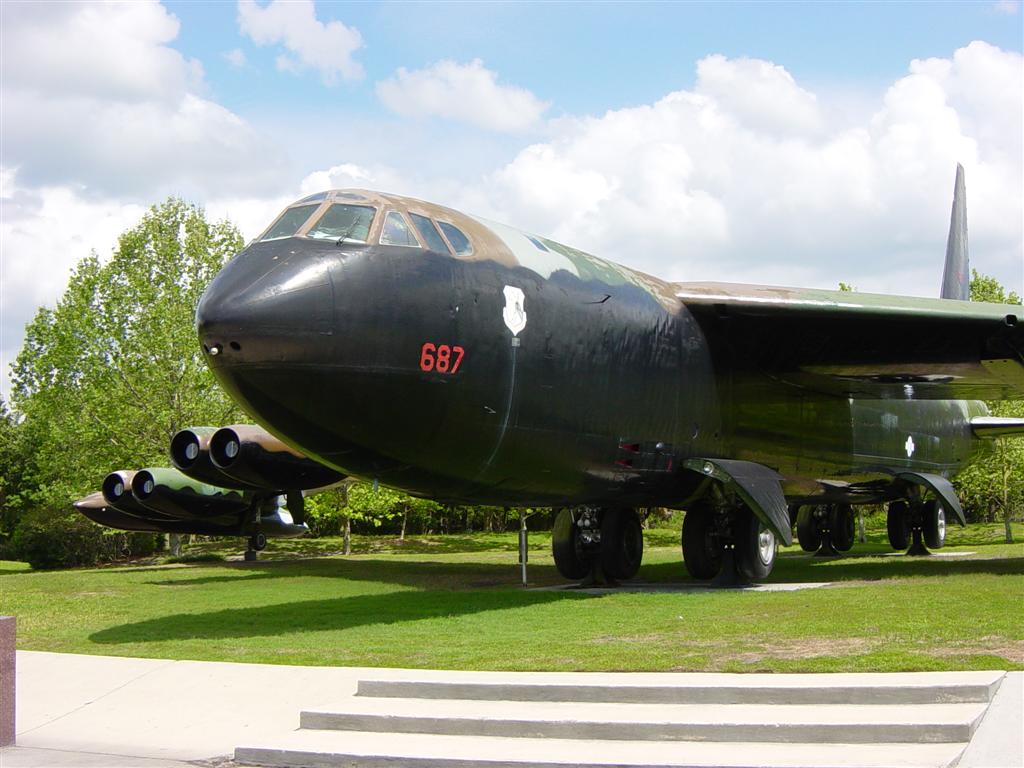
In 1984, a B-52D Stratofortress, AF Serial No. 56-0687, on loan from the National Museum of the United States Air Force, was flown to Orlando International Airport from the 7th Bomb Wing at the then-Carswell AFB, Texas for permanent static display at the airport's McCoy AFB / B-52 Memorial Park. It is located north-northwest of the current civilian commercial terminal and just east of and adjacent to the former location of the since dismantled Orlando-McCoy Jetport civilian terminal.

McCoy Annex operated until Naval Training Center Orlando's closure in late 1999 pursuant to a 1993 Base Realignment and Closure Commission (BRAC) decision. The former military family housing area originally constructed by the Air Force and later utilized by the Navy and other military service branches was fully turned over to the City of Orlando in late 1999 and was redeveloped into The Villages at Southport. Housing sales began in 1996 and the complex was awarded a US Department of Housing and Urban Development (HUD) award for outstanding development.

With the closure of NTC Orlando in late 1999, The only military activities remaining at the former McCoy AFB today are units of the Reserve components of the United States Armed Forces.

The 1LT David R. Wilson Armed Forces Reserve Center hosts the United States Army Reserve 143rd Sustainment Command (Expeditionary), 912th Human Resources Company, 196th Transportation Company, 146th Transportation Detachment, 520th Transportation Detachment/3rd Team, 174th Judge Advocate General Detachment/10th Team, 174th Judge Advocate General Detachment/11th Team, 174th Judge Advocate General Detachment, the United States Navy Reserve Navy Operational Support Center Orlando (NOSC Orlando) and the United States Marine Corps Reserve Motor Transportation Company, Combat Logistics Battalion 451.

The Taft United States Army Reserve Center is located at 9500 Armed Forces Reserve Drive and includes the 689th Engineer Company and 418th Military Police Detachment.

The McCoy United States Army Reserve Center is home for the 377th Military Intelligence Battalion, which utilizes McCoy AFB's former SAC bomber and tanker flight crew Alert Facility (e.g., "mole hole").

The Orlando Armory of the Florida Army National Guard is located within the grounds of the former McCoy AFB, having converted the former McCoy AFB Officers Club into the 164th Air Defense Artillery Brigade (FL ARNG) Headquarters.

The Navy Exchange (to include an NEX MaxiMart grocery facility in lieu of a Defense Commissary Agency commissary) continued operations at the former McCoy Air Force Base. The Navy Exchange facility has a Barber Shop, Optical Shop, Tailor Shop, Subway restaurant and a Morale, Welfare and Recreation (MWR) Information, Tours and Tickets office. This is due to the continued presence of Naval Air Warfare Center and Naval Support Activity Orlando, a large National Guard & Reserve Component presence, and the military retiree population in the Orlando/Central Florida area that makes the facility financially self-sustaining.

See also

[edit]

References

[edit]
[edit]
Revisions and contributorsEdit on WikipediaRead on Wikipedia
from Grokipedia

McCoy Air Force Base was a former installation located approximately 10 miles southeast of , that primarily functioned as a (SAC) heavy bomber base from its reactivation in 1951 until closure in 1975.
Originally established in 1940 as Orlando Army Air Field No. 2 and redesignated Pinecastle Army Air Field, the site supported flight training and bombardment operations with aircraft such as the B-25 Mitchell, B-26 Marauder, and B-17 Flying Fortress. After a period of postwar inactivity, it was reactivated in 1951 under SAC as Pinecastle Air Force Base and renamed McCoy in 1957 to honor Colonel Michael N. W. McCoy, the killed in a B-47 crash earlier that year.
The base hosted the 306th Bombardment Wing, equipped successively with B-47 Stratojets and later B-52 Stratofortresses alongside KC-135 Stratotankers for , contributing to nuclear deterrence during the and conducting combat missions over as part of . It also supported U-2 operations and served as a staging point for SAC bomber deployments. Selected for closure in 1973 amid post-Vietnam force reductions, the 306th Wing was inactivated, and the facility transferred to civilian use, with most acreage now comprising .

Establishment and World War II Era

Founding and Initial Development

The site of McCoy Air Force Base originated as an auxiliary airfield to Orlando Army Air Base, with land acquisition beginning in 1942 on approximately 2,216 acres southeast of . Developed amid expansion of U.S. Army Air Forces training infrastructure, it supported advanced flight operations and tactical exercises. Construction focused on essential facilities including runways capable of handling medium bombers, hangars, and support structures to facilitate rapid deployment for combat preparation. Initially designated Orlando Army Air Field #2, the installation was renamed Pinecastle Army Airfield in January 1943 to reflect its location near the historic Pine Castle estate. It functioned primarily under the Army Air Forces Tactical Center headquartered at Orlando, emphasizing applied tactics, bombing, and gunnery training. During this period, the airfield hosted squadrons equipped with medium bombers, enabling crew proficiency in , , and simulated combat missions critical to the . Initial development prioritized operational readiness over permanent , with temporary and administrative buildings erected to house personnel. By mid-1943, Pinecastle had become integral to Central Florida's network of airfields, contributing to the training of thousands of aircrews through realistic scenario-based exercises that mirrored Pacific and European theater demands. This foundational role laid the groundwork for the site's evolution into a major strategic asset , though its WWII contributions centered on enhancing tactical effectiveness without direct deployment.

Training Missions and Contributions to War Effort

Orlando Army Air Base, established in 1941 as a key facility for the U.S. Army Air Forces, primarily served as an advanced training center during , focusing on tactical air operations and combat simulation. In October 1942, the base hosted the activation of the Army Air Forces School of Applied Tactics (AAFSAT), which conducted rigorous exercises in coordinated air-ground maneuvers, fighter interception tactics, and strategic bombardment techniques, utilizing simulated combat scenarios across ranges. This training emphasized practical application of emerging doctrines, preparing aircrews for real-world engagements by integrating fighter, bomber, and reconnaissance elements in large-scale mock battles. By 1943, AAFSAT evolved into the Army Air Forces Tactical Center, expanding operations to include specialized instruction for heavy bomber crews, such as those operating B-17 and later B-29 aircraft, with Pinecastle Army Air Field serving as an auxiliary site for bombing practice and crew qualification. Training missions incorporated live-fire exercises over designated ranges, including test bombings that honed accuracy and essential for precision strikes against enemy targets. The center also developed and tested tactical innovations, such as improved methods, which were disseminated to units deploying to and the Pacific theaters. German prisoners of war were housed at the base to support logistical operations, indirectly aiding training continuity by providing labor for infrastructure maintenance. These efforts contributed significantly to the Allied war effort by producing tactically proficient air forces; doctrines refined at Orlando influenced operational successes, including the development of effective strategies that reduced bomber losses over and supported island-hopping campaigns in the Pacific. Units like elements of the 454th Bomb Group underwent practical field training at affiliated fields, ensuring rapid deployment readiness. By war's end in 1945, the base had transitioned to a separation center, processing thousands of returning personnel, while its training legacy underpinned the AAF's expansion to over 2.4 million personnel and sustained air superiority. The emphasis on empirical tactical testing, rather than theoretical instruction alone, yielded causal improvements in mission effectiveness, as evidenced by lower attrition rates in subsequent campaigns attributable to Orlando-trained leaders.

Postwar Transition and Early Cold War

Reversion to Inactive Status and Reactivation

Following the conclusion of and the rapid demobilization of U.S. military forces, Pinecastle Army Air Field, like many training installations, saw its active units disbanded and operations curtailed, leading to its reversion to inactive status by late as bomber training demands evaporated. The airfield was placed under caretaker maintenance with a skeleton crew to preserve facilities amid broader budget cuts and force reductions. The base remained largely dormant through the late 1940s, reflecting the transitional postwar period before escalating tensions prompted a reevaluation of strategic airpower needs. In response to the and the push for expanded pilot proficiency in jet-age bombers, the U.S. reactivated the installation on January 1, 1951, redesignating it Pinecastle Base and assigning it to . Initial reactivation efforts focused on infrastructure upgrades, including runway extensions and hangar rehabilitations, to accommodate advanced programs. By mid-1951, the base hosted squadrons conducting familiarization and gunnery exercises, laying the groundwork for its role in operations. This reactivation aligned with broader expansions, increasing active-duty end strength from approximately 400,000 in 1950 to over 900,000 by 1952.

Assignment to Air Training Command

In response to the demands of the and the expansion of Strategic Air Command's bomber fleet, reactivated the former Pinecastle Army Airfield as Pinecastle Air Force Base on September 1, 1951, assigning it for advanced combat crew training. The primary mission focused on preparing aircrews for the , the USAF's new medium-range strategic bomber designed for nuclear delivery missions. The 3540th Combat Crew Training Wing was established at the base in 1952 to oversee B-47 training operations, which included instruction in navigation, bombing, gunnery, and formation flying tailored to SAC operational requirements. Initial combat crew training for B-47s commenced with Class 53-6A on April 1, 1953, marking the start of formalized programs that graduated hundreds of crews essential for equipping SAC bombardment wings. ATC invested heavily in infrastructure, expanding runways to handle the B-47's operational needs and constructing facilities for simulator training and maintenance, enabling the base to support up to several squadrons of training aircraft by the mid-1950s. This assignment underscored ATC's role in rapidly scaling USAF capabilities during early buildup, with Pinecastle serving as one of several reactivated WWII-era fields repurposed for jet-age proficiency. The training emphasis remained until the base's transition to direct SAC control, facilitating the deployment of fully qualified B-47 units to operational alerts.

Peak Cold War Operations

Strategic Bombardment Wings and Nuclear Deterrence

McCoy Air Force Base served as a key installation for the (SAC), hosting bombardment wings equipped for long-range nuclear strikes as part of the U.S. nuclear deterrence posture during the . The 321st Bombardment Wing, operating bombers, was assigned to the base in the mid-1950s, providing medium-range strategic capabilities capable of delivering atomic and later thermonuclear weapons against Soviet targets. These aircraft, supported by KC-97 Stratofreighters for , maintained readiness under SAC's alert system, with crews trained for rapid response to potential wartime scenarios. In the early 1960s, McCoy transitioned to heavy bombardment operations as SAC phased out many B-47 units in favor of the . The 4047th Strategic Wing facilitated this shift, reassigning the 347th Bombardment Squadron to McCoy on September 1, 1961, to operate B-52s initially for training and transition purposes. By February 1963, the SAC strategic wing concept was discontinued, leading to the redesignation and full activation of dedicated bombardment wings at the base. The 306th Bombardment , previously a strategic wing, relocated to McCoy in 1963 and operated B-52D Stratofortresses alongside KC-135 Stratotanker refuelers until the base's closure in 1974. This wing's mission centered on strategic nuclear deterrence, with aircraft configured to carry up to 70,000 pounds of nuclear ordnance, including Mark 28 hydrogen bombs, as part of the (SIOP) for massive retaliation. B-52s from McCoy participated in airborne alert missions, such as , where bombers remained aloft with live nuclear weapons to ensure survivability against a preemptive strike, exemplifying SAC's emphasis on continuous deterrence through visible and responsive nuclear forces. These wings contributed to the broader SAC bomber fleet, which numbered over 1,000 heavy bombers by the mid-1960s, deterring aggression through assured second-strike capability amid escalating U.S.-Soviet tensions. McCoy's proximity to the Atlantic facilitated deployments to forward bases in and , enhancing global reach for deterrence operations. The base's strategic role underscored the causal link between maintained nuclear readiness and stability, as empirical assessments of Soviet capabilities informed the need for robust, on-call striking power rather than reliance on unproven diplomatic assurances alone.

Interceptor and Reconnaissance Units

In November 1957, the Air Defense Command assigned the 76th Fighter Interceptor Squadron to McCoy Air Force Base, where it operated the , one of the final USAF units to employ this all-weather interceptor equipped with AN/APG-33 radar and air-to-air rockets or early guided missiles for continental defense against potential Soviet bombers. The squadron maintained alert status, conducting training intercepts and contributing to the Southeast Air Defense Sector's coverage amid escalating tensions, before transferring out as the F-89 was phased out in favor of supersonic interceptors like the F-101 Voodoo. Reconnaissance operations at McCoy intensified during the October 1962 Cuban Missile Crisis, when a detachment from the 4080th Strategic Reconnaissance Wing—primarily based at Laughlin AFB, Texas—deployed Lockheed U-2 high-altitude aircraft to the base for overflights of Cuba, capturing the initial photographic evidence of Soviet medium-range ballistic missiles on October 14 by Major Richard Heyser and conducting subsequent missions until Major Rudolf Anderson's U-2 was downed by a Soviet SA-2 missile on October 27, marking the crisis's sole U.S. combat fatality. These missions, flown at altitudes exceeding 70,000 feet with specialized cameras, provided Strategic Air Command with critical intelligence on missile site construction, nuclear warhead storage, and Il-28 bomber deployments, directly influencing President Kennedy's quarantine and negotiation strategy. From February 1962 to December 1969, the 966th Airborne Air Control Squadron, subordinate to the 551st Wing, operated aircraft from McCoy, providing radar surveillance, command-and-control, and early warning for air defense and over the Atlantic and Gulf approaches, with four-engine propeller-driven platforms carrying AN/APS-95 radars capable of detecting targets at 200+ miles. These missions supported interceptor scrambles and tracked potential intruders, evolving from RC-121 photo-recon variants to EC-121 electronic intelligence gatherers amid threats from Cuban-based Soviet aircraft. Temporary deployments augmented these capabilities; for instance, during the crisis, elements of the 354th Tactical Fighter Wing arrived with 63 North American F-100 Super Sabres for potential air superiority and roles, though primarily tactical rather than dedicated interception. Overall, McCoy's interceptor and assets underscored its dual role in SAC's nuclear deterrence and continental air defense networks through the 1960s.

Joint Operations with Civilian Aviation

In 1961, city officials in Orlando negotiated an agreement with the U.S. to establish civilian aviation operations at McCoy Base, enabling the construction of the Orlando Jetport at McCoy, which opened on January 1, 1962. This joint-use arrangement permitted commercial airlines to access one of the base's two 12,000-foot runways, facilitating scheduled passenger flights while military operations, primarily involving B-52 Stratofortress bombers and KC-135 Stratotanker refuelers, continued unabated. The setup divided facilities geographically, with civilian terminals positioned on the eastern side and infrastructure, including hangars and control towers, on the western side, minimizing interference between military , , and strategic deterrence missions and growing commercial air traffic. The provided a large —previously used for B-47 Stratojet maintenance—for civilian servicing, marking an early model for shared civil-military airfields that influenced subsequent joint-use policies nationwide. By , the jetport handled over 1 million passengers annually, with airlines such as and National Airlines operating flights alongside 306th Bombardment Wing activities, though military priorities occasionally required runway prioritization during alerts or exercises. integrated both sectors under a unified tower, ensuring deconfliction; for instance, civilian departures were often scheduled to avoid peak military refueling or U-2 reconnaissance operations from the base. This coexistence persisted until the base's deactivation on March 31, 1975, amid post-Vietnam force reductions, after which the airfield transitioned fully to civilian control as , retaining the IATA code MCO derived from McCoy. The joint operations demonstrated effective resource sharing but highlighted logistical challenges, such as noise complaints from nearby communities and occasional delays from military scrambles, without reported major conflicts or safety incidents directly attributable to the dual-use model.

Critical Strategic Roles

Involvement in Cuban Missile Crisis

McCoy Air Force Base served as a key launch and recovery site for Lockheed U-2 reconnaissance missions critical to verifying Soviet missile deployments in Cuba during the October 1962 crisis. On October 14, Major Richard Heyser piloted a U-2 from Edwards Air Force Base, California, over western Cuba, capturing the first photographic evidence of medium-range ballistic missiles near San Cristóbal; he landed at McCoy AFB, where the exposed film was rushed for analysis in Washington, D.C. Subsequent U-2 operations from McCoy intensified as the crisis escalated, with flights probing Soviet activities despite rising risks from surface-to-air missiles. On October 27, Major Jr. departed McCoy in U-2A serial 56-6676 for a mission over eastern near Banes, targeting suspected SAM sites and low-level weather reconnaissance; his aircraft was struck by an missile at approximately 10:15 a.m., making him the only direct U.S. combat fatality of the crisis. Anderson's downing, attributed to unauthorized Cuban or Soviet action amid communication breakdowns, heightened tensions but did not derail diplomatic resolution, as President Kennedy opted against immediate retaliation to avoid broader escalation. As a installation under the 823d Air Division, McCoy also contributed to nuclear deterrence through its resident bombers, which were placed on heightened ground and airborne alert status alongside other SAC assets nationwide. The base's proximity to —about 200 miles—positioned it for rapid response, though local bombardment wings dispersed aircraft to reduce vulnerability, while McCoy hosted temporary deployments of tactical fighter units, including F-100 Super Sabres from the 4th Tactical Fighter Wing, enhancing conventional strike options. These measures aligned with SAC's 2 posture, dispersing over 150 bombers and fueling airborne operations to signal resolve without provoking preemptive strikes.

Airborne Early Warning and Control Missions

The 966th Airborne Early Warning and Control Squadron was activated on 18 December 1961 under Air Defense Command to conduct radar surveillance operations from McCoy Air Force Base, addressing vulnerabilities in coverage over the Gulf of Mexico and approaches to the southeastern United States amid escalating tensions with Cuba. The unit organized on 1 February 1962, employing Lockheed EC-121H Warning Star aircraft—converted civilian Super Constellations fitted with AN/APS-95 long-range search radars offering detection ranges exceeding 200 nautical miles and provisions for directing interceptors via onboard communications relays. Primary missions entailed sustained airborne orbits over the Florida Straits and , delivering continuous radar tracks of airborne and surface targets to integrated air defense networks, including fighter bases and naval forces, to enable rapid response to incursions. During the Cuban Missile Crisis commencing 16 October 1962, EC-121s from McCoy provided critical overwatch, monitoring Soviet air and naval activity and relaying intelligence that supported the quarantine enforcement and air defense alerts. From April 1965 to December 1969, the squadron detached aircrews and up to six aircraft rotations to , where they furnished radar surveillance, MiG warnings, and tactical control for U.S. fighters over , , and adjacent waters, logging thousands of combat sorties under direction. The squadron inactivated on 1 July 1969 as EC-121 operations phased toward newer platforms like the E-3 Sentry, though detachments persisted at McCoy until EC-121 relocations to Homestead AFB in 1973–1974 amid base realignments. These missions underscored McCoy's role in continental air defense, logging over 20,000 flight hours annually at peak with crews enduring 8–10 hour patrols under rigorous alert postures.

Incidents and Operational Challenges

1972 B-52 Stratofortress Crash

On March 31, 1972, at approximately 11:20 a.m., a B-52D-80-BO Stratofortress (serial number 56-0625) from the 306th Bombardment Wing at McCoy Air Force Base crashed during a local training flight originating and intending to return to the base in . The aircraft, call sign SIR 21, was engaged in a mock bombing exercise when a broke out in engine number 7, spreading to the starboard and causing multiple engine failures. The crew, consisting of seven members—Captain Wendell W. Campbell (pilot), Captain Barry E. Applebee (co-pilot), First Lieutenant Robert Heatherly (navigator), Lieutenant Colonel George P. Gamache (navigator/instructor), Major James J. Hammons (bombardier), Major William E. Kesler (electronic warfare officer), and Master Sergeant Allen H. Murray (aerial gunner)—attempted an on runway 18R but crashed about 3,220 feet (one-half mile) short of the threshold in a residential neighborhood near South Conway Road and Merryweather Drive. The impact created a 150-foot-wide , ignited approximately 40,000 gallons of , and destroyed the aircraft along with four houses, engulfing a two-block area in flames. All seven crew members perished in the crash. On the ground, eight civilians sustained serious injuries, including seven children; one of them, 10-year-old Anthony Ellington, succumbed to his injuries three days later, bringing the total death toll to eight. The incident marked the worst aviation disaster in history at the time. The official cause was attributed to the engine fire and subsequent structural failure, though the precise reason for the initial engine ignition remained undetermined in publicly available records, with the U.S. declining to release full investigation details citing potential hindrance to ongoing inquiries. In 2012, the Orange County Board of County Commissioners dedicated a plaque at the site, now B-52 Memorial Park, to honor the crew and commemorate the event.

Other Accidents and Safety Record

Prior to its renaming as McCoy Air Force Base in 1958, the installation operated as Pinecastle AFB under the 321st Bombardment Wing, which experienced several B-47 Stratojet accidents reflective of the aircraft's high operational risks during early jet bomber deployment. On October 9, 1957, a DB-47B (51-2177) disintegrated in mid-air during a high-speed demonstration flight from Pinecastle, killing Col. Michael N. W. McCoy, Maj. George W. Simler, Maj. William F. Goodwin, and T/Sgt. Richard L. Bakke; the incident prompted the base's renaming in McCoy's honor. On January 28, 1958, a B-47B (51-2220) of the 321st Bomb Wing was destroyed during a landing mishap at Pinecastle AFB, with the aircraft written off but crew survival details unreported in available records. Later that year, on July 25, 1958, the crew of B-47E (51-2206) abandoned the aircraft over McCoy AFB following an in-flight emergency, resulting in the plane's loss. McCoy AFB's safety record during the B-47 era aligned with broader Strategic Air Command challenges, where the Stratojet's unstable swept-wing design and demanding low-altitude handling contributed to a fleet-wide loss rate of approximately 10% across 2,032 produced aircraft, including 464 fatalities. No major fatal accidents beyond the 1957 mid-air breakup and 1972 B-52 crash were documented at the base during B-52 operations, though routine training with reconnaissance assets like U-2s and interceptors such as F-101 Voodoos carried inherent risks without publicized on-base losses. Overall, the installation maintained operational tempo amid Cold War deterrence demands, with accident rates typical of 1950s-1960s USAF bomber bases prior to improved safety protocols in later decades.

Closure and Realignment

Post-Vietnam Force Reductions

In the wake of the U.S. withdrawal from in 1973, the Department of Defense pursued extensive force reductions to address escalating costs from the war and align military infrastructure with a diminished post-conflict posture, including personnel cuts from nearly 905,000 members in 1968 to lower levels. McCoy Base was designated for closure that year as one of over 40 installations affected by this reduction in force, driven primarily by budget constraints. The reductions at McCoy directly targeted the 306th Bombardment Wing (Heavy), assigned to and responsible for maintaining B-52 Stratofortress s alongside KC-135 Stratotanker assets for strategic deterrence and global strike capabilities. Progressive unit inactivations began with support elements; notably, the 306th Air Refueling Squadron transferred its final KC-135 on 31 August 1973 and was inactivated the following month on 30 September. Bombardment squadrons followed suit, with aircraft and personnel realigned to other SAC bases, reflecting broader command efforts to consolidate operations amid fiscal pressures. By late 1974, the 306th Wing was fully inactivated, culminating the base's operational drawdown and enabling its transfer from military control. This process eliminated McCoy's role in SAC's alert forces and nuclear mission, contributing to the command's overall contraction while preserving capabilities at surviving installations like those under headquarters. The base's closure in 1974 marked a key step in reallocating resources away from Vietnam-era expansions toward a leaner deterrence framework.

Deactivation Process and Base Transfer

The deactivation of McCoy Air Force Base began in 1973 when it was selected for closure amid post-Vietnam War force reductions by the U.S. , targeting installations to streamline operations and reduce costs. This process involved the phased inactivation of tenant units, including the 306th Strategic Wing, which was officially inactivated on July 31, 1974, marking the departure of its B-52D Stratofortress and KC-135 Stratotanker squadrons to other bases. Air Force flying operations ceased by late 1974, with the base fully declared surplus in 1975 after environmental assessments and asset liquidation. Transfer of the facility followed federal surplus property protocols under the General Services Administration, with the City of Orlando receiving the deed to approximately 3,000 acres of airfield and support infrastructure in 1975 for a nominal fee of $1, enabling repurposing for civilian aviation. Florida state legislation enacted in 1975 authorized the city to convey operations to the newly formed Greater Orlando Aviation Authority (GOAA), which oversaw the conversion of runways and terminals into what became Orlando International Airport (MCO). Non-airfield portions, including hangars and administrative areas, were retained initially as the McCoy Annex under Naval Training Center Orlando until its own closure in 1999, after which they supported industrial development in the Orlando Tradeport area. By 1978, all former base lands had been deeded to civilian or reserve entities, completing the military divestiture.

Economic and Strategic Consequences

The closure of McCoy Air Force Base in 1975 resulted in the inactivation of the 306th Bombardment Wing, leading to the relocation of approximately 3,000 and associated jobs, though exact local figures at the base are not precisely documented in available records. This short-term economic disruption occurred amid broader post-Vietnam War defense cutbacks, which eliminated 124,000 defense-related jobs nationwide between 1971 and 1974 through multiple base closures. However, the rapid transfer of the facility to aviation authorities mitigated lasting negative effects; by 1976, the site had begun operations as (MCO), capitalizing on the region's burgeoning tourism sector following World's 1971 opening. Long-term economic outcomes proved beneficial, with MCO evolving into a major hub that generated over $41 billion in regional economic impact by 2020 (pre-COVID figures) and supported tens of thousands of jobs in , , and tourism-related industries. Empirical analyses of similar 1970s base closures indicate that communities with prompt, productive reuses—like Orlando's conversion—experienced minimal per-capita income declines and faster employment recovery compared to stagnant sites, as payrolls were often replaced by diversified civilian activities. The base's prior infrastructure, including runways capable of handling heavy bombers, directly enabled the 's expansion to accommodate growing commercial traffic, aligning with Florida's shift from defense-dependent growth to service-oriented economics. Strategically, McCoy's deactivation reflected Strategic Air Command's (SAC) efforts to streamline operations post-Vietnam, consolidating bomber assets at fewer, more cost-effective bases amid budget constraints and reduced alert force requirements. The loss of McCoy as a B-52 alert site diminished SAC's dispersed footprint in the southeastern U.S., but this was offset by redistributing the 306th Wing's squadrons to surviving installations like Barksdale AFB, , maintaining overall nuclear deterrence capabilities with a leaner of approximately 15-20 heavy bombardment wings by the mid-1970s. No evidence suggests the closure compromised SAC's readiness or response posture, as it formed part of a deliberate rationalization that prioritized efficiency over redundancy, enabling sustained global strike options without the maintenance burdens of underutilized facilities. By 1980, SAC had evaluated but declined to retain even a minimal operating location at the site, underscoring the irreversible shift away from McCoy in favor of centralized basing.

Legacy and Current Utilization

Conversion to Orlando International Airport

Following the inactivation of the 306th Bombardment Wing on March 31, 1974, McCoy Air Force Base underwent a phased closure as part of post-Vietnam military force reductions, with full deactivation completed by early 1975. The U.S. government declared the majority of the 3,700-acre site surplus property, and in 1975, the City of Orlando received the deed for the land specifically for redevelopment as a civilian facility. This transfer was facilitated by special state legislation enabling the Greater Orlando Aviation Authority (GOAA) to issue revenue bonds for construction, addressing the need for expanded capacity amid growing tourism in . Prior to full military divestiture, civilian airlines had already begun utilizing McCoy's infrastructure under a joint-use agreement, including access to its two 12,000-foot runways (18L/36R and 18R/36L) for commercial flights as early as the late 1960s, which alleviated congestion at the smaller Herndon Airport. These runways, along with ancillary facilities like hangars and the control tower, were directly incorporated into the new airport, minimizing initial capital outlay and enabling rapid operational transition. By 1976, GOAA had relocated all remaining commercial services from Herndon to the McCoy site, rebranding it progressively toward full civilian control. Construction of the modern commenced in the late 1970s, culminating in the opening of a new $300 million terminal complex in 1981, designed in a hub-and-spoke configuration with a central atrium to handle projected passenger growth. The airport retained the IATA code "MCO" derived from "McCoy," a designation that persists today, reflecting the site's heritage. Additional runways were later added—09L/27R in 1987 and 17C/35C in 2002—to expand capacity beyond the original base layout, supporting over 6 million annual passengers by 1981 and evolving into one of the world's busiest airports for . This conversion preserved strategic aviation assets while repurposing them for , though it required remediation of contaminants under subsequent federal oversight.

Persistent Military and Federal Uses

The McCoy United States Army Reserve Center, situated on a portion of the former McCoy Air Force Base site at 10730 in , maintains an active military presence through U.S. Army Reserve operations. Established post-closure to support reserve component training and administration, the facility hosts units including the 377th , which conducts and electronic warfare functions. Additionally, elements of the 321st Expeditionary utilize the center for fitness testing, administrative duties, and operational readiness activities. The center also supports the headquarters of the 143rd Expeditionary Sustainment Command (ESC), the largest such command in the Reserve, responsible for and sustainment across the . This unit exercises command over more than 110 subordinate units and approximately 10,000 soldiers, facilitating mobilization, deployment certification, and sustainment planning in coordination with First . These activities ensure the site's role in national defense continuity, with facilities adapted from surplus base infrastructure for reserve-specific needs like command posts compliant with standards, Florida building codes, and requirements. The adjacent McCoy Annex, encompassing retained federal parcels, includes designated areas for Army Reserve and operations, preserved amid the broader site's redevelopment into . These holdings, assumed stable in local planning documents, accommodate training support, equipment storage, and administrative functions without interfering with civilian aviation dominance. Federal civilian uses persist through oversight of and , integral to the joint-use model's operational demands, though military reserve activities represent the primary enduring defense footprint.

Environmental Remediation and Health Concerns

Following the closure of McCoy Air Force Base in 1975 and its conversion to civilian use, environmental investigations under the Formerly Used Defense Sites (FUDS) program identified contamination at several locations, primarily from historical military operations such as and fuel handling. Key sites included the Firefighter Training Area, where contained petroleum compounds and was impacted by industrial solvents and petroleum hydrocarbons, and the USDA/Air Cargo Buildings Site, where at depths of 25 to 40 feet exhibited industrial solvents. Additionally, early assessments in the early revealed saturation with cancer-causing solvents, including and heavy metals, beneath the fire-training area, now part of property. Remediation efforts, overseen by the U.S. Army Corps of Engineers (USACE) Jacksonville District, involved remedial investigations, feasibility studies, and targeted cleanups, such as removal at contaminated hotspots. Quantitative risk assessments concluded that contaminants posed no unacceptable risks to or the environment, given that the impacted is not used for drinking and the sites are inaccessible to the public. The site, encompassing former base lands, was evaluated under the Comprehensive Environmental Response, Compensation, and Liability Act (CERCLA) and classified by the Environmental Protection Agency (EPA) as No Further Planned (NFRAP), with no placement on the (NPL) as of the latest determinations, indicating sufficient prior actions to address identified issues. Health concerns centered on potential exposure to volatile organic compounds like , a known , through groundwater migration, though assessments emphasized minimal pathways due to non-potable aquifer use and institutional controls. No widespread human impacts have been documented from base-related , aligning with risk evaluations that found levels below thresholds requiring further intervention. Long-term monitoring continues under FUDS protocols to ensure stability, reflecting standard practices for legacy sites where empirical data prioritizes verifiable exposure risks over speculative harms.

References

Add your contribution
Related Hubs
User Avatar
No comments yet.