


Community hub
Recent from talks
Contribute something
Nothing was collected or created yet.
Linderhof Palace
View on Wikipedia
Linderhof Palace (German: Schloss Linderhof) is a schloss in Germany, 10 km west of the village of Ettal in southwest Bavaria. It is the smallest of the three palaces built by King Ludwig II of Bavaria and the only one which was actually completed and that he lived in most of the time from 1876 onward.
Key Information


Development
[edit]
Ludwig already knew the area around Linderhof from his youth when he had accompanied his father King Maximilian II of Bavaria on his hunting trips in the Bavarian Alps. When Ludwig II became King in 1864, he inherited a hunting lodge, the so-called Königshäuschen ("King's little house") from his father, and in 1869 began enlarging the building. In 1874, he decided to tear down the Königshäuschen and rebuild it in its present-day location in the park. At the same time three new rooms and the staircase were added to the remaining U-shaped complex, and the previous wooden exterior was clad with stone façades. The building was designed in the style of the second rococo-period. Between 1863 and 1886, a total of 8,460,937 marks was spent constructing Linderhof.[1]
In 2025, the palace was designated as a World Heritage Site by UNESCO.[2]
Symbolic background
[edit]Although Linderhof is much smaller than Versailles, it is evident that the palace of the French Sun-King Louis XIV (who was an idol for Ludwig) was its inspiration. The staircase, for example, is a reduction of the famous Ambassador's staircase in Versailles, which would be copied in full in Herrenchiemsee, another palace project by Ludwig that was designed less as a residential building than as a homage to the Sun-King.[citation needed]
Stylistically, however, the building and its decor take their cues from the mid-18th century Rococo of Louis XV, and the small palace in the Graswang valley was more directly based on that king's Petit Trianon on the Versailles grounds.[3] The symbol of the sun that can be found everywhere in the decoration of the rooms represents the French notion of absolutism that, for Ludwig, was the perfect incorporation of his ideal of a God-given monarchy with total royal power. Such a monarchy could no longer be realised in Europe in the second half of the nineteenth century. In the Kingdom of Bavaria, the monarch was constitutionally severely restricted, quite apart from Ludwig's incompetence and disinterest in really taking care of state affairs and political power struggles. Especially the bedroom was important to the ceremonial life of an absolute monarch; Louis XIV of France used to give his first (lever) and last audience (coucher) of the day in his bedchamber. In imitation of Versailles, the bedroom is the largest chamber of Linderhof Palace. By facing north, however, the Linderhof bedroom inverts the symbolism of its Versailles counterpart, showing Ludwig's self-image as a "Night-King", because he had gotten into the habit of turning night into day and vice versa.[citation needed] The reclusive monarch naturally never intended to live surrounded by thousands of people in a vast palace, rising and going to bed in the presence of dozens of dignitaries like the Sun King. Yet he revered the latter (and envied his unlimited power), which is why allusions to him can be found in numerous other details. For example, the ceiling of the dining room depicts scenes from life at the court of Versailles, and the horseshoe-shaped cabinets are decorated with portraits of French courtiers and noblemen (including Madame de Pompadour, the mistress of Louis XV).
The rooms
[edit] |
Linderhof, in comparison to other palaces, has a rather private atmosphere. In fact, there are only four rooms that have a real function.
Hall of Mirrors
[edit]This room was used by the king as a drawing room; he enjoyed sitting in the niche, sometimes reading there the whole night. Because Ludwig II used to sleep in the daytime and stay awake in the night, the mirrors created an effect for him when they reflected the light of the candles. The parallel placement of some mirrors evoke the illusion of a never ending avenue.
Appointments:
The middle table has a top with lapis-lazuli, amethyst and chalcedony inlay work and shows the Bavarian coat of arms in glass mosaic.
A carpet made of ostrich plumes.
An Indian ivory candelabra in the alcove with 16 branches.
Two mantelpieces clad with lapis-lazuli and decorated with gilded bronze ornaments.
Eastern and Western Tapestry Chambers
[edit]The two tapestry chambers are almost identical and have no specific function. The western one is sometimes called "Music Room" because of the aeolodion (an instrument combining piano and harmonium) in it. Only the curtains and the coverings on the furniture are real products of the Parisian Gobelin Manufactory. The scenes on the walls are painted on rough canvas in order to imitate real tapestries.
Audience Chamber
[edit]The audience chamber is located to the west of the palace and is flanked by the yellow and lilac cabinets. The cabinets were only used as antechambers to the larger rooms. Ludwig II never used this room to hold an audience. This would have been against the private character of Linderhof and the chamber would have been much too small for it. He rather used it as a study where he thought about new building projects. That there is an audience chamber in Linderhof, however, reminds us of the demand of the king in an absolute monarchy.
Appointments:
Two round tables with malachite tops, gift of Grand Duchess Maria Alexandrovna of Russia to King Ludwig II.
Throne baldachin with ostrich feather bunches (as an oriental symbol of royal power).
Dining Room
[edit]This room is located to the east and is flanked by the pink and blue cabinets. The pink cabinet, unlike the other cabinets, had a real function. The king used it as a robing room. The dining room is famous for its disappearing dumb-waiter called "Tischlein deck dich". The table disappeared on a lifting platform into the kitchen on the lower floor, where it was set with the next course and brought up again. This mechanism was installed so that Ludwig could dine alone here without being disturbed by servants. Yet the staff had to lay the table for at least four persons because it is said that the king used to talk to imaginary people like Louis XV, Mme de Pompadour or Marie Antoinette while he was eating. For Ludwig II enjoyed the imagined company of those people and admired them. You can find portraits of them in the cabinets, and scenes of their lives everywhere in the palace's rooms. Here, too, a strong contrast emerges between idol and imitator: While Ludwig even shunned the presence of servants, the Sun King used to dine with his wife and brother at a table, while dozens of select court dignitaries had the honor of watching, lined up along the walls.
Appointments:
Meissen porcelain centrepiece with china flowers.
Bedchamber
[edit]The model for this room was not Louis XIV's bedchamber in Versailles but the bedroom of the Rich Rooms in Munich Residence. As in Versailles or the Munich Residence, one finds a separation of the bed part from the rest of the room, which would allow the first or last audience of the day (the so-called Lever and Coucher) to be held at the bed, as the Sun King did. Only, during his daily ceremony of rising, Louis XIV was surrounded by at least 50 high-ranking spectators, while this number would hardly have fit into the small bedroom in Linderhof.
The position of the bed itself on steps in the alcove that is closed off by a gilded balustrade, like the baroque Munich model, gives it the appearance of an altar and thereby glorifies Ludwig II as he slept during the day. He often also spent the night waking and reading in this room, which was illuminated by numerous candles, among other a glass candelabra with 108 candles. The king was very well read about the legends and mythologies of the Middle Ages as well as about court life and the arts in the era of Louis XIV.
The two console tables are of Meissen porcelain (which was the king's favorite china). This room was completely rebuilt in 1884 and could not be totally finished until the king's death two years later.
Gallery
[edit]-
 Palace from the Baroque parterre garden
 -
Video of the fountain
-
 East view with the Eastern parterre garden
 -
 Porcelain chandelier
 -
 Chapel of St. Anne in the park
 -
 Passage in the park
 -
 Information board in the surrounding park
 -
 Ludwig's Peacock throne in the Moorish Kiosk
 -
 The king's bedchamber
 -
 Dining room
 -
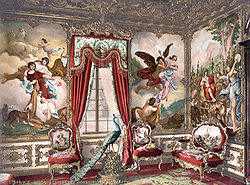 Eastern tapestry room with painted imitation tapestries


.jpg)


The park
[edit]The gardens surrounding Linderhof Palace are considered one of the most beautiful creations of historicist garden design, designed by Court Garden Director Carl von Effner. The park combines elements of Renaissance and Baroque formal gardens with landscaped sections that are similar to the English landscape garden.[citation needed]
Linderhof's Linden or The Old "Königslinde"
[edit]Deriving from the romantic image of animated nature Ludwig was fascinated by trees. For this reason a tall, 300-year-old linden tree was allowed to remain in the formal gardens although disturbing its symmetry. Historic pictures show a seat in it, where Ludwig used to take his "breakfast" at sunset hidden from view amongst the branches. Contrary to common understanding the tree did not give the palace its name. It came from a family called "Linder" that used to cultivate the farm (in German "Hof" = farm) that over centuries had been in the place where now Linderhof palace is.[4]
Formal gardens
[edit]The palace is surrounded by formal gardens that are subdivided into five sections that are decorated with allegoric sculptures of the continents, the seasons and the elements:

The northern part is characterized by a cascade of thirty marble steps. The bottom end of the cascade is formed by the Neptune fountain and at the top there is a Music Pavilion.
The centre of the western parterre is formed by basin with the gilt figure of "Fama". In the west there is a pavilion with the bust of Louis XIV. In front of it you see a fountain with the gilt sculpture "Amor with dolphins". The garden is decorated with four majolica vases.
The crowning of the eastern parterre is a wooden pavilion containing the bust of Louis XVI. Twenty-four steps below it there is a fountain basin with a gilt sculpture "Amor shooting an arrow". A sculpture of "Venus and Adonis" is placed between the basin and the palace.
The water parterre in front of the palace is dominated by a large basin with the gilt fountain group "Flora and puttos". The fountain's water jet itself is nearly 25 meters high.
The terrace gardens form the southern part of the park and correspond to the cascade in the north. On the landing of the first flight there is the "Naiad fountain" consisting of three basins and the sculptures of water nymphs. In the middle arch of the niche you see the bust of Marie Antoinette of France. These gardens are crowned by a round temple with a statue of Venus formed after a painting by Antoine Watteau (The Embarkation for Cythera).
Landscape garden and structures in the park
[edit]The landscape garden covers an area of about 50 hectares (125 acres) and is perfectly integrated in the surrounding natural alpine landscape. There are several buildings of different appearance located in the park.
- Venus Grotto

The building is hidden under an artificial hill with a rock entrance. It is wholly artificial and was built for the king as an illustration of the First Act of Wagner's Tannhäuser. At the beginning of the first act, Tannhäuser is in the cave of Venusberg. In keeping with the theme, the painting by August von Heckel in the background of the main grotto depicts “Tannhäuser with Frau Venus”.[citation needed]
The grotto was built under the direction of the opera set designer August Dirigl between 1875 and 1877. It is an iron construction whose partition walls were covered with impregnated canvas, which in turn was sprayed with a cement mixture from which the artificially created stalactites are made. The grotto is divided into two side grottos and a main grotto.[citation needed] In artificial caves in the "rock walls" there are two seats from which the king could follow musical performances: the gold plated "shell throne" and a "crystal throne" on the "Loreley Rock", from which one gazes into a mirror in which the dream world continues indefinitely. Depending on the lighting, the king could thus immerse himself in the respective scenes of the opera. The crystal prisms surrounding the seat had been illuminated from below with electric light bulbs since their manufacture in 1877, so that their prism-like glow reflected rainbow colors on the walls. The holders for the series-connected batteries have been preserved to this day. This is all the more remarkable because the patent for light bulbs was not granted until years later, in 1880.[5][6]

_c_Susanne_Wosnitzka.png)
Seven stoves were needed to heat the damp and cool rooms several days in advance, even in summer. A waterfall and a shell-shaped barge were custom-made for use in the grotto. A rainbow projection device and a wave machine completed the illusion as the king was rowed around on the artificial lake while musicians played motifs from Tannhäuser. At the same time he wanted his own blue grotto of Capri. Therefore, 24 dynamo generators powered by a steam engine, had been installed by Johann Sigmund Schuckert in 1878 and so already in the time of Ludwig II it was possible to illuminate the grotto with arc lamps in changing colours. This is said to have not only been the first Bavarian electricity plant but the first permanently installed power plant in the world.[7] The king's desire for a “bluer blu” spurred the then young paint industry and, four years after Ludwig's death, the Baden Aniline and Soda Factory (BASF) received a patent from the Imperial Patent Office for the production of artificial indigo dye.[citation needed] The power plant, the light bulbs with batteries, the projection devices and the artificial blue represented technical innovations of unprecedented novelty, no opera house at that time could boast anything comparable. Indeed, the requirements and orders that the king set for the furnishing of his grotto led to remarkable technological advances. He wasn't interested in the technologies used; he wanted to achieve specific, precise effects – and it was up to engineers to invent them for him.
These installations are somewhat reminiscent of Ludwig's bedroom at Hohenschwangau Castle, into which he had a group of artificial rocks built in 1864, over which a waterfall flowed, as well as an apparatus for producing an artificial rainbow and a night sky with the moon and stars, illuminated by a complicated system of mirrors from the upper floor. The creation of perfect illusions through the use of cutting-edge technologies actually makes the “fairytale king” appear more in tune with modernity and more open to the achievements of the Industrial Revolution than his backward-looking image would suggest.
The grotto was entirely renovated from 2024 until 2025, as the moisture-sensitive construction on a mountain slope was significantly damaged by rain and meltwater.[8]. The entire restoration process involved around 500,000 working hours and 58.9 million euros.[9]
- Hunding's Hut

From the outside, a simple wooden house with walls made of uniform, peeled tree trunks, the interior was inspired by Richard Wagner's directions for the First Act of the Die Walküre and a corresponding stage design by Josef Hoffman from 1876. In the middle of the hall there is the ash tree from which Siegmund pulled the sword Gram with magical power.[citation needed]
In 1884 the hut burned down, but was immediately rebuilt. In 1945 it fell victim to the flames again due to arson, although some of the furniture and furnishings were preserved. In the summer of 1990, Hunding's Hut was rebuilt at a new location closer to the palace. A reconstruction at the original location could not be carried out for reasons of nature conservation.[citation needed]
Ludwig used to celebrate Germanic feasts in Hunding's Hut. In his 1972 Ludwig film epic, the director Luchino Visconti shot naked or half-clothed farm boys hanging lazily on the branches in the hut (in a film studio in Rome). The censors cut these and other scenes from the first version.[10]
- Gurnemanz' Hermitage
The small wooden building is inspired by Wagner's opera Parsifal, where in the Third Act Gurnemanz, a knight of the Holy Grail, is living alone as a hermit in the forest. After many years of wandering, Parsifal suddenly appears here on Good Friday carrying the lost Holy Lance. Kundry recognizes him as the pure fool, now enlightened by compassion and freed from guilt through purifying suffering, and believes him to be the forever new king of the knights of the Grail, as which he is then proclaimed by the dying king Amfortas and the knights.[citation needed]
Aside from his magnificent palaces, the king owned a number of modest Alpine huts. He visited these regularly in a fixed annual cycle in spring and autumn. The most famous is the King's House on Schachen, where he spent his birthday every August. Good Fridays he used to spend in the Ammergau Alps forest contemplating. For this purpose, he had Gurnemanz' Hermitage, an imaginary hermit's hut built in a forest clearing there in 1877. In order to reflect the uplifting mood of the third act, the king really wanted to have a flower meadow around the hut on Good Friday. If there was no such meadow because there was still snow lying, the garden director had to plant one for the king. He reported about the hermitage to Wagner in a letter and wrote: "There on the consecrated site I can already hear the silver trumpets from the Grail's Castle..." The original hermitage with its bell tower fell into disrepair in the 1960s. In 1999/2000, private donations made it possible to reconstruct the Gurnemanz hermitage for Linderhof. The replica was placed only about 150 meters west of the new Hunding's Hut.[citation needed]
-
 Gurnemanz' Hermitage in the Ammer Forest (watercolor by Heinrich Breling, 1882)
 -
 The reconstructed structure at Linderhof
.jpg)

These three structures, the "Venus Grotto", "Hunding's Hut" and "Gurnemanz Hermitage" remind us another time of the operas of Richard Wagner. But besides that and the baroque architecture Ludwig was also interested in the oriental world.
- Moorish Kiosk
This building was designed by the Berliner architect Karl von Diebitsch for the International Exhibition in Paris 1867. Ludwig II wanted to buy it but was forestalled by the railroad king Bethel Henry Strousberg. Ludwig bought the pavilion after the bankruptcy of Strousberg. He had the furnishings made. The most notable piece of furniture is the peacock throne, a modern interpretation of the lost Peacock Throne of the emperors of the Mughal Empire in India.
-
 The Moorish kiosk
 -
 Interior of the Moorish kiosk
 -
 The Moroccan House
 -
 Interior of the Moroccan House
.jpg)


- Moroccan House
This wooden house was actually built in Morocco for the International Exhibition in Vienna 1873. The king bought it in 1878 and redecorated it in a more royal Moorish revival style. Unlike the King's House on Schachen, which had been built around 1870 and whose Turkish Hall features an oriental-inspired, opulent mix of styles, the kiosk is more authentically influenced by Moorish architecture. It was set up in the furthest area of the park, very close to the Austrian border. After the king's death, the Moroccan House was sold to a private purchaser in Oberammergau, where it slowly fell into disrepair in a garden. In 1980 the house was bought back, carefully restored and rebuilt at a new location in the park closer to the palace. It has stood there since 1998.
See also
[edit]References
[edit]- ^ Kobell, Louise von (25 January 2018). König Ludwig II. von Bayern und die Kunst (in German). ISBN 978-3-96169-052-7.
- ^ "Bavarian fairy tale castles and French Carnac Megaliths among new UNESCO World Heritage sites". Euronews. 12 July 2025.
- ^ "Le château de Linderhof – Connexion-Française". www.connexion-francaise.com. 14 July 2007.
- ^ McIntosh, Christopher (15 September 2012). The Swan King: Ludwig II of Bavaria. I.B.Tauris. p. 193. ISBN 978-1-84885-847-3.
- ^ Die Venusgrotte – Eine Touristische Attraktion, vr-dynamix.com
- ^ Die Restaurierung des Kristallthrons auf dem Loreleyfelsen in der Grotte zu Linderhof (blog: The restoration of the crystal throne on the Loreley rock in the grotto at Linderhof), July 2025, schloesserblog.bayern.de by the Bavarian Administration of State-Owned Palaces, Gardens and Lakes
- ^ Siemens AG: Siemens recalls pioneers of the first age of electricity at Linderhof Palace (PDF)
- ^ "Bayerische Schlösserverwaltung | Schlossanlage Linderhof | Aktuelles | Parkführung". www.schlosslinderhof.de.
- ^ Press release from the Bavarian state government, 30 April 2025
- ^ Alexander García Düttmann, Visconti: Einsichten in Fleisch und Blut, Kadmos, 2006, p. 75. See also: Censorship and alternate versions of Visconti's Ludwig film.
Further reading
[edit]- Krückmann, Peter Oluf; Bayerische Verwaltung der Staatlichen Schlösser, Gärten und Seen (2000). Linderhof (in German). Munich: Prestel. ISBN 3-7913-2369-5. OCLC 45539571.
- Hojer, Gerhard; Schmid, Elmar D.; Stephan, Manfred (1999). Schloss Linderhof : amtlicher Führer (in German). München: Bayerische Verwaltung der Staatlichen Schlösser. ISBN 978-3-932982-23-1. OCLC 76132813.
- Rauch, Alexander (1997). Linderhof : König Ludwig II. und seine Schlösser (in German). München: Edition Charivari. ISBN 3-429-01857-9. OCLC 610990812.
- Schick, Afra (2003). Möbel für den Märchenkönig : Ludwig II. und die Münchner Hofschreinerei Anton Pössenbacher = Furniture for the dream king : Ludwig II and the Munich court cabinet-maker Anton Pössenbacher (in German). Stuttgart: Arnoldsche. ISBN 3-89790-186-2. OCLC 54044176.
External links
[edit]
- Official website (in German, English, French, and Italian)
- Linderhof Palace, Ludwig's favorite castle
- Linderhof Palace
- Photo Tour of Linderhof castle, more castle details.
- Linderhof tour review
- Photo Gallery of Linderhof
| International | |
|---|---|
| National | |
| People | |
| Other | |

Linderhof Palace
View on GrokipediaLinderhof Palace (German: Schloss Linderhof) is a rococo-style villa in southwestern Bavaria, Germany, commissioned by King Ludwig II (1845–1886) as his only completed major residence.[1][2] Originating from a modest hunting lodge expanded starting in 1869 under architect Georg von Dollmann, the palace was substantially rebuilt and finished by 1878, featuring opulent interiors evoking absolutist grandeur inspired by Louis XIV's Versailles.[3][1] Ludwig II, who ascended the throne in 1864, favored the site for its seclusion in the Ammergau Alps near Ettal, using it as a private retreat amid his ambitious but often unfinished building projects.[4][1] The palace's compact design contrasts with Ludwig's grander visions elsewhere, yet it exemplifies 19th-century neoclassicism through its gilded halls, such as the Hall of Mirrors and Oriental-inspired bedchamber, funded by state resources totaling millions of marks despite economic strains on Bavaria.[5][1] Surrounding the structure is a 50-hectare park with terraced gardens, cascading fountains powered by hydraulic engineering, and eccentric follies including the Venus Grotto—an artificial cave with artificial lighting for Wagnerian operas—and the Moorish Kiosk, reflecting Ludwig's eclectic romanticism and escapism from political realities.[6][7] Today managed by the Bavarian Palace Administration, Linderhof stands as a testament to Ludwig's architectural patronage, drawing visitors for its preserved extravagance and historical insight into monarchical fantasy amid 19th-century Europe's shifting powers.[5][8]
Historical Development
Origins as a Hunting Lodge
The site of Linderhof Palace originated as a modest forester's house in the Graswang Valley, which served as a hunting lodge for King Maximilian II of Bavaria during expeditions in the Bavarian Alps.[1] This structure, known as the Royal Lodge and dating to 1790, was initially situated precisely where the palace's main building now stands and provided basic accommodations amid the forested terrain favored for royal hunts.[9] Maximilian II, who reigned from 1848 to 1864, utilized it as a retreat for such activities, reflecting the Wittelsbach dynasty's tradition of leveraging alpine locations for sport and seclusion.[9] Crown Prince Ludwig, the future King Ludwig II, frequently visited the lodge during his youth for hunting trips, developing an attachment to the isolated setting that influenced his later architectural ambitions.[1] Upon inheriting the property after Maximilian's death in 1864, Ludwig retained its function as a personal lodge until expansions began, but in 1874, the original 1790 structure was relocated nearby to accommodate palace construction, preserving it as a remnant of the site's hunting origins.[9] This humble precursor contrasted sharply with the opulent palace that would emerge, underscoring the site's evolution from utilitarian outpost to royal fantasy.[1]Construction and Expansion Phases
The origins of Linderhof Palace trace back to a forester's house on the site, which King Ludwig II of Bavaria had rebuilt in 1869 as the initial "Royal Lodge," marking the first building phase.[1] This modest structure served as Ludwig's retreat in the Graswangtal valley, reflecting his preference for seclusion amid the Ammergau Alps.[1] In 1870, under the supervision of court building director Georg von Dollmann, the second phase commenced with the addition of a single-axis wing to the lodge, expanding its footprint while maintaining a provisional wooden framework.[1] By spring 1871, a third phase introduced a second wing connected by a bedroom, forming a U-shaped complex equipped with a wooden staircase, further adapting the building for royal occupancy during ongoing works.[1] The fourth phase, approved in February 1873, involved cladding the wooden elements in stone and installing cross-shaped roofs, transitioning the structure toward permanence.[1] On 20 January 1874, the original Royal Lodge was relocated approximately 200 meters away to accommodate the fifth phase, which constructed the south tract, vestibule, and staircase, thereby completing the palace's exterior by 1876.[1] A final expansion in 1885–1886 enlarged the king's bedroom northward, necessitating a new central section and roof; this phase concluded after Ludwig II's death in June 1886.[1] Overall, these iterative phases transformed the site from a simple lodge into a compact rococo-inspired palace by around 1880, with Dollmann overseeing the architectural coherence throughout.[3]Completion and Ludwig II's Use
The main structure of Linderhof Palace reached substantial completion by 1876, with the exterior finalized in 1874 following the cladding of the wooden framework in stone and the addition of new roofs in 1873.[1] Interior furnishings and decorations were largely finished by that year, allowing the palace to function as a habitable royal residence, though minor expansions continued thereafter.[1] In 1885, King Ludwig II initiated the enlargement of his bedroom, which remained incomplete at the time of his death on June 13, 1886; this made Linderhof the only one of his major palace projects to be essentially ready for occupancy during his lifetime.[1] Prior to the palace's main completion, Ludwig II frequently resided in the adjacent Royal Lodge (Königshäuschen), a structure originally built in 1790 as a forester's house and expanded starting in 1869, which served as his initial base for overseeing construction.[9] After 1876, he used the palace as his primary private retreat, spending extended periods there—often several months annually—away from Munich's political demands, treating it as a personal sanctuary for contemplation and indulgence in his artistic visions.[1] Unlike his grander, unfinished projects at Neuschwanstein or Herrenchiemsee, Linderhof functioned as an intimate, operational residence where Ludwig hosted no large court events but instead pursued solitary routines, including nocturnal wanderings in the park and tableaus vivants inspired by mythology and opera.[1] He visited regularly until 1886, logging over 170 documented stays, underscoring its role as his favored escape amid growing isolation from governance.[10]Architectural Design
Exterior Features
The exterior of Linderhof Palace consists of a compact Baroque-style facade clad in stone, measuring 30 by 27 meters upon completion in 1886.[1] [3] Construction began in 1869 with wooden post-and-beam elements forming a U-shaped complex, which was expanded under architect Georg von Dollmann in 1870–1871.[1] In February 1873, King Ludwig II approved cladding the wooden structure with solid stone and installing a cross-shaped roof complex, executed by 1874 to provide durability against the alpine environment.[1] The facades draw on historical Baroque motifs, with the main southern facade featuring a central projecting risalit for emphasis, though executed freely without strict adherence to a single period prototype.[3] The south tract was added in 1874 after relocating the original royal lodge 200 meters southward, finalizing the exterior silhouette by 1876, followed by a northern bedroom extension in 1885–1886.[1] Plastered lower floors and boarded upper sections from earlier phases were unified under the stone veneer, concealing the initial "Alpine hut" appearance.[1] This modest scale contrasts with grander Versailles inspirations, prioritizing seclusion over monumental presence.[3]Influences from Versailles and French Baroque
King Ludwig II of Bavaria conceived Linderhof Palace as a scaled-down recreation of the Palace of Versailles, embodying the absolutist splendor of Louis XIV. In 1868, Ludwig directed his court architect Georg Dollmann to develop plans for a "new Versailles" in the Linderhof valley, intending to evoke the French monarch's era of grandeur amid the Bavarian Alps.[11] This vision manifested in the palace's grand Baroque facade, characterized by symmetrical design, arcaded wings, and a central pavilion that mirrors the formal opulence of French 17th-century architecture.[3] The surrounding park reinforces these influences through meticulously laid-out French Baroque gardens, designed by landscape architect Carl von Effner, who trained in Paris. Construction of the Eastern and Western parterres began in 1872, featuring strict geometric patterns, clipped hedges, and the Water Parterre with a fountain reaching 25 meters in height, directly emulating Versailles' axial layouts and hydraulic displays.[6] Additional elements include three ascending terrace gardens crowned by a round temple and a preserved 300-year-old lime tree, alongside a cascade of 30 marble steps leading to the Neptune Fountain, all completed by 1880 to simulate the cascading water features and mythological motifs of Versailles.[6] While the palace's interior leans toward Neo-Rococo, the exterior and park prioritize Baroque principles of symmetry, proportion, and theatrical water engineering, underscoring Ludwig's deliberate homage to French absolutism over local Bavarian traditions.[3] These features were realized with 180 workers, including accelerated tree cultivation to achieve mature landscaping within a decade, prioritizing visual immediacy akin to Versailles' engineered perfection.[6]Symbolic and Ideological Elements
Ludwig's Vision of Absolutism
Ludwig II of Bavaria, ascending the throne in 1864 amid the constitutional framework of his kingdom, harbored a profound aspiration for the divine-right absolutism of Louis XIV, whom he admired as the embodiment of unchecked monarchical power.[4] Constrained by Bavaria's parliamentary system—exacerbated after the 1871 unification of Germany under Prussian dominance—he viewed his role as king as insufficiently sovereign, preferring a "holy kingdom by the Grace of God" where royal will superseded elected assemblies.[4] This tension drove Ludwig to architectural escapism, transforming Linderhof from a modest hunting lodge begun in 1869 into a private domain for realizing absolutist fantasies unbound by political realities.[1] Linderhof Palace served as Ludwig's miniaturized Versailles, directly inspired by Louis XIV's residence as the pinnacle of baroque absolutism, with initial 1868 plans explicitly modeling a grand palace in that vein before scaling to a villa completed by 1878.[1] The structure's neo-Rococo interiors and controlled layout emphasized personal dominion, allowing Ludwig— who resided there frequently, especially nocturnally—to orchestrate solitary rituals evoking the Sun King's levée and courtly splendor without ministerial interference.[12] Elements such as the Hall of Mirrors, where candlelight and reflections conjured illusions of vast, eternal space, mirrored Versailles' Galerie des Glaces to project the infinite reach of royal authority.[12] Further underscoring this vision, the royal bedchamber featured gilded rails partitioning the space in imitation of Louis XIV's ceremonial rising, symbolizing the sacred separation of the monarch from subjects.[12] The audience chamber, though unused for genuine receptions, housed a throne beneath an ostrich-feathered baldachin, a motif of exotic yet absolute regality drawn from absolutist iconography, reinforcing Ludwig's self-conception as an omnipotent ruler in microcosm.[12] Integrated technologies, including rising dining tables and artificial lighting, enhanced this theatrical isolation, enabling Ludwig to sustain the illusion of godlike command amid the Graswang Valley's seclusion until his deposition in 1886.[4]Moon and Night King Symbolism
Ludwig II of Bavaria styled himself as the "Moon King," positioning his rule in nocturnal contrast to Louis XIV's "Sun King" persona, with Linderhof Palace embodying this inversion through architectural and lifestyle choices.[13][14] The king's bedchamber at Linderhof faces north, deliberately opposing the south-facing orientation of Versailles' royal bedroom, which symbolized solar dominion; this northward alignment evoked lunar and shadowy sovereignty, aligning with Ludwig's preference for night over day.[13][15][16] This "Night King" imagery extended to Ludwig's daily routines, where he inverted temporal norms by sleeping during daylight and conducting affairs under moonlight or artificial illumination, often alone in the candlelit Hall of Mirrors.[17][18] Such habits reinforced his escapist absolutism, free from diurnal parliamentary constraints, with the palace's seclusion in the Graswang Valley facilitating uninterrupted immersion in this symbolic realm.[13][4] Moon motifs permeate Linderhof's design indirectly through Ludwig's Wagnerian influences and romantic nocturnalism, though explicit lunar iconography is subdued compared to solar elements in his other residences; the palace's fountains and illuminated gardens, activated at night, amplified this ethereal kingship.[18][19] Critics of Ludwig's era viewed these as eccentric indulgences, yet they stemmed from his first-hand conviction in divine, otherworldly monarchy unbound by modern constitutionalism.[4]Interior Rooms and Furnishings
Hall of Mirrors
The Hall of Mirrors, known in German as the Spiegelsaal, serves as a principal reception space within Linderhof Palace, designed in the opulent Rococo style prevalent in 18th-century Bavaria.[20] Constructed between 1876 and 1877 under the direction of architect Georg Dollmann, the room draws inspiration from earlier Bavarian Rococo interiors, such as those by François de Cuvilliés in the Munich Residenz, rather than directly replicating the Baroque grandeur of Versailles.[21] Its walls are nearly entirely clad in large, continuous sheets of mirror glass, creating an illusion of infinite extension and amplifying both light and perceived space through endless reflections.[20] Key furnishings include centrally heated fireplaces topped with chimney pieces of lapis lazuli, alongside fine Carrara marble sculptures positioned throughout the space.[20] Lighting is provided by numerous wall-mounted candelabras holding countless candles, a grand Viennese crystal chandelier suspended from the ceiling, and an additional exquisite chandelier crafted from ivory, which together produce a dazzling, multifaceted glow particularly suited to nighttime illumination.[20] The floor features ornate elements, including an ostrich down carpet placed before a central alcove, while surrounding furniture incorporates rosewood veneer accented with bronze figural motifs.[20] King Ludwig II, a nocturnal figure who favored the palace's seclusion, utilized the hall primarily as a private drawing room after dark, often retreating to the alcove niche for extended reading sessions that could last through the night.[20] This reflected his broader preference for moonlit solitude over daytime activity, with the mirrors' reflective properties enhancing the room's ethereal quality under candlelight, though he rarely employed it during daylight hours.[20] The space underscores Ludwig's vision of refined absolutist retreat, prioritizing personal reverie over public ceremonial use.[21]Tapestry Chambers and Private Apartments
The Tapestry Chambers, comprising the Eastern and Western Gobelin rooms, form part of the sequential layout in King Ludwig II's apartments at Linderhof Palace, functioning primarily as antechambers without assigned purposes. These rooms feature walls covered in imitation Gobelin tapestries, executed as paintings on coarse canvas rather than woven textiles, depicting idyllic pastoral scenes of love and harmony inspired by works of François Boucher and Antoine Watteau. The Western chamber, oriented toward the evening sun, includes a ceiling fresco portraying Apollo receiving Venus, symbolizing the union of art and beauty as an allegory of dusk, alongside a life-sized porcelain peacock from the Sèvres manufactory and an Aeolodicon—a rare harmonium styled as an upright piano—that occasionally designates it as the "Music Room."[22] The Eastern counterpart, facing sunrise, mirrors this design with a ceiling depiction of Apollo and Aurora evoking dawn, maintaining near-identical aesthetics to emphasize thematic continuity in Ludwig's vision of romantic idealism.[23] The Private Apartments, centered on the king's expansive bedroom, represent the most intimate and symbolically laden spaces Ludwig II inhabited during his frequent retreats to the palace from the mid-1870s onward. This bedroom, disproportionately grand within the compact structure completed in 1878, centers a massive canopied bed in royal blue, elevated like a catafalque and emblazoned with Ludwig's embroidered coat of arms, flanked by angels bearing the Bavarian crown to invoke absolutist grandeur. Six opulently gold-embroidered fabric panels adorn the alcove, featuring cherubs and motifs that constitute the palace's costliest interior element, while towering candelabras impart a ceremonial, almost ecclesiastical aura. Doorway paintings evoke Versailles rituals, including Louis XIV's morning levée, the Dauphin's wedding in the Hall of Mirrors, evening coucher, and garden carousels, underscoring Ludwig's emulation of French monarchy as a dynastic ideal rather than mere escapism.[24] These quarters, rarely accessed by others, facilitated Ludwig's nocturnal lifestyle and reflections on sovereignty, aligning with his documented preference for Linderhof as a completed haven amid unfinished grander projects.[1]Dining and Audience Areas
The dining room at Linderhof Palace is an intimate oval space renowned for its mechanical "wishing table," a device inspired by an 18th-century French invention and the Grimms' fairy tale of the same name.[25] The table, along with its settings, could be lowered via a crank mechanism to the kitchen below, allowing servants to prepare and send up meals without entering the room, thus preserving the king's solitude.[25] Wall carvings depict scenes of gardening, hunting, fishing, and farming, symbolizing the sources of royal provisions.[25] King Ludwig II dined alone here, often setting the table for three or four places and engaging in imagined conversations with historical figures such as Louis XIV, Louis XV, Madame de Pompadour, and Madame de Maintenon, as recounted in the memoirs of his cook, Theodor Hierneis.[25] Contrary to initial intentions for more social use, the room facilitated Ludwig's undisturbed reverie rather than entertaining guests.[25] Adjoining the sequence of rooms in the palace's west wing, the Audience Room serves as the opulent culmination, featuring furnishings that blend throne-like elements with practical office use.[26] A central table equipped with a gold-plated bronze desk set beneath a canopy functioned dually as a symbolic throne and a reading desk for the king.[26] Mantelpieces hold equestrian statues of Louis XIV and Louis XV on Italian marble, while a pair of small round tables with malachite tops were gifts from Russian Empress Marie Alexandrovna.[26] The room abounds with emblems of Ludwig II and allusions to the French absolutist court, underscoring his idealized vision of monarchy over constitutional duties.[26] Though designed for receiving audiences, its modest scale precluded formal legations, and Ludwig primarily utilized it as a study for signing documents, with only rare audiences occurring.[26][3]Park and Landscape Features
Formal Gardens and Terraces
The formal gardens of Linderhof Palace, laid out primarily between 1870 and 1872 under the direction of court garden director Carl von Effner, exhibit French Baroque characteristics with geometric parterres, clipped hornbeam hedges, and symmetrical water features.[27] These gardens immediately encircle the palace, integrating ornate fountains and allegorical sculptures to evoke the grandeur of Versailles.[28] The water parterre, positioned north of the palace, features a central basin dominated by the gilt fountain group depicting Flora and putti, surrounded by a geometric layout of hedges and paths.[29] To the east and west lie the Eastern and Western parterres, completed as the initial garden elements in 1872; the Western Parterre displays colorful flowerbeds flanked by two gilt fountain figures, while the Eastern Parterre spans three levels with ornamental beds symbolizing the four elements through sculptures.[28][30] South of the palace, the terrace gardens ascend the Linderbichl slope in three tiers, adopting an Italianate style distinct from the French formal areas.[31] Guarded by cast zinc lions at the access steps, the middle terrace centers on the Neptune Fountain, featuring a figure inspired by Benvenuto Cellini's Perseus with the Head of Medusa, complemented by the Naiad Fountain, bell-shaped basin fountains in flower beds, and zinc vases along the stairs.[31] The uppermost terrace culminates in a round temple modeled after the Temple of Vesta in Tivoli, with a grotto-like niche housing a bust of Marie Antoinette.[31] These terraces, integrated into the broader 50-hectare park blending Baroque precision with English landscape irregularity, reflect Ludwig II's vision for staged scenic effects amid the Ammergau Alps.[27]Grottoes and Artificial Structures
The Venus Grotto, the principal artificial grotto in the Linderhof Palace park, was constructed between 1875 and 1877 under the direction of King Ludwig II of Bavaria as a centerpiece of his fantastical landscape design.[7] This 90-meter-long structure, reaching heights of up to 14 meters, simulates a natural stalactite cave with shell-encrusted walls and ceilings crafted from cement and stucco to mimic dripstone formations.[7] At its core lies an artificial lake heated by steam pipes embedded in the walls, enabling year-round use despite the alpine climate, alongside a functional waterfall and cascade system.[32] Engineering innovations defined the grotto's interior, including Bavaria's first electrically illuminated space, powered by a generator in the nearby power house, which allowed for colored lighting effects, rainbows projected via prisms, and an artificial moon simulating celestial scenes.[33] Ludwig II, inspired by Richard Wagner's opera Tannhäuser and its depiction of the Venusberg, envisioned the space as a mythical realm for seclusion and staged performances; he reportedly floated in a swan-prowed boat on the lake while listening to opera excerpts piped through acoustic channels.[34] Two elevated seats embedded in the artificial rock walls provided vantage points for the king and guests, underscoring the grotto's role in his private theatrical illusions.[7] Additional artificial elements in the park's rocky terrain include smaller contrived caves and niches integrated into the constructed "natural" slopes surrounding the palace terraces, designed to enhance the romantic landscape aesthetic with hidden seating and viewing platforms.[35] These features, excavated and sculpted from scree during the park's development in the 1870s, complemented the Venus Grotto's grandeur without independent lighting or water systems. The entire ensemble underwent extensive restoration from 2015 to 2025, addressing structural decay from moisture and aging infrastructure while preserving original mechanisms where feasible.[35]Follies and Exotic Pavilions
The exotic pavilions in Linderhof Park include the Moorish Kiosk and the Moroccan House, both acquired from international exhibitions and relocated to reflect King Ludwig II's fascination with Oriental architecture. The Moorish Kiosk, originally constructed for the 1867 Paris World Exhibition, was rebuilt in the park during the 1870s as a decorative pavilion featuring intricate Islamic-style interiors, including a peacock throne symbolizing opulent fantasy.[36][37] The Moroccan House, sourced from a Paris World Exhibition, was positioned in a forest clearing overlooking the palace, offering a mud-brick aesthetic with North African motifs to evoke an immersive Eastern retreat.[38] Follies inspired by Richard Wagner's operas add romantic and theatrical elements to the landscape. Hunding's Hut, erected in 1876 near the Kreuzspitze peak, replicates the rustic dwelling from the first act of Die Walküre, constructed with timber and thatch to immerse visitors in the opera's primal setting.[39] Adjacent to it, the Hermitage of Gurnemanz, modeled after the third act of Parsifal, served as a contemplative wooden chapel-like structure, originally built in the late 1870s and reconstructed in 1999–2000 using historical plans and donations to restore its Wagnerian symbolism.[40] These structures, integrated into the park's terrain, underscore Ludwig's vision of merging myth, music, and architecture in a private idyll.[41]Controversies and Financial Aspects
Extravagance and Political Backlash
The construction of Linderhof Palace between 1870 and 1886 incurred costs of approximately 8 million marks, reflecting King Ludwig II's vision of a secluded Versailles-inspired retreat amid the Bavarian Alps. This expenditure supported extravagant features such as mechanized table settings in the dining room, a porcelain chandelier in the Hall of Mirrors, and the opulent Moorish Kiosk with its peacock throne, all executed with gold leaf, crystal, and imported materials.[42] While Ludwig financed these primarily through his annual civil list allowance of about 1 million marks, inherited assets, and extensive personal loans—rather than direct state treasury draws—the cumulative burden of such projects strained royal finances.[43] By 1885, Ludwig's building initiatives, including Linderhof's expansions like the enlarged bedroom in 1885–1886, had amassed debts exceeding 6.5 million marks for the royal cabinet, prompting creditor lawsuits and halts in construction. Bavarian ministers, led by figures like Johann von Lutz, viewed these endeavors as fiscally reckless, especially as Bavaria navigated economic challenges following its 1871 incorporation into the German Empire. Public caricatures and press reports increasingly portrayed Ludwig's palaces as emblematic of detachment from governance, fueling demands for accountability.[43][44] The escalating crisis from autumn 1885 peaked in spring 1886 amid scandals like the Nanette Wagner affair, which amplified perceptions of Ludwig's instability and extravagance. On June 9, 1886, psychiatrist Bernhard von Gudden certified Ludwig as mentally unfit, enabling Prince Luitpold's regency and Ludwig's deposition; Ludwig died under mysterious circumstances on June 13. This political maneuver, driven by ministerial fears of bankruptcy and monarchical overreach, preserved the cabinet system but curtailed further royal projects, with Linderhof standing as a completed testament to the tensions between absolutist patronage and constitutional restraint.[43]Debates on Ludwig's Sanity and Vision
The deposition of King Ludwig II of Bavaria on June 8, 1886, rested on a psychiatric commission's diagnosis of "paranoia (madness)," rendered by Bernhard von Gudden and three colleagues—Friedrich Wilhelm Hagen, Hubert von Grashey, and Max Hubrich—without a direct examination of the king.[45] The evaluation drew from sworn servant testimonies describing behaviors such as Ludwig's solitary dinners for phantom guests, reported as early as 1873 by Cosima Wagner, and his nocturnal sleigh rides at Linderhof Palace, where he impersonated Louis XIV in Bourbon-inspired fantasies.[45] These accounts framed Ludwig's architectural pursuits, including Linderhof's construction from 1870 to 1886 at a cost of roughly 8 million marks, as symptomatic of delusional extravagance and financial irresponsibility.[46] The palace, a compact Versailles analogue with gilded interiors and terraced gardens, exemplified his fixation on absolutist retreats amid Bavaria's constitutional monarchy and debts exceeding state revenues.[45] Contemporary and modern critiques contend the diagnosis was flawed in method and substance, relying on potentially biased, second-hand reports rather than empirical observation, and serving political ends to avert bankruptcy and consolidate power under Prince Regent Luitpold amid Ludwig's resistance to Prussian-dominated unification.[45] An autopsy on June 13, 1886, disclosed frontal lobe atrophy and scars, pointing to possible frontotemporal dementia or schizotypal traits rather than acute paranoia, with no evidence of hallucinations corroborated by independent witnesses.[45] Defenders of Ludwig's rationality highlight the precision of his visions: Linderhof's execution involved coordinated engineering, from hydraulic tables to illuminated grottos, reflecting a deliberate aesthetic escape into Wagnerian and medieval romanticism, not incoherent mania.[47] His coherent correspondence and project oversight, despite reclusiveness and sociophobia, suggest stress-induced eccentricity amplified by ministerial intrigue over scandals and withdrawal from daily rule, rather than incapacity.[45][48] The enduring debate pits organic pathology or political fabrication against visionary absolutism: while some psychiatrists retroactively infer progressive neurodegeneration explaining isolation and fiscal denial, others view Ludwig's palace-building as a rational, if quixotic, assertion of monarchical autonomy against encroaching modernity, with Linderhof's intimate scale underscoring personal fantasy over megalomaniacal delusion.[45]Preservation and Legacy
Post-Ludwig Restorations
Following King Ludwig II's death on June 13, 1886, Linderhof Palace underwent no major structural expansions, as construction had reached substantial completion, but subsequent preservation efforts focused on maintaining its opulent Rococo interiors and resolving issues with incomplete or financially strained park elements.[1] Immediate post-mortem financial constraints led to the auction of furnishings from structures like the Chinese Summer Palace and the dismantling of others, with the Bavarian state later repurchasing the Chinese House shell around 1980, restoring it, and reconstructing it at a new park location by 1998. [49]
In the 20th century, the Bavarian Palace Administration initiated targeted conservations, such as the two-year restoration of the Peacock Throne in the Moorish Kiosk, completed in July 2016 to repair damages and preserve its gilded details.[50] A landmark project was the Venus Grotto's overhaul from 2015 to 2025, which conserved surviving historical materials, repaired technical systems like lighting and water features, and exceeded initial cost estimates at 60 million euros versus the planned 25 million, culminating in its reopening on April 30, 2025.[35] [51] [52]
Since the 1990s, systematic restorations across the palace complex have addressed wear from tourism and environmental factors, ensuring the site's integrity as Ludwig's only fully realized major residence.[3] These efforts contributed to Linderhof's inclusion in July 2025 as part of the UNESCO World Heritage Site "The Palaces of King Ludwig II of Bavaria," recognizing its architectural and cultural significance alongside Neuschwanstein, Herrenchiemsee, and Schachen.[53] [54]