


Community hub
Recent from talks
Contribute something
Nothing was collected or created yet.
London Conference of 1912–1913
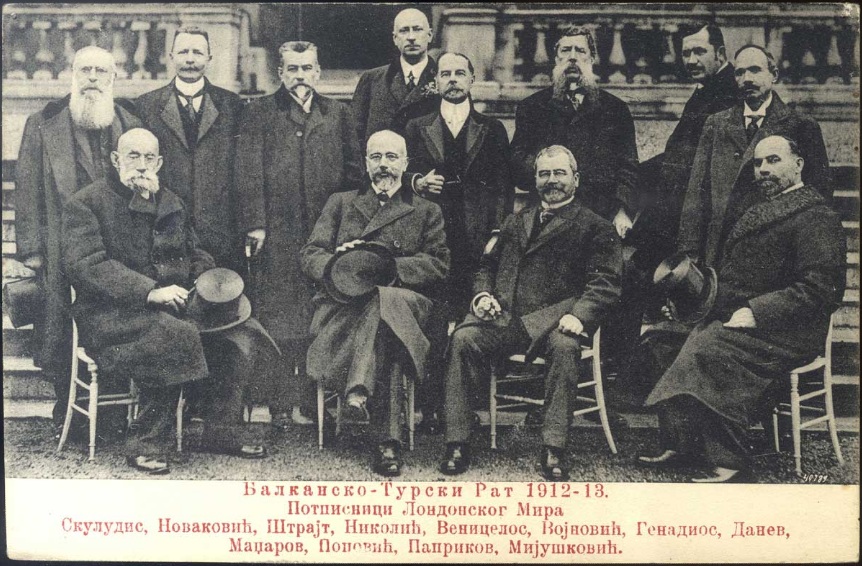
View on Wikipedia Representatives of the Balkan states | |
| Date | September 1912 – August 1913 |
|---|---|
| Location | London, United Kingdom |
| Also known as | London Peace Conference |
| Type | Conference |
| Motive | To arbitrate between the warring powers as to territorial acquisitions, and also to determine the future of Albania |
| Participants | |
| Outcome | Establishment of the Principality of Albania |


The London Conference of 1912–1913, also known as the London Peace Conference or the Conference of the Ambassadors, was an international summit of the six Great Powers of that time (Austria-Hungary, France, Great Britain, Germany, Italy, and Russia) convened in December 1912 due to the successes of the Balkan League armies against the Ottoman Empire in the First Balkan War. In particular, the conference intended to arbitrate between the warring powers as to territorial acquisitions, and also to determine the future of Albania, whose independence was proclaimed during the conflict.
History
[edit]An armistice to end the First Balkan War had been signed on 3 December 1912. The London Peace Conference was attended by delegates from the Balkan allies (including Greece) who had not signed the previous armistice, as well as the Ottoman Empire.
The Conference started in September 1912 at the St James's Palace under the chairmanship of Sir Edward Grey.[1] Further sessions of the conference began on 16 December 1912, but ended on 23 January 1913, when the 1913 Ottoman coup d'état (also known as the Raid on the Sublime Porte) took place.[2] Coup leader Enver Pasha withdrew the Ottoman Empire from the Conference.
On 30 May 1913, without the Ottoman Empire being present, the conference signed the Treaty of London (1913), an agreement under which Ottoman Empire would give up all territory west of the Enos-Midia line. After much discussion, the Ambassadors reached a formal decision on 29 July 1913, to establish the Principality of Albania as a sovereign state independent of the Ottoman Empire.[3]
As a result of the decisions taken and because of pressures from Greece and Serbia, half of the territory claimed by the newly established Albanian state, and between 30%[4] and 40% of the total Albanian population, was left out of the newly established Principality of Albania; in particular the Albanian-inhabited region of Kosovo Vilayet was given to Serbia and much of southern Chameria to Greece.[5] Concerning the Greco-Albanian frontier, the only time the Great Powers intervened, was when Austria-Hungary and Italy forbid a Greek occupation of Vlorë, after the Greek navy had shelled the town on 3 December; as a result no Great Power opposed the cession of Ioannina to Greece (as long as they could take it).[6]
A special boundary commission was sent to delineate the Greek-Albanian border. However, being unable to delineate the area on an ethnographic basis, it fell back upon economic, strategic and geographical arguments, which resulted in the decision of the London Conference to cede most of the disputed area to Albania. This turn of event catalyzed an uprising among the local Greek population, who declared the Autonomous Republic of Northern Epirus.[7]
The situation of the Aromanians was also discussed. The Aromanians are a small ethnic group scattered throughout the Balkans. In the London Conference, it was proposed that all the lands inhabited by Aromanians, such as the Pindus and its area around, be granted to the new Albanian state to protect them from Greek and Serbian (as Serbia had annexed Vardar Macedonia) assimilatory policies. Such proposals were supported by the Kingdom of Romania. On the simultaneous Albanian Congress of Trieste, the Aromanians also demanded regional autonomy within Albania, but this was rejected as the Aromanians within the new fixed borders of Albania, excluding expansion proposals, did not live in compact areas. In the end, the Aromanians were neither annexed to Albania nor were they given autonomy.[8]
-
 Rival territorial claims and proposals during the Conference
 -
 Map with the final territorial modifications; published in the Report of the International Commission on the Balkan Wars, 1914


See also
[edit]References
[edit]
- ^ Michael Graham Fry; Erik Goldstein; Richard Langhorne (1 March 200). Guide to International Relations and Diplomacy. Continuum International Publishing Group. p. 144. ISBN 978-0-8264-7301-1. Retrieved 29 May 2012.
{{cite book}}: ISBN / Date incompatibility (help) - ^ "The Treaty of London, 1913". Archived from the original on 1997-05-01. Retrieved 2008-01-14.
- ^ Elsie, Robert. "The Conference of London". Archived from the original on 17 July 2011. Retrieved 5 January 2012.
- ^ Elsie, Robert (2010), "Independent Albania (1912—1944)", Historical dictionary of Albania, Lanham: Scarecrow Press, p. lix, ISBN 978-0-8108-7380-3, OCLC 454375231, retrieved 4 February 2012,
... about 30 percent of the Albanian population were excluded from the new state
- ^ Bugajski, Janusz (2002). Political Parties of Eastern Europe: A Guide to Politics in the Post-Communist Era. M. E. Sharpe. p. 675. ISBN 978-1-56324-676-0. Retrieved 29 May 2012.
But because of strong pressures from Albania's neighbors, the Great Powers gave the Albanian-inhabited region of Kosova to Serbia and much of the southern Çamëria region to Greece. Roughly half of the predominantly Albanian territories and 40% of the population were left outside the new country's borders.
- ^ Hall, Richard C. (2002). The Balkan Wars 1912-1913: Prelude to the First World War. Routledge. pp. 72–74. ISBN 9781134583638.
The Austrian-Hungarians, however, were not overly concerned about the southern frontiers of Albania. Since they had no conflict with Greece, they were not so vigilant about the future Greco-Albanian frontier. The only time the Austrians and Italians bestirred themselves about the southern frontier of Albania was to forbid a Greek occupation of Vlorë after the Greek navy had shelled the town on 3 December. The Greeks had no Great Power opponent and no Great Power patron to press their interests in southern Albania. The Greek navy imposed a blockade on the Albanian coast, isolating the Albanian Provisional Government in Vlore. As a result, no Great Power made any serious effort in London to deny Janina to the Greeks so long as they could take it.
- ^ Draper, Stark. "The conceptualization of an Albanian nation" (PDF). Ethnic and Racial Studies. Volume 20, Number 1. pp. 4–5. Archived from the original (PDF) on 20 March 2012. Retrieved 2 February 2012.
- ^ Meta, Beqir (2009). "Pakica etno-kulturore vllehe në vitet 1912-1920". Studime Historike (in Albanian) (1–2): 57–76.
London Conference of 1912–1913
View on GrokipediaBackground
The First Balkan War and Its Territorial Gains
The First Balkan War commenced on October 8, 1912, when Montenegro declared war on the Ottoman Empire, followed by Bulgaria, Serbia, and Greece on October 17 and 18, as members of the Balkan League sought to exploit Ottoman military weaknesses and fulfill irredentist claims to territories in Macedonia, Thrace, Albania, and Epirus.[1] The League's coordinated offensives rapidly overwhelmed Ottoman defenses, with Serbian forces capturing Skopje by October 26 and advancing into Kosovo, while Bulgarian troops pushed toward the Çatalca fortifications near Constantinople by late October, effectively securing most Ottoman European possessions outside the Anatolian heartland.[3] Greek armies seized Thessaloniki on October 26 after the Battle of Sarantaporo and advanced in Epirus, and Montenegrin troops initiated the Siege of Scutari on October 28, marking early control over northern Albanian regions.[4] These conquests yielded substantial territorial gains for the Balkan states by early 1913: Serbia annexed approximately 20,000 square kilometers including northern Macedonia and Kosovo, Bulgaria controlled Eastern Thrace up to the Enos-Midia line, Greece incorporated southern Macedonia, the Janina region, and several Aegean islands, and Montenegro held parts of northern Albania despite local Albanian resistance, such as in the Battle of Lumë where irregular Albanian forces repelled Serbian incursions between October 30 and December 6, 1912.[5] The Ottoman Empire lost roughly 80% of its European territories, reducing its presence west of the Midia-Enos line, though holdouts persisted at key fortresses like Adrianople, Scutari, and Janina.[5] The Ottoman request for an armistice on November 3, 1912, was not immediately accepted, as Balkan commanders continued operations to capture excluded strongholds, leading to the formal armistice signing on December 3, 1912, by Bulgaria, Serbia, Greece, and Montenegro.[6] Disputes over armistice terms highlighted emerging fractures within the League, with conflicting claims to Macedonia—primarily between Serbia and Bulgaria—and Albanian territories exacerbating allied divisions, while the scale of Balkan advances alarmed the Great Powers, prompting intervention to prevent further destabilization, potential Russian dominance in the region, and threats to the European balance of power.[1]Escalation of Crises Prompting Great Power Intervention
The rapid Ottoman defeats in the First Balkan War, culminating in the loss of most European territories by late November 1912, created a power vacuum that alarmed European diplomats, as Balkan League forces approached Constantinople and threatened the Straits.[1] The Ottoman government, facing military collapse, appealed to the great powers on November 12, 1912, for intervention to secure an armistice, fearing total expulsion from Europe without external mediation.[7] This request aligned with growing concerns in Vienna and St. Petersburg over rival Slavic and South Slav expansions, where Austrian mobilization against Serbian gains risked direct Russo-Austrian confrontation, potentially igniting a wider war.[1] Russia, having backed the Balkan League's formation to counter Austrian influence in the Balkans, proposed a great powers conference in London on December 3, 1912, to enforce an armistice and negotiate territorial settlements, thereby locking in Slavic victories while averting escalation with Austria-Hungary.[8] Britain, under Foreign Secretary Edward Grey, endorsed and hosted the conference starting December 17, prioritizing balance-of-power stability over unilateral Balkan dominance, as unchecked advances could dismantle the Ottoman buffer state restraining Russian access to Mediterranean waters.[8] The armistice, signed that same day primarily with Bulgaria (and extended to others), halted major fighting along a line roughly at the Çatalca fortifications west of Constantinople, underscoring how military realities demanded diplomatic overlay to prevent faits accomplis from destabilizing the region further.[1][6] Compounding Ottoman vulnerabilities were internal fractures, including the 1912 Albanian revolts against Young Turk centralization policies, which had eroded imperial authority in the western Balkans prior to the war's outbreak and fueled local autonomy demands amid the chaos.[9] Albanian chieftains declared independence on November 28, 1912, as Serbian and Montenegrin troops occupied Kosovo and northern Albania, creating overlapping claims that great powers deemed unresolvable without intervention to carve a neutral Albanian entity and block Serbian Adriatic access.[8] These dynamics highlighted causal pressures from Balkan disunity—evident in emerging League fissures over spoils—and European imperatives to preserve Ottoman territorial integrity as a firewall against Russian pan-Slavic ambitions, motivating collective great power action to impose order.[1]Participants
Ambassadors of the Great Powers
The Conference of Ambassadors convened on 17 December 1912 at St. James's Palace in London under the chairmanship of British Foreign Secretary Sir Edward Grey, who prioritized Balkan stability to secure imperial communications through the Mediterranean and avert wider European conflict.[10][11] Grey's approach emphasized mediation within the Concert of Europe framework, excluding direct participation by Balkan League states or the Ottoman Empire to preserve great power authority over territorial adjustments.[12] The six representatives, all resident ambassadors to the Court of St. James except for Grey himself, included:| Country | Representative |
|---|---|
| United Kingdom | Sir Edward Grey (Foreign Secretary) |
| France | Paul Cambon |
| Russia | Count Alexander von Benckendorff |
| Germany | Prince Karl Max von Lichnowsky |
| Austria-Hungary | Count Alfred von Mensdorff |
| Italy | Marchese Guglielmo Imperiali |
Interests of the Belligerent Parties
The Ottoman Empire prioritized retaining strategic enclaves such as Adrianople (Edirne) and Scutari (Shkodër) to safeguard ethnic Muslim communities and maintain defensive lines protecting Constantinople, with Adrianople serving as a fortified gateway featuring a predominantly Turkish and Pomak population exceeding 100,000 amid mixed demographics.[17] Scutari's garrison, under commanders like Hasan Riza Pasha until his assassination on March 30, 1913, resisted to preserve Ottoman influence over Albanian Muslim majorities and control of key trade routes.[18] In contrast, the Balkan League demanded comprehensive partition of Ottoman Rumelia per their March 1912 secret treaty, envisioning Bulgaria annexing Thrace to the Enos-Midia line for direct access to the Aegean and Black Sea, while securing eastern Macedonia's ethnic Bulgarian zones.[1] Serbia pressed for Kosovo, Metohija, and northern Albanian territories including ports like Durrës to resolve its landlocked status and fulfill national unification goals, viewing Adriatic access as essential for economic viability despite limited ethnic Serbian presence there.[19] Montenegro's siege of Scutari, initiated October 28, 1912, with up to 30,000 troops under Janko Vukotić, exemplified aggressive pursuit of coastal expansion, pressuring Ottoman forces numbering around 15,000.[20] Greece asserted claims over Epirus, southern Macedonia, and Aegean islands like Lesbos, Chios, and Imbros, leveraging naval dominance to occupy them by late 1912 and citing substantial Greek Orthodox populations—e.g., over 90% on major islands—as basis for incorporation, adding a maritime dimension to continental irredentism.[21] These demands encountered empirical challenges from ethnic heterogeneity, as Albanian revolts erupted against Serbo-Montenegrin advances in Kosovo and northern Albania starting early 1913, with irregular forces under leaders like Azem Galica clashing over perceived violations of local autonomy and demographic realities where Albanians comprised majorities in contested vilayets, undermining simplistic partition narratives.[22][14]Proceedings
Opening Phase and Armistice Efforts (December 1912)
The London Conference convened its first meeting on 16 December 1912 at St. James's Palace, with British Foreign Secretary Sir Edward Grey assuming chairmanship to coordinate the ambassadors of the six Great Powers—Germany, Austria-Hungary, France, Great Britain, Italy, and Russia—in mediating the First Balkan War.[2] The opening sessions prioritized procedural logistics and immediate efforts to enforce and extend the existing armistice, aiming to suspend hostilities across all theaters to enable substantive peace talks, amid concerns over escalating great power rivalries triggered by Balkan territorial advances.[2] An armistice had been concluded on 3 December 1912 between the Ottoman Empire and the primary Balkan League members—Bulgaria, Serbia, and Montenegro—providing for Ottoman withdrawal toward the Chatalja lines and Gallipoli Peninsula, but Greece initially refused to adhere, continuing operations in Epirus and the Aegean islands until pressured by the powers to comply around mid-December.[6] Ottoman forces, however, demonstrated non-compliance by maintaining vigorous defense of Adrianople (Edirne), where the Bulgarian siege persisted unabated despite the truce, as the garrison under Shukri Pasha rejected evacuation orders to preserve a symbolic Thrace foothold amid domestic political pressures in Istanbul.[23] This reluctance stemmed from Ottoman strategic calculations that holding Adrianople could leverage better terms, even as Balkan armies' momentum from rapid victories—capturing most European territories—rendered unconditional surrender inevitable without great power intervention.[1] Ambassadors exchanged telegrams with Istanbul urging full Ottoman adherence and proposing humanitarian pauses for provisioning besieged garrisons, while the Balkan delegates insisted on total evacuation west of the Midia-Midye line as a prerequisite for any durable halt, reflecting their de facto control over Thrace and Macedonia.[2] These efforts underscored the causal primacy of battlefield realities over diplomatic ideals, as the powers' guarantees of neutrality and mediation failed to override Ottoman defiance at Adrianople or fully align Balkan compliance without threats of collective coercion, resulting in only partial suspensions of fighting by month's end.[1] The procedural delays highlighted institutional frictions, including Ottoman internal debates and Balkan maximalism, setting a contentious tone for subsequent negotiations.[2]Core Negotiations on Borders and Albania (January–April 1913)
In January 1913, the Conference of Ambassadors proposed that the Ottoman Empire cede European territories up to a demarcation line excluding core Albanian regions from direct annexation by Montenegro, Serbia, and Greece, initially envisioning Albania as an autonomous entity under nominal Ottoman suzerainty to preserve strategic balance in the Adriatic.[24] This formula aimed to limit Balkan expansionism while addressing ethnic realities, but Balkan military advances complicated implementation, prompting intensified diplomatic haggling over precise borders.[25] The Albanian declaration of independence on November 28, 1912, gained traction in February 1913 as the powers shifted toward recognizing full Albanian autonomy or independence, influenced by evidence of ethnic cohesion and to counter Serbian and Montenegrin territorial ambitions for Adriatic access.[11] Austro-Hungarian and Italian diplomats vigorously advocated for a viable Albanian state, citing Ottoman census data indicating Muslim Albanians comprised approximately 70% of the population in northern vilayets like Scutari, arguing partition would destabilize the region and favor Slavic expansion at the expense of ethnic self-determination.[26] In contrast, Russian representatives prioritized Serbian interests, pushing for concessions in northern Albania to secure Slavic dominance, highlighting great power rivalries where strategic realism often overrode pure ethnographic claims.[27] Negotiations on Macedonian borders exposed fractures within the Balkan League, as Serbia, Greece, and Bulgaria vied for Ottoman-held territories without great power arbitration, leading Britain to invoke ethnographic principles for division while emphasizing power equilibrium to prevent inter-allied war.[24] British Foreign Secretary Edward Grey advocated mapping settlements based on population majorities, but deferred detailed adjudication to the belligerents, recognizing that empirical ethnic data—such as mixed Orthodox and Muslim communities in Monastir vilayet—could not resolve competing nationalisms without risking broader conflict.[28] These debates underscored the tension between causal territorial realism, grounded in demographic facts, and the expansionist pressures of the Balkan allies, setting the stage for subsequent crises.[25]Crisis Over Scutari and Final Stalemate (May 1913)
Following the capture of Scutari on 23 April 1913, when Ottoman commander Esad Pasha Toptani surrendered the city to Montenegrin forces after the assassination of his superior Hasan Riza Pasha, King Nikola I of Montenegro proclaimed Scutari the kingdom's new capital on 24 April, defying the ongoing armistice of 3 December 1912 and the decisions of the London Conference of Ambassadors.[29] This act intensified the crisis, as Montenegrin troops refused to withdraw despite the great powers' prior determination in the London Protocol of 22 March 1913 to assign Scutari to the newly recognized Albanian state, citing the region's predominant ethnic Albanian population and strategic Adriatic access concerns.[29] Local Albanian irregular forces, motivated by loyalties to Albanian independence over Montenegrin or Ottoman control, continued guerrilla resistance against the occupiers, complicating enforcement on the ground.[29] British Foreign Secretary Sir Edward Grey, coordinating the ambassadors' efforts, escalated diplomatic pressure by authorizing a naval blockade of the Montenegrin coast from Antivari (Bar) to the Drin River estuary, later expanded to include occupied Albanian ports; this multinational operation involved warships from Austria-Hungary, Italy, Britain, France, and Germany, aimed at isolating Montenegro economically without direct military confrontation.[29] King Nikola initially rejected evacuation demands, viewing Scutari as vital compensation for Montenegro's limited territorial gains elsewhere, but the combined threat of blockade-induced hardship and unified great power condemnation—despite underlying divergences, such as Austria-Hungary's stronger anti-Montenegrin stance—forced capitulation.[29] On 4 May 1913, Montenegro declared willingness to hand over the city to an international detachment, leading to its formal surrender on 14 May under powers' supervision, with Scutari placed temporarily under international administration to stabilize Albanian sovereignty.[29][30] The Scutari standoff exposed the conference's enforcement vulnerabilities, as military faits accomplis by smaller powers outpaced diplomatic consensus, requiring coercive measures like the blockade to compel compliance rather than binding arbitration alone.[29] This impasse, rooted in Montenegro's opportunistic seizure amid ethnic fragmentation and the powers' reluctance for unilateral force, contributed to broader negotiations' paralysis; by late May, unresolved Balkan demands—particularly over Adrianople—prompted Grey to warn delegates on 27 May of eroding international confidence, culminating in the conference's effective suspension without comprehensive border enforcement mechanisms.[27] The reliance on pressure tactics, while averting immediate war, underscored causal weaknesses in great power unity, where veto-prone coordination failed to override local irredentist drives, presaging recurrent Balkan diplomatic breakdowns.[29]Outcomes
Provisions of the Treaty of London
The Treaty of London, signed on 30 May 1913 by representatives of the Ottoman Empire and the Balkan League (Bulgaria, Greece, Serbia, and Montenegro), comprised seven brief articles that formalized major territorial concessions while delegating unresolved issues to international bodies. Article II required the Ottoman Empire to cede all its European territories west of the Enos–Midia line—running from the Aegean coast near Gallipoli to the Black Sea coast east of Constantinople—excluding Albania, thereby limiting Ottoman holdings in Europe to Eastern Thrace; an international commission was mandated to demarcate the exact frontier.[31][32] Article IV explicitly ceded Crete to the allies, with the Ottoman Empire renouncing all sovereignty claims, effectively affirming Greek administration as established during the war. Article V referred the status of remaining Ottoman Aegean islands (excluding Crete) and the Mount Athos peninsula to the six Great Powers (Austria-Hungary, France, Germany, Great Britain, Italy, and Russia) for disposition, leading to subsequent agreements that imposed demilitarization on islands like Imbros and Tenedos to prevent threats to Ottoman security and maintain naval equilibrium in the region. The Straits' regime, including potential oversight or fortification limits, was implicitly addressed through the powers' broader mediation role but left without binding demilitarization in the treaty itself, prioritizing rapid conclusion over detailed regulation.[31][32] The treaty included no specific provisions for minority protections or enforcement mechanisms, with Article VII vaguely calling for special conventions on prisoners of war, nationality, jurisdiction, and commerce—clauses reflecting expedited compromises to secure formal peace amid ongoing military pressures, rather than comprehensive implementation frameworks. Financial liabilities from the war and cessions were deferred to a Paris-based international commission under Article VI. Ratification proceeded in the ensuing weeks, with the Ottoman parliament approving the terms despite internal nationalist resistance that highlighted the perceived humiliation of yielding historic Balkan possessions, while the Balkan states endorsed it notwithstanding latent disagreements over territorial partitions.[31][33]Establishment of Albanian Independence
The London Conference of Ambassadors initiated discussions on Albania's status on 17 December 1912, agreeing in principle to its recognition as an autonomous principality under nominal Ottoman suzerainty, with borders to be delineated primarily along ethnographic lines while safeguarding great power interests in the Adriatic.[11] [14] This provisional arrangement responded to Albania's declaration of independence on 28 November 1912 amid the First Balkan War and ongoing Albanian revolts against Ottoman reforms since 1910, which had mobilized diverse Albanian groups across religious lines against centralization efforts.[34] Following the Treaty of London on 30 May 1913, which transferred Ottoman European territories to the Balkan allies without resolving Albania's fate, the ambassadors' protocol of 29 July 1913 formalized Albania's full independence as a neutral principality under the collective guarantee of the six Great Powers.[35] Borders were drawn to exclude Kosovo—predominantly Albanian-inhabited—from the north, assigning it to Serbia, and southern areas such as parts of Epirus to Greece, despite ethnographic evidence of Albanian populations there, as determined by consular reports and surveys emphasizing strategic containment over strict self-determination.[14] [36] Austria-Hungary and Italy drove this outcome, advocating Albania as a buffer state to block Serbian littoral access and curb emergent Slavic hegemony, countering Russian-backed Serbian ambitions for territorial continuity to the sea.[37] Their position drew empirical support from documented Albanian resistance in 1912 revolts and great power intelligence on ethnic distributions, which highlighted Albanian demographic concentrations in central and coastal regions but subordinated fuller inclusion to balance-of-power imperatives.[38] Balkan League representatives and Albanian delegates were sidelined from core deliberations, underscoring the conference's prioritization of European stability and rivalry management over accommodating local maximalist claims.[14]Aftermath
Immediate Collapse into the Second Balkan War
The Treaty of London, signed on 30 May 1913, failed to address the division of Ottoman territories conquered by the Balkan allies during the First Balkan War, leaving the de facto military occupations in Macedonia as the primary source of contention.[1] Bulgaria, having borne the brunt of the fighting against Ottoman forces, claimed the largest share of Macedonia based on pre-war ethnic distributions and secret alliance protocols, but Serbia controlled most of the region through battlefield gains, while Greece held southern portions; these overlapping occupations fueled mutual accusations of betrayal and refusal to negotiate bilaterally.[1] The treaty's silence on intra-allied spoils—focusing instead on Ottoman cessions west of the Enos-Midia line—exacerbated alliance cohesion failures, as no enforcement mechanism existed beyond diplomatic exhortations, rendering the agreement ineffective against entrenched nationalisms.[1] On the night of 29–30 June 1913, Bulgarian forces launched surprise attacks on Serbian and Greek positions in Macedonia, initiating the Second Balkan War and aiming to seize disputed areas before potential Great Power mediation.[1] Serbia and Greece repelled the offensives, counterattacking and advancing toward Bulgarian borders, while Romania invaded from the north on 10 July to claim southern Dobruja, and Ottoman forces re-entered the fray to recapture Adrianople (Edirne) on 21 July, exploiting Bulgaria's overextension.[1] This rapid escalation among former allies and adversaries underscored the treaty's causal limits, as paper commitments dissolved without military backing, enabling opportunistic strikes amid unresolved territorial claims. Montenegro's evacuation of Scutari (Shkodër) on 14 May 1913, compelled by Great Power naval blockades and Austrian threats of intervention, represented partial adherence to London Conference decisions on Albanian borders, yet broader Balkan defiance persisted.[29] The powers' subsequent abstention from enforcing the treaty—adopting a self-denying ordinance to maintain unity among themselves, as articulated by British Foreign Secretary Sir Edward Grey—exposed the conference's enforcement failures, allowing nationalist imperatives to override diplomatic outcomes without risk of external reprisal.[39][1]Broader Geopolitical Ramifications Leading to World War I
The London Conference exposed deepening divisions within the Concert of Europe, as great powers increasingly deferred to rigid alliance commitments rather than collective arbitration, foreshadowing the system's collapse in 1914. Austria-Hungary's insistence on an independent Albania as a buffer against Serbian expansion clashed with Russia's advocacy for broader Slavic territorial gains, intensifying bilateral rivalries that bypassed multilateral consensus. This antagonism persisted beyond the May 30, 1913, Treaty of London, with Austria viewing the outcomes as insufficient checks on pan-Slavism, while Russia perceived them as concessions to Habsburg influence, eroding the cooperative mechanisms that had stabilized Europe since 1815.[12][40] The establishment of Albania delayed immediate Slavic-Ottoman flashpoints by creating a neutral entity, yet failed to resolve underlying ethnic irredentism, as evidenced by the rapid outbreak of the Second Balkan War on June 29, 1913, when Bulgaria challenged the treaty's divisions. Serbia's frustrated ambitions for Adriatic access, curtailed by Albanian borders, fueled nationalist militancy that manifested in the June 28, 1914, assassination in Sarajevo, where Bosnian Serb irredentists targeted Austro-Hungarian rule amid unresolved Balkan grievances. Ottoman territorial losses west of the Enos-Midia line, formalized in the treaty, engendered revanchist sentiments under the Committee of Union and Progress, prompting military reforms and a pivot toward German alignment by 1914 to reclaim European holdings.[41][42] Post-conference military escalations underscored the fragility of diplomatic balances without enforceable deterrence, as Balkan states disregarded neutrality pledges and pursued unilateral revisions. The Balkan Wars acted as an "ignition" for the "Great Acceleration" in armaments, with European land forces expanding rapidly—Serbia's army grew from 200,000 to over 300,000 mobilized troops by mid-1914, while Austria-Hungary and Russia accelerated conscription and artillery procurement in response to regional instability. This precedent of prioritizing great-power equilibria over ethnographic self-determination perpetuated instability, as artificial borders ignored predominant Albanian populations in Kosovo or Macedonian complexities, incentivizing adventurism that great powers could no longer contain through conference diplomacy alone.[43][44]Assessments and Controversies
Achievements in Crisis Mediation
The Treaty of London, signed on 30 May 1913, imposed a formal cessation of hostilities in the First Balkan War, requiring the Ottoman Empire to relinquish all European territories west of the Enos–Midia line, which encompassed roughly 83% of its pre-war holdings in the region and thereby contained the immediate expansion of Balkan League conquests.[1] This outcome reflected the great powers' mediation in aligning diplomatic terms with military realities on the ground, preventing the Ottoman forces from regaining lost positions amid their defeats at Adrianople and elsewhere.[3] By institutionalizing Albanian independence as an autonomous, hereditary principality guaranteed by the six great powers, the conference established a neutral entity to buffer Adriatic access and ethnic Albanian-majority areas from absorption by Montenegro, Serbia, or Greece, ensuring its survival as a distinct state despite territorial encroachments and occupations during the ensuing Second Balkan War.[11] This measure addressed rival claims over Albanian-inhabited regions, averting unilateral annexations that could have ignited direct clashes among the Balkan victors or provoked Russian intervention on behalf of Slavic interests against Austro-Hungarian opposition.[13] The proceedings represented the Concert of Europe's concluding pre-World War I multilateral exertion, wherein Britain, France, Germany, Austria-Hungary, Russia, and Italy collectively restrained escalation by deferring Aegean island sovereignty to further arbitration and preserving Ottoman suzerainty over the Dardanelles Straits, which diminished short-term naval confrontations in the eastern Mediterranean stemming from Greek and Bulgarian advances.[45] Such diplomacy temporarily forestalled a generalized great power war over Balkan partitions, as evidenced by the avoidance of mobilized Russian-Austrian hostilities despite heightened alliance strains.[12]Criticisms of Great Power Diplomacy and Enforcement Failures
The exclusion of the Balkan League states from direct participation in the London Conference, limiting them to submitting memoranda while great power ambassadors dictated terms, engendered profound resentment among Serbia, Bulgaria, Greece, and Montenegro, as it disregarded their expansionist incentives rooted in ethnic irredentism and the spoils of their victories against the Ottoman Empire. This procedural flaw failed to incorporate the belligerents' perspectives, treating them as supplicants rather than stakeholders, which eroded any incentive for compliance with the imposed Treaty of London signed on May 30, 1913.[1][46] The resulting ambiguities in territorial divisions, particularly over Macedonia, directly precipitated the Second Balkan War, as Bulgaria—denied its claimed share despite bearing the brunt of casualties—launched offensives against Serbia and Greece on June 16, 1913, exposing the conference's inability to address causal drivers of intra-allied rivalry beyond superficial armistice lines.[1] Great power diplomacy at the conference exhibited pronounced biases, with Italy and Austria-Hungary prioritizing geopolitical spheres of influence over equitable arbitration, notably in favoring Albanian autonomy and enlarged borders that curtailed Serbian access to the Adriatic despite Serbia's conquests in northern Albania and Kosovo. Italy, driven by fears of Slavic dominance and its own imperial ambitions, advocated aggressively for an independent Albania encompassing territories with Albanian majorities but also strategic buffers against Serbia, overriding Serbian claims backed by Russian support and military occupation.[14][11] This partiality, evident in the conference's December 1912 recognition of Albanian independence under Ottoman suzerainty evolving into full sovereignty by July 1913, reflected Austria-Hungary's parallel opposition to Serbian expansion to preserve its South Slav holdings, subordinating neutral mediation to balance-of-power calculations that inflamed Balkan grievances.[14] Enforcement mechanisms were structurally deficient, lacking coercive authority or unified military commitment, as demonstrated by the protracted Scutari crisis where Montenegrin forces occupied the city on April 22, 1913, prior to the treaty but refused evacuation post-May 30 despite great power ultimatums, necessitating an international naval blockade and bombardment threats that Montenegro only partially heeded amid escalating regional chaos.[47] The powers' reliance on diplomatic pressure without dedicated enforcement—divided by competing interests, such as Russia's reluctance to alienate Slavic allies—rendered the treaty's provisions, including vague minority safeguards, unenforceable, allowing local actors to exploit ambiguities for further aggression.[12] This vacuum enabled unchecked ethnic militancy, ignoring granular ethnic distributions in redrawn borders and forgoing robust protections, which facilitated atrocities in the Second Balkan War, including documented expulsions and killings of Albanian and Muslim populations in Serbian- and Greek-held areas, with estimates of tens of thousands displaced or dead from violence, disease, and reprisals.[1][48] Critics contend that narratives portraying the conference as a "civilizing" intervention by Europe overlook its causal exacerbation of fragmentation, as optimistic assumptions of great power consensus clashed with realist asymmetries—local armies outnumbered and outmaneuvered distant diplomats, while unaddressed incentives for conquest persisted unchecked.[46] Empirical outcomes, including the treaty's rapid collapse into renewed hostilities involving over 300,000 troops by July 1913, underscore how the diplomacy's detachment from on-the-ground power dynamics and ethnic fault lines not only failed to stabilize the Balkans but amplified instability through resented impositions without binding follow-through.[1]Historiographical Debates on Causal Role in Balkan Instability
Historians have long debated the London Conference's contribution to Balkan instability, with traditional interpretations portraying it as a pivotal failure that exacerbated ethnic tensions and fractured great power cooperation, setting the stage for the Second Balkan War and broader European conflict. Fritz Fischer's analysis of German foreign policy emphasized the rigidity of Berlin and Vienna during the 1912–1913 crises, interpreting their support for Austro-Hungarian interests as prioritizing bilateral alliances over multilateral restraint, which eroded trust in the Concert of Europe and primed the region for escalation into World War I.[49] [50] Post-centenary revisionist scholarship, including works after 2012, challenges Eurocentric emphases on great power overreach by highlighting sympathetic British public perceptions of Balkan Christian states' campaigns against Ottoman rule, framed as civilizational progress rather than mere barbarism. Analyses of contemporary war correspondence reveal how domestic advocacy, such as from the Balkan Committee, promoted these views through atrocity narratives targeting Ottoman forces, often sidelining Balkan League internecine violence and Ottoman diplomatic maneuvers. Such perspectives underscore nationalism's endogenous drive as the primary instability vector, with conference diplomacy attempting containment amid irredentist pressures rather than originating them.[51] The conference's delineation of Albanian borders remains contentious, with critics arguing their ethnographic artificiality—encompassing a "rump" state excluding over half of Albanian-inhabited territories like Kosovo—fostered enduring irredentism and minority grievances that destabilized successors like Yugoslavia. Proponents of pragmatic realism counter that excluding Serbian Montenegro's claims and limiting Slavic expansion preserved Adriatic access for Austria-Hungary, averting Russian hegemony and immediate great power war, even if prioritizing strategic equilibrium over ethnic homogeneity. Empirical assessments prioritize Balkan nationalisms' causal primacy, as secret alliances and revanchist mobilizations outpaced diplomatic arbitration, rendering the conference's territorial awards temporary bulwarks against deeper ethno-religious fractures.[52] [53] Recent historiography, drawing on centennial reexaminations, critiques tendencies in prior accounts to idealize the wars as anti-imperial triumphs, instead documenting systematic ethnic cleansings of Muslim populations by Balkan League armies—estimated at 400,000–800,000 displaced or killed—alongside great powers' enforcement limits despite mediation efforts. These findings, rooted in eyewitness reports like the 1914 Carnegie Endowment inquiry, reveal multi-directional atrocities as integral to state-building, challenging narratives that attribute instability chiefly to diplomatic errors while underemphasizing local agency in violence.[54] [48]References
- https://en.wikisource.org/wiki/Treaty_of_London_-_Peace_Treaty_between_Greece%2C_Bulgaria%2C_Serbia%2C_Montenegro_and_the_Ottoman_Empire