



Community hub
Recent from talks
Contribute something
Nothing was collected or created yet.
Luminous efficacy
View on Wikipedia| Luminous efficacy | |
|---|---|
Common symbols | K |
| SI unit | lm⋅W−1 |
| In SI base units | cd⋅s3⋅kg−1⋅m−2 |
| Dimension | |

Luminous efficacy is a measure of how well a light source produces visible light. It is the ratio of luminous flux to power, measured in lumens per watt in the International System of Units (SI). Depending on context, the power can be either the radiant flux of the source's output, or it can be the total power (electric power, chemical energy, or others) consumed by the source.[1][2][3] Which sense of the term is intended must usually be inferred from the context, and is sometimes unclear. The former sense is sometimes called luminous efficacy of radiation,[4] and the latter luminous efficacy of a light source[5] or overall luminous efficacy.[6][7]
Not all wavelengths of light are equally visible, or equally effective at stimulating human vision, due to the spectral sensitivity of the human eye; radiation in the infrared and ultraviolet parts of the spectrum is useless for illumination. The luminous efficacy of a source is the product of how well it converts energy to electromagnetic radiation, and how well the emitted radiation is detected by the human eye.
Efficacy and efficiency
[edit]Luminous efficacy can be normalized by the maximum possible luminous efficacy to a dimensionless quantity called luminous efficiency. The distinction between efficacy and efficiency is not always carefully maintained in published sources, so it is not uncommon to see "efficiencies" expressed in lumens per watt, or "efficacies" expressed as a percentage.
Luminous efficacy of radiation
[edit]By definition, light outside the visible spectrum cannot be seen by the standard human vision system, and therefore does not contribute to, and indeed can subtract from, luminous efficacy.
Explanation
[edit]
Luminous efficacy of radiation measures the fraction of electromagnetic power which is useful for lighting. It is obtained by dividing the luminous flux by the radiant flux.[4] Light wavelengths outside the visible spectrum reduce luminous efficacy, because they contribute to the radiant flux, while the luminous flux of such light is zero. Wavelengths near the peak of the eye's response contribute more strongly than those near the edges.
Wavelengths of light outside of the visible spectrum are not useful for general illumination[note 1]. Furthermore, human vision responds more to some wavelengths of light than others. This response of the eye is represented by the luminous efficiency function. This is a standardized function representing photopic vision, which models the response of the eye's cone cells, that are active under typical daylight conditions. A separate curve can be defined for dark/night conditions, modeling the response of rod cells without cones, known as scotopic vision. (Mesopic vision describes the transition zone in dim conditions, between photopic and scotopic, where both cones and rods are active.)
Photopic luminous efficacy of radiation has a maximum possible value of 683.002 lm/W, for the case of monochromatic light at a wavelength of 555 nm .[note 2] Scotopic luminous efficacy of radiation reaches a maximum of 1700 lm/W for monochromatic light at a wavelength of 507 nm.[note 3]
Mathematical definition
[edit]Luminous efficacy (of radiation), denoted K, is defined as[4]
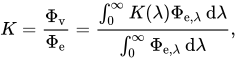
where
- Φv is the luminous flux;
- Φe is the radiant flux;
- Φe,λ is the spectral radiant flux;
- K(λ) = KmV(λ) is the spectral luminous efficacy.
Examples
[edit]| Type | Luminous efficacy of radiation (lm/W) |
Luminous efficiency[note 4] |
|---|---|---|
| Tungsten light bulb, typical, 2800 K | 15[9] | 2% |
| Class M star (Antares, Betelgeuse), 3300 K | 30 | 4% |
| Black body, 4000 K, ideal | 54.7[note 5] | 8% |
| Class G star (Sun, Capella), 5800 K | 93[9] | 13.6% |
| Black-body, 7000 K, ideal | 95[note 5] | 14% |
| Black-body, 5800 K, truncated to 400–700 nm (ideal "white" source)[note 6] | 251[9][note 7] | 37% |
| Black-body, 5800 K, truncated to ≥ 2% photopic sensitivity range[note 8] | 292[9] | 43% |
| Black-body, 2800 K, truncated to ≥ 2% photopic sensitivity range[note 8] | 299[9] | 44% |
| Black-body, 2800 K, truncated to ≥ 5% photopic sensitivity range[note 9] | 343[9] | 50% |
| Black-body, 5800 K, truncated to ≥ 5% photopic sensitivity range[note 9] | 348[9] | 51% |
| Monochromatic source at 540 THz | 683 (exact) | 99.9997% |
| Ideal monochromatic source: 555 nm (in air) | 683.002[10] | 100% |
| Type | Luminous efficacy
of radiation (lm/W) |
Luminous
efficiency[note 4] |
|---|---|---|
| Ideal monochromatic 507 nm source | 1699[11] or 1700[12] | 100% |


Lighting efficiency
[edit]Artificial light sources are usually evaluated in terms of luminous efficacy of the source, also sometimes called wall-plug efficacy. This is the ratio between the total luminous flux emitted by a device and the total amount of input power (electrical, etc.) it consumes. The luminous efficacy of the source is a measure of the efficiency of the device with the output adjusted to account for the spectral response curve (the luminosity function). When expressed in dimensionless form (for example, as a fraction of the maximum possible luminous efficacy), this value may be called luminous efficiency of a source, overall luminous efficiency or lighting efficiency.
The main difference between the luminous efficacy of radiation and the luminous efficacy of a source is that the latter accounts for input energy that is lost as heat or otherwise exits the source as something other than electromagnetic radiation. Luminous efficacy of radiation is a property of the radiation emitted by a source. Luminous efficacy of a source is a property of the source as a whole.
Examples
[edit]The following table lists luminous efficacy of a source and efficiency for various light sources. Note that all lamps requiring electrical/electronic ballast are unless noted (see also voltage) listed without losses for that, reducing total efficiency.
| Category | Type | Overall luminous efficacy (lm/W) |
Overall luminous efficiency[note 4] |
|---|---|---|---|
| Combustion | Gas mantle | 1–2[13] | 0.15–0.3% |
| Incandescent | 15, 40, 100 W tungsten incandescent (230 V) | 8.0, 10.4, 13.8[14][15][16][17] | 1.2, 1.5, 2.0% |
| 5, 40, 100 W tungsten incandescent (120 V) | 5.0, 12.6, 17.5[18] | 0.7, 1.8, 2.6% | |
| Halogen incandescent | 100, 200, 500 W tungsten halogen (230 V) | 16.7, 17.6, 19.8[19][17] | 2.4, 2.6, 2.9% |
| 2.6 W tungsten halogen (5.2 V) | 19.2[20] | 2.8% | |
| Halogen-IR (120 V) | 17.7–24.5[21] | 2.6–3.5% | |
| Tungsten quartz halogen (12–24 V) | 24 | 3.5% | |
| Photographic and projection lamps | 35[22] | 5.1% | |
| Light-emitting diode | LED screw base lamp (120 V) | 102[23][24][25] | 14.9% |
| 5–16 W LED screw base lamp (230 V) | 75–217[26][27][28][29] | 11–32% | |
| 21.5 W LED retrofit for T8 fluorescent tube (230 V) | 172[30] | 25% | |
| Theoretical limit for a white LED with phosphorescence color mixing | 260–300[31] | 38.1–43.9% | |
| Arc lamp | Carbon arc lamp | 2–7[32] | 0.29–1.0% |
| Xenon arc lamp | 30–90[33][34][35] | 4.4–13.5% | |
| Mercury-xenon arc lamp | 50–55[33] | 7.3–8% | |
| Ultra-high-pressure (UHP) mercury-vapor arc lamp, free mounted | 58–78[36] | 8.5–11.4% | |
| Ultra-high-pressure (UHP) mercury-vapor arc lamp, with reflector for projectors | 30–50[37] | 4.4–7.3% | |
| Fluorescent | 32 W T12 tube with magnetic ballast | 60[38] | 9% |
| 9–32 W compact fluorescent (with ballast) | 46–75[17][39][40] | 8–11.45%[41] | |
| T8 tube with electronic ballast | 80–100[38] | 12–15% | |
| PL-S 11 W U-tube, excluding ballast loss | 82[42] | 12% | |
| T5 tube | 70–104.2[43][44] | 10–15.63% | |
| 70–150 W inductively-coupled electrodeless lighting system | 71–84[45] | 10–12% | |
| Gas discharge | 1400 W sulfur lamp | 100[46] | 15% |
| Metal-halide lamp | 65–115[47] | 9.5–17% | |
| High-pressure sodium lamp | 85–150[17] | 12–22% | |
| Low-pressure sodium lamp | 100–200[17][48][49][50] | 15–29% | |
| Plasma display panel | 2–10[51] | 0.3–1.5% | |
| Cathodoluminescence | Electron-stimulated luminescence | 30–110[52][53] | 15% |
| Ideal sources | Truncated 5800 K black-body[note 7] | 251[9] | 37% |
| Green light at 555 nm (maximum possible luminous efficacy by definition) | 683.002[10][54] | 100% |
Sources that depend on thermal emission from a solid filament, such as incandescent light bulbs, tend to have low overall efficacy because, as explained by Donald L. Klipstein, "An ideal thermal radiator produces visible light most efficiently at temperatures around 6300 °C (6600 K or 11,500 °F). Even at this high temperature, a lot of the radiation is either infrared or ultraviolet, and the theoretical luminous [efficacy] is 95 lumens per watt. No substance is solid and usable as a light bulb filament at temperatures anywhere close to this. The surface of the sun is not quite that hot."[22] At temperatures where the tungsten filament of an ordinary light bulb remains solid (below 3683 kelvin), most of its emission is in the infrared.[22]
SI photometry units
[edit]
| Quantity | Unit | Dimension [nb 1] |
Notes | ||
|---|---|---|---|---|---|
| Name | Symbol[nb 2] | Name | Symbol | ||
| Luminous energy | Qv[nb 3] | lumen second | lm⋅s | T⋅J | The lumen second is sometimes called the talbot. |
| Luminous flux, luminous power | Φv[nb 3] | lumen (= candela steradian) | lm (= cd⋅sr) | J | Luminous energy per unit time |
| Luminous intensity | Iv | candela (= lumen per steradian) | cd (= lm/sr) | J | Luminous flux per unit solid angle |
| Luminance | Lv | candela per square metre | cd/m2 (= lm/(sr⋅m2)) | L−2⋅J | Luminous flux per unit solid angle per unit projected source area. The candela per square metre is sometimes called the nit. |
| Illuminance | Ev | lux (= lumen per square metre) | lx (= lm/m2) | L−2⋅J | Luminous flux incident on a surface |
| Luminous exitance, luminous emittance | Mv | lumen per square metre | lm/m2 | L−2⋅J | Luminous flux emitted from a surface |
| Luminous exposure | Hv | lux second | lx⋅s | L−2⋅T⋅J | Time-integrated illuminance |
| Luminous energy density | ωv | lumen second per cubic metre | lm⋅s/m3 | L−3⋅T⋅J | |
| Luminous efficacy (of radiation) | K | lumen per watt | lm/W | M−1⋅L−2⋅T3⋅J | Ratio of luminous flux to radiant flux |
| Luminous efficacy (of a source) | η[nb 3] | lumen per watt | lm/W | M−1⋅L−2⋅T3⋅J | Ratio of luminous flux to power consumption |
| Luminous efficiency, luminous coefficient | V | 1 | Luminous efficacy normalized by the maximum possible efficacy | ||
| See also: | |||||
- ^ The symbols in this column denote dimensions; "L", "T" and "J" are for length, time and luminous intensity respectively, not the symbols for the units litre, tesla and joule.
- ^ Standards organizations recommend that photometric quantities be denoted with a subscript "v" (for "visual") to avoid confusion with radiometric or photon quantities. For example: USA Standard Letter Symbols for Illuminating Engineering USAS Z7.1-1967, Y10.18-1967
- ^ a b c Alternative symbols sometimes seen: W for luminous energy, P or F for luminous flux, and ρ for luminous efficacy of a source.
See also
[edit]- Photometry
- Light pollution
- Wall-plug efficiency
- Coefficient of utilization
- List of light sources
- SI defining constants, including Kcd (used in the definition of candela)
Notes
[edit]- ^ There are special cases of illumination involving wavelengths of light that are outside the human visible range. One example is Ultraviolet light which is not itself visible, but can excite some pigments to fluoresce, where the pigments re-emit the light into the visible range. Such special cases are not a contributing part of luminous efficacy calculations.
- ^ Standard vision typically perceives 555 nm as a hue of yellowish-green , which can be emulated on an sRGB display with CSS color value
rgb(120,255,0)or hex#78ff00. - ^ Under standard photopic vision 507 nm is perceived as a blue-green hue similar to viridian , however scotopic rod-only vision does not create a color sensation in the standard human vision system.
- ^ a b c Defined such that the maximum possible luminous efficacy corresponds to a luminous efficiency of 100%.
- ^ a b Black body visible spectrum
- ^ Most efficient source that mimics the solar spectrum within range of human visual sensitivity.
- ^ a b Integral of truncated Planck function times photopic luminosity function times 683.002 lm/W.
- ^ a b Omits the part of the spectrum where the eye's sensitivity is very poor.
- ^ a b Omits the part of the spectrum where the eye's sensitivity is low (≤ 5% of the peak).

References
[edit]- ^ Allen Stimson (1974). Photometry and Radiometry for Engineers. New York: Wiley and Son. Bibcode:1974wi...book.....S.
- ^ Franc Grum; Richard Becherer (1979). Optical Radiation Measurements, Vol 1. New York: Academic Press.
- ^ Robert Boyd (1983). Radiometry and the Detection of Optical Radiation. New York: Wiley and Son.
- ^ a b c International Electrotechnical Commission (IEC): International Electrotechnical Vocabulary, ref. 845-21-090, Luminous efficacy of radiation (for a specified photometric condition)
- ^ International Electrotechnical Commission (IEC): International Electrotechnical Vocabulary, ref. 845-21-089, Luminous efficacy (of a light source)
- ^ Roger A. Messenger; Jerry Ventre (2004). Photovoltaic systems engineering (2 ed.). CRC Press. p. 123. ISBN 978-0-8493-1793-4.
- ^ Erik Reinhard; Erum Arif Khan; Ahmet Oğuz Akyüz; Garrett Johnson (2008). Color imaging: fundamentals and applications. A K Peters, Ltd. p. 338. ISBN 978-1-56881-344-8.
- ^ ISO (2005). ISO 23539:2005 Photometry — The CIE system of physical photometry (Report). Retrieved 2022-01-05.
- ^ a b c d e f g h Murphy, Thomas W. (2012). "Maximum spectral luminous efficacy of white light" (PDF). Journal of Applied Physics. 111 (10) 104909: 104909–104909–6. arXiv:1309.7039. Bibcode:2012JAP...111j4909M. doi:10.1063/1.4721897. S2CID 6543030.
- ^ a b "BIPM statement: Information for users about the proposed revision of the SI" (PDF). Archived (PDF) from the original on 21 January 2018. Retrieved 5 May 2018.
- ^ Kohei Narisada; Duco Schreuder (2004). Light Pollution Handbook. Springer. ISBN 1-4020-2665-X.
- ^ Casimer DeCusatis (1998). Handbook of Applied Photometry. Springer. ISBN 1-56396-416-3.
- ^ Westermaier, F. V. (1920). "Recent Developments in Gas Street Lighting". The American City. 22 (5). New York: Civic Press: 490.
- ^ "Philips Classictone Standard 15 W clear".
- ^ "Philips Classictone Standard 40 W clear".
- ^ "Bulbs: Gluehbirne.ch: Philips Standard Lamps (German)". Bulbs.ch. Retrieved 2013-05-17.
- ^ a b c d e Philips Product Catalog[dead link] (German)
- ^ Keefe, T.J. (2007). "The Nature of Light". Archived from the original on 2012-01-18. Retrieved 2016-04-15.
- ^ "Osram halogen" (PDF). osram.de (in German). Archived from the original (PDF) on November 7, 2007. Retrieved 2008-01-28.
- ^ "Osram 6406330 Miniwatt-Halogen 5.2V". bulbtronics.com. Archived from the original on 2016-02-13. Retrieved 2013-04-16.
- ^ "GE Lighting HIR Plus Halogen PAR38s" (PDF). ge.com. Retrieved 2017-11-01.
- ^ a b c Klipstein, Donald L. (1996). "The Great Internet Light Bulb Book, Part I". Archived from the original on 2001-09-09. Retrieved 2006-04-16.
- ^ "Toshiba E-CORE LED Lamp". item.rakuten.com. Retrieved 2013-05-17.
- ^ "Toshiba E-CORE LED Lamp LDA5N-E17". Archived from the original on 2011-07-19.
- ^ Toshiba to release 93 lm/W LED bulb Ledrevie
- ^ "EGLO 110326 technical datasheet" (PDF). EGLO. Retrieved 2024-09-13.
- ^ "LED Bulb Filament A60 / E27 / 5 W (75 W) / 1 060 lm / neutral white EN | EMOS". en.b2b.emos.cz. Retrieved 2024-05-09.
- ^ "Philips - LED bulbs". Retrieved 2020-03-14.
- ^ "LED CLA 60W A60 E27 4000K CL EELA SRT4 | null". www.lighting.philips.co.uk. Retrieved 2021-09-26.
- ^ "MAS LEDtube 1500mm UE 21.5W 840 T8". Retrieved 2018-01-10.
- ^ Zyga, Lisa (2010-08-31). "White LEDs with super-high luminous efficacy could satisfy all general lighting needs". Phys.org. Retrieved 17 November 2021.
- ^ "Arc Lamps". Edison Tech Center. Retrieved 2015-08-20.
- ^ a b "Technical Information on Lamps" (PDF). Optical Building Blocks. Retrieved 2010-05-01. Note that the figure of 150 lm/W given for xenon lamps appears to be a typo. The page contains other useful information.
- ^ OSRAM Sylvania Lamp and Ballast Catalog. 2007.
- ^ "XENARC ORIGINAL D1S | OSRAM Automotive". www.osram.com. Retrieved 2021-09-30.
- ^ REVIEW ARTICLE: UHP lamp systems for projection applications[permanent dead link] Journal of Physics D: Applied Physics
- ^ OSRAM P-VIP PROJECTOR LAMPS Osram
- ^ a b Federal Energy Management Program (December 2000). "How to buy an energy-efficient fluorescent tube lamp". U.S. Department of Energy. Archived from the original on 2007-07-02.
{{cite journal}}: Cite journal requires|journal=(help) - ^ "Low Mercury CFLs". Energy Federation Incorporated. Archived from the original on October 13, 2008. Retrieved 2008-12-23.
- ^ "Conventional CFLs". Energy Federation Incorporated. Archived from the original on October 14, 2008. Retrieved 2008-12-23.
- ^ "Global bulbs". 1000Bulbs.com. Retrieved 2010-02-20.|
- ^ Phillips. "Phillips Master". Retrieved 2010-12-21.
- ^ Department of the Environment, Water, Heritage and the Arts, Australia. "Energy Labelling—Lamps". Archived from the original on July 23, 2008. Retrieved 2008-08-14.
{{cite web}}: CS1 maint: multiple names: authors list (link) - ^ "BulbAmerica.com". Bulbamerica.com. Archived from the original on December 1, 2012. Retrieved 2010-02-20.
- ^ SYLVANIA. "Sylvania Icetron Quicktronic Design Guide" (PDF). Retrieved 2015-06-10.
- ^ "1000-watt sulfur lamp now ready". IAEEL newsletter. No. 1. IAEEL. 1996. Archived from the original on 2003-08-18.
- ^ "The Metal Halide Advantage". Venture Lighting. 2007. Archived from the original on 2012-02-15. Retrieved 2008-08-10.
- ^ "LED or Neon? A scientific comparison".
- ^ "Why is lightning coloured? (gas excitations)". webexhibits.org.
- ^ Hooker, J.D. (1997). "The low-pressure sodium lamp". IEEE Conference Record - Abstracts. 1997 IEEE International Conference on Plasma Science. p. 289. doi:10.1109/PLASMA.1997.605090. ISBN 0-7803-3990-8. S2CID 102792535.
- ^ "Future Looks Bright for Plasma TVs" (PDF). Panasonic. 2007. Retrieved 2013-02-10.
- ^ "TV-Tube Technology Builds an Efficient Light Bulb". OSA. 2019. Retrieved 2020-09-12.
- ^ Sheshin, Evgenii P.; Kolodyazhnyj, Artem Yu.; Chadaev, Nikolai N.; Getman, Alexandr O.; Danilkin, Mikhail I.; Ozol, Dmitry I. (2019). "Prototype of cathodoluminescent lamp for general lighting using carbon fiber field emission cathode". Journal of Vacuum Science & Technology B. 37 (3). AVS: 031213. Bibcode:2019JVSTB..37c1213S. doi:10.1116/1.5070108. S2CID 155496503. Retrieved 2020-09-12.
- ^ Choudhury, Asim Kumar Roy (2014). "Characteristics of light sources: luminous efficacy of lamps". Principles of Colour and Appearance Measurement: Object appearance, colour perception and instrumental measurement. Vol. 1. Woodhead Publishing. p. 41. doi:10.1533/9780857099242.1. ISBN 978-0-85709-229-8.
If the lamp emits all radiation at 555 nm (where Vλ = 1), the luminous efficacy will be of about 680 lm W−1, the theoretical maximum value. The lamp efficacy will be 26 and 73 lm W−1, when the whole light is emitted at 450 and 650 nm respectively. The luminous coefficient is luminous efficiency expressed as a value between zero and one, with one corresponding to an efficacy of 683 lm W−1.
External links
[edit]- Hyperphysics has these graphs of efficacy that do not quite comply with the standard definition
- Energy Efficient Light Bulbs
- Other Power
Luminous efficacy
View on GrokipediaBasic Concepts
Definition and Importance
Luminous efficacy is defined as the ratio of luminous flux, which quantifies the perceived brightness of light as measured in lumens, to the electrical power consumed by the source, expressed in watts, yielding units of lumens per watt (lm/W).[7] This metric evaluates how effectively a light source converts input energy into visible light that aligns with human perception.[8] The concept and term "luminous efficacy" emerged in the early 20th century, coinciding with the widespread adoption of electric lighting technologies such as incandescent bulbs, which necessitated standardized ways to assess their performance.[9] Prior to this, lighting efficiency was not systematically quantified, but the shift to electricity-driven illumination prompted the development of photometric standards to bridge radiometry—the measurement of physical radiant power—and photometry, which weights light output according to the human eye's sensitivity to different wavelengths.[10][11] Luminous efficacy plays a pivotal role in lighting design, energy conservation efforts, and international standards aimed at curbing electricity use for illumination, which represents about 15% of global electricity consumption.[12] The International Energy Agency (IEA) promotes higher efficacy through policies and minimum performance standards that require light sources to deliver more lumens per watt, facilitating substantial reductions in energy demand and associated greenhouse gas emissions.[13] By prioritizing sources with superior efficacy, these initiatives support sustainable practices without compromising visual comfort or functionality.[14]Efficacy versus Efficiency
Luminous efficacy quantifies the effectiveness of a light source in producing visible light, expressed as the ratio of luminous flux (in lumens) to either electrical power input or radiant power output, typically in lumens per watt (lm/W). In contrast, luminous efficiency is a dimensionless metric that normalizes the efficacy by dividing it by the theoretical maximum possible efficacy for the given spectrum, yielding a value between 0 and 1 that represents the fraction of the source's radiated power falling within the visible spectrum as perceived by the human eye. This distinction highlights how efficacy emphasizes practical output in visible terms, while efficiency provides a relative measure of spectral utilization without units. A common point of confusion in the lighting industry arises from interchanging terms like "luminous efficacy of radiation" (LER), which measures lumens per watt of radiant power and focuses solely on optical output, with "luminous efficiency of the device" (LE), or wall-plug efficacy, which accounts for lumens per watt of electrical input and includes losses in conversion processes such as thermal dissipation. This misuse can lead to overstated performance claims, as LER values (often 200–300 lm/W for white light spectra) ignore electrical inefficiencies, whereas wall-plug efficacy is typically lower (e.g., 100–200 lm/W for high-end LEDs) due to non-radiative losses. Such terminological overlap has been noted in technical literature as a barrier to accurate comparisons in product specifications and research evaluations. In regulatory contexts, luminous efficacy serves as the primary metric for assessing and labeling lighting products to promote energy savings. For instance, the European Union's energy labeling framework under Regulation (EU) 2019/2015 classifies light sources from A (most efficient) to G based directly on their luminous efficacy in lm/W, enabling consumers to compare devices like LEDs (often exceeding 100 lm/W) against incandescents (around 15 lm/W) and driving market shifts toward higher-efficacy technologies. This approach ensures that labels reflect real-world visible light output per unit of electricity consumed, supporting broader energy efficiency goals without conflating it with broader radiant or thermal efficiencies.Luminous Efficacy of Radiation
Explanation
Luminous efficacy of radiation (LER) quantifies the fraction of a light source's radiant flux that contributes to visible light as perceived by the human eye, defined as the ratio of luminous flux to radiant flux for a specific spectral power distribution.[2] This measure is independent of the source's electrical-to-optical conversion efficiency, focusing instead on the inherent properties of the emitted spectrum within the visible range.[1] By weighting the radiant power according to the eye's spectral sensitivity, LER provides a standardized way to assess how effectively radiation stimulates visual perception, regardless of the technology used to generate it.[15] The perceptual basis of LER stems from the human visual system's sensitivity, particularly under photopic conditions where cone cells dominate. The standard photopic luminous efficiency function, V(λ), peaks sharply at 555 nm in the green-yellow region, reflecting maximum sensitivity there, and declines rapidly outside the approximate 400–700 nm visible spectrum, rendering ultraviolet and infrared radiation ineffective for vision.[16] This function, established through psychophysical experiments, ensures that LER emphasizes wavelengths that align with daylight-adapted vision, prioritizing the portion of the spectrum that humans perceive as bright.[17] Idealized spectra illustrate LER's extremes: monochromatic radiation at 555 nm achieves the theoretical maximum of 683 lm/W, as it perfectly matches the eye's peak sensitivity without wasting energy in non-visible wavelengths.[18] In contrast, blackbody radiators, which emit across a broad continuum, yield lower LER values that depend on temperature; for instance, those approximating solar or incandescent spectra distribute significant power into infrared, reducing the visible fraction.[19] Under low-light mesopic conditions, such as in street lighting where both rods and cones contribute, the effective luminous efficacy is intermediate between photopic and scotopic levels due to the shifted and broadened sensitivity curve.[20] This adaptation enhances detection in dim environments, influencing applications like roadway illumination where spectral optimization can improve perceived brightness.[21]Mathematical Definition
The luminous efficacy of radiation (LER), denoted as , is mathematically defined as the ratio of the luminous flux to the radiant flux emitted by a radiation source, expressed in lumens per watt (lm/W). This quantity quantifies how effectively the spectral power distribution of the radiation contributes to visible light as perceived by the human eye under photopic conditions. The foundational equation derives from the definition of luminous flux provided by the International Commission on Illumination (CIE), where with in lumens, the photopic spectral luminous efficiency function (normalized to a maximum of 1 at 555 nm), the spectral radiant flux in watts per nanometer, and the constant 683 lm/W representing the maximum luminous efficacy for monochromatic radiation at 555 nm, where .[22][18] The radiant flux is the integral of the spectral radiant flux over all wavelengths: . Thus, the LER for a given spectral power distribution (where for unit total power) is which normalizes the weighted visible portion against the total radiated power. This derivation follows directly from substituting the luminous flux expression into the efficacy ratio, ensuring reaches its theoretical maximum of 683 lm/W only for pure 555 nm light; for broadband sources like blackbody radiators, values are typically lower, e.g., around 15 lm/W for a 2800 K tungsten filament.[23][18][19] A related normalization is the luminous efficiency lm/W, which expresses the LER as a fraction of the photopic maximum, ranging from 0 to 1 and highlighting the spectral match to human vision. For scotopic vision (low-light conditions), an analogous framework uses the spectral luminous efficiency function , peaking at 507 nm, with a maximum efficacy constant of 1699 lm/W to account for rod cell sensitivity, though effective values remain adjusted for overall visibility thresholds.[18] Recent CIE standards, such as CIE S 018:2019, have refined the tabulated values of with higher-resolution data (1 nm steps) and physiological basis updates, improving accuracy for narrowband spectra like those from LEDs by better aligning with empirical visual response measurements.[24]Luminous Efficacy of Sources
Definition
Luminous efficacy of a source, often abbreviated as LES, quantifies the performance of a complete lighting system by measuring the total luminous flux produced, in lumens (lm), divided by the total electrical power input consumed, in watts (W), yielding units of lm/W.[25] This metric serves as a practical indicator of how effectively electrical energy is converted into visible light output for real-world applications, encompassing the entire device from power supply to emission.[8] In contrast to the luminous efficacy of radiation (LER), which evaluates only the theoretical efficiency based on the spectrum of emitted light relative to its radiant power, LES incorporates all practical conversion losses, including those from thermal dissipation, non-radiative recombination, and electrical drive circuitry.[2] Mathematically, LES is given by the product of LER, radiant efficiency (the ratio of radiant flux to the electrical power delivered to the emitter), and electrical efficiency (the fraction of total input power that reaches the emitter without loss in drivers or ballasts): LES = LER × η_radiant × η_electrical.[8] This formulation highlights how LES reflects the cumulative impact of device physics and engineering on overall light production. Several factors influence LES, particularly in modern solid-state lighting. For light-emitting diodes (LEDs), driver efficiency—typically around 85% for converting alternating current to direct current and managing control functions—plays a critical role, as inefficiencies here can reduce LES by over 30%.[8] In fluorescent lamps, ballast losses from power regulation circuitry further diminish efficacy, though electronic ballasts mitigate this compared to older magnetic types, enabling system-level LES in the 80–100 lm/W range.[4] Broader system design elements, such as thermal management to minimize junction heating (which can cut efficacy by up to 15%) and optical extraction to preserve flux, are essential for optimizing LES across lamp architectures.[8] As of 2025, laboratory advancements in quantum dot and perovskite LEDs have pushed LES beyond 200 lm/W, driven by improved spectral matching to the human eye response and reduced non-radiative losses, signaling transformative potential for energy-efficient illumination.Examples
Incandescent light sources, such as traditional tungsten-filament bulbs, typically achieve a luminous efficacy of around 15 lm/W, largely due to significant energy loss as infrared radiation rather than visible light.[26] Halogen lamps, an improved variant using halogen gas to extend filament life, offer slightly better performance at approximately 20 lm/W.[26] Fluorescent lamps provide a substantial advancement, with compact fluorescent lamps (CFLs) reaching 50-75 lm/W and linear fluorescents up to 75-100 lm/W, thanks to their excitation of phosphors that better align with the human eye's sensitivity curve.[26] High-intensity discharge (HID) lamps, including metal halide and high-pressure sodium types, further improve efficiency to 80-120 lm/W, making them suitable for large-scale applications like street lighting.[27] Emerging organic light-emitting diode (OLED) panels, valued for their diffuse light quality, currently attain about 100 lm/W in commercial products.[28] Light-emitting diodes (LEDs) represent the current benchmark, with commercial white LEDs averaging 150 lm/W as of 2025 and high-end models exceeding 220 lm/W in specialized applications.[26] The theoretical maximum for white light under photopic vision conditions ranges from 250-350 lm/W, limited by the spectral distribution that optimizes both color rendering and eye sensitivity.[29] Historically, Thomas Edison's early incandescent bulb in 1879 achieved only 1-2 lm/W, marking a modest start to electric lighting.[14] Over the subsequent decades, efficiencies progressed incrementally to 15 lm/W for standard incandescents by the mid-20th century, followed by fluorescents in the 1930s at 30-50 lm/W. The advent of LEDs in the 1990s accelerated gains, with average efficacies rising from under 20 lm/W to over 100 lm/W by 2010, driven by advancements in semiconductor materials and phosphor conversion.[14] According to the International Energy Agency (IEA), this evolution has led to LEDs comprising 50% of global residential lighting sales by 2022, with projections for 100% adoption by 2025, potentially reducing worldwide lighting energy use by 50% compared to 2015 levels.[26] The following table compares luminous efficacies across key source types, illustrating the progression toward higher efficiency:| Light Source Type | Typical Luminous Efficacy (lm/W) | Notes |
|---|---|---|
| Early Incandescent (Edison-era) | 1-2 | Carbon filament, short lifespan.[14] |
| Standard Incandescent | ~15 | High infrared output.[26] |
| Halogen | ~20 | Gas-filled for longevity.[26] |
| Compact Fluorescent | 50-75 | Phosphor-based spectrum matching.[26] |
| HID (Metal Halide/Sodium) | 80-120 | For high-output applications.[27] |
| Commercial White LED (2025 average) | 150 | Phosphor-converted blue LED.[26] |
| High-End LED | >220 | Optimized for specific uses.[26] |
| OLED | ~100 | Diffuse, flexible panels.[28] |