


Community hub
Recent from talks
Contribute something
Nothing was collected or created yet.
United States Marine Corps Scout Sniper
View on Wikipedia| United States Marine Corps Scout Snipers | |
|---|---|
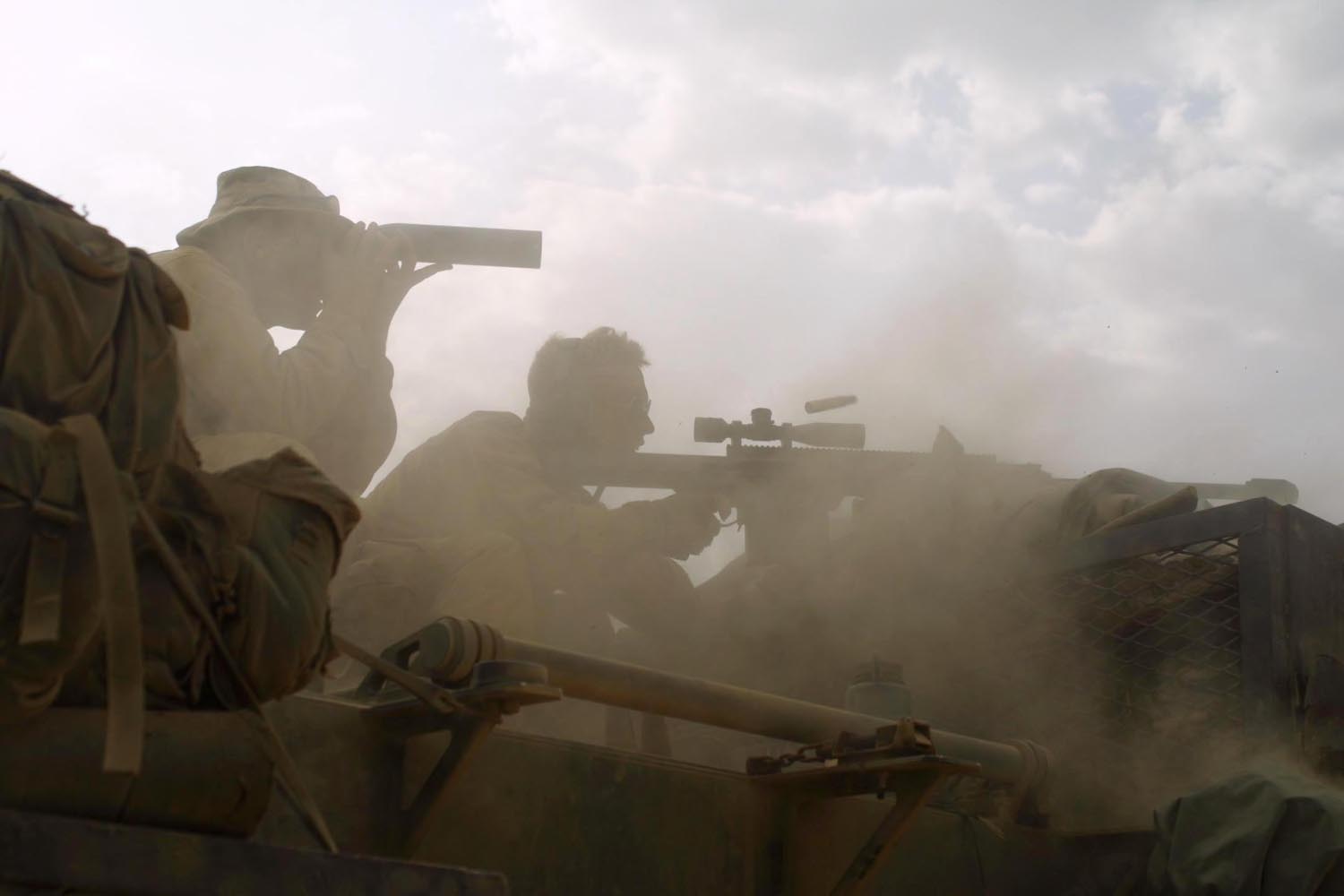
 Scout Snipers from the 26th Marine Expeditionary Unit (Special Operations Capable) in Djibouti, circa 2003 | |
| Active | 1943–December 15, 2023 |
| Country |  United States United States |
| Branch |  United States Marine Corps United States Marine Corps |
| Type | Reconnaissance scout/sniper[1] |
| Role | Close-quarters combat Direct support of infantry and reconnaissance units Reconnaissance Special operations |
| Size | Platoon (8–10 men) |
| Engagements | |
United States Marine Corps Scout Sniper (MOS 0317, formerly 8541) was a secondary MOS (Military Occupational Specialty) designator of U.S. Marine Corps infantrymen and reconnaissance Marines that have graduated from a U.S. Marine Corps Scout Sniper School. Scout Snipers were required to earn the rank of Lance Corporal, be selected by their battalion to join the scout-sniper platoon, and complete an approved scout-sniper course in order to receive this designation. As of December 2023, Marine scout snipers (0317 MOS) have been reorganized as MOS 0322 Reconnaissance Sniper Marines, as part of a 26-Marine Scout Platoon.[4]
History
[edit]A USMC Scout Sniper was a marine infantryman highly skilled in fieldcraft and marksmanship, who can deliver long-range precision fire on high-value targets from concealed positions in support of combat operations. The first Scout Snipers were trained near San Diego, California in 1943 and saw combat in the Pacific Theater of Operations during World War II.[5]
A USMC Scout Sniper Team was a detachment of one or more sniper teams performing an assigned task of engaging selected targets, targets of opportunity, collecting and reporting information, or a combination of all, contributing to the accomplishment of the supported unit's mission.
Surveillance and Target Acquisition (STA) Platoons, very similar units, existed until shortly after the Gulf War. They consisted of Scout Snipers and Intelligence Marines.
A Scout Sniper platoon was composed of 8–10 Scout Sniper teams, some of which are specially suited for night operations and fully capable of operating in almost complete darkness through use of night vision scopes and infrared laser equipment. Typically, each Scout Sniper team has two members: one is the actual shooter, equipped with a long-range, specially-made sniper rifle, such as the M40, and also frequently issued an M9 9mm pistol as a defensive side arm; the other is the spotter, typically armed with an M4 carbine and uses a high-power spotting scope to spot targets and provide ballistic information for the shooter. The shooter/spotter relationship was not always set; some platoons established designated shooters, while others have team members taking turns doing the shooting/spotting. Within a platoon, there were four anti-materiel rifles chambered in .50 BMG designated the Special Application Scoped Rifle (SASR), such as the M82 or M107. These can be issued to a team as needed to give supported commanders the option of taking out heavy equipment or lightly armored vehicles. Scout Sniper teams trained to engage man-sized targets with the M40 out to 1,000 yards (3,000 ft), and can be effective at a range of up to 1.25 mi (2.01 km) with the M82, if the environment is right.
Controversial use of the "SS" symbol
[edit]
 flag in Afghanistan in 2010, triggered the controversy about the Scout Snipers' use of the symbol.
In February 2012, U.S. media reported that Marine scout snipers had been using the double Sig rune (ϟϟ, "SS") in its "Armanen" form () to symbolize their function since at least the 1980s.[6][7] The same stylized double rune was the symbol of the SS, the Nazi organization that was instrumental in conducting the Holocaust. Strong media criticism of this practice ensued. The Commandant of the Marine Corps gave orders to stop it, issued an apology, and ordered an investigation into the prevalence of this practice.[7]
A Marine official was quoted as saying that their leadership believed that the Marines did not understand the logo's significance.[7] The Military Religious Freedom Foundation, which had helped circulate an image of snipers posing with a blue "SS" flag, questioned this assumption, writing that the flag was sold by a website dedicated to German World War II and Nazi memorabilia.[8]
Despite the official prohibition, the New York Times reported in 2020 that the "SS" logo continues to be used by Marines, "much like a secret handshake".[9]
End of service
[edit]With the implementation of Force Design 2030, Marine scout snipers have been replaced with MOS 0322 Reconnaissance Sniper Marines, as part of a 26-Marine Scout Platoon.[4] The last 0317 class graduated December 15, 2023.[10]
Overview
[edit]A Marine Corps Scout Sniper was a Marine highly skilled in fieldcraft and marksmanship who delivers long range precision fire, on select targets, from concealed positions in support of combat operations.
- Support combat operations by delivering precision fire on selected targets.[11]
- Establish concealed sniper/observation sites from which targets are analyzed, engaged, and information gathered.[12]
- Use map and compass for day or night land navigation.[13]
- Operate and maintain weapons and optical equipment employed by the Scout Sniper
Scout Snipers provided close reconnaissance and surveillance to the infantry battalion.[14] By doctrine, a Scout Sniper was a Marine highly skilled in field craft and marksmanship who delivers long range precision fire on selected targets from concealed positions in support of combat operations.
Scout Snipers in Marine infantry battalions fell under the Surveillance and Target Acquisition (STA) units initially, and subsequently to the infantry battalion's Scout Sniper Platoon (SSP), usually within the Headquarters and Service (H&S) Company or Weapons Company. Marine Scout Snipers were trained at one of the four school house locations.
The term "Scout Sniper" is only used officially by the Marine Corps, but it does not imply a differing mission from the U.S. Army Sniper. An Army Sniper's primary mission is to support combat operations by delivering precise long-range fire on selected targets. By this, the sniper creates casualties among enemy troops, slows enemy movement, frightens enemy soldiers, lowers morale, and adds confusion to their operations. The sniper's secondary mission is collecting and reporting battlefield information, Section 1.1 FM 23-10 Sniper Training.
The Marine Corps is unique in its consolidation of reconnaissance and sniper duties for a single Marine. Most other conventional armed forces, including the U.S. Army, separate the reconnaissance soldier or scout from the sniper. In the U.S. Army, the 19D MOS, "Cavalry Scout" is the primary special reconnaissance and surveillance soldier and the term "Infantry Scout" refers to a specially trained infantrymen that functions in a reconnaissance and surveillance capacity, while "Sniper" refers to a specially selected and trained soldier that primarily functions as a sniper.[15] Most military forces believe that the separation of reconnaissance and sniper capabilities allows for a higher degree of specialization.
Scout Sniper Course
[edit]
The Marine Scout Sniper Course qualified students as Marine Corps Scout Snipers. The graduation rate in 2017 was 44 percent.[16] There were three different school houses in the Marine Corps that offer the Scout Sniper Course.

 |
- School of Infantry (West), Marine Corps Base Camp Pendleton, California
- Marine Corps Base Camp Lejeune, North Carolina
- Marine Corps Base Quantico, Virginia
In 2009, a major change in curriculum occurred with the Scout Sniper Basic Course and it was shortened from the traditional 10-week course to an 81⁄2 week course. This was done concurrently with the removal of the Advanced Course and the addition of the Team Leader Course of four weeks. This reduction of 11⁄2 weeks is because of the removal of the course's mission planning phase and the addition of this curriculum to the Team Leader Course. Missions are still conducted during the course's last week, but are now not a major part of curriculum.
In 2010, a new curriculum was introduced, with shooting as the course's primary focus and stalking a secondary focus. The new course was now 121⁄2 weeks long. With elimination of the advanced course, Scout Sniper Basic Course was re-designated as the "Scout Sniper Course". There were nine straight weeks of shooting qualifications, before the majority of field training.
Basic requirements
[edit]These were the basic requirements that must be met in order to attend school. Units vary with indocs and pre-reqs.
Minimum Requirements: As per HQMC School Quota Message:
- Criteria: 60 days prior to a class convening, the G-3 at each division will receive a message from HQMC stating the number of funded quotas given to each division, the gear list, report date, and criteria for attending.
Marines who did not meet the following prerequisites would be denied entrance to the program and returned to their units.
- Must hold any rank from Lance Corporal (E-3) to Captain (O-3), inclusive.
- Infantry MOS or MOS 0203 (Ground Intelligence Officer).
- Vision correctable to 20/20 in both eyes. Color blindness is discouraged.
- Serving in or designated for assignment to a Scout Sniper billet.
- Minimum of 12 months remaining on current contract on completion of course (does not apply to reservists).
- Must score a First Class United States Marine Corps Physical Fitness Test on the day the course convenes.
- Current rifle Expert. Must have qualified in the last fiscal year. (Reservist can have a score three years old, but must be current Expert.)
- No courts martial or NJP within the last six months.
- Minimum GT (General Technical) of 100 on the ASVAB)
- No history of mental illness.
- Must be a volunteer.
- It is highly recommended, but not required, for the student to have completed the following MCI courses: Land Navigation, Patrolling, Calling and Adjusting Supporting Arms, and Reconnaissance Marine. It is also recommended, but not required, that the student have conducted basic Scout Sniper field skills: stalks, concealment, field sketches, range cards, range estimations, and firing of the M40A1 rifle prior to attending the course. Students should also possess a high degree of maturity, equanimity, and common sense.
- Swim Qual: 500 meter swim using side or breast stroke, 50 meter swim holding a weight out of water, tread water for 30 seconds holding a weight out of water, no signs of panic.
Phases of training
[edit]- Phase 1: Marksmanship and Basic Fields Craft Phase
- During this phase, Marines are trained in basic marksmanship on the Known Distance (KD) Range and also receive classes in basic skills such as camouflage, individual movement, weapons systems, observations, and field sketches.
- Day one begins with in processing, which includes a PFT, gear check, and service record check for prerequisite compliance. Potential students must also pass day and night land navigation courses. After all students have been admitted to the course, classes and a general overview of the course are given.
- KD range includes shooting at the 300, 500, 600, 700, 800, 900, and 1000 yard lines. Five rounds are fired at each yard line. During this phase of training, Marines must become experts at the fundamentals of marksmanship. They must also become experts at calling wind and weather. During this portion two students work together, one on the rifle and the other behind the spotting scope calling wind. If a student is not proficient at calling wind, they will cause their partner to fail, not themselves. After the first student fires his rounds, the two switch positions. After each yard line, the students must quickly throw on their packs and grab all their equipment and run to the next yard line. The course of fire for qualification is as follows:
- 300, 500, & 600: three stationary and two movers
- 700: three stationary and two stop and go movers
- 800: three stationary and two bobbers
- 900 & 1000: five stationary
- Out of 35 rounds, 28 rounds must be in the black to qualify on the range.
- After the range students head back to the schoolhouse and clean weapons. After this important task they immediately do a field sketch and observation exercises. Often a Kim's Game is conducted as well.
- During an observation, students must use their M49 spotting scope and binoculars to find 10 hidden items in a specifically defined area. These observations can be done at short distances utilizing miniature items, or at long distances with full sized items. Observations are an essential skill that the sniper must learn to be effective. Furthermore, for the purposes of the course it is important to learn observation skills, particularly how to "Burn Through" bushes for the stalking phase. Learning this skill is imperative to being able to find the observation post from behind cover during stalking and is often the difference between a student passing or failing. An overall average of 70% must be obtained on observations to pass the course.
- During a field sketch, students are given an hour and a specific area or building to sketch. The target must be drawn with as many details as possible. It must include information about its surroundings and target reference points on the sketch. Sketches are graded for neatness, correctness, details, and usable information. An overall average of 70% must be obtained on field sketches to pass the course.
- Phase 2: Unknown Distance and Stalking
- The UKD (Unknown Distance) and Stalking portion kicks off as soon as Phase 1 is completed. During this phase students will become experts at engaging targets at unknown distances by way of range estimation and range cards.
- During the unknown distance phase students will run 100-pound steel targets out to ranges between 300 and 800 yards. There are 10 targets in each course of fire, and after each course of fire, the targets are rearranged.
- A student has two attempts to hit each target, a first round impact is worth 10 points and a second is worth 8. An overall average of 80% must be obtained during the 3 weeks of UKD to pass the course. **Thereafter, the portion of the course with the highest attrition rate begins, stalking.
- Stalking involves moving from a distance between 1200 and 800 yards to within 200 yards of an observation post (OP) undetected. After doing this, the student must set up a Final Firing Position (FFP) and fire two shots without being found by the OP within a time period of 3–4 hours.
- After the first shot is fired, a walker (a neutral instructor who does not help students or the instructors in the OP) will get close to the sniper's position to make sure he can positively ID the OP. Positive ID is established by the observers holding up cards with 2-3 letters on them above their binoculars. The sniper must then correctly tell the walker what is written on them. After positive ID has been confirmed, the walker will move within 10 yards of the shooter and inform the OP that he is within 10. The OP will then attempt to walk the walker onto the sniper's position by way of movement commands. The OP must get the walker within 1 foot of the shooter. If the shooter cannot be found, the walker will tell the shooter to fire a second shot on his command. After the second shot has been fired, the OP will look for blast from the rifle or movement from the shooter. If the OP cannot find the shooter, then the walker will indicate the shooters position to the OP and check to make sure the shooter had the correct windage and elevation settings, along with correct position and stable shooting platform.
- Grading is as follows for stalking:
- 0: Being out of bounds on the stalk lane, not freezing on the command freeze (when the OP believes they know the position of a student, they call freeze and all students on the stalk lane have to immediately freeze in whatever position they are in), poor FFP.
- 40: Caught out of range or fired out of range (not within 200 yards).
- 50: Caught within range.
- 60: 1 shot fired but, no positive ID, incorrect windage or elevation, unstable shooting platform.
- 70: 1 shot fired and positive ID, correct windage, elevation, shooting platform but OP walked onto shooter after first shot.
- 80: 2 shots fired and positive ID, correct windage, elevation, shooting platform but OP saw blast from shooter's position after second shot.
- 100: 2 shots fired and positive ID, correct windage, elevation, shooting platform and shooter was never found.
- Students must obtain an overall average of 70% out of 10 stalks, with a minimum of two 100s and no more than a single zero in order to pass stalking.
- Phase 3: Advanced Field Skills and Mission Employment
Other schools
[edit]
|
After graduating the basic course, Marines were given the opportunity to obtain a variety of other courses to further refine their skills.
- Urban Snipers
- High Angle (Mountain) Snipers
- Scout Snipers Team leader course (formerly the advanced course)
- Foreign Forces Snipers Schools
- British Royal Marine Snipers School
- Israeli Foreign Forces Snipers School
Notable Scout Snipers
[edit]
- Carlos Hathcock, during the Vietnam War had 93 confirmed kills, 300–400 estimated kills, and until 2002, had the longest recorded shot made by a Scout Sniper.
- Chuck Mawhinney, USMC Scout/Sniper during Vietnam War, credited with 103 confirmed kills and 216+ probable kills during 16 months in Vietnam.
- Lee Marvin, scout-sniper during World War II and Purple Heart recipient. After war, actor and Academy Award winner.
- Dakota Meyer, a Medal of Honor recipient, was a scout-sniper working with Embedded Training Team 2-8 for actions during Battle of Ganjgal of the War in Afghanistan.[17][18]
- Eric England, also known as The Phantom of Phu Bai, was a sniper during the Vietnam War. 98 confirmed kills in 7 months; wounded by mortar. Returned to Vietnam, making as many as 200 additional unconfirmed enemy kills.[19]
See also
[edit]- United States Army Sniper School
- Marksmanship badges (United States)
- Hog's tooth
- Intelligence, surveillance, target acquisition, and reconnaissance
- Related military roles
- Related military operations
- Operation Foxley – plan to kill Adolf Hitler using a sniper
- Sniper Alley
- Snipers of the Soviet Union
- Special forces
- Related military weapons
References
[edit]- ^ "The Marine Corps has trained its final 8 scout snipers". Marine Corps Times. 28 December 2023.
- ^ "Scout sniper serving in Iraq awarded U.S. Military's third highest award for valor". 1st Marine Division.
- ^ "6 Marine Snipers Are Slain in Ambush in Western Iraq; Another Dies in Suicide Attack (Published 2005)". The New York Times. 3 August 2005.
- ^ a b "MARINE CORPS ANNOUNCES DECISION TO ESTABLISH THE SCOUT PLATOON TO INCREASE INFANTRY BATTALION CAPABILITIES AS PART OF FORCE DESIGN 2030". The Official United States Marine Corps Public Website. 2023-03-06.
- ^ Sasser, Charles W.; Roberts, Craig (1990). One Shot-One Kill. Pocket Books.
- ^ Lamothe, Dan (9 February 2012). "Marine scout snipers used Nazi SS logo". Marine Corps Times. Archived from the original on 12 February 2012. Retrieved 11 February 2012.
- ^ a b c Lamothe, Dan (10 February 2012). "Amos sorry for Marine use of Nazi SS logo". Marine Corps Times. Archived from the original on 13 February 2012. Retrieved 11 February 2012.
- ^ Rodda, Chris (10 February 2012). "Those Marines Bought an SS Flag Without Knowing What it Was? Seriously? That's Your Excuse?". Military Religious Freedom Foundation. Retrieved 11 February 2012.
- ^ Cooper, Helene (2020-05-25). "For African-Americans in Uniform, It's Duty, Honor, Country. But Don't Expect to Lead". The New York Times. ISSN 0362-4331. Retrieved 2020-05-25.
- ^ SKOVLUND, JOSHUA (2023-11-21). "End of an era: The last class of Marine Scout Snipers graduates on Dec. 15". Task & Purpose.
- ^ "Goodbye to Romance - What It Takes To Be A Marine Scout/Sniper". Snipercountry.com. Retrieved 2013-08-17.
- ^ Valdes, Robert. "How Military Snipers Work". Science.howstuffworks.com. Retrieved 2013-08-17.
- ^ "Scout/Sniper Basic Course Overview". Marines.com. Retrieved 2013-08-17.
- ^ "Marine Corps Scout Sniper Training". Usmilitary.about.com. Archived from the original on 2013-04-15. Retrieved 2013-08-17.
- ^ U.S Army FM 7-20 Infantry Battalion
- ^ Schogol, Jeff (March 5, 2017). "Sniper shortage: Too many Marines are washing out of sniper school". Marine Corps Times. Retrieved 2018-03-20.
- ^ Lamothe, Dan (November 23, 2010). "MoH nominee says he does not feel like a hero". Marine Corps Times. Archived from the original on 2011-11-11.
Former Cpl. Dakota Meyer says he didn't respond any differently than many other Marines would have during an ambush in Afghanistan. He simply did his job.
- ^ "Meyer, Dakota". Congressional Medal of Honor Society.
- ^ "Eric England, Master Sergeant, U.S.M.C., (ret.)". Union County Historical society. 2011. Archived from the original on 2014-05-30. Retrieved 2014-05-29.
Further reading
[edit]- Taylor, Jay L. (2010). Point of Aim, Point of Impact. Bloomington, IN: AuthorHouse. ISBN 9781449062064. OCLC 644160968. Taylor's experience as a scout sniper during the Vietnam War.
- Swofford, Anthony (2003). Jarhead. Charles Scribner's Sons. ISBN 0-7432-3535-5.
- Schogol, Jeff (March 5, 2017). "Sniper shortage: Too many Marines are washing out of sniper school". Marine Corps Times. Retrieved 2018-03-20.
External links
[edit]

- U.S.M.C. Scout Sniper website
- United States Marine Corps Scout/Sniper Association
- AmericanSnipers.org
| Leadership |
|  | |||
|---|---|---|---|---|---|
| Major commands | |||||
| Auxiliary | |||||
| Structure | |||||
| Personnel and training |
| ||||
| Uniforms and equipment | |||||
| History and traditions |
| ||||

United States Marine Corps Scout Sniper
View on GrokipediaHistory
Origins in Early 20th Century Conflicts
The United States Marine Corps' scout sniper role emerged during World War I, following the American entry into the conflict on April 6, 1917. In anticipation of trench warfare demands, the Marine Corps initially contracted gunsmith Adolph Niedner to modify 1,650 rifles with telescopic sights, though this effort was abandoned due to irregularities. Subsequently, on July 2, 1917, the Corps ordered 500 M1903 Springfield rifles equipped with Winchester A5 telescopic sights, alongside other variants using Warner & Swazey scopes, to equip specialized marksmen for long-range observation and precision fire. These preparations reflected early recognition of sniping's value in static fronts, drawing from British and Canadian experiences where scoped rifles proved decisive against enemy positions.[7] To formalize training, the Marine Corps established its first Scout Sniper School on January 25, 1918, at the Overseas Depot in France, under the broader effort to train personnel for reconnaissance and targeted engagements. By the Armistice on November 11, 1918, the school had instructed 75 non-commissioned officers and 375 privates, emphasizing fieldcraft, camouflage, and scoped marksmanship alongside scouting duties. Marine officers, including some from the Corps, also received instruction from British sniping schools starting in October 1917, with 90 M1903A5 rifles supplied for their use. This integration of scouting and sniping laid the doctrinal foundation for combined-arms intelligence roles, distinct from pure infantry marksmanship.[7] In combat, Marine scout snipers demonstrated effectiveness during key battles, such as at Belleau Wood in June 1918, where Gunnery Sergeant Walter Cook of the 5th Marine Regiment earned the Navy Cross, Distinguished Service Cross, and multiple Silver Stars for eliminating over a dozen German soldiers and suppressing machine-gun nests at ranges exceeding 800 yards. Similarly, Corporal John H. Pruitt of the 6th Marine Regiment received the Medal of Honor—the first awarded to an American sniper—for single-handedly neutralizing two machine-gun positions on October 3, 1918, at Blanc Mont Ridge, capturing prisoners and forcing surrenders before his death from artillery fire. These actions, often involving forward observation and selective fire support, validated the scout sniper's utility in disrupting enemy advances amid the war's attrition. Post-Armistice, the specialized program largely disbanded, with limited continuity into interwar "small wars" like those in Haiti and Nicaragua, where individual marksmanship skills were applied in counter-guerrilla operations but without formalized scout sniper units.[8][7]World War II and Korean War Contributions
During World War II, scout-sniper units in the United States Marine Corps emphasized reconnaissance and intelligence gathering over pure marksmanship, operating as specialized platoons attached to regiments for patrolling, stalking, and selective long-range engagements in the Pacific theater. Lieutenant Colonel William J. "Wild Bill" Whaling pioneered the concept in 1941 as executive officer of the 5th Marine Regiment, securing approval from Commandant General Alexander Vandegrift to form dedicated platoons focused on fieldcraft, camouflage, navigation, and precision shooting with scoped M1903 Springfield rifles. By February 1943, these units were integrated into the 1st Marine Division, with training incorporating endurance marches up to 30 miles and ambush tactics to support infantry operations against Japanese forces. Their primary contributions involved disrupting enemy command through targeted kills of officers and providing forward intelligence that informed larger assaults, though high casualties often limited sustained sniping roles. In key campaigns, scout-snipers demonstrated tactical utility despite rudimentary formal training. On Guadalcanal starting August 7, 1942, Whaling's platoon conducted deep patrols that identified Japanese positions and ambushed supply lines, yielding critical situational awareness amid dense jungle terrain. During the Tarawa invasion from November 20 to 23, 1943, elements supported the beachhead assault, with Lieutenant William A. Hawkins earning the Medal of Honor for leading a scout-sniper team in clearing fortified positions, accounting for multiple enemy casualties in close-quarters fighting. The 6th Marines' "40 Thieves" platoon on Saipan, from June 15 to July 9, 1944, executed raids that neutralized a Japanese tank using stolen bazookas and rifles, while gathering intelligence on defenses that facilitated the island's capture after 31 days of combat. At Iwo Jima beginning February 19, 1945, a 32-man platoon from the 24th Marines suffered an 80% casualty rate—seven killed and seven wounded—while conducting reconnaissance patrols, counter-sniping (including one confirmed kill on March 15), and reinforcing infantry lines with M1 Garands and later scoped M1903s, contributing to the securing of key terrain despite psychological strains from prolonged exposure. In the Korean War, Marine scout-sniper teams shifted toward defensive fire support in rugged, cold-weather environments, operating in pairs with one spotter using binoculars or scopes to direct fire from bolt-action M1903A4 rifles or semi-automatic M1C Garands modified with 2.2x telescopic sights. Informal training began in April 1951 when the 2nd Battalion, 5th Marines established a sniper school amid ongoing offensives, followed by a formalized three-week course in early 1952 by the 3rd Battalion, 5th Marines to address sniper threats from Chinese forces. These teams provided overwatch during hill battles and withdrawals, targeting enemy machine guns, mortars, and leaders to suppress assaults, as seen in static positions along the main line of resistance where they enhanced Marine defensive perimeters against massed infantry waves. Their contributions proved vital in winter operations, including the Chosin Reservoir campaign from November 27 to December 13, 1950, where precision fire supported the 1st Marine Division's fighting retreat against overwhelming odds, though exact kill tallies remained unverified due to chaotic conditions and emphasis on survival over individual records. This era refined team-based tactics but highlighted equipment limitations, such as inadequate cold-weather optics, informing post-war developments.Vietnam War Revival and Innovations
The United States Marine Corps scout sniper program, which had diminished following the Korean War, underwent revival with the initiation of formal sniper/scout training in 1960 amid preparations for potential conflicts.[9] The onset of the Vietnam War in the mid-1960s, characterized by dense jungle terrain and elusive enemy tactics, accelerated this resurgence, highlighting the need for specialized long-range reconnaissance and precision marksmanship to counter Viet Cong snipers and ambushes. By late 1965, the USMC implemented regional in-country sniper training programs at the company level to rapidly equip units with capable teams, marking the first deployment of formal Marine sniper elements in October 1965.[10][11] Innovations during this period included the standardization of equipment and tactics tailored to Vietnam's environment. In 1966, the Marine Corps adopted the Remington Model 700 bolt-action rifle, chambered in 7.62×51mm NATO and fitted with a 3–9× Unertl telescopic sight, designating it the M40 sniper rifle; approximately 700 units were procured to provide reliable, accurate fire support beyond standard infantry ranges.[12] This weapon addressed limitations of earlier improvised setups, such as the Winchester Model 70, by incorporating military-grade durability and precision optics suited for humid, foliage-obscured engagements. Scout sniper teams, typically consisting of a shooter and spotter, emphasized stealthy infiltration, ghillie suit camouflage adapted for jungle use, and integrated intelligence gathering, evolving from mere marksmanship to a dual-role doctrine combining observation with selective engagement.[13] Notable figures exemplified these advancements. Gunnery Sergeant Carlos Hathcock, deploying in 1966 with the 2nd Marine Division, achieved 93 confirmed kills over multiple tours, pioneering techniques such as extreme-range shots—including one through an enemy sniper's scope at over 700 yards—and the repurposing of the M2 .50-caliber machine gun for anti-personnel sniping up to 2,500 yards.[14] Similarly, Staff Sergeant Charles Mawhinney recorded 103 confirmed kills and over 200 probables in 16 months, demonstrating the efficacy of sustained, patient observation in disrupting enemy movements.[15] These innovations, validated by combat outcomes, influenced post-war formalization of scout sniper schools, prioritizing empirical field data over theoretical models despite institutional inertia in other branches.[9]Cold War Developments and Gulf Wars
Following the Vietnam War, the United States Marine Corps formalized its Scout Sniper program with the establishment of a permanent Scout Sniper School in 1977, ensuring consistent training in fieldcraft, marksmanship, and reconnaissance tactics amid evolving Cold War threats.[16] This development addressed the need for specialized units capable of operating in high-intensity European theaters against Soviet forces, emphasizing stealthy infiltration, target acquisition, and integration with artillery or air support over pure counterinsurgency roles. Equipment advancements included refinements to the M40 series rifles, with the M40A1 variant incorporating improved McMillan fiberglass stocks, heavy contour barrels, and enhanced optics like the Leupold Mark 4 for sub-MOA accuracy at extended ranges, reflecting doctrinal shifts toward precision in conventional warfare scenarios.[12] In the 1991 Gulf War, Marine Scout Snipers from units like the 1st and 2nd Marine Divisions played key roles during Operations Desert Shield and Desert Storm, conducting forward reconnaissance in Kuwaiti and Iraqi desert terrain to identify enemy positions, heavy weapons crews, and armor.[17] Teams, often paired with spotters, used M40A1 rifles chambered in 7.62×51mm NATO to neutralize Iraqi machine gunners and anti-tank teams, while directing close air support and artillery strikes that disrupted Republican Guard movements; for instance, snipers provided real-time intelligence on enemy fortifications ahead of the February 24, 1991, ground offensive, contributing to the rapid liberation of Kuwait with minimal Marine casualties from direct fire.[17] During the 2003 invasion of Iraq and subsequent operations, Scout Snipers adapted to urban and counterinsurgency environments, providing overwatch for mechanized advances and engaging paramilitary forces in cities like Nasiriyah, where teams from Task Force Tarawa suppressed fedayeen ambushes on March 23, 2003, using precision fire to protect convoys crossing key bridges.[18] In Fallujah and Anbar Province, snipers countered insurgent marksmen equipped with scoped Dragunovs, achieving notable long-range kills—such as a confirmed shot exceeding 1,000 meters by a 1st Battalion, 5th Marines team—and supporting house-to-house clearances by observing Ba'athist and jihadist positions for indirect fires.[19] However, operations carried high risks, as evidenced by the August 1, 2005, ambush near Haditha where six Scout Snipers from 3rd Battalion, 25th Marines were killed after their observation post was overrun by insurgents, highlighting vulnerabilities in prolonged hides against massed attacks.[20] These engagements validated the dual-role doctrine, with snipers logging hundreds of confirmed kills while gathering intelligence that informed battalion-level maneuvers.[21]Operations in the Global War on Terror
Marine Corps Scout Snipers conducted reconnaissance, surveillance, and precision engagements in support of infantry operations during Operation Iraqi Freedom in Iraq, often providing overwatch in urban environments like Fallujah and Ramadi.[22][23] In November 2004, during Operation al-Fajr in Fallujah, Scout Snipers scanned streets and buildings for insurgents at the operation's outset, enabling targeted fire support amid intense house-to-house fighting.[22] Similarly, in October 2004, snipers from 1st Battalion, 23rd Marines engaged enemy forces to reclaim a city from insurgents, marking the first such direct combat action by that unit's snipers in history.[24] In Al Anbar Province, Scout Sniper platoons faced high-risk missions, including counter-smuggling operations across deserts since 2003 and patrols in cities like Hit and Haditha.[25][26] The 1st Battalion, 7th Marines Scout Sniper Platoon deployed during OIF 6.8-2 to Al Anbar, conducting surveillance amid escalating insurgent activity.[26] On August 1, 2005, six Scout Snipers from an unspecified unit were overrun and killed in a hide site near Haditha, highlighting the vulnerabilities of prolonged observation posts.[20] Valor awards underscored their impact; in 2006, a 22-year-old Scout Sniper from 1st Battalion, 7th Marines received the Silver Star for actions in Iraq while still deployed.[27] During Operation Enduring Freedom in Afghanistan, Scout Snipers focused on intelligence gathering in Helmand Province, including rooftop overwatch during multi-day operations like Helmand Viper to monitor enemy movements and supply lines.[28] Units such as 1st Battalion, 1st Marines provided battlefield surveillance for Regimental Combat Team 6, supporting infantry advances against Taliban forces.[28] From 2017 onward, Marine Scout Snipers trained approximately 100 Afghan snipers for deployment in Helmand, enhancing local precision capabilities against insurgents.[29] Casualties reflected the demanding nature of these missions; Sergeant Thomas Z. Spitzer, a Scout Sniper team leader with 1st Battalion, 7th Marines, was killed on July 4, 2014, during combat operations in Helmand.[30] Sergeant Joshua Robinson died from enemy fire on August 7, 2011, near Helmand Province, and Sergeant Matthew Abbate was fatally wounded on December 2, 2010, in Sangin District amid a coalition airstrike.[31][32] These engagements demonstrated Scout Snipers' role in disrupting insurgent networks through targeted intelligence and fire, though urban and rural ambushes posed persistent threats.[33]Force Design 2030 and 2023 Reorganization
In February 2023, the United States Marine Corps announced the disestablishment of scout sniper platoons within infantry battalions as part of Force Design 2030, a comprehensive overhaul aimed at enhancing distributed maritime operations and reconnaissance capabilities against peer adversaries.[34] This restructuring shifted sniper personnel from infantry units to reconnaissance battalions, reclassifying the 0317 Scout Sniper military occupational specialty (MOS) as 0322 Reconnaissance Sniper to align with prioritized intelligence, surveillance, and reconnaissance missions in littoral environments.[5] The change addressed perceived limitations in the traditional scout sniper role, which emphasized long-range precision fire, by redistributing assets to support broader force maneuver and all-domain sensing.[35] By March 6, 2023, the Corps formalized the creation of company-level scout platoons, expanding from 18-Marine scout sniper teams to larger 26-Marine formations led by a first lieutenant and an infantry gunnery sergeant, intended to bolster infantry battalion organic reconnaissance without specialized sniper optics or marksmanship.[35] These new platoons prioritize all-weather scouting, target acquisition, and integration with unmanned systems, while retaining precision engagement through designated marksmen embedded in rifle companies.[6] Through fiscal year 2023, training continued at the Scout Sniper School to maintain transitional capabilities, but the program concluded with the graduation of its final eight students on December 28, 2023, marking the end of dedicated scout sniper instruction.[6] The Scout Sniper Instructor Course was deactivated in November 2023, redirecting resources toward reconnaissance sniper training under Marine Special Operations Command and recon battalions.[36] Force Design 2030's sniper reorganization reflects empirical assessments from wargames and experiments, such as those in Task Force 61, which informed the disaggregation of sniper teams to enhance distributed lethality over centralized platoons vulnerable to counter-reconnaissance in contested domains.[37] Critics, including some Marine veterans, have questioned the move's causal efficacy, arguing it dilutes specialized overwatch capabilities honed over a century of conflicts, though official rationale emphasizes scalable recon networks for Indo-Pacific scenarios.[38] Existing scout snipers were reassigned or retrained, preserving institutional expertise within recon units while infantry focuses on scalable scouting to support littoral regiments.[39] This 2023 implementation advances the Corps' goal of a leaner, expeditionary force by 2030, reducing end strength by approximately 12,000 personnel overall.[40]Role and Operational Doctrine
Reconnaissance and Intelligence Gathering
United States Marine Corps Scout Snipers serve as the infantry battalion's organic asset for ground reconnaissance, surveillance, and target acquisition, enabling the collection of actionable intelligence on enemy forces and terrain.[1] Their primary missions include conducting operations beyond forward lines to observe enemy composition, disposition, and intentions, while maintaining stealth to avoid detection.[38] Teams, typically consisting of two to four Marines, establish concealed observation posts or hide sites for persistent, all-weather monitoring, providing real-time data that supports commanders' critical information requirements.[1] This capability extends to amphibious reconnaissance, where they deliver pre-assault reports on beach hydrography, enemy defenses, and landing site suitability via methods such as combat diving or small boat insertions.[1] Surveillance techniques emphasize fieldcraft, including advanced camouflage, site selection, and construction of low-signature hides that allow extended observation without movement or resupply for days.[1] Scout Snipers employ multi-spectral optics, night vision, and thermal imaging to gather detailed ground-level imagery, sketching enemy positions, movements, and activities while minimizing electronic signatures.[38] Insertion occurs via stealthy means such as helicopter infiltration, parachuting, or dismounted patrols, followed by stalking maneuvers to reach vantage points undetected; extraction prioritizes low-observability tactics like special patrol insertion/extraction or overland evasion.[1] These operations integrate with battalion intelligence sections, yielding Level I (immediate tactical) and Level II (post-mission analysis) reports that include battle damage assessments and enemy consumption rates.[1] In operational doctrine, Scout Sniper intelligence contributions enhance battlespace awareness by reducing uncertainty through human intelligence and visual confirmation of threats, often in high-risk environments where larger units cannot penetrate.[1] They facilitate targeting by designating high-value individuals and providing terminal guidance for precision fires or close air support, directly influencing maneuver decisions.[38] Historically rooted in Vietnam-era adaptations for jungle surveillance, this role evolved into formalized surveillance and target acquisition platoons, proving essential in conflicts like the Global War on Terror for persistent overwatch in urban and asymmetric settings.[38] By operating organically within infantry battalions—typically as three teams plus a headquarters element of 23 personnel—Scout Snipers deliver economy-of-force reconnaissance that shapes engagements without committing maneuver elements prematurely.[1]Precision Engagement and Fire Support
United States Marine Corps scout snipers fulfill the precision engagement role by delivering targeted, long-range direct fire against high-value enemy targets, such as commanders, communications nodes, and weapon systems, from concealed positions to shape the battlefield and enable friendly maneuvers. This capability stems from specialized marksmanship training that emphasizes first-shot accuracy under variable environmental conditions, allowing snipers to disrupt enemy cohesion without committing larger forces. In doctrinal terms, their engagements prioritize selective reduction of threats that indirect fires cannot isolate effectively, thereby conserving ammunition and reducing risk to adjacent units.[38][41] As an organic fire support asset within infantry battalions, scout snipers integrate their precision fires into the ground combat element's overall fire support coordination, providing responsive, low-signature support that complements artillery, mortars, and close air support. They achieve this by observing enemy movements during reconnaissance patrols and adjusting fires in real-time, often employing spotters to calculate ballistic solutions for engagements beyond 1,000 meters. This role has proven critical in distributed operations, where snipers can suppress or eliminate overwatch positions, facilitating advances by rifle companies. Instruction in fire support planning, including target handoff and coordination with joint fires, is embedded in their training to ensure seamless integration with higher echelons. In practice, precision engagement by scout snipers minimizes civilian casualties and logistical demands compared to area fires, as evidenced by their employment in counterinsurgency environments where pinpoint targeting of improvised explosive device teams or sniper nests preserved operational tempo. For instance, during exercises and deployments, snipers have demonstrated the ability to engage moving targets at extended ranges using systems like the M40A6 rifle chambered in 7.62×51mm NATO, achieving hit probabilities that support commander intent for economy of force. Their fire support contributions extend to calling for and adjusting indirect fires based on forward observations, enhancing the lethality of Marine air-ground task forces.[42][43]Adaptation to Peer Competitor Threats
In response to peer competitor threats from nations like China and Russia, characterized by advanced anti-access/area denial (A2/AD) systems, sophisticated sensors, and integrated air defenses, the United States Marine Corps has restructured scout sniper capabilities under Force Design 2030 to prioritize survivability and integration in contested maritime environments.[37] Traditional scout sniper platoons, organic to infantry battalions and comprising approximately 18 Marines focused on both reconnaissance and precision engagement, were disestablished effective fiscal year 2024 to align with distributed operations against peer adversaries.[34] This shift addresses limitations in operating within enemy weapon engagement zones, where legacy structures proved vulnerable to detection by unmanned aerial systems, electronic warfare, and counter-sniper measures prevalent in great power conflicts.[38] Sniper expertise has been preserved and enhanced through the establishment of Military Occupational Specialty (MOS) 0322, Reconnaissance Sniper, assigned to Marine Reconnaissance Battalions.[35] These personnel, drawn from qualified 0321 Reconnaissance Marines or transitioned 0317 Scout Snipers via the Reconnaissance Sniper Course, emphasize long-range observation, target acquisition, and precision fires in support of Marine Littoral Regiments (MLRs) conducting expeditionary advanced base operations (EABO).[44] In peer scenarios, such as potential Indo-Pacific island-chain defenses against Chinese forces, reconnaissance snipers provide persistent intelligence, surveillance, and reconnaissance (ISR) to cue joint precision munitions, reducing reliance on forward-deployed infantry snipers exposed to massed fires.[45] Infantry companies now incorporate designated marksmen with precision rifles for close-range engagements, while scout platoons—expanded to 26 Marines under a first lieutenant—focus on organic scouting to bolster all-weather information gathering absent in counterinsurgency-focused designs.[35] This doctrinal evolution integrates scout sniper skills with unmanned systems and resilient communications for decision advantage in degraded environments, as evidenced by 2025 Force Design updates emphasizing precision fires and mobility against evolving peer tactics.[46] Equipment adaptations, including the Mk22 Advanced Sniper Rifle achieving full operational capability in November 2024, enable modular calibers for anti-personnel and anti-materiel roles against armored peer threats at extended ranges exceeding 1,500 meters.[47] Critics, including Marine veterans, argue the changes risk diluting specialized overwatch in maneuver units, but proponents assert enhanced recon integration yields superior effects in high-intensity warfare by leveraging battalion-level assets for deeper, more sustainable operations.[48]Training and Qualification
Selection Criteria and Prerequisites
Candidates must be volunteers from operating forces, typically holding ranks from lance corporal (E-3) to gunnery sergeant (E-7), with infantry military occupational specialties (MOS) in the 03XX series; space-available waivers apply for staff non-commissioned officers, officers, and ground intelligence officers (MOS 0203).[49] A minimum General Technical (GT) score of 100 on the Armed Services Vocational Aptitude Battery is mandated to ensure cognitive aptitude for advanced fieldcraft and calculations.[49] [50] Vision must be correctable to 20/20 in both eyes, with color blindness discouraged due to camouflage and target identification demands.[49] A service obligation of at least 24 months remaining upon course completion is required, along with availability for unit deployment post-training for reservists.[49] [50] Physical and marksmanship standards emphasize endurance and precision under stress. A first-class Physical Fitness Test (PFT) score of 235 or higher is mandatory, reflecting superior strength, cardiovascular capacity, and resilience.[49] Candidates must qualify as expert rifleman with a score of 220 or above on Table 1A (or equivalent Annual Rifle Qualification for reservists, valid up to three years prior).[49] A 500-meter swim in Marine Corps combat utility uniform demonstrates water confidence and load-bearing stamina.[49] [50] Medical clearance requires full duty status, no history of mental disorders or recurring injuries, and low susceptibility to heat injuries, verified by a current physical exam within five years.[49] Disciplinary and preparatory hurdles further filter applicants. No non-judicial punishments (NJPs) or courts-martial within the prior 12 months, with commanders certifying absence of family, legal, or financial issues impeding focus.[49] Pre-course training at unit or division level includes 10 evaluated stalks, 10 surveillance/observation exercises, 12 hours of land navigation (achieving 6 of 8 points within 10 meters), 5 hours of range estimation practice, and ghillie suit construction; completion of a formal pre-sniper course certificate satisfies this.[49] [50] Recommended but non-mandatory Marine Corps Institute courses cover land navigation, infantry patrolling, forward observation, and reconnaissance skills to build foundational expertise.[50] Waivers for certain standards must be no older than one year and are subject to command endorsement.[49] Following the 2023 Force Design 2030 reorganization, the dedicated Scout Sniper MOS (0317) was discontinued, with personnel reassigned to infantry battalions and capabilities integrated into scout platoons or reconnaissance units, necessitating adaptation of selection through Basic Reconnaissance Course pathways or unit-level infantry sniper billets rather than standalone courses.[5][35]Phases of the Scout Sniper Basic Course
The Scout Sniper Basic Course (SSBC) trains selected infantry Marines in the dual roles of scouting and precision sniping over approximately 12 weeks at the School of Infantry-East or -West. The curriculum progresses through three phases, emphasizing marksmanship fundamentals, fieldcraft, reconnaissance, and operational integration to produce qualified MOS 0317 personnel capable of supporting infantry units with long-range observation and engagement. Instruction covers rifle ballistics, land navigation, camouflage, communications, and fire support coordination, with a focus on physical endurance and mental resilience under simulated combat conditions. Phase 1: Marksmanship and Basic Fieldcraft focuses on establishing core shooting proficiency and environmental awareness. Trainees, referred to as "PIGs" (Professionally Instructed Gunmen), conduct precision fire with bolt-action rifles such as the M40A6 at known distances from 300 to 1,000 yards, incorporating cold-bore shots, doping adjustments for wind and elevation, and range card preparation. Concurrently, basic land navigation, observation techniques, and field sketching are taught to develop initial scouting skills, requiring accurate target identification and position reporting without technological aids. Failure to qualify here eliminates students early, as these elements form the causal foundation for subsequent phases.[51][52] Phase 2: Unknown Distance Engagement and Stalking builds on Phase 1 by introducing variability and stealth. Students estimate ranges to targets using mil-relation formulas and engage at unknown distances, often under low-light or adverse weather, to simulate real-world uncertainties where precise measurement tools are unavailable. Stalking drills involve undetected approaches over distances up to several kilometers, crawling through brush, urban debris, or open terrain while evading "hunter-killer" teams; success rates depend on ghillie suit construction and movement discipline, with evaluations using thermal and optical detection. This phase hones causal decision-making in dynamic environments, where detection equates to mission failure.[51][52] Phase 3: Advanced Field Skills and Mission Integration culminates in holistic application through extended patrols and live-fire scenarios. Trainees execute multi-day reconnaissance missions, establishing hides for surveillance, calling indirect fire via radio, and providing sniper support to mock infantry advances. Training includes urban and rural site selection, counter-sniper tactics, and after-action reviews to refine intelligence reporting and ethical target engagement rules. Graduation, earning the "HOG" (Hunter of Gunmen) title, requires passing a final exercise demonstrating sustained operational effectiveness, with historical attrition rates exceeding 50% due to the cumulative physical and cognitive demands.[51][52]Advanced Training in Reconnaissance and MARSOC Programs
Following the 2023 Marine Corps reorganization, advanced training for reconnaissance snipers—reclassified under MOS 0322 and embedded in 26-Marine scout platoons within reconnaissance battalions—emphasizes integration with deep reconnaissance operations and special operations forces, replacing standalone infantry scout sniper platoons.[35] This shift prioritizes snipers capable of supporting amphibious reconnaissance and intelligence-driven missions against peer competitors, with pathways to Marine Forces Special Operations Command (MARSOC) for elite personnel.[34] The Reconnaissance Sniper Course (RSC), established on January 19, 2021, by the Reconnaissance Training Company at Camp Pendleton, provides specialized training for reconnaissance Marines (MOS 0321) who have completed the Basic Reconnaissance Course (BRC).[53] Lasting 9 weeks, the course condenses elements of the former 12-week Basic Scout Sniper Course by omitting redundant BRC-covered skills, focusing instead on reconnaissance-specific enhancements like advanced urban sniper tactics, multiple-target engagements, and proficiency with systems including the M40A6, Mk13 Mod 7, M110 SASS, and M107 SASR.[54] The curriculum divides into phases: weeks 1-6 on precision marksmanship; week 7 on stalking, camouflage, and hide-site construction; and weeks 8-9 on urban movement, loophole shooting, and mission planning tailored to reconnaissance overwatch roles.[54] Prerequisites include BRC completion, plus advanced qualifications such as Airborne School or Combatant Diver Course, ensuring participants integrate sniper capabilities into long-range patrol and surveillance missions.[54] For MARSOC integration, qualified reconnaissance snipers or infantry veterans pursue the Individual Training Course (ITC) after Assessment and Selection (A&S), followed by the 10-week MARSOF Advanced Sniper Course (MASC) to achieve Special Operations Forces (SOF) Level I Sniper certification.[55] Offered biannually at the Marine Raider Training Center with classes limited to 6-16 students, MASC targets Critical Skills Operators (CSOs) or SOF equivalents who hold rifle expert qualifications and secret clearances.[55] The course progresses through four blocks: initial classroom and basic marksmanship; advanced target engagement and qualification to SOCOM standards; special reconnaissance including digital collections, hide construction, and urban/rural observation; and SOF tactics such as high-angle shooting, counter-sniper operations, ballistics testing, aerial integration, and close-proximity engagements.[55] Graduates support full-spectrum SOF missions with enhanced field craft and precision fire in austere environments, bridging conventional reconnaissance with special operations reconnaissance.[55]Equipment and Technology
Sniper Rifle Systems and Calibers
The primary sniper rifle systems employed by United States Marine Corps scout snipers have evolved to prioritize precision, reliability, and adaptability to mission requirements, with a focus on bolt-action designs for inherent accuracy. The M40 series, chambered exclusively in 7.62×51mm NATO (also known as .308 Winchester), serves as the foundational platform, originating from a 1966 adoption of the Remington Model 700 short-action receiver customized by Marine Corps gunsmiths at Quantico.[56] This caliber provides effective engagement ranges up to 800-1,000 meters under optimal conditions, balancing recoil manageability with terminal ballistics suitable for anti-personnel roles.[12] Variants progressed as follows: the M40A1 (fielded in the 1970s) introduced a heavier McMillan fiberglass stock for improved stability; the M40A3 (late 2001) added a Schneider barrel and enhanced bedding; the M40A5 (2009) incorporated a Schmidt & Bender PMII scope and dual-stage trigger; and the M40A6 (2016 onward) featured a folding stock and Sage International chassis for better transportability without sacrificing sub-metric-of-angle accuracy.[57] Each iteration maintained the 7.62mm caliber to ensure ammunition commonality with standard Marine infantry weapons, emphasizing logistical simplicity in expeditionary operations.[12] For engagements beyond the M40's envelope, the Mk 13 Mod 7 was introduced in 2018 as a complementary long-range system, chambered in .300 Winchester Magnum to extend effective ranges to approximately 1,500 meters with heavier projectiles for superior energy retention and wind resistance.[58] Built on a Remington 700 long-action receiver within an Accuracy International Chassis System (AICS) 2.0, it achieved full operational capability by July 2019, with initial fielding to I Marine Expeditionary Force units that September.[59][60] The .300 Win Mag round, typically loaded with 190-220 grain bullets, delivers enhanced lethality against lightly armored targets compared to 7.62mm, though it demands greater shooter proficiency due to increased recoil and barrel wear.[58]| Rifle System | Caliber | Effective Range (m) | Key Features | Fielding Date |
|---|---|---|---|---|
| M40A6 | 7.62×51mm NATO | ~1,000 | Folding stock, Sage chassis, sub-MOA accuracy | 2016 |
| Mk 13 Mod 7 | .300 Winchester Magnum | ~1,500 | AICS chassis, quick-change barrel compatibility | 2018-2019 |