


Community hub
Recent from talks
Contribute something
Nothing was collected or created yet.
Magalang
View on WikipediaMagalang, officially the Municipality of Magalang (Kapampangan: Balen ning Magalang; Tagalog: Bayan ng Magalang), is a municipality in the province of Pampanga, Philippines. According to the 2024 census, it has a population of 133,883 people.[5]
Key Information


.svg)

History
[edit]
Magalang was mentioned as a visita of the nearby town of Arayat on December 29, 1598. On April 30, 1605, it was separated by the Augustinians from Arayat and attained township status due to the bajo de la campana system. The Augustinians appointed Fr. Gonzalo de Salazar, OSA as the first pastor.
Magalang was initially called Magalo, derived from the Kapampangan word "Galo", which means wavy and moving, describing the dangerous flow of the Parua River.
Magalang was where Juan Severino Mallari, the first recorded Filipino serial killer who killed at least 57 people, served as the town's parish priest from 1816 to 1826 and committed his murders.[6]
The town proper was located in Macapsa, but due to the natural calamities and revolts led by Andres Malong and his subordinate Melchor de Vera against the Spanish in 1660, it was nearly abandoned. It was moved to San Bartolome in 1734 until it was swept by the flood due to the overflow of the Parua River in 1863. It was transferred to the present site in barrio San Pedro Talimunduc on December 13, 1863, led by the parish priest, Fr. Ignacio Manzanares, OSA and some of the members of principalia including Pablo M. Luciano, gobernadorcillo of Magalang at that time.
In 1885, the agricultural experiment station La Granja Modelo de Luzon was transferred from San Isidro, Nueva Ecija to the foothills of Mount Arayat, which became the present Pampanga State Agricultural University.
The revolutionary government took over the local government on June 12, 1898, led by General Francisco Macabulos and Colonel Lorenzo D. Camaya. During that time, Magalang was one of the revolutionary centers in Pampanga due to its proximity to Camansi, a revolutionary headquarters located in Mount Arayat. The forces of Major General Servillano Aquino defended Magalang against the Americans until it was successfully captured on November 5, 1899, led by Major General Arthur MacArthur and Colonel Jacob H. Smith.
During the Second World War, Japanese forces defeated the Filipino-American forces composed of Igorot troops led by Major Helmert Duisterhof and Capt. Russell W. Volckmann, paving the way for the capture of Magalang on January 1, 1942. It was liberated by the 148th Infantry of 37th Division, US Army with the help of Hukbalahap on January 25, 1945. It was one of the hotbeds of the Hukbalahap insurgency until the rebellion was crushed in 1954.
On December 28, 1963, Mayor Benedicto T. Dayrit was assassinated by the alleged men of Commander Sumulong during a night ball in the town plaza. In 1968, Mayor Daniel T. Lacson was sworn in as mayor of Magalang until his term ended in 1986.
In December 1993, Mayor Daniel Lacson Jr. was briefly replaced by his political rival Elpidio Lakandula when the latter was declared the victor in the 1992 election by the Angeles City Regional Trial Court on December 28, which was immediately met with protests by Lacson and his followers.[7]
During the tenure of Mayor Pastor Z. Guiao, Magalang was named one of the cleanest municipalities in the Philippines. Mayor Maria Lourdes P. Lacson was sworn in on June 30, 2016, as the first woman mayor of Magalang.[8]
The National Museum of the Philippines declared on December 23, 2015, the "Magalang Municipal Hall" as an Important Cultural Property (Philippines).[9]
Heliograph Towers
[edit]On August 21, 2017, the “Heliograph Towers” inside the premises of Cariyana Monastery in Barangays San Isidro and Santa Cruz were declared as Important Cultural Property (Philippines) of the National Museum of the Philippines per Resolution 14-2016. They were officially turned over by the National Museum of the Philippines to the local government unit on May 27, 2021. The "Torre" was called "imburnal", “bornal” or “batiawan” as smoke outlets for “cabiawan” or trapiche of early carabao-driven sugar mills. These solar-sun telegraphs are made of fine laryu (red bricks) and huge cut stones of pumiceous rocks and volcanic tuff. They were used as “sun writers” (mirrored communications devices for sending messages in Morse code by flashing the reflected sun's rays to a distant station).
The 1896 description states: “An instrument called the heliograph, or sun telegraph, constructed with small mirrors made to turn upon both a horizontal and vertical axis, mounted upon a tripod, so arranged as to make the flashes appear and disappear in rapid succession, is to a limited extent in use in the army; and by it, messages may be transmitted much faster than with flags or torches, and it can be used at longer ranges. It is manipulated by a key similar to the electric telegraph instrument. Mirror signaling was first used by the North American Indians.”[10]
Erected by General Don Ricardo Monet y Carretero, a Commandant of War in 1863, the twers were used by the Spanish army as stations of communication for faster transmission of messages and signals and to destroy the revolutionary forces in Camansi in Mount Arayat led by General Francisco Macabulos. In a letter dated May 8, 1898, Monet informed the Comandancia General del Centro de Luzon of the destruction of activities of the detachment of Camansi located at Mount Arayat, transforming it into a blok-haus constructed at Magalang with some torre heliografico located in the 10 towns of Magalang and Concepcion, Tarlac with a height of 20 meters and made under the charge of the Engineering Corps. Originally, three "batiauan" or watchtowers were built but only two existed (Santa Cruz and San Isidro) and were also used to watch the coming of the enemies. Later the towers once produced muscovado sugar and panotsa.[11][12]
Geography
[edit]Magalang is 41 kilometres (25 mi) from San Fernando and 107 kilometres (66 mi) from Manila.
Barangays
[edit]Magalang is politically subdivided into 27 barangays, as shown below. Each barangay consists of puroks and some have sitios.
- Ayala
- Bucanan
- Camias
- Dolores
- Escaler
- La Paz
- Navaling
- San Agustin
- San Antonio
- San Francisco
- San Ildefonso
- San Isidro
- San Jose
- San Miguel
- San Nicolas I
- San Nicolas II (Concepcion)
- San Pablo
- San Pedro I
- San Pedro II
- San Roque
- San Vicente
- Santa Cruz
- Santa Lucia
- Santa Maria
- Santo Nino
- Santo Rosario
- Turu
Climate
[edit]| Climate data for Magalang, Pampanga | |||||||||||||
|---|---|---|---|---|---|---|---|---|---|---|---|---|---|
| Month | Jan | Feb | Mar | Apr | May | Jun | Jul | Aug | Sep | Oct | Nov | Dec | Year |
| Mean daily maximum °C (°F) | 30 (86) |
31 (88) |
32 (90) |
34 (93) |
33 (91) |
31 (88) |
31 (88) |
29 (84) |
29 (84) |
30 (86) |
30 (86) |
29 (84) |
31 (87) |
| Mean daily minimum °C (°F) | 19 (66) |
19 (66) |
20 (68) |
22 (72) |
24 (75) |
24 (75) |
24 (75) |
24 (75) |
24 (75) |
22 (72) |
21 (70) |
20 (68) |
22 (71) |
| Average precipitation mm (inches) | 5 (0.2) |
5 (0.2) |
10 (0.4) |
23 (0.9) |
136 (5.4) |
191 (7.5) |
245 (9.6) |
241 (9.5) |
200 (7.9) |
108 (4.3) |
36 (1.4) |
12 (0.5) |
1,212 (47.8) |
| Average rainy days | 2.6 | 2.5 | 4.4 | 8.3 | 20.9 | 24.4 | 27.4 | 26.9 | 25.0 | 18.2 | 9.2 | 3.6 | 173.4 |
| Source: Meteoblue[13] | |||||||||||||
Demographics
[edit]Population census of Magalang | |||||||||||||||||||||||||||||||||||||||||||||||||||||||
|
| ||||||||||||||||||||||||||||||||||||||||||||||||||||||
| Source: Philippine Statistics Authority[14][15][16][17][18][19] | |||||||||||||||||||||||||||||||||||||||||||||||||||||||
In the 2024 census, the population of Magalang was 133,883 people,[20] with a density of 1,400 inhabitants per square kilometre or 3,600 inhabitants per square mile.
Religion
[edit].jpg)

Roman Catholics account for 85% of the population; Magalang also hosts churches of Members Church of God International or Ang Dating Daan. Other major religious groups are Iglesia ni Cristo which has the adherence of 3% of the population, Evangelical Christians and others.
Aside from Catholic churches, the town has a United Methodist Church. In 1908, Protestantism was introduced and Vicente Naguit was the first convert.
San Bartolome Parish Church
[edit].jpg)
St. Bartholomew Parish Church (Roman Catholic Archdiocese of San Fernando, Vicariate of St. John the Beloved) was established by the Augustinians on April 30, 1605. The present edifice was constructed in 1866 by Fr. Ramon Sarrionandia, OSA. The 3-aisle church is made of stone and wood. It is 55m. long, 21m. wide and 7m. high. Interplay of arches, as seen on the main entrance, doors and niches, pediments and fenestrations, including those of the belltowers and adjacent convent suggest a touch of baroque.[21][22][23]
San Agustin Chapel
[edit]This chapel located in Dapa, San Agustin, Magalang; where the miraculous image of San Agustin is enshrined. During Spanish period, the image was believed to be carved out by a bandit nearby Mt. Arayat. The small image of San Agustin was brought to Dapa, and there, the small image gradually become larger and miraculous. The image itself cured many diseases and granting child, for those couples who are childless. The chapel is open during Fridays and Holy Week.[24]
San Padre Pio Pietrelcina Chapel
[edit]This chapel is located in sitio Mabato-Bato in San Francisco, Magalang. A first class relic composed of hair particles of St. Padre Pio Pietrelcina was enshrined in this chapel last 2017. Devotees of Padre Pio came to this chapel to paid visit, seek his intercession to their different personal intentions. The chapel is open during Thursdays, 8:00am to 7:00pm. A holy mass is to be offer during third Thursday of the month; and the veneration of the relic is followed after the mass.[25]
Lord's Epiphany Parish
[edit]This parish church located in Angeles-Magalang Road, San Francisco, Magalang was established in 1996. A first class relic of St. Francis of Assisi composed of a piece of bone and his staff, was enshrined in the church last 2016. The veneration of the relic is open during Tuesdays. A holy mass is to be offer in that same day in 6:00pm. After the holy mass, the veneration of the relic and anointing of St. Francis' oil is held after the mass.[26]
Sta Clara de Assisi Chapel
[edit]This chapel is located in sitio Tambacan in San Francisco, Magalang. The chapel, where the second class relic of Saint Claire of Assisi is enshrined. The relic is composed of small piece of veil used by the saint. The chapel is open during Thursdays.[27]
Banal a Bunduk, Dalan ning Krus
[edit]This iconic site was born due to the efforts of Soroptimist International of Magalang. The site is located in sitio Orchard, barrio Ayala, Magalang; in the rolling foothills of Mt. Arayat. This site is composed of life sized images of 14 stations of the cross of Christ. It is favorite destination of pilgrims and devotees during Holy Week.
Economy
[edit]Poverty incidence of Magalang
18.07
9.92
10.80
8.07
4.98
9.72
4.96
11.81
Source: Philippine Statistics Authority[28][29][30][31][32][33][34][35]
Fishpond owners in Pampanga source their fingerlings (tilapia) from producers in this town, it's well known for its confectionaries (sweets) particularly the incomparable pastilla de leche, a popular item for gift-giving and a table dessert on fiestas and social gatherings. Magalang sweets are distinct in their unique taste because of the quality of the milk from water buffalo (carabao) that feed on green grass growing on the fresh well-irrigated pastureland of the agricultural section of the town. And large amount of land is Corn or Rice Grain.[36]
Government
[edit]Magalang is part of the 1st Congressional District of Pampanga.
Local government
[edit]Like other towns in the Philippines, Magalang is governed by a mayor and vice mayor who are elected to three-year terms. The mayor is the executive head and leads the town's departments in executing the Sangguniang Bayan's ordinances and improving public services. The vice mayor heads a legislative council consisting of councilors, as members.
List of local chief executives
[edit]- Gobernardorcillos
- Pablo M. Luciano (1863)
- Pablo Pineda (1864)
- Jose Calalang (1865)
- Emigdio Mendoza (1866)
- Santiago C. Suing (1867)
- Manuel S. Lacson (1868)
- Valentin L. Dayrit (1869-1871)
- Anacleto S. Lacson (1871-1873)
- Luis M. Magdangal (1873-1875)
- Tereso C. Manalo (1875-1877)
- Apolonio Lising (1877-1879)
- Abdon Supan (1879-1881)
- Pablo M. Luciano (1881-1882)
- Teopisto S. Ganzon (1882)
- Domingo E. David (1882-1883)
- Raymundo Sanchez (1883-1885)
- Santiago Angeles (1885-1887)
- Tomas R. Dizon (1887-1888)
- Domingo P. Tayag (1888)
- Paulino C. Gueco (1888-1889)
- Domingo H. Gantioqui (1889-1891)
- Aniceto S. Lacson (1891-1893)
- Capitan Municipales (Regimen Maura)
- Manuel C. Gueco (1893-1895)
- Teopisto S. Ganzon (1895-1896)
- Paulino C. Gueco (1896-1898)
- Revolucion
- Buenaventura C. Paras (1898)
- Ladislao C. Dayrit (1898-1899)
- American Regime (Alcalde)
- Daniel O. Lacson (1899-1901)
- Municipal Presidents
- Juan P. Feliciano (1901-1902)
- Tomas R. Dizon (1902-1903)
- Regino P. Gamboa (1903-1904)
- Manuel C. Gueco (1904-1905)
- Jose F. Luciano (1905-1907)
- Juan P. Feliciano (1907-1909)
- Dr. Andres J. Luciano (1909-1912)
- Irineo F. Dizon (1912-1913)
- Alfredo G. Ganzon (1913-1916)
- Pablo A. Luciano (1917-1923)
- Antonio Y. Luciano (1923-1925)
- Juan P. Feliciano (1925-1928)
- Atanacio M. Baluyut (1928-1931)
- Atty. Jose C. Morales (1931-1934)
- Alcalde (Commonwealth Period)
- Dr. Servillano D. Ayuyao (1934-1937)
- Jose M. Navarro (1937-1940)
- Alcalde (Japanese Government)
- Jose M. Navarro (1940-1943)
- Atty. Isidoro D. Ayuyao (1943-1945)
- Alcalde (Liberation)
- Antonio P. Tiglao (1945-1947)
- Mayors (Republic of the Philippines)
- Dr. Ricardo Tapnio (1947-1951)
- Enrique P. Baluyut (1952-1955)
- Orencio A. Gueco (1956-1959)
- Benedicto T. Dayrit (1960-1963)
- Rogelio O. Tiglao (1964-1965)
- Dr. Gregorio S. Liwanag (1966-1967)
- Daniel T. Lacson, Sr. (1968-1986)
- Pablo David (1986-1987)
- Daniel L. Lacson, Jr. (1988-1998)
- Lamberto M. Cruz (acting) (1998)
- Pastor Z. Guiao (1998-2007)
- Lyndon A. Cunanan (2007-2009)
- Romulo F. Pecson (2009-2016)
- Maria Lourdes P. Lacson (2016-2019)
- Romulo F. Pecson (2019-2022)
- Maria Lourdes P. Lacson (2022-)
Infrastructure
[edit]Roads
[edit]During the visit of the governor in the remote barangay of Turu in Magalang, she announced the concrete pavement of the one kilometer farm to market road in the said village amounting to P6-million.[38]
- Magalang – Angeles Road – connecting between Angeles City to Magalang
- Magalang - Mabalacat Road. – connecting between Magalang to Mabalacat
- Magalang – Arayat – Santa Ana Road – connecting between Magalang to Santa Ana, bypassing Arayat
- Magalang – Concepcion Provincial Road (Ninoy Aquino Highway) – provincial road from Magalang, Pampanga to Concepcion, Tarlac
- Don Luis Dizon Drive (also known As PAC Rd.) –connecting Magalang Poblacion - AMLHS and Pampanga State Agricultural University (PAC)
Health care
[edit]On January 10, 2012, Governor Lilia Pineda led the inauguration of the P35-million Andres Luciano District Hospital (ALDH) in Barangay San Pablo.[39]
Education
[edit]
There are two schools district offices which govern all educational institutions within the municipality. They oversee the management and operations of all private and public, from primary to secondary schools.[40] These are the Magalang North Schools District Office, and Magalang South Schools District Office.
Primary and elementary schools
[edit]- AYZ Little Saint's School
- Balitucan Elementary School
- Brighter Years Child Development Center
- Bucanan Elementary School
- Cabalantian Elementary School
- Christian Vision Academy Foundation
- Christian Vision Academy San Isidro (Annex)
- Escaler Elementary School
- Golden Vine Center for Childcare and Development
- Great Shepherd School
- Hillcrest Heights Institute
- Magalang Christian Ecumenical School
- Magalang Christian Ecumenical School (Santa Cruz)
- Magalang Elementary School (Magalang Central School)
- Magalang Institute
- Navaling Elementary School
- Orchard Elementary School
- San Agustin Elementary School
- San Francisco Elementary School
- San Miguel Elementary School
- San Pablo Elementary
- San Pedro 2 Elementary School
- San Roque Elementary School
- San Vicente Elementary School
- Santa Cruz Elementary School
- Santa Maria Elementary School
- Santo Nino Elementary School
- Santo Rosario Elementary School
- St. Bernice School
- St. Nathanael Academy
- True Light Foundation School
- Turu Elementary School
Secondary schools
[edit]
- Andres M. Luciano High School
- Ayala High School
- Balitucan National High School
- Dolores National High School
- Rodolfo V. Feliciano Memorial High School
- Tinajero National High School (Annex)
Higher educational institutions
[edit]- Pampanga State Agricultural University
- Far East College of Information and Technology
Festivals and Events
[edit]| Date | Name |
|---|---|
| April 30 | Magalang Foundation Day |
| August 24 | Magalang Town Fiesta (Camaru Festival) |
| August 28 | Feast of San Agustin |
| December 12 | Banal a Batuin or Lubenas |
| December 13 | Transfer Day |
Notable personalities
[edit]- Liza Lorena, actress
- Tonton Gutierrez, actor
- Mariel Rodriguez, actor
- Yeng Guiao, athlete and politician
- Vivencio Cuyugan, co-founder of the Hukbalahap
- Ed Ocampo, athlete
- Oscar V. Cruz, Roman Catholic prelate
- Norman Gonzales, athlete
Images
[edit]-
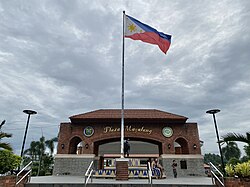
 Town hall
 -
 Public market
 -
 Plaza of Rizal
 -
 The covered court
 -
 View of Mount Arayat from Magalang, Pampanga highway
 -
 The Heliograph Tower


References
[edit]- ^ Municipality of Magalang | (DILG)
- ^ "2015 Census of Population, Report No. 3 – Population, Land Area, and Population Density" (PDF). Philippine Statistics Authority. Quezon City, Philippines. August 2016. ISSN 0117-1453. Archived (PDF) from the original on May 25, 2021. Retrieved July 16, 2021.
- ^ "2024 Census of Population (POPCEN) Population Counts Declared Official by the President". Philippine Statistics Authority. 17 July 2025. Retrieved 18 July 2025.
- ^ "PSA Releases the 2021 City and Municipal Level Poverty Estimates". Philippine Statistics Authority. 2 April 2024. Retrieved 28 April 2024.
- ^ "2024 Census of Population (POPCEN) Population Counts Declared Official by the President". Philippine Statistics Authority. 17 July 2025. Retrieved 18 July 2025.
- ^ "Victim or Villain? The Untold Story of the Priest Who Became the First Filipino Serial Killer". Esquire. 28 August 2021. Retrieved 27 October 2022.
- ^ Burgos, Roberto (January 13, 1994). "More cops deployed to avert violence". Manila Standard. Kamahalan Publishing Corp. p. 4. Retrieved December 26, 2021.
Lakandula immediately took over the municipal hall, prompting Mayor Lacson and his supporters to stage protest actions that threatened peace and order in the town.
- ^ Bartolo, Louie Aldrin and Dizon, Lino.(2016) The Magalang Book: The Historical Life and Culture of a Kapampangan Town (1605-2015). National Commission for Culture and the Arts.
- ^ Villa, Alexandra (December 25, 2015). "National Museum bares 2015 list of cultural treasures, properties". Philippine Daily Inquirer.
- ^ Pavia, Joey (March 5, 2017). "Pampanga town promotes historical structures". BusinessMirror.
- ^ Cayabyab, Charlene (May 31, 2021). "Magalang's commitment to cultural preservation". SunStar.
- ^ "Magalang Heliograph Towers declared 'cultural properties'". SunStar. August 22, 2017.
- ^ "Magalang: Average Temperatures and Rainfall". Meteoblue. Retrieved May 5, 2020.
- ^ "2024 Census of Population (POPCEN) Population Counts Declared Official by the President". Philippine Statistics Authority. 17 July 2025. Retrieved 18 July 2025.
- ^ Census of Population (2020). "Region III (Central Luzon)". Total Population by Province, City, Municipality and Barangay. Philippine Statistics Authority. Retrieved 8 July 2021.
- ^ Census of Population (2015). "Region III (Central Luzon)". Total Population by Province, City, Municipality and Barangay. Philippine Statistics Authority. Retrieved 20 June 2016.
- ^ Census of Population and Housing (2010). "Region III (Central Luzon)" (PDF). Total Population by Province, City, Municipality and Barangay. National Statistics Office. Retrieved 29 June 2016.
- ^ Censuses of Population (1903–2007). "Region III (Central Luzon)". Table 1. Population Enumerated in Various Censuses by Province/Highly Urbanized City: 1903 to 2007. National Statistics Office.
- ^ "Province of". Municipality Population Data. Local Water Utilities Administration Research Division. Retrieved 17 December 2016.
- ^ "2024 Census of Population (POPCEN) Population Counts Declared Official by the President". Philippine Statistics Authority. 17 July 2025. Retrieved 18 July 2025.
- ^ Historical / Public - Magalang Historical and Cultural Heritage
- ^ [eK!] magalang, pampanga, philippines: profile & brief history
- ^ history
- ^ Amlat Magaleno
- ^ Amlat Magaleno
- ^ Amlat Magaleno
- ^ Amlat Magaleno
- ^ "Poverty incidence (PI):". Philippine Statistics Authority. Retrieved December 28, 2020.
- ^ "Estimation of Local Poverty in the Philippines" (PDF). Philippine Statistics Authority. 29 November 2005.
- ^ "2003 City and Municipal Level Poverty Estimates" (PDF). Philippine Statistics Authority. 23 March 2009.
- ^ "City and Municipal Level Poverty Estimates; 2006 and 2009" (PDF). Philippine Statistics Authority. 3 August 2012.
- ^ "2012 Municipal and City Level Poverty Estimates" (PDF). Philippine Statistics Authority. 31 May 2016.
- ^ "Municipal and City Level Small Area Poverty Estimates; 2009, 2012 and 2015". Philippine Statistics Authority. 10 July 2019.
- ^ "PSA Releases the 2018 Municipal and City Level Poverty Estimates". Philippine Statistics Authority. 15 December 2021. Retrieved 22 January 2022.
- ^ "PSA Releases the 2021 City and Municipal Level Poverty Estimates". Philippine Statistics Authority. 2 April 2024. Retrieved 28 April 2024.
- ^ Magalang dot Org - Online Community for Magaleños, Magalang Pampanga Archived 2013-10-03 at the Wayback Machine
- ^ Bartolo, Louie Aldrin and Dizon, Lino.(2016) The Magalang Book: The Historical Life and Culture of a Kapampangan Town (1605-2015). National Commission for Culture and the Arts.
- ^ "Capitol spends P342M for infra in 7 towns". SunStar. 28 February 2014.
- ^ Reynaldo G. Navales (January 10, 2012). "P35-Million(or 800 thousand USD) Magalang hospital opens". SunStar. Sun.Star Publishing, Inc. Retrieved 13 December 2012.
- ^ "Masterlist of Schools" (PDF). Department of Education. January 15, 2021. Retrieved September 13, 2025.
External links
[edit]
- Magalang Profile at PhilAtlas.com
- magalang-heritage.weebly.com
- Magalang Online
- Philippine Standard Geographic Code
- Philippine Census Information
- Local Governance Performance Management System Archived 2012-07-01 at the Wayback Machine
Places adjacent to Magalang | |
|---|---|


 Province of Pampanga Province of Pampanga | |
|---|---|
| Municipalities | |
| Component cities | |
| Highly urbanized city |
|
Magalang
View on GrokipediaHistory
Founding and Early Settlement
Magalang was established as a pueblo on April 30, 1605, by Augustinian friars in the province of Pampanga, making it one of the region's oldest municipalities.[1][2] The founding occurred at the original site of Macapsa, located near present-day Sitio Balitucan in Barangay San Ildefonso, on the western slopes of Mount Arayat.[1] This establishment reflected the Spanish colonial strategy of organizing indigenous settlements into structured towns under ecclesiastical and civil administration to facilitate governance, evangelization, and tribute collection.[1] Early settlement centered on agriculture, with the fertile lands supporting rice cultivation and other crops from the outset, as the area's volcanic soil from Mount Arayat provided rich alluvial deposits.[8] By 1660, Magalang had solidified its status among Pampanga's 15 principal towns, indicating stable population growth and integration into the colonial economy.[1] The name "Magalang" derives from the Kapampangan term "magalang," denoting respectfulness or courtesy, attributed to the courteous demeanor of the early inhabitants.[1] Initial settlers were primarily indigenous Kapampangans, with the Augustinians overseeing the construction of a church and basic infrastructure to anchor community life.[1] Due to frequent flooding from the nearby Parua River, the town site was relocated in 1700 to Barangay San Bartolome, where it remained until a further transfer in the 19th century amid ongoing environmental challenges.[1][9] This early period laid the foundation for Magalang's enduring agricultural character, with settlement patterns emphasizing dispersed barrios suited to farming rather than dense urban centers.[8]Colonial Era and Revolutions
Magalang was formally established as a pueblo on April 30, 1605, by Augustinian friars under the Spanish reduccion system, which aimed to concentrate indigenous populations into organized settlements for easier administration and Christianization. Father Gonzalo de Salazar served as the first parish priest, and the town was initially known as Magalo, derived from the Kapampangan term describing the wavy flows of the nearby Parua River.[10] The settlement's location shifted multiple times due to flooding, relocating from Macapsa to San Bartolome in 1734 and later to San Pedro Talimunduc following a decree on December 13, 1863.[10] Under Spanish rule, Magalang emerged as a key agricultural hub in Pampanga, specializing in rice and sugarcane cultivation, alongside buri palm processing for products like tuba (palm wine), mats, and starch. Tobacco farming and indigo production for dyeing were also prominent, with the La Granja Modelo de Luzon experimental farm earning recognition at the 1887 Exposicion General de Islas Filipinas for cash crop innovations.[8] Territorial adjustments reduced its extent, as areas were separated to form Mabalacat, Bamban, Capas in 1680, Tarlac in 1686, and Concepcion in 1863.[8] During the 1660 Maniago Revolt, Magalang residents joined Kapampangan principales led by Don Francisco Maniago in protesting Spanish indigo quotas and forced labor, though the uprising was swiftly suppressed.[9] In the Philippine Revolution of 1896, initial revolutionary efforts in Magalang faced strong Spanish resistance; on September 8, 1896, volunteers from Bulacan and Nueva Ecija crushed local insurgents.[11] By February 1897, plans to liberate the town were formulated at Don Tomas Dizon's residence, leading to an assault on August 29, 1897, which Spanish forces repelled, killing 13 revolutionaries.[11] Further clashes intensified in late 1897, with Spanish troops capturing the Camansi base on November 27-28, resulting in 93 revolutionary deaths, though leaders General Francisco Macabulos and Major Servillano Aquino escaped.[11] Spanish defenses included blok haus fortifications and heliograph towers erected on May 8, 1898, in San Antonio to monitor insurgent movements, recognizing Magalang's strategic position as a gateway toward revolutionary strongholds in Cavite.[12] Magalang aligned with the Katipunan on June 26, 1898, arresting the local Spanish friar, and a revolutionary government assumed control by mid-1898 under Macabulos and Colonel Lorenzo D. Camaya.[11]American Period and Heliograph Towers
Magalang fell to United States forces on November 5, 1899, after Filipino revolutionaries under Major General Servillano Aquino mounted defenses against the invading American troops during the Philippine-American War.[13] This marked the transition to American military governance in the municipality, which preceded the establishment of civil administration under the Philippine Organic Act of 1902.[14] Under American colonial rule, Magalang prospered as a key center for sugar and rice production, benefiting from improved agricultural techniques and infrastructure developments typical of the era.[1] The establishment of the Pampanga Agricultural College during this period served as a pivotal institution, fostering advancements in farming practices and contributing to the town's economic growth.[1] Public education expanded significantly, with the implementation of the American educational system introducing compulsory elementary schooling and English-language instruction to promote literacy and civic values.[12] The heliograph towers, constructed in the late Spanish colonial period around 1897 on orders from General Ricardo Monet, represent enduring military infrastructure from the preceding revolutionary conflicts.[15] Designed for long-distance communication via reflected sunlight and Morse code signals using mirrors, these structures in Barangays Santa Cruz and San Isidro enabled the Spanish army to coordinate against Filipino revolutionaries, including forces led by General Francisco Macabulos.[15] Though predating American rule, the towers—declared important cultural properties by the National Museum in 2016—highlight Magalang's strategic role in regional defense and remain the only surviving examples in the Philippines.[16]Post-Independence Developments
Following Philippine independence in 1946, Magalang experienced ongoing instability due to the Hukbalahap rebellion, a communist-led peasant uprising that persisted in Central Luzon until 1954 and positioned the municipality as one of its strongholds. Huk forces conducted raids in the area as early as July 1946, displacing residents and disrupting local agriculture amid broader grievances over land tenancy and post-war economic hardship.[17][18] Efforts to stabilize and develop education emerged amid these challenges, with the founding of Magalang Institute in 1946 as the town's first private secondary school, aimed at producing local leaders and addressing wartime disruptions in schooling. The pre-existing Magalang Farm School, focused on agricultural training, was elevated to Pampanga National Agricultural School in 1954 under Commonwealth Act 313, expanding intermediate and high school programs to bolster rural productivity in rice, corn, and sugarcane farming.[19][20] This institution later evolved into Pampanga Agricultural College in 1974 via Republic Act 4576 and ultimately Pampanga State Agricultural University, emphasizing applied agricultural research and extension services to support the municipality's agrarian economy.[21] Economic progress accelerated from the 1970s, driven by government initiatives to enhance rural infrastructure and quality of life, including irrigation improvements and crop diversification that reduced reliance on subsistence farming. By the late 20th century, Magalang's economy remained anchored in agriculture, with key outputs like rice and dairy products such as pastillas de leche from carabao milk, supplemented by emerging commercial activities.[9][22] Recent decades have seen diversification into heritage and recreational tourism, leveraging sites like Mount Arayat trails and historical landmarks, earning recognition in 2022 for cultural preservation efforts that boosted local revenue without compromising agricultural roots.[5]Geography
Location and Topography
Magalang is a landlocked municipality located in the province of Pampanga within the Central Luzon region of the Philippines. It occupies a land area of 97.32 square kilometers. The municipal center is situated at approximately 15.214° N latitude and 120.662° E longitude.[3][23] The topography of Magalang features predominantly flat to gently undulating terrain typical of the Central Luzon plains, with average elevations around 44 meters above sea level. Elevations in the low-lying areas range from near sea level to about 50 meters, facilitating extensive agricultural use. The landscape rises notably toward the eastern and southeastern portions due to the proximity of Mount Arayat, an extinct stratovolcano that serves as a dominant landform in the region.[24][25] Mount Arayat reaches a height of 1,026 meters above sea level and straddles the boundary between Magalang and the adjacent municipality of Arayat, with significant portions of its northern slopes and summit falling within Magalang's jurisdiction. This volcanic feature contrasts sharply with the surrounding alluvial plains formed by the Pampanga River system, contributing to varied micro-topographies including foothills and plateaus suitable for diverse land uses.[26][27]
Administrative Divisions
Magalang is a municipality in the province of Pampanga, Philippines, politically subdivided into 27 barangays, which function as the basic political and administrative units under the Local Government Code of 1991.[3][1] These barangays include both urban poblacion areas, such as San Nicolas 1st, San Pedro 1st, and Santa Cruz, and rural zones encompassing agricultural lands and residential communities.[1] The barangays are: Ayala, Bucanan, Camias, Dolores, Escaler, La Paz, Navaling, San Agustin, San Antonio, San Francisco, San Ildefonso, San Isidro, San Jose, San Miguel, San Nicolas 1st, San Nicolas 2nd, San Pablo, San Pedro 1st, San Pedro 2nd, San Roque, San Vicente, Santa Cruz, Santa Lucia, Santa Maria, Santo Niño, Santo Rosario, and Turu.[3][1] Each barangay is governed by an elected barangay captain and council, responsible for local services, zoning, and community development within their jurisdiction.[3]Climate and Environmental Features
Magalang exhibits a tropical monsoon climate (Köppen classification Am), marked by consistently high temperatures, high humidity, and pronounced wet and dry seasons.[25] The dry season spans from December to May, while the wet season occurs from June to November, influenced by the southwest monsoon.[25] Average annual precipitation measures approximately 1,825 mm, with the heaviest rainfall concentrated between June and September.[28] Temperatures remain warm year-round, averaging 28.1°C annually, with minimal seasonal variation.[29] The hottest period occurs in March to May, when daily highs can reach 34°C and lows around 25°C, particularly in April.[25] Cooler conditions prevail from November to February, with average highs of 30°C and lows near 23°C, though relative humidity often exceeds 80%, contributing to oppressive conditions.[25] Environmentally, Magalang occupies low-lying plains at an average elevation of 44 meters, transitioning to the forested slopes of Mount Arayat in its northern barangays.[30] This stratovolcano, straddling the boundary with Arayat municipality, forms a prominent topographic feature that supports local hiking trails and biodiversity within Mount Arayat National Park.[31] The mountain's presence moderates microclimates in adjacent areas and contributes to fertile alluvial soils derived from volcanic activity and river deposits, vital for the region's agriculture.[32] However, the flat terrain and proximity to rivers heighten vulnerability to seasonal flooding during intense monsoon rains.[33]Demographics
Population Trends
The population of Magalang has demonstrated overall growth from the early 20th century onward, rising from 8,516 residents in the 1903 census to 124,188 in the 2020 census, reflecting factors such as agricultural expansion, improved infrastructure, and proximity to urban centers like Angeles City.[3] This represents an increase of 115,672 people over 117 years, with average annual growth rates varying from negative during wartime disruptions to peaks exceeding 8% in periods of rapid economic development.[3] A temporary decline occurred between 1939 and 1948, when the population fell from 16,634 to 13,049 at an annual rate of -2.46%, primarily due to World War II-related deaths, displacement, and destruction in Pampanga.[3] Postwar recovery accelerated expansion, with annual growth rates surpassing 3% from 1960 through 1975, driven by national population booms and local agricultural productivity.[3] The highest recorded rate, 8.67% annually from 1995 to 2000, coincided with industrialization in nearby areas and possible boundary adjustments or influx from rural-urban migration.[3] In recent decades, growth has moderated to approximately 2% annually, as seen in the 1.98% rate from 2015 to 2020, aligning with national trends of slowing fertility rates and urbanization pulling residents to larger cities.[3] This pattern underscores Magalang's transition from rapid rural expansion to steadier suburban development within Central Luzon.[3]| Census Year | Population | Avg. Annual Growth Rate (Previous Period, %) |
|---|---|---|
| 1903 | 8,516 | — |
| 1918 | 9,780 | 0.88 |
| 1939 | 16,634 | 2.69 |
| 1948 | 13,049 | -2.46 |
| 1960 | 18,626 | 3.18 |
| 1970 | 26,342 | 3.45 |
| 1975 | 31,462 | 3.63 |
| 1980 | 34,840 | 2.06 |
| 1990 | 43,940 | 2.35 |
| 1995 | 52,607 | 3.43 |
| 2000 | 77,530 | 8.67 |
| 2007 | 98,595 | 3.37 |
| 2010 | 103,597 | 1.82 |
| 2015 | 113,147 | 1.69 |
| 2020 | 124,188 | 1.98 |
Ethnic and Linguistic Composition
The population of Magalang consists predominantly of Kapampangans, the primary ethnolinguistic group native to Pampanga province, where they form the historical and cultural core of the region.[34] This composition aligns with provincial patterns, though rural municipalities like Magalang exhibit higher concentrations of indigenous Kapampangans compared to urbanized areas influenced by migration.[35] Minorities include Tagalogs and other groups from internal Philippine migration, but no granular ethnic census data specific to Magalang post-2000 is publicly detailed by the Philippine Statistics Authority; ethnolinguistic affiliation often proxies via language use, with Kapampangans numbering over 2 million nationally, largely in Pampanga.[36] Kapampangan is the dominant language spoken at home in Magalang, reflecting its status as the vernacular of the Kapampangan people.[37] Local 1995 census figures indicate 93.56% of residents spoke Kapampangan as their primary language, compared to 2.51% for Tagalog, with the remainder using other dialects or none specified; these proportions likely persist or slightly decline due to national trends favoring Tagalog/Filipino in education and media, though provincial usage remains around 78% for Kapampangan in everyday communication.[38][39] English serves as a secondary language in official and commercial contexts, consistent with national bilingual policy.Economy
Agricultural Sector
The agricultural sector forms a cornerstone of Magalang's economy, with rice as the dominant crop due to the area's alluvial soils and access to irrigation from the Pampanga River system and local canals. Sugarcane, corn, and tobacco rank as principal cash crops, supporting both local markets and export-oriented processing industries in Central Luzon.[32][40] Corn production in Magalang benefits from adoption of biotechnology, positioning the municipality among Pampanga's leading areas for biotech maize, which enhances yields and pest resistance through genetically modified varieties approved for commercial use.[41] Livestock integration, including buffalo dairying, complements arable farming; local carabao breeds improved via artificial insemination yield up to 14 liters of milk daily during peak lactation, bolstering rural incomes amid crop seasonality.[42] The Pampanga State Agricultural University (PSAU), established in Magalang since 1885 and chartered in 1974, advances sector productivity through research in sustainable models, including organic vegetable production, bio-fertilizers, and integrated pest management to reduce chemical dependency.[43][44] Initiatives like tissue culture labs target micropropagation of upland crops, while provincial programs urge diversification into high-value commodities such as those in demand for urban markets to mitigate risks from typhoon damage, which inflicted ₱110 million in losses during Super Typhoon Rolly in 2020.[45][46][47]Commercial and Industrial Activities
Commercial activities in Magalang center on retail trade, local markets, and small-scale businesses, supported by available commercial spaces for shops, offices, and services. The municipality's public market facilitates daily trade in goods, while properties in the town proper and barangays like Sta. Cruz are leased for retail stores, cafes, restaurants, pharmacies, and clinics, reflecting steady demand for consumer-oriented enterprises.[48][49] Industrial development is driven by export-oriented manufacturing, with the 62-hectare Philtai Industrial Park serving as a key PEZA-registered special economic zone for light to medium industries. Located 15 minutes from Clark Freeport Zone and near Clark International Airport, the park provides infrastructure including roads, power, water, and waste management, fostering job opportunities and business efficiency through government incentives.[50] Notable industrial projects include the Rebisco North Plant expansion on a 28-hectare site, where Phase 1 encompasses 150,000 square meters for manufacturing, distribution centers, and support facilities, with construction starting in Q1 2024 and targeting completion by September 2025. Manufacturing firms operating in Magalang encompass steel production by Chuangxing Steel Incorporated and printing by RNCJ Design and Print, contributing to the locality's diversification beyond agriculture.[51][52]Government
Local Governance Structure
The Municipality of Magalang adheres to the standard governance framework for Philippine local government units as outlined in Republic Act No. 7160, the Local Government Code of 1991, which delineates executive and legislative functions at the municipal level.[1] The executive branch is headed by the mayor, who holds primary responsibility for enforcing laws, managing administrative operations, and overseeing public services, with authority to appoint department heads and veto ordinances.[1] The current mayor, Maria Lourdes P. Lacson, was reelected on May 12, 2025, for a three-year term commencing July 1, 2025.[53] The legislative body, the Sangguniang Bayan, is presided over by the vice mayor and consists of eight elected councilors, along with three ex-officio members: the president of the Liga ng mga Barangay, the president of the Pederasyon ng mga Sangguniang Kabataan, and the municipal president of the Philippine Councilors' League.[7] This body enacts municipal ordinances, approves the annual budget, and conducts legislative oversight, with sessions held regularly as evidenced by the 12th Sangguniang Bayan's activities in 2025.[54] The current vice mayor, Eller Villanueva Pecson, leads these proceedings following the 2025 elections.[54] At the sub-municipal level, Magalang comprises 27 barangays, the smallest administrative divisions, each governed by a Sangguniang Barangay comprising an elected barangay captain and six councilors, including representatives for women, youth, and other sectors.[13] Barangay officials, serving three-year terms, manage local peacekeeping, basic services, and community development, reporting to the municipal government while maintaining autonomy in grassroots governance.[1]Historical Chief Executives
During the Spanish colonial period, Magalang's chief executives were known as gobernadorcillos or capitanes municipales, responsible for local administration under ecclesiastical and civil oversight. One early example was the brother of Fr. Juan Severino Mallari, elected as gobernadorcillo but relieved of duty in 1825 amid allegations of involvement in local murders.[55] Following the American occupation in 1899, the role transitioned to presidentes municipales under U.S. civil governance, emphasizing infrastructure and education reforms. Notable figures included Andres Luciano, who served from 1923 to 1925 and oversaw the construction of the new municipal building in 1924, replacing the old casa tribunal.[56] Isidro Ocampo held the position in the 1920s, reflecting the era's focus on local elite leadership tied to ancestral estates.[57] Jose C. Morales succeeded as presidente from 1928 to 1931, later serving as a provincial board member; his tenure involved political rivalries, including disputes with Luciano over alleged arson against sugarcane fields in 1932, which were dismissed in court by 1934.[58][59] Under Japanese occupation (1942–1945), Jose Navarro continued as the initial mayor after serving through the late American era until 1941, followed by Isidoro Ayuyao, Sr., whose administration faced severe hardships leading to his family's evacuation; Ayuyao had previously been municipal secretary during the American period.[60][61] Post-liberation in 1945, Benedicto T. Dayrit acted as town chief executive, contributing to reconstruction efforts documented in local histories.[9] The Commonwealth and post-independence eras saw the title standardize to mayor, often dominated by landed families amid sugar industry influences. The Lacson family exerted long-term control: Daniel T. Lacson, Sr., served from 1968 to 1986, spanning martial law under Ferdinand Marcos.[13] After the 1986 People Power Revolution, Pastor Z. Guiao's tenure elevated Magalang as one of Pampanga's cleanest municipalities through sanitation initiatives.[13] Daniel L. Lacson, Jr., followed from 1988 to 1998. Subsequent elections featured contests, such as the disputed 2007 victory of Lyndon Cunanan over Romulo Pecson amid fraud allegations, resolved in Pecson's favor.[1] Maria Lourdes "Malu" P. Lacson, the first female mayor, assumed office in 2022, continuing family influence while prioritizing local development.[62]| Name | Term/Period | Key Notes |
|---|---|---|
| Andres Luciano | 1923–1925 | Oversaw municipal building construction; American-era infrastructure focus.[56] |
| Isidro Ocampo | 1920s | Tied to local elite properties; early American governance.[57] |
| Jose C. Morales | 1928–1931 | Political rivalries; later provincial role.[58] |
| Jose Navarro | Up to 1941 (American); 1942 (Japanese) | Bridged regimes; occupation continuity.[60] |
| Isidoro Ayuyao, Sr. | Japanese era (1940s) | Evacuated amid hardships; prior administrative experience.[61] |
| Daniel T. Lacson, Sr. | 1968–1986 | Long tenure including martial law; family political dynasty. |
| Pastor Z. Guiao | Post-1986 | Sanitation and cleanliness awards.[13] |
| Daniel L. Lacson, Jr. | 1988–1998 | Continued family leadership. |
| Maria Lourdes P. Lacson | 2022–present | First female mayor; recent inauguration emphasized landslide victory.[62] |
Infrastructure
Transportation Networks
Magalang's transportation infrastructure relies predominantly on road networks, with no dedicated rail or waterway systems serving the municipality directly. National secondary roads, including the Mabalacat-Magalang Road and Magalang-Arayat Road as components of Route 213, provide connectivity to adjacent municipalities such as Mabalacat and Arayat. These routes facilitate access to broader provincial links, including the Jose Abad Santos Avenue (N3), enabling travel toward Tarlac to the north and Laguna to the south. Additionally, the Magalang-Concepcion Road connects the area to Tarlac's Concepcion, supporting inter-provincial movement.[63] The Department of Public Works and Highways (DPWH) has enhanced local connectivity through projects like the Arayat-Magalang Bypass Road, which reached 80% completion as of March 2024 and serves as an alternate route between Arayat and Magalang while integrating with the Pampanga Circumferential Road. In April 2025, DPWH finished Phase 2 of a farm-to-market road initiative in Magalang, improving access for agricultural transport and reducing travel times for rural residents. These developments aim to alleviate congestion on primary arteries and bolster links to economic hubs.[64][65] Public transportation in Magalang centers on jeepneys and tricycles for intra-municipal travel, with jeepneys operating along major roads to nearby towns like Angeles City and San Fernando. Tricycles dominate short-distance and barangay-level mobility, often serving as the primary mode for last-mile connectivity. Intercity buses from the nearby Dau terminal in Mabalacat provide service to Manila, with journeys taking approximately 2 hours and 27 minutes at a cost of ₱420 to ₱500 as of recent estimates. Access to Clark International Airport involves road travel via Mabalacat roads, typically 20-30 minutes by jeepney or taxi from Magalang. Buses from Dau also link to the North Luzon Expressway (NLEX) for efficient Manila commutes.[66][67]Health and Public Services
The primary health infrastructure in Magalang consists of government-operated rural health units (RHUs) and limited private facilities. The Magalang Rural Health Unit I, relocated to a new modern "super" facility in Barangay San Nicolas I on October 5, 2025, offers general consultations, maternal and child healthcare, immunizations, laboratory testing, and health education programs.[68] A second unit, Rural Health Unit II, provides complementary primary care services across the municipality.[69] The sole private hospital, St. John Paul II Medical Center Corporation, serves as the first such institution in Magalang, handling a range of inpatient and outpatient needs.[70] Public health initiatives emphasize preventive care and community outreach. Annual events like the Buntis Congress, held on September 17, 2025, deliver education, medical check-ups, and support for pregnant women to reduce maternal risks.[71] Local ordinances mandate RHUs and barangays to implement dengue prevention projects, including vector control and public awareness, supported by forecasting models for incidence prediction.[72] Training for barangay health workers in basic life support and advanced cardiac life support continues to bolster emergency response capabilities.[73] Public services include social welfare programs managed by the Municipal Social Welfare and Development Office (MSWDO), which addresses vulnerable populations through assistance and referrals.[74] A five-hectare regional hub for the Department of Social Welfare and Development is under development in Magalang on donated land, aiming to centralize services like livelihood programs and child protection.[75] Emergency hotlines operate for public safety coordination, while initiatives such as public market clean-ups promote sanitation and hygiene.[76]Utilities and Basic Amenities
Electricity distribution in Magalang is handled by Pampanga I Electric Cooperative, Inc. (PELCO I), a member-owned utility serving the municipality through its dedicated Magalang Area Office located on Luiz Dizon Drive in Barangay San Nicolas.[77] PELCO I maintains the local grid to ensure stable power supply, with the cooperative covering multiple Pampanga municipalities including Magalang, though residents have reported occasional outages attributed to regional infrastructure demands.[78] Potable water supply is primarily managed by the Magalang Water District, a local waterworks entity responsible for distribution and billing in the municipality.[79] Community-level systems, such as those in Barangay Asafa, rely on groundwater sources but face sustainability challenges due to over-extraction and limited maintenance, as assessed in local studies.[80] Broader Pampanga-wide concerns include potential groundwater shortages by 2025 from unchecked deep well usage by households and industries, prompting calls for integrated resource management.[81] Sanitation services incorporate a septage management program enforced via municipal ordinance, with collection fees integrated into water bills to fund waste treatment and disposal for households and businesses.[82] This system addresses onsite sanitation needs in the absence of widespread sewerage infrastructure, though enforcement and funding have drawn local debate, including temporary suspension requests amid economic pressures in 2025. Solid waste management falls under municipal oversight, with basic collection services provided, but detailed coverage metrics remain tied to barangay-level implementation.[83] Telecommunications infrastructure supports basic connectivity through national providers like Globe, which expanded affordable WiFi hotspots in select Magalang areas by 2020, alongside local internet service providers such as RTDS Network and Broadcable offering fiber and cable options up to 50 Mbps.[84][85] Mobile coverage includes 3G, 4G, and emerging 5G signals from major carriers, facilitating public services access.[86] Overall utility availability ranks moderately in national competitiveness indices, reflecting functional but infrastructure-constrained access typical of rural Philippine municipalities.[7]Education
Tertiary Institutions
The Pampanga State Agricultural University (PSAU) is the primary tertiary institution in Magalang, operating as a state university with its main campus situated in the municipality. Specializing in agricultural sciences and related disciplines, PSAU emphasizes education, research, and extension services to support regional agricultural development.[87] Its programs align with national mandates for advancing food security and sustainable farming practices.[88] PSAU offers undergraduate degrees such as Bachelor of Science in Agricultural Economics, alongside graduate programs, with annual tuition for bachelor's courses ranging from ₱12,000 to ₱14,000. As a state university and college (SUC), it qualifies under Republic Act No. 10931, the Universal Access to Quality Tertiary Education Act of 2017, granting free tuition to eligible first-time students in priority programs. The institution maintains ISO-certified quality management systems to ensure academic standards and has pursued international collaborations, including faculty exchanges with institutions like the University of Technology and Applied Sciences in Oman.[89] While smaller private entities like the Far East College of Information and Technology operate in Magalang and provide technical-vocational training registered with TESDA, they primarily focus on certificate-level courses in information technology and hospitality rather than full degree programs, limiting their role in traditional tertiary education.[90] PSAU remains the dominant provider of higher education degrees in the area, contributing to local workforce development in agriculture-dependent sectors.[87]Primary and Secondary Schools
Public primary education in Magalang is delivered through 30 elementary schools under the Department of Education (DepEd), providing coverage for the municipality's 27 barangays.[91][3] These institutions follow the national K-12 curriculum, focusing on foundational literacy, numeracy, and basic skills for grades 1 through 6. Secondary education encompasses junior high (grades 7-10) and senior high (grades 11-12) levels, served by seven public high schools.[91] Andres M. Luciano High School in Barangay San Pablo stands as the primary public secondary institution, originally established as Balitucan High School and later expanded and renamed in honor of local educator Andres Magdangal Luciano.[20] Other notable public high schools include Dolores National High School and Rodolfo V. Feliciano Memorial High School.[92] Private schools supplement public offerings, providing alternatives with potentially smaller class sizes and specialized programs. The Magalang Christian Ecumenical School, Inc., operates from primary through senior high levels, offering strands such as Accountancy, Business, and Management (ABM).[93] Magalang Institute Corporation similarly provides primary, secondary, and senior high education, including Humanities and Social Sciences (HUMSS) tracks.[93] The inaugural private secondary school in Magalang was founded in 1946 by community leaders to address growing educational demands post-World War II.[20]Recent Educational Initiatives
In May 2025, the Department of Public Works and Highways (DPWH) Pampanga 2nd District Engineering Office completed and turned over a two-story, four-classroom building at Mapiña Elementary School in Barangay San Ildefonso, valued at ₱14.6 million and funded through the General Appropriations Act.[94][95] This facility, equipped with comfort rooms on each floor, serves over 200 students and addresses overcrowding to improve academic performance and learning environments.[96] In February 2025, Don Honorio Ventura State University established partnerships with two public schools in Magalang under Project E-RISE (Electronics and Robotics Initiative for STEM Excellence), aimed at enhancing STEM education by providing training and resources to DepEd teachers and students in electronics and robotics.[92] These collaborations seek to foster innovation and technical skills among learners in the municipality.[92]Culture and Heritage
Religious Institutions
The San Bartolome Parish Church, dedicated to Saint Bartholomew the Apostle, serves as the central Roman Catholic institution in Magalang and falls under the Archdiocese of San Fernando. Established by Augustinian friars on April 30, 1605, in the original settlement of Macapsa, the parish marks one of the earliest missionary efforts in the region.[97] [98] The present Baroque church structure, with its original facade and walls, was constructed in the 19th century and is situated in Barangay San Nicolas I, reflecting enduring Spanish colonial architectural influences.[99] Santo Rosario Parish in Barangay Tinabang provides another focal point for Catholic worship, catering to residents in that area of the municipality.[100] Protestant presence includes the Mt. Zion United Methodist Church, located on Lacson Street in the poblacion, which supports Methodist services and community activities for local adherents.[101] Smaller evangelical groups, such as Hills of Glory International Christian Center and Mapina Missionary Baptist Church, offer additional worship options, contributing to religious diversity amid the predominantly Catholic population.[102][103]Festivals and Traditions
The Camaru Festival, held annually during the third week of August, celebrates the town's historical reliance on the mole cricket (Gryllotalpa orientalis), known locally as camaru, a protein-rich delicacy fried or cooked in traditional Kapampangan dishes. This event coincides with the Magalang Town Fiesta on August 24, honoring the patron saint Saint Bartholomew through religious processions, masses at San Bartolomé Parish Church, and civic activities including street dances, trade fairs, and cultural performances that highlight pre-colonial foraging practices and Spanish-era influences on local cuisine.[104][105][106] Lubenas, a longstanding Christmas tradition observed from December 16 to 24, involves barangay-level lantern processions (pasku-burol) preceding Simbang Gabi masses, where participants carry star-shaped parol lanterns symbolizing the Star of Bethlehem and recount biblical narratives through songs and prayers in Kapampangan. Recent iterations have featured over 400 illuminated lanterns converging in the town plaza, accompanied by orchestral concerts and culinary stalls offering native sweets, preserving a syncretic Catholic-indigenous ritual dating to the 19th century.[107][108] Holy Week, referred to as Mal a Aldo in the local dialect, includes solemn processions of religious images from San Bartolomé Church, with pre-war accounts describing temporary thatched markets and youth-led vigils around the chapel, emphasizing penance and community fasting rooted in Spanish colonial evangelization. The Taramindu Festival, an emerging event promoting tamarind (Tamarindus indica) as a cash crop, features harvest demonstrations and product fairs, aligning with efforts to position Magalang as a tamarind production hub amid agricultural diversification.[106][5]Historical Landmarks and Preservation Efforts
The San Bartolome Parish Church, also known as Magalang Church, stands as a primary historical landmark in Magalang, Pampanga. Established by Augustinian friars on April 30, 1605, in the area then called Macapsa, the parish predates the formal founding of the town proper.[97] The current structure, a 19th-century Baroque edifice located in Barangay San Nicolas I, features original facade and walls from the Spanish colonial period, reflecting enduring architectural integrity despite subsequent modifications. Magalang's heliograph towers, constructed in 1863 as solar telegraph stations, represent another key colonial-era landmark. These structures, equipped with mirrors for signaling via reflected sunlight in Morse code, facilitated military communication across Pampanga's terrain during Spanish rule; one tower in Barangay Santa Cruz remains better preserved than its counterpart in Barangay San Isidro.[109] In 2017, the National Museum of the Philippines declared both towers Important Cultural Properties, underscoring their role in pre-electric telecommunication history.[16] Local preservation initiatives have focused on documenting and maintaining these sites amid urban development pressures. The Magalang local government launched a heritage mapping project in 2019 to inventory historic structures, including the heliograph towers and church, aiming to integrate preservation into tourism and planning.[110] The Magalang Heritage Museum, operated by community advocates, collects artifacts and promotes awareness to safeguard tangible and intangible cultural elements, such as colonial-era relics from these landmarks.[111] These efforts align with broader provincial recognitions, emphasizing structural repairs and public education to prevent deterioration, as evidenced by the towers' inclusion in cultural property lists.[112]Notable Personalities
Political and Public Figures
Eusebio Aquino, known locally as Tatang Bio, emerged as a key political and resistance figure in Magalang despite being born in Concepcion, Tarlac. After relocating to barrio San Nicolas, he established a blacksmith shop near the Pasudeco station and organized guerrilla forces against Japanese occupiers during World War II. Serving as municipal mayor, he was the first to be re-elected under the Philippine Republic and was assassinated in the line of duty on December 28, 1963.[61][113] Joseller "Yeng" M. Guiao, born March 19, 1959, in Magalang, combined careers in politics and sports. He represented Pampanga's 1st congressional district in the House of Representatives from 2010 to 2013, affiliating with parties including the Liberal Party. Guiao's political tenure focused on local development issues in the region.[114] The Lacson family has exerted significant influence over Magalang's governance, with roots in colonial-era leadership. Modern examples include Maria Lourdes "Malu" Paras-Lacson, who was inaugurated as mayor following her 2022 election victory. Her administration emphasized local priorities amid competitive races. Vice Mayor Norman L. Lacson has supported municipal operations.[62] Romulo Pecson served multiple terms as mayor, notably reclaiming the position in 2019 by defeating incumbent Malu Lacson with a margin of 27 votes in a closely contested election. His returns highlight persistent rivalries in local politics.[115]Cultural and Academic Contributors
Emilio Aguilar Cruz (June 5, 1915–1991), a native of Magalang, emerged as a multifaceted cultural figure renowned for his work as a painter, writer, journalist, art critic, and diplomat. Displaying prodigious talent from childhood, including leading the local church choir by reading musical notation, Cruz studied fine arts and became a proponent of Philippine Impressionism, producing satirical works critiquing Filipino extravagance and vanity while influencing subsequent generations of artists through his affiliation with the Dimasalang group.[116][117][118] As a writer and editor, Cruz contributed essays, literary pieces, and journalistic commentary, often under the pseudonym "Abe," blending nationalism with social critique; he later served as the Philippines' permanent representative to UNESCO from 1978 to 1981, self-teaching French to translate foreign texts during his tenure in Paris.[119][120] His oeuvre extended to curation and advocacy, with family donations of over 100 artworks to the National Museum in 2017 marking his centennial and underscoring his enduring impact on Philippine visual arts.[121] In academia and education, Magalang's contributions are evident through familial lineages like the Ayuyaos, who produced educators such as Carmelita Mandig, former registrar at Pampanga State Agricultural University, and Magdalena G. Sarmiento, a longtime public school teacher, reflecting a local emphasis on instructional roles amid the municipality's agricultural and historical focus.[122] Local writers like Jose M. Navarro, who authored poetry, essays, and zarzuela scripts alongside public service as chief of police and two-term mayor, further bridged cultural expression with community leadership, though national prominence remains centered on figures like Cruz.[123]References
- https://commons.wikimedia.org/wiki/File:9570jfConcepcion_Tarlac_Highway_Magalang_Pampanga_Roadfvf_15.JPG
- https://commons.wikimedia.org/wiki/Category:Magalang_Heliograph_towers