Hubbry Logo
PastillasPastillasMain
Open search
Pastillas
Community hub
Pastillas
logo
8 pages, 0 posts
0 subscribers
Be the first to start a discussion here.
Pastillas
Pastillas
from Wikipedia

Pastillas
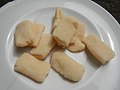
Traditional pastillas made from carabao's milk
TypeSweets
Place of originPhilippines
Region or stateSan Miguel, Bulacan, San Pedro, Laguna
Main ingredientsCarabao or cow milk
VariationsYema
  •   Media: Pastillas

Pastillas, also known as pastillas de leche (literally "milk pills"), refer to a type of milk-based confections that originated in the town of San Miguel in Bulacan, Philippines. From San Miguel, pastillas-making spread to other Philippine provinces such as Cagayan and Masbate.[1]

Description

[edit]

Initially, pastillas de leche were primarily home-made by carabao-rearing farmers. A small-scale industry on the food product soon grew, with the pastillas made from either carabao or cow milk or both. Refined sugar and calamansi juice are also added during the pastillas-making process.[1]

In San Miguel, Bulacan, a Pastillas Festival has been celebrated every May since 2006. The pabalat tradition is also included in the festival, which involves the display of elaborate paper-cut designs using the pastillas' wrapper material.[2]

Variants

[edit]

There are three main categories of pastillas based on consistency: soft pastillas, hard pastillas, and toasted pastillas. Soft pastillas has a soft creamy texture. Hard pastillas is a denser version that crumbles when eaten. Toasted pastillas is lightly baked in an oven so that the exterior is browned - giving it the texture of hard pastillas on the outside and soft pastillas on the inside. Another category is the filled pastillas, which are basically just pastillas with a different-flavored filling.

Pastillas has numerous variants based on the ingredients used. One of the most common variants is the pastillas de yema (also called yema pastillas or pastiyema). It is a type of filled pastillas with a filling of yema, a very sweet traditional Filipino custard confectionary.[3]

Other variants also use other flavors and ingredients, like pastillas de mani (peanuts), pastillas de pili (pili nuts), pastillas de ube (purple yam), pastillas de mangga (mango), and so on. In the Davao region of southern Mindanao, a popular variant is the pastillas de durian (also called "durian candy").[3]

Similar dishes

[edit]

Dulce gatas is another type of confection from Negros Island, which is sometimes considered a type of pastillas since it uses the same ingredients of carabao milk and sugar (in this case, muscovado sugar). Unlike pastillas, however, it is a liquid, and isn't eaten as a candy, but rather as a spread for bread or crackers.[3]

See also

[edit]

References

[edit]
Revisions and contributorsEdit on WikipediaRead on Wikipedia
from Grokipedia
Pastillas de leche, commonly known as pastillas, is a traditional Filipino milk candy characterized by its soft, creamy texture and sweet, milky flavor, made primarily from , sugar, and sometimes butter or . These bite-sized confections, often shaped into small cylinders or ovals and wrapped in delicate, colored rice paper, represent a beloved staple in Philippine sweets and are enjoyed as snacks or gifts during holidays and celebrations. Originating in the town of San Miguel in province, pastillas de leche traces its roots to the Spanish colonial period, when () farmers in the region began producing the as a way to preserve and utilize surplus , likely influenced by Spanish colonial culinary traditions that emphasized dairy-based sweets. Traditionally prepared by slowly cooking down carabao's with until it thickens into a dough-like consistency, the process was labor-intensive and home-based, evolving from a into a small-scale industry that remains iconic to local economy and culture. In contemporary Philippine society, pastillas holds significant cultural value as a symbol of and regional pride, frequently shared at fiestas, weddings, and as (gifts for loved ones) when traveling, with the artisanal paper wrappers—often featuring intricate cut-out designs—adding to its charm and serving as a tradition unique to San Miguel. While classic pastillas relies on simple ingredients for its pure taste, modern variations incorporate flavors like ube (purple yam), durian, or pandan to appeal to diverse palates, yet the original version continues to embody the essence of Filipino ingenuity in transforming everyday dairy into a cherished .

History

Origins

Pastillas de leche, a milk-based confection, emerged in the during the Spanish colonial period spanning the 16th to 19th centuries, rooted in the dairy practices introduced by Spanish colonizers. The reflects an adaptation of European milk sweets to local resources, particularly the milk from carabaos (water buffaloes), which were integral to Filipino agriculture and provided surplus dairy for rural households. The geographic origins trace to province, north of , where carabao-rearing farmers in areas like San Miguel began producing pastillas at home using excess from their , which yielded about 1 liter per animal daily as a sideline activity. This province's proximity to the colonial capital facilitated the integration of Spanish culinary influences with indigenous farming traditions, transforming surplus carabao —richer and creamier than cow's —into a preserved sweet to prevent waste. First documented production of pastillas occurred around the late in these rural farmlands, coinciding with increased peddling of buffalo milk in and the growth of small-scale dairy processing among farmers. Food historian Felice Prudente Sta. Maria notes that the likely developed during this era as a practical response to available ingredients, marking the beginning of its cultural significance in .

Development and Spread

In the early , pastillas production in the transitioned from a homemade craft primarily undertaken by elite women in rural households to small-scale commercial ventures, particularly in , where the abundance of milk supported local industry growth. This shift was facilitated by the confection's appeal as a festive treat for community events, gradually extending to other areas in and nearby provinces. Following , traditional pastillas making experienced a period of decline due to , industrialization, and reduced carabao populations, which limited fresh availability; however, production rebounded through adaptations like substituting , enabling easier and more scalable manufacturing amid postwar resource constraints. These changes allowed pastillas to evolve from a farm-based —originally reliant on carabao simmered with —into a more accessible product suitable for wider distribution. By the , pastillas surged in popularity among Filipino communities, fueled by its role as a nostalgic cultural for balikbayans and through initiatives like the 2005 One Town One Product (OTOP) program, which featured the confection in international showcases such as Las Vegas trade fairs. This global outreach, combined with annual festivals in starting in 2006, solidified pastillas as a symbol of Philippine heritage, with small- to medium-scale producers adapting to meet overseas demand from overseas Filipino workers and their families.

Characteristics

Physical Description

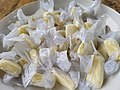
Pastillas de leche typically take the form of small, cylindrical logs or spherical balls, measuring about 1 to 2 inches in length or diameter, making them convenient bite-sized treats. The candies exhibit a smooth, off-white or milky appearance derived from their milk base, often dusted or rolled in granulated sugar to create a sparkling, crystalline exterior that enhances their visual appeal. When fresh, pastillas are soft and pliable to the touch, with a firm yet yielding consistency that can become slightly chewy upon slight pressure. Traditionally, individual pieces are wrapped in colorful , wax paper, or Japanese paper (papel de hapon), often folded into neat squares or cylinders to protect the delicate confection and add an ornamental touch suitable for gifting. These wrappers may feature intricate designs, and the candies are sometimes presented in boxes for commercial or festive packaging. Regional variations might include elongated sticks or other shapes, but the classic form remains compact and handheld.

Flavor and Texture

Pastillas de leche is renowned for its sweet, milky flavor profile, which is primarily derived from the prolonged cooking of milk and sugar, resulting in subtle caramelized notes that enhance its richness without overpowering the inherent creaminess. This combination evokes a comforting, nostalgic taste that balances intense sweetness with a gentle undertone, making it a beloved treat in . The texture of classic pastillas is soft and chewy, offering a delightful that slowly melts upon chewing, providing a smooth and creamy sensation. A slight graininess, stemming from undissolved sugar crystals formed during preparation, adds a subtle tactile contrast that contributes to its authentic character, as noted in sensory evaluations assessing on a scale from smooth to grainy. When stored properly in an at or refrigerated, pastillas maintains its quality for 1 to 2 weeks, though it tends to firm up gradually as moisture evaporates, transitioning from its initial pliability to a denser consistency. Flavored variants may alter this sensory experience with added notes, but the traditional form preserves its signature milky purity.

Ingredients

Primary Components

The primary ingredient in traditional pastillas de leche is carabao milk, also known as milk, which serves as the creamy base that gives the candy its characteristic richness and smooth texture. A standard batch typically uses about 1 liter (or roughly 4-5 cups) of this fresh milk, sourced from carabao farming regions like in the , where the milk's higher fat content contributes to the confection's velvety consistency. White granulated is the essential sweetener and thickening agent, typically added in amounts of ½ to 1 per liter of to balance the milk's natural flavors while helping reduce the mixture to a pliable dough-like state during preparation. This simple combination of and forms the core of the traditional recipe, emphasizing the candy's origins as a straightforward dairy-based treat. Butter or is optionally incorporated in small amounts, typically 1 to 2 tablespoons per batch, to enhance richness and prevent sticking without overpowering the primary flavor. While not always present in the most basic historical versions, this addition has become common in many traditional formulations for added smoothness. In modern recipes, substitutions like condensed or may replace fresh carabao for convenience.

Variations in Composition

In modern urban settings, where access to fresh may be limited and preparation time is a concern, or serves as a convenient substitute for the traditional fresh milk base in pastillas recipes. These alternatives reduce the need for extensive to evaporate water content, allowing for no-cook or quicker methods while maintaining the creamy texture through combination with . Subtle flavor enhancements can be achieved by incorporating extracts such as or pandan into the mixture during blending. adds a mild, comforting aroma that complements the milk's richness without overpowering the core sweetness, often used in small amounts like 1 per batch. Pandan extract, derived from the screwpine , introduces a nutty, grassy note typical of Southeast Asian desserts, enhancing the tropical profile in variations like buko pandan pastillas. Texture variations are introduced by adding small quantities of nuts or purees to the dough-like , providing subtle crunch or without altering the fundamental milk-sugar composition. For example, chopped roasted nuts (about 1 tablespoon) can be folded in for a nutty bite, as seen in fruity pastillas that also incorporate well-drained, chopped fruit cocktail for a hint of tartness and natural puree-like consistency. In kalabasa pastillas, 2 cups grated squash (or equivalent mashed puree) is mixed in to yield a slightly denser, vegetable-infused texture while boosting through added beta-carotene.

Preparation

Traditional Process

The traditional process for making pastillas de leche relies on fresh milk, ideally from carabao for its higher fat content and creamier result, combined with sugar to create a simple yet labor-intensive confection. The preparation starts by pouring the milk into a wide, heavy-bottomed pot and adding sugar, for example in a ratio of 5 cups milk to 1 cup sugar, then heating the mixture over low flame while stirring continuously to prevent scorching or curdling. This simmering continues for 1 to 2 hours, gradually evaporating the liquid until the mixture thickens into a soft, dough-like paste that pulls away from the sides of the pot, concentrating the natural milk solids and developing a subtle caramelized flavor. Some recipes incorporate , lime zest, or after initial reduction to enhance smoothness and firmness. After reaching the proper consistency, the hot paste is transferred to a lightly greased surface, such as a plate or board, and allowed to cool for 10 to 15 minutes until warm but handleable, avoiding full cooling to maintain workability. The slightly cooled mixture is then kneaded vigorously by hand for several minutes, folding and pressing it to distribute moisture evenly and eliminate any lumps, resulting in a smooth, elastic that holds its shape without sticking excessively. The kneaded dough is portioned into small pieces, often 20 to 40 depending on desired size, and rolled or pressed into cylindrical logs about 1 to 2 inches long or into balls for variation. Each piece is then rolled in fine granulated to form a thin, sparkling coating that adds texture and preserves freshness, before being individually wrapped in , wax paper, or traditional Japanese paper to prevent drying out and facilitate easy serving. This hands-on method, passed down through generations in regions like , emphasizes patience and constant attention to yield the authentic milky sweetness and tender bite of classic pastillas.

Modern Adaptations

In contemporary kitchens, modern adaptations of pastillas preparation emphasize efficiency and convenience, leveraging readily available ingredients like to bypass the labor-intensive of fresh required in traditional recipes. These methods cater to busy home cooks and small-scale producers by minimizing cooking time and equipment needs while preserving the candy's signature creamy, chewy texture. A prominent no-cook technique involves mixing with and melted to create a pliable . The mixture is stirred until uniform, shaped into small logs or balls, and rolled in granulated sugar for coating; this approach yields about 30 to 40 pieces in under an hour total, offering a quick alternative that requires no stove or oven. For commercial or large-batch production, food processors enable efficient scaling by rapidly the dough-like mixture, processing up to several cups of with liquids in seconds to achieve a consistent texture across hundreds of pieces. This mechanized replaces manual effort, allowing producers to handle bulk quantities while maintaining uniformity in shape and firmness.

Variants

Regional Styles

Pastillas production in the showcases distinct regional styles shaped by local resources and culinary practices, particularly in milk selection and processing techniques that influence texture and form. The style, originating from San Miguel, centers on pure milk as the primary ingredient, creating smaller, softer pieces that are smooth and melt-in-the-mouth due to the milk's high fat content and minimal additives. This approach preserves the confection's traditional tenderness, often wrapped in intricately cut Japanese paper for presentation.

Flavored and Filled Types

Pastillas variants extend the traditional milk-based confection by incorporating additional flavors or fillings to create diverse taste profiles and textures. Ube pastillas, a widely enjoyed flavored type, is made by blending ube halaya—a jam derived from purple yam—with condensed milk and powdered milk, resulting in a soft, chewy candy with a vibrant violet color and a nutty, slightly earthy taste that complements the milky sweetness. Filled pastillas introduce a layered experience, most notably in yema-filled versions where a smooth outer shell of classic pastillas encloses a creamy core called yema. The yema filling is prepared by cooking yolks with and to form a thick, rich paste, providing a contrasting custardy interior that enhances the overall indulgence while maintaining the confection's portable, bite-sized form. Fruit-infused pastillas further diversify the category by integrating natural fruit elements into the dough for added tanginess and aroma. pastillas, for example, achieve their tropical profile through the addition of mango-flavored or puree mixed with , yielding a chewy treat that evokes the fruit's sweet, juicy essence. Similarly, variants incorporate the Philippine lime's zest or juice to introduce a subtle brightness, balancing the richness of the milk base as permitted in standard compositions.

Cultural Significance

Role in Filipino Cuisine

Pastillas de leche holds a cherished place in as a versatile and , prized for its soft, creamy texture and subtle sweetness derived from and sugar. Often enjoyed during , the traditional afternoon break, it provides a simple yet satisfying indulgence that complements everyday meals. This confection is frequently paired with hot beverages such as or , enhancing the merienda experience by balancing the richness of the milk-based candy with the warmth and slight bitterness of the drink. In festive contexts, pastillas is a staple in gift baskets during holidays like and local fiestas, where it is wrapped in colorful paper and shared as a token of and celebration. Nutritionally, pastillas is high in calories, with each piece containing approximately 50 to 100 calories depending on size and preparation, primarily from carbohydrates in the form of milk sugars like and added . These sugars deliver quick energy, making it a convenient pick-me-up for busy days in Filipino food culture.

Traditions and Commercialization

In , pastillas holds a prominent place in town fiestas, where homemade batches are prepared in large quantities and shared communally among attendees. These events, such as the annual Pastillas Festival in San Miguel, feature pastillas wrapped in intricate (handcrafted paper cut-outs) used as decorations, table centerpieces, and souvenirs, fostering community bonds and showcasing local craftsmanship. Pastillas also plays a key role in Filipino gift-giving customs, particularly as —souvenirs brought by travelers returning from provincial visits to share with family and friends in urban areas. This tradition underscores its symbolic value as a token of home and , often evoking and cultural connection during reunions or holidays. The commercialization of pastillas has transformed it from a home-based delicacy to a widely available product, with major producers emerging in regions like and . Businesses such as Ocampo's Specialty Products in , and Aying's Homemade Pastillas in , , have scaled up operations using local milk, expanding to multiple outlets and innovative flavors while preserving traditional methods. Urban distribution centers in areas like facilitate broader market access through stores and kiosks, meeting national demand.

Similar Filipino Confections

Pastillas shares its and foundation with several other traditional Filipino confections, reflecting shared culinary influences from Spanish colonial times that emphasized sweetened dairy products. Among these, yema stands out as a close relative, both being classified as ethnic milk-based sweets under Philippine food standards. Yema is prepared by cooking yolks with and —often in modern versions—to form a thick, custard-like paste that is shaped into balls or pyramids and sometimes glazed with . Unlike pastillas, which is molded into smooth cylinders or sticks and rolled in granulated for a chewy texture, yema typically remains unshaped beyond basic forming, resulting in a softer, more custard-y consistency while maintaining a comparable intense sweetness. In contrast, polvoron offers a crumbly alternative to pastillas' pliability, though it incorporates as a key ingredient. This shortbread-style treat is made by toasting and mixing it with , , and melted , often enhanced with additions like toasted or nuts, before pressing into molds. The resulting texture is powdery and melts in the mouth upon biting, diverging from pastillas' firm yet yielding chew, but both rely on derivatives and for their rich, comforting flavor profile rooted in everyday Filipino snacking traditions. Tablea, or tablea tsokolate, connects to pastillas through broader colonial sweet-making practices introduced by the Spanish in the via the Galleon Trade, which brought cacao cultivation to regions like and . These pure cacao tablets, formed by grinding roasted cacao beans with minimal sugar, are primarily used to prepare thick drinks but represent an early adaptation of European techniques to local ingredients. While pastillas focuses on solidification, tablea emphasizes cacao's bitter-sweet essence, yet both exemplify how colonial exchanges fostered enduring Filipino treats centered on sugar processing and simple molding.

Global Comparisons

Pastillas de leche shares a foundational similarity with dulce de leche in its reliance on reducing milk and sugar to create a concentrated, sweet confection, though pastillas remains pale and chewy with a pronounced milky essence rather than caramelizing to a golden, spreadable consistency. This method of slow-cooking milk solids with sugar highlights a common thread in Latin American and Filipino milk-based sweets, emphasizing preservation and flavor intensification without the deep browning typical of dulce de leche. In Indian cuisine, pastillas de leche parallels peda, a soft milk fudge crafted from khoa (reduced milk solids), sugar, and often ghee for added richness, resulting in a comparable tender, melt-in-the-mouth texture that balances creaminess and subtle sweetness. Unlike pastillas, which typically uses fresh or carabao milk without additional fats like clarified butter, peda incorporates ghee to enhance its fudgy mouthfeel and may include cardamom or nuts for aromatic depth, yet both represent traditional techniques for transforming milk into portable, festive treats. Peda's semi-soft, disc-like form with a central indentation, originating from regions like Uttar Pradesh, underscores its role as an everyday or celebratory sweet, much like pastillas in Philippine gifting traditions. Japanese milk candies, such as Fujiya's Peko-chan , exhibit a similar intense sweetness profile to pastillas de leche, derived from high-quality like milk condensed into a creamy base, but feature a softer, chewy taffy-like consistency that dissolves smoothly on the . Introduced in amid Japan's milk shortage, these candies prioritize a pure milk flavor without spices, contrasting pastillas' occasional notes, while their individual wrapping and portability echo the tissue-paper presentation of Filipino versions. This shared emphasis on milk as the star ingredient reflects broader Asian innovations in confections during the mid-20th century.

References

Add your contribution
Related Hubs
User Avatar
No comments yet.