Hubbry Logo
Marcus Wallenberg Jr.Marcus Wallenberg Jr.Main
Open search
Marcus Wallenberg Jr.
Community hub
Marcus Wallenberg Jr.
logo
8 pages, 0 posts
0 subscribers
Be the first to start a discussion here.
Marcus Wallenberg Jr.
from Wikipedia

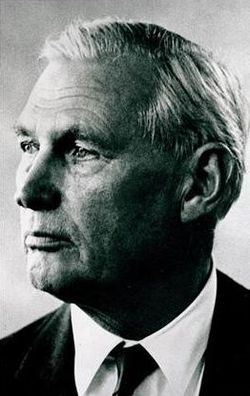
Marcus "Dodde" Wallenberg Jr. RoKKMO (5 October 1899 – 13 September 1982), was a Swedish banker, business manager and member of the Swedish Wallenberg family. He was the most influential representative for the Swedish industrial tradition and Swedish business’ during the 20th century. He was the CEO of Stockholms Enskilda Bank 1946–1958 and during half a century – from the early 1930s until his death in 1982 – he led and reconstructed many of Sweden's largest companies. During World War II, Marcus, together with Erik Boheman, were appointed to conduct the Swedish trade negotiations.[1][2]

Key Information

Marcus Wallenberg had a big interest in sailing and tennis. He participated in the 1936 Olympic sailing competitions and was a Swedish elite tennis player. He received a technological honorary degree from Royal Institute of Technology.

The historian of business and author Ronald Fagerfjäll [sv] describes him as Europe's most powerful banker of the 20th century.[3]

Early life

[edit]

Wallenberg was born on 5 October 1899, in Stockholm, Sweden, the son of Marcus Wallenberg and his wife Amalia (née Hagdahl) and brother of Jacob Wallenberg.[4] He passed studentexamen in 1917, became a reserve officer in 1919, and graduated from the Stockholm School of Economics in 1920. Wallenberg pursued banking studies and had various jobs in Geneva, London, New York City, Paris, and Berlin from 1920 to 1925.[4] Wallenberg was an avid tennis player and became Swedish indoor champion in singles game for gentlemen in tennis in 1920 and 1926.[4]

Career

[edit]

Wallenberg became assistant director of Stockholms Enskilda Bank in 1925 and was Vice CEO and member of the board there from 1927.[5] Wallenberg was during the early 1930s board member of Järnvägs AB Stockholm–Saltsjön, AB Atlas Diesel, Investor AB, AB Diligentia, Rederi AB Tanker, ASEA, AB Elektro-Invest and Trafik AB Stockholm-Björknäs. He was also a member of the council of the Stockholm Chamber of Commerce.[5] He was in the late 1930s, chairman of the board of AB Atlas-Diesel, AB Lauxein-Casco, Hults Bruks AB, Industri AB Furuplywood and Trafik AB Stockholm-Björknäs. Wallenberg was also vice chairman of Telefon AB L.M. Ericsson and board member of AB Diligentia, Electro-Invest, AB Förenade Flygverkstäderna, AB Nordströms Linbanor, AB Scania-Vabis, AB Svenska Järnvägsverkstäderna, ASEA, Ericsson Telephones Limited, Järnvägs AB Stockholm–Saltsjön, Mexican Telephone and Telegraph Co., Plantagengesellschaft Clementina, Società Elettro-Telefónica Meridionale, Società Esercizi Telefonici and the Federation of Swedish Industries (Sveriges Industriförbund). He was also chairman of the Swedish Lawn Tennis Association (Svenska Lawntennisförbundet) and the Sailing Association Havsörnarna.[6]

Wallenberg (right) together with SAS' board of directors, 1960s.

Wallenberg was in the mid-1940s the chairman of AB Atlas Diesel, Hults Bruks AB, Igelsta Trävaru AB, Järnvägs AB Stockholm–Saltsjön, Mexikandra Telefon AB and Max Sieverts Fabriks AB.[4] He was vice chairman of Halmstad-Nässjö Järnvägs AB, Goodyear Gummi Fabrik AB, AB Papyrus, Svensk Interkontinental Lufttrafik AB, Telefon AB L.M. Ericsson and Yngeredsfors Kraft AB.[4] Wallenberg was also board member of ASEA, Björneborgs Jernverks AB, AB Aerotransport, AB Diligentia, AB Elektro-Invest, AB Nordströms Linbanor, AB Scania-Vabis, AB Svenska Amerika Linien, AB Svenska Järnvägsverkstäderna, AB Svenska Maskinverken, AB Svenska Ostasiatiska Kompaniet, Stora Kopparbergs Bergslags AB, SAAB, Wifstavarfs AB, Banque d'État du Maro, Mexican Telephone & Telegraph Co., Federation of Swedish Industries, Swedish Bankers' Association (Svenska Bankföreningen), Swedish National Commission for International Business (Svenska nationalkommissionen för internationella näringsfrågor) and the Swedish National Museum of Science and Technology.[4]

He was chairman of the Swedish representatives on the permanent Swedish-British Intergovernmental Commission from 1939 to 1943[4] and member of the permanent Swedish-British-American Intergovernmental Commission from 1943[4] and the Swedish Commission for the Swedish-Finnish trade negotiations from 1940 to 1944.[7] He was also board member of the Swedish-English Association (Svensk-Engelska Föreningen)[4] and chairman of the Swedish Tennis Association (Svenska Tennisförbundet) from 1934 to 1953.[8] In 1946, Wallenberg became CEO of Stockholms Enskilda Bank. He held the post until 1958 when he became vice chairman of the board.[8] During the 1950s, he was chairman of the board of AB Atlas Diesel, LM Ericsson, Scandinavian Airlines and the Swedish Bankers' Association.[7] Wallenberg was a board member of ASEA (chairman from 1956), Stora Kopparbergs Bergslags AB, Federation of Swedish Industries (vice chairman from 1959,[8] chairman 1962-1964[9]) and the International Chamber of Commerce as well as chairman of its Swedish National Committee from 1951 to 1964 (honorary chairman from 1964)[9] and was CEO of the English-Swedish Chamber of Commerce from the 1954. Wallenberg was also chairman of the Royal Lawn Tennis Club (Kungliga Lawn Tennis Klubben)[7] and he became honorary chairman of the Swedish Tennis Association in 1953.[8]

Wallenberg was chairman of the Swedish Bankers' Association twice, 1949-1951 and 1955-1957[8] and chairman of the Research Institute of Industrial Economics from 1950 to 1975 (honorary chairman from 1975).[10] He was chairman of the Council of European Industrial Federations (CEIF) from 1960 to 1963 and in the Business and Industry Advisory Committee to the OECD (BIAC) from 1962 to 1964. Wallenberg was a member of the Economic Planning Council (Ekonomiska planeringsrådet) from 1962 to 1964 and chairman of the International Chamber of Commerce from 1965 to 1967.[9] He was a member of the Steering Committee of the Bilderberg Group from 1954 to his death in 1982. He was also a board member of Knut and Alice Wallenberg Foundation[9] and the Nobel Foundation.[10] Wallenberg co-chaired the ICC-UN/GATT Economic Consultative Committee from 1969 to 1971. In 1969, he left the post of vice chairman of Stockholms Enskilda Bank and became chairman for two years until 1971 when the bank merged with Skandinaviska Banken and formed Skandinaviska Enskilda Banken. Wallenberg was chairman there from 1972 to 1976.[10]

Personal life and death

[edit]
Villa Täcka Udden, residence of Wallenberg from 1978 until his death in 1982.

He was the father of Marc Wallenberg (1924–1971; who in turn was the father of Marcus Wallenberg), Peter Wallenberg Sr. (1926–2015) and Ann-Mari Wallenberg (1929–2019) in his first marriage (1923–1935) with Dorothy Mackay (1900–1984) from Scotland, the daughter of Alexander C.A. Mackay and Edith Bums.[11][5] In 1936 he married Baroness Marianne De Geer af Leufsta (born 1893), the daughter of chamberlain Baron Louis de Geer af Leufsta and Baroness Märtha Cederström.[6] Marianne had previously been married to Carl Bernadotte af Wisborg.[11]

Death

[edit]

Wallenberg died on 13 September 1982 in his residence, the Villa Täcka Udden on Djurgården in Stockholm, after having been ill since the beginning of the year. The funeral was held in Saint James's Church in Stockholm on 22 September. The bells of the Riddarholmen Church rang the so-called Serafimerringning because Wallenberg was a Knight of the Royal Order of the Seraphim. He had built a private cemetery on Vidbynäs in Södertörn south of Stockholm, which was Wallenberg's residence until his wife's death in 1978. There his urn was buried at the side of the urn that holds the dust of his second wife.[12]

Awards and decorations

[edit]

Swedish

[edit]

Foreign

[edit]

Honours

[edit]

See also

[edit]

References

[edit]

Further reading

[edit]
[edit]
Revisions and contributorsEdit on WikipediaRead on Wikipedia
from Grokipedia
Marcus Wallenberg Jr. (1899–1982) was a Swedish banker and industrialist from the fourth generation of the , which founded in 1856. As CEO of the bank from 1946 to 1958, he directed its operations and those of , the family's investment company established in 1916, steering a vast industrial conglomerate that included leading firms in telecommunications, aviation, and engineering. Under his stewardship, the Wallenberg sphere expanded to control companies such as , SAAB, , , , and Stora, pioneering structures like dual-class shares to consolidate voting power. Wallenberg Jr. demonstrated hands-on leadership by rescuing Ericsson from financial ruin following the 1932 Kreuger crash, joining its board in 1933 and chairing it from 1953 to 1977, during which he negotiated key international deals that bolstered its global position. His tenure saw the family's holdings achieve dominance in the Swedish economy, representing about 40% of the Stockholm Stock Exchange's market capitalization by 1982 and employing roughly 40% of the nation's industrial workforce in the 1970s. A defining trait was his pragmatic approach to international relations, including maintaining trade with both Allied and during to protect Swedish economic interests, alongside post-war negotiations that positioned Swedish industry for recovery and growth. This austere, long-term focus transformed the family bank into a cornerstone of Europe's industrial finance, though it drew scrutiny for wartime dealings with .

Early Life and Education

Birth and Family Background

Marcus Wallenberg Jr. was born on 5 October 1899 in , . He was the son of Marcus Wallenberg Sr. (1864–1943), a leading figure in Swedish banking who served as managing director and later chairman of the board of , and Gertrud Carolina Amalia Wallenberg (née Hagdahl, 1864–1959), daughter of physician and cookbook author Charles Emil Hagdahl. The Wallenberg family, into which he was born, traced its rise to economic prominence to André Oscar Wallenberg (1816–1886), who established Stockholms Enskilda Bank in 1856 as Sweden's first private commercial bank, laying the foundation for the family's enduring influence in finance and industry. By the late 19th century, under leaders like Knut Agathon Wallenberg (1853–1938), André's son, the bank had expanded into a powerhouse financing Swedish exports, infrastructure, and industrial ventures, including early investments in shipping, forestry, and manufacturing. Marcus Sr., as a key executive, continued this legacy, steering the bank through Sweden's industrialization and positioning the family as stewards of national economic interests. As the second son—after brother (1892–1980)—Marcus Jr. grew up in an environment steeped in banking tradition and elite Swedish society, with the family's control over extending to board seats in major corporations, fostering a culture of long-term stewardship and international orientation. This background instilled expectations of involvement in the family's enterprises from an early age, amid Sweden's neutral, export-driven economy reliant on familial networks in and .

World War I Service

Marcus Wallenberg Jr., aged 15 at the outbreak of in 1914, resided in neutral , which avoided direct involvement in the conflict while bolstering its defenses through expanded military training and for young men. During this period, he focused primarily on his education, completing the studentexamen—the Swedish upper leaving examination—in 1917 at age 18. Sweden's neutrality did not preclude domestic military preparedness; the government mobilized reserves and intensified training amid regional tensions, including the 1917 Russian Revolution's spillover effects. Wallenberg, as a fit young citizen, would have been subject to such obligations, though no records indicate deployment abroad or combat exposure. His formal military qualification came shortly after the , when he passed the examination for reserve officer status in 1919, entering the reserves as a fänrik ( equivalent). This early affiliation with the armed forces aligned with family traditions, as his older brother had trained at the Royal Swedish Naval Academy prior to the war.)

Formal Education and Early Influences

Marcus Wallenberg Jr. received his formal education in , studying at the Royal Institute of Technology and the in . He graduated from the , an institution focused on business and economics that had been established by his family's banking interests. Following his studies in , Wallenberg traveled abroad to gain practical experience in international banking, working and studying in financial centers including , , and New York. These early professional exposures from the early 1920s introduced him to diverse banking practices and global economic networks, fostering a pragmatic, outward-looking approach to that complemented the domestic orientation of the enterprise. His father's leadership in expanding Stockholms Enskilda Bank during the early 20th century provided a foundational influence, emphasizing long-term industrial investment over short-term speculation, a principle Wallenberg Jr. later applied in his own career. This familial mentorship, rooted in the bank's transformation under Marcus Wallenberg Sr. since 1911, oriented his early efforts toward integrating Swedish industry with international capital flows.

Pre-War Career and Diplomacy

Entry into Family Banking

Following the completion of his formal education in law at and economics at , Marcus Wallenberg Jr. joined , the family-founded institution established by his great-grandfather in 1856, in the mid-1920s. This entry aligned with the Wallenberg tradition of grooming successors for leadership in Swedish finance, though his older brother assumed primary management responsibility for the bank in 1927 following the death of CEO Josef Nachmanson. Marcus Jr.'s initial involvement focused on operational and international aspects, reflecting the bank's emphasis on industrial financing and export-oriented lending amid Sweden's post-World War I economic recovery. Despite familial tensions—Jacob reportedly resisted delegating significant authority to his younger brother—Marcus Jr. began contributing to the bank's strategic efforts, including navigation of the turbulent financial landscape marked by and speculative bubbles. His early work at the bank intersected with broader family interests in heavy industry, such as securing loans for key clients like LM Ericsson, which faced liquidity strains during the decade. This period laid the groundwork for his later prominence, as he leveraged diplomatic skills honed from prior naval service and travels to foster the bank's cross-border relationships, particularly in and the . By the late , these contributions positioned him as a key figure in mitigating risks from events like the impending Kreuger financial collapse, though his formal executive ascent awaited the post-war era.

Interwar Business Expansion

Following his international banking apprenticeships in Geneva, , New York, , and from 1920 to 1925, Marcus Wallenberg Jr. returned to and integrated into the operations of , the family institution central to the Wallenberg financial network. Initially concentrating on fostering global ties for the bank amid 's postwar economic recovery, Wallenberg contributed to maintaining its conservative lending practices, which limited exposure to speculative ventures compared to competitors. The 1932 collapse of Ivar Kreuger's multinational conglomerate—triggered by the financier's suicide in and exposure of fraudulent involving billions in inflated assets—disrupted Sweden's industrial landscape, particularly in , , and . Wallenberg Jr., then in his early 30s, engaged directly by consulting Swedish Riksbank officials on Kreuger's opaque transactions, including unreported dollar loans, which informed the family's strategic restraint. Leveraging Investor AB's pre-existing minority stakes, the Wallenbergs avoided deep losses—holding under 5% in Kreuger-linked entities—and positioned themselves to acquire controlling interests in salvaged firms through debt-for-equity swaps and recapitalizations. By 1933, Wallenberg Jr. had secured board seats at pivotal enterprises, including Telefonaktiebolaget LM Ericsson (telecommunications), Allmänna Svenska Elektriska Aktiebolaget (ASEA, heavy electricals), AB Electrolux (appliances), and Svenska Cellulosa Aktiebolaget (pulp and paper), expanding the family's oversight from banking into core export-oriented manufacturing. These roles facilitated operational rationalizations, such as streamlining Ericsson's international patents post-Kreuger disentanglement from ITT dominance, which boosted efficiency amid the Great Depression's export slump. Investor AB's portfolio grew to encompass over a dozen industrial holdings by the late 1930s, with Wallenberg Jr. advocating export diversification to mitigate domestic cyclical risks, thereby solidifying the group's influence over approximately 10-15% of Sweden's large-scale industry by 1939. This phase marked a shift from opportunistic to proactive industrial stewardship, preempting wartime disruptions.

Diplomatic Roles in the 1930s

In the , Marcus Wallenberg Jr. was dispatched by the Swedish government on multiple overseas missions to negotiate trade agreements, leveraging his position as a leading banker at to secure vital imports amid escalating global economic pressures and geopolitical uncertainties. These efforts were essential for maintaining Sweden's economic stability and non-aligned , as the country depended heavily on foreign trade for raw materials like and machinery. Wallenberg's involvement stemmed from his extensive networks and financial acumen, which the government utilized when formal diplomatic channels proved insufficient for complex commercial dealings. Particularly in the late , Wallenberg conducted negotiations with German counterparts, focusing on pacts that addressed Sweden's export of strategic goods such as in exchange for industrial imports. Correspondence from 1937 onward between Wallenberg, his brother , and German-speaking business contacts highlighted these interactions, which were intertwined with broader efforts to mitigate risks from Germany's rearmament and autarkic policies. These talks, documented in Swedish archives, aimed to balance economic pragmatism with neutrality, though they drew scrutiny post-war for potential alignments with Axis interests. Wallenberg's diplomatic activities extended to other European capitals, where he facilitated arrangements and deals to avert shortages, reflecting Sweden's reliance on private-sector expertise for state objectives. For example, his role in restructuring international loans and trade credits during the decade's financial strains paralleled his domestic banking responsibilities, underscoring the between commerce and state in interwar . These missions enhanced his personal influence while serving national interests, positioning him as a key figure in Sweden's pre-war economic maneuvering.

Role in World War II

Marcus Wallenberg Jr. contributed to Sweden's maintenance of armed neutrality during by leveraging his position at to facilitate balanced economic engagements with both Axis and Allied powers, ensuring the country's economic viability amid geopolitical pressures. Appointed by the Swedish government as trade representative to the Allies—complementing his brother Jacob's parallel role toward —Wallenberg negotiated agreements that preserved access to essential imports and markets for Swedish exports, such as , which accounted for up to 40% of Sweden's pre-war exports to alone. These efforts, conducted alongside diplomat Erik Boheman, helped avert blockades and sustain industrial output, with Sweden exporting over 10 million tons of annually to until restrictions tightened in 1944. Wallenberg's diplomatic interventions emphasized pragmatic realism over ideological alignment, as evidenced by his 1941 public statements affirming Sweden's strict adherence to neutrality principles despite encroachments like German troop transits through Norwegian territory in 1940. Through the , he managed cross-border financing that complied with neutrality laws, including exchanges and loans to sustain flows, though this drew Allied suspicions; U.S. officials in 1943 urged him to halt dealings with on moral grounds, to which he responded by prioritizing national economic imperatives to avoid starvation or collapse. Such maneuvers allowed Sweden to reject full Axis alignment while resisting Allied demands for premature concessions, exemplified by prolonged negotiations over safe passage for Norwegian refugees and Allied airmen. Postwar inquiries highlighted tensions in these strategies, with facing accusations of extending unsecured loans to German-controlled firms as late as 1943, totaling millions in kronor, which critics argued indirectly supported the despite neutrality's legal framework prohibiting direct . Wallenberg maintained that such transactions were collateralized by Swedish assets and essential for reciprocal trade benefiting the , where and shortages loomed; Sweden's records confirm the bank handled over 100 million kronor in wartime without violating controls until Allied pressure forced a pivot in 1944. This balancing act preserved Sweden's sovereignty but fueled debates on whether economic pragmatism compromised moral imperatives, with Wallenberg's defenders citing the policy's success in averting —Sweden mobilized 500,000 troops by 1942—over detractors' claims of .

Trade and Economic Relations with Belligerents

During World War II, Marcus Wallenberg Jr., as a senior executive at Stockholms Enskilda Bank (SEB), played a pivotal role in facilitating economic transactions that supported Sweden's neutrality by sustaining trade with both Axis and Allied powers, amid pressures to curtail exports vital to Germany's war effort. SEB, under Wallenberg family control, acquired shares in the American Bosch Corporation—a U.S. subsidiary of the German Robert Bosch GmbH—in May 1940 for SEK 12.4 million, establishing a voting trust and cloaking arrangement to shield German-owned assets from potential Allied seizure, with an understanding that control would revert post-war. Marcus Wallenberg Jr. personally oversaw the U.S.-related aspects of this deal, including legal defenses and communications emphasizing SEB's protective intent. Similarly, SEB-enabled subsidiaries of Wallenberg-controlled Svenska Kullagerfabriken (SKF) supplied up to 70 percent of Germany's imported ball bearings during the early war years, with one SKF plant in Schweinfurt producing 60 percent of Germany's total output, contributing significantly to Axis military production until exports halted in October 1944 following Allied diplomatic pressure. Appointed by the Swedish government as trade representative to the Allies, Marcus Wallenberg Jr. negotiated adjustments to Sweden's export policies, including reductions in iron ore shipments to Germany—capped at around 10 million tons annually until Allied demands prompted cuts to 7 million tons by late 1943—to avert sanctions and preserve access to essential imports like oil and coal. These efforts complemented his brother Jacob's parallel role as representative to Germany, allowing the Wallenbergs to balance relations and secure Sweden's economic survival, though U.S. Treasury officials, including Secretary Henry Morgenthau Jr., suspected SEB of deeper complicity in German financing, such as uncollateralized loans and Reichsbank transfers exceeding $4.5 million in 1940–1941. Post-war investigations revealed SEB's destruction of documents to obscure these ties, leading to asset freezes and a 1950 settlement where SEB recovered $2.6 million for its Bosch investments after U.S. claims of wartime profiteering. Such dealings, while enabling Swedish firms to profit from wartime commerce—including handling German bonds and looted gold—reflected pragmatic hedging against invasion risks, as Germany's pre-war dependence on Swedish iron ore and components underscored the stakes of non-compliance.

Humanitarian and Family Connections

Marcus Wallenberg Jr. maintained close family ties within the extended Wallenberg clan, including to , whose father Raoul Oscar Wallenberg was a first cousin to Marcus Jr.'s father .. This connection placed Marcus Jr. in indirect proximity to one of the era's most notable humanitarian endeavors, as —having previously worked at the family-controlled in the 1930s—was selected for a diplomatic posting in that leveraged his business acumen and family prestige. Raoul Wallenberg arrived in on July 9, 1944, as Sweden's special envoy, tasked primarily with humanitarian objectives amid the deportation of Hungarian Jews to Auschwitz; he issued thousands of protective passports (Schutz-Pass), established safe houses under Swedish , and intervened directly to halt deportations and executions, credibly estimated to have saved between 20,000 and 100,000 lives before his arrest by Soviet forces on January 17, 1945. While Marcus Jr. focused on Sweden's wartime trade negotiations to safeguard economic neutrality, the family network's international credibility—bolstered by prior grooming of Raoul for trade roles—facilitated his rapid deployment and effectiveness in negotiating with Hungarian and German authorities. These ties underscored a divergence within the family during the war: Raoul's mission aligned with Allied rescue priorities funded by the U.S. War Refugee Board, contrasting with the banking branch's emphasis on bilateral trade sustaining Swedish industry, including exports to Germany. Post-arrest inquiries revealed limited proactive engagement from Marcus Jr. and brother Jacob in pressing Soviet authorities for Raoul's release, prioritizing instead the restoration of family business assets seized in Eastern Europe. No direct personal humanitarian initiatives by Marcus Jr. are documented, though the Raoul connection remains the principal link to wartime rescue efforts bearing the family name.

Post-War Industrial Leadership

Rebuilding Stockholms Enskilda Bank

Upon the death of his brother on February 2, 1946, Marcus Wallenberg Jr. assumed the role of managing director (verkställande direktör) of , a position he held until 1958. This transition occurred amid post-World War II economic disruptions, including a U.S. Treasury Department blockade imposed in , which designated the bank and the Wallenberg brothers as "special blocked nationals" due to the bank's wartime financial dealings with German entities. The restrictions froze assets and required U.S. permits for transactions, hampering international operations essential to the bank's role in financing Swedish industry. Wallenberg Jr. prioritized resolving these sanctions through diplomatic negotiations, achieving full release from the asset freeze after approximately 18 months, by early 1947. This restoration enabled the bank to resume unrestricted global activities, facilitating Sweden's economic recovery as a neutral nation benefiting from reconstruction demands in war-torn . Under his leadership, solidified its position as the primary financier and coordinator for key Swedish industrial firms, channeling capital into export-oriented sectors like and to capitalize on post-war trade opportunities. During the late and , the bank expanded its lending and portfolios, supporting the modernization of client companies and establishing international partnerships that enhanced Sweden's competitiveness. Wallenberg Jr.'s strategic focus on long-term industrial stewardship, rather than short-term speculation, helped stabilize the bank's amid inflationary pressures and fluctuations in the immediate period. By 1958, having strengthened the institution's foundations, he transitioned to vice chairman, redirecting efforts toward broader industrial oversight while his son succeeded as managing director.

Development of Investor AB and Key Holdings

Following , Marcus Wallenberg Jr. directed the strategic evolution of , emphasizing active ownership and long-term value creation in industrial enterprises to capitalize on Sweden's neutral position and export potential. Established in 1916 to hold Stockholms Enskilda Bank's industrial shares amid regulatory changes, under Wallenberg Jr.'s chairmanship—maintained until his death on September 13, 1982—shifted toward consolidating influence in export-oriented heavy industries, supporting national economic reconstruction through targeted investments and governance. Wallenberg Jr. oversaw expansions in key sectors, including increased stakes in firm (predecessor to ABB) and giant Stora Kopparberg (now ), building on pre-war foundations to enhance technological and resource-based competitiveness. In the automotive domain, a landmark initiative was the 1969 merger of Saab and Scania-Vabis into , aimed at streamlining production and strengthening global market presence amid rising international competition. His direct involvement extended to chairing from the 1950s, where he championed international growth, including acquisitions like Arpic Engineering in 1956, to position the compressor and tooling manufacturer for demand. Core holdings during this era encompassed engineering leaders such as (ball bearings) and (appliances), alongside the aforementioned entities, forming a diversified portfolio that by the late saw Wallenberg Jr. as chairman of 33 companies and board member of 31 others, exerting substantial influence over Sweden's industrial landscape. This structure prioritized causal links between ownership, management expertise, and sustained profitability, eschewing short-term speculation in favor of enduring industrial stewardship.

Major Industrial Initiatives (1946-1970s)

Following World War II, Marcus Wallenberg Jr. directed significant efforts toward the expansion and stabilization of Sweden's industrial base through the family's investment vehicle, Investor AB. As a key figure in the Wallenberg sphere, he assumed leadership roles in multiple companies, focusing on post-war reconstruction and international competitiveness. His involvement spanned sectors including electrical engineering, automotive manufacturing, and heavy machinery, where he navigated economic challenges and fostered growth. Wallenberg served on the boards of pivotal firms such as , a leading producer of electrical equipment, where held substantial stakes, enabling technological advancements and exports during the and . Similarly, his oversight extended to Scania-Vabis, a and vehicle manufacturer, which he helped steer through operational successes and toward consolidation; this culminated in the 1969 merger with Saab to form , combining automotive production with aerospace capabilities and strengthening Sweden's position in defense and transport industries. Additional initiatives included guiding companies like Atlas Diesel (later Atlas Copco), Separator (now Alfa Laval), and Stora Kopparberg through crises and expansions, emphasizing efficiency and innovation in machinery, dairy processing, and forestry. These efforts involved strategic mergers, such as the 1957 integration of Providentia into Investor AB, which consolidated family holdings and enhanced control over industrial assets. By the 1970s, Wallenberg-led enterprises accounted for approximately 40% of Sweden's industrial employment, reflecting the scale of his influence in building a coordinated industrial ecosystem.

Economic and Political Influence

Shaping Sweden's Post-War Economy

Following , Marcus Wallenberg Jr. assumed the role of chief executive officer at in 1946, steering the institution through reconstruction efforts amid Sweden's transition to a peacetime economy characterized by robust export growth and industrial modernization. Under his direction, the bank restructured key enterprises such as LM Ericsson, facilitating technological advancements and operational efficiencies that bolstered Sweden's competitive edge in and engineering sectors. This period saw Sweden leverage its wartime neutrality—preserving intact production capacity—to supply rebuilding , with Wallenberg's strategic financing enabling rapid scaling of output in ball bearings, machinery, and components through holdings like and Saab. Wallenberg Jr. expanded the family's influence via , consolidating control over a portfolio that by the encompassed over 30 percent of Swedish industry, including pivotal firms in heavy engineering and consumer goods. He prioritized international partnerships, forging alliances that opened export markets and integrated Swedish products into global supply chains, such as collaborations enhancing Atlas Copco's pneumatic tools and ASEA's electrical equipment for postwar projects. These initiatives capitalized on Sweden's resource advantages—like abundant hydroelectric power and skilled labor—driving annual export growth averaging 7-8 percent in the and , which underpinned the nation's shift from agrarian roots to a high-tech powerhouse. Politically, Wallenberg Jr. cultivated pragmatic alliances with the dominant Social Democratic Party, which governed uninterrupted from 1932 to 1976, enabling private enterprise to coexist with expanding welfare policies despite ideological tensions over concentrated capital. This cooperation, described as mutually beneficial, involved informal consultations on industrial strategy, averting nationalizations and securing favorable trade regulations that protected export-oriented firms from excessive taxation or union demands. By the 1970s merger of with Skandinaviska Banken—forming a dominant entity under Wallenberg oversight—he modernized Sweden's , channeling capital into R&D-intensive industries amid oil shocks and global competition. His stewardship ensured the Wallenberg sphere's enterprises employed a substantial share of 's industrial workforce, fostering through long-term investments rather than short-term , though critics later highlighted risks of oligopolistic control in a . This approach contributed to 's postwar GDP per capita rising from approximately $2,000 in 1945 to over $10,000 by 1980 (in constant dollars), with industrial output tripling via export-led expansion. Wallenberg Jr.'s emphasis on meritocratic management and technological adaptation positioned as a model of neutral prosperity, balancing state intervention with private dynamism.

Criticisms of Concentrated Power

Critics of the Wallenberg family's influence under Marcus Wallenberg Jr.'s highlighted the concentration of in a single dynasty as a threat to competitive markets and democratic oversight. By the 1970s, Wallenberg-controlled entities accounted for approximately 30% of Swedish industrial output and over one-third of industrial , achieved through ownership structures and cross-holdings via , which Wallenberg Jr. helped establish and expand post-war. This dominance, spanning sectors like banking, , and , was argued to stifle innovation and new entrants by leveraging financial leverage and board interlocks to maintain control with minority equity stakes. Swedish socialists and trade unions, particularly the LO confederation, viewed this as emblematic of capitalist entrenchment incompatible with social democracy's egalitarian aims. In 1975, LO and the Social Democratic Party proposed wage-earner funds (löntagarfonder), mandating annual transfers of corporate profits into union-managed funds to gradually acquire shares from concentrated owners like the Wallenbergs, ostensibly to democratize capital and counter "power imbalances" in boardrooms. Proponents claimed such structures enabled undue political sway, as evidenced by Wallenberg Jr.'s informal consultations with governments on , potentially prioritizing family interests over broader economic diversification. Wallenberg Jr. himself acknowledged public apprehensions in a address, noting "mistrust felt by those who fear the consequences of an excessive concentration of power in the hands of ," though he defended it as necessary for efficient long-term amid Sweden's regulated . Detractors, including leftist economists, contended this masked risks of and reduced , with the family's banking roots—via the merged Skandinaviska Enskilda —facilitating preferential lending that reinforced oligopolistic positions in export-heavy industries. The wage-earner funds debate intensified scrutiny, culminating in scaled-back implementation in 1982 after business opposition, but it underscored persistent concerns that dynastic control hindered Sweden's shift toward more pluralistic ownership amid stagnating growth in the late .

Long-Term Stewardship vs. Short-Term Critiques

Despite contemporaneous criticisms of the Wallenbergs' dominant market position as fostering and , Marcus Wallenberg Jr.'s tenure exemplified oriented toward generational continuity and industrial resilience rather than immediate returns. Under his leadership from the 1940s through the 1970s, the family's holdings via prioritized sustained capital allocation into core sectors like , , and , enabling Swedish firms to capture reconstruction opportunities and expand globally. For instance, strategic partnerships with American and European entities facilitated technology transfers, positioning companies such as and for export dominance, which by the accounted for over 20% of Sweden's total exports from industrial goods. This approach contrasted with short-termist models prevalent elsewhere, where quarterly pressures often precipitated divestitures; Wallenberg's framework instead preserved ownership stakes, allowing for patient R&D investments that yielded innovations like advanced diesel engines at Atlas Diesel. Critiques, often articulated in 1970s Swedish debates amid rising socialist sentiments, focused on the risks of "power concentration" in hands, arguing it stifled competition and democratic oversight—concerns echoed in policy pushes for dilution of holdings. Such views, prevalent in academic and media circles with egalitarian leanings, underrepresented the causal linkage between concentrated stewardship and outcomes: by the late 1970s, Wallenberg-affiliated enterprises employed approximately 40% of Sweden's industrial workforce, underpinning a welfare model reliant on high and low rates averaging under 2% during the period. from Sweden's boom—real GDP growth exceeding 4% annually from 1950 to 1970—attributes much of this to the stability of long-horizon , which buffered firms against cyclical downturns and foreign takeovers, unlike more fragmented systems prone to short-term . Over decades, this stewardship validated itself through compounded value creation, with Investor AB's portfolio delivering enduring dividends to shareholders and society, including funding for that exceeded SEK 2 billion annually by later generations' continuity of the model. Short-term detractors overlooked how diffused might have eroded the incentives for such , potentially mirroring the industrial hollowing seen in other European economies during the oil shocks. Wallenberg Jr.'s insistence on active, intergenerational thus prioritized causal mechanisms for prosperity—rooted in aligned incentives and expertise—over populist apprehensions, yielding a legacy of adaptive that sustained Sweden's global competitiveness.

Personal Life and Succession

Marriage, Family, and Succession Challenges

Marcus Wallenberg Jr. married Dorothy Helen Mackay in 1923, with whom he had three children: sons Marc (born 1924) and Peter (born 1926), and daughter Ann-Mari. The marriage ended in divorce in 1935. In 1936, he wed Baroness De Geer af Leufsta (1893–1978), daughter of Baron Louis de Geer af Leufsta and Märtha Cederström; this union yielded no additional children and lasted until her death. The Wallenberg family's emphasis on continuity in business leadership placed significant expectations on the heirs from Marcus Jr.'s first marriage. Eldest son Marc, groomed from an early age, assumed the managing directorship of in 1958, positioning him as the designated successor to his father's extensive industrial and financial roles. Marc's by gunshot on November 19, 1971, at age 47, profoundly disrupted these plans and introduced acute succession challenges. Observers attributed the act partly to pressures from family business conflicts, including opposition from cousin to the 1971 merger forming Scandinaviska Enskilda Banken, which Marc had negotiated. With Marc's death occurring amid this merger—intended to consolidate Wallenberg influence—the family faced immediate leadership gaps at the new entity, where non-family executives like Lars-Erik Thunholm temporarily filled the chairman role. Younger son Peter, who had pursued an independent path at rather than being primed for the patriarch's role, was compelled to step forward. He assumed increasing oversight of and related holdings post-1971, formally succeeding as chairman upon Marcus Jr.'s death in 1982, though the transition highlighted vulnerabilities in the family's foundation-based governance model, where leadership selection depends on board statutes rather than . Daughter Ann-Mari played no prominent role in business succession, underscoring the patrilineal dynamics that amplified the impact of Marc's loss on the dynasty's continuity.

Personal Interests and Philanthropy

Marcus Wallenberg Jr. pursued personal interests in competitive sports, notably and , which complemented his professional life. As a young man, he excelled in , achieving national champion status and representing in matches. His involvement in the sport reflected the era's emphasis on physical discipline among business elites, though he transitioned from active competition to business leadership by the 1920s. In sailing, Wallenberg competed at the elite level, commissioning the yacht Ilderim specifically for international regattas. He skippered the vessel for in the 8-meter class at the in , finishing fourth overall in a field of seven boats. This participation underscored his affinity for maritime pursuits, a interest shared with other members active in circles. Wallenberg's philanthropic efforts centered on establishing enduring institutional support for . In 1963, he founded the Marianne and Marcus Wallenberg Foundation to commemorate his wife Marianne's 70th birthday, endowing it with resources to promote scholarly work. The foundation prioritizes funding in social sciences, encompassing , , , and related fields, with grants awarded to academic projects and institutions. By design, it sustains long-term intellectual contributions rather than short-term aid, aligning with the family's broader pattern of channeling wealth into foundational .

Death and Honors

Final Years and Death

In his later years, Marcus Wallenberg Jr. maintained significant involvement in the oversight and strategic direction of the Wallenberg family's industrial holdings, participating in key business decisions into the early despite having delegated day-to-day banking leadership to his son Marc in 1958. He resigned as chairman of Telefonaktiebolaget LM Ericsson in 1977, concluding a 45-year tenure on the board that had been instrumental in the company's international expansion. Wallenberg died on September 13, 1982, at his residence, Villa Täcka udden in , at the age of 82. The cause of death was not publicly detailed in contemporary reports, consistent with natural causes given his advanced age. His passing prompted the transition of family leadership to at , signaling a generational shift in the stewardship of Sweden's largest corporate sphere.

Awards, Decorations, and Recognitions

Marcus Wallenberg Jr. was appointed Knight and Commander of the (Serafimerorden) in 1974, Sweden's most prestigious order of chivalry, limited to 24 living Swedish knights excluding royals and awarded for extraordinary contributions to the realm. This distinction highlighted his instrumental role in steering Sweden's industrial recovery and expansion following , as one of the final non-royal recipients before the order's reform in 1975 restricted further appointments outside the monarchy. He also held the Commander Grand Cross of the (Nordstjärneorden), reflecting recognition for civil merits, though specific conferral dates remain documented primarily in official Swedish records. Similar Swedish honors, such as the , underscored his domestic influence, while foreign decorations from nations including , , the , and acknowledged his global business leadership in banking and manufacturing.

References

Add your contribution
Related Hubs
User Avatar
No comments yet.