Hubbry Logo
Marine wormMarine wormMain
Open search
Marine worm
Community hub
Marine worm
logo
8 pages, 0 posts
0 subscribers
Be the first to start a discussion here.
Marine worm
Marine worm
from Wikipedia

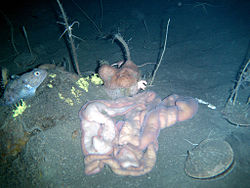
A large marine worm, Parborlasia corrugatus lives at depths of up to 3,590 m (11,780 ft) in the ocean around Antarctica.

Any worm that lives in a marine environment is considered a sea or marine worm. Marine worms are found in several different phyla, including the Platyhelminthes, Nematoda, Annelida (segmented worms), Chaetognatha, Hemichordata, and Phoronida.

Reproduction

[edit]

Marine worms exhibit numerous types of reproduction, both sexually and asexually. Asexually many are able to reproduce via budding or regeneration. This regeneration is most notably studied in Plathelminths or Triclad, known for being one of the earliest animals to be studied for its regenerative capabilities.[1] Marine worms will also sexually reproduce, internally and externally, with some releasing spawn into the ocean currents. This is in opposition to the much more internal and invasive method displayed by flat-worms called Penis fencing where hermaphroditic organisms will flight to try and impregnate their opponent while avoiding becoming impregnated.[2] This method is driven by the biological disadvantages (such as resource need and energy expenditure) behind carrying offspring instead of the more prolific gene passage through multiple impregnations.[citation needed]

Genetics and taxonomy

[edit]

Polynoid scale worms are estimated to have arrived in deep sea ecosystems around sixty million years ago. Through the comparison of 120 genes, researchers came to the conclusion that genes related to DNA repair, recombination, and integration were only present in the deep sea polynoidae, which correlates with the idea that they have to adapt to deal with potential hypoxia in deep sea environments.[3]

Feeding methods

[edit]

Marine worms can be herbivores, carnivores, parasites, detritivores, or filter feeders, but many strange examples of feeding are seen in this diverse type of animal. The group of Siboglinidae have developed a relationship with symbiotic bacteria within their gut that often perform chemosynthesis from which the worm benefits. These bacteria reside in a specialized organ called the Trophosome.[4] Some worms have an extendable pharynx or a proboscis for consuming prey, while others have developed jaws.[5]

Circulation

[edit]

Marine worms have a variety of circulation and respiration processes. For example, in platyhelminths this is achieved through diffusion of oxygen (as well as other nutrients) across a moist epithelial layer, whereas annelids have a closed circulatory system with blood vessels lining the body.[6][7]

Many of these worms have specialized tentacles used for exchanging oxygen and carbon dioxide which also may be used for reproduction. These specialized tentacles allow for gas exchange, further decreasing oxygen content in dead zones and in shallow water, which encourages plant and algae growth.[citation needed]

This quality is also observed in deeper oceans, where tube worms that use respiratory plumes with tentacles perform gas exchange of hydrogen sulfide and methane around hydrothermal vents. These types of circulatory systems differ from marine worms previously mentioned that can perform gas exchange through their entire bodies. This synapomorphy of gas exchange causes even related terrestrial annelids to be restricted to moist environments.[citation needed]

Environmental niches

[edit]

Marine worms are known to inhabit many different environments, having been found in both fresh and saltwater habitats globally.[citation needed]

Some marine worms are tube worms, of which the giant tube worm lives in waters near underwater volcanoes and can withstand temperatures up to 90 °C (194 °F). They share this space with fellow polychaetas known as "pompeii worms" that can resist 105 °C waters coming out of vents for short periods of time, making them one of the most heat resistant animals ever recorded (Islam and Schulze-Makuch,2007).[8]

Some worms can live in extremely deep oceanic trenches, such as in the Pacific Ocean off the Galápagos Islands.[9]

Marine deep sea polychaetes under the genus Osedax will colonize at whale falls in many different oceans, using a symbiont that can digest the bones within the carcasses (Jones et al,2007) This earned them the common name of "boneworms," and they are speculated to be a keystone species of these types of environments due to lack of organisms in whale falls without observed Osedax worms. These whale falls remain undigested for many more years than those observed with marine worm cultivations.[10]

In recent years, marine worms (especially those found in the ocean) have been observed ingesting microplastic particles found in the oceans. This trend is concerning many scientists, as marine worms act as an important food source for many fish and wading birds. Marine worms are often keystone species in an ecosystem, and the introduction of plastic in the oceans not only diminishes the growth rates of the marine worms, but also affects the food chain of that ecosystem.[11]

References

[edit]
Revisions and contributorsEdit on WikipediaRead on Wikipedia
from Grokipedia

Marine worms encompass a polyphyletic assemblage of soft-bodied, elongate animals from multiple phyla, including Annelida, Nematoda, Platyhelminthes, and , adapted to diverse marine habitats such as seafloors, sediments, and water columns, where they exhibit bilateral symmetry, a or pseudocoelom in many cases, and locomotion via undulation or burrowing without appendages. These organisms range in size from microscopic nematodes to polychaetes exceeding several meters, with bodies often featuring segmentation in annelids or an eversible in nemerteans for predation.
Ecologically, marine worms dominate benthic communities, with polychaetes comprising a significant portion of and in ocean sediments, functioning as detritivores, predators, and engineers through bioturbation and tube construction. Nematodes, the most abundant multicellular animals on , underpin marine food webs by processing , while nemerteans employ toxin-laced proboscides to capture prey like crustaceans and annelids. Flatworms contribute to parasitic and free-living roles, influencing host dynamics in coral reefs and fisheries. Their reproductive strategies vary widely, from broadcast spawning in polychaetes to in some nematodes, ensuring resilience in fluctuating marine conditions. Notable adaptations include symbiosis with chemosynthetic in vestimentiferan tube worms at hydrothermal vents, enabling survival without , and defensive mechanisms such as regenerative abilities in ribbon worms, which can reform from fragments. These traits underscore their evolutionary success, with over 10,000 alone documented, though many remain undescribed due to challenges in deep-sea sampling. While generally inconspicuous, certain like the bobbit worm pose risks to aquarists through aggressive predation, highlighting their predatory prowess.

Definition and Classification

Scope and Diversity

Marine worms constitute a polyphyletic assemblage of elongate, soft-bodied adapted to marine habitats, spanning multiple phyla without shared recent ancestry beyond of worm-like morphology. This informal grouping includes primarily free-living benthic and pelagic forms from phyla such as Annelida, , , , Nematoda, and Platyhelminthes, excluding strictly parasitic or terrestrial lineages. Their scope extends from intertidal zones to abyssal depths, encompassing burrowing, tube-dwelling, and swimming lifestyles that exploit diverse ecological niches like sediment processing and predation. The greatest diversity occurs within Annelida, particularly the class Polychaeta, which comprises the majority of marine annelid species with over 10,000 described forms exhibiting varied parapodia for locomotion and respiration. Polychaetes alone represent a significant portion of benthic marine biomass, with species counts exceeding 17,000 across Annelida when including integrated groups like and following molecular phylogenies. Morphological variations include iridescent scaleworms reaching 30 cm and microscopic interstitial forms, reflecting adaptations to predation pressures and substrate types from coral reefs to hydrothermal vents. Other phyla contribute substantial but lesser diversity; includes approximately 1,300 marine ribbon worms with eversible proboscises for prey capture, often exceeding 1 meter in length in species like . , now classified within Annelida, harbors about 160 peanut worm species confined to soft sediments, while marine nematodes from Nematoda number in the tens of thousands, dominating meiofaunal communities. Platyhelminthes contributes polyclad flatworms and acoelomorphs, adding to the group's ecological roles in predation and , though exact marine species tallies vary due to ongoing taxonomic revisions. Overall, marine worms exceed 20,000 species, underscoring their pivotal role in marine food webs and nutrient cycling.

Major Taxonomic Groups

The major taxonomic groups of marine worms are polyphyletic, encompassing species from at least six phyla that exhibit convergent evolution toward elongated, vermiform body plans suited to interstitial, benthic, or pelagic marine habitats. Prominent among these are the segmented polychaetes of phylum Annelida, which include over 8,000 described species characterized by metameric segmentation, parapodia bearing chaetae for crawling and gas exchange, and a closed circulatory system; these dominate marine annelid diversity, occupying roles from infaunal burrowers to errant predators across intertidal to hadal zones. Phylum Nemertea, comprising approximately 1,300 mostly marine species, features unsegmented ribbon-like bodies with an eversible housed in a rhynchocoel for capturing prey or anchoring, distinguishing them from other worm-like phyla; benthic and forms predominate, with some reaching lengths exceeding 10 meters in species like . Phylum Platyhelminthes contributes marine turbellarians, acoelomate flatworms with dorsoventrally flattened bodies, ciliated epidermis, and often rhabdocoel or polyclad forms adapted for creeping over substrates or parasitizing hosts, though free-living marine species number in the hundreds amid the phylum's predominantly freshwater and terrestrial diversity. Phylum Nematoda includes numerous free-living marine roundworms with pseudocoelomate, cylindrical bodies encased in a flexible , exhibiting and a four-layered body wall; while the phylum totals over 25,000 described globally, marine nematodes form dense meiobenthic assemblages, comprising up to 90% of individuals in some samples due to their tolerance of low oxygen and . Additional groups like phylum (peanut worms, now often allied with Annelida, featuring introvert proboscis and coelomic burrowing) and phylum (spoon worms, with U-shaped guts and sediment-feeding ) contribute smaller but ecologically key contingents, each with fewer than 200 confined to soft . (arrow worms) and Hemichordata () round out worm-like marine forms, the former as planktonic predators with grasping spines and the latter with pharyngeal slits linking to ancestry, though their inclusion varies by definition due to less strictly vermiform morphology.

Anatomy and Morphology

Body Plan Variations

Marine worms display diverse body plans adapted to benthic, pelagic, and marine environments, ranging from metameric (segmented) structures in annelids to non-segmented forms in nemerteans, sipunculans, and echiurans. Segmentation in annelids facilitates modular organ repetition and flexibility, whereas unsegmented plans emphasize extensible anterior regions for feeding and evasion. These variations arise from distinct evolutionary trajectories, with molecular phylogenies placing sipunculans and echiurans within Annelida despite their lack of overt segmentation. Polychaetes exhibit a body plan: an anterior , a series of 20 to over 300 similar metameres (segments), and a terminal pygidium, with each segment bearing paired parapodia—lateral outgrowths supporting chaetae (chitinous bristles) for locomotion, burrowing, or . Parapodia vary morphologically by : paddle-shaped with long setae in errant swimmers like syllids, reduced or absent in sedentary tube-dwellers such as sabellids, and equipped with toxic bristles in fireworms (e.g., ). This segmentation enables peristaltic movement and organ repetition, including gonads and nephridia per segment.
Nemerteans possess unsegmented, elongate, ribbon-like bodies capable of extending to several times their resting length via circular and longitudinal musculature, lacking metameres but featuring a fluid-filled rhynchocoel housing an eversible for prey immobilization. The , often tipped with a stylet, inverts over the head for striking, contrasting with appendages by enabling ballistic predation without segmentation-derived propulsion. Body walls include epidermal cilia and glands for , aiding over substrates.
Sipunculans maintain unsegmented, coelomate bodies comprising a posterior muscular trunk and an anterior introvert—a slender, retractable cylinder with tentacles, hooks, or spines for deposit feeding and anchoring. The trunk, often globular or cylindrical when contracted (resembling peanuts), houses a spirally coiled gut and lacks segment boundaries, though retractor muscles enable introvert protrusion up to trunk length. This plan supports infaunal burrowing without the modularity of annelid segmentation, reflecting secondary loss in their annelid lineage. Echiurans similarly lack segmentation, featuring a sac-like trunk and an expansive, ciliated (often spoon- or fan-shaped) that sweeps sediments for food particles, with the attaching to the and lacking a . This anterior specialization prioritizes surface deposit feeding in U-shaped burrows, diverging from introvert-based mechanisms in sipunculans.

Segmentation and Specialized Structures

Marine worms in the phylum Annelida, particularly the class Polychaeta, exhibit metameric segmentation, characterized by the division of the body into a linear series of repeating segments known as somites. These segments are delineated externally by annular grooves and internally by transverse that partition the coelomic cavity, enabling independent movement and functional specialization within each unit. Metamerism enhances locomotor efficiency by localizing muscle contractions and supports regeneration, as segments can be added posteriorly via a teloblastic growth zone during development. In typical polychaetes, the number of segments ranges from dozens to over 200, remaining constant in adults of a given , though variations occur across marine habitats. Each segment houses replicated organ systems, including pairs of nephridia for excretion, gonadal rudiments, and layers of circular and longitudinal muscles that interact with the as a for peristaltic locomotion. Specialized appendages, notably parapodia, project laterally from most segments in polychaetes; these biramous structures comprise a dorsal notopodium and ventral neuropodium, often equipped with embedded acicula for rigidity. Parapodia facilitate crawling, swimming, and sediment sifting in errant species, while in sedentary forms like sabellids, they may form radiolar crowns for filter-feeding and respiration. Chaetae, or setae—chitinous, bristle-like rods arrayed in bundles on the parapodia—provide traction against substrates during burrowing or anchoring, with composition and arrangement varying taxonomically for identification. Anterior modifications include the , bearing sensory palps, tentacles, and nuchal organs for chemoreception, while the pygidium terminates the body with an anal opening and potential cirri. Certain polychaetes, such as those in , develop eversible pharynges with jaws as predatory adaptations, underscoring segmental specialization for feeding. This modular architecture contrasts with non-segmented marine worms like nemerteans, highlighting adaptations to diverse benthic and pelagic niches.

Physiology

Circulation and Respiration Mechanisms

Marine worms, encompassing diverse phyla such as Annelida (particularly s) and , exhibit varied circulation mechanisms, predominantly closed systems adapted to their elongated body plans. In annelids, a closed features a dorsal vessel running anteriorly as the primary pumping conduit and a ventral vessel directing blood posteriorly, interconnected by segmental loops and ring vessels that supply parapodia and the gut. Contractile regions in these vessels, functioning as pseudo-hearts, propel colorless or pigmented blood (containing or chlorocruorin in some species) to facilitate nutrient and oxygen distribution. Smaller polychaetes may lack a dedicated system, relying instead on coelomic fluid movement for transport. Nemertean ribbon worms also maintain a closed without a true heart, comprising paired lateral blood vessels linked to the rhynchocoel and body wall sinus; circulation depends on peristaltic contractions of body musculature to drive flow. in nemerteans often includes within coelomocytes or tissues, enhancing oxygen-carrying capacity despite low metabolic demands. Respiration across marine worms relies primarily on cutaneous through the thin, moist body wall, enabling of oxygen and without specialized lungs or tracheae. In polychaetes, parapodia increase surface area for and generate water currents to renew boundary layers, while some taxa possess branchial gills on parapodia for enhanced exchange in low-oxygen environments; supports oxygen storage during hypoxia, sustaining metabolism for periods up to 31 minutes at saturation levels in certain deep-sea species. ns similarly respire via body surface , with no gills, adapting to variable oxygen tensions through pigments and anaerobic capabilities in prolonged anoxia. These mechanisms reflect evolutionary pressures for efficiency in aquatic media, where distances remain short due to worm-like morphologies.

Nervous System and Sensory Adaptations

Marine polychaete worms, representing a dominant group of segmented marine annelids, possess a basiepidermal nervous system characterized by a dorsal prostomial brain with an anterior compact neuropil that encircles coelomic cavities and connects via circumesophageal connectives to paired lateral medullary cords fusing into a ventral nerve cord. These medullary cords feature segmental ganglia that integrate sensory inputs and coordinate peristaltic locomotion, with giant fibers in some species facilitating rapid escape responses by propagating action potentials along the cord. Sensory adaptations include densely ciliated lateral organs innervated by medullary cord nerves for mechanoreception and palp nerves originating from dorsal and ventral roots of the connectives, enabling chemosensory detection of prey or sediment during deposit feeding. Nuchal organs, often positioned anteriorly, provide chemosensory input via slender neurites, while larval stages may retain pigmented eyespots for phototaxis before reduction in sediment-dwelling adults. In nemertean worms, the exhibits greater complexity with a prominent anterior divided into two ventral and two dorsal lobes linked by commissures, alongside paired medullary lateral cords and a finer unpaired dorsal cord originating from the . This configuration supports predatory behaviors, including eversion, through integrated neuropils and perikarya that process sensory . Sensory adaptations center on paired cerebral organs flanking the , comprising ciliated canals for external connectivity and neuroglandular cells expressing regulatory genes like otx and bf1, functioning in chemosensation and mechanoreception to detect prey chemicals or currents. Sipunculan peanut worms maintain a decentralized with a dorsal cerebral ganglion encircling the , functioning as a , and a single ventral cord lacking strong segmentation, innervating retractor muscles and the introvert for burrowing. Lacking eyes, they rely on well-developed nuchal organs for chemosensation on the introvert's dorsal surface and statocyst-like structures for geotactic orientation, adaptations suited to infaunal habitats where visual cues are absent. Across these groups, nervous regeneration capacity, as observed in polychaetes like Diopatra claparedii with upregulated proteins such as noelin-like isoforms during anterior repair, underscores evolutionary resilience to predation and environmental damage.

Reproduction and Life History

Reproductive Modes

Marine worms, predominantly annelids, exhibit diverse reproductive strategies, with being the predominant mode across most species. , involving separate sexes, prevails in many polychaetes, where gametes are typically released into the water column for via broadcast spawning, often synchronized with environmental cues such as lunar cycles or tidal patterns to maximize encounter rates. In contrast, sequential or simultaneous hermaphroditism occurs in certain families, enabling self-fertilization or cross-fertilization, though selfing is rarer due to mechanisms promoting . Specialized reproductive phenotypes, such as , characterize species in families like , where benthic atokes transform into pelagic epitokes—swarming forms with enlarged gamete-filled posterior segments—for mass spawning events that enhance fertilization success in dilute . Brooding, where fertilized eggs are retained in masses, tubes, or body cavities until hatching, represents an alternative to pelagic larval development, reducing predation risk but limiting dispersal; this mode is documented in over 20% of genera, often correlating with unstable habitats. Asexual reproduction, though less common than in freshwater annelids, occurs in select marine polychaetes via transverse fission, paratomic fission, or , producing clonal offspring that regenerate into functional individuals; for instance, syllid worms employ stolonization, detaching epitoke-like posterior stolons for sexual while the anterior atoke persists asexually. Such strategies facilitate rapid population recovery in disturbed environments but are typically supplemented by sexual phases to maintain . Mixed modes, combining both processes within a single or population, are observed in taxa like sabellids, allowing flexibility in response to density or resource availability.

Developmental Stages and Larval Ecology

Most annelids, the predominant group of marine worms, exhibit indirect development characterized by a free-swimming trochophore larval stage following and spiral cleavage of eggs. The trochophore emerges as a pear-shaped, translucent form approximately 300 μm in length, featuring a prototroch—a prominent ring of cilia—for locomotion, an apical ciliary tuft for sensory function, a telotroch at the posterior, and rudimentary organs including a , , , and median eye on a sensory plate. These structures enable active swimming in the and, in planktotrophic variants, particle capture of for feeding. Subsequent progression involves elongation into metatrochophore or nectochaete stages, where early segmentation appears, parapodia and chaetae develop, and larval features gradually integrate with juvenile morphology. culminates in settlement to the , marked by resorption of transient larval cilia and organs, alongside elaboration of adult structures like jaws in predatory forms. Approximately 26% of polychaete species produce planktotrophic larvae that feed externally, contrasting with 11% featuring lecithotrophic, yolk-dependent larvae that shorten the pelagic phase. Direct development without a free larva occurs in groups like syllids, minimizing dispersal. Larval ecology centers on the planktonic realm, where trochophores and later stages constitute key components of coastal and oceanic , subject to intense predation by and supporting trophic webs. Planktotrophic forms achieve broad dispersal—potentially hundreds of kilometers—facilitating and colonization of remote habitats, as observed in vent-associated species like Riftia pachyptila symbionts. Settlement cues, detected via eyes, nuchal organs, or chemical senses, include bacterial films, conspecific , or suitable substrates, with competence often reached after days to weeks in the ; suboptimal delays can impair post-settlement survival. High larval mortality underscores the stage's role in , with brooding in deep-sea taxa adapting to sparse resources by curtailing exposure.

Ecology and Behavior

Habitat Preferences and Distribution

Marine worms, predominantly annelids, exhibit broad habitat preferences centered on benthic marine and estuarine environments, including intertidal mudflats, sandy beaches, beds, sediments, and coral reefs. They favor substrates with high organic content, such as fine-grained sediments or polluted harbors, where many species or construct protective tubes from and surrounding particles. Epifaunal forms adhere to algal-covered rocks or live pelagically in the , while others exploit extreme conditions like hydrothermal vents via larval settlement. Depth preferences range from shallow coastal waters to subtidal zones exceeding 400 meters, with some species adapted to abyssal depths and low-oxygen sediments. Factors influencing habitat choice include sediment grain size, oxygenation, salinity gradients in estuaries, and structural complexity, such as shell fragments or patches, which provide refuge and opportunities. Globally distributed across all oceans—from polar to tropical latitudes—polychaetes comprise over 10,000 described species, with highest diversity in coastal shelves and reduced numbers in freshwater or hypersaline niches. While most are obligate marine, a minority tolerate brackish or freshwater habitats near coastlines, reflecting adaptations to varying physicochemical stressors.

Feeding Strategies and Trophic Interactions

Marine worms, encompassing annelids and nemerteans, exhibit diverse feeding strategies adapted to benthic and pelagic environments. primarily employ deposit feeding, suspension feeding, or carnivory, with deposit feeders like capitellids everting a mucoid to ingest and extract . Suspension feeders, such as sabellids, utilize ciliated radioles to capture from the , often switching modes based on flow conditions. Carnivorous , including lumbrinerids, use jaws to tear , , or small . Nemerteans are predominantly predatory, deploying an eversible armed with a stylet to inject toxins and subdue prey such as polychaetes, crustaceans, and mollusks. Heteronemerteans target polychaetes, while hoplonemerteans favor crustaceans, with the enabling rapid capture and ingestion. Some nemerteans supplement diet with dissolved organic material absorbed cuticularly. In trophic interactions, marine worms occupy multiple levels: as detritivores and primary consumers recycling nutrients via bioturbation, enhancing oxygenation and microbial activity. serve as prey for , birds, and , supporting higher trophic tiers, while nemerteans exert top-down control on and populations. Their feeding activities influence community structure, with selective predation by nemerteans potentially regulating infaunal diversity. Studies of like Sthenelais boa and Euphrosine capensis reveal isotopic niches indicating omnivory and mid-trophic positioning.

Predation, Defense, and Symbiosis

Many worms act as predators within marine ecosystems, employing diverse strategies to capture prey. For instance, , a eunicid , functions as an by burrowing into soft sediments and extending its powerful, jawed to strike passing , bivalves, and other annelids, often injecting paralytic toxins for immobilization. These worms can attain lengths exceeding 2.5 meters, with strikes occurring at speeds sufficient to sever prey or damage larger organisms. Other predatory polychaetes, such as those in the Oenonidae family, secrete toxins via specialized cells to subdue crustaceans and smaller worms. Predation by polychaetes also targets larval and juvenile stages of commercially important species, including (Haliotis iris), where worms inhabiting crusts consume post-settlement juveniles at rates influencing recruitment success. Marine worms exhibit a range of defense mechanisms against predation, primarily from fish and crustaceans. Chemical defenses predominate, with approximately 37% of surveyed polychaete species proving unpalatable due to secondary metabolites that deter generalist predators; exposed feeding structures in tube-dwelling forms are often selectively defended. Species like Cirriformia punctata rely on such compounds, rendering them chemically defended without behavioral evasion or structural barriers. Physical and behavioral adaptations include burrowing into refuges, tube construction for protection, and autotomy of bioluminescent appendages to distract attackers, as observed in certain syllid polychaetes. Mimicry also occurs, with some undescribed species imitating toxic nudibranchs to avoid predation despite lacking inherent toxicity. Sessile or semi-sessile forms integrate these traits, prioritizing chemical unpalatability on hard substrates exposed to epibenthic predators. Symbiosis is prevalent among polychaetes, with over 600 species forming associations with other , ranging from to mutualism. Scale worms () exemplify this, often inhabiting the tubes or bodies of hosts like brittle stars or octopuses, where they gain protection while providing minor cleaning or no clear benefit to the host. Boring spionid polychaetes establish symbiotic relationships within shells or skeletons, feeding on host tissues or without necessarily harming the host severely. These interactions enhance polychaete survival in predator-rich environments, as hosts offer shelter; genomic studies of polynoid-gastropod pairs reveal adaptations for such , including territorial behaviors in symbionts. polychaetes, common in annelid , exploit host structures for feeding without reciprocity, contributing to broader trophic dynamics.

Evolutionary History

Fossil Evidence and Ancient Origins

The fossil record of marine polychaete worms, which constitute the majority of marine annelids, is sparse owing to their soft-bodied composition, with body fossils primarily preserved in exceptional Lagerstätten featuring rapid burial and anoxic conditions that inhibit decay. Durable structures such as jaws (scolecodonts) and calcareous tubes provide more abundant evidence, but these often lack associated soft tissues, complicating taxonomic assignments. Biomineralized tubes from serpulid polychaetes appear sporadically from the onward, while scolecodonts are documented from the (~485–443 million years ago), with diverse assemblages in deposits like those of , , yielding over 20 species across five genera. Earliest definitive polychaete body fossils emerge in the Early (~541–514 million years ago), aligning with the of metazoan diversity. A notable example is Yunnanozoon and related forms from the Chengjiang biota in Yunnan Province, China, dated to approximately 514 million years ago, preserving segmented bodies with parapodia-like appendages indicative of early annelid morphology. Similarly, the Formation in , (~508 million years ago), has yielded well-preserved polychaetes such as Kootenia and a newly described species with traces of neural and vascular tissues, marking the first such soft-tissue preservation in fossil annelids and suggesting advanced sensory capabilities in stem-group forms. These fossils represent stem-group polychaetes with complex parapodia and head appendages, implying that ancestors diverged from simpler bilaterian worms prior to the , potentially in the late (~541 million years ago), though direct fossil evidence for pre- polychaetes remains elusive due to poor preservation of soft tissues. Incorporation of such fossils into phylogenetic analyses supports polychaetes as basal to modern clades, with key innovations like segmentation and chaetae evolving amid rising oxygenation and ecological pressures in seas. Post- diversification is evidenced by increasing scolecodont abundance and tube-building in serpulids by the (~201–145 million years ago), including colonization of deep-sea and seep environments.

Phylogenetic Relationships and Key Innovations

Annelids, the primary group comprising marine worms, form a monophyletic within the clade of , a subdivision of the . Total-evidence analyses combining molecular data from six genes and morphological characters confirm this placement, with Annelida exhibiting sister-group relationships to other lophotrochozoans such as and Brachiopoda, though exact branching orders remain debated due to rapid early divergences. Within Annelida, polychaetes render the group paraphyletic, as clitellates (e.g., earthworms and leeches) nest within polychaete lineages, while molecular phylogenies have integrated formerly separate phyla including , , and Pogonophora (now ) as derived annelids, supported by shared traits like trochophore larvae and segmental structures. A defining innovation in annelid evolution is metamerism, the subdivision of the into repeated segments by transverse , enabling modular body plans with serial homologues of organs, muscles, and nerves. This segmentation, absent in ancestral non-metameric lophotrochozoans, likely originated as an for burrowing through sediments, allowing peristaltic locomotion via antagonistic dorsal and ventral muscle layers and enhancing efficiency in resource extraction across elongated bodies. Chitinous chaetae (setae), emerging segmentally from parapodia or , provided traction and defense, with phylogenetic reconstructions indicating their presence in the annelid stem lineage around the . Further polychaete-specific innovations include parapodia, fleshy lateral outgrowths functioning in locomotion, respiration, and feeding, which diversified into swimming paddles or tube-building aids in marine habitats. A closed , with dorsal and ventral vessels connected by segmental loops, facilitated efficient oxygen transport in active marine lifestyles, contrasting with the open systems of many coelomate relatives. These traits, corroborated by and fossil traces, underscore annelids' into diverse benthic and pelagic niches.

Human Interactions and Applications

Economic Impacts and Pests

Marine polychaete worms, such as ragworms (Nereis virens) and bloodworms (Glycera dibranchiata), support a commercial bait industry valued for recreational fishing and aquaculture broodstock maturation. In the United Kingdom, companies like Seabait Ltd have cultured N. virens since 1985, supplying live bait to anglers targeting species like cod and flatfish, as well as essential fatty acids for shrimp gonadal development. In the United States, bloodworm harvesting generates income for gatherers and benefits recreational fisheries, with trade data indicating significant economic contributions to coastal communities. Similarly, Maine's marine worm sector supports approximately 775 jobs within the broader seafood industry as of 2023. Polychaetes also play roles in aquaculture waste management and feed production, reducing environmental impacts while creating by-products. Trials have demonstrated that species like Hediste diversicolor process organic waste from fish farms, yielding protein-rich biomass for animal feed and potentially lowering operational costs. In Vietnam, experimental sea worm farming has provided employment and conserved wild stocks by culturing worms suitable for export markets. As pests, shell-boring polychaetes such as Polydora spp. (mudworms) infest cultured bivalves worldwide, creating blisters that devalue half-shell market products and necessitate costly treatments. In regions like the , these worms have a long history of impacting and farms, with larval recruitment influenced by water quality and temperature. Sabellid polychaetes similarly infest in facilities, compromising shell integrity without directly causing mortality but requiring control measures. In the , invasive Marenzelleria spp. elevate abatement costs by altering benthic ecosystems, with modeled increases up to €1094 billion under certain regimes as of 2017. Bait harvesting itself can exert pressure on wild populations, prompting management concerns in areas like the and U.S. coasts where fisheries extract substantial biomass.

Biomedical and Scientific Uses

Marine worms, particularly certain species such as Arenicola marina, have yielded hemoglobin-based oxygen carriers like M101, which exhibits therapeutic potential in preserving organ viability during transplantation by mitigating ischemia-reperfusion injury. In preclinical models, including porcine transplants, M101 reduced graft ischemia when administered prior to reperfusion, demonstrating improved tissue oxygenation without triggering significant immune responses. This extracellular , purified from the lugworm's coelomic fluid, maintains stability under physiological conditions and has been explored for treating conditions like due to its high oxygen-binding capacity. Extracts and compounds from worms also show promise in antimicrobial and -healing applications. For instance, the defensive hallachrome, isolated from Pseudopotamilla occelata, inhibits , including against methicillin-resistant Staphylococcus aureus, suggesting utility in preventing infections. Aqueous extracts of the baitworm Marphysa sanguinea accelerated closure in rat models, reduced , and exhibited low , attributed to bioactive peptides and that promote proliferation and deposition. Venomous marine annelids produce proteinaceous toxins with potential and anti-inflammatory effects, as identified through transcriptomic analyses, which could inform development of novel therapeutics for or tissue repair. In scientific research, marine polychaetes serve as model organisms for studying regeneration and . Species like Platynereis dumerilii regenerate lost body segments via of existing cells into stem-like states, providing insights into mechanisms of cellular plasticity applicable to human . These worms' segmental growth zones contain specialized stem cells regulated by conserved signaling pathways, enabling precise control over posterior addition of body parts, which contrasts with regeneration and highlights evolutionary divergences in repair strategies. Additionally, polychaetes model neurodegenerative disorders, with their nervous systems exhibiting protein aggregation and neuronal loss akin to , facilitating genetic and pharmacological screens for . Genomic sequencing of and other marine annelids has revealed biosynthetic gene clusters for novel secondary metabolites, aiding bioprospecting for antibiotics and anticancer agents.

Environmental Roles and Debates

Marine worms, predominantly polychaete annelids, contribute to marine ecosystem functioning through bioturbation, the process of sediment reworking by burrowing species such as Arenicola marina and Nereis spp., which mixes particles, ventilates anoxic layers, and promotes oxygen penetration to depths of several centimeters. This activity enhances microbial decomposition of organic matter, accelerating nutrient release (e.g., nitrogen and phosphorus) into the water column, thereby supporting phytoplankton growth and primary production in coastal and estuarine habitats. Quantitatively, bioturbating polychaetes can increase sediment solute exchange by factors of 2–10 compared to abiotic diffusion alone, as measured in Baltic Sea sediments. Filter-feeding polychaetes, including tube-dwellers like sabellids, process large volumes of —up to 100 liters per square meter per day in dense assemblages—removing suspended particulates and improving while recycling fecal pellets back to sediments for further breakdown. As both predators and prey, they regulate invertebrate populations (e.g., via predation on meiofauna) and form a basal trophic link for , crustaceans, and birds, with contributions exceeding 50% of macrofaunal production in some soft-sediment communities. In deep-sea settings, vestimentiferan worms around hydrothermal vents create sulfide-oxidizing habitats that enable chemosynthetic symbioses, fostering hotspots. Polychaetes serve as bioindicators of environmental stress, with opportunistic (e.g., Capitella capitata) proliferating in polluted sediments under organic enrichment, signaling reduced oxygen and heavy metal contamination, as evidenced by assemblage shifts in monitoring programs since the 1970s. Their sensitivity to contaminants allows for quantitative assessment of recovery, with diversity indices correlating inversely with gradients in estuarine studies. Debates center on invasive polychaetes like Marenzelleria spp., introduced to North American and European coasts via ballast water since the , which elevate bioturbation intensities by 200–300% in invaded sediments, potentially boosting efflux and altering carbon remineralization rates but risking displacement through competition. Proponents argue these invaders enhance overall resilience via increased functional redundancy, as seen in mesocosm experiments, while critics cite losses and unforeseen biogeochemical feedbacks, such as amplified from stimulated . Additionally, climate-driven projected to lower by 0.3–0.4 units by 2100 threatens shell-boring spionids, potentially disrupting bivalve recruitment and cascading to fisheries, though adaptive tolerances vary phylogenetically. Empirical data from acidification mesocosms indicate 20–50% reductions in boring activity at pH 7.6, underscoring uncertainties in predictive models.

References

Add your contribution
Related Hubs
User Avatar
No comments yet.