Hubbry Logo
Martin WhitmarshMartin WhitmarshMain
Open search
Martin Whitmarsh
Community hub
Martin Whitmarsh
logo
8 pages, 0 posts
0 subscribers
Be the first to start a discussion here.
Martin Whitmarsh
Martin Whitmarsh
from Wikipedia

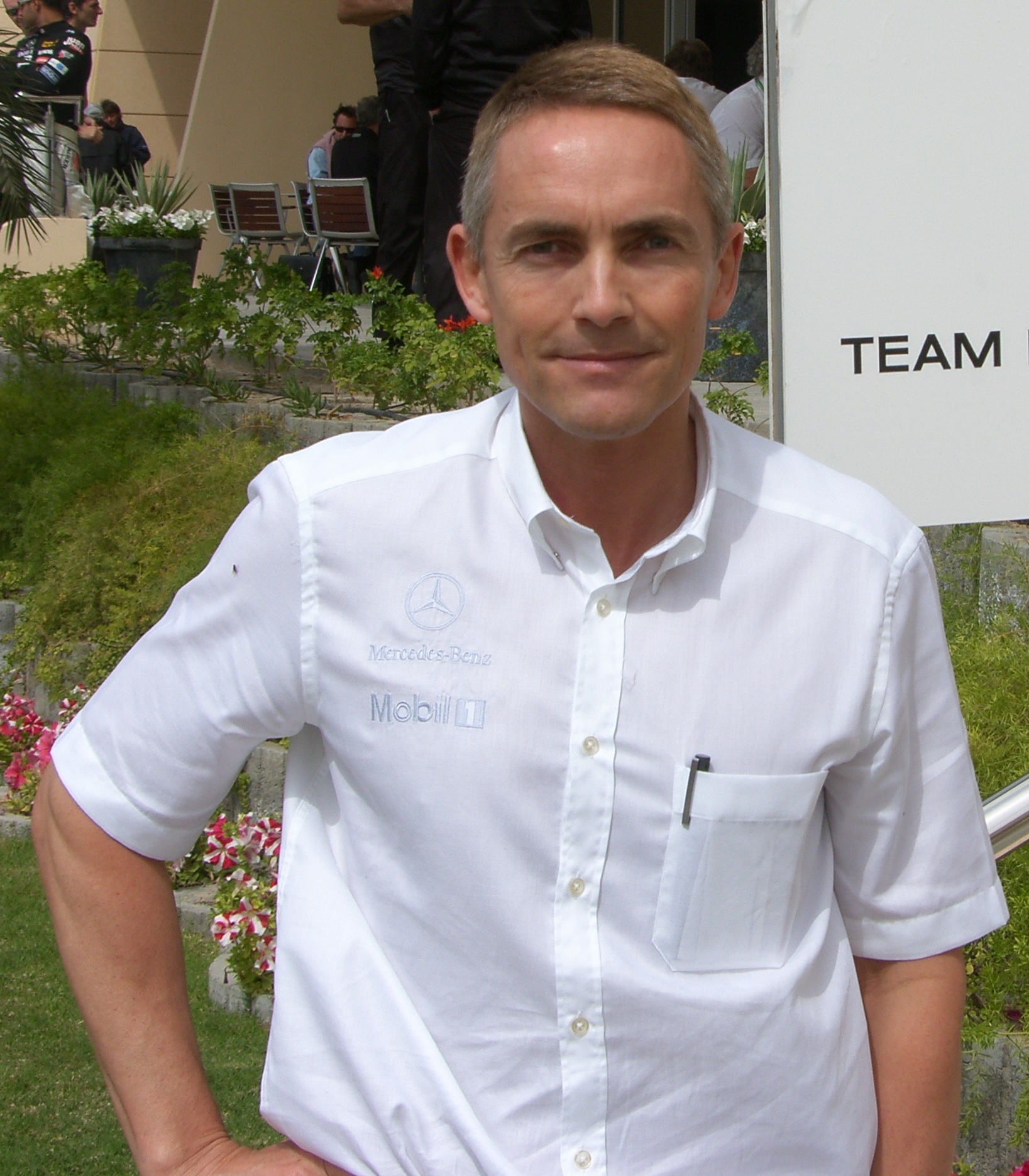
Martin Richard Whitmarsh (born 29 April 1958)[1] is a British businessman and former Group CEO of the Aston Martin Formula One Team.[2][3] Whitmarsh is best known to motorsport insiders, media, and fans for his long and successful period at McLaren, for which he worked for 25 years (1989–2014) in various senior positions,[4] including group chief executive officer,[5] as well as Formula One Team Principal for six years (2008–2014).[6][7]

Key Information

Under his leadership, McLaren diversified its business activities beyond its core activity of Formula One, launching McLaren Automotive and McLaren Applied Technologies.[8] Whitmarsh played a senior and leading role in the winning of more than 100 Formula One Grands Prix and multiple Formula One World Championships, and was at the centre of the development of several Formula One World Champions, including Lewis Hamilton.[9] Whitmarsh was also chairman of the Formula One Teams Association for three years (2010–2012).[10][11]

Motorsport

[edit]

McLaren

[edit]

Whitmarsh joined McLaren in 1989 as an operations director,[12] having come from British Aerospace (BAE). In 1997, Whitmarsh was promoted to the position of managing director and in April 2004, he was again promoted, this time to the position of chief operating officer of McLaren Group and chief executive officer of McLaren Racing.[13]

On 1 March 2009, Ron Dennis stepped down as head of McLaren Racing to take a role in McLaren Automotive and Whitmarsh became team principal as a result,[14] and a year later he was appointed to two new roles: chief executive officer of McLaren Group and deputy chairman of McLaren Automotive. Whitmarsh left his position as CEO of McLaren Racing and McLaren Group in January 2014 and replaced by his predecessor Ron Dennis in January 2014.[15][16] He formally parted ways with McLaren in August 2014 after 25 years with the organisation.[17]

Formula One Teams Association

[edit]

In January 2009, Whitmarsh was elevated to president of the Formula One Teams Association (FOTA), replacing Ferrari chairman and FOTA founder Luca Cordero di Montezemolo. Whitmarsh maintained this position for four years until he stated that he would not stand for re-election in 2013 [18]

Formula E

[edit]

In 2017, Whitmarsh joined the Global Advisory Board member of the Formula E. A series statement said the board's purpose would be "to steer the future direction of Formula E as a key player in influencing the global uptake of electric vehicles and its impact on reducing emissions."[19]

Aston Martin

[edit]

In October 2021, Whitmarsh was appointed as Group CEO of the newly created Aston Martin Performance Technologies where he was responsible for combining Aston Martin's Formula One activities with developing, applying and taking to market the group's technical capabilities, as well as intellectual property.[13][20]

He subsequently left the role in October 2024, being replaced by former Managing Director of the Mercedes-AMG High Performance Powertrains Andy Cowell, who replaced Whitmarsh as Group CEO.

Other roles

[edit]

Land Rover BAR

[edit]

In 2015, Whitmarsh became chief executive officer of Ben Ainslie Racing,[21] subsequently Land Rover BAR, the British America's Cup team. During Whitmarsh's tenure, the business competed in the 35th America's Cup but was eliminated in the semi-final by Emirates Team New Zealand who ultimately won the World Series.[22]

In 2017, Whitmarsh stepped aside as CEO of Land Rover Bar to be replaced by Grant Simmer, the four times America's Cup winner, on the understanding that the team would need someone with a full time focus on the racing team.[23] Whitmarsh continues as an advisor to the team.

BAR Technologies Limited

[edit]

Whitmarsh is the chairman and co-founder of BAR Technologies,[24] a technology start-up business focussed on the marine sector and bringing innovative solutions to enhance the efficiency of marine products and reduce carbon emissions.[25]

Chair of Offshore Wind Growth Partnership Limited

[edit]

Whitmarsh is Chair of Offshore Wind Growth Partnership limited,[26] a company formed with the support of  government and the industrial sector to promote and develop the UK supply chain seeking to achieve 60% UK content in home sector.

References

[edit]
Revisions and contributorsEdit on WikipediaRead on Wikipedia
from Grokipedia
Martin Richard Whitmarsh (born April 1958) is a British motorsport executive and engineer known for his leadership roles in , including as team principal and chief executive of from 2008 to 2014. During his 25-year tenure at starting in as operations director, the team achieved multiple drivers' and constructors' championships, with Whitmarsh contributing to a growth in group turnover from £20 million to £700 million. Whitmarsh holds an engineering degree and began his career in , advancing to direct projects involving advanced composite structures. He assumed the team principal role in 2008, succeeding , and guided the team to the 2008 Constructors' Championship victory. Following his departure from in 2014, he served as chief executive of the British sailing team until 2017. In 2021, Whitmarsh returned to as group chief executive officer of Performance Technologies, overseeing the team's technical and performance operations with ambitions to contend for titles. He departed from in 2024, replaced by . Currently, Whitmarsh is chairman and co-founder of BAR Technologies, focusing on efficiency innovations across and sectors, and chairs the Offshore Wind Growth Partnership.

Early life and education

Academic background and initial interests

Martin Whitmarsh was born on 29 April 1958 in , . Whitmarsh studied at (now the ), earning a BSc degree in 1980. This education emphasized principles of and , aligning with subsequent applications in demanding engineering fields.

Early career

Aerospace engineering roles

Following his graduation with a mechanical engineering degree from Portsmouth Polytechnic in 1980, Whitmarsh entered the sector at (now ), initially serving as a at its Hamble facility. In this role, he applied finite element analysis techniques to evaluate structural integrity under operational stresses, focusing on optimizing material performance and load distribution in components. These efforts contributed to projects aimed at enhancing efficiency in high-performance systems, where design iterations directly influenced real-world reliability and weight reduction metrics essential for applications. Whitmarsh advanced rapidly within , taking on broader responsibilities in R&D before ascending to a directorial position overseeing the manufacture of . This progression involved systems integration tasks, coordinating multidisciplinary s to align aerodynamic, , and elements for production-scale outcomes, with causal emphasis on how prototyping choices mitigated failure risks in demanding environments. His work underscored performance optimization through data-driven validation, contrasting the sector's stringent regulatory frameworks with opportunities for iterative experimentation. By , after nearly a decade in , Whitmarsh transitioned to , later reflecting that the move from his established trajectory at represented an unconventional shift toward more dynamic, high-stakes challenges unbound by aerospace's procedural constraints. This foundation in rigorous analysis and manufacturing efficiency informed subsequent applications in competitive domains.

McLaren Racing tenure

Operational and directorial rise (1989–2007)

Martin Whitmarsh joined McLaren Racing in 1989 as Head of Operations, tasked with overseeing logistics, manufacturing processes, and infrastructural support for the team. Drawing from his background at , where he had advanced to managing airframe production, Whitmarsh applied finite element analysis and production optimization techniques to enhance operational reliability amid the team's competitive demands. His role involved coordinating the and facility management, contributing to the stability that underpinned McLaren's performance during a decade of constructors' and drivers' championships. In 1997, Whitmarsh was promoted to Managing Director of International, assuming responsibility for non-racing operations including commercial partnerships, sponsor relations, and manufacturing oversight. This elevation enabled team principal to delegate day-to-day operational duties, allowing focus on broader group strategy such as the TAG McLaren conglomerate's expansion. Under Whitmarsh's direction, strengthened its manufacturing capabilities through collaborations informed by his prior industry ties, including personnel exchanges with that bolstered production expertise. Whitmarsh's tenure in these roles facilitated organizational scaling, with McLaren's employee base growing from around 100 in 1989 to support expanded technical and logistical needs by the early 2000s, while maintaining cost efficiencies through data-driven process refinements. These efforts emphasized empirical metrics for performance, such as throughput rates and , aligning operations with the rigor required for sustained competitiveness without delving into on-track tactics.

Leadership as CEO and team principal (2008–2014)

Martin Whitmarsh assumed the role of McLaren team principal on March 1, 2009, succeeding Ron Dennis, while retaining his position as a senior executive overseeing the McLaren Group. This transition marked the beginning of his combined leadership of the Formula One team's operations and broader corporate strategy, including coordination between racing, automotive, and technology divisions. In April 2010, a management restructure formalized his appointment as Chief Executive Officer of the McLaren Group and Deputy Chairman of McLaren Automotive, enhancing his authority over resource allocation and cross-divisional integration. A pivotal personnel decision under Whitmarsh's was the recruitment of to form an all-British driver lineup with for the 2010 season. Announced on November 18, 2009, the multi-year deal replaced and was framed by Whitmarsh as prioritizing competitive synergy over financial incentives, with Button's salary aligned to prior commitments. This pairing aimed to leverage complementary driving styles amid evolving regulations, though subsequent contract extensions, such as Button's in 2011, reflected ongoing evaluations of team dynamics. Whitmarsh directed McLaren's strategic responses to regulatory shifts, including the 2009 abolition of refueling and reintroduction of slicks, which necessitated adaptations in chassis design and fuel management. The team maintained its engine partnership through , focusing budgets on compliance with freeze rules from 2010-2013 and preparations for the hybrid era's 1.6-liter turbocharged power units with enhanced systems. Internal efforts included reallocating resources toward hybrid technology development, with Whitmarsh signaling key technical hires by early to bolster capabilities under the new rules. To address organizational inefficiencies, Whitmarsh oversaw the adoption of a matrix structure in technical leadership, distributing responsibilities across , , and teams to foster interdisciplinary and mitigate siloed development risks during resource-constrained periods. priorities shifted toward sustaining competitiveness amid FIA cost-control measures, with investments in simulation tools and upgrades to navigate development restrictions. These initiatives sought to sustain McLaren's edge, though they operated within the constraints of frozen components and escalating regulatory complexity.

Key achievements

During Martin Whitmarsh's tenure as McLaren's CEO and subsequent team principal from 2008 to 2014, the team finished second in the 2008 Constructors' with 151 points, providing critical operational support for Lewis Hamilton's Drivers' win that year, which included five Grand Prix victories for the team. McLaren's engineering efforts yielded consistent competitiveness, with the team securing second place in the 2011 Constructors' , accumulating 497 points through multiple podiums and race wins, such as Hamilton's victories in the Chinese and Grands Prix. Innovations under Whitmarsh's oversight sustained performance amid regulatory changes, including the 2010 introduction of the F-duct aerodynamic system, which enhanced straight-line speed and management to rival leading teams. The team targeted incremental lap-time improvements of 0.15 seconds per race through targeted upgrades, contributing to overall gains that positioned as a front-runner in variable conditions during 2010–2012. Whitmarsh noted that strategic decisions had rendered the car approximately one second per lap faster by addressing early-season deficiencies, enabling consistency despite evolving technical rules. McLaren maintained organizational stability via enduring supplier partnerships exceeding 30 years, fostering reliable development pipelines and for sustained infrastructure efficiency. This foundation supported talent continuity, with key personnel contributing to over 100 Grand Prix wins across Whitmarsh's broader 25-year involvement, though focused leadership from 2008 onward emphasized operational resilience in a high-stakes environment.

Criticisms and strategic challenges

In 2013, Whitmarsh conceded that McLaren had committed "big mistakes," personally shouldering responsibility for a season devoid of finishes during the team's 50th anniversary, culminating in a fifth-place constructors' finish with just 122 points. These stemmed from an ill-timed radical redesign of the MP4-28 midway through , incorporating aggressive alterations to nose height, front and rear suspensions, bodywork, and exhaust layout, which diverged from the prior year's proven configuration and squandered approximately six months of viable development. The decisions, driven by ambition to preempt rivals' conservative approaches under impending regulation shifts, instead yielded a slower than the 2012 model at launch and unable to close the gap to leaders like , Mercedes, Ferrari, and Lotus, as resources were diverted reactively rather than progressively. Broader critiques centered on McLaren's recurrent failure to translate qualifying dominance and victories into sustained title challenges, exemplified in when the team secured six wins and seven poles yet conceded both championships to amid late-season development lapses and operational inconsistencies. Whitmarsh's drew for inadequate adaptation to Red Bull's aerodynamic innovations and resource efficiencies in an era without formal cost caps, where rivals leveraged higher effective spending on key personnel and wind-tunnel iterations, eroding McLaren's historical edge in process-driven design. Driver management emerged as a flashpoint, with Hamilton voicing frustrations over repeated strategy blunders, such as the 2010 miscommunication where engineers incorrectly assured him teammate posed no passing threat, costing positions. Whitmarsh's public assertion that Hamilton had underestimated 's consistency—prompting Hamilton to rebut it as "rubbish"—highlighted interpersonal strains and perceived favoritism debates, though Whitmarsh defended the pairing as fostering growth despite inconsistent point maximization. Post-departure reflections in 2018 underscored lingering strategic voids, as reports surfaced of staff delegations appealing to Whitmarsh amid qualifying woes like 14th and 15th in , no wins since 2012, and a midfield rut exacerbated by engine transitions and internal politics. Whitmarsh urged purging key figures and refocusing on F1 core competencies over diversification, attributing decline to silos that diluted cohesion—concerns empirically borne out by constructors' rankings plummeting to ninth in 2015 and 2017, though dismissed his input as "ill-judged and ill-informed." These views aligned with causal factors like over-reliance on committee consensus versus singular design vision, contrasting Red Bull's model and prolonging recovery until regulatory resets.

Formula One governance

Role in Formula One Teams Association (FOTA)

Martin Whitmarsh was elected chairman of the (FOTA) on 5 January 2010, succeeding Ferrari president Luca di Montezemolo, with the role spanning until August 2012 when he declined re-election amid growing internal divisions. As chairman, Whitmarsh represented the collective interests of FOTA's member teams—primarily manufacturer-backed outfits like , Mercedes, and —in negotiations with the FIA and Management (FOM) over regulatory and commercial terms, emphasizing cost controls to counteract escalating team budgets that threatened smaller entrants' viability. Under Whitmarsh's leadership, FOTA pursued voluntary resource restriction agreements, including proposals for standardized development freezes and limits on aerodynamic testing to curb spending disparities, building on the fragile unity forged during the 2009 FIA-FOTA standoff over budget caps and entry regulations. These efforts aimed to foster competitive equity by reallocating resources away from high-expenditure R&D races, though empirical data from the period showed uneven adoption, with top teams continuing dominance— securing constructors' titles from 2010 to 2013—partly due to uneven enforcement rather than purely technical superiority. Whitmarsh publicly critiqued teams' lack of cohesion for failing to extract a larger share from FOM's commercial rights, attributing stalled progress on prize money redistribution to internal rivalries that undermined bargaining power against dominant stakeholders like . Tensions escalated during Whitmarsh's tenure as manufacturer teams clashed with independents over cost-capping mechanisms; Ferrari withdrew from FOTA in December 2011, citing in approach to expenditure limits, which fragmented the association and weakened its leverage against FIA overreach on technical directives. Despite these setbacks, FOTA's advocacy under Whitmarsh contributed to short-term stability by averting immediate team insolvencies—such as those faced by and prior to —through negotiated deferrals on regulatory changes, though long-term outcomes revealed limitations, as political fragmentation rather than unified governance reforms perpetuated eras of unchallenged performance leads and financial strain for midfield squads.

Post-McLaren motorsport engagements

Formula E initiatives

In 2012, while serving as McLaren's team principal, Whitmarsh expressed support for the nascent series, stating that was evaluating the technology challenge it presented and could consider entering at some point to explore opportunities for future racing cars. He highlighted the potential of electric motors for delivering instant , , and , positioning the series as a platform for innovation in sustainable performance. Following his departure from in 2014, Whitmarsh joined Formula E's newly formed Global Advisory Board in November 2017, alongside figures such as and , to provide strategic input on the championship's rules, technical regulations, and long-term growth. His role emphasized guiding the series toward enhanced competitiveness and relevance in electric mobility, drawing on his operational expertise amid Formula E's expansion from its inaugural 2014-15 . By 2018, this advisory capacity focused on refining governance and future development to address challenges in battery technology and race format viability. Whitmarsh's contributions aligned with Formula E's emphasis on energy efficiency as a proving ground for road-relevant electric advancements, though the series faced hurdles in matching racing's and refueling dynamics, limiting direct technological parity with established formulas. No formal team entry under his direct leadership materialized, with efforts centered on advisory influence rather than operational bids.

Aston Martin Formula One involvement (2021–2024)

In October 2021, Martin Whitmarsh was appointed Group Chief Executive Officer of Performance Technologies, a new division integrating the company's road car engineering with its operations, effective from October 1. This role positioned him to oversee the F1 team's strategic development as sought to elevate its competitive standing following its 2021 re-entry as a constructor. Under Whitmarsh's leadership, Aston Martin expanded its facilities, including the design and completion of a new factory to support advanced manufacturing and R&D for both road and race programs. The team pursued key hires in and technical roles to bolster capabilities, while directing resources toward compliance and for the 2026 engine regulations, amid partnerships like the upcoming power unit deal. These efforts aimed to address foundational gaps in infrastructure and expertise, though the team remained constrained by the cost cap and competition for top talent from established rivals. On-track results during Whitmarsh's tenure reflected midfield positioning, with a brief surge in 2023 yielding six podiums—primarily from —but subsequent regression in 2024, where the team scored only 86 points across 24 races, highlighting development shortfalls in and integration relative to front-runners. Causal factors included over-reliance on early-season upgrades that proved unsustainable, limited time as a newer entrant, and internal resource dilution across production demands. Whitmarsh transitioned out of the role by the end of 2024, with —former Mercedes High Performance Powertrains managing director—succeeding him as Group CEO from October 1, 2024, to drive further integration ahead of the 2026 ruleset. The handover followed evaluation of progress against ambitious targets, underscoring the challenges of scaling a manufacturer-backed team in a field dominated by decades of specialized evolution.

Other professional ventures

America's Cup with Land Rover BAR

In March 2015, Whitmarsh was appointed chief executive officer of Racing (BAR), a British challenger syndicate founded by Olympic sailor Sir to compete in the 35th . The team secured sponsorship from , rebranding as BAR, with Whitmarsh overseeing operational aspects including boat design, engineering logistics, and resource allocation for the 2017 regatta. His leadership emphasized rigorous testing protocols and simulation-driven development of foiling catamarans, which achieved speeds exceeding 50 knots through optimized configurations and lightweight composites. Land Rover BAR dominated the preceding in 2016, clinching the championship with consistent podium finishes across six events, earning two bonus points for the Cup match. In the June 2017 Challenger Playoffs, the team progressed to the final by defeating Sweden's Artemis Racing 5-2 in the semi-finals, despite structural damage to their during a collision. Facing defender Emirates Team New Zealand in the July match, Land Rover BAR secured one victory in Race 5 but lost the series 1-7, finishing as runners-up; the defeat stemmed from inferior foiling stability in variable winds and New Zealand's superior boat tuning, compounded by the challenger's limited access to defender-specific protocol advantages under rules. Whitmarsh's tenure highlighted causal constraints on challenger success, including a £100 million shortfall relative to the defender's resources and the inherent home-ground calibration edge for New Zealand's , which allowed iterative refinements unavailable to BAR. Post-regatta, he transitioned from CEO to advisory role in November 2017, while BAR's youth academy, under his strategic oversight, won the Youth on June 22, 2017, outperforming international rivals with a final score of 50 points. These efforts underscored data-centric innovations in hydrodynamics, though ultimate outcomes reflected structural asymmetries in funding and regulatory protocols rather than execution flaws.

BAR Technologies foundation and innovations

BAR Technologies was established by Martin Whitmarsh and Simon Schofield in the aftermath of the BAR campaign in 2017, with the aim of commercializing advanced engineering solutions derived from and principles to enhance maritime efficiency. The company, headquartered in the , focuses on simulation-driven innovations applicable to commercial shipping, emphasizing empirical prototyping and data-validated performance improvements in fuel consumption and emissions reduction. A flagship innovation is the patented WindWings® system, comprising modular, three-element rigid wing sails up to 45 meters tall, designed for automated wind-assisted propulsion on retrofitted vessels. Inspired by aerodynamic foils from racing yachts, WindWings generate thrust equivalent to 2.5 times that of conventional soft sails through optimized shapes and active control surfaces. Trials, including the 2023 installation on the Cargill-chartered tanker, have yielded DNV-verified fuel savings of up to 3 tonnes per day for dual-wing configurations on transoceanic routes with favorable , equating to potential annual CO₂ reductions of around 3,000 tonnes per vessel depending on operational profiles. Complementing propulsion advancements, BAR Technologies introduced the AeroBridge®, an aerodynamic fairing that reduces vessel drag by streamlining over deckhouses and areas. This passive device, integrated into hull-form optimizations via , has demonstrated efficiency gains of 5-10% in and towing tank tests when combined with hull appendages, addressing parasitic resistance in large . Commercial deployments include partnerships with Berge Bulk for WindWings on bulk carriers and Union Maritime for tanker retrofits, with over a dozen vessels contracted by 2025 for installation. These applications prioritize empirical route modeling, projecting average savings of 10-20% in fuel use for wind-exposed trades, though real-world efficacy varies with meteorological conditions and requires structural reinforcements that increase upfront costs by 5-15% of vessel value. Despite scalability challenges—such as limited applicability to high-density urban ports or low-wind itineraries—prototype data underscores the technologies' role in bridging current maritime decarbonization gaps, outperforming baseline alternatives like Flettner rotors in thrust-to-footprint efficiency for certain hull types.

Renewable energy leadership

In June 2019, Whitmarsh was appointed chair of the Offshore Wind Growth Partnership (OWGP), an industry-funded initiative aimed at building a globally competitive offshore wind through support, skills development, and policy recommendations. The program, backed by initial commitments exceeding £100 million, focused on transforming UK companies to capture opportunities in the sector's expansion toward government targets of 40 GW capacity by 2030. Under his leadership, OWGP published a supply chain review emphasizing the need for sustained deployment of at least 2 GW per year to sustain industrial growth, alongside prospectuses urging firms to engage in a projected £30 billion market opportunity. Whitmarsh's tenure, which ended in July 2023, saw OWGP deliver targeted interventions, including the WEST Pilot Programme that provided business transformation support to 32 companies in 2021, enhancing their capabilities in offshore wind manufacturing and services. These efforts contributed to supply chain resilience amid challenges like the , with Whitmarsh publicly highlighting the sector's potential for job creation and export growth while advocating for policy stability to attract . Concurrently, as chairman of BAR Technologies, he oversaw the 2022 launch of the SEACAT Columbia, a pioneering transfer vessel optimized for offshore wind farm operations, featuring designs that reduce fuel consumption and emissions during turbine maintenance access. While Whitmarsh's advocacy supported sector expansion, offshore wind's economic viability has hinged on subsidies, with renewable supports cumulatively exceeding £113 billion in direct payments by 2024, including Contracts for Difference mechanisms that have underwritten projects amid falling but still elevated levelized costs of energy (LCOE) estimated at £44-73 per MWh for fixed-bottom installations in recent assessments. The technology's poses grid integration challenges, necessitating capacity and storage to manage output variability, as fluctuates with weather patterns and correlates imperfectly across regions. Furthermore, offshore exhibits a lower (EROI) of approximately 12-14 compared to onshore 's 17-18, reflecting higher upfront and operational demands despite stronger offshore resources. These factors underscore that growth, while policy-driven, requires ongoing interventions to offset inherent limitations over more dispatchable energy alternatives.

References

Add your contribution
Related Hubs
User Avatar
No comments yet.