


Community hub
Recent from talks
Contribute something
Nothing was collected or created yet.
Massachusetts Museum of Contemporary Art
View on Wikipedia
Key Information


Arnold Print Works | |
_3.jpg) Buildings of the Arnold Print Works, now MASS MoCA, along a tributary of the Hoosic River (2012) | |
   | |
| Location | 87 Marshall St., North Adams, Massachusetts |
|---|---|
| Coordinates | 42°42′5″N 73°6′59″W / 42.70139°N 73.11639°W |
| Area | 24 acres (9.7 ha) |
| Built | 1872 |
| Architectural style | Italianate Industrial |
| MPS | North Adams MRA |
| NRHP reference No. | 85003379[1] |
| Added to NRHP | October 25, 1985 |
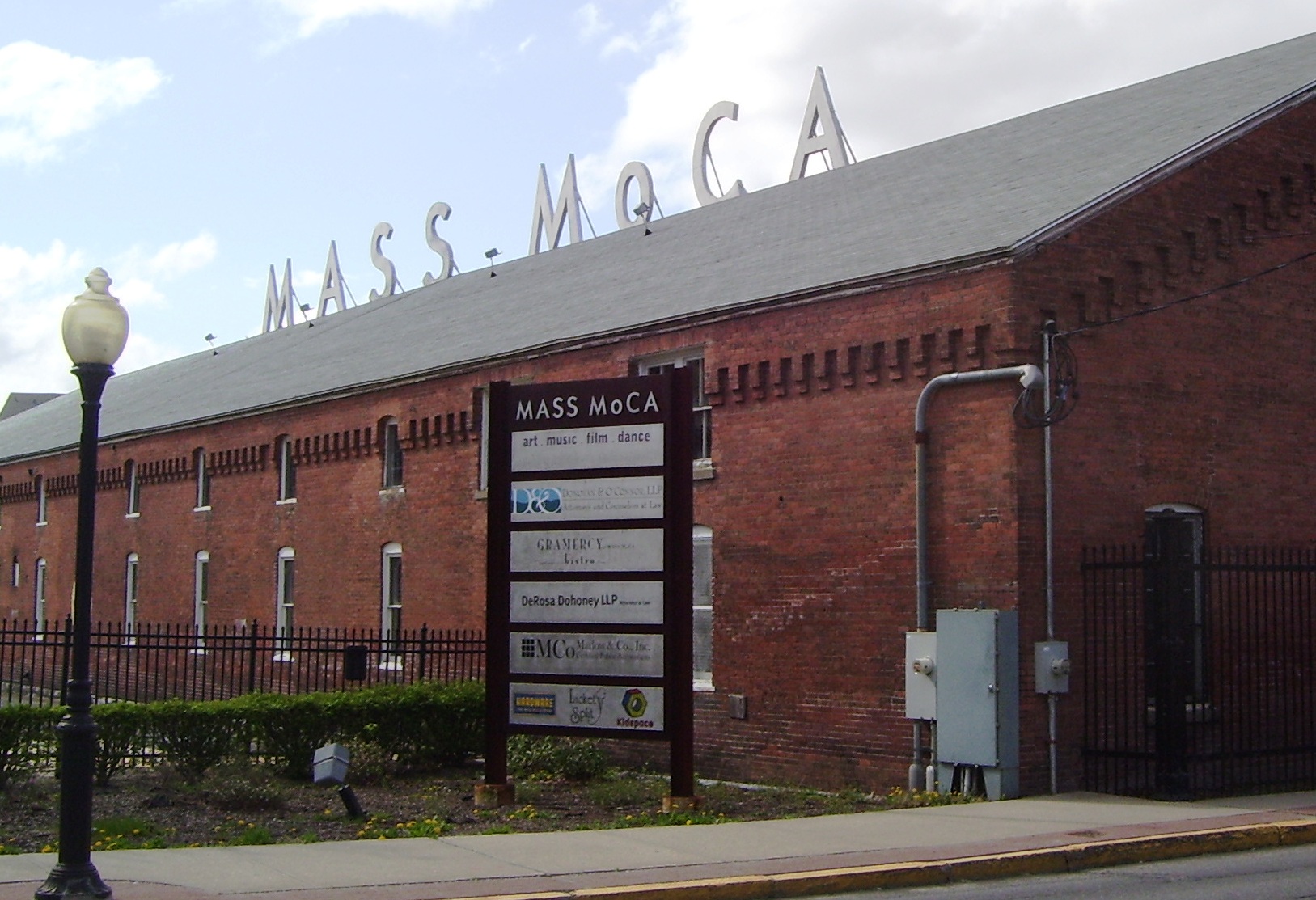
The Massachusetts Museum of Contemporary Art (MASS MoCA) is a museum within the converted Arnold Print Works factory building complex in North Adams, Massachusetts. It is one of the largest centers for contemporary visual art and performing arts in the United States.
Built by the Arnold Print Works, which operated on the site from 1860 to 1942, the complex was used by the Sprague Electric company before its conversion. MASS MoCA originally opened with 19 galleries and 100,000 sq ft (9,300 m2) of exhibition space in 1999. It has expanded since, including the 2008 expansion of Building 7 and the May 2017 addition of roughly 130,000 square feet when Building 6 was opened.[2]
In addition to housing galleries and performing arts spaces, it also rents space to commercial tenants.[3] It is the home of the Bang on a Can Summer Institute, where composers and performers from around the world come to create new music. The festival, started in 2001, includes concerts in galleries for three weeks during the summer. Starting in 2010, MASS MoCA has become the home for the Solid Sound Music Festival.
MASS MoCA, along with the Clark Art Institute and the Williams College Museum of Art (WCMA), forms a trio of significant art museums in the northern Berkshires.
Museum location and history
[edit]Arnold Print Works
[edit]The buildings that MASS MoCA now occupies were originally built between 1870 and 1900 by the company Arnold Print Works. These buildings, however, were not the first to occupy this site. Since colonial times small-scale industries had been located on this strategic peninsular location between the north and south branches of the Hoosic River. In 1860 the Arnold brothers arrived at this site and set up their company with the latest equipment for printing cloth. They began operating in 1862 and quickly took off. Aiding their success were large government contracts during the Civil War to supply cloth for the Union Army.[4]
In December 1871, a fire swept through the Arnold Print Works factory and destroyed eight of its buildings. Rebuilding started almost immediately and an expanded complex was finished in 1874. Despite a nationwide depression during the 1870s Arnold Print Works purchased additional land along the Hoosic River and constructed new buildings. By 1900, every building but one in today's Marshall Street complex was constructed.[4]
_5.jpg)
At its peak in 1905, Arnold print works employed more than 3,000 workers and was one of the world's leading producers of printed textiles. Arnold produced 580,000 yards or 330 miles of cloth per week. Arnold had offices in New York City and Paris. In addition to printing the textiles, Arnold Print Works expanded and built their own cloth-weaving facilities in order to produce "grey cloth", which was the crude, unfinished textile from which printed color cloth was made.[5]
In 1942 Arnold Print Works was forced to close its doors and leave North Adams due to the low prices of cloth produced in the South and abroad, as well as the economic effects of the Great Depression.
Sprague Electric Company
[edit]Robert C. Sprague's (son of Frank J. Sprague) Sprague Electric Company was a local North Adams company, and it purchased the Marshall Street complex to produce capacitors. During World War II Sprague operated around the clock and employed a large female workforce—not only due to the lack of men, but also because it took small hands and manual dexterity to construct the small, hand-rolled capacitors. In addition to manufacturing electrical components, Sprague had a large research and development department.[6] This department was responsible for research, design, and manufacturing of the trigger for the atomic bomb and components used in the launch systems for the Gemini space missions.
At its peak during the 1960s, Sprague employed 4,137 workers in a community of 18,000. Essentially the factory was a small city within a city with employees working alongside friends, neighbors and relatives. The company was almost completely self-sufficient, holding a radio station, orchestra, vocational school, research library, day-care center, clinic, cooperative grocery store, sports teams, and a gun club with a shooting range on the campus.
In the 1980s, Sprague began to face difficulties with global changes in the electronics industry. Cheaper electronic components were being produced in Asia combined with changes in high-tech electronics forced Sprague to sell and shutdown its factory in 1985. As a result, North Adams was left "deindustrialized" and found itself on a steep economic decline.[7]
The site was formerly listed as a superfund contaminated site.[8] The complex was listed on the National Register of Historic Places in 1985.[1][9]

MASS MoCA
[edit]The development of MASS MoCA began a year after Sprague vacated the buildings. In 1986, a group of staff from the nearby Williams College Museum of Art were looking for large factory or mill buildings where they could display and exhibit large works of modern and contemporary art that they weren't able to display in their more traditional museum/gallery setting. They were directed to the Marshall Street complex by the mayor of North Adams. When they spent time with the space, they quickly realized the buildings had much more potential than an offshoot gallery. The process for MASS MoCA began.
It took a number of years of fund-raising and organization to develop MASS MoCA. During this process the project evolved to create not only new museum/gallery space but also a performing arts venue. The transformation was chronicled by photographer Nicholas Whitman's Mass MoCA: From Mill to Museum.[10] The museum was granted $18.6 million by the Commonwealth of Massachusetts after a public/private coalition petitioned the state government to support the project.[11] Local residents and businesses contributed $8 million to the project.[12] In 1999 MASS MoCA opened its doors.
Designed by the Cambridge architecture firm of Bruner Cott & Assoc, it was awarded highest honors by the American Institute of Architects and The National Trust for Historic Preservation.[13]
In 2015, an Assets for Artists residency program began providing artists and writers business coaching and studio space at the museum and at Maker's Mill,[14] a collaborative workspace founded that year to bring to downtown North Adams the "artisanal work that once formed the manufacturing economy of the region, fiber arts and printing."[15][16]

On May 29, 2017, Building 6 was opened as gallery space, adding some 130,000 square feet of exhibition space.[17]
The museum is the subject of the 2018 documentary film Museum Town.[18]
Ongoing exhibitions
[edit]Sol LeWitt Wall Drawing Retrospective Exhibition
[edit]
On November 16, 2008, the museum opened an exhibition of Sol LeWitt wall drawings in partnership with Yale University Art Gallery and Williams College Museum of Art. The exhibition, Sol LeWitt: A Wall Drawing Retrospective occupies a 27,000-square-foot (2,500 m2) building located at the center of the campus. More than 100 monumental wall drawings and paints conceived by the artist from 1968 to 2007 will be on view through 2033. Cambridge-based Bruner/Cott & Associates converted the historic mill building and worked with LeWitt to design the gallery space. LeWitt designed the final placement of the drawings before his death in April 2007, and the drawings were installed by a team of draftsmen between April 1 and September 30, 2008.[19] The exhibition was chosen as the "top museum exhibition of 2008" by Time Magazine.[20]
Anselm Kiefer
[edit]A collaboration with the Hall Art Foundation, this presentation of work by German painter and sculptor Anselm Kiefer consists of three monumentally scaled installations, Etroits Sont Les Vaisseaux, Les Femmes De La Revolution, and Velimir Chlebnikov, and occupies a 10,000 square foot building renovated for the exhibition. On view Spring/Summer/Fall through 2028.[21]

James Turrell
[edit]Into the Light. A multi-decade retrospective of Turrell's work in B6: The Robert W. Wilson Building. This exhibition features a major work from each decade of the artist's career.

Past exhibitions
[edit]Invisible Cities
[edit]Titled after an Italo Calvino book, the exhibition featured the work of ten artists who reimagine urban landscapes both familiar and fantastical. Invisible Cities included works by Lee Bul, Carlos Garaicoa, and Sopheap Pich, as well as commissions by Diana al-Hadid, Francesco Simeti, Miha Strukelj, and local artists Kim Faler and Mary Lum. (May 24, 2012 – February 3, 2013.)
Oh, Canada
[edit]The largest survey of contemporary Canadian art ever produced outside Canada, "Oh, Canada" featured work by more than 60 artists from every Canadian province and nearly every Canadian territory, spanning multiple generations and working in many media. (May 26, 2012 – April 8, 2013.)
Notable participating artists:
- Kim Adams
- Shuvinai Ashoona
- Dan Barrow
- Rebecca Belmore
- Shary Boyle
- Bill Burns
- Eric Cameron
- Douglas Coupland
- Michel de Broin
- Marcel Dzama
- Michael Fernandes
- Noam Gonick and Luis Jacob
- David Hoffos
- Sarah Anne Johnson
- Garry Neill Kennedy
- Wanda Koop
- Micah Lexier
- Craig Leonard
- Kelly Mark
- Rita McKeough
- Chris Millar
- Kent Monkman
- Kim Morgan
- Annie Pootoogook
- Ned Pratt
- Michael Snow
- Charles Stankievech
- Hans Wendt
- Janet Werner
Katharina Grosse
[edit]One Floor Up More Highly. Katharina Grosse applied paint to four mounds of soil which seemed to spill from the upper balcony into the enormous space below. Stacks of styrofoam shards rose out of the mountains of color, mirroring the white of the gallery walls. (April 4, 2010 – January 1, 2012.)
Petah Coyne
[edit]Everything That Rises Must Converge. Baroque style pieces were displayed in four galleries on MASS MoCA's main floor. One piece, "Scalapino/Nu Shu", came upon the viewer as a former apple-bearing tree. Coyne had it uprooted and brought to the museum after it stopped bearing fruit. The exhibition also includes a selection of her photography. (May 29, 2010 – April 11, 2011.)
Sean Foley
[edit]Ruse. Sean Foley's commissioned work for MASS MoCA occupied the over-100-foot-long wall outside of the Hunter Center for the Performing Arts. (January 23, 2010 – December 31, 2011.)
Jörg Immendorff
[edit]Student of Beuys, 6 paintings. Jörg Immendorff was one of several prominent artists who studied under Joseph Beuys at the Düsseldorf Academy of Art. This exhibition was the second in a series of shows focused on Beuys and those influenced by his work and teaching. (June 1, 2010 – February 26, 2012.)
Jenny Holzer Projections
[edit]On November 18, 2007, Jenny Holzer presented her first indoor projection in the United States. Holzer's projection at MASS MoCA filled a large chamber first with selected poems by Nobel laureate Wisława Szymborska, and later with selections from prose by Nobel laureate Elfriede Jelinek. (November 16, 2007 – November 16, 2008.) Other works have included the siting of twenty-one of her carved stone benches across MASS MoCA's sixteen-acre campus. A selection of her stone benches are currently on long-term view throughout the Robert W. Wilson Building.
Badlands: New Horizons in Landscape
[edit]Badlands was an exhibition of environmental art that explored contemporary artists' fascination with the Earth and their responses to environmental concerns. Works were commissioned for the exhibit from Vaughn Bell, the Center for Land Use Interpretation, Nina Katchadourian, Joseph Smolinski and Mary Temple. Other artists exhibiting included Robert Adams, the Boyle Family, Melissa Brown, Leila Daw, Gregory Euclide, J. Henry Fair, Mike Glier, Anthony Goicolea, Marine Hugonnier, Paul Jacobsen, Mitchell Joachim, Jane Marsching, Alexis Rockman, Edward Ruscha, Yutaka Sone and Jennifer Steinkamp.[22][23] (May 24, 2008 – April 12, 2009.)
Simon Starling
[edit]Simon Starling's The Nanjing Particles was based on small stereoscopic photograph depicting a large group of Chinese workers in front of Sampson Shoe Factory. Sampson had brought them east from California to break a strike, making the largest population of Chinese workers this side of the Mississippi RIver. Starling viewed the stereograph image underneath an electron microscope, allowing him to see individual metal particles that compose the photograph, propelling him towards the creation of two large-scale sculptures that were manufactured by hand in Nanjing, China. (December 13, 2008 – November 1, 2009.)
Iñigo Manglano-Ovalle
[edit]Iñigo Manglano-Ovalle's Gravity is a Force to be Reckoned With opened with an upside-down Mies van der Rohe glass house in MASS MoCA's large Building 5 gallery space. The architecture of the house comes from plans made by Mies van der Rohe for his house with four columns or the 50x50 house (1951), that was never realized. Accompanying the house was a film, titled Always After (The Glass House) (2006). (December 12, 2009 – October 31, 2010.)
The Knitting Machine
[edit]A sculptural installation by Dave Cole, who was in residence at MASS MoCA with his project The Knitting Machine, which consisted of two excavators specially fitted with massive 20′ knitting needles, making an oversized American flag. When finished, it was it was folded into the traditional flag triangle and was on display in a presentation case which Cole described as "slightly smaller than a Volkswagen Beetle", accompanied by the 20′ knitting needles and a video of the knitting process. (June 30, 2005 – December 31, 2005.)
Material World
[edit]Sculpture to Environment. Working in a range of industrially produced materials—from plastic sheeting to fishing line—Michael Beutler, Orly Genger, Tobias Putrih, Alyson Shotz, Dan Steinhilber, and collaborators Wade Kavanaugh and Stephen B. Nguyen engage the former factory spaces of the museum's second and third floors. (April 24, 2010 – March 1, 2011.)
Leonard Nimoy
[edit]Secret Selves. Artist/actor Leonard Nimoy exhibited a recent photographic series. Shooting in nearby Northampton, Massachusetts, Nimoy recruited volunteers from the community with an open call for portrait models willing to be photographed posed and dressed as their true or imagined "secret selves". Accompanying the large, life-size photographs was a video documenting the artist's conversations with his subjects. (August 1, 2010 – January 2, 2011.)
Laylah Ali
[edit]Paintings on Paper was an exhibition of small-scale works on paper (1996–1999) by the inimitable artist Laylah Ali. Ali's comic book-like figures, genderless with bulbous green heads and a variety of pared-down uniforms, are depicted in the midst of mysterious unfolding dramas. At first glance, her Greenheads are colorful and inviting like illustrations from a comic strip or children's book. Upon closer examination, though, the disturbing narratives become clear. Ali, who is African-American, has created surreal figures that seem to have undergone numerous cultural and racial transmutations. Ali's enigmatic narratives, with so many details left unarticulated, are each easily applied to any number of historical time periods worldwide. From Nazi Germany, to the Salem witch trials, to domestic and school violence, Ali's cartoonish figures offer not just oddly timeless pictures of history, but also mirrors of the present and foreboding visions of the future. (November 8, 2001 – January 28, 2002.)[24] In 2006, Ali exhibited the work figures on a field at MASS MoCA, a collaborative performance with Dean Moss (debuted in 2005 at The Kitchen). Ali is also a professor at nearby Williams College.
Past Building 5 exhibitions
[edit]Past exhibitors in Building 5 include Robert Rauschenberg, Tim Hawkinson, Robert Wilson, Ann Hamilton, Cai Guo-Qiang, Carsten Höller, Sanford Biggers, Xu Bing, and Ledelle Moe.
Christoph Büchel's installation
[edit]In May 2007, the museum became embroiled in a legal dispute with Swiss installation artist Christoph Büchel. The museum had commissioned Büchel to create a massive installation, "Training Ground for Democracy", the exhibit was to include a rebuilt movie theater, nine shipping containers, a full-size Cape Cod–style house, a mobile home, a bus, and a truck.[25] On May 21, 2007, MASS MoCA filed a one-count complaint in the United States District Court for the District of Massachusetts's Judge Michael A. Ponsor, stating that the museum was entitled to present to the public Büchel's art installation without the artist's consent.[26]
Büchel claimed that allowing the public to view it in an unfinished state and without his permission would misrepresent his work, infringe his copyrights, and infringe his moral rights granted under U.S. law, specifically, the 1990 Visual Artists Rights Act.[26] Contrary to Büchel's allegation, the museum alleged that Büchel did not respond to requests by the museum to come and remove the materials.[27] On September 21, 2007, Judge Ponsor of the Federal District Court for Massachusetts in Springfield ruled that there was no copyright violations and no distortion inherent in showing an unfinished work as long as it was clearly labeled as such. Judge Ponsor noted that his opinion would likely not be viewed as creating a legal precedent. Although the museum was granted permission to exhibit Büchel's art installation without his consent, it chose not to do so.
Büchel appealed the district court's ruling, and in January 2010 the United States Court of Appeals for the First Circuit overruled Judge Ponsor, finding that the Visual Artists Rights Act applies to unfinished works of art, and that Büchel asserted a viable claim under the Copyright Act that MASS MoCA violated his exclusive right to display his work publicly.[28]
Directors
[edit]- 1999–2021: Joe Thompson
- 2021–present: Kristy Edmunds[29]
See also
[edit]References
[edit]- ^ a b "National Register Information System". National Register of Historic Places. National Park Service. March 13, 2009.
- ^ "Big Art, Big Money And Big Hopes Drive MASS MoCA's New Building 6". www.wbur.org.
- ^ Dobrzynski, Judith H. (May 30, 1999). "Massachusetts Home for Contemporary Art". The New York Times. Retrieved September 20, 2007.
- ^ a b Trainer, p. 9
- ^ Trainer, p. 10
- ^ Trainer, p. 11
- ^ Trainer, p.11
- ^ "CQS – CQS is a global multi-strategy asset management firm". www.cqs.com. Archived from the original on July 30, 2012.
- ^ "Press Release: Site History". Mass MoCA. Archived from the original on August 4, 2012. Retrieved September 20, 2007.
- ^ Whitman, Nicholas (September 1, 2000). Mass MoCA: From Mill to Museum. Te Neues Publishing Company. ISBN 0970073801.
- ^ Trainer, p. 12
- ^ Watson, Bruce, "A Unique Home for Cutting-Edge Art, Smithsonian, March 2000, p. 129.
- ^ "Bruner/Cott Award". brunercott.com. Archived from the original on June 18, 2007. Retrieved September 20, 2007.
- ^ DeBrincat, A.M. (2016). "Making Space To Create". ArtFile Magazine. Brooklyn, NY. Retrieved February 28, 2020.
- ^ Levulis, Jim (June 15, 2015). "Collaborative Makers' Space Opens In North Adams". AMC/Northeast Public Radio. Albany, NY. Retrieved February 28, 2020.
- ^ Stafford, Scott (July 5, 2020). "Area Artisans Stitch Together Makers' Mill in North Adams". Berkshire Eagle. Pittsfield, MA. Retrieved February 28, 2020.
- ^ "Building 6's big bang attracts thousands to Mass MoCA's new expanded footprint". May 28, 2017.
- ^ Gyarkye, Lovia (December 17, 2020). "'Museum Town' Review: A Love Letter to Mass MoCA". The New York Times.
- ^ Smee, Sebastian (November 16, 2008). "In vast LeWitt show, absurdity and beauty". Boston Globe. Retrieved December 9, 2008.
- ^ Lacayo, Richard (November 3, 2008). "Sol LeWitt: A Wall Drawing Retrospective". 2008 Top Ten Museum Exhibits. Time Magazine. Archived from the original on September 13, 2012. Retrieved December 9, 2008.
- ^ "Anselm Kiefer". www.massmoca.org. October 15, 2015.
- ^ "Badlands: New Horizons in Landscape". MASS MoCA (Massachusetts Museum of Contemporary Art). May 24, 2008. Archived from the original on December 7, 2013. Retrieved January 8, 2014.
- ^ Markonish, Denise (July 11, 2008). Badlands. MIT Press. ISBN 9780262633666. Retrieved January 8, 2014.
- ^ "Laylah Ali Paintings on Paper | MASS MoCA". April 20, 2016. Retrieved February 2, 2024.
- ^ Smith, Roberta (September 16, 2007). "Is It Art Yet? And Who Decides?". The New York Times. Retrieved September 20, 2007.
- ^ a b "MassMOCA v Buchel District Court Opinion". Scribd. Retrieved December 12, 2015.
- ^ Johnson, Ken (July 1, 2007). "No admittance: Mass MoCA has mishandled disputed art installation". The Boston Globe. Retrieved September 20, 2007.
- ^ "Mass MoCA v. Christoph Büchel, First Circuit Opinion". Scribd. Retrieved December 12, 2015.
- ^ Alex Greenberger (September 23, 2021), MASS MoCA Names Influential Performing Arts Center Leader as New Director ARTnews.
General bibliography
[edit]- Trainer, Jennifer (ed.); Whitman, Nicholas (photographer), MASS MoCA: From Mill to Museum. North Adams: MASS MoCA Publications, 2000.
External links
[edit]
| Topics |  | ||||||||||||||||
|---|---|---|---|---|---|---|---|---|---|---|---|---|---|---|---|---|---|
| Lists by county | |||||||||||||||||
| Lists by city |
| ||||||||||||||||
| Other lists | |||||||||||||||||


| Art | .jpg) | ||||||
|---|---|---|---|---|---|---|---|
| Athletics |
| ||||||
| Campus | |||||||
| History | |||||||
| Social | |||||||
| International | |
|---|---|
| National | |
| Geographic | |
| Academics | |
| Artists | |
| Other | |

Massachusetts Museum of Contemporary Art
View on GrokipediaThe Massachusetts Museum of Contemporary Art (MASS MoCA) is a museum dedicated to contemporary visual art and performing arts, located in North Adams, Massachusetts, within a repurposed complex of 19th-century factory buildings originally part of the Arnold Print Works and later Sprague Electric.[1] Opened to the public in 1999 after planning that began in 1986, it occupies 250,000 square feet of gallery space across multiple buildings, making it one of the largest venues for contemporary art exhibitions in the United States.[2][3] MASS MoCA emphasizes large-scale, site-specific installations and immersive experiences that leverage its industrial architecture, alongside facilities for artist residencies and fabrication, hosting over 75 exhibitions and performances annually with works from established and emerging creators.[2] The institution supports art-making on-site through programs like The Studios at MASS MoCA, which provide workspace for residencies, and it integrates commercial tenants and community events to sustain operations in a former manufacturing hub that once employed thousands but declined with industrial shifts.[1][2] A defining controversy arose in 2007 when MASS MoCA commissioned Swiss artist Christoph Büchel for the installation Training Ground for Democracy, but escalating costs prevented completion; the museum sought to exhibit the unfinished materials behind barriers without attribution, prompting a lawsuit from the artist over moral rights, which a federal judge resolved in the museum's favor, allowing display but barring the artist's name and clarifying limits on artists' control post-commission.[4] This case underscored practical challenges in commissioning ambitious contemporary projects and influenced discussions on contractual obligations in the art world.[5]
Historical Development
Industrial Foundations (1860s–1980s)
The Arnold Print Works was established in 1860 by O. Arnold and Company in North Adams, Massachusetts, initially focusing on advanced cloth-printing operations that benefited from Union Army contracts during the Civil War.[1] By 1905, the facility had expanded significantly, employing 3,200 workers and utilizing 25 of the 26 buildings that would later form the core of the MASS MoCA campus, establishing it as the dominant textile printing operation in the region.[1] The company's prosperity stemmed from its scale and technological edge in printing colored fabrics, but it faced mounting pressures from declining cloth prices exacerbated by the Great Depression.[1] Operations ceased in 1942, with the firm consolidating to a smaller site in nearby Adams amid wartime economic shifts and industry-wide contraction.[1] Following the Arnold closure, Sprague Electric Company acquired the site in 1942, repurposing the textile mill into an electronics manufacturing plant producing components such as capacitors for World War II weaponry, including the atomic bomb, and later for the Gemini space missions.[1] At its peak in 1966, Sprague employed 4,137 workers in a town of approximately 18,000 residents, underscoring its role as a major economic anchor during the post-war electronics boom.[1] However, by the early 1980s, production lines began shutting down due to intensified global competition from cheaper foreign-sourced components, leading to the facility's permanent closure in 1985.[1] This decline reflected broader technological shifts and offshoring trends in the American electronics sector. The 16-acre campus, comprising 26 brick buildings originally developed for heavy industry, accumulated environmental contamination from decades of textile dyeing and electronics production, including coal tar waste, petroleum residues, and dye effluents discharged into the adjacent Hoosic River.[6][7][8] Remediation efforts later addressed these issues, with costs exceeding $25 million for cleanup of pervasive pollutants that posed challenges for any redevelopment.[7] The site's vast scale and industrial legacy—rooted in causal economic displacements from domestic manufacturing dominance to globalized production—provided the physical foundation for subsequent adaptive reuse, though not without substantial infrastructural hurdles.[6]Planning and Conversion (1980s–1990s)
In the mid-1980s, following the 1985 closure of the Sprague Electric Company, which had occupied a sprawling 16-acre complex of 28 industrial buildings in North Adams, local business and political leaders sought to repurpose the underutilized site amid the city's economic decline from deindustrialization.[1] The initiative gained traction through collaboration with Williams College Museum of Art director Thomas Krens, who envisioned a large-scale venue for contemporary art to serve as an economic anchor; North Adams Mayor John Barrett III suggested the Sprague campus specifically for its scale and infrastructure.[1] In 1986, Joseph C. Thompson was appointed founding director to lead the project, shifting focus from a minimal art museum to a multifaceted center incorporating visual arts, performing arts, and adaptive reuse of the factory structures.[1][9] Funding efforts began with a 1988 state grant approved by the Massachusetts legislature, but progress stalled for nearly eight years due to a severe recession, shifts in state political leadership, and broader economic upheaval.[10] These delays exacerbated funding shortfalls and led to regulatory hurdles, with some buildings falling into disrepair while planners adopted a phased redevelopment strategy to mitigate risks.[11] Skepticism persisted, as evidenced by media critiques questioning the project's feasibility after initial state investments of around $2 million yielded limited tangible progress by 1990.[12] By the mid-1990s, renewed state support materialized, including a $35 million grant supplemented by over $8 million in private matching funds, enabling construction to advance.[13][1] In 1992, Bruner/Cott Architects was selected to oversee the adaptive reuse, with contributions from firms like Frank Gehry and Robert Venturi for specific elements; final designs for the initial phase were completed in 1995.[1] Governor William Weld endorsed Phase 1 in 1993 and released initial construction funds in 1994, focusing on converting mill buildings into galleries while preserving industrial features such as exposed brick and vast open spaces.[14] After over a decade of planning and intermittent setbacks, the transformed campus—encompassing approximately 250,000 square feet—opened to the public in May 1999 as the Massachusetts Museum of Contemporary Art.[11][15]Establishment and Early Operations (1999–2010)
The Massachusetts Museum of Contemporary Art (MASS MoCA) opened to the public on May 30, 1999, debuting approximately 200,000 square feet of exhibition and performance space adapted from the former Sprague Electric complex in North Adams. Initial programming emphasized large-scale, site-responsive installations that leveraged the vast industrial architecture, including the group exhibition Critical MASS, curated to test the venue's capacity for ambitious contemporary works. Concurrently, Test Site featured sculptural installations by artists such as Carl Andre and Dan Flavin, running from the opening through spring 2000 and highlighting the museum's commitment to monumental, immersive art forms suited to the repurposed mill buildings.[16][17][18] Early operations integrated visual art with performing arts and educational initiatives, such as the 1999 launch of Kidspace in collaboration with Williams College and the Clark Art Institute, aimed at interactive family engagement. Artist residencies and commissions fostered site-specific creations, enabling experimentation in the expansive galleries and supporting the production of new works rather than solely displaying existing collections. By 2002, annual attendance reached 120,000 visitors, reflecting steady growth from initial post-opening figures as programming diversified to include both temporary exhibitions and long-term installations.[18][1] The museum navigated operational challenges in its formative years, including inconsistent state funding that led to periods where staff, including director Joseph Thompson, worked without salaries to sustain activities. Economic pressures in the early 2000s, amid broader post-industrial decline in North Adams, prompted adaptations to balance visual art dominance with expanded performing arts, such as dance and music events, to broaden appeal and stabilize finances. A notable controversy arose in 2007 over the unfinished exhibition Training Ground for Democracy by Christoph Büchel, where disputes over completion and withdrawal highlighted tensions in collaborative artist-museum dynamics but ultimately reinforced commitments to risk-taking programming. Milestones included the 2004 fifth-anniversary celebrations and the 2008 opening of Sol LeWitt: A Wall Drawing Retrospective, a collaborative project with Yale University Art Gallery featuring over 70 works planned for display through 2033, signaling maturation in hosting enduring, large-scale retrospectives.[19][1][20][18]Facilities and Infrastructure
Campus Composition and Adaptive Reuse
The Massachusetts Museum of Contemporary Art (MASS MoCA) spans a 16-acre campus along the Hoosic River in North Adams, encompassing 26 buildings mostly erected by the late 1890s as part of the Arnold Print Works textile mill complex. These primarily brick-and-steel structures, later adapted for electronics manufacturing by Sprague Electric from 1942 to 1985, form the core of the site's adaptive reuse, preserving vast interior volumes and raw industrial aesthetics that enable site-specific, large-scale contemporary installations unattainable in standard gallery formats.[1] Adaptive reuse emphasized minimal exterior alterations to maintain historical integrity, with interior conversions focusing on structural reinforcement and utility upgrades while respecting load-bearing limitations and open floor plans inherent to mill design. Building 5 serves as a primary venue for major visual exhibitions, leveraging its expansive, column-free spaces for immersive displays, whereas the Hunter Center accommodates performing arts through acoustically tuned repurposed halls. These engineering choices prioritized the causal interplay between original industrial constraints—such as high ceilings and durable framing—and artistic demands for unorthodox spatial experiences.[1][22][23] Environmental remediation preceded artistic repurposing, addressing legacy contamination from textile dyeing and electronics production, including shoreline stabilization and removal of 5,000 cubic yards of heavily polluted material between 1973 and 1977, alongside ongoing abatement of asbestos in over 40,000 linear feet of piping and 130,000 square feet of transite panels. Classified as Massachusetts' largest such initiative, this brownfield cleanup underscored the prohibitive costs of industrial residue, necessitating phased interventions that delayed full occupancy until site safety standards were met.[24][25]Major Expansions and Architectural Features
In 2017, MASS MoCA completed a major expansion with the renovation and opening of Building 6, designated the Robert W. Wilson Building, which added approximately 130,000 square feet of exhibition space to the campus.[26][27] The project opened to the public on May 28, 2017, nearly doubling the museum's prior gallery capacity and enabling the accommodation of expansive, site-specific installations such as James Turrell's light-based works.[28][29] Architectural elements in Building 6 preserve the site's industrial heritage while enhancing functionality for contemporary art, featuring restored historic lightwells that introduce natural daylight into interior spaces and original factory windows extending from floor to ceiling in select galleries.[30][31] Raw concrete floors and voluminous interiors support kinetic sculptures and multimedia installations requiring structural robustness and spatial flexibility.[32] Acoustic improvements, including enhanced sound isolation between galleries and reduced HVAC noise, facilitate performing arts by minimizing interference and optimizing auditory clarity.[33] More recent infrastructure adaptations address environmental vulnerabilities, particularly following floods in the 2010s from the nearby Hoosic River. In February 2024, MASS MoCA secured a $1 million grant from the Barr Foundation to bolster collaborative efforts with North Adams on placemaking, encompassing flood-resilient features like chutes to mitigate stormwater risks without compromising the campus's adaptive reuse character.[34][35]Artistic Programming
Permanent and Long-Term Installations
One of the defining features of MASS MoCA's approach to contemporary art is its dedication to long-term installations that leverage the museum's vast industrial spaces for site-specific, large-scale works, often spanning decades and requiring ongoing maintenance to preserve their immersive impact. The most extensive is Sol LeWitt's A Wall Drawing Retrospective, installed in 2008 across approximately 27,000 square feet in Building 7, comprising 105 murals executed by teams following the artist's precise instructions, with the exhibition structured as a 25-year commitment extendable through repainting as needed.[36][37] This retrospective, developed in collaboration with Yale University Art Gallery and Williams College Museum of Art, underscores the museum's emphasis on durational art that evolves through replication rather than decay, occupying an entire former factory building to create a labyrinthine environment of geometric patterns and color fields.[38] Anselm Kiefer's installations, initiated in 2013 through a partnership with the Hall Art Foundation, occupy significant portions of the campus with monumental steel, concrete, and mixed-media structures evoking themes of history and mythology, designed for quasi-permanent display in adapted industrial volumes that accommodate their massive scale and material weight.[39] These works, including scorched-lead paintings and vitrine-encased artifacts, demand structural reinforcements in the repurposed buildings, reflecting MASS MoCA's capacity to host art that integrates with—and challenges—the architecture's post-industrial durability.[40] In 2017, following expansions to Building 6, James Turrell's Into the Light retrospective was installed as a multi-decade presentation, featuring one major work from each of the artist's six decades, including the Skyspace C.A.V.U. (ceiling-aperture viewing unit) that manipulates natural light through an oculus in a darkened chamber, requiring precise engineering for perceptual immersion over extended periods.[29][36] This installation exploits the building's high ceilings and raw concrete to heighten sensory isolation, committing to Turrell's light-based phenomenology as a fixed experiential anchor amid rotating programming.[41] Long-term elements from residencies by Laurie Anderson and Jenny Holzer, also housed in Building 6 since 2017, include Anderson's interactive digital projections like Chalkroom—a virtual reality environment mapping handwritten texts on infinite chalkboards—and Holzer's Redaction Paintings series alongside stone carvings and LED truisms, both calibrated for the spaces' acoustics and sightlines to ensure sustained viewer engagement without reliance on fleeting trends.[30][42] These works prioritize material and technological persistence, with Holzer's incorporating classified document redactions etched into granite for archival permanence, illustrating MASS MoCA's model of commissioning art that withstands empirical scrutiny over time through institutional stewardship.[43][40]Rotating Visual Art Exhibitions
MASS MoCA's rotating visual art exhibitions have emphasized large-scale, site-responsive installations that leverage the museum's expansive industrial spaces, evolving from early focuses on individual artists' immersive environments to broader thematic surveys and multimedia works incorporating global and cultural narratives. In the late 2000s and early 2010s, exhibitions like Simon Starling's The Nanjing Particles (December 2008–November 2009) explored manufacturing processes and labor through a site-specific installation in Building 5, transforming raw materials into conceptual sculptures that interrogated industrial history in North Adams.[44] Similarly, Katharina Grosse's One Floor Up More Highly (April 2010–January 2012) featured spray-painted immersive landscapes across multiple floors, using vibrant colors and architectural interventions to challenge traditional painting scales and viewer perception.[45] Mid-period rotations shifted toward sculptural complexity and national surveys, exemplified by Petah Coyne's Everything That Rises Must Converge (May 2010–March 2011), which presented over a dozen large-scale sculptures incorporating taxidermy, wax drips, and organic forms in the triple-height galleries, evoking ethereal ecosystems and drawing critical acclaim for its uncanny materiality.[46] The sprawling Oh, Canada (May 2012–April 2013) marked a pivot to thematic breadth, surveying contemporary Canadian art with over 100 works by 62 artists across several buildings, including new commissions that prompted discourse on national identity and artistic exportation, though reviewers noted its subjective curation sometimes overshadowed cohesive critique.[47] By the mid-2010s and into the 2020s, exhibitions increasingly integrated multimedia elements and diverse global perspectives, reflecting programmatic maturation toward interactive and culturally resonant installations. Recent 25th anniversary programming highlights this trajectory, with Jeffrey Gibson's POWER FULL BECAUSE WE'RE DIFFERENT (November 2024–May 2026) commissioning an immersive Building 5 environment blending beaded garments, illuminated dance floors, and Two-Spirit cultural references to foster communal reflection on identity and collaboration.[48] Complementing this, Vincent Valdez's Just a Dream… (May 2025–April 2026), the artist's first major survey spanning two decades of paintings and drawings, examines American socio-political margins through figurative works, co-organized to underscore evolving institutional emphasis on narrative-driven, historically contextualized visuals.[49] These shifts have correlated with sustained visitor interest, as evidenced by anniversary events drawing crowds for guided interactions, though specific engagement metrics remain institutionally reported rather than publicly quantified.[50]Performing Arts, Events, and Festivals
MASS MoCA maintains an active performing arts program that encompasses music, contemporary dance, theater, and multimedia events, presented across its Hunter Center stage and outdoor spaces year-round.[51] These offerings emphasize experimental and boundary-pushing works, often developed through artist residencies that leverage the museum's industrial-scale facilities for site-specific creations.[52] The museum's flagship festivals anchor this programming, blending live performance with its visual art environment. Solid Sound, curated by the band Wilco, originated in 2010 as a biennial event spanning music, comedy, and art installations across the 16-acre campus; the 2024 iteration ran June 28–30, featuring Wilco alongside acts like Billy Bragg performing full sets from their collaborative album Mermaid Avenue.[53][54] FreshGrass, an annual bluegrass and roots music festival produced in partnership with FreshGrass LLC, occurs each September and highlights both traditionalists and innovators on multiple stages; the 2025 edition is set for September 19–21, with initial performers including Greensky Bluegrass and Cimafunk.[55][56] These festivals utilize the museum's galleries and courtyards, fostering interdisciplinary experiences where attendees encounter ongoing visual exhibitions amid performances.[57] Individual performances underscore the program's scope, such as the Philip Glass Ensemble's sold-out presentation of Philip Glass's score live to the film Koyaanisqatsi on October 19, 2024, in the Hunter Center.[58] In October 2025, MASS MoCA launched MASS MoCA Records, a collaborative label with Hen House Studios focused on releasing site-recorded music, sound art, and spoken-word projects; its inaugural album, a self-titled collection of Malawian roots music by the Kasambwe Brothers, debuted on October 24, with further Berkshires-recorded works planned for 2026.[59] This initiative extends performing arts into recorded formats, capturing works created during museum residencies.[60] Sound-based performances integrate closely with visual art through dedicated installations, such as Bruce Odland and Sam Auinger's Harmonic Bridge, which uses acoustic resonators to amplify environmental sounds within gallery spaces, and Stephen Vitiello's All Those Vanished Engines, blending audio with sculptural elements.[61] These hybrid works, often commissioned for the museum's architecture, draw on its history of adaptive reuse to create immersive auditory experiences that complement static exhibitions.[61] Partnerships with artists and organizations like Wilco and No Depression magazine enhance the program's reach, positioning MASS MoCA as a hub for innovative live events that attract dedicated audiences.[62]Leadership and Operations
Key Directors and Administrative Evolution
Joseph C. Thompson served as the founding director of MASS MoCA from its inception in 1988 through his departure in October 2020, overseeing the museum's transformation of a 13-acre former industrial complex into a hub for large-scale contemporary art installations that leveraged adaptive reuse of factory buildings for immersive exhibitions.[63][64] Under Thompson's leadership, the institution prioritized long-term artist commissions and residencies, which stabilized programming by fostering sustained creative output amid economic fluctuations in North Adams.[65] Following Thompson's exit, deputy director Tracy Moore assumed an interim role in late 2020 to ensure operational continuity during the leadership transition, marking an initial shift toward distributed administrative responsibilities.[65] Kristy Edmunds, previously executive director of UCLA's Center for the Art of Performance, was appointed director in September 2021, bringing expertise in interdisciplinary programming to expand performing arts integration with visual exhibitions.[66] Edmunds has guided the museum through its 25th anniversary in 2024 and the rollout of the 2024–2030 strategic plan, which emphasizes post-pandemic recovery via enhanced artist support, staff equity improvements, and diversified programming to bolster institutional resilience.[67][68] The administrative model has evolved from Thompson's founder-centric vision to a more collaborative board-governed structure, incorporating trustee input in strategic planning and succession processes to mitigate risks associated with singular leadership dependencies.[69] This transition has influenced programming stability by prioritizing artist residencies as core to long-term commitments, while diversifying revenue streams through expanded events to reduce vulnerability to external disruptions.[67] In response to the 2025 termination of a National Endowment for the Arts grant for Jeffrey Gibson's commission—attributed to federal policy shifts prioritizing traditional artistic heritage—Edmunds publicly addressed the decision, highlighting broader grant rescissions and underscoring the need for adaptive internal strategies to sustain innovative projects without federal support.[70][71] This administrative stance has reinforced focus on self-reliant programming models, influencing decisions to accelerate the strategic plan's emphasis on community-rooted initiatives for operational steadiness.[70]Funding Mechanisms and Financial Sustainability
MASS MoCA's funding relies on a combination of earned revenue, philanthropic contributions, and public grants, with the latter historically dominating capital and operational support. Earned income primarily derives from ticket sales for admissions and performing arts events, which constituted approximately 70% of revenue prior to the COVID-19 pandemic, though overall earned revenue covers only about one-third of operating costs.[72][73] In fiscal year 2017, total operating expenditures reached $11.1 million, supported in part by 245,200 visitor-days generating box office attendance revenue.[74] Philanthropic gifts supplement this, such as the $1 million grant from the Barr Foundation in February 2024 to fund dedicated staff positions for creative placemaking collaborations with North Adams.[75] The museum also generates income through leases and program services, reported at $3.8 million in recent financials alongside $11.6 million in grants and contributions. Public subsidies have been pivotal, particularly for infrastructure. The Commonwealth of Massachusetts provided a $35 million construction grant for initial development, of which $18.6 million was drawn by the 1999 opening, supplemented by a $22 million grant and additional $9.4 million in state bonds.[76][77] A further $25.4 million state grant in the mid-2010s enabled gallery expansions adding 120,000 square feet.[78] Federal support via the National Endowment for the Arts (NEA) has been smaller but targeted, though vulnerable to policy shifts; in May 2025, the NEA terminated a $50,000 grant awarded in 2024 for the Jeffrey Gibson exhibition "Power Full Because We're Different," citing updated priorities under the Trump administration.[70][79] Financial sustainability faces risks from over-reliance on volatile earned and public funding streams. The 2020 pandemic closures eliminated ticket and event revenue—prompting over 100 layoffs—and contributed to broader Massachusetts cultural sector losses exceeding $425 million, with recovery dependent on tourism rebound.[80][81] Recent NEA cuts exacerbate strains, as noted by director Kristy Edmunds, who highlighted their impact on project viability amid appeals.[82] To mitigate these, MASS MoCA's 2024–2030 Strategic Plan prioritizes diversified income through a feasibility study for a comprehensive capital campaign by 2026, alongside investments in green technologies and institutional stabilization to counter economic and climate uncertainties.[83][84]Economic and Social Impact
Tourism, Attendance, and Regional Economy
MASS MoCA attracts substantial annual attendance, with fiscal year 2017 recording 245,200 visitor-days, of which 84% originated from outside the region, indicating a strong draw for cultural tourism.[74] Visitor expenditures in that year totaled $19.7 million, distributed across lodging ($9 million), food ($8.4 million), retail ($3.4 million), transportation ($1.4 million), and other categories, directly injecting funds into local businesses.[74] These visits contribute to a broader regional economic output of $50.8 million annually as of 2017, encompassing $11.1 million from museum operations and multiplier effects from supply chains and induced spending, which amplify the initial inputs.[74] The institution supports 586 jobs in total, including 408 direct positions and 178 indirect or induced roles, with average worker income at $32,072, primarily benefiting hospitality, retail, and creative sectors in Berkshire County.[74] By catalyzing a transition from North Adams' manufacturing base to an arts-driven economy, MASS MoCA has spurred growth in tourism-related employment and visitor-dependent enterprises, as evidenced by longitudinal analyses showing increased payroll and business establishments post-opening.[85] Recent initiatives, such as 2024's 25th anniversary programming and recurring events like the Solid Sound Festival, have sustained and elevated attendance above 245,000 visitors per year, promoting year-round economic activity through enhanced partnerships and seasonal draws.[19][59]Community Revitalization Efforts and Challenges
MASS MoCA has pursued community revitalization through targeted partnerships with North Adams, notably via a $1 million Barr Foundation grant awarded in February 2024 to bolster collaborative capacity, including dedicated staff for creative placemaking initiatives such as housing development, flood mitigation chutes along the Hoosic River, and infrastructure improvements tied to the Route 2 overpass.[34] Complementing this, the city secured a $750,000 federal Reconnecting Communities grant in 2023 for a feasibility study on redeveloping the overpass, which bisects downtown and isolates the museum campus, with MASS MoCA actively involved in exploring options like removal or redesign to enhance pedestrian connectivity.[86] The museum's Assets for Artists program further supports local integration by offering grants, residencies, and professional development to encourage artists to settle in North Adams, with the initiative expanding its focus on hometown retention before transitioning to an independent nonprofit on October 1, 2025.[87] These endeavors have yielded measurable outcomes in arresting post-industrial decline, including population stabilization after a sharp drop following the 1986 closure of Sprague Electric, alongside boosts in community wealth estimated at nearly $14 million by 2006 through property value gains and tax revenue increases.[88] Economic analyses attribute indirect effects, such as job creation and visitor spillover, to fostering a nascent creative economy that mitigated further outmigration in the Northern Berkshires.[19] Persistent challenges include environmental legacies from the site's industrial past, where remediation of toxic wastes like asbestos delayed initial openings and prompted ongoing scrutiny, exemplified by a 2024 whistleblower claim of improper disposal leading to an employee's termination.[89] Gentrification risks have surfaced amid rising property values and development pressures, with critics arguing that museum-driven projects prioritize transient tourism infrastructure over affordable housing or year-round employment, potentially displacing long-term residents without broad-based benefits.[84] The region's over-reliance on seasonal arts visitation, rather than diversified industry, exacerbates vulnerabilities during downturns, as evidenced by Berkshire economic strains during the 2020 tourism halt, underscoring causal limits in replacing lost manufacturing with culturally anchored but fluctuating revenue streams.[73][13]Controversies and Criticisms
Artist Rights and Institutional Conflicts
In 2006, Swiss artist Christoph Büchel began developing the installation Training Ground for Democracy for exhibition at the Massachusetts Museum of Contemporary Art (MASS MoCA), an ambitious project involving military-themed elements like a tank and voting booths, conceived as a critique of democratic processes.[90] The initial budget was set at $160,000, with MASS MoCA agreeing to purchase materials under Büchel's direction while he oversaw fabrication remotely for periods.[91] Disputes arose over procurement delays, the scope of elements Büchel demanded—such as acquiring a real Boeing 747 fuselage—and escalating expenditures, which surpassed $300,000 by early 2007 as the museum staff constructed components without Büchel's final on-site approval.[92] Büchel accused MASS MoCA of insufficient commitment to his vision and fiscal constraints imposed by the institution, while the museum argued that Büchel's shifting requirements and absences contributed to inefficiencies, leading him to withdraw in May 2007 before completion.[93] Facing sunk costs exceeding the original budget by over $140,000 and an unfinished structure occupying significant gallery space, MASS MoCA sought to exhibit the partial installation with disclaimers labeling it as unapproved by the artist, proposing titles like Purgatory Lost to frame it as an institutional response rather than Büchel's work.[94] Büchel filed suit under the Visual Artists Rights Act (VARA) of 1990, claiming violations of his rights of attribution and integrity, asserting that public display would distort his intended artwork and harm his reputation; he also invoked copyright claims for unauthorized preparation of derivative works.[95] In September 2007, the U.S. District Court for the District of Massachusetts granted summary judgment to MASS MoCA, ruling that VARA protections did not extend to the unfinished piece due to lack of a fixed medium and that any display with clear labeling avoided integrity violations.[96] The First Circuit Court of Appeals reversed in January 2010, holding that VARA applies to unfinished but recognizable artworks and that genuine factual disputes existed over collaboration levels, the work's completion status, and potential distortion, remanding for trial while affirming Büchel's viable copyright claim.[97][98] The case drew media scrutiny for exposing frictions in commissioning large-scale installations, where artists' demands for absolute control clash with museums' needs for budgetary oversight and public accountability, often resulting in protracted litigation that burdens both parties.[99] Ultimately, on December 7, 2010, MASS MoCA and Büchel reached a confidential settlement resolving all claims, allowing the museum to avoid further trial risks while Büchel retained moral rights assertions without public disclosure of terms.[100] This dispute underscores broader institutional tensions in contemporary art production, where ambitious commissions risk financial overruns—here amplifying MASS MoCA's exposure as a nonprofit reliant on grants and admissions—and legal precedents under VARA have tilted toward protecting artists' interpretive authority over incomplete works, deterring museums from unilateral exhibitions despite contractual ambiguities.[101] While earlier rulings favored institutions by emphasizing disclaimers, the appellate outcome highlighted evidentiary burdens on museums to prove non-collaboration or minimal alteration, influencing subsequent contracts to include clearer exit clauses and cost caps for high-stakes collaborations.[102]Public Funding Dependencies and Skepticism
The establishment of MASS MoCA in the 1990s relied heavily on public grants, with state and federal support totaling millions amid Massachusetts' fiscal constraints following the early 1990s recession, prompting early doubts about the return on investment for converting industrial facilities into an arts venue rather than pursuing direct economic development alternatives.[85] Economists, including Williams College's Stephen Sheppard, later assessed that the museum fell short of its initial projections for job creation and regional revitalization, generating measurable but limited multipliers compared to promised outcomes.[13] Subsequent expansions amplified these dependencies, such as the 2014 Phase III project costing $55 million, of which $25 million came from state capital bonds approved during ongoing budget pressures.[103] Critics highlighted opportunity costs, arguing that such subsidies diverted resources from infrastructure or education amid mixed evidence of self-sustaining growth; while Williams College studies estimated annual economic impacts ranging from $34 million in 2015 to $52 million by 2020 through visitor spending and job support, these figures included indirect effects and did not offset persistent operational deficits or fully realize early hype for transformative ROI.[104][74][79] Federal funding cuts in 2025 underscored vulnerabilities, with the National Endowment for the Arts terminating grants including a $50,000 award for an ongoing exhibition, contributing to broader rescissions totaling over $2.7 million across Massachusetts cultural organizations and exacerbating financial strain as acknowledged by museum leadership.[79][71][105] Proponents counter with analogies to private-sector adaptive reuse successes in North Adams, citing the museum's role in stabilizing property values and tax revenues, yet empirical data reveals gaps in long-term self-sufficiency, as ongoing subsidy needs persist despite reported multipliers.[106]References
- https://www.[archdaily](/page/ArchDaily).com/883699/mass-moca-building-6-bruner-cott-and-associates