Hubbry Logo
May 16 coupMay 16 coupMain
Open search
May 16 coup
Community hub
May 16 coup
logo
8 pages, 0 posts
0 subscribers
Be the first to start a discussion here.
May 16 coup
May 16 coup
from Wikipedia

May 16 coup
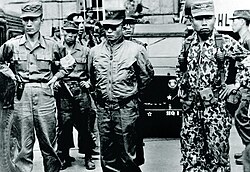
From top to bottom, Major-General Park Chung Hee (front center) and soldiers tasked with effecting the coup, South Korean Marines march to the capitol after the coup, and officer cadets of Korea Military Academy march in support of the military coup
DateMay 16, 1961 (1961-05-16)
Location
Seoul, South Korea
Result

Coup successful

Belligerents
Military Revolutionary Committee Second Republic of Korea
Commanders and leaders
May 16 coup
Hangul
5·16 군사정변
Hanja
五一六軍事政變
RR5·16 gunsajeongbyeon
MR5·16 kunsajŏngbyŏn

The May 16 military coup d'état (Korean: 5·16 군사정변) or the May 16 Military Revolution (Korean: 5·16 군사혁명) was a military coup d'état in South Korea in 1961, organized and carried out by Park Chung Hee and his allies who formed the Military Revolutionary Committee, nominally led by Army Chief of Staff Chang Do-yong after the latter's acquiescence on the day of the coup. The coup rendered powerless the democratically elected government of Prime Minister Chang Myon and President Yun Posun, and ended the Second Republic, installing a reformist military Supreme Council for National Reconstruction effectively led by Park, who took over as chairman after Chang's arrest in July.

The coup was instrumental in bringing to power a new developmentalist elite and in laying the foundations for the rapid industrialization of South Korea under Park's leadership, but its legacy is controversial for the suppression of democracy and civil liberties it entailed, and the purges enacted in its wake. Termed the "May 16 Military Revolution" by Park and his allies, "a new, mature national debut of spirit",[1] the coup's nature as a "revolution" is controversial and its evaluation contested.

Background and causes

[edit]

The background to the coup can be analysed both in terms of its immediate context and in terms of the development of post-liberation South Korea. Although the singularly problematic economic and political climate of the Second Republic encouraged a military intervention, the roots of the coup go back to the late Rhee period. Historians like Yong-Sup Han argue that the common view of the coup as caused solely by the vagaries of a new regime paralyzed by instability is too simplistic.[2]

South Korea under Syngman Rhee

[edit]

From 1948, South Korea was governed by President Syngman Rhee, an anti-Communist who used the Korean War to consolidate a monopoly on political power in the republic. Rhee represented the interests of a conservative ruling class, the so-called "liberation aristocrats" who had risen to positions of influence under American occupation. These "liberation aristocrats" formed the bulk of the political class, encompassing both Rhee's supporters and his rivals in the Democratic Party, which advanced a vision of society broadly similar to his own.[3] Rhee eliminated any significant source of real opposition, securing for example the execution of Cho Bong-am, who had campaigned against him in the presidential elections of 1956 on a platform of peaceful reunification and had attracted some 30% of the vote, an unacceptably high level of support for an opposition candidate.[4]

Even such significant opposition figures as Cho, however, can be considered to have been part of the broad conservative consensus of the governing class,[5] which rested on a traditionalist, Confucian worldview that saw "pluralism in ideology and equality in human relationships [as] foreign concepts",[6] and which upheld the value of paternalist government and the power of extensive networks of political patronage. Rhee, under this traditionalist model, was the foremost "elder" in Korean society, to whom Koreans owed familial allegiance, and this relationship was strengthened by the ties of obligation that connected Rhee to many in the ruling class.[6]

One result of the rule of the "liberation aristocrats" was the stalling of development in South Korea, in marked contrast to the situation in nearby Japan. Where South Korea had been intensively developed under the Japanese colonial system, Rhee's presidency saw little significant effort to develop the South Korean economy, which remained stagnant, poor and largely agrarian.[7] The lack of development under Rhee provoked a growing nationalistic intellectual reaction which called for a radical restructuring of society and a thorough political and economic reorganization. Park Chung Hee, the later leader of the May Coup who at that time was a second-tier army officer with decidedly ambiguous political leanings,[8][9] was heavily influenced by this unfolding intellectual reaction.[10]

Social and economic problems of the Second Republic

[edit]

After rigged elections in March 1960, growing protests developed into the April Revolution, and Rhee was pressured by the United States into a peaceful resignation on April 26. With Rhee out of the way, a new constitution was promulgated establishing the Second Republic, and legislative elections on June 29 resulted in a landslide victory for the Democratic Party, with Rhee's Liberals reduced to a mere two seats in the newly constituted lower house of the National Assembly.[11] The Second Republic adopted a parliamentary system, with a figurehead president as head of state; executive power was effectively vested in the prime minister and cabinet. Democrat Yun Posun was elected as president in August, with former vice-president Chang Myon becoming prime minister.[12]

The April Revolution

The Second Republic was beset with problems from the start, with bitter factionalism in the ruling Democratic Party competing with implacable popular unrest for the government's attention. The South Korean economy deteriorated under heavy inflation and high rates of unemployment, while recorded crime rates more than doubled; from December 1960 to April 1961, for example, the price of rice increased by 60 percent, while unemployment remained above 23%.[12] Widespread food shortages resulted. Chang, meanwhile, representing the Democratic Party's "New Faction", had been elected prime minister by the thin margin of three votes.[12] Purges of Rhee's appointees were rendered ineffective in the public eye by Chang's manipulation of the suspect list to favour wealthy businessmen and powerful generals.[13] Although Rhee had been removed and a democratic constitution instituted, the "liberation aristocrats" remained in power, and the worsening problems facing South Korea were proving insurmountable for the new government.[citation needed]

The breakdown of South Korean politics and the administrative purges racking the army combined to demoralise and discourage the Military Security Command, which was charged with the maintenance of the chain of command in the military and weeding out insubordination.[14] The reluctance of the Military Security Command to act allowed plans for a coup to unfold, and the problems of the Second Republic provided the context for the coup to be organised and realised.[15]

Factionalism in the military

[edit]

A direct factor in paving the way to the coup was factionalism in the South Korean army itself, one of the largest in the world at the time with 600,000 soldiers.[16] The army had been given a distinctive identity by the dual Japanese and subsequently American training that many of its members had received, "combin[ing] the Japanese militarist ethos with the American spirit of technical efficiency to expand its mission from defending the country against communist aggression to that of helping it build itself into a modern nation".[16] Reformist junior officers viewed the senior generals as having been corrupted by party politics, and the problem was compounded by a bottleneck in promotions caused by the consolidation of the positions of the senior commanders of the army after the end of its rapid expansion in the Korean War.[17]

The army was also divided along regional lines and between factions of officers who had graduated from the same school. Of the latter, the most influential were the competing factions who had graduated from the Japanese Military Academy and from the Manchurian officers' school at Xinjing respectively, while more lower-ranked officers were divided by their class of graduation from the post-liberation Korean Military Academy.[18] Park had attended all three institutions, and was uniquely positioned to lead what would become the coup coalition, with his extensive ties among both the senior commanders of the army and the younger factions.[18]

After the overthrow of the Rhee regime and the institution of the Second Republic, the reformists, led by KMA alumni, began to call for the senior commanders to be held to account for complicity in the rigging of the 1960 and 1956 presidential elections.[19] Park, relatively high-ranking as Major General, threw himself into the spotlight by declaring his support for the reformists and demanding the resignation of Army Chief of Staff Song Yo-chan on May 2.[8][20] On September 24, 16 colonels, led by Kim Jong-pil, demanded the resignation of Chairman of the Combined Chiefs of Staff Choi Yong-hui in an incident known as the "revolt against seniors" (하극상 사건; 下剋上事件; hageuksang sageon). By this point, initial plans for a coup were already advanced, and they were accelerated by the "revolt against seniors".[21]

Planning and organization

[edit]

Central organization

[edit]

The first plan for a military coup to evolve was the so-called "May 8 plan", a plan calling for a putsch on May 8, 1960. This plan was discussed and formulated at the start of 1960 by reformist officers including Park, and was aimed at unseating Rhee from the presidency.[22] This plan never moved significantly beyond being an idea, and was soon superseded by the April Revolution. From May to October 1960, however, Park assembled a variety of officers to organize a new plan for a coup, largely on the basis of his ties with other graduates of the Manchurian Military Academy. He also secured the loyalty of the editor of the Pusan Daily News, aiming to ensure a propaganda basis for the coup. By October, Park had gathered nine core members, tasking his close associate Kim Jong-pil with the role of general secretary.[23]

Fortuitously in November, Park was transferred from his post at Pusan to Seoul, and at a meeting on November 9 at his Seoul residence, the core group decided that they would manipulate the anti-corruption movement within the military to support their aims. Furthermore, it was decided that Park would focus on building support for the coup among other generals, while the other core members would recruit younger officers and construct revolutionary cells within and outside Seoul.[14] By Chang Do-yong's account, however, on January 12, 1961, it was discovered that Park had been placed on a list of 153 officers scheduled to be moved to the Reserve Army in May.[24] This discovery would likely have accelerated the plans for the coup.[25] The historian Kim Hyung-A suggests by contrast that it is possible that Chang, as Army Chief of Staff, deliberately spread the rumors of Park's imminent removal in order to provide political cover for the coup; he concludes that "it is obvious that Park had received extraordinary support from someone in power".[24]

Immediate preparation

[edit]
Army Chief of Staff Chang Do-yong

Over the course of the next half-year, the coup plans became an open secret within the military. Park failed in winning over the army's Counter-Intelligence Command and the 9th Division, but neither organization reported the plans to higher authorities, allowing the planning to proceed unimpeded. As 1960 drew to a close, moreover, Park began parallel talks outside of his core group, structuring a loose network of supporters for his plan; among those brought in by these talks was Major General Lee Chu-il, with whom Park agreed that once the coup had taken place, Chang Do-yong would be placed as head of the Revolutionary Council in order to get the entire army's support.[26] In March 1961, the core group met at the Chungmu-jang Restaurant in Seoul, and fixed the date April 19 for the coup, expecting significant disturbances on that day due to its being the anniversary of the revolution that had overthrown Rhee's regime. Park also secured the financial backing of prominent businessmen, amassing a total of 7.5 million hwan.[27]

Finally, on April 10, 1961, Park took the initiative in revealing the details of the plan to Chang Do-yong himself.[28] Chang's subsequent ambivalent response was decisive in allowing the coup to take place. While he turned down the leadership position offered to him, he neither informed the civilian government of the plan, nor ordered the arrest of the conspirators.[28] This allowed Park to present Chang as an "invisible hand" guiding the organization of the coup. According to Han, this ambivalence was most likely because Chang had calculated that the coup organizers had by this time gathered too much momentum to stop, though this analysis assumes Chang's earlier non-involvement.[28] The date of April 19 passed without the expected disturbances, however, and the planners rescheduled the coup for May 12.[27]

Failed coup of May 12 and emergency planning

[edit]

Some time shortly after this, the May 12 plan was finally leaked by accident to the military security forces, who reported it to Prime Minister Chang Myon and Defense Minister Hyeon Seok-ho. Chang Myon was dissuaded from commissioning an investigation by the intervention of Army Chief of Staff Chang Do-yong, who convinced him that the security report was unreliable. Pervasive unrealized rumours of the imminence of a military coup also contributed to Chang Myon's decision, and the report on the May 12 plan was dismissed as a false alarm. The coup organizers responded by aborting the May 12 plan and fixing a new, and final, date and time, 3am on May 16.[29]

Course of events

[edit]

The plot was leaked once again early in the morning of May 16, and this time immediate action was taken.[30] The Counter-Intelligence Command raised an alert that a mutiny was underway, and a detachment of military police was sent to round up the suspected perpetrators. Park moved to the Sixth District Army Headquarters,[14] now Mullae Park,[31] to take personal control of the coup operations and salvage the plan. Park gave a speech to the assembled soldiers, saying:

We have been waiting for the civilian government to bring back order to the country. The Prime Minister and Ministers, however, are mired in corruption, leading the country to the verge of collapse. We shall rise up against the government to save the country. We can accomplish our goals without bloodshed. Let us join in this Revolutionary Army to save the country.

The speech was so successful that even the military police who had been dispatched to arrest the mutineers defected to their cause.[30] With the Sixth District Army now secure under his control, Park chose Colonel Kim Jae-chun to organize the vanguard of the occupation of Seoul and dispatched a message to Chang Do-yong, instructing him to definitively join the coup or suffer the consequences of association with the civilian government. He then departed for Special Warfare Command, where he issued instructions to cross the Han River and occupy the presidential residence at the Blue House.

Meanwhile, an artillery brigade occupied the central Army Headquarters and secured the downtown areas of Seoul north of the Han. By 4:15am, after a brief exchange of fire with loyalist military police who were guarding the bridge across the Han, Park's forces had occupied the administrative buildings of all three branches of government.[32] They proceeded to seize the headquarters of the Korean Broadcasting System, issuing a proclamation announcing the Military Revolutionary Committee's seizure of power:

The military authorities, thus far avoiding conflict, can no longer restrain themselves, and have taken a concerted operation at the dawn of this day to completely take over the three branches of the Government ... and to form the Military Revolutionary Committee. ... The armed services have staged this uprising because:

(1) We believe that the fate of the nation and the people cannot be entrusted to the corrupt and incompetent regime and its politicians.

(2) We believe that the time has come [for the armed forces] to give direction to our nation, which has gone dangerously astray.

— Military Revolutionary Committee[32]

General Lee Han-lim, the only commanding officer to declare public opposition to the coup[33]

The broadcast went on to outline the policy objectives of the coup, including anti-communism, strengthening of ties with the United States, the elimination of political corruption, the construction of an autonomous national economy, Korean reunification, and the removal of the present generation of politicians.[32] The proclamation was issued in the name of Chang Do-yong, who was referred to as the chairman of the committee, but this was without his prior approval.[34] When dawn broke, a marine corps unit under Kim Yun-geun crossed the Han River and took control of the Blue House as instructed.

The civilian government rapidly imploded. Prime Minister Chang Myon had fled Seoul on hearing of the coup, and President Yun Posun accepted the coup as a fait accompli.[30] Yun continued to serve as nominal head of state until 1963, though stripped of all effective power. Commander Lee Han-lim of the First Army had prepared to mobilize the reserves to suppress the coup, but backed down to prevent an opportunity for a North Korean attack. He was arrested two days later.[35] Twenty heavily armed divisions now stood in support of the coup in Seoul, preventing any realistic chance of its suppression. After three days of hiding, Chang Myon reappeared to announce the resignation of the entire cabinet, and ceded power to the new junta.[36] Army cadets marched through the streets proclaiming their support for the coup. Chang Do-yong now accepted his appointment as chairman of the committee, granting it the final stamp of authority that it required. The May 16 coup was now complete.[36]

Aftermath

[edit]

Consolidation and power struggle

[edit]
The leaders of the Military Revolutionary Committee pictured on 20 May, four days after the coup: chairman Chang Do-yong (left) and vice-chairman Park Chung Hee (right)

The business of consolidating a new government began soon after the coup had been completed. Martial law was immediately put into force. On May 20, the Military Revolutionary Committee was renamed the Supreme Council for National Reconstruction (SCNR), and the following day a new cabinet was instituted.[37] Chang Do-yong, the chairman of the committee, remained Army Chief of Staff, but also took on the additional offices of Prime Minister and Defense Minister, becoming formal head of the administration.[38] The SCNR was formalized as a junta of the 30 highest-ranking military officers initially arranged in 14 subcommittees, and assumed a wide-ranging responsibility that included the powers to promulgate laws, appoint cabinet posts, and oversee the functioning of the administration as a whole.[37]

The constitution of the new cabinet was the subject of an intense internal power struggle, however, and over the course of the next two months Park soon engineered a rapid transfer of power into his own hands. On June 6, the SCNR promulgated the Law Regarding Extraordinary Measures for National Reconstruction, which stripped Chang of his posts of Defense Minister and Army Chief of Staff. Much of this law was drafted by Yi Seok-che, who was operating under instructions from Park to "eliminate" Chang.[38] Four days later, on June 10, the Supreme Council for National Reconstruction Law was enacted, which specified that the deputy chairman of the SCNR would be chairman of its standing committee, granting Park additional powers. Finally, on July 3, Chang himself was arrested on a charge of conspiracy to carry out a counter-coup, and the June 10 law was amended to allow Park to assume the office of chairman both of the SCNR and its Standing Committee.[38]

United States response

[edit]

Part of the immediate task of the coup leaders was to secure American approval for their new government. This approval came quickly, as on May 20, President John F. Kennedy dispatched a message to the SCNR confirming the friendship between the two countries. Carter B. Magruder, commander-in-chief of the United Nations Command, simultaneously announced the return to the ROK Army of all rights of operational command.[39] By May 27, the coup leaders were confident in American support and dissolved the martial law they had imposed on the day of the coup.[36] On June 24, American Ambassador Samuel D. Berger arrived in Seoul, and reportedly informed Park that the United States was interested in publicly supporting his government, but required the cessation of "purges and recriminations".[40] Finally, on July 27, Secretary of State Dean Rusk announced the United States' official recognition of the SCNR government at a press conference.[41]

State building

[edit]

A significant development occurred soon after the coup with the planning and subsequent establishment of the Korean Central Intelligence Agency (KCIA). Members of the Military Revolutionary Committee were briefed on May 20 by Kim Jong-pil on the intended functions of this new agency. The KCIA was realized on June 10 with the enactment of Law No. 619, which brought the agency into being under the direction of Kim Jong-pil. The KCIA would be Park's central power base throughout his leadership of South Korea, and it served an important function from the outset, granting Kim and Park the ability to remove Chang from the council and to initiate a series of wide-ranging purges of civilian institutions.[42]

The KCIA was supported in this latter work by the Inspection Committee on Irregularities in the Public Service.[42] The purges of state ministries were escalated by the announcement on July 20 of a policy programme aiming at the forced retirement of almost 41,000 "excess" bureaucrats and the reduction of the number of civil servants by 200,000.[43] The purges of the government apparatus, Park's triumph in the power struggles that followed the May coup, and his eventual election as civilian president in 1963 set the stage for the consolidation of his developmental regime.[44]

Legacy and evaluation

[edit]

The May 16 coup was the starting point of a series of military regimes that would last in some form until 1993. It also provided a precedent for the December Twelfth and the May Seventeenth coups of Chun Doo-hwan, Park's effective successor. With the development of a concerted opposition under Park and its evolution into the Gwangju Democratization Movement after 1980, the coup became the subject of much controversy, with many opponents of the military regime, such as Kim Dae Jung, looking back on the coup as an unjustified act of insurrectionary violence that toppled South Korea's first genuinely democratic government.[45] Others point to the positive legacy of the coup, however, such as the 1994 Freedom House analysis which refers to the rapid industrialization that followed the coup, and alleged the "uncorrupt" nature of Park's rule.[46]

Name

[edit]

In official discourse before 1993, the coup was referred to as the "May 16 Revolution" (5·16 혁명; 五一六革命; O-illyuk hyeongmyeong), but under the reforming non-military administration of erstwhile opposition leader Kim Young-sam, the event was re-designated as a coup or military insurrection (군사 정변; 軍事政變; gunsa jeongbyeon). Park had described the "May Revolution" as an "unavoidable ... act of self-defense by and for the Korean people",[47] and in the historiography of the military regimes, the Revolution was presented as having been the result of the will of the nation as a whole. Kim Young-sam's re-designation of the event rejected this analysis, and was accompanied by the corresponding recognition of the April 1960 demonstrations as the "April Revolution". This reading was cemented in 1994–95 with curriculum reforms and the issuing of history textbooks applying the new labels.[48]

See also

[edit]

References

[edit]

Sources

[edit]
  • Freedom House (1994). Freedom in the World: The Annual Survey of Political Rights and Civil Liberties 1993–1994. University Press of America.
  • Jager, S. M. (2003). Narratives of Nation Building in Korea: A Genealogy of Patriotism. M. E. Sharpe.
  • Kim, Byung-Kook; Vogel, Ezra F., eds. (2011). The Park Chung Hee Era: The Transformation of South Korea. Harvard University Press.
  • Kim, Choong Nam (2007). The Korean Presidents: Leadership for Nation Building. EastBridge.
  • Kim, Dae-jung (1997). Rhee, Tong-chin (ed.). Kim Dae-jung's "Three-Stage" Approach to Korean Reunification: Focusing on the South-North Confederal Stage. University of Southern California.
  • Kim, Hyung-A (2004). Korea's Development Under Park Chung Hee: Rapid Industrialization, 1961–79. RoutledgeCurzon.
  • Kim, Hyung-A (2003). "The Eve of Park's Military Rule: The Intellectual Debate on National Reconstruction, 1960–61". East Asian History (25/26). Australian National University: 113–140.
  • Kim, Se-jin; Cho, Chang-Hyun (1972). Government and Politics of Korea. Research Institute on Korean Affairs.
  • Kohli, Atul (2004). State-Directed Development: Political Power and Industrialization in the Global Periphery. Cambridge, UK: Cambridge University Press.
  • Koo, Hagen, ed. (1993). State and Society in Contemporary Korea. Cornell University Press. ISBN 9780801481062.
  • Lee, Chae-Jin (2006). A Troubled Peace: U.S. Policy and the Two Koreas. Johns Hopkins University Press.
  • Nohlen, D.; Grotz, F. (2001). Elections in Asia and the Pacific: A Data Handbook, Vol. II. Oxford University Press.
  • Seth, M. J. (2002). Education Fever: Society, Politics, and the Pursuit of Schooling in South Korea. University of Hawaii Press.
Revisions and contributorsEdit on WikipediaRead on Wikipedia
from Grokipedia
The coup d'état, occurring in the early hours of , 1961, was a swift military takeover in led by Major General Park Chung-hee and a group of army officers who mobilized approximately 3,500 troops to seize key government buildings in , including the and the prime minister's office, thereby dissolving the civilian-led Second Republic under President and Prime Minister with minimal bloodshed. The coup perpetrators declared and established the , with Park as chairman, citing rampant corruption, political paralysis, and vulnerability to communist subversion following the instability after the 1960 that ousted President as the primary motivations for intervention to restore national order and security. This event marked the onset of 18 years of authoritarian rule under , who transitioned to civilian presidency in after a constitutional , implementing state-directed economic policies that propelled from postwar poverty to rapid industrialization through export promotion and heavy investment in infrastructure and manufacturing, often termed the "," though these gains were accompanied by severe restrictions on political dissent, media censorship, and the purge of perceived leftist elements under anti-communist laws. The coup's success stemmed from widespread public disillusionment with the fractious democratic experiment of the Second , military dissatisfaction with civilian oversight, and Park's strategic alliances within the officer corps, including with figures like , enabling uncontested control by dawn despite initial U.S. reservations about the undemocratic shift. Controversies persist over its legacy, with proponents crediting it for averting national collapse amid North Korean threats and fostering economic self-sufficiency, while critics highlight the entrenchment of military dominance that suppressed and enabled abuses, including mass arrests and the institutionalization of .

Background

Syngman Rhee's Regime and the April Revolution

, an anticommunist leader who had been imprisoned by Japanese colonial authorities, became the first president of the Republic of Korea upon its establishment on August 15, 1948, following elections on May 10 of that year. His regime, often described as authoritarian, maintained power through electoral manipulations, including fraud in the 1952, 1956, and 1960 presidential elections, and systematic suppression of opposition parties and dissenters via security forces like the Korean Central Intelligence Agency's predecessor organizations. Amid postwar recovery from the (June 25, 1950–July 27, 1953), which left South Korea's economy in ruins with GDP per capita around $70 in 1953, Rhee's government depended on substantial U.S. economic and totaling over $3 billion by 1960, yet pervasive among officials and sluggish growth—averaging under 4% annually in the 1950s—fueled public discontent. The tipping point came during the March 15, 1960, presidential election, where Rhee's Liberal Party rigged results to secure victory for his vice-presidential running mate, , prompting immediate protests in starting March 15 and spreading elsewhere. On April 7, the discovery of student protester Kim Ju-yeol's body in Masan harbor—ruled a suicide by authorities but widely believed to result from police violence—ignited nationwide student-led demonstrations against and authoritarian rule. These escalated into the , with tens of thousands marching in on April 19; police fired on crowds near the , killing at least 130 demonstrators and injuring over 1,000, according to contemporary reports, though some estimates cite 186 deaths. was declared, but sustained protests involving up to 100,000 participants by April 26 forced Rhee's resignation that day, after which he was evacuated to exile in by U.S. assistance. In the revolution's aftermath, an interim government under oversaw constitutional reforms, adopting a on June 15, 1960, that diminished presidential powers in favor of the and . elections on July 29 returned a Democratic Party majority, leading to Chang Myon's appointment as and Yun Posun's election as ceremonial president by the assembly on August 13. This Second Republic represented South Korea's initial experiment with , emphasizing civilian rule and multipartisan governance free from Rhee's personalist control.

Instability and Failures of the Second Republic

The Second Republic, established in July 1960 under President and , adopted a parliamentary cabinet that exacerbated governance challenges through fragmented authority and intra-party divisions within the ruling Democratic Party. Factional strife between "New Democrats" and "Old Democrats" paralyzed decision-making, leading to repeated no-confidence motions and cabinet reshuffles that prevented sustained implementation. This structural weakness, inherited from the post-April Revolution constitution emphasizing legislative supremacy over executive power, resulted in paralysis amid pressing reconstruction needs following the . Economically, the government failed to curb rampant , which reached approximately 17% in 1960, compounded by widespread and affecting over 40% of the in absolute poverty. Black markets dominated due to supply shortages and inadequate controls, while agricultural deteriorated from low grain-price policies aimed at inflation containment but yielding fiscal imbalances. persisted without effective job creation programs, as the administration prioritized political reforms over economic stabilization, fostering public disillusionment with unaddressed postwar reconstruction. Social unrest intensified with a surge in labor strikes, including two major coal miners' actions and an eleven-month seamen's dispute, reflecting demands for wage increases amid rising living costs. protests and petitions from labor groups highlighted stagnation and inefficacy, eroding confidence further through exposed scandals involving officials. These disturbances, numbering in the hundreds, underscored the republic's inability to maintain order or deliver socioeconomic progress. Ideological rifts between pro-U.S. liberals committed to alliance-dependent and neutralist-leaning factions advocating reduced foreign influence weakened national resolve against North Korean infiltration threats. Parliamentary debates often stalled on , with neutralist sentiments—echoed in some Democratic Party circles—diluting unified security measures at a time of heightened border tensions. This division, rooted in post-colonial factionalism, contributed to perceived vulnerability, as the government prioritized internal liberalization over robust defense postures.

Military Discontent and Factionalism

Following the armistice in July 1953, President Syngman Rhee's government oversaw a rapid expansion of the (ROKA), growing it from wartime levels to approximately 600,000 personnel across 20 divisions by the late 1950s, supported by U.S. aid and aimed at bolstering defenses against North Korean threats. This buildup intertwined professionalism with political loyalties, creating factions between career officers prioritizing operational readiness—"pure military" elements—and Rhee-appointed loyalists embedded in command structures for regime protection. Such divisions intensified as Rhee's favoritism toward certain units, like those from his pre-war networks, bred resentment among younger, merit-based officers who viewed politicization as undermining discipline and effectiveness. The Second Republic, established after the in July 1960 under Prime Minister , exacerbated these tensions through administrative purges targeting Rhee-era and police officials accused of authoritarian excesses, displacing thousands of officers and eroding morale among those seen as disloyal to the new democratic order. Budgetary strains further fueled discontent, as the civilian government grappled with fiscal constraints—defense expenditures consumed about 40% of the national budget for the oversized 600,000-man force—prompting calls for a smaller, restructured amid economic instability and U.S. to rationalize spending. Officers perceived these moves as weakening , especially given intelligence reports of North Korean buildups and the government's perceived leniency toward leftist influences, including tolerance of protests that disrupted discipline. Amid this factionalism, networks of younger field-grade officers—primarily lieutenant colonels and colonels from Korean Military Academy classes of the —emerged as a cohesive group disillusioned with the Second Republic's chaotic experiments in parliamentary , which they argued failed to deliver the authoritative governance needed to deter communist aggression. These reformist elements, drawing from wartime experiences and anti-communist , prioritized ideological commitment to national reconstruction over civilian oversight, viewing intervention as essential to restore military autonomy and enforce internal stability. Their frustrations crystallized in private discussions decrying the regime's ineffectiveness, setting the stage for coordinated action without yet formalizing leadership structures.

Planning and Prelude

Formation of the Coup Leadership

In early 1961, a secretive core group of mid-level military officers, frustrated by the Second Republic's political paralysis, corruption, and inability to address and security threats, began coordinating a coup to impose disciplined . Kim Jong-pil, drawing from his prior dismissal for activism within the army, initiated planning and recruited Major General Park Chung-hee during a meeting in on February 19, 1961, positioning Park as the public face due to his seniority as Director-General of Army Operations. This alliance, forming a tight "triangle" with Major Kim Dong-ha, emphasized loyalty and anti-communist resolve over broad recruitment, limiting initial involvement to trusted elements from the Capital Division and select other units to minimize risks of betrayal or leaks. The group's ideological rationale centered on a perceived causal necessity for authoritarian restructuring to rescue from democratic dysfunction, which they attributed to the flawed transition after the 's ouster of in 1960. Influenced by shared experiences of military discontent under Rhee's favoritism and the Second Republic's factional gridlock—marked by over 2,000 strikes, rampant exceeding 30% annually, and rising and Kim framed their plot as a "revolution for national reconstruction," prioritizing centralized leadership to enforce stability, economic mobilization, and defense against North Korean infiltration rather than perpetuating what they saw as ineffective parliamentary debate. On , 1961, formally declared his leadership to assembled officers, solidifying the core's commitment to this vision without extending to higher echelons prone to U.S. alignment or internal rivalries. This selective assembly underscored a first-principles approach: effective required uncompromised command structures, as evidenced by the officers' deliberate exclusion of unreliable factions like those tied to former Rhee loyalists, ensuring the plot's cohesion amid widespread factionalism. Primary accounts, including declassified U.S. and Kim Jong-pil's later reflections, corroborate the duo's pivotal roles, with Kim's operational acumen complementing 's symbolic authority, though debates persist on the extent of Kim's initiatory claim versus Park's strategic oversight.

Organizational Preparations

In the weeks preceding the coup, Major General Park Chung-hee and his core group of conspirators focused on mobilizing reliable military assets under their influence, drawing primarily from units within the Republic of Korea Army (ROKA) that exhibited sympathy toward reforming the perceived failures of civilian rule. Key participants included elements of the 1st Marine Brigade based on the Kimpo Peninsula, commanded by Brigadier General Kim Yun Geun, along with personnel from the 30th, 31st, and 33rd Reserve Divisions, ROK Special Forces, VI Corps Artillery Units, and the 1st Combat Team (Airborne). These selections ensured access to approximately 2,000-3,000 troops equipped with standard-issue small arms such as M1 rifles, carbines, and machine guns, as well as light artillery pieces from the involved divisions, without requiring external procurement. Logistical arrangements emphasized swift, covert deployment to , utilizing military trucks and foot marches to cross the Han River bridges under cover of darkness, thereby bypassing potential interference from the Defense Ministry or Army Chief of Staff Chang Do-yeong, who were deliberately excluded from prior notifications to prevent countermeasures. Communications relied on existing channels for unit-level coordination, with contingency measures including rapid seizure of the (KBS) radio station to disseminate pre-drafted proclamations framing the action as a patriotic effort to restore national order and combat corruption, rather than a simple power grab. This messaging, outlined in a prepared revolutionary pledge broadcast shortly after the initial moves, highlighted anti-communist resolve and economic revitalization to garner public and institutional acquiescence.

Aborted Coup Attempt on May 12

On , 1961, a group of junior army officers initiated a premature, small-scale action targeting the in , intending to exploit ongoing political paralysis under Prime Minister by disrupting legislative sessions and signaling military intervention. This move stemmed from widespread frustration among mid- and lower-ranking officers over corruption, , and factional rivalries in the Second Republic's armed forces, but lacked broader command support or logistical preparation. The attempt collapsed rapidly due to deficient coordination, with participating units failing to synchronize movements or secure key positions, allowing government-aligned forces to contain the incursion without widespread clashes or casualties. Authorities swiftly arrested several involved officers, whose interrogations exposed fragments of underlying conspiratorial networks within the , though not the full scope of the emerging mainstream plot led by figures like Park Chung-hee. This exposure heightened government vigilance and risked preemptive crackdowns on elements. In response, the core coup organizers aborted their original phased timeline, advancing the primary operation to while imposing stricter compartmentalization to prevent further leaks. The episode underscored vulnerabilities from intra-military factionalism—particularly rivalries between older, politically connected officers and younger reformers—prompting demands for unequivocal pledges of loyalty from critical units like the Capital Division and , thereby refining tactics for operational security.

Execution of the Coup

Timeline of May 16 Events

The coup commenced in the predawn hours of May 16, 1961, when Major General Park Chung-hee assumed command at the 6th Military District Headquarters around midnight and directed units, including a reserve of the 1st Marine Brigade, to advance toward , crossing the Han River bridge by approximately 3:00 a.m. with minimal initial opposition from military police. These movements caught Chang Myon's civilian unprepared, as intelligence failures and internal military divisions left defenses uncoordinated. By 5:00 a.m., coup participants had secured the radio station and issued initial broadcasts proclaiming the establishment of the under Park's influence, signaling the intent to restore order amid perceived governmental instability. Resistance remained negligible, with loyalist forces offering only sporadic challenges at bridges and entry points into the capital, allowing rapid positioning without widespread combat. At 9:00 a.m., the Military Revolutionary Committee announced over radio that the entire nation was under emergency martial law, formalizing the suspension of constitutional authority. By 10:00 a.m., coup forces, bolstered by marine and airborne elements, had secured downtown Seoul, achieving operational control of the capital by midday and positioning Park as the de facto head of the emerging junta through the Committee's directives.

Seizure of Key Institutions and Forces

The coup participants, comprising approximately 3,500 soldiers from select army units including paratroopers and the 1st Marine Brigade, along with tanks and artillery, swiftly secured central north of the Han River to preempt any organized resistance. These forces occupied the Blue House presidential residence, the building, and other executive and legislative sites by around 4:15 a.m., encountering negligible opposition from government personnel. Control over communications was established through the takeover of the (KBS), enabling the prompt dissemination of the coup proclamation via radio at approximately 5:00 a.m. Police stations and remaining civilian security elements were neutralized with minimal violence, as the intruders' superior armament and surprise tactics overwhelmed disorganized holdouts without significant casualties. To forestall counter-mobilization by regional army commands south of the Han River, infantry and armored units positioned tanks at critical bridges and access points, effectively isolating the capital while elements of the Marine Brigade and artillery units cordoned off potential escape routes and reinforcement paths from peripheral garrisons. Rival military factions, including holdouts at army headquarters, were subdued through a tense standoff resolved by the coup leaders' consolidation of command, ensuring no effective opposition materialized. This coordinated, low-lethality approach underscored the operation's efficiency, with the entire seizure of strategic assets completed within hours.

Immediate Aftermath

Overthrow of Civilian Leadership

Following the seizure of key government buildings in Seoul on May 16, 1961, coup participants moved to neutralize Prime Minister Chang Myon, who had evaded initial arrest attempts at his residence and gone into hiding. Chang remained absent for approximately 54 hours, during which the military secured control without his intervention, before reemerging to formally resign his cabinet and transfer authority to the insurgents. He was subsequently placed under house arrest for six months. President Yun Bo-seon faced similar constraints, with coup forces imposing while nominally retaining him in office to provide a veneer of continuity. This arrangement rendered Yun powerless, as real authority shifted to the military leadership, stripping the presidency of executive function amid the rapid dissolution of civilian institutions. The insurgents promptly suspended the 1960 constitution, dissolved the National Assembly, and imposed martial law nationwide, justifying these steps as essential temporary actions to achieve "national salvation" by addressing perceived governmental paralysis and threats from corruption and North Korean subversion. The civilian regime's collapse was evidenced by its failure to coordinate any coherent response; neither Chang nor Yun could rally police forces or loyal military elements, with government communications severed and orders unheeded as coup units faced negligible opposition from state security apparatus.

Internal Power Dynamics and Consolidation

Following the successful seizure of power on , 1961, the coup leaders established the () as the interim governing authority, with its first broadcast declaring control over the nation at approximately 5:00 a.m. that day. Nominally headed by Army Chief of Staff General , the served to legitimize the junta's rule under , but effective command resided with Major General Park Chung-hee and his core allies among younger officers. This structure reflected initial efforts to project unity while navigating factional tensions between reformist mid-level officers and more conservative senior military figures wary of the coup's radicalism. Internal rivalries quickly emerged, particularly from senior officers like , who sought to reassert traditional hierarchy and limit the coup group's influence, viewing the action as a breach of military protocol. Park countered these challenges by aligning with younger, ideologically committed officers—such as , his key planner and relative by marriage—and orchestrating the swift removal of opponents, including Chang and his supporters, through arrests and forced retirements in the days immediately following the coup. These purges, targeting approximately 200 high-ranking officers deemed disloyal or incompetent, dismantled potential counter-coups and centralized authority within Park's faction, averting fragmentation that could have invited chaos amid North Korean threats. By late May 1961, the had evolved into the more formalized (SCNR), a 32-member body chaired by Park, which absorbed executive functions and issued decrees like the ban on on and a provisional on June 6. This transition solidified Park's dominance by institutionalizing the junta under his leadership, with the SCNR's composition favoring coup loyalists and excluding rival factions, thereby resolving power struggles through structured hierarchy rather than prolonged infighting. Such maneuvers ensured operational cohesion, as evidenced by the absence of major intra-military revolts in the ensuing months, prioritizing stability over broader consultation.

Domestic Public Response

The domestic public response to the May 16, 1961, coup was marked by widespread apathy and subdued acceptance rather than organized resistance, largely attributable to the exhaustion from the Second Republic's chronic political paralysis, rampant strikes, and economic malaise in the preceding months. Civilians, having endured over 300 labor disputes and exceeding 50% in 1960, perceived the military's swift seizure of power as a pragmatic antidote to the government's inability to maintain order or address corruption. Initial pockets of opposition emerged among students and intellectuals, who staged small-scale protests in decrying the end of civilian rule, echoing the April Revolution's democratic fervor but lacking its mass mobilization. These demonstrations, involving hundreds rather than thousands, were rapidly dispersed by troops enforcing curfews and declarations, with arrests numbering in the dozens by May 17. Labor unions, active in pre-coup agitation, mounted limited walkouts but faced similar suppression, as military broadcasts emphasized purges targeting the old regime's elites. In provincial areas like and , sporadic unrest flared on May 17–18, including minor clashes over troop movements, but these subsided within days amid the junta's effective control of communications and infrastructure. The Supreme Council for National Reconstruction's public pledges—rooting out graft, stabilizing the economy, and countering —fostered a shift toward , as empirical indicators of low civilian casualties (under 10 reported) and no sustained uprisings underscored the coup's uncontested consolidation. This response reflected causal priors of fatigue from democratic dysfunction outweighing ideological commitment to the ousted leadership.

International Reactions

United States Initial Condemnation and Pragmatic Acceptance

The government initially condemned the May 16, 1961, coup, affirming support for the democratically elected government of . Early on May 16, General Carter B. Magruder, of the , urged restoration of order under the constitutional regime, while Chargé d'Affaires Marshall Green emphasized U.S. backing for the government resulting from the 1960 elections. The Kennedy administration adopted a wait-and-see posture amid the coup's rapid success and public indifference in , avoiding overt military intervention to prevent escalation but refraining from strong public endorsement of the ousted leadership once its collapse appeared inevitable. Diplomatic pressure followed, with the State Department announcing suspension of economic aid to and President Kennedy declining to meet coup leaders seeking Washington consultations. Ambassador Walter P. McConaughy conveyed U.S. concerns over the military's extraconstitutional actions, pressing for a swift return to civilian democratic rule amid reports of North Korean infiltration and border threats that underscored South Korea's vulnerability. By June 1961, however, the administration pragmatically reassessed the situation, recognizing the coup regime's potential as an anti-communist bulwark given the prior government's instability and the coup's consolidation of control. This shift led to tacit acceptance, with resumption of economic assistance and normalization of relations, prioritizing alliance stability against communist expansion over immediate democratic restoration. Park Chung-hee's visit to Washington in November 1961 culminated in a friendly joint statement with Kennedy, affirming U.S. support for the new leadership's anti-communist orientation.

Responses from Other Nations

The communist bloc's initial response to the , 1961, coup was restrained, with the Soviet Union's agency issuing a statement on the same day that merely relayed details from American press reports, eschewing explicit condemnation or calls for action. North Korean leadership perceived as establishing a staunchly anti-communist regime in , which heightened Pyongyang's wariness but did not prompt immediate aggressive exploitation for unification propaganda or incursions, despite prior considerations of intervening in South Korean . Chinese reactions aligned with bloc patterns, framing the coup within broader critiques of South Korean as beholden to external influences, though no verifiable diplomatic protests or mobilizations ensued in the short term. Japan adopted a pragmatic stance, prioritizing regional stability amid its own economic priorities; following the coup, Tokyo agreed with the new Seoul authorities to resume stalled normalization talks by late 1961, signaling tacit acceptance of the military-led order as a bulwark against communist expansion. Neutral and international bodies, including the , exhibited minimal engagement, with divisions precluding consensus on resolutions or oversight, as veto powers and ideological rifts stymied any collective intervention. Empirically, the absence of military responses or sanctions from adversaries or allies underscored the coup's regional tolerance, driven by shared security imperatives against North Korean threats rather than democratic norms, as no nation pursued escalatory measures despite the overthrow of civilian rule.

Establishment of Military Rule

Creation of the

On May 20, 1961, four days after the coup, the initial formed by the coup leaders was renamed the (SCNR), establishing it as the provisional ruling body of . Major General Park Chung-hee, who had led the coup operations, was appointed chairman, consolidating military authority under a 25-member council primarily composed of army officers. This reorganization dissolved ad hoc revolutionary committees and centralized decision-making to address perceived governmental paralysis from the Second Republic. The SCNR immediately pursued administrative reforms, including widespread purges of civil servants and officials linked to the regime (1948–1960) and the subsequent government. These actions targeted individuals accused of , favoritism in property allocations, and incompetence, with appointed to key bureaucratic positions to dismantle entrenched patronage networks. By July 1961, the council had arrested numerous high-ranking figures, including industrialists and politicians, on charges of bribery and illicit gains from vested properties, aiming to restore public trust through demonstrable accountability. To circumvent the inefficiencies of the dissolved and prioritize rapid reconstruction, the SCNR created specialized committees for policy formulation and execution, vesting executive power in military-led structures. These bodies focused on streamlining and enforcing , reflecting the junta's emphasis on hierarchical efficiency over deliberative processes. This framework enabled the SCNR to function as both and executive until the transition to civilian rule in late 1963.

Early Governance and Anti-Corruption Measures

Following the May 16, 1961 coup, the (SCNR), chaired by Chung-hee, assumed control and initiated administrative reforms to address inherited issues from the Second Republic, including rampant bureaucratic inefficiency and economic instability. The SCNR prioritized stabilizing the currency, which had depreciated amid rates exceeding 50% annually in 1960-1961, by enforcing stricter monetary controls and cracking down on and activities that diverted essential goods and military supplies. These measures targeted illicit trade networks, which had proliferated due to weak enforcement under the prior civilian government, resulting in reduced diversion of resources and initial containment of inflationary pressures through direct interventions like supply seizures and border controls. Anti-corruption drives formed a core of early , with the SCNR purging officials deemed corrupt or unqualified across and sectors to streamline and instill disciplinary standards. This included dismissals of personnel involved in graft from the previous , alongside appointments of veterans to key posts to enforce merit-based criteria via expanded examinations—yielding 5,535 successful applicants in 1963 alone. In the and education systems, purges removed judges and educators linked to prior scandals, aiming to eliminate favoritism and promote functional efficiency; empirical indicators showed a decline in indicted public officials for , from 36.8% of cases in the to 17.2% in the , reflecting targeted enforcement against and . These reforms culminated in a transitional framework toward civilian rule, with the SCNR organizing a constitutional on December 17, 1962, which approved the Third Republic's by 78% of voters (with 85% turnout), establishing a strong presented by the regime as to prevent a return to pre-coup instability. The new constitution abolished the prior , transferring powers to the , and introduced mechanisms like a Judicial Committee to curb political interference in appointments, thereby addressing causal roots of administrative dysfunction without immediate full .

Long-Term Consequences

Economic Policies and Rapid Industrialization

Following the May 16 coup, the military regime under Park Chung-hee shifted South Korea's economy toward an export-led industrialization model, formalized through the First Five-Year Economic Development Plan (1962-1966), which prioritized infrastructure development, light industries such as textiles and consumer goods, and agricultural exports to build . This plan targeted an annual GDP growth of 7.2%, but achieved 7.8% on average, laying the groundwork for self-reliant industrial structures amid limited natural resources. Subsequent plans, including the Second (1967-1971) and Third (1972-1976), escalated focus to heavy and chemical industries like , , and , supported by of the won in 1964 and incentives for exporters such as rebates and low-interest loans. The government channeled resources through family-owned conglomerates, or chaebols—including , Hyundai, and —by allocating directed credit from state-controlled banks, which comprised up to 40% of total lending by the late , to prioritize strategic sectors over market-driven allocation. This state-orchestrated approach enabled rapid scaling of production capacity, with chaebols absorbing labor from and driving technological transfers via joint ventures, transforming an economy where primary sectors accounted for 40% of GDP in 1960 into one dominated by by the mid-1970s. Empirical outcomes included sustained high growth, with real GDP expanding at an average annual rate of approximately 9% from to 1973, elevating from $87 in 1960 to over $1,400 by 1980—an 18-fold increase in real terms—and reducing absolute poverty through job creation in export industries that absorbed rural surplus labor. Exports surged from $55 million in 1962 (2% of GDP) to $10 billion by 1980 (35% of GDP), fueled by manufactured goods that rose from negligible levels to dominate trade, underpinning the "Miracle on the Han" by overcoming pre-coup stagnation where growth averaged under 4% annually. The regime's centralized planning mitigated coordination failures inherent in fragmented democratic , enabling disciplined resource mobilization toward long-term industrial targets despite initial reliance on foreign aid.

Authoritarian Governance and Suppression of Dissent

The military junta established after the May 16, 1961 coup initially imposed martial law nationwide, which was selectively extended and reimposed over the subsequent decades to justify governance by decree and curtail civil liberties. Martial law, first declared on May 16, 1961, was lifted in late 1963 amid transition to civilian rule but reinstated in December 1964, June 1979, and most extensively on October 17, 1972, during Park Chung-hee's self-coup, enabling the suspension of the constitution and assembly dissolution. These extensions empowered security forces to detain suspects without trial and censor media, framing dissent as a national security threat amid persistent North Korean infiltration attempts, including documented agent operations in the South during the 1960s and 1970s. The Yushin Constitution of October 21, 1972, formalized authoritarian centralization by granting the president indefinite reelection, authority to issue emergency decrees bypassing the legislature, and power to appoint up to one-third of seats, effectively neutralizing legislative checks. This shift intensified crackdowns on opposition figures, with the Korean Central Intelligence Agency (KCIA) arresting over 10,000 individuals between 1972 and 1979 on anti-state charges, including subversion and espionage, often without ; prominent cases involved the execution of alleged spies and the imprisonment of intellectuals like Kim Chi-ha for poetry deemed critical of the regime. Such measures were rationalized by regime officials as countermeasures to communist subversion, citing incidents like the 1968 by North Korean commandos as evidence of internal vulnerabilities exploited by domestic agitators. Labor dissent was systematically suppressed through state dominance of unions and bans on strikes in strategic sectors, reducing recorded labor disputes from hundreds annually in the unstable Second Republic (1960–1961) to near negligible levels by the mid-1960s under junta oversight. The Federation of Korean Trade Unions was restructured as a government-aligned entity, with independent organizing labeled seditious; protests, such as the 1970 self-immolation of worker Chun Tae-il in Seoul's Pyeonghwa Market to decry exploitative conditions and union bans, highlighted the regime's intolerance, prompting further KCIA interventions. In the 1970s, events like the violent dispersal of the 1974 YH Trading Company strike—where police killed workers—and suppression of student-led anti-Yushin demonstrations underscored the trade-off: enforced quiescence amid fears of North Korean-orchestrated unrest, but pervasive erosion of assembly and expression rights.

Evaluations and Controversies

Pro-Coup Perspectives: Restoring Order and Enabling Growth

Proponents of the , 1961 coup argued that the preceding Second Republic under suffered from severe political paralysis, widespread , and social unrest, including rampant labor strikes and student demonstrations that undermined governance and . This instability, they contended, created opportunities for communist subversion from , necessitating military intervention to restore order and prevent potential invasion. Supporters highlighted the coup leaders' "revolutionary pledge," which promised to eradicate , eliminate , and establish a robust anti-communist posture as essential steps to reestablish and public confidence. From this perspective, the coup enabled decisive leadership that prioritized national reconstruction over factional politics, allowing for the implementation of structured that transformed from an aid-dependent agrarian society into an industrial powerhouse. Advocates point to the post-coup adoption of five-year plans starting in 1962, which emphasized , infrastructure investment, and human capital development through and vocational training. Empirical outcomes underscore this view: 's GDP per capita rose from approximately $136 in 1961 to $1,681 by 1980 in current U.S. dollars, reflecting sustained annual growth rates averaging over 8% during the and , a stark contrast to the stagnation and reliance on foreign aid in the immediate pre-coup years. In divided nations facing existential military threats, pro-coup analyses maintain that weak democratic institutions foster inefficiency and division, impeding the unified policy execution required for survival and prosperity; the military regime's centralized authority, they argue, provided the causal mechanism for mobilizing resources toward modernization while maintaining vigilant anti-communist defenses, as evidenced by the swift enactment of the Anti-Communist Act and fortified alliances with the . This framework posits that such intervention averted collapse akin to other fragile post-colonial states, instead channeling national efforts into productivity gains that lifted living standards and positioned as a global economic contender.

Anti-Coup Criticisms: Erosion of Democratic Institutions

Critics of the , 1961, coup, including remnants of the Second 's democratic leadership and subsequent opposition figures, argued that the military's seizure of power fundamentally undermined South Korea's nascent democratic institutions established after the of 1960. The coup dissolved the , arrested civilian officials, and installed the , effectively suspending constitutional governance and replacing elected leaders like with unelected military authority. This abrupt end to the Second , which had introduced parliamentary and civil liberties following the ouster of , was decried as a betrayal of the April Revolution's push for accountable rule, prioritizing martial control over electoral processes amid post-war instability. Under Park Chung-hee's regime, detractors highlighted systematic abuses, including the of political opponents by the Korean Central Intelligence Agency (KCIA), established in 1961 to consolidate power. Reports from the era document instances of physical and psychological coercion against dissidents, such as beatings and forced confessions, used to neutralize perceived threats and extract compliance, with at least 13 prominent critics publicly alleging in 1975 to fabricate admissions of subversion. These practices extended to arbitrary detentions and suppression of assembly rights, eroding as military tribunals supplanted civilian courts for handling opposition cases. Media censorship intensified post-coup, with the regime imposing strict controls on newspapers, , and publications to stifle , including shutdowns of outlets deemed sympathetic to democratic restoration or neutral reporting on failures. The government enforced pre-publication reviews and prosecuted journalists under anti-communist laws, framing as ideological infiltration rather than legitimate debate, which opponents claimed stifled public discourse and institutional . Specific flashpoints, such as the March 1964 student-led uprisings protesting Park's secretive normalization talks with , exemplified critics' views of institutional erosion, as protests—echoing the April Revolution's scale—were met with military crackdowns, mass arrests, and further entrenchment of emergency decrees over dialogue. These events, involving thousands of demonstrators decrying and foreign policy opacity, were suppressed without concessions, reinforcing accusations that the regime prioritized regime survival over participatory governance ideals from 1960. While left-leaning narratives often portray repression as indiscriminate targeting of all , declassified records indicate that many actions addressed verifiable North Korean subversive activities, including infiltrations and attempts documented in U.S. intelligence assessments of the , amid ongoing border incursions and ideological warfare that necessitated heightened security measures in a divided context. This era's existential threats from communist expansion, rather than mere authoritarian whim, contextualize the scope of institutional controls, though critics maintain they disproportionately curtailed democratic norms beyond immediate necessities.

Balanced Historiographical Debates

Historiographical interpretations of the May 16 coup have shifted toward greater nuance, incorporating empirical metrics of economic transformation alongside records of , rather than adhering to binary moral judgments. Early post-coup scholarship often framed the event through the lens of democratic interruption, influenced by contemporaneous Western democratic norms and later narratives in South Korean academia, which exhibited tendencies toward emphasizing institutional erosion over contextual necessities like post-1960 . By the , however, public and academic discourse began advocating for assessments that integrate developmental outcomes, as evidenced by discussions in calling for views beyond vilification to account for the coup's role in stabilizing governance amid and factionalism under the Second . Theses such as Justin Malzac's 2016 "Mythbusting : A Reexamination of Park and His Coup" exemplify this reevaluation by scrutinizing the 1961-1963 junta phase, highlighting contradictions between the regime's initial anti-corruption rhetoric and its consolidation of military , while questioning overstated narratives of premeditated . Malzac's analysis draws on primary documents to argue that Park's leadership navigated immediate threats like student unrest and , challenging assumptions of inevitable authoritarian excess without denying suppression tactics. This approach counters biases in progressive historiography, which, per meta-critiques, often amplifies repression accounts from dissident sources while underweighting verifiable pre-coup chaos, such as the 1960 April Revolution's unresolved . Empirical historiography prioritizes causal linkages, contrasting South Korea's post-coup growth trajectory—real GDP per capita rising from approximately $87 in to over $1,500 by 1979—with data on dissent controls, including the internment of around 40,000 suspected communists by 1962, to evaluate net societal trade-offs. Such frameworks, informed by comparative studies of developmental states, reject absolutist condemnations by tracing how military discipline facilitated export-led industrialization, even as it curtailed , fostering debates on whether institutional costs were causally outweighed by poverty alleviation for millions. Recent scholarship thus urges disaggregation of the coup's effects from Park's broader tenure, acknowledging that while authoritarian methods enabled efficiency, alternative democratic paths might have yielded slower or stalled progress amid North Korean threats and internal divisions.

Legacy

Official Naming and Commemorative Practices

The military leaders who seized power on , 1961, officially designated the event as the "May 16 Military Revolution," framing it as an essential step for national reconstruction amid perceived governmental failures. This terminology was propagated through state media and institutions under the , which justified the coup as a corrective to and instability rather than a simple overthrow. After South Korea's democratization in the late 1980s, official narratives shifted, with state-approved history textbooks adopting the term "May 16 Coup d'état" to underscore its interruption of democratic processes. Conservative efforts to revise this in alternative textbooks, such as labeling it a "revolution" in publications by groups like the New Right in 2008, encountered resistance and were not incorporated into mainstream curricula. In 2007, Park Geun-hye, during her Grand National Party presidential candidacy hearing, explicitly defended her father's role by describing the event as a "revolution to save the nation" from collapse. Commemorative practices remain politically contested, with annual observances reflecting ruling administrations' orientations; conservative-led governments have sponsored events and discussions emphasizing the coup's role in restoring order, as seen in 2011 calls under President for a "balanced view" of its historical significance. Progressive administrations and oppositional civil groups, conversely, prioritize remembrances highlighting the coup's authoritarian origins, often through public forums and publications that reject revolutionary framing in favor of democratic critique. No national holiday marks the date, but these varying state and non-state activities underscore ongoing terminological debates between "coup" and "."

Enduring Influence on South Korean Development

The May 16 coup initiated a system of centralized that profoundly shaped South Korea's institutional framework, with the establishment of the Economic Planning Board in 1961 coordinating five-year plans starting in 1962 to prioritize and export promotion over import substitution. This approach directed state-controlled credit and subsidies toward select family-owned conglomerates, or , such as and Hyundai, fostering their dominance in sectors like , , and automobiles by tying incentives to performance targets like export quotas. By 1970, accounted for over 70% of South Korea's gross national product, embedding a hierarchical, state-guided corporate structure that persisted into the democratic era despite later reforms. This institutional model drove sustained economic transformation, evidenced by per capita GDP rising from approximately $87 in 1961 to $1,589 by 1979, with average annual growth exceeding 9% during the and through disciplined and labor mobilization. The export focus, enforced via currency devaluation and incentives, shifted from an agrarian economy—where agriculture comprised 40% of GDP in 1960—to a powerhouse, laying groundwork for later technological leadership in semiconductors and , as invested in R&D under state mandates. Empirical analyses attribute this trajectory to the coup-enabled stability, which overcame pre-1961 stagnation marked by 2-4% annual growth and fiscal deficits exceeding 10% of GDP. The coup also entrenched a security-oriented national ethos, reinforcing anti-communist institutions like the National Security Act of 1948, which was rigorously applied post-1961 to suppress perceived internal threats, thereby prioritizing sovereignty amid ongoing North Korean hostilities. This mindset fostered military expansion—South Korea's defense spending rose to 5-6% of GDP by the —and a cultural emphasis on collective discipline and rapid modernization, correlating with resilience against northern aggression, as economic self-sufficiency reduced vulnerability to or . Long-term data show that this framework contributed to South Korea's deterrence posture, with GDP per capita surpassing North Korea's by a factor of 20 by 2020, underscoring how initial authoritarian controls facilitated enduring autonomy in a divided .

References

Add your contribution
Related Hubs
User Avatar
No comments yet.