Hubbry Logo
MelyridaeMelyridaeMain
Open search
Melyridae
Community hub
Melyridae
logo
8 pages, 0 posts
0 subscribers
Be the first to start a discussion here.
Melyridae
Melyridae
from Wikipedia

Melyridae
Temporal range: Middle Jurassic–Recent
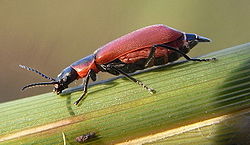
Anthocomus rufus
Scientific classification Edit this classification
Kingdom: Animalia
Phylum: Arthropoda
Class: Insecta
Order: Coleoptera
Suborder: Polyphaga
Infraorder: Cucujiformia
Superfamily: Cleroidea
Family: Melyridae
Leach, 1815
Synonyms
  • Attalomimidae
  • Dasytidae
  • Malachiidae

Melyridae (common name: soft-winged flower beetles) are a family of beetles of the superfamily Cleroidea.

Description

[edit]

Most are elongate-oval, soft-bodied beetles 10 mm long or less. Many are brightly patterned in black and brown, yellow, or red. Some melyrids (Malachiinae) have peculiar orange structures along the sides of the abdomen, which may be everted and saclike or withdrawn into the body and inconspicuous. Some melyrids have the two basal antennomeres greatly enlarged. Most adults and larvae are predaceous, but many are common on flowers. The most common North American species belong to the genus Collops (Malachiinae); C. quadrimaculatus is reddish, with two bluish black spots on each elytron.[1]

Four New Guinean species of Choresine (the more abundant C. pulchra, the less abundant C. semiopaca and the two infrequent C. rugiceps and C. sp. A, the latter as yet unnamed) have been found to contain batrachotoxins, which may account for the toxicity of some birds such as the blue-capped ifrit and hooded pitohui which eat them. The hypothesis that Phyllobates frogs in South America obtain batrachotoxins from related genera of the Melyridae (Choresine does not occur there) has not been tested due to the difficulty of field-work in Colombia.[2]

Evolutionary history

[edit]

The oldest fossil of the family are Sinomelyris and Juraniscus from the late Middle Jurassic (Callovian) Daohugou bed in Inner Mongolia, China.[3] The oldest member of Dasytinae is Protodasytes from the early Late Cretaceous (Cenomanian) aged Charentese amber of France.[4]

Distribution

[edit]

The family Melyridae contains over 100 genera worldwide, with ~520 species in 48 genera in North America, and 16 genera in Europe; the largest diversity is in dry temperate regions.

Subfamilies

[edit]

Various authorities have, at times, treated each of the presently-recognized subfamilies as families, and a few tribes have been accorded family status, as well (e.g., "Attalomimidae"). The family Mauroniscidae was removed from Melyridae in 1995, and Rhadalidae in 2019.[5]

Dasytes plumbeus (Dasytinae)

Selected genera

[edit]

Notes

[edit]
[edit]
Revisions and contributorsEdit on WikipediaRead on Wikipedia
from Grokipedia
Melyridae, commonly known as soft-winged flower beetles, is a family of beetles in the superfamily Cleroidea characterized by their elongate-oval bodies, soft and flexible elytra, and small size ranging from 2 to 7 mm in length. These beetles are distributed worldwide, with over 500 species recorded in alone across 37 genera and approximately 6,000 species globally in more than 300 genera, making Melyridae the largest family in Cleroidea. The family has a fossil record extending from the to the present, with early representatives known from deposits in , . Adults of Melyridae are typically diurnal and conspicuous on flowers, where they exhibit omnivorous habits, consuming , , small , and insect eggs. Their larvae are predaceous, developing in diverse microhabitats such as decaying wood, , litter, or under bark, where they feed chiefly on other . The family currently comprises two main subfamilies, Dasytinae and Malachiinae, following the elevation of Rhadalinae to family status in recent classifications. Melyridae play ecological roles as pollinators and predators in various ecosystems, from grasslands and forests to coniferous habitats, and some species are noted for their aposematic coloration or chemical defenses. Certain tropical members, particularly in the Dasytinae, have been hypothesized as dietary sources of batrachotoxins—potent neurotoxins found in poison dart frogs—highlighting their biochemical significance.

Description and Morphology

Adult Characteristics

Adult Melyridae beetles are typically elongate-oval in body shape, soft-bodied, and measure 2–10 mm in length. Their elytra are flexible and often lack the rigidity seen in more sclerotized beetle families, contributing to the common name "soft-winged flower beetles." Coloration in adults is diverse and often striking, ranging from black, brown, yellow, red, to metallic hues, with many species covered in erect pubescence that imparts a hairy appearance. For example, Collops quadrimaculatus exhibits a reddish body contrasted by bluish-black spots on the elytra. The head is prognathous and flattened, usually slightly transverse to elongate with parallel sides, featuring prominent compound eyes. Antennae are 11-segmented, filiform to slightly serrate in form. The pronotum bears distinct lateral margins and is narrower than the elytra at the humeri. Legs are adapted for running, with a tarsal formula of 5-5-5 in most species. In some subfamilies, abdominal segments are partially exposed beyond the elytra. Males in the Malachiinae often possess eversible orange structures along the abdominal sides, used in . is pronounced in certain Malachiinae, including enlarged hind femora and modified antennae in males.

Larval Characteristics

Melyridae larvae are predominantly campodeiform, featuring an elongate, dorsoventrally flattened body that facilitates active movement through confined spaces. This body form includes a prominent, sclerotized head capsule, well-developed antennae for sensory detection, and robust thoracic legs equipped with segmented prolegs for locomotion and prey capture. At maturity, they typically measure 5–15 mm in length, with the bearing sparse to dense setae that aid in and sensory perception within their microhabitats. The mouthparts are adapted for a predatory lifestyle, dominated by strong, pointed mandibles with sclerotized edges suitable for piercing and tearing small prey; in some species, the maxillary palpi are arranged transversely, enhancing manipulative capabilities during feeding. These larvae often inhabit , under bark, or in , where their campodeiform structure and setae-covered body enable effective predation on small arthropods such as mites and eggs. Variations occur across subfamilies: Dasytinae larvae tend to be more robust, with densely setose, strongly sclerotized tergites and stout mandibles reflecting adaptations to tougher detrital environments, as seen in species like Idgia notaticollis. In contrast, Malachiinae larvae, such as those of Malachius prolongatus, are more slender and agile, featuring rugose, softly pigmented bodies with prominent setae that support rapid foraging on mobile prey like nymphs.

Taxonomy and Classification

Higher Classification and History

Melyridae is classified within the order Coleoptera, suborder , infraorder , and superfamily Cleroidea, where it represents one of the most diverse families in this polyphagan lineage. The family was originally established by in 1815, based on morphological features such as the soft elytra characteristic of its members. In contemporary taxonomy, Melyridae is recognized in the broad sense, incorporating groups historically treated as separate families, including Dasytidae Laporte de Castelnau, 1840; Malachiidae Fleming, 1821; and Attalomimidae Reitter, 1909, now subsumed as subfamilies Dasytinae, Malachiinae (with Attalomini as a tribe within it), and the core Melyrinae. The classification history of Melyridae reflects ongoing debates over the boundaries of Cleroidea families, with early treatments often elevating subfamilies to family rank due to limited comparative morphology. For instance, Dasytidae and Malachiidae were long considered independent families until phylogenetic analyses integrated them into Melyridae based on shared synapomorphies like the reduced elytral sclerotization and predatory larval habits. This broader circumscription positions Melyridae as the largest family within Cleroidea, encompassing approximately 300 genera and 6,000 species distributed worldwide, far exceeding other cleroid families in diversity. Key taxonomic revisions have refined these boundaries by excluding peripheral groups. In 1995, Karel Majer provided a comprehensive revision of Mauroniscidae, elevating it from a putative of Melyridae to a distinct based on unique genitalic and thoracic structures, thereby narrowing the scope of Melyridae. Similarly, the 2019 phylogenetic study by Gimmel et al., combining molecular data from multiple genes with morphological characters, supported the recognition of Rhadalidae as a separate , removing the former Rhadalinae from Melyridae and confirming its position within the broader melyrid lineage. These changes, along with earlier nomenclatural consolidations in Ślipiński et al. (2011), have stabilized the family's core composition around three primary : Melyrinae, Dasytinae, and Malachiinae. Molecular and morphological evidence from studies like Bocak et al. (2011) further corroborates the of this restricted Melyridae, highlighting synapomorphies in wing venation and larval mouthparts that unite these .

Subfamilies

The family Melyridae is traditionally divided into three subfamilies: Melyrinae, Dasytinae, and Malachiinae. This classification, established in a comprehensive review, recognizes Melyrinae as the nominal subfamily, with the others incorporated from previously distinct groups such as Dasytidae and Malachiidae. Melyrinae, predominantly tropical in distribution, encompasses approximately 50 genera and 300 species; these beetles are characterized by their soft-bodied form and a tendency to feed on flowers as adults. Dasytinae, which is cosmopolitan, includes around 150 genera and 3,000 species; members often exhibit metallic coloration and predaceous habits, particularly in the larval stage. Malachiinae, widespread across various regions, comprises about 100 genera and 2,500 species; these beetles are notable for their vibrant colors and pronounced sexual dimorphism, including enlarged forelegs in males. Diagnostic traits distinguish the subfamilies morphologically: Melyrinae lack metaventral postcoxal lines, Dasytinae possess interlocking elytral margins that provide structural reinforcement, and Malachiinae are marked by their flexible abdomens allowing greater mobility. These features aid in identification and reflect adaptations to diverse ecological niches within the family. Recent taxonomic revisions have incorporated former families into Melyridae, but ongoing phylogenomic studies suggest potential restructuring; for instance, molecular analyses support elevating Dasytinae and Malachiinae to full family status, rendering Melyridae sensu stricto limited primarily to Melyrinae. A 2024 taxonomic overview of Dasytinae maintains its status as a subfamily while acknowledging the debate and implementing updates to North American fauna. Such proposals, driven by mitogenomic and multi-locus data, highlight the need for further integrative taxonomy to resolve relationships within Cleroidea.

Genera and Diversity

The family Melyridae comprises approximately 300 genera and 6,000 species worldwide, representing the largest lineage within the superfamily Cleroidea. This diversity is distributed globally, with the highest concentrations occurring in tropical regions and dry temperate zones. In , around 520 species are documented across 58 genera. hosts a more modest representation of the family. Regional patterns reflect broader biogeographic trends, including high endemism in and , where unique genera have evolved in isolation. Numerous undescribed species persist in biodiversity hotspots, particularly in Neotropical and Australasian forests, underscoring ongoing taxonomic challenges. Notable genera illustrate this variation. , primarily North American, includes over 40 species that are predaceous on flower-inhabiting insects. The Neotropical genus Choresine is recognized for producing batrachotoxins, potent alkaloids sequestered by certain birds and frogs. Astylus, widespread in , encompasses pollen-feeding species like A. atromaculatus, which can damage crops such as in agricultural settings.

Evolutionary History

Fossil Record

The fossil record of Melyridae is relatively sparse, with the earliest known representatives appearing in the Middle Jurassic of Asia. The oldest described fossils belong to Sinomelyris praedecessor and Juraniscus majeri, both from the Callovian stage (~163 Ma) of the Daohugou Beds in Inner Mongolia, China. These compression fossils represent primitive members of the melyrid lineage, characterized by elongate bodies, four elytral carinae, and simple tarsal claws, features that suggest affinities with early Melyrinae; their preservation indicates soft, flexible elytra typical of the family. Sinomelyris praedecessor, measuring 6.2–6.8 mm in length, exhibits a habitus resembling some extant melyrines but is notably smaller, while Juraniscus majeri (4.25 mm) shows symmetrical antennomeres and tarsal lobes, placing it as a basal cleroid potentially related to Melyridae. Cretaceous records provide evidence of early diversification within the family, particularly in the Dasytinae subfamily. A key specimen is Protodasytes cretaceus, from the early (~99 Ma) Charentese amber deposits at Plage de la Vierge, Fouras Peninsula, southwestern . This 2.29 mm long, setose features a small antennal club, symmetrical claws, and a distinct pronotal fringe, marking it as a stem-group dasytine and the earliest known member of the subfamily in . Its morphology, including subcylindrical body form and setation, aligns with modern Dasytini and Listrini, suggesting that Dasytinae had begun radiating by the mid-, potentially in association with early angiosperm ecosystems. Post-Cretaceous fossils are limited but include sparse Tertiary occurrences, primarily preserved in . Eocene Baltic and European ambers have yielded the first records of Melyridae in that region, with a 2025 description of seven new in a novel and (Amelyris subgen. nov.), highlighting previously unrecognized diversity in late Eocene forests. Overall, approximately 25 extinct have been described across the family's fossil record, with most from inclusions in and deposits; additional fragmentary remains, such as Acanthocnemoides sukatshevae from the of (Taimyr ), underscore a broader presence. These findings imply an Asian origin for Melyridae in the , followed by radiation across Laurasian landmasses during the era.

Phylogenetic Relationships

Melyridae is situated within the superfamily Cleroidea of the coleopteran suborder , with the divergence of Cleroidea from the closely related Cucujoidea estimated at approximately 200 million years ago during the , based on phylogenomic analyses of 68 nuclear protein-coding genes calibrated with 57 fossil priors. Within Cleroidea, Melyridae forms part of the basal "melyrid lineage," which branches early relative to more derived families such as and Lophocateridae, as recovered in multi-gene Bayesian and maximum-likelihood analyses of 377 taxa using 18S rRNA, 28S rRNA, cox1, and cytb sequences (posterior probability = 0.98; bootstrap support = 100). This basal positioning is reinforced by synapomorphies observed in both adult and larval stages, notably the soft, flexible elytra and overall soft-bodied morphology characteristic of the lineage. The comprises three primary subfamilies—Dasytinae, Malachiinae, and Melyrinae—with molecular data strongly supporting the of Malachiinae ( = 1; bootstrap = 100) and Melyrinae ( = 1; bootstrap = 100), and the overall ( = 0.98; bootstrap = 100). Inter-subfamily relationships indicate Malachiinae as sister to the combined Dasytinae + Melyrinae , though Dasytinae exhibits with two distinct subclades, one of which has Melyrinae nested within it ( > 0.96; bootstrap > 36 for relevant nodes). These findings stem from comprehensive phylogenies integrating morphological and molecular evidence, defining Melyridae to encompass these subfamilies while recognizing Rhadalidae as a separate . While the overall of Melyridae is robustly confirmed across recent multi-locus studies, debates persist regarding the resolution of certain genera, particularly within the Apalochrini (Malachiinae), where morphological variability and limited molecular sampling necessitate additional phylogenomic data for precise placement. Fossil-calibrated timelines suggest early diversification within the subfamilies during the , aligning with the family's ancient origins in .

Distribution and Ecology

Global and Regional Distribution

The family Melyridae has a , occurring on all continents except . It comprises approximately 6,000 across more than 300 genera worldwide, with high diversity in the Neotropical, Oriental, and Australian regions, as well as dry temperate areas. In the Neotropics, approximately 886 species in 61 genera are known (as of ). In , Melyridae are represented by approximately 520 species in 58 genera (as of 2002), with notable concentrations in the arid southwestern deserts where dry temperate conditions prevail. European diversity is lower, with 16 genera and about 200 species documented, predominantly in Mediterranean areas favoring warmer climates. Australia hosts over 350 across 11 genera, including several endemic genera such as Dicranolaius with at least 79 described . In , the family is sparsely distributed, mainly in southern regions, with notable presence including more than 110 in the genus Astylus alone. Biogeographic patterns of Melyridae are shaped by dispersal mechanisms linked to flower visitation and predatory habits, facilitating spread across floral resources; invasive introductions remain rare.

Habitats, Behavior, and Life Cycle

Melyridae species occupy diverse microhabitats, primarily in dry temperate to tropical regions, where adults are diurnal and frequently observed on flowers and foliage of herbaceous plants. They show a particular affinity for blooms in the families and , such as sunflowers and , where they aggregate during daylight hours. Larvae, in contrast, inhabit concealed terrestrial niches including , leaf litter, under bark, and occasionally dead wood or insect oothecae, reflecting their more cryptic lifestyle. Behavioral patterns in Melyridae emphasize floral exploitation and predation. Adults are omnivorous, consuming and as primary resources while opportunistically preying on small arthropods like insect eggs, , and other flower visitors, thereby contributing to local . Larvae exhibit predatory or scavenging habits, targeting soft-bodied in their subterranean or litter-based environments. Some species, particularly in certain genera, adopt myrmecophilous lifestyles, associating with colonies where they may feed on fungi or brood. In the Malachiinae, involves elaborate displays, with males everting specialized abdominal glands to release pheromonal secretions that females actively consume, facilitating pair formation on or near flowers. The life cycle of Melyridae is holometabolous, encompassing , larval, pupal, and stages. Females deposit s in clusters within , leaf , bark crevices, or low , where they hatch after several days to weeks depending on . Larvae undergo multiple instars as active predators, often persisting for several months and overwintering in within protected microhabitats. Pupation typically occurs in the or , forming simple chambers rather than elaborate cocoons, with s emerging in or summer. Most species complete one to two generations annually, with activity peaking during warmer months and declining in autumn as larvae enter overwintering.

Biological Significance

Chemical Ecology

The chemical ecology of Melyridae is dominated by the production of potent neurotoxic alkaloids, particularly batrachotoxins, in certain genera that serve as primary defenses against predators. These steroidal alkaloids, including (BTX) and homobatrachotoxin (HTX), are synthesized by beetles in the genus Choresine, where they occur in high concentrations—up to approximately 1.8 μg per individual, as measured in Choresine semiopaca. This toxicity renders the beetles unpalatable and potentially lethal to and predators, facilitating their survival in tropical environments. Batrachotoxins from Choresine beetles are sequestered through predation by higher trophic levels, integrating into complex tropical food webs. In , toxic passerine birds such as the hooded pitohui (Pitohui dichrous) and the blue-capped ifrita (Ifrita kowaldi) acquire these compounds from their diet, which includes Choresine beetles alongside other small arthropods, concentrating the toxins in their skin and feathers to deter parasites and predators. Similarly, poison-dart frogs of the genus Phyllobates in contain batrachotoxins, hypothesized to originate from dietary Melyridae relatives, as Choresine does not occur in the Neotropics; however, direct confirmation of the beetle source remains elusive despite the of the family. This sequestration exemplifies chemical defense transfer across taxa, enhancing predator deterrence in biodiverse ecosystems. Beyond , chemical defenses in other Melyridae subfamilies are poorly documented, with soft-bodied species likely relying on inherent rather than specialized glandular secretions. on Choresine and related genera highlights their understudied status, with many of the family's over 300 genera untested for production or other defensive compounds. Batrachotoxins' mechanism—irreversibly binding voltage-gated sodium channels to cause persistent —has spurred pharmacological interest, serving as a tool for studying function and holding potential for applications in , though their extreme limits direct therapeutic use.

Ecological and Economic Roles

Melyridae beetles play diverse roles in ecosystems, primarily as pollinators and predators within food webs. Species in the subfamily Dasytinae, such as those in western , are significant pollinators of flowering , visiting flowers to consume and , thereby facilitating pollen transfer among over 300 in the region. As omnivorous insects, adults of genera like prey on soft-bodied pests including , , Lygus nymphs, and mites, contributing to natural pest regulation in agricultural and natural settings. In food webs, Melyridae serve as prey for birds; for instance, soft-winged flower beetles appear in the diets of like the ( vociferus) and (Aeronautes saxatalis), supporting avian populations. Certain Melyridae species engage in interactions that influence community dynamics, including occasional associations with ant nests that may aid in nest processes, though such is typically incidental rather than . Additionally, some melyrids, particularly in the genus Choresine, produce potent toxins like batrachotoxins, which can transfer through chains to predators such as birds, potentially conferring chemical defenses in higher trophic levels. Economically, Melyridae have mixed impacts, serving as beneficial agents in (IPM) while occasionally acting as minor pests. Predatory species like Collops vittatus help control key agricultural pests such as and in crops like and , reducing the need for chemical interventions. Conversely, the spotted maize beetle (Astylus atromaculatus) feeds on of crops including , sunflower, and , potentially lowering yields in South American and African regions, though damage is generally limited to pollen consumption rather than direct plant tissue harm. Conservation concerns for Melyridae center on habitat loss in drylands and hotspots, where fragmentation and threaten their populations, though no species are currently listed as major endangered. These beetles' roles in and underscore the need to preserve floral-rich habitats to maintain services, with general declines in arid regions amplifying risks to melyrid diversity.

References

Add your contribution
Related Hubs
User Avatar
No comments yet.