Hubbry Logo
Click beetleClick beetleMain
Open search
Click beetle
Community hub
Click beetle
logo
8 pages, 0 posts
0 subscribers
Be the first to start a discussion here.
Click beetle
Click beetle
from Wikipedia

Click beetles
Temporal range: Triassic–Recent
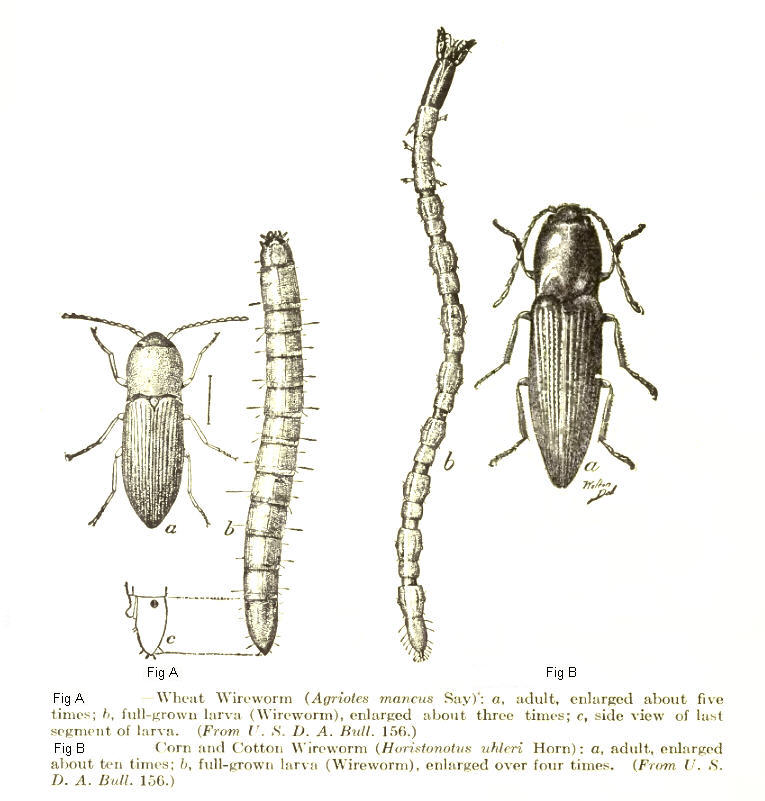
Click beetle adults and larvae (wireworms)
Left: Wheat wireworm (Agriotes mancus)
Right: Sand wireworm (Horistonotus uhlerii)
Scientific classification Edit this classification
Kingdom: Animalia
Phylum: Arthropoda
Class: Insecta
Order: Coleoptera
Suborder: Polyphaga
Infraorder: Elateriformia
Superfamily: Elateroidea
Family: Elateridae
Leach, 1815
Subfamilies[2]

Agrypninae
Campyloxeninae
Cardiophorinae
Dendrometrinae
Elaterinae
Eudicronychinae
Hemiopinae
Lissominae
Morostomatinae
Negastriinae
Oestodinae
Omalisinae[1]
Parablacinae
Physodactylinae
Pityobiinae
Plastocerinae
Semiotinae
Subprotelaterinae
Tetralobinae
Thylacosterninae

Synonyms

Ampedidae
Campylidae
Cavicoxumidae
Ludiidae
Monocrepidiidae
Pangauridae
Phyllophoridae
Plastoceridae
Prosternidae
Pyrophoridae
Synaptidae

Elateridae or click beetles (or "typical click beetles" to distinguish them from the related families Cerophytidae and Eucnemidae, which are also capable of clicking) are a family of beetles. Other names include elaters, snapping beetles, spring beetles or skipjacks. This family was defined by William Elford Leach (1790–1836) in 1815. They are a cosmopolitan beetle family characterized by the unusual click mechanism they possess. There are a few other families of Elateroidea in which a few members have the same mechanism, but most elaterid subfamilies can click. A spine on the prosternum can be snapped into a corresponding notch on the mesosternum, producing a violent "click" that can bounce the beetle into the air.[3] The evolutionary purpose of this click is debated: hypotheses include that the clicking noise deters predators or is used for communication, or that the click may allow the beetle to "pop" out of the substrate in which it is pupating.[4] It is unlikely that the click is used for avoiding predators as it does not carry the beetle very far (<50 cm), and in practice click beetles usually play dead or flee normally.[4] There are about 9300 known species worldwide,[5] and 965 valid species in North America.[6]

Etymology

[edit]

Leach took the family name from the genus Elater, coined by Linnaeus in 1758. In Greek, ἐλατήρ means one who drives, pushes, or beats out.[7] It is also the origin of the word "elastic", from the notion of beating out a ductile substance.[8]

Description and ecology

[edit]

Some click beetles are large and colorful, but most are under two centimeters long and brown or black, without markings. The adults are typically nocturnal and phytophagous, but only some are of economic importance. On hot nights they may enter houses, but are not pests there. Click beetle larvae, called wireworms, are usually saprophagous, living on dead organisms, but some species are serious agricultural pests, and others are active predators of other insect larvae. Some elaterid species are bioluminescent in both larval and adult form, such as those of the genus Pyrophorus.

Wireworms

[edit]

Larvae are elongate, cylindrical or somewhat flattened, with hard bodies, somewhat resembling mealworms. The three pairs of legs on the thoracic segments are short and the last abdominal segment is, as is frequently the case in beetle larvae, directed downward and may serve as a terminal proleg in some species.[9] The ninth segment, the rearmost, is pointed in larvae of Agriotes, Dalopius and Melanotus, but is bifid due to a so-called caudal notch in Selatosomus (formerly Ctenicera), Limonius, Hypnoides and Athous species.[10] The dorsum of the ninth abdominal segment may also have sharp processes, such as in the Oestodini, including the genera Drapetes and Oestodes. Although some species complete their development in one year (e.g. Conoderus), most wireworms spend three or four years in the soil, feeding on decaying vegetation and the roots of plants, and often causing damage to agricultural crops such as potato, strawberry, maize, and wheat.[11][12] The subterranean habits of wireworms, their ability to quickly locate food by following carbon dioxide gradients produced by plant material in the soil,[13] and their remarkable ability to recover from illness induced by insecticide exposure (sometimes after many months),[14] make it hard to exterminate them once they have begun to attack a crop. Wireworms can pass easily through the soil on account of their shape and their propensity for following pre-existing burrows,[15] and can travel from plant to plant, thus injuring the roots of multiple plants within a short time. Methods for pest control include crop rotation and clearing the land of insects before sowing.

Other subterranean creatures such as the leatherjacket grub of crane flies which have no legs, and geophilid centipedes, which may have over two hundred, are sometimes confused with the six-legged wireworms.[9]

Clicking ability

[edit]

The ability of click beetles to "click" their bodies, sometimes launching themselves into the air, has been studied in detail.[4] It has three stages—the pre-jump stage, the takeoff stage, and the airborne stage.[4] The beetle is supine, on its back, in the pre-jump stage, and over ~2-3s it rotates its prothorax (foremost section) down to touch the ground in a bracing position.[4] In the takeoff phase the prothorax rotates rapidly upward in a "snap", launching the beetle off of the ground and ballistically into the air.[4] Crucially, the beetle uses specialized mechanisms to hold itself in the bracing position while its muscles continue to contract, until it releases the tension in one "snap".[4]

Evolution and taxonomy

[edit]

The oldest known species date to the Triassic, but most are problematic due to only being known from isolated elytra. Many fossil elaterids belong to the extinct subfamily Protagrypninae.[16]

Approximately 20 subfamilies are included in the Elateridae, considered typical of beetles in the superfamily Elateroidea;[17] authorities have moved genera from related families (e.g. "false click beetles" to the Thylacosterninae[18]).

Thylacosterninae

[edit]

Authority: Fleutiaux, 1920

  1. Balgus Fleutiaux, 1920
  2. Cussolenis Fleutiaux, 1918
  3. Pterotarsus Guérin-Méneville
  4. Thylacosternus Gemminger, 1869

Other selected genera

[edit]
[edit]

Notes

[edit]

References

[edit]
[edit]
Revisions and contributorsEdit on WikipediaRead on Wikipedia
from Grokipedia
Click beetles (family Elateridae) are elongate, cosmopolitan in the order Coleoptera, distinguished by a specialized clicking mechanism in the that enables them to flip their bodies and right themselves when overturned, producing a characteristic audible snap. Adults typically measure 6.4–19.1 mm in length, with flattened, parallel-sided bodies that are usually brown to black, though some species feature spots or stripes; they possess serrate antennae and backward-pointing lateral margins on the . The clicking action results from a prosternal spine interlocking with a mesosternal catch, releasing suddenly to propel the beetle into the air as a defense against predators. These undergo complete , with eggs laid in and larvae—known as wireworms—developing underground for 1–5 years, feeding on roots, seeds, tubers, or occasionally other in habitats such as , under bark, or decaying . Pupation occurs in chambers, after which short-lived adults (weeks to months) emerge to feed on and in flowers or on bark, often appearing as nocturnal visitors to lights. Economically, click beetles are notable for their wireworm larvae, which are significant agricultural pests damaging crops like corn, potatoes, and turf by severing roots and seeds, though adults cause minimal harm beyond occasional nuisance indoors. Notable include the eastern eyed click beetle (), a larger form (up to 5 cm) with prominent eye-like spots on the , found in eastern . The family encompasses approximately 10,000 worldwide, contributing to in diverse ecosystems from gardens to forests.

Etymology and Classification

Etymology

The "click beetle" derives from the distinctive audible clicking sound produced by these when they flip themselves upright after being turned onto their backs, a defensive mechanism to evade predators. This onomatopoeic name highlights the sharp, snapping noise generated by the rapid release of tension in their thoracic structure. The scientific family name Elateridae originates from the genus , which was established by in the 10th edition of his in 1758. The term "Elater" stems from the Greek word ἐλατήρ (elatēr), meaning "driver," "pusher," or "projector," alluding to the beetles' ability to propel themselves suddenly into the air. This etymology reflects the explosive jumping action that inspired Linnaeus's choice, evoking the image of a mechanical driver or spring-like force. The family designation Elateridae was later formalized by in 1815, directly adopting Linnaeus's genus name. In addition to "click beetle," these insects are known by various common names such as "skipjack," "snapping beetle," "spring beetle," and "elater," which emphasize their leaping or sound-producing traits. "Skipjack" is particularly prevalent in North American English, referring to the skipping motion during jumps, while "snapping beetle" underscores the abrupt sound in broader usage. These alternative names vary regionally but consistently tie back to the beetle's characteristic behavior.

Taxonomic Classification

Click beetles are classified within the order Coleoptera, the beetles, and specifically belong to the superfamily and the family Elateridae, which encompasses approximately 10,000 described species distributed worldwide. This family is characterized by its members' distinctive clicking mechanism, though the taxonomic framework emphasizes structural and genetic traits over behavioral ones. The Elateridae family is subdivided into approximately 18 subfamilies, with prominent ones including Elaterinae, Agrypninae, Cardiophorinae, and Thylacosterninae, each exhibiting morphological variations that reflect adaptive radiations across diverse habitats. Within Thylacosterninae, the genus Thylacosternus stands out due to its apomorphic antennal features, where antennomeres 4 through 11 are modified into flabellate structures bearing long, delicate, densely hairy rami that enhance sensory capabilities in specialized environments. Selected genera illustrate the family's diversity: Agriotes species, whose larvae are notorious wireworms causing crop damage; Athous, a widespread genus in temperate zones with elongated bodies adapted to soil and vegetation interfaces; and Pyrophorus, notable for bioluminescent adults that emit steady light from thoracic organs, primarily in tropical regions. Molecular phylogenetic analyses conducted since the early 2000s, utilizing markers such as and anchored hybrid enrichment datasets, have established Elateridae's close affinity to Lampyridae (fireflies) within a monophyletic elaterid-lampyroid of , supporting shared evolutionary origins for traits like in certain lineages. Recent phylogenomic studies as of 2021 suggest that Elateridae may be paraphyletic, with Lampyridae and related families nested within it. These studies underscore the family's position within , with implications for understanding diversification patterns across evolution.

Morphology and Physiology

Adult Morphology

Adult click beetles, belonging to the family Elateridae, exhibit a body that is typically elongated and parallel-sided, measuring between 4 and 50 mm in length. The body is dorsoventrally flattened, with hardened forewings known as elytra that cover the and often feature fine punctures or striations for texture. This streamlined form facilitates movement through or vegetation habitats. The head is deflexed and somewhat flattened, featuring downward-facing (hypognathous) mouthparts adapted for feeding on or , along with prominent, laterally positioned compound eyes that provide wide visual coverage. Antennae arise from insertions in front of the eyes and are typically serrated or saw-like in both sexes, though many display pectinate (comb-like) forms, particularly in males. The prothorax is notably enlarged and rectangular or subquadrate, bearing a prominent prosternal process—a peg-like or V-shaped ridge extending posteriorly from the prosternum—that interlocks with the mesothorax to enable the characteristic clicking action. Legs are generally long and cursorial, suited for rapid running across surfaces. Coloration in adult click beetles varies widely, ranging from drab brown or black in temperate species to metallic green, blue, or coppery hues in some tropical forms, providing camouflage or aposematic signaling. Notably, genera like Pyrophorus in tropical regions possess bioluminescent organs, with ventral photic areas emitting steady green-to-orange light and smaller dorsal spots producing green glow, visible during nocturnal activity. Sexual dimorphism is evident primarily in the antennae, where males often have longer, more elaborate pectinate structures to enhance detection of female pheromones, contrasting with the simpler serrate antennae of females. The prothorax contributes to this dimorphism in some species through subtle size differences, though overall body proportions remain similar between sexes.

Larval Morphology

The larvae of click beetles, commonly known as wireworms, are elongate, cylindrical, and hardened, adapted for a subterranean . They possess a tough, wiry that provides protection in environments, with body lengths ranging from approximately 1.4 mm in newly hatched individuals to 14–38 mm in mature larvae, depending on the species. Coloration varies from creamy white or pale yellow in early instars to golden-brown, yellowish, or reddish-brown in later stages, often with a glossy appearance. Three pairs of short, five-segmented thoracic legs enable burrowing and locomotion through . The head capsule is prominently sclerotized, featuring strong, chitinized mandibles suited for chewing roots and , facilitating their role as soil burrowers. Wireworms lack functional eyes, relying instead on chemoreceptors and other sensory structures, such as urogomphi—horn-like projections on the abdominal segment—for detecting environmental cues like and sources during navigation in dark, opaque . The body exhibits 9–11 visible abdominal segments (actually 10 in total), with the terminal segment bearing urogomphi or cerci in many species, which vary in shape and may aid in sensory or anchoring. These larvae can sometimes assume a coiled posture when disturbed, serving as a basic defensive response. Unlike the C-shaped, softer white grubs of (such as June beetles), wireworms are distinctly linear and rigid, lacking a thoracic shield and emphasizing elongation for efficient soil penetration. Morphological variations occur across genera; for instance, larvae of pest species in the genus Agriotes tend to be more robust and uniformly straw-yellow, reaching up to 25 mm in length, with a bluntly pointed ninth abdominal segment featuring subtle eye spots. These adaptations underscore their generalist herbivory, including brief mention of their impact as root pests in .

Clicking Mechanism

The clicking mechanism in click beetles (family Elateridae) enables these to generate a sudden propulsive force without using their legs, primarily for self-righting when inverted. This process relies on specialized thoracic , where a wedge-shaped prosternal process—a spine-like projection from the prosternum—engages with a V-shaped mesosternal receptor (also called the prosternal rest of the mesoventrite) on the underside of the . During , the beetle flexes its body dorsally in a jack-knifing motion, latching the prosternal process into the mesosternal receptor to lock the mechanism. This latching deforms the saddle-shaped mesonotum and other elastic cuticular structures, storing over a loading phase lasting 0.15–0.72 seconds. Energy storage occurs through the slow contraction of key thoracic muscles, notably the large M4 muscle (a dorsoventral indirect flight muscle) and (a longitudinal muscle), which compress the thorax and build elastic strain in the without requiring a dedicated trigger muscle. Release happens abruptly when the prosternal process disengages from the mesosternal receptor in the takeoff phase (0.0016–0.0026 seconds), causing rapid thoracic recoil and launching the beetle upward with accelerations up to 380 times gravity. The audible click, lasting 0.007–0.015 seconds at frequencies of 160–250 Hz, results from the violent impact of the thoracic structures and serves as an acoustic to deter predators. This force can propel the beetle to heights of 5.4–14.7 cm, sufficient to flip it from a dorsal position to ventral orientation upon landing. The mechanism provides an evolutionary advantage by enhancing survival against predators, allowing quick self-righting and escape from an upside-down vulnerability; laboratory observations confirm jumps often result in a 50% success rate for landing upright, with the 55° body flexion angle optimized for vertical over horizontal distance. This thoracic has likely persisted in Elateridae for over 200 million years, reflecting its adaptive value in diverse habitats. Variations exist across species, with the mechanism generally conserved but performance scaling with body size—larger individuals (up to 37 mm in length) achieve greater absolute jump heights and distances due to isometric scaling of body mass and allometric increases in velocity relative to body length, though relative performance (jump height per body length) remains similar. In some genera, such as Sinelater, sclerotized sutures reduce elasticity compared to more flexible structures in species like Campsosternus auratus, potentially altering efficiency. Seminal studies, beginning with detailed analyses in the 1970s, have elucidated these through high-speed and morphological dissections.

Life Cycle and Ecology

Reproduction and Development

Click beetles (family Elateridae) exhibit holometabolous metamorphosis, undergoing complete transformation through egg, larval, pupal, and adult stages. Mating typically occurs soon after adult emergence in spring or early summer, with females releasing sex pheromones to attract males, who detect these chemical signals using their highly sensitive antennae. In some tropical species of the genus Pyrophorus, bioluminescent courtship displays from ventral light organs on the thorax and abdomen may aid in mate attraction during nocturnal activity. Following , females deposit eggs in clusters or singly within moist , producing 50 to 300 eggs per female depending on species and environmental conditions. Eggs incubate for 1 to 4 weeks, hatching into larvae influenced by and . The resulting wireworm larvae, as described in larval morphology sections, feed on and roots for 1 to 5 years in temperate regions, undergoing multiple instars before entering to overwinter. Pupation occurs in earthen cells within the , lasting 1 to 2 weeks during warmer periods, during which the pupa displays transitional features such as folded elytra and developing structures. Adults emerge in spring or summer, ready to mate and continue the cycle. Most temperate Elateridae are univoltine, completing one per year with triggered by cooler temperatures and shorter days, while tropical may be multivoltine, producing multiple s annually under favorable conditions.

Habitat and Distribution

Click beetles, belonging to the family Elateridae, exhibit a across all major continents except , with approximately 10,000 described species worldwide. Diversity is highest in tropical regions, reflecting the family's adaptability to warm, moist environments, though significant numbers occur in temperate zones as well, including over 900 species in . The larvae, known as wireworms, are predominantly soil-dwellers, inhabiting grasslands, forests, and agricultural fields where they burrow into moist soils rich in . Adults typically reside on foliage or beneath tree bark, with a few species favoring the damp margins of aquatic habitats. Elateridae occupy a wide altitudinal gradient, from to elevations exceeding 3,000 meters in mountainous ecosystems, demonstrating tolerance for varied climatic conditions. In temperate regions, larvae overwinter deep in the , enduring freezing temperatures as low as -30°C through physiological adaptations like . Tropical species, by contrast, often shelter in leaf litter during dry periods, benefiting from the consistent humidity of forest floors. Endemism is pronounced in isolated landmasses, such as , where genera like Toorongus are confined to the continent, and , which hosts the endemic genus Crepicardus comprising ten . Human-mediated dispersal has facilitated invasions, notably by Agriotes from into starting in the early 20th century, establishing populations in agricultural soils. Climate change poses risks to click beetle distributions, with studies since 2010 documenting potential northward and elevational range shifts in temperate populations driven by warming temperatures and altered precipitation. These shifts may expand pest pressures in northern latitudes while contracting suitable habitats in southern temperate areas.

Ecological Interactions

Click beetles (family Elateridae) play diverse roles within food webs, serving both as prey and predators depending on life stage. Adult click beetles are preyed upon by a variety of vertebrates and invertebrates, including insectivorous birds such as woodpeckers and thrushes, small mammals like moles and shrews, and predatory arthropods including spiders and mantises. Larvae, known as wireworms, face parasitism primarily from entomopathogenic nematodes (e.g., species in the genera Heterorhabditis and Steinernema) and fungi such as Metarhizium anisopliae, which infect and kill the larvae in soil environments, contributing to natural population regulation. As consumers, click beetle larvae occupy a detritivorous or herbivorous niche, feeding on roots, seeds, and decaying in the , which positions them as intermediaries in nutrient cycling. Some exhibit predatory , consuming small soil-dwelling and thereby controlling minor pest populations. Adults primarily consume , , and soft tissues, providing minimal but notable services to nocturnal flowers in their habitats. Symbiotic relationships enhance the ecological functionality of click beetles, particularly in larval stages. Gut microbiota in wireworm larvae include diverse bacterial communities dominated by Proteobacteria and Actinobacteria, which aid in the digestion of lignocellulosic materials through enzymatic breakdown, facilitating decomposition of plant detritus. In bioluminescent species such as those in the genus Pyrophorus, light emission serves for mate attraction via flashing displays and aposematic warning against predators, integrating into broader bioluminescent networks within tropical ecosystems. Wireworms function as indicators of , with their abundance reflecting conditions like levels and moisture; populations decline in areas contaminated by or pesticides, as documented in 21st-century field studies across agricultural landscapes. This sensitivity underscores their utility in monitoring . Furthermore, click beetles contribute to by promoting soil decomposition—larvae process , enhancing nutrient availability and —while their lineage links to the independent of within , a trait that diversified in multiple clades for ecological signaling.

Human Significance

Agricultural Impact

Click beetles, particularly their larval stage known as wireworms, represent a significant agricultural challenge due to their role as soil-dwelling pests that inflict damage on various crops worldwide. Wireworms primarily target root and seed-feeding, leading to substantial yield reductions in staple foods such as potatoes, (including , , and corn), and turf grasses. For instance, in cereal crops, wireworms feed on germinating and young , causing stand failures and that can result in over 50% loss of seedlings in severely infested fields. The damage mechanisms involve wireworms boring into roots, stems, and tubers, often girdling plants and preventing nutrient uptake, which is particularly severe in moist, organic-rich soils where larvae thrive for their extended developmental period of up to several years. These pests exhibit a preference for fields with high organic matter, such as those following grass or pasture, exacerbating issues during crop rotations. Economically, wireworm infestations have led to notable losses; in Austria alone, they account for approximately 10% of table potato yields, equating to 30,000 tons annually and several million euros in damages. Globally, wireworms pose a substantial threat to potato and grain production, with historical reports from the mid-20th century highlighting their role in widespread crop failures. Affected regions include Europe, where species like Agriotes obscurus, A. lineatus, and A. sputator—introduced from Europe to other areas—cause severe damage to potatoes and cereals; North America, particularly in cereal-growing areas of the Pacific Northwest and Midwest; and Australia, where native and introduced wireworms impact grains and vegetables. Outbreaks are frequently linked to the conversion of grasslands to arable land, as larvae accumulate in grassy areas and persist after plowing; during World War II, such conversions in the UK alone affected over 1 million hectares, triggering major infestations in newly planted crops. In 20th-century wheat belts of North America, historical outbreaks, such as those in the 1920s Great Plains, led to abandoned fields and prompted shifts in farming practices, including delayed planting and rotation adjustments. While certain click beetle species are notorious pests, many others are harmless to agriculture and even beneficial, serving as decomposers by feeding on decaying plant material and small soil invertebrates, thus aiding nutrient cycling in ecosystems. Additionally, bioluminescent click beetles, such as those in the genus Pyrophorus, hold ornamental value due to their glowing organs, which have attracted interest for educational displays and captive rearing in bioactive setups.

Pest Management

Pest management for click beetles, particularly their wireworm larvae, focuses on reducing damage to crops such as , cereals, and through a of preventive and targeted strategies. These approaches aim to minimize economic losses while promoting , especially in regions where wireworms cause significant yield reductions. Effective control requires early detection and integration of multiple tactics to address the pests' long larval stage, which can persist in for several years. Cultural controls form the foundation of wireworm management by disrupting pest life cycles and habitats without relying on chemicals. Crop rotation with non-host plants, such as , reduces wireworm populations by limiting food availability and improving , with long-term rotations showing benefits in maintaining lower pest densities. Tillage practices, including deep plowing or frequent disking in fields, expose larvae to environmental stresses and , thereby decreasing their survival rates. Avoiding rotations from grasslands or cereals to susceptible crops like potatoes further prevents population buildups. Chemical controls target wireworm larvae in soil, often applied as seed treatments or soil drenches during planting. Insecticides such as have historically provided effective suppression but have been phased out in many regions, including the in 2021 due to environmental and health concerns. seed treatments, including and , offer residual protection by being absorbed by plant roots, though their outdoor use has been banned in the since 2018 to mitigate impacts on pollinators. These treatments are most effective when applied prophylactically in high-risk fields, with efficacy varying by and application timing. Biological controls utilize natural enemies to suppress wireworm populations, providing environmentally friendly alternatives to synthetic pesticides. Entomopathogenic nematodes, such as species in the genus Heterorhabditis, infect and kill larvae by entering their bodies and releasing bacteria that cause septicemia, with applications showing promise in irrigated fields. Fungal pathogens like Metarhizium anisopliae similarly penetrate wireworm cuticles, leading to mortality over weeks, and have been tested successfully in combination with other methods for protection. Predatory ground beetles (Carabidae) can be encouraged through habitat management, though commercial augmentation remains limited. Integrated pest management (IPM) combines monitoring, cultural, biological, and chemical tactics to achieve sustainable control while minimizing inputs. Monitoring relies on traps—such as - or bran-based stations buried in during spring—to detect wireworm presence, with traps checked after 10-14 days to guide decisions. Economic thresholds vary by ; for potatoes, averages exceeding 0.5 wireworms per station, determined via buried traps, warrant intervention to prevent substantial damage (e.g., >30% in high-risk scenarios). IPM programs emphasize high-risk areas, like fields following grass, and adjusting rotations or treatments based on trap catches of one or more wireworms per station. Emerging methods address evolving challenges, including resistance and influences. Genetic studies are advancing the development of varieties with enhanced tolerance to wireworm feeding, such as lines showing reduced seedling damage through , potentially integrating host plant resistance into IPM frameworks. Research from the highlights -adaptive strategies, noting that warmer soils may increase wireworm activity and northward range expansion, prompting recommendations for adjusted planting dates and resilient rotations to mitigate heightened risks in changing conditions. As of 2025, wireworm issues are on the rise globally due to , with new initiatives like the European Wireworm Research Network Workshop advancing IPM solutions, including biological controls achieving up to 75% reduction in damage.

References

Add your contribution
Related Hubs
User Avatar
No comments yet.